
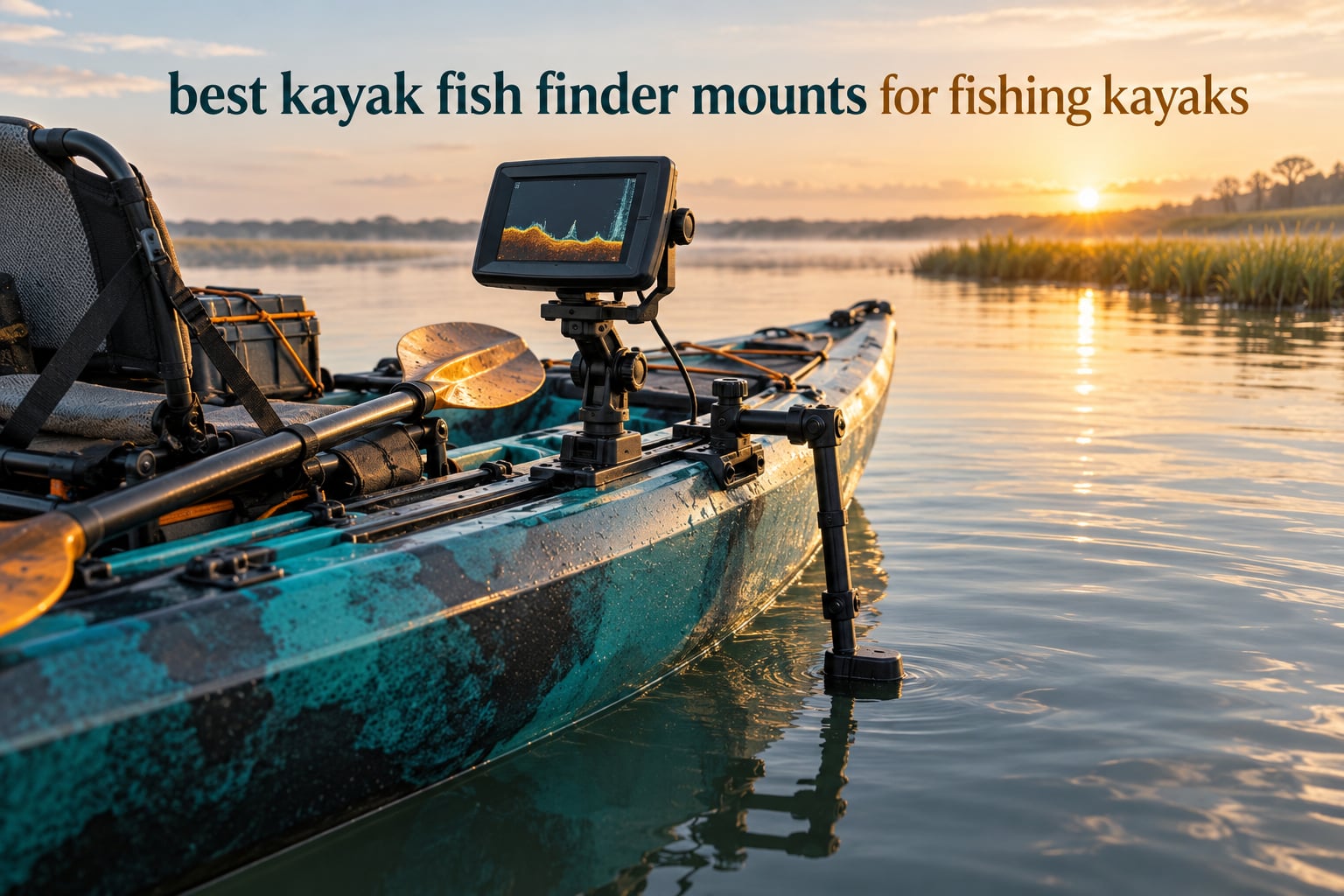
The best kayak fish finder mount is the one that matches your hull hardware, your screen size, and your willingness to drill. Our top pick, the WINDFRD cast aluminum C-size mount, wins on build quality and joint rigidity, while the YakAttack CellBlok combo wins if you want a whole rig that lifts off the track without tools. Everything in between is a tradeoff between stability, fitment certainty, and total system cost.
I have spent enough seasons rigging kayaks to know where rigs fail. It is never the sonar unit. It is the plastic collar around the ball joint loosening after a season of salt spray, the gooseneck arm sagging forward with a 9-inch screen on a 1-inch ball, or the transducer cable snagging a paddle blade because nobody routed it along the hull line. The mount is the least expensive part of the whole electronics package and the one that decides whether the expensive part works.
This roundup covers eight kayak fish finder mounts across every architecture that actually shows up on fishing kayaks: cast pedestal mounts, brand-specific track cradles, two-in-one display and transducer arm systems, a battery-box rig, a bare universal plate, and two budget track options. We pulled the specifications, materials, warranty terms, and fitment notes for each one, then ranked them against the criteria that show up most often in angler complaints: wobble under paddle load, whether the mount fits the specific unit in your hand, corrosion resistance, and how much extra hardware the finished rig still needs.
Two things to keep in mind before you read further. First, a mount rating is only half the purchase; the transducer arm, adapter plate, and cable glands are separate pieces, and the sum of them is what you actually spend. Second, a fish finder display and a transducer are two separate mounting problems, and most kayaks need answers to both. If you are also shopping angling tech broadly, our picks for drones for fishing cover the aerial scouting side of the same trips.
Table of Contents
Quick Picks: The Best Kayak Fish Finder Mount for Every Setup
Best overall, most stable build — WINDFRD Cast Aluminum C Size 1.5 Inch Short Arm Mount. One-piece cast aluminum with a 1.5 inch C-size ball, 15.5 lbs static capacity, and 316L stainless hardware. This is the mount that stops a large screen from wobbling.
Best for Lowrance Hook2, Hook Reveal 5, and Simrad Cruise 5 — YakAttack Fish Finder Mount. A purpose-fit cradle that locks onto standard kayak track with one hand and no drilling.
Best two-in-one track rig — WINDFRD Fish Finder Track Mount with Transducer Arm. Display arm and a telescoping transducer arm on a single track base, 11.42 to 17.91 inches, with a 3-year warranty.
Best for a complete rig including power — YakAttack CellBlok with SwitchBlade Transducer Arm. Battery box, display platform, and hydrodynamic transducer arm; two knobs release the whole thing from the track.
Best budget display mount — VAUBORTTI Aluminum Ball Mount for Garmin Striker 4. Die-cast aluminum, dual 1 inch balls, and both a T-bolt track base and a drill base in one package.
Best platform for custom-built rigs — YakAttack Universal Mounting Plate, 6 x 3.5 inch. A bare LockNLoad platform for anglers assembling a multi-component electronics stack by hand.
Best for paddleboards and compact kayaks — Universal Kayak Fish Finder Mount with 9-14 Inch Transducer Arm. Tool-free track install and the shortest arm range in the group, sized for small decks.
Best value transducer arm — Scotty 0141 Kayak and SUP Transducer Mounting Arm. The most proven part here, with 2,955 ratings at 4.6 stars, telescoping 11.5 to 18 inches with a 360 degree swivel.
The short version: if wobble is your main worry, buy the cast aluminum mount. If your kayak already has track and your electronics are one of a short list of models, buy the brand cradle. If you want display and transducer solved at once, buy a two-in-one. The rest of this article covers the evidence behind each choice.
Top 3 Picks for Kayak Fish Finder Mounts (October 2026)

WINDFRD Cast Aluminum C Size Mount
- One-piece cast aluminum body
- 1.5 inch C-size ball joint
- 15.5 lbs static capacity
- 316L stainless hardware

YakAttack Lowrance Hook2 Mount
- Purpose-fit for Hook2 and Cruise 5
- LockNLoad track attachment
- One-hand release
- No drilling required
Scotty 0141 Transducer Arm
- Telescopes 11.5 to 18 inches
- 360 degree swivel
- Includes 0438 gear-head adapter
- 16 oz composite build
All 8 Kayak Fish Finder Mounts Compared Side by Side (October 2026)
| Product | Specifications | Action |
|---|---|---|
| WINDFRD Cast Aluminum C Size 1.5 Inch Mount |
|
Check Latest Price |
| YakAttack Mount for Lowrance Hook2 and Cruise 5 |
|
Check Latest Price |
 WINDFRD Track Mount with Transducer Arm WINDFRD Track Mount with Transducer Arm |
|
Check Latest Price |
 YakAttack CellBlok with SwitchBlade Transducer Arm YakAttack CellBlok with SwitchBlade Transducer Arm |
|
Check Latest Price |
 VAUBORTTI Aluminum Ball Mount for Garmin Striker 4 VAUBORTTI Aluminum Ball Mount for Garmin Striker 4 |
|
Check Latest Price |
 YakAttack Universal Mounting Plate 6 x 3.5 Inch YakAttack Universal Mounting Plate 6 x 3.5 Inch |
|
Check Latest Price |
 Universal Mount with 9-14 Inch Transducer Arm Universal Mount with 9-14 Inch Transducer Arm |
|
Check Latest Price |
| Scotty 0141 Transducer Mounting Arm |
|
Check Latest Price |
How We Chose: The Criteria and Weights Behind These Picks
Stability under load carried the heaviest weight, at 30 percent, because wobble is the complaint that ruins a fish finder faster than anything else. Install method mattered at 20 percent, and in this category we scored no-drill systems above drilled ones since a drilled hull can affect warranty coverage. Durability under sun, salt, and temperature cycling took another 20 percent, with materials and hardware grade deciding most of it.
Fitment certainty accounted for 15 percent. That is not a measure of brand prestige; it is a measure of whether the mount holds the specific screen model you own without adapters, which is the single most common regret reported by buyers. The final 15 percent went to value, scored on total system cost rather than the mount sticker alone.
Our stability check follows the method veteran anglers use. Mount the display, tighten every knob to working tension, then push firmly on the outer edge of the screen. Any visible deflection fails. We also run a paddle test in open water and a fifteen-minute shakedown on a trailered hull to see whether joints loosen or arms sag after repeated impacts.
One caveat on durability data: newer products here have too little field history to judge long-term UV and corrosion behaviour, and we weighted review volume accordingly. Ratings count, but so does how long people have been running the part.
1. WINDFRD Cast Aluminum C Size 1.5 Inch Short Arm Fish Finder Mount — Best Overall
- One-piece cast aluminum with no plastic parts
- Holds 7 to 9 inch Garmin and Lowrance screens without sag
- Pre-drilled AMPS and rectangular hole patterns
- 15.5 lbs static and 6.6 lbs in motion
- Works with RAM
- Arkon and iBolt 1.5 inch adapters
- Humminbird Helix 7 screw pattern needs adapting
- Can shake in chop if not tied to a console or spreader block
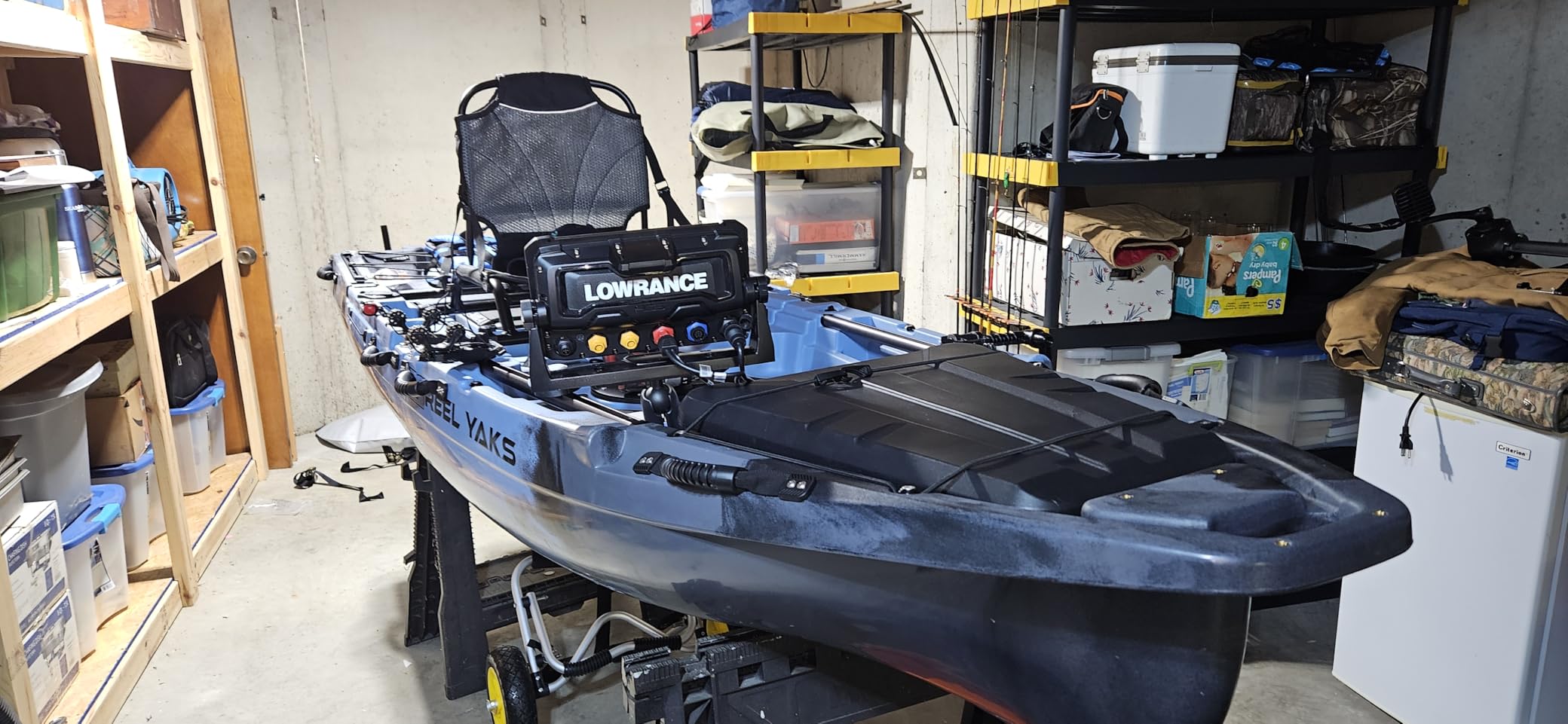
This is the mount I would hand to someone who has already been disappointed by a flopping screen. The body is cast in a single piece of aluminum rather than assembled from stacked plastic and machined inserts, and that single fact explains most of the complaints it simply does not have. There is no collar to strip, no ratchet teeth to wear, and no joint that slowly develops slop.
Capacity is rated at 15.5 lbs at rest and 6.6 lbs in motion, which puts it well above the weight of any portable display you would put on a kayak deck. The 3.35 inch arm is short, which is a deliberate choice: a short arm between ball and plate has less leverage, so a 9-inch screen is far less likely to pitch forward. The plate ships as both a rectangle and a round base, and both carry pre-drilled hole patterns, so most AMPS-pattern brackets line up without drilling new holes.
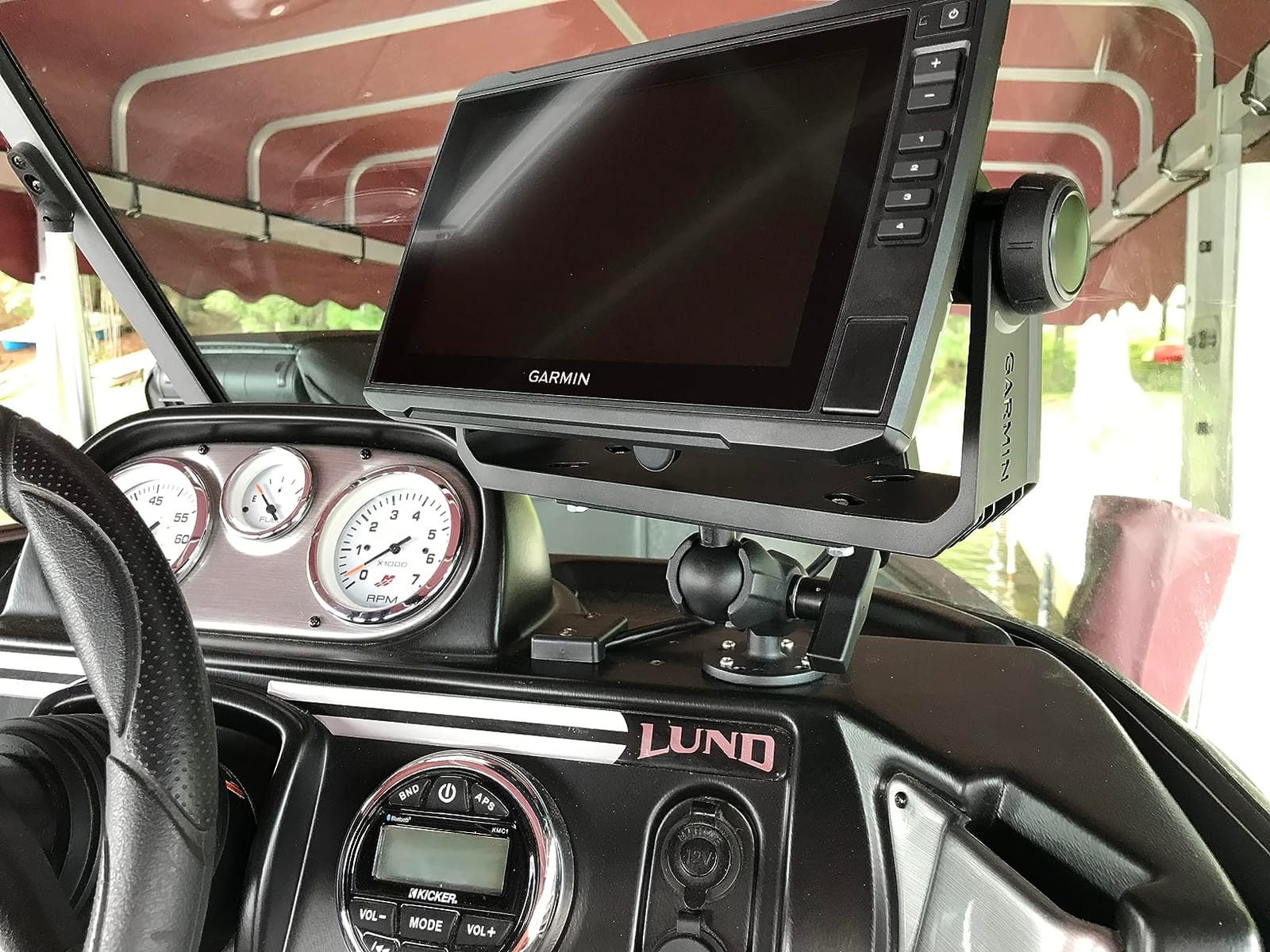
Compatibility is the strong suit. The listed fitment spans Garmin ECHOMAP, GPSMAP, Striker, Striker Plus and Striker Vivid, Lowrance Eagle, ELITE FS, HDS, Hook Reveal and Hook2, and Humminbird Helix 8, 9 and Xplore. It also accepts RAM Mount, Arkon and iBolt 1.5 inch, C-size, 38 mm adapters and arms, so it slots into an existing ball ecosystem rather than forcing a new one.
Why the Cast Aluminum Base Holds Up Where Plastic Collars Fail
Owners consistently describe the joint staying firm through wave impact rather than loosening over a season, and the metal-only construction means there is no UV-brittle polymer in the load path. The included hardware is 316L marine-grade stainless, and the powder coating has been salt spray tested, which matters if you fish tidal water rather than a protected lake.
The 600 g total weight is the one place this mount feels heavy. On a 10.5 foot fishing kayak that mass sits low and close to the hull, which is actually helpful for stability, but on a sit-on-top or a paddleboard it is noticeable. If you are moving a rigged kayak onto a roof rack alone, budget for two trips up the ramp.
When a Bracket-Specific Cradle Would Serve You Better
Two limitations show up repeatedly. The Humminbird Helix 7 screw pattern does not line up with the plate out of the box and needs adapting, and buyers note some vibration over choppy water when the mount is not tied directly to a console or braced with a spreader block. On a kayak with no console, that second point is worth weighing against a track-based system.
It is also a drill-base pedestal by design. There is no track T-bolt in the box, so on a kayak you intend to keep drilling-free, you will need an adapter or a different mount entirely. For saltwater anglers running a stationary console or a permanent console block, that is a fair trade. For a warranty-conscious angler, it is not.
2. YakAttack Fish Finder Mount for Lowrance Hook2 and Simrad Cruise 5 — Best for Lowrance Units
- Snaps onto standard kayak track with no drilling
- Purpose-fit cradle for Hook2
- Hook Reveal 5 and Cruise 5
- One-hand lock makes portage removal fast
- Corrosion-resistant polymer and stainless components
- Fitment limited to a short list of Lowrance and Simrad models
- Listed as not water resistant
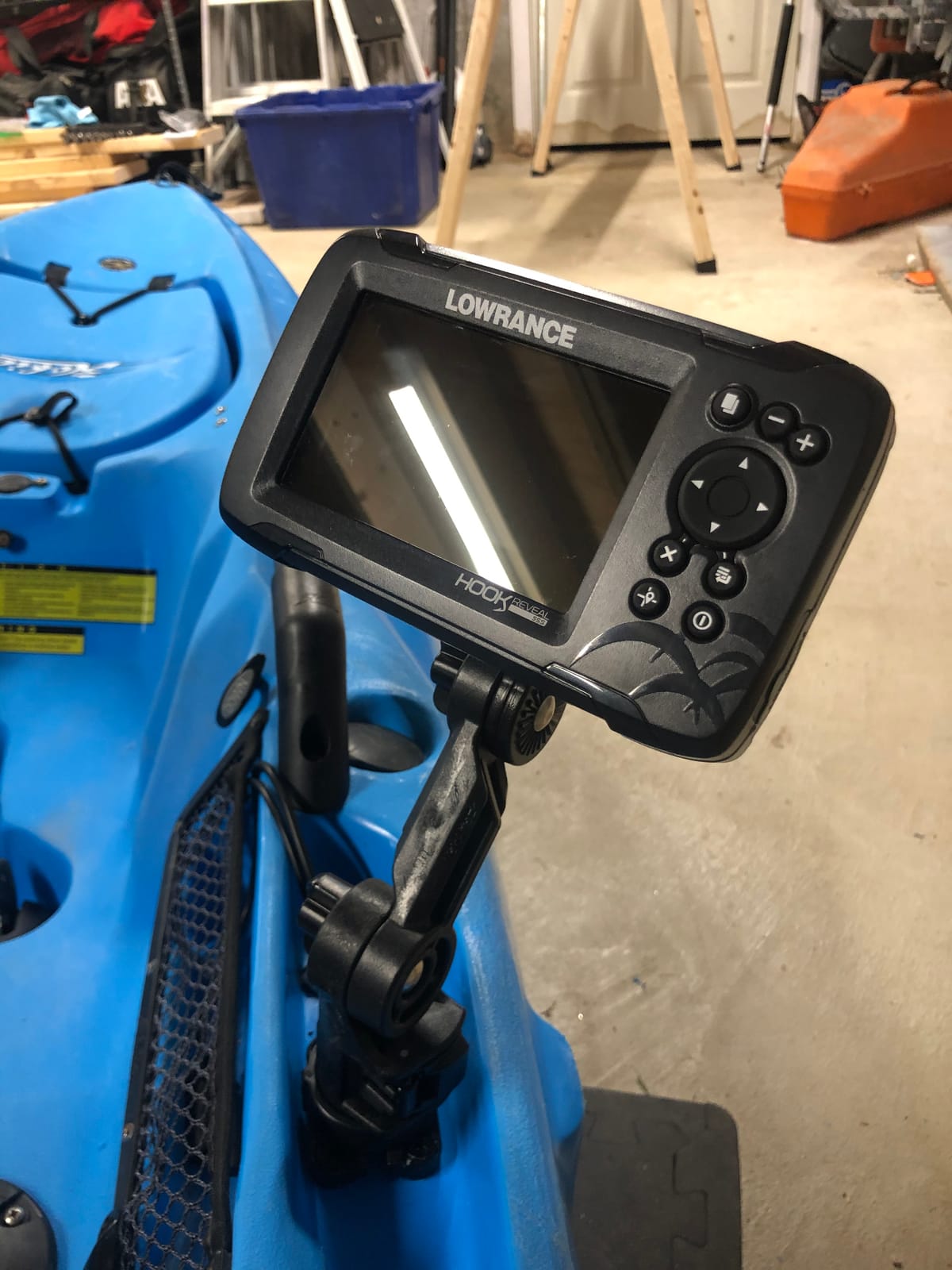
Brand-specific cradles solve a problem generic mounts cannot: the awkward moulded back of a particular unit, where the mounting holes are not on a standard pattern. This YakAttack cradle is shaped for the Lowrance Hook2-4x, Hook2-5, Hook Reveal 5 series and the Simrad Cruise 5, and it seats those units without play.
It attaches through the LockNLoad interface, which integrates with GearTrac, Mighty Mount II and most kayak track systems, so nothing is drilled. That single design decision is what makes this the safe pick for anyone whose kayak warranty matters or whose hull is a rotomolded sit-in with no good drilling surface.
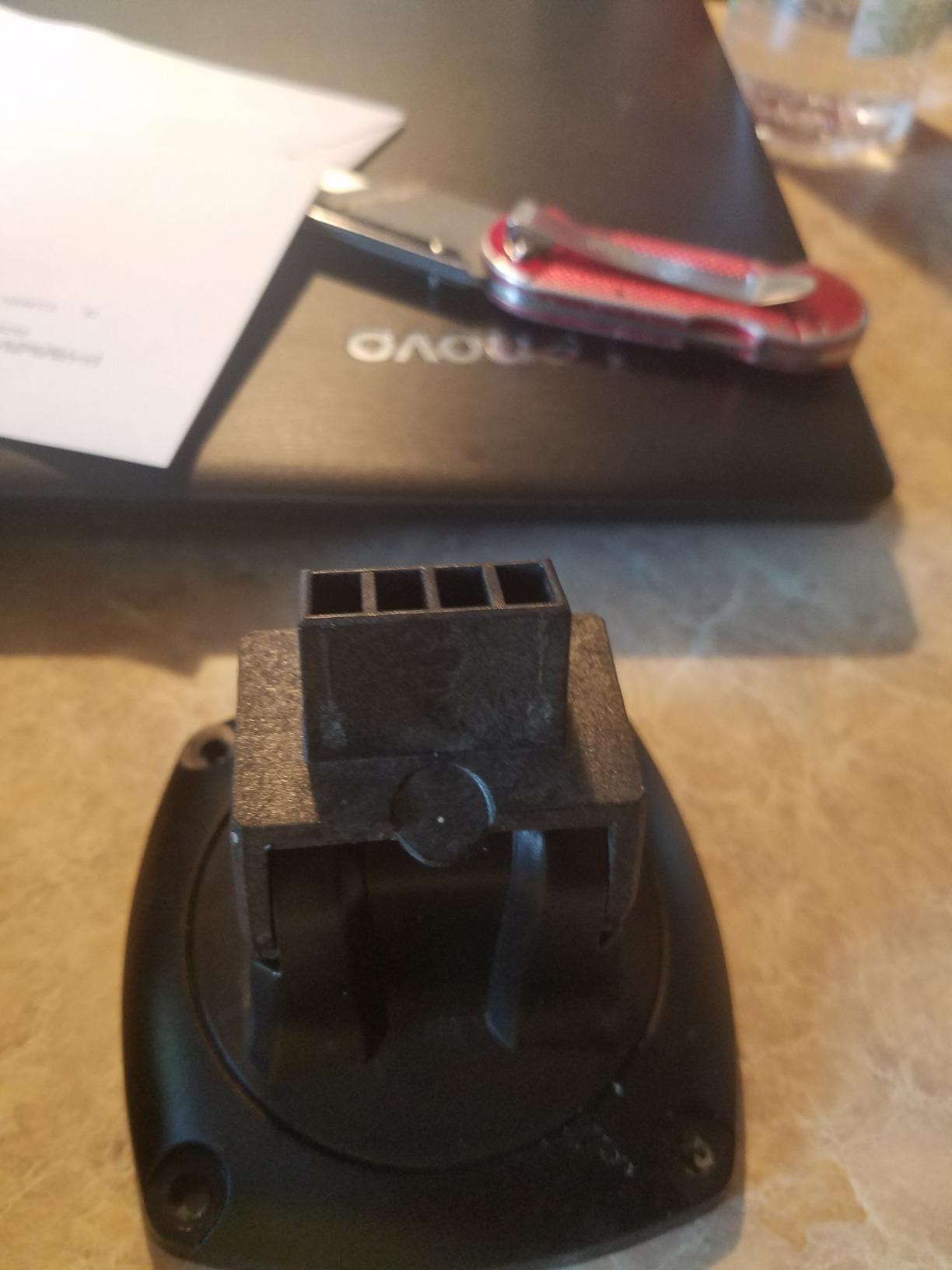
The mechanism is genuinely one-handed. You press and squeeze to lock, squeeze again to release, and the whole cradle comes off the rail in one motion. For anglers who portage or load at a dark trailhead, that matters more than any adjustment range, and it is the same quick-release behaviour the track mounting crowd rates highly.
It is made in the USA from corrosion-resistant polymers with stainless components, and it can sit on a deck or on a CellBlok with the supplied track hardware, which means the battery box option further down this list pairs naturally with it.
Why Fitment Certainty Outranks Universal Compatibility Here
Buyers with the matching model report an exact, wobble-free seat and clean removal for transport. Because the cradle wraps the specific housing, there is no free play between bracket and screen, which is the failure mode that makes generic plates feel loose after a few months.
The polymer construction keeps the whole part light, and 76 percent of ratings are five star among 490 reviews. That is a strong satisfaction rate for a part with a narrow remit.
When Your Electronics Are Something Else Entirely
This is a model-specific cradle, so if you own a Humminbird Helix, a Garmin Striker or a larger Lowrance unit, it will not seat correctly and you should skip it. The listing also rates the cradle itself as not water resistant, which is fine for a dry deck but means it is not a sealed enclosure and should not be relied on to keep moisture out of the display.
Because it is a cradle with no arm, it solves display mounting only. You will still need a transducer arm for any side-imaging unit, which is why the two-in-one rigs below often make more sense for a first complete setup.
3. WINDFRD Fish Finder Track Mount with Transducer Mounting Arm — Best Two-in-One Track Rig
WINDFRD Fish Finder Track Mount with Transducer Mounting Arm for Kayak Boat
- Display and transducer mounted on one assembly
- Telescoping arm held position through chop at speed
- Ball and knobs stay put once tightened
- Universal plate fits Garmin
- Lowrance and Humminbird
- Arm folds for transport
- Adjustment knobs collide
- so small on-water tweaks need two hands
- Transducer can lift from the water in slight chop on the shorter setting
Most first rigs fail because the display mount and the transducer arm were bought separately and were never designed to share a base. This system exists to remove that step: one track base carries a display arm and a telescoping transducer arm together, with a universal plate for the screen.
Adjustment is generous. The 1.5 inch double-socket ball gives 360 degree infinite movement, and a 360 degree ratcheting slip disc handles fine transducer angle changes. The transducer arm telescopes from 11.42 to 17.91 inches, and the track base either slides on a T-bolt or drills down permanently, so the same assembly works as a removable or permanent rig.
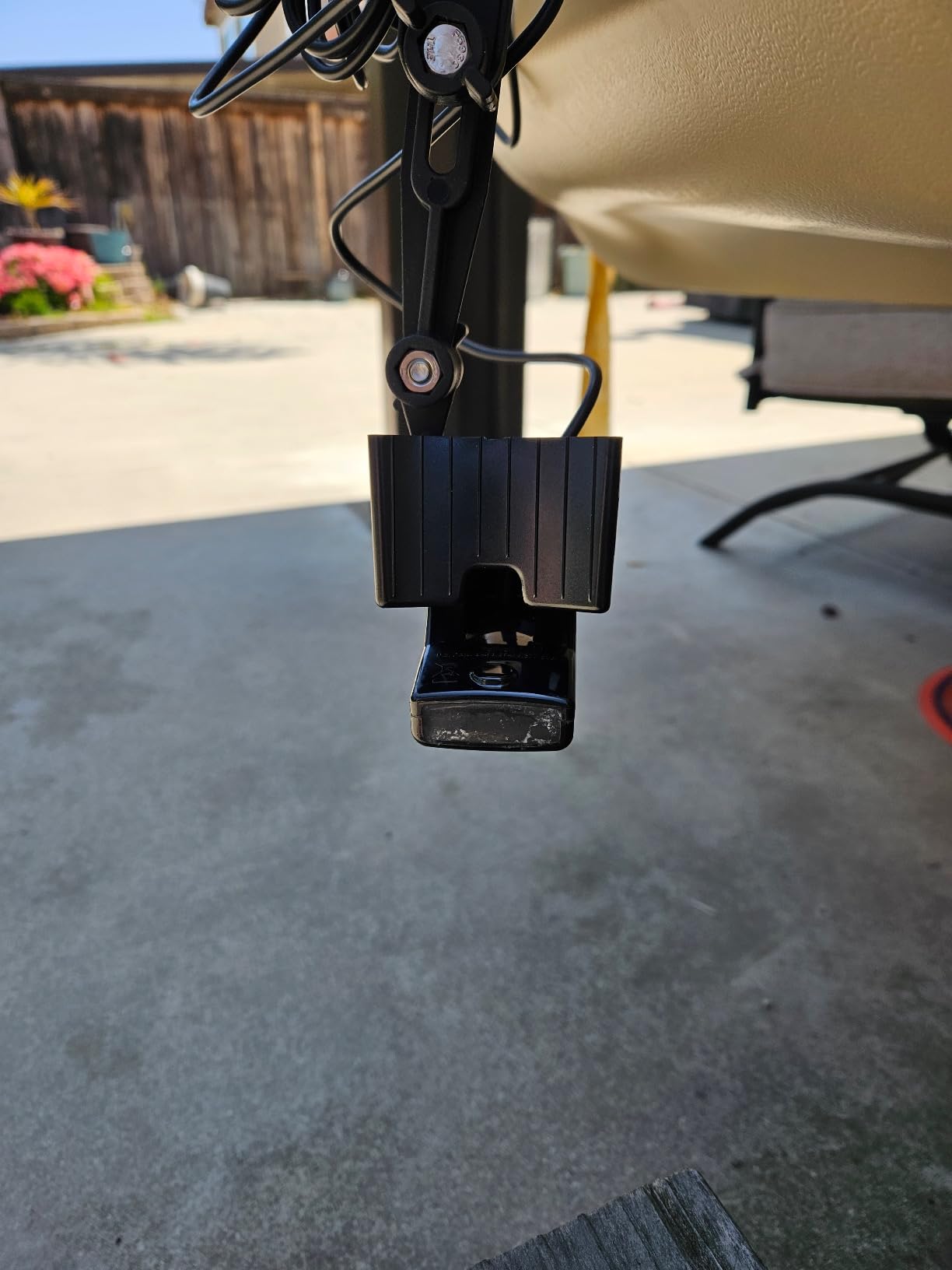
Owners highlight the clean deck as the main payoff, along with a telescoping arm that held its position under repeated chop and at speed. Knobs stay where you put them once tightened, and the fold-flat arm makes portage simpler than a fixed-length pole.
The build is glass-reinforced nylon with aluminum and industrial rubber ball hardware, rated to 10 lbs, backed by a 3-year warranty, and shipped with four sets of M5 x 20 marine-grade 316L stainless screws and lock nuts. Compatibility covers Garmin Striker 4, Plus and Vivid plus ECHOMAP Plus, Lowrance Elite, Hook Reveal 5 and Hook2, and Humminbird Piranha Max 4Di.
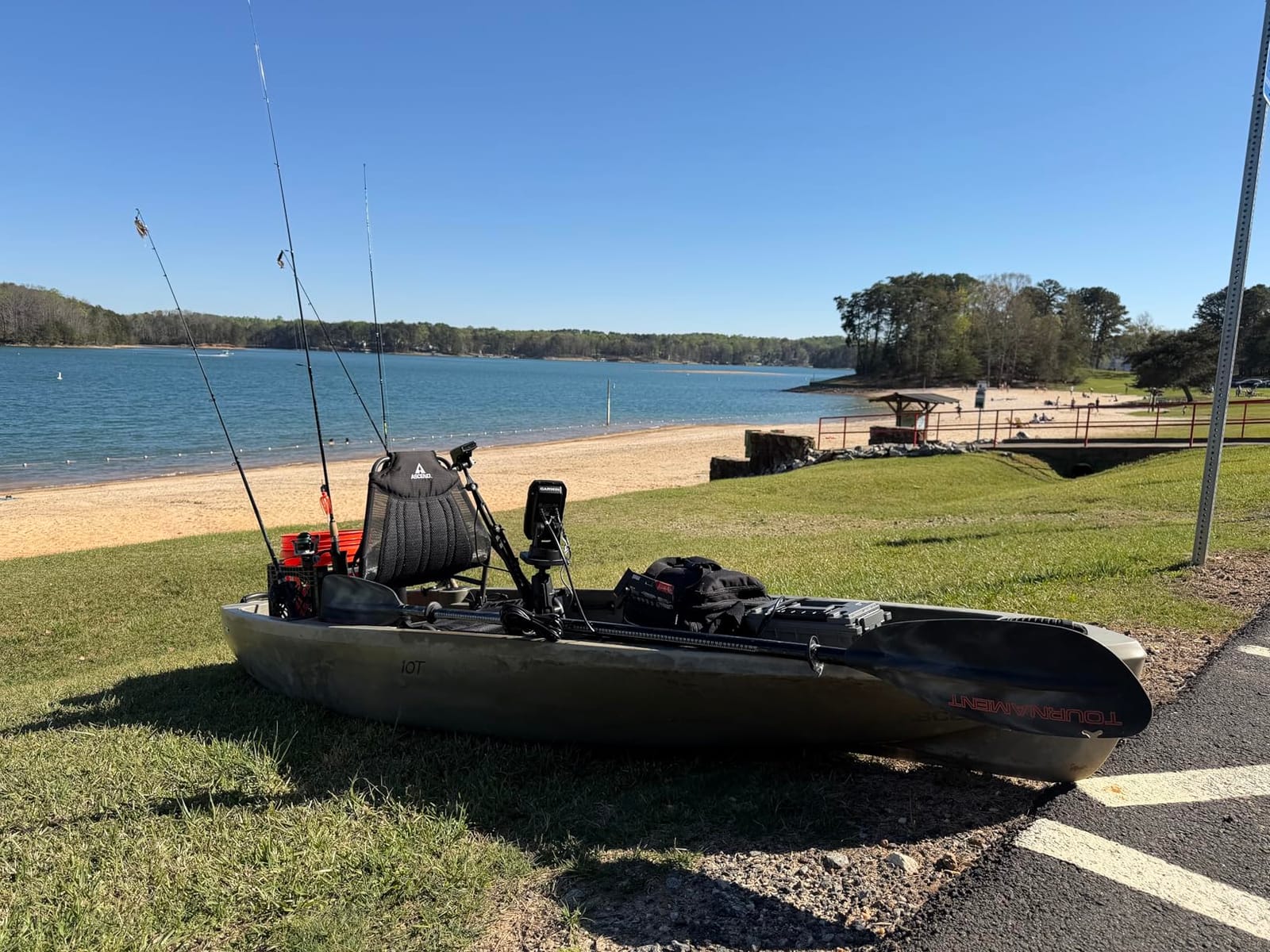
Why a Single Base Beats Two Separate Mounts
One base means one attachment point, one place to route the cable, and one set of knobs to tighten before you launch. It also means the display and transducer can be positioned as a unit, which keeps the screen in your eyeline while the transducer sits below the waterline at the same fore-aft position.
The 4.3 average across 435 ratings reflects real enthusiasm offset by a specific complaint about adjustability, not about build. At 67 percent five star and 15 percent four star, this is a well-liked product with one recurring irritation.
When Two Hands and a Ratchet Stop Being Convenient
The most repeated gripe is knob interference. Several users report that on-water fine adjustments take two hands because the knobs collide, and that removing the assembly from the track requires rotating the whole mount and then re-adjusting the knobs afterward. If you expect to retune your angle constantly while drifting, that friction is real.
Two other issues are worth weighing. On the shorter setting, a few owners report the transducer lifting out of the water in slight chop, so check your intended deployment length against your typical conditions. And loosening the knobs too far lets adjustment screws back all the way out, which is a small thing that can cost you a part on the water.
4. YakAttack CellBlok with SwitchBlade Transducer Arm Combo — Best for a Complete Rig
- Battery
- display and transducer lift off the track in seconds
- Stout housing that feels built for saltwater
- Cable storage and quick battery access in one box
- Transfers between kayaks for multi-craft anglers
- Assembly instructions are confusing and cover the pieces separately
- Lower transducer arm section can loosen or vibrate
Most anglers building electronics from zero also need somewhere to put a battery, and that is what this combo solves. The CellBlok is a track-mounted battery box with a top platform for the display, paired with the SwitchBlade transducer arm. The interior measures 6.375 by 4.25 by 2.60 inches, sized for 10Ah batteries and larger cable wraps.
Installation needs no drilling at all. Two knobs release the entire assembly from the track, and the system works with MightyMount, GearTrac and most factory or aftermarket track systems, with adapters available for Feel Free, Three Water and Jonny Boats. Total weight is 1.4 lbs for battery box and arm together, which is light for what it carries.
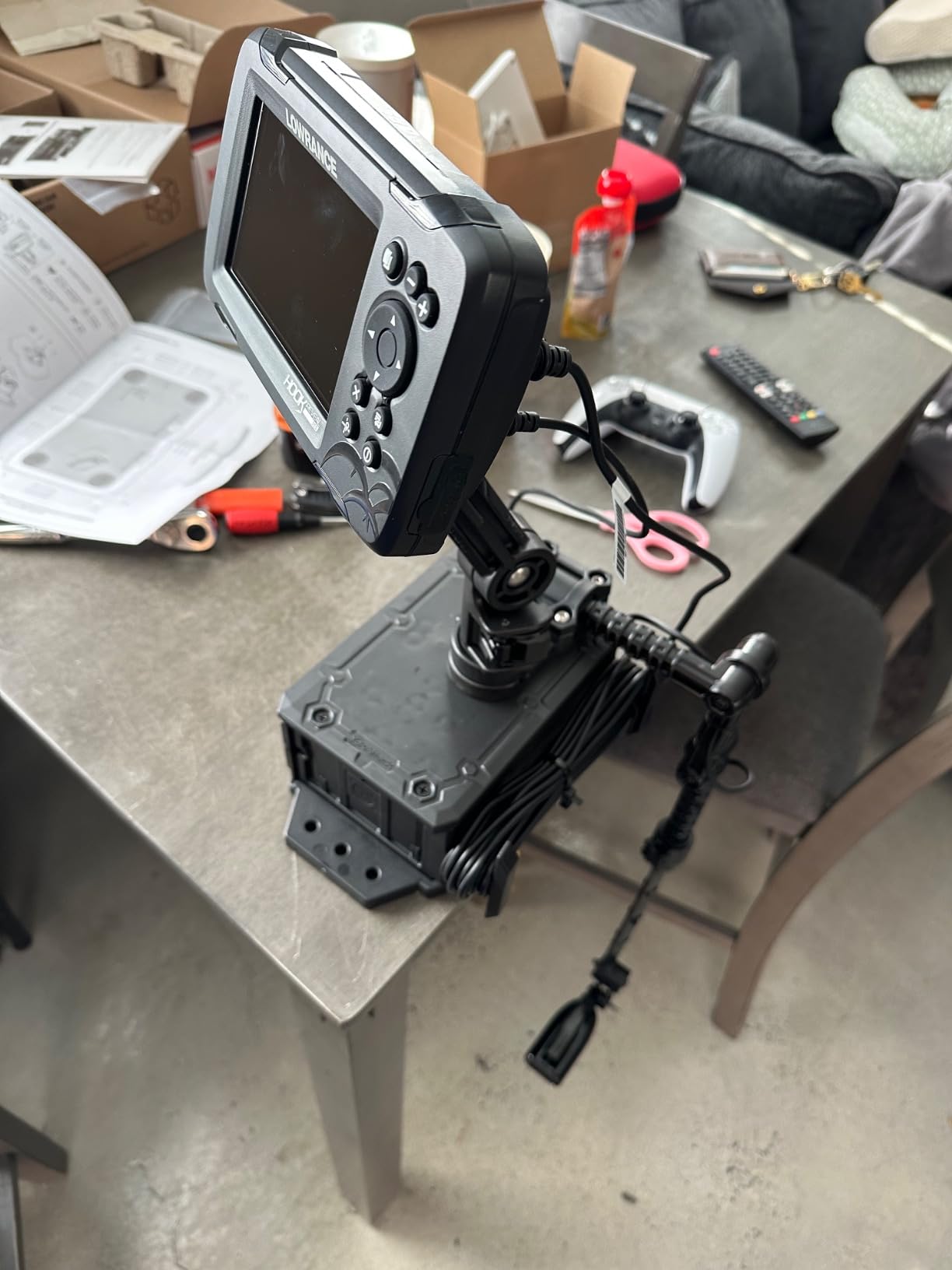
The SwitchBlade arm is hydrodynamic, which matters more than it sounds. A flat or rough arm gurgles at trolling and paddling speeds and drags behind the hull, and the shaped profile reduces that. It also folds compactly for carrying and can be cut to length, which is the modification side-imaging users need.
Owners describe the housing as feeling built like a tank once assembled, and several call this the best no-drill all-in-one kayak electronics solution they have used. Transferring the whole rig between boats at a lake with two kayaks is a genuine convenience, and 70 percent of the 301 ratings are five star.
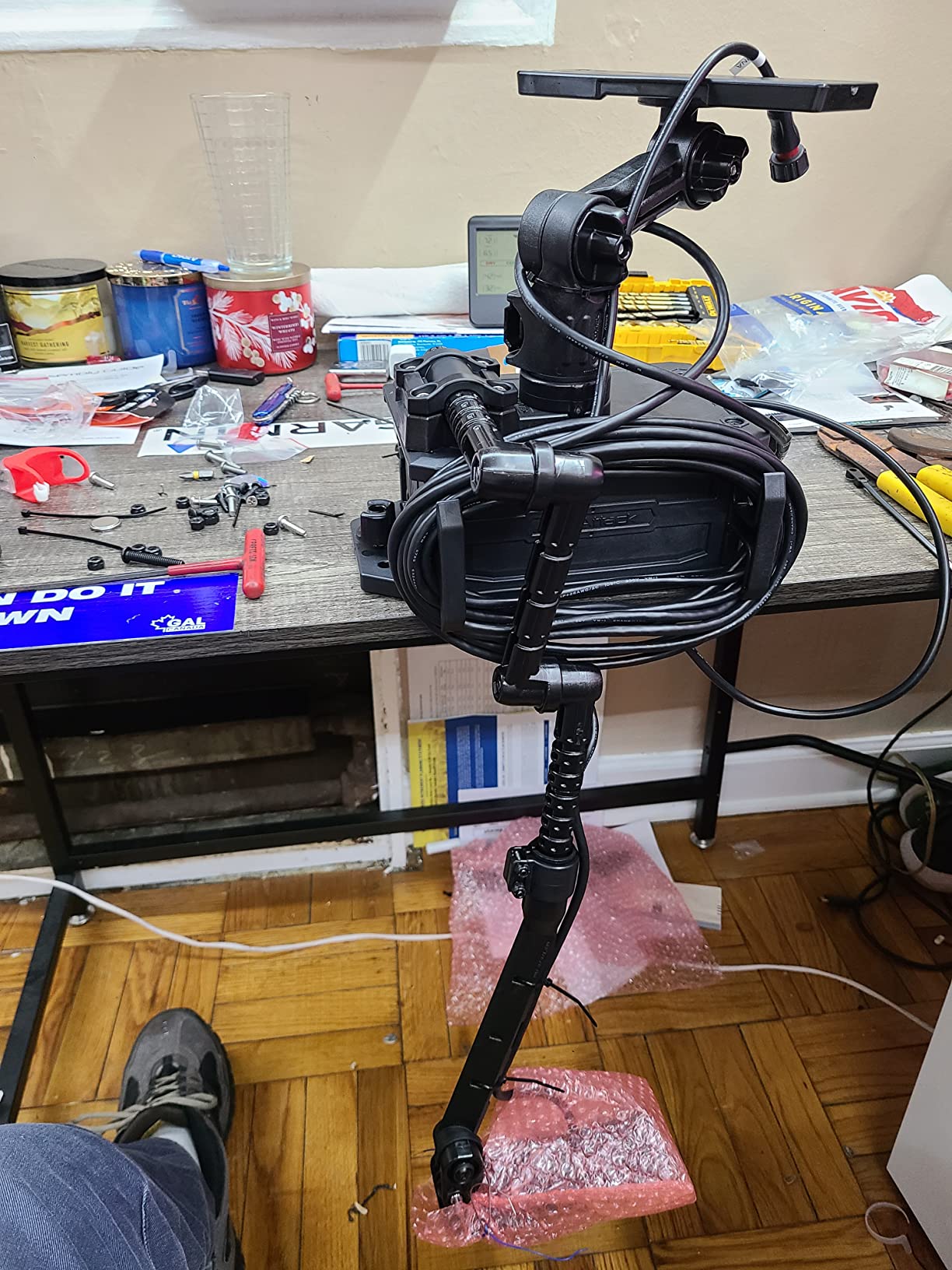
Why Battery Housing and Transducer Arm Belong in One Part
Routing the transducer cable is the most common thing people get wrong on a first rig. When the battery box, the display platform and the arm all come from one system, the cable path is designed rather than improvised, the box doubles as cable storage, and you get fast access to the battery for a swap at a launch.
Colours are offered in Battleship Grey, Black and YakAttack Orange, and the platform on top is a natural home for a compact display. If your kayak already has a battery box you like, you can still run the arm alone as a building block.
When the Instructions Cost You an Afternoon
The dominant complaint is documentation, not hardware. Multiple reviewers describe assembly as the hardest part, because the combo arrives as two separate sub-assemblies that must be disassembled and rebuilt together while the instructions cover the individual pieces rather than the assembled combination. Budget an unhurried hour with the parts laid out before the first launch.
Second, a handful of owners report the lower section of the transducer arm loosening or vibrating at low speed even when tightened, and some note the battery box front cover is held by a small notch and can come loose. If you run shallow water at low speed a lot, check that joint on the water rather than assuming it is set.
5. VAUBORTTI Aluminum Ball Mount for Garmin Striker 4 — Best Budget Display Mount
- Rigid all-aluminum build once tightened
- Dual 1 inch balls give a wide viewing angle range
- Track base and drill base both included
- Compact enough for a small kayak deck
- T-bolt can be slightly too thick for some stock Old Town tracks
- Supplied screws may not match the Striker 4 pattern
This is the pick for an angler with a compact unit like the Garmin Striker 4 who wants a rigid, all-metal display mount and does not want to commit to a full track ecosystem. The body is high-temperature die-cast aluminum alloy with a polyethylene powder coating, and the base is cast integrally rather than bolted on, which improves breakage resistance.
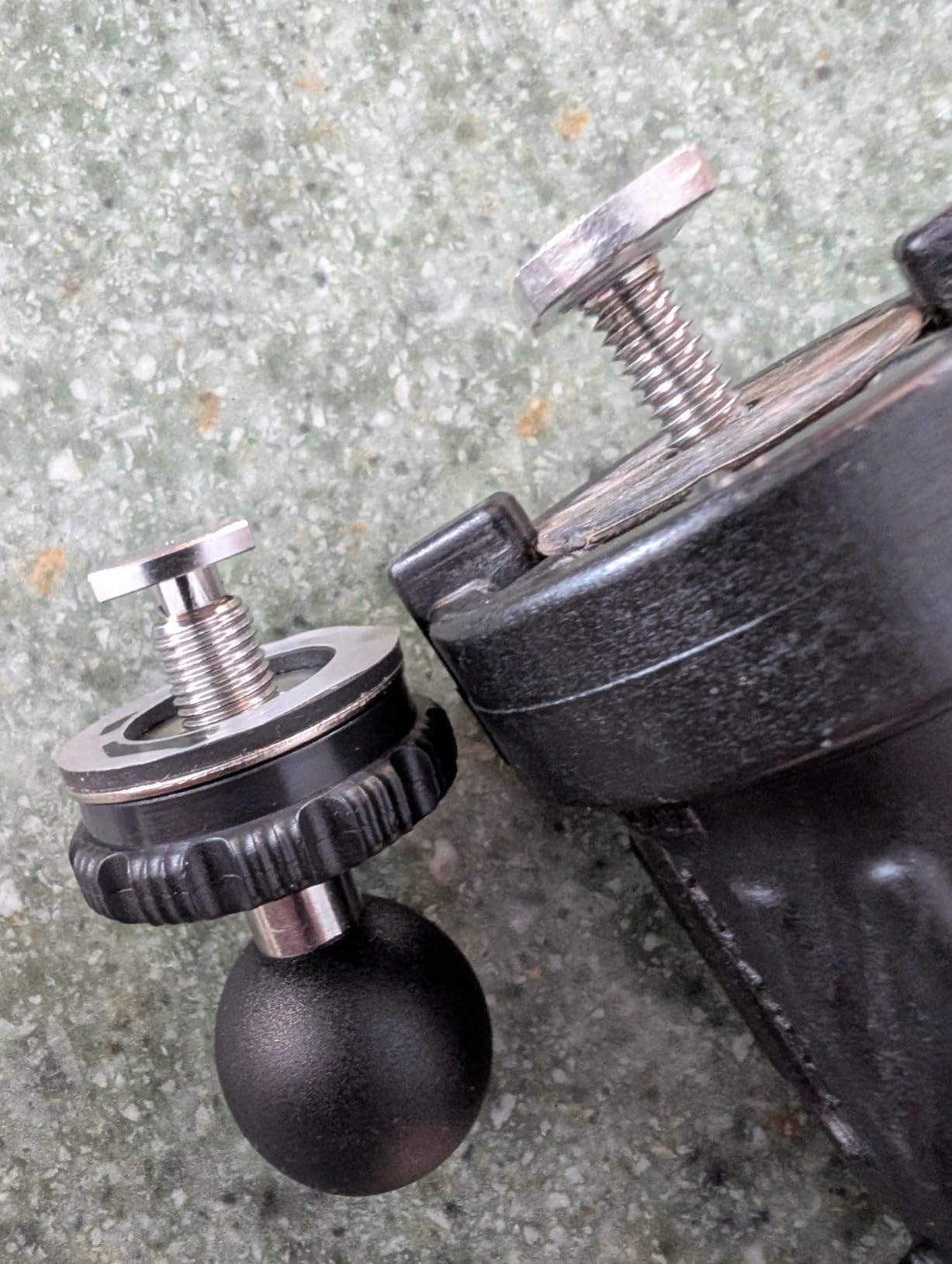
Adjustment comes from two 1 inch balls across a 5.7 inch total length, giving a wide range of viewing positions for a small screen. The package includes both a T-bolt attachment for gear track and a permanent drill base, so you can decide at install time whether the kayak stays drill-free.
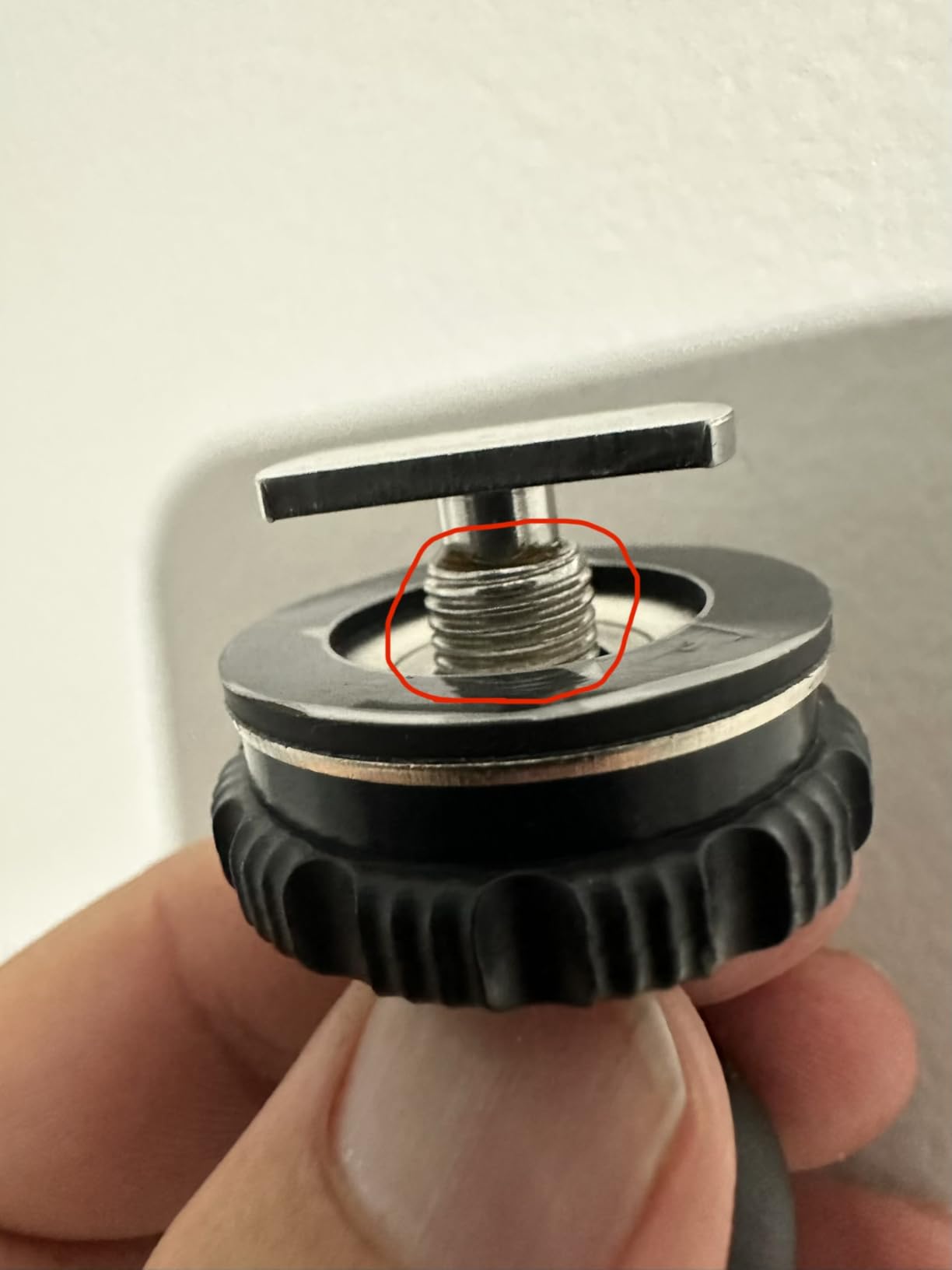
Buyers rate the construction as solid and the angle range as genuinely useful, and the flexibility of having both bases in one box is frequently called out as good value against premium-brand alternatives. At 69 percent five star across 153 ratings, it is well received for its tier.
The AMPS hole pattern suits GPS, fish finders, phones and tablets, and the listed vehicle compatibility is broad: kayak, jon boat, canoe, pontoon, ATV, truck dashboard and more. That makes it a sensible shared part if you move electronics between craft.
When a 1 Inch Ball Is the Right Size Rather Than a Compromise
Ball diameter should scale with screen size, and a 1 inch ball is appropriate for small displays in the 4 to 5 inch range. The Striker 4 sits comfortably in that window, and the dual-ball layout lets you change angle without swapping a single part. Nothing here is oversized for the job, and the compact length suits a small fishing kayak deck.
One-year warranty coverage is the weakest in this group, so treat it as a consumable-grade part rather than a long-term investment.
When You Will Need Different Hardware Before It Fits
The hardware is where the complaints sit. Several Striker 4 owners had to source their own M4 nuts because the supplied screws do not match the advertised pattern. A specific group of Old Town Sportsman owners report the T-bolt diameter does not suit the stock track and may need filing, and the T-bolt threads can bottom out and stop the mount sliding fully into the rail.
If your track is from a brand with tight tolerances, measure the slot width before ordering. If you run a 7 to 9 inch screen, step up to a 1.5 inch C-size ball rather than loading a 1 inch joint with a much larger screen.
6. YakAttack Universal Mounting Plate, 6 x 3.5 Inch, LockNLoad Track Mount — Best Platform for Custom Builds
YakAttack Universal Mounting Plate 6″ x 3.5″, LockNLoad Track Mount
- Clean LockNLoad attachment to standard kayak tracks
- Large enough for most displays but compact on the deck
- Marine-grade polymer suited to saltwater
- Good foundation for a custom electronics rig
- A bare platform
- so a separate arm or ball mount is still required
- Less rigid than metal alternatives for heavy displays
This plate is not a finished mount, and pretending otherwise would sell you the wrong part. It is a 6 by 3.5 inch locking platform that drops onto GearTrac, MightyMount II and MightyMount XL track systems, and it is the base layer for an electronics stack you assemble yourself: battery box, arm, display and control panel, all sharing one attachment point.
For multi-kayak anglers or anyone running more than one device, that shared base is the whole argument. One plate on the rail, several components on the plate, and every cable runs back to a single removable block.
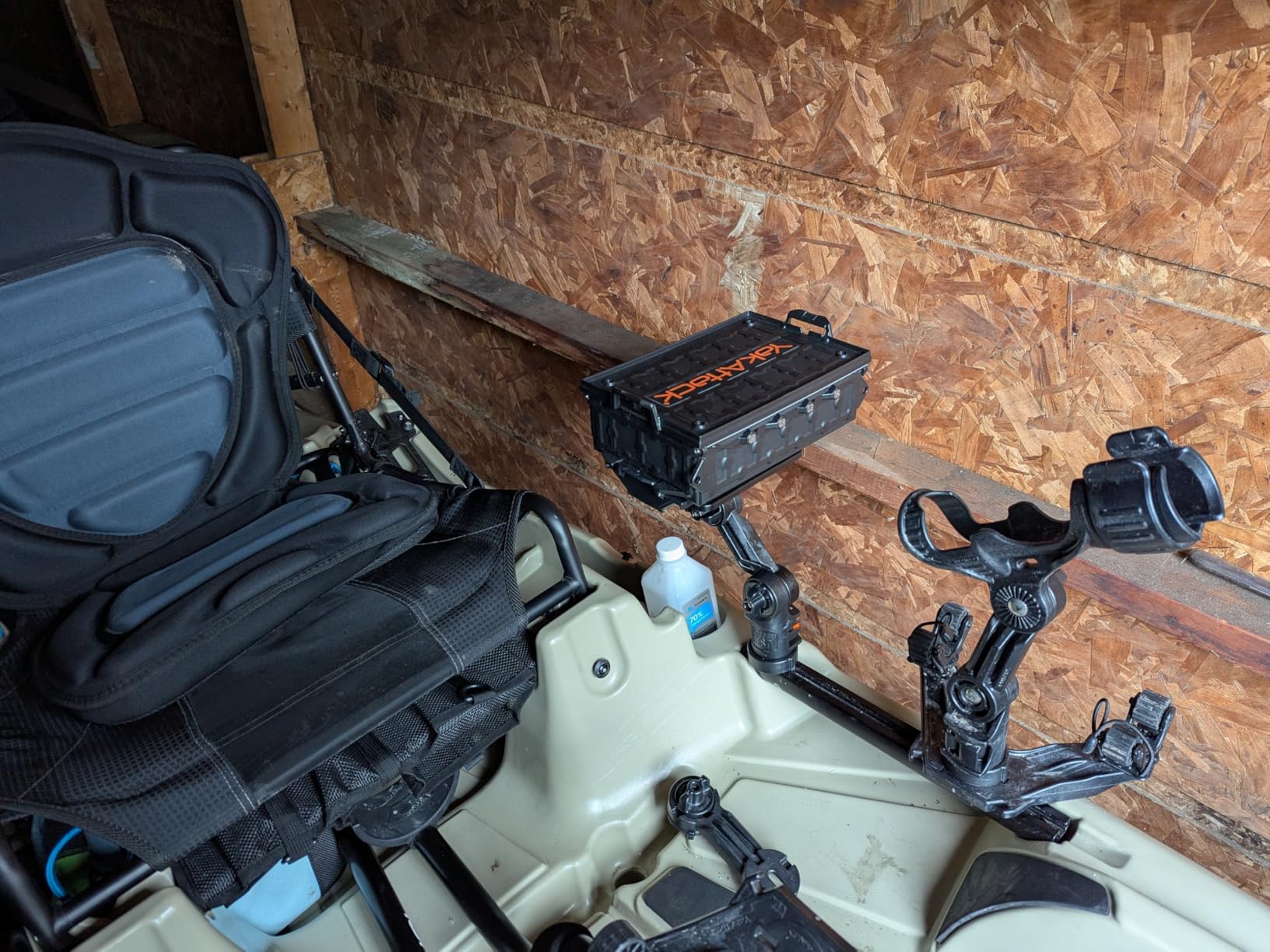
Reviewers like that the footprint is large enough for most compact displays while staying out of the way on a fishing kayak deck, and the marine-grade corrosion-resistant polymer is a sensible material choice for saltwater use. It is made in the USA and backed by the YakAttack Built for Life Guarantee.
At 4.6 stars from 100 ratings with 76 percent five star, the satisfied group here is small but unusually consistent, which is what you would expect from a part with a specific and clearly understood job.
Why Builders Choose a Locking Platform Over a Fixed Bracket
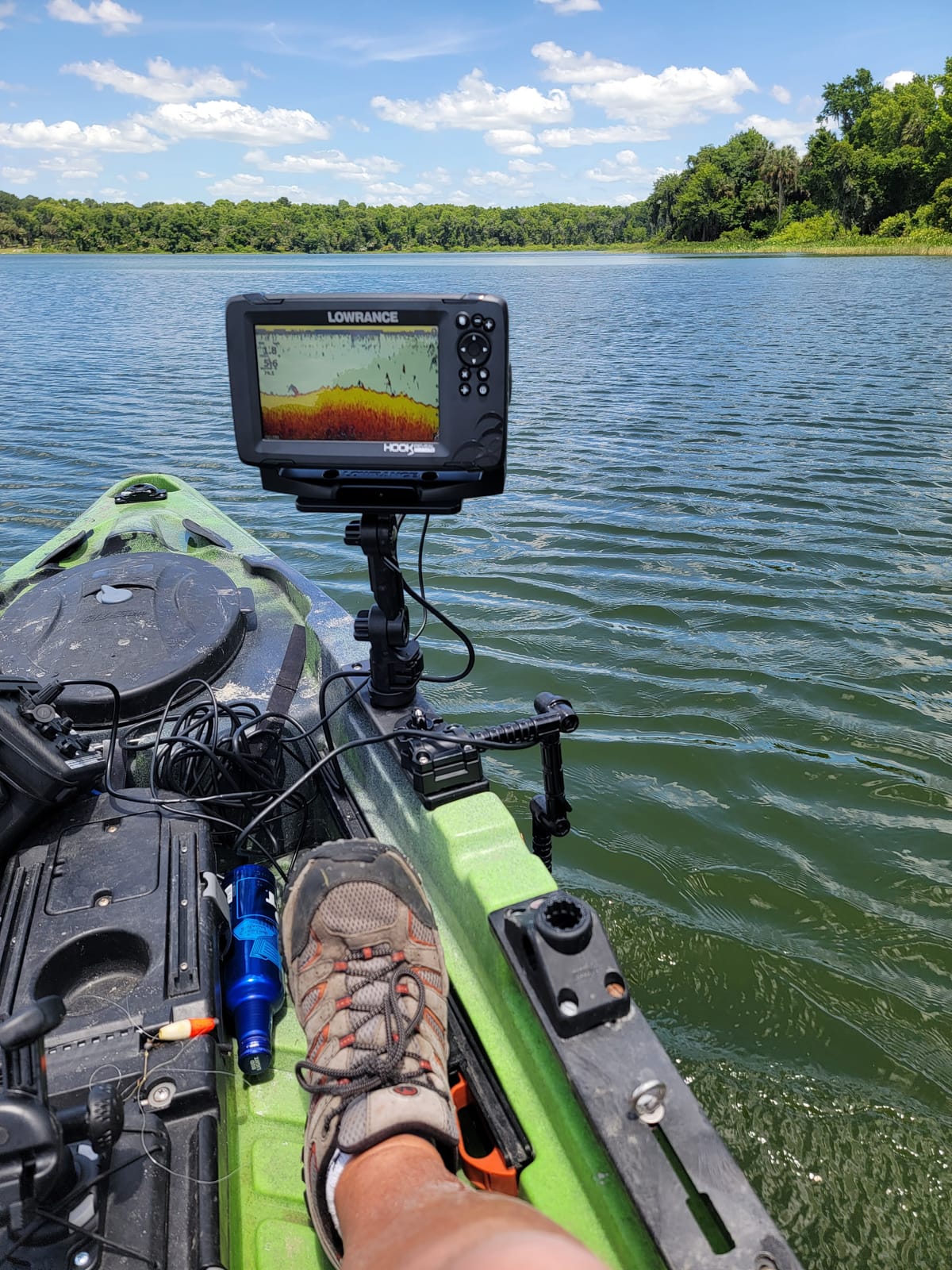
The LockNLoad interface means the plate releases with one hand, so a rigged kayak can be carried without dismantling the electronics, and a multi-device stack can be added or removed in one movement. The polymer holds its shape in salt air without the weight of an equivalent metal plate, which keeps deck load down on smaller kayaks.
As a companion to the CellBlok combo above, it lets you mount a second device or an extra battery on the same rail run without a second drilling or clamping operation.
When a Single Plate Cannot Carry the Rig Alone
This is a platform, not a display mount. You still need an arm, a ball mount or a device-specific cradle to actually hold a fish finder, and the total cost of the finished rig will include those parts. If you are buying your first display and want one box to open, this is the wrong purchase.
Second, the polymer is less rigid than metal alternatives. For a heavy 9 inch display, or for a pedal-drive kayak where the mount sits close to moving parts, an aluminum pedestal is the stiffer choice. The plate is at its best carrying lighter electronics or a control panel rather than a large chartplotter.
7. Universal Kayak Fish Finder Mount with 9-14 Inch Transducer Arm — Best for Paddleboards and Compact Kayaks
EDSRDPLT Universal Kayak Fish Finder Mount with Transducer Arm Adjustable 9–14” Tool-Free Rail Installation – Fish Finder Bracket for Kayaks, SUPs & Small Boats
- Everything for a full rig in one box
- Tool-free track install for fast rig and unrig
- Short 9-14 inch range suits small kayaks and paddleboards
- Marine-grade composite and stainless parts
- Shortest arm range in the group
- Composite body is less rigid than a metal arm
- Thinnest review base in the set at 52 ratings
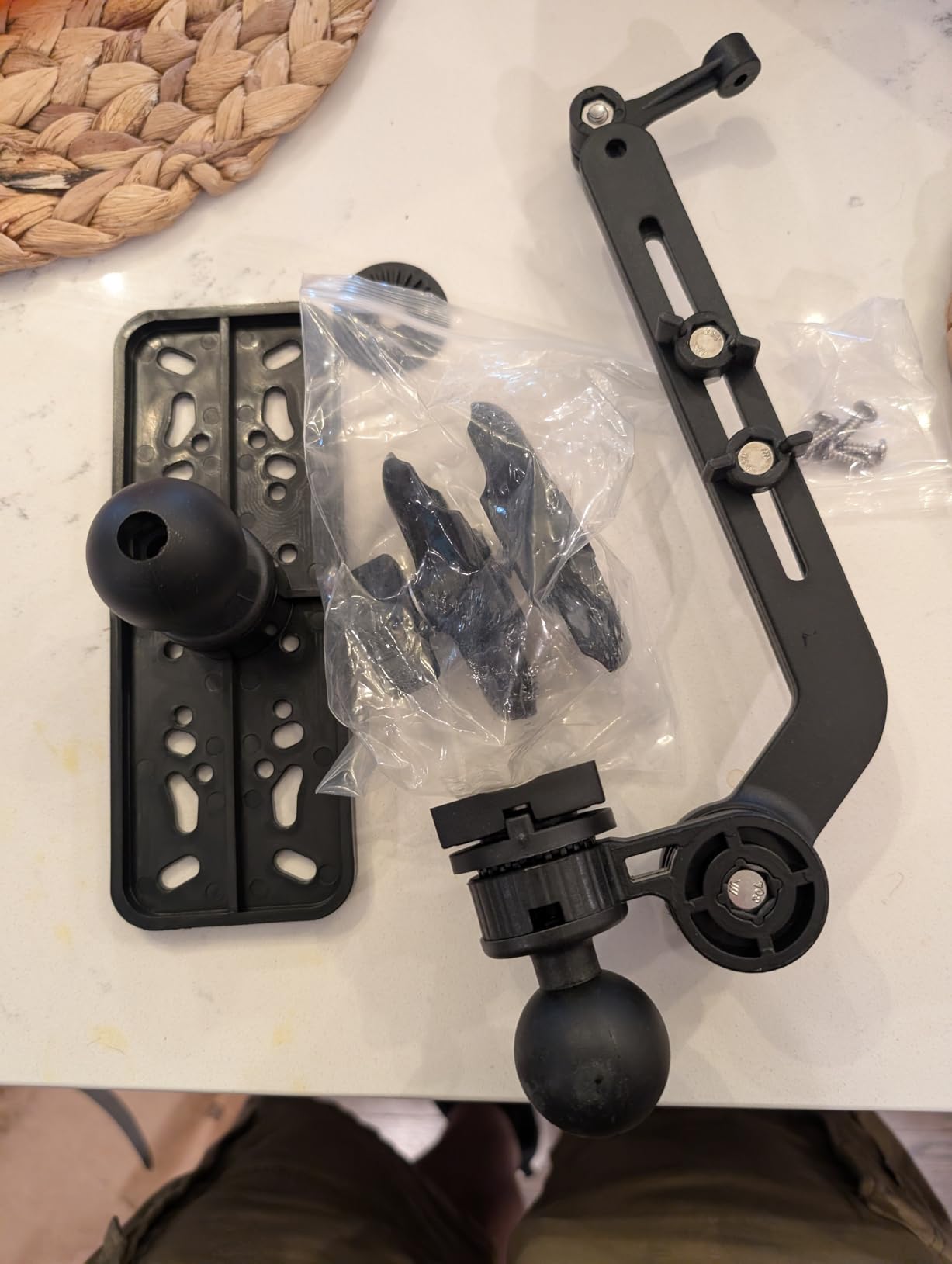
Stand-up paddleboards and very compact kayaks have a specific problem: there is no track, no console and very little deck. This kit addresses that with a tool-free, drill-free install on a kayak gear track, and ships the full set, a 1.5 inch ball head, a fish finder plate, a track base and a telescoping transducer arm, in one box.
It is also offered in a transducer-arm-only variant, which is useful if you already have a display mount and want to keep the cost down. Compatibility covers most Garmin, Lowrance and Humminbird displays, and the materials are described as marine-grade composite with stainless steel hardware rated for sun, salt and splash.
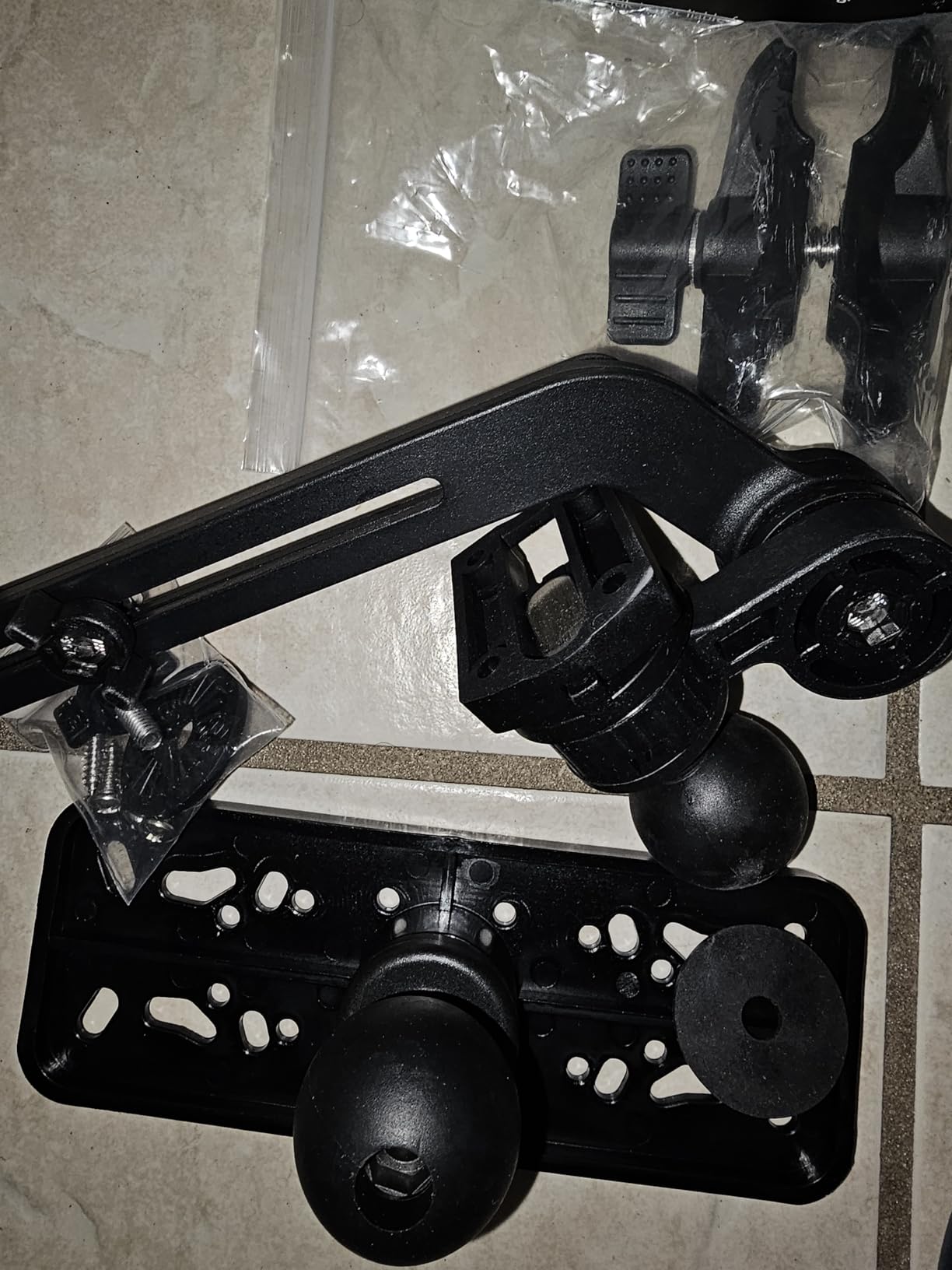
Buyers like the completeness of the box and how quickly the rig comes off the track when you are done. The 9 to 14 inch adjustment range is genuinely the right size for a small craft, where a longer arm would foul the deck or hit the water at the wrong angle.
Be aware of what you are buying here: this is the lowest-rated product in the group at 4.0 stars, with 63 percent five star and a 15 percent one-star share from 52 ratings. That is a thin review history for a structural part, so treat it as a value choice rather than a long-term investment.
When Short Arm Range Is an Advantage Instead of a Limit
An arm that telescopes 9 to 14 inches keeps the transducer close to the hull on a shallow paddleboard launch, where a longer arm drags. It also folds to a smaller footprint, which on a small deck is worth more than deployment depth. Anglers fishing lakes and estuaries with a steady drift get a usable angle range without a long pole swinging.
For a display in the 5 to 7 inch range, a 1.5 inch ball head with the supplied plate is a sensible pairing, and the tool-free track base means you can move the whole rig between craft.
When Build Rigidity Decides Against It
The recurring negatives are the short adjustment window compared with 17 to 18 inch arms, and general rigidity, with several buyers saying it works but feels less solid than metal-arm competitors. The listing shows stainless hardware while the main body is composite, so the load path is not metal throughout.
If you fish open water with a large display and a lot of wave action, or if you already own a proven transducer arm, spending the same money on a longer, stiffer arm is the better use of it.
8. Scotty 0141 Kayak and SUP Transducer Mounting Arm with Gear-Head Adapter — Best Value Transducer Arm
Scotty 0141 Kayak/SUP Transducer Mounting Arm with Gear-Head Adapter, Black
- Most proven part here with 2955 ratings
- Holds up at paddling and trolling speeds with no bending
- Swivels and telescopes for fast up-and-down repositioning
- Easy on and off the Scotty slide track
- Doubles as a base for a trolling motor or rod holder
- Will not telescope short enough for some shallow launches
- T-track bolt is slightly too long
- Transducer fitting often needs spacers or adapters
With 2,955 ratings at 4.6 stars, the Scotty 0141 has more field history than anything else on this list by an order of magnitude. That matters for a structural part, because UV brittleness, joint softening and arm sag only reveal themselves after a couple of seasons of sun and salt.
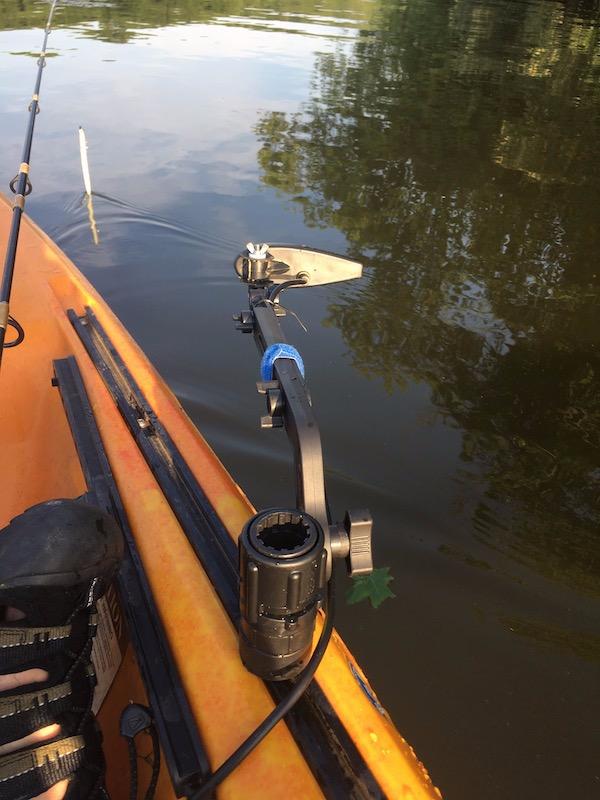
The arm telescopes from 11.5 inches compact to 18 inches fully extended and swivels 360 degrees, so you can raise the transducer for a beach launch and drop it without disassembly. It includes the 0438 gear-head track adapter, which fits the Scotty slide track and accepts the Scotty universal sounder mount, and the top drops and locks any Scotty post-mount accessory.
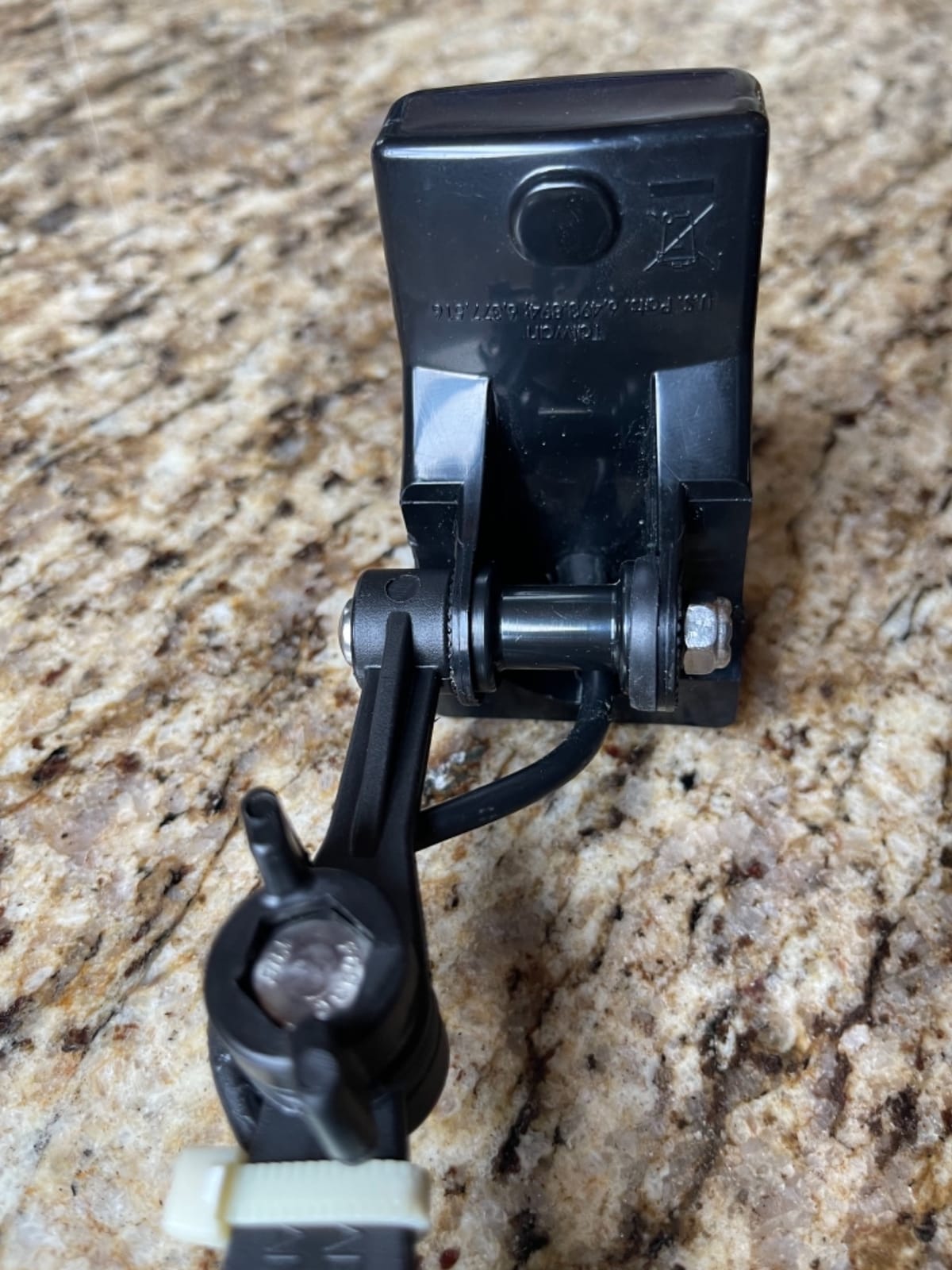
Long-term owners describe it as rock solid at paddling and trolling speeds, including runs at 3 to 5 mph, with no bending when the mount is tightened. It weighs 16 oz, uses high-strength composite construction, and works as a base for a trolling motor or rod holder as well as a transducer.
One detail worth planning around: the universal sounder mount and the Scotty slide track are sold separately, so budget for the adapter if you do not already own a Scotty track system.
Why Review Volume Beats Novelty for a Mounting Part
A composite arm that has survived thousands of logged seasons is a safer bet than a newer metal-looking design with fifty ratings, and 75 percent of those ratings here are five star. Anglers using it as a shared rail attachment alongside a display mount report the two components coexisting without fighting for space.
The 360 degree swivel also makes it a genuine multi-role part: retract for transport, extend for trolling, lock upright when launching into shallow water.
When Retraction Length and Adapter Fit Work Against You
The consistent theme in lower-rated reviews is the transducer fitting rather than the arm. Several users needed nylon spacers, washers or trimming on the T-track bolt, because the supplied bolt is slightly too long and the upper hole will not click and lock without shortening it. Others note the arm will not retract as short as they would like, risking the transducer dragging on the bottom at a launch.
It is also not suitable for inflatable craft, where the arm meets the pontoon side and angles away from the hull. If your boat is inflatable, choose a rail-clamp or pontoon-dedicated mount instead. Finally, the square nuts may loosen with turbulence and need periodic re-tightening, so make checking them part of your pre-launch routine.
How to Choose a Kayak Fish Finder Mount for Your Boat
Check what your kayak already has before you choose anything
Start with the hull, because it decides your options. Hobie, Jackson, Perception and Old Town fishing kayaks usually ship with a factory T-track, and a Track Mount or LockNLoad product drops straight in with no drilling. Rotomolded sit-ins often have accessory rails rather than full track, and some sit-on-top models have neither, which narrows you to a drill-base pedestal or a rail clamp.
Inflatable kayaks and paddleboards are their own category. They have accessory rails only, and pole mounts that depend on a rigid hull will not sit correctly, as the Scotty 0141 reviews illustrate. A rail-clamp or track-base kit is the right shape for that boat, and it is worth buying a purpose-made inflatable mount rather than adapting a hard-hull part.
Pedal-drive kayaks need a clearance check before purchase. Mount arms and transducer arms can interfere with Overdrive or Motor Drive hardware and with propulsion fins, particularly if the mount sits forward of the drive shaft. Measure from the drive mechanism to the bow, position the mount behind it, and confirm the transducer arm clears the fin at full deployment.
Match the ball size to the screen size
Ball diameter is the most commonly mismatched spec. A 1 inch ball is appropriate for displays up to about 5 inches. A 1.5 inch ball, known as C-size or 38 mm, is what you want for 7 to 9 inch screens. Mounting a large screen on a 1 inch ball is the direct cause of the forward sag and wobble described in angler complaints.
If you are between sizes, buy the mount rated one size up. The cost difference is small, and a stiffer joint on a lighter screen is far better than a marginal joint on a heavy one. The cast aluminum pick and the two-in-one track rig in this list both use 1.5 inch C-size ball hardware, while the budget VAUBORTTI option uses dual 1 inch balls for smaller displays.
Rigidity at the joint is the same physics in every other field, so our picks for portable equatorial mounts for travel work through the same tradeoffs between a lightweight build and a stiffer one when vibration is constant.
Understand what the mount does and does not include
A display mount holds the screen. A transducer arm holds the transducer below the waterline. Very few products solve both, and the ones that do are exactly the two-in-one systems covered above. Buying a cheap display mount and then discovering the transducer arm costs more separately is the most common piece-by-piece buying mistake, and it is the reason some rigs end up with mismatched hardware.
Add up four lines before you commit: the display mount, the transducer arm, any adapter plate or brand-specific bracket, and the cable glands or conduit. Then check that all four came from a system designed to work together, or at least that the mounting patterns are compatible.
Decide where the transducer is going
You have three practical options, and only one of them is fully reversible.
External arm. The transducer hangs below the waterline on a deployable arm. This is the only option that works with side-imaging sonar, because a side beam needs an unobstructed path to the sides of the boat. It is also the option that needs the least hull modification.
Scupper mount. A pole drops through a scupper hole and holds the transducer outside the hull. No drilling, fully reversible, and a genuinely practical answer to the no-drill question, though it needs a compatible scupper and a stable pole base.
In-hull with plumber’s putty. The transducer is bonded to the inside of the hull with marine putty, eliminating beaching risk entirely because there is nothing external to drag. The critical caveat is that this technique works for down imaging only. Side imaging needs a clear lateral beam path, which an in-hull installation does not have.
A through-hull install is a fourth route, done with marine sealant against the hull. It gives the cleanest sonar of the four and is effectively permanent, so factor in the warranty question before cutting anything.
For guidance on the sonar itself, it helps to be clear that down imaging and side imaging answer different questions. Down imaging shows what is directly beneath you, which is what a putty-mounted in-hull transducer can deliver. Side imaging shows structure and fish to your left and right, which is what drives the choice of an external arm. If side imaging is the goal, the transducer goes outside the hull, no matter what the mounting convenience argument says.
Check the materials against the water you fish
Freshwater anglers can run almost anything. Coastal and brackish water is where material specification separates a mount that lasts from one that fails in a season. Look for marine-grade aluminum, powder coating, 316L or 316 stainless hardware, and UV-stabilized or glass-reinforced polymers. A salt-spray-tested finish is an even stronger signal.
Galvanic corrosion is the quiet failure mode in saltwater rigs. Mixed metals in contact, an aluminum bracket touching a stainless bolt with no isolation, or a battery sitting directly against an aluminum surface, all create a current that eats metal faster than salt water alone. Keeping dissimilar metals separated and protecting exposed fasteners pays off over seasons.
Warranty length is a reasonable proxy for how long a manufacturer expects the part to last. Some parts here carry a lifetime-equivalent guarantee, some offer three years, one offers one year, and a few carry no stated term. Long coverage is not proof of quality, but a one-year term on a structural mount is a signal about expected service life.
Think about cable routing as a safety issue, not a finishing touch
Nobody wants to drill a hole for a transducer cable, and there is a real hazard in leaving a loose cable across a cockpit where a paddle blade or a fish finder cable can snag. Route the transducer cable along the hull, not across the deck, and secure it with ties or hook-and-loop wraps at intervals. On a two-person or tandem kayak, run the cable behind the seat line so it cannot reach the other paddler’s space.
Use proper waterproof cable glands where the cable enters a battery box, and keep the run away from any hardware that heats up. If your rig uses the CellBlok-style battery box, the enclosure doubles as cable storage and the short internal run is already solved.
Two fitment gotchas are worth knowing in advance. On through-hull installs, the backing nut for the hull plug may not fit over the nut on the end of the transducer cable, so check that pairing before you commit to the cutout. And on model-specific cradles, confirm the exact model number of your display rather than the product family, because similar-looking units often use different mounting patterns.
Finally, plan for removal. A valuable display left on a rigged kayak at a trailhead is a target, and lifting a fully rigged kayak onto a roof rack in the dark is where back injuries happen. The one-hand and two-knob release mechanisms on the LockNLoad and CellBlok systems exist for exactly this, and they are worth paying attention to even if you never leave the rig unattended.
How to Mount It and Run the Paddle Test
Installation differs by architecture, but the verification step is identical no matter which mount you chose.
Confirm the fit before anything else. Check the hole pattern of your display against the plate or cradle, and measure the track slot width if you are using a T-bolt. This is the stage where compatibility problems surface, and it is far cheaper to catch here.
Mount the base to the hull or track. T-bolt systems slide onto the rail and lock with a round knob. Drill-base pedestals use the supplied 316L stainless kit. If you are drilling, seal the hole properly and check your kayak warranty terms before you cut.
Fit the display to the plate or cradle. Brand-specific cradles seat the housing directly. Universal plates use the AMPS four-bolt pattern, which is the pattern most portable fish finders share and the reason generic mounts can claim universal fitment.
Install the transducer. Mount the arm to the track, set the deployment length for your water depth, then tighten the ball joint and the ratcheting disc to working tension, not maximum torque.
Route and secure the cable. Run it along the hull, secure it at intervals, and use a waterproof cable gland where it enters the battery box. Leave enough slack near the arm joint that full articulation does not tension the cable.
Run the paddle test and the ramp shakedown. On the water, paddle hard for several minutes and watch the screen for movement. Then trailer the kayak for fifteen minutes and re-check every knob. A mount that has shifted after a shakedown will only get worse on the next trip.
On the deflection check, push firmly on the outer edge of the screen with the system fully tightened. Any visible give at the ball joint means the ball is undersized for the screen, or the joint needs another pass with the wrench. Tightening harder is not the answer; a correctly sized joint does not deflect in the first place.
Our broader guides cover the mechanics of secure mounting for other applications, including bike phone mounts for commuting, where vibration tolerance and quick release work the same way they do here.
Frequently Asked Questions
What is the best kayak fish finder mount?
The best kayak fish finder mount depends on your hull and screen. For most anglers the WINDFRD cast aluminum C-size mount is the strongest all-round choice because a one-piece aluminum body and a 1.5 inch ball hold 7 to 9 inch displays without sag. If your kayak has factory track and you run a Lowrance Hook2, Hook Reveal 5 or Simrad Cruise 5, the YakAttack model-specific cradle gives an exact fit with no drilling. If you want display and transducer solved together, a two-in-one track rig avoids mismatched parts.
Does a fish finder work on a kayak?
Yes, and portable fish finders were designed for exactly this. The display mounts on the deck, on a track or on a rail, and the transducer hangs below the waterline on an arm. A kayak has no issue with sonar performance. The only real constraints are mounting rigidity, transducer deployment depth and cable routing, all of which are solved by the right hardware.
How do I mount a transducer without drilling my kayak?
Three no-drill methods work well. First, use a track-mounted or rail-mounted transducer arm that hangs from an existing T-track or accessory rail, which is the most common approach. Second, use a scupper-mount pole that drops through a scupper hole and holds the transducer outside the hull. Third, bond the transducer to the inside of the hull with plumber’s putty, which eliminates beaching risk but works for down imaging only, because side imaging needs a clear beam path to the sides.
Will a transducer work through a kayak hull?
A through-hull transducer reads through a solid hull and gives the cleanest sonar, but it requires drilling and sealing the hull. An in-hull transducer mounted with plumber’s putty also works, and is fully reversible, but the hull attenuates the signal and the technique is only suitable for down imaging. Side-imaging sonar needs an unobstructed path, so the transducer has to sit outside the hull on an arm.
What size ball mount do I need for my fish finder?
Match the ball to the screen size. A 1 inch ball works for displays up to about 5 inches. A 1.5 inch ball, also called C-size or 38 mm, is what you want for 7 to 9 inch screens. Using a 1 inch ball with a large display is the main cause of forward sag and wobble. If you are between sizes, buy the mount rated one size up.
Will drilling my kayak for a fish finder void the warranty?
It can. Hull drilling is a modification, and some kayak manufacturers treat it as a warranty-excluding event, particularly for structural or leak-related claims. That is why track and rail mounts dominate this category. If you must drill, use a manufacturer-approved location, seal the hole with marine sealant, and keep the documentation of the modification with your purchase records.
Do I need a transducer arm for a kayak?
You need one for any external transducer, and that covers every side-imaging setup. It is optional only if you choose an in-hull installation, which is reversible and safe on shallow launches but limits you to down imaging. A two-in-one system that carries the display and the transducer arm on one track base avoids the common mistake of buying mismatched parts separately.
How do I stop my fish finder mount from wobbling?
Four fixes cover almost every case. Use a ball sized for your screen, so 1.5 inch C-size for 7 to 9 inch displays. Tighten the joint to working tension and check it again after a boat-ramp shakedown. Shorten the arm between ball and plate, since a long arm multiplies leverage. And brace the mount to a spreader block or console on a hull with no rigid deck reference. If it still deflects when you push the screen edge, the joint is undersized.
The Mount That Matches Your Rig
After working through the specifications and the owner reports, the WINDFRD cast aluminum C-size mount takes the top spot for a straightforward reason: nothing in this group matches it for rigidity, and rigidity is what keeps a fish finder readable. One-piece cast aluminum, a 1.5 inch C-size ball, 316L stainless hardware and a 15.5 lb static rating add up to a mount that does not develop slop, and a 4.8 rating across 759 reviews backs that up.
Match your pick to your situation rather than to the ranking. Track-equipped kayak and Lowrance electronics means the YakAttack cradle for an exact fit and one-hand removal. Display plus transducer in one purchase means the WINDFRD two-in-one track rig, and adding power means the CellBlok combo. A small display on a tight budget points to the VAUBORTTI dual-ball mount, and a proven transducer arm that can double as a trolling motor base is the Scotty 0141.
Whatever you choose, verify it the same way before the first trip: push the screen edge, paddle hard, run a fifteen-minute shakedown, and check the joints again. A mount that passes those three tests in 2026 will still be passing them next season.