
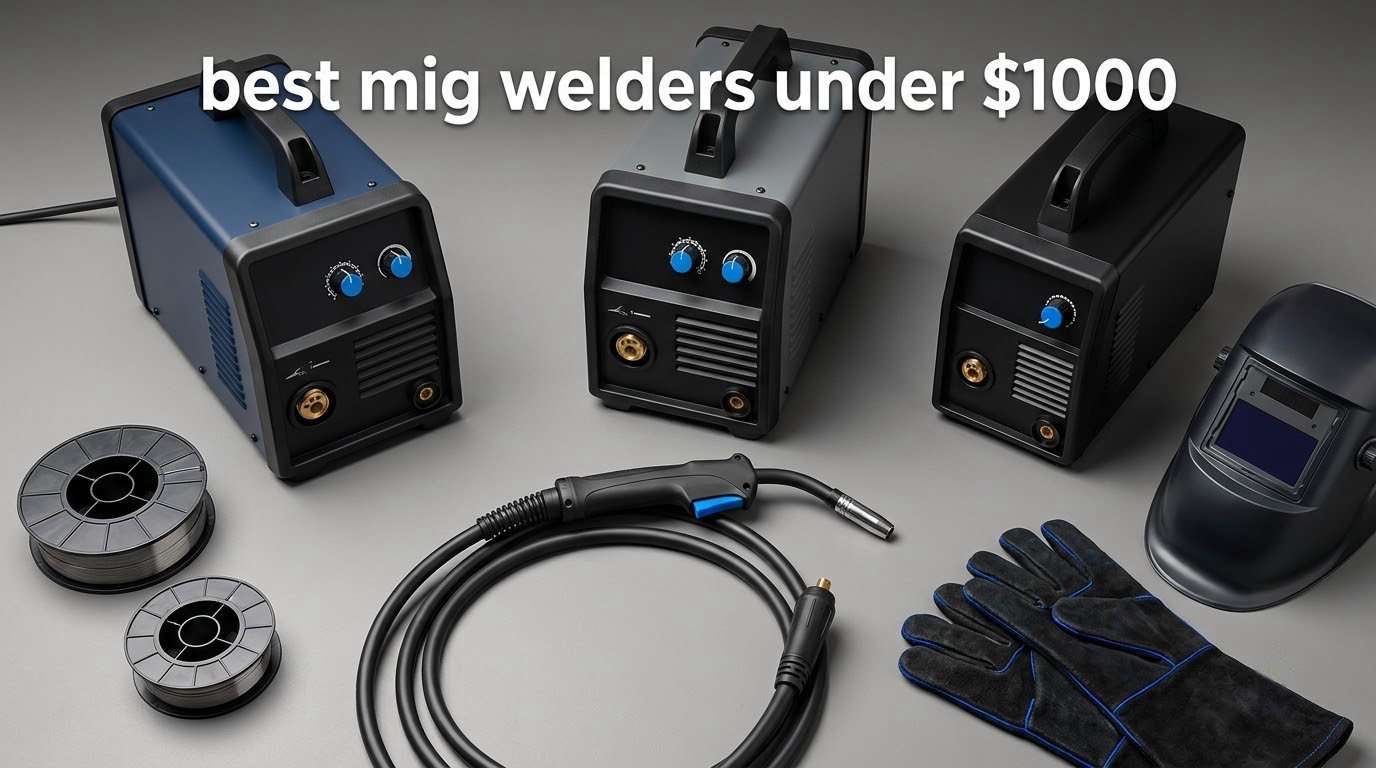
If you want one machine that handles most home garage jobs and keeps the whole purchase under 1000 dollars, the Forney Easy Weld 140 Amp is the pick. It is a single-process flux-core machine, which is a real limitation, but it carries a 4.6 star average across 3387 reviews, welds up to 1/4 in of mild steel on a standard household outlet, and needs no gas cylinder to get started. That combination of proven reliability and zero gas logistics is why it tops our list of the best MIG welders under 1000 dollars for 2026.
We spent weeks reading owner reviews, comparing output ratings against material thickness, and checking what each machine actually ships with rather than what the listing headline implies. Ten machines made the cut. Everything below sits inside our 1000 dollar ceiling, and every specification comes from the manufacturer listing we verified for this guide.
One thing worth saying up front: most of the machines in this price range are not gas MIG welders in the strict sense. Many are flux-core gasless units, and that single fact decides what materials you can touch. Flux core handles mild steel outdoors without a gas bottle. It does not handle stainless or aluminum well, and it throws more spatter onto the part.
We also noticed something the shopping listings rarely tell you. Duty cycle, not headline amperage, decides whether a machine survives an afternoon of work. A 140A name on the front panel says nothing about how long the machine holds that output before the thermal cutout trips. We explain how to read the number in the buying guide below.
One more framing note before the list. If you are building out a workshop on a budget, our guides to the best laptops under 1000 dollars for students and the best laser engravers under 1000 dollars cover the rest of the bench, and our picks for the best drones under 1000 dollars cover inspection footage. The welder is the one tool where a cheap mistake shows up in every weld you make afterward.
Table of Contents
Top 3 Picks for the Best MIG Welders Under $1000 (October 2026)
These three cover the most common situations a first welder runs into, and each one solves a different problem the other two leave open.
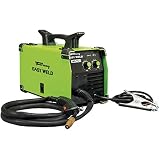
Forney Easy Weld 140 Amp
- Welds up to 1/4 in mild steel
- 0.030 in flux core wire
- 19 lb all-metal body
- 2 lb or 10 lb spools
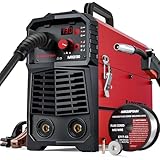
ARCCAPTAIN 130A Flux Core
- 3-in-1 flux core
- stick
- lift TIG
- Synergic auto wire match
- 2-year warranty
- 11.79 lb body
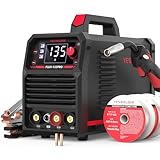
YESWELDER 135A 3-in-1
- 135A on 110V
- Synergic voltage matching
- LED current readout
- Includes flux core wire and torch
The Forney takes the top spot on evidence, not on novelty. Where cheaper machines have thin documentation or a one-year warranty, Forney backs the machine with a 12 month warranty and a brand with decades of shop-floor presence. Reviewers also point to the ground clamp and the drive system holding up over years, which matters more than any feature list.
Best MIG Welders Under 1000 at a Glance
Here is the full lineup with the deciding feature for each machine. Every product below stays inside the 1000 dollar ceiling, and the specifications listed were re-verified against the manufacturer listings in September 2026.
| Product | Specifications | Action |
|---|---|---|
| Forney Easy Weld 140 Amp |
|
Check Latest Price |
| ARCCAPTAIN 130A Flux Core |
|
Check Latest Price |
| YESWELDER 135A 3-in-1 |
|
Check Latest Price |
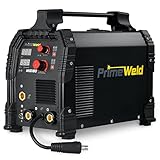 PrimeWeld MIG180 PrimeWeld MIG180 |
|
Check Latest Price |
 Bestarc 145A Dual Voltage Bestarc 145A Dual Voltage |
|
Check Latest Price |
 Lincoln Electric 90i FC Weld-PAK Lincoln Electric 90i FC Weld-PAK |
|
Check Latest Price |
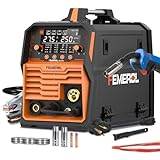 FEMEROL 250A 6-in-1 FEMEROL 250A 6-in-1 |
|
Check Latest Price |
 HITBOX 200A 3-in-1 HITBOX 200A 3-in-1 |
|
Check Latest Price |
 BESTMIG 135A Helmet Bundle BESTMIG 135A Helmet Bundle |
|
Check Latest Price |
 AZZUNO MIG 130F AZZUNO MIG 130F |
|
Check Latest Price |
Two patterns stand out in that table. Only three machines handle gas MIG, and only one includes a spool gun for aluminum. If aluminum is on your project list, the field narrows fast and your real choice is between a spool-gun machine and a shop that rents gun time.
1. Forney Easy Weld 140 Amp – Best Overall Flux-Core Workhorse
FORNEY Easy Weld 140 Amp 120-Volt Flux-Cored Wire Feed Welder (No Gas Needed)
- Proven reliability with 3387 reviews at 4.6 stars
- Handles both 2 lb and 10 lb wire rolls
- No gas cylinder or regulator needed
- 19 lb all-metal case is easy to carry
- Includes 8 ft gun and 8 ft ground clamp plus 20A-15A adapter
- Flux core only
- no MIG with gas or stick mode
- Spatter needs grinding before cosmetic work
- Practice needed on thin material to avoid burn-through
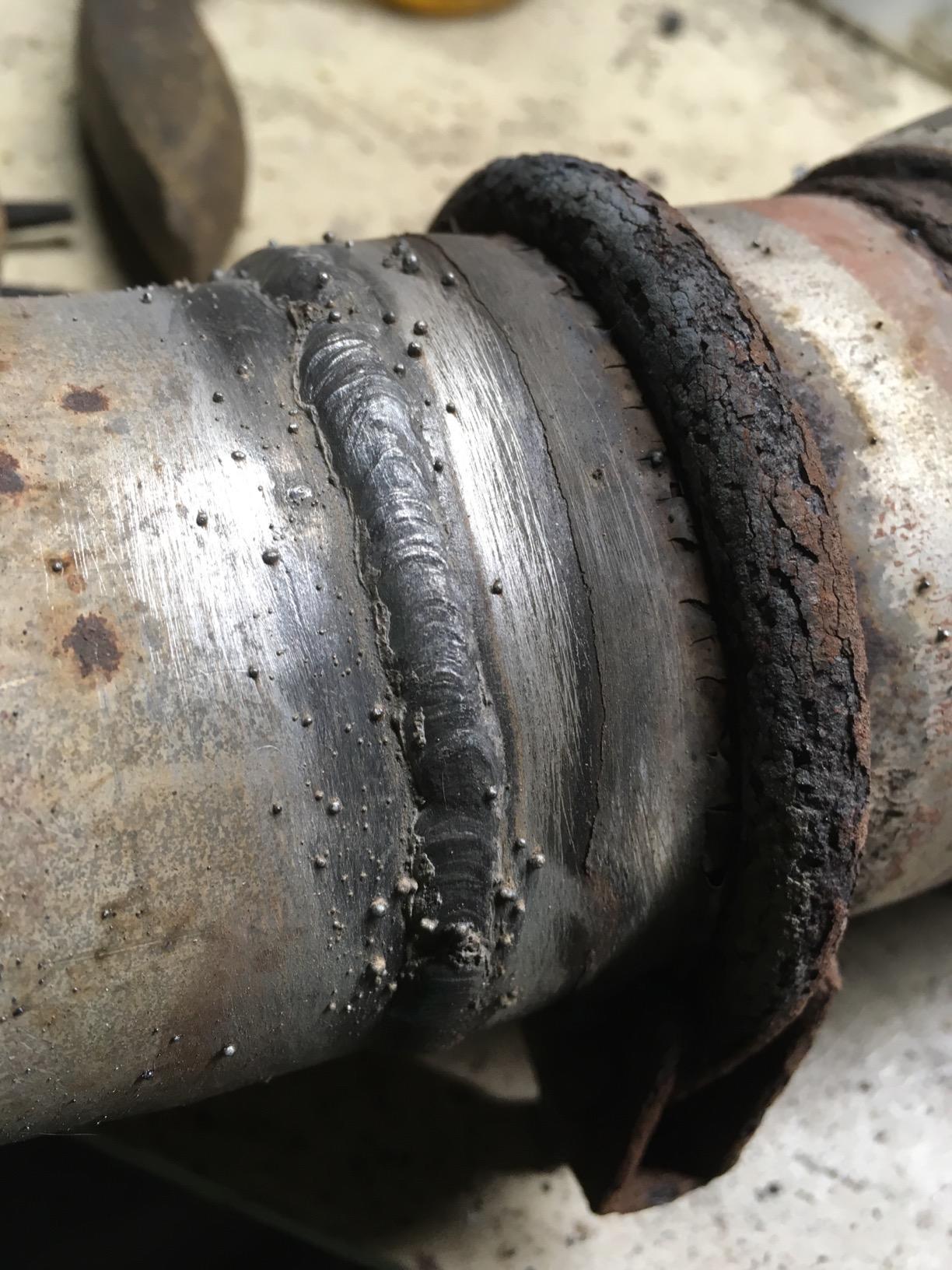
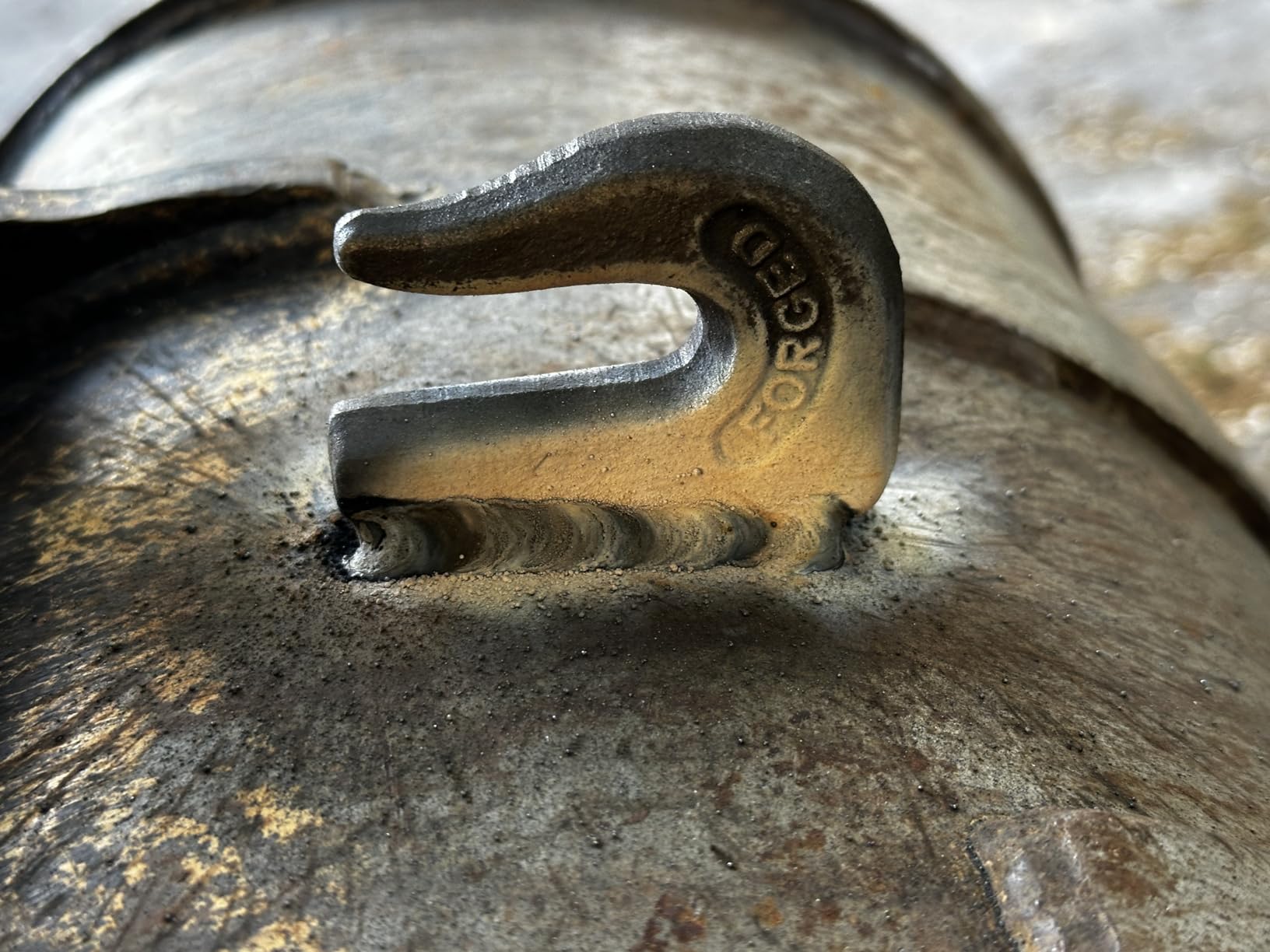
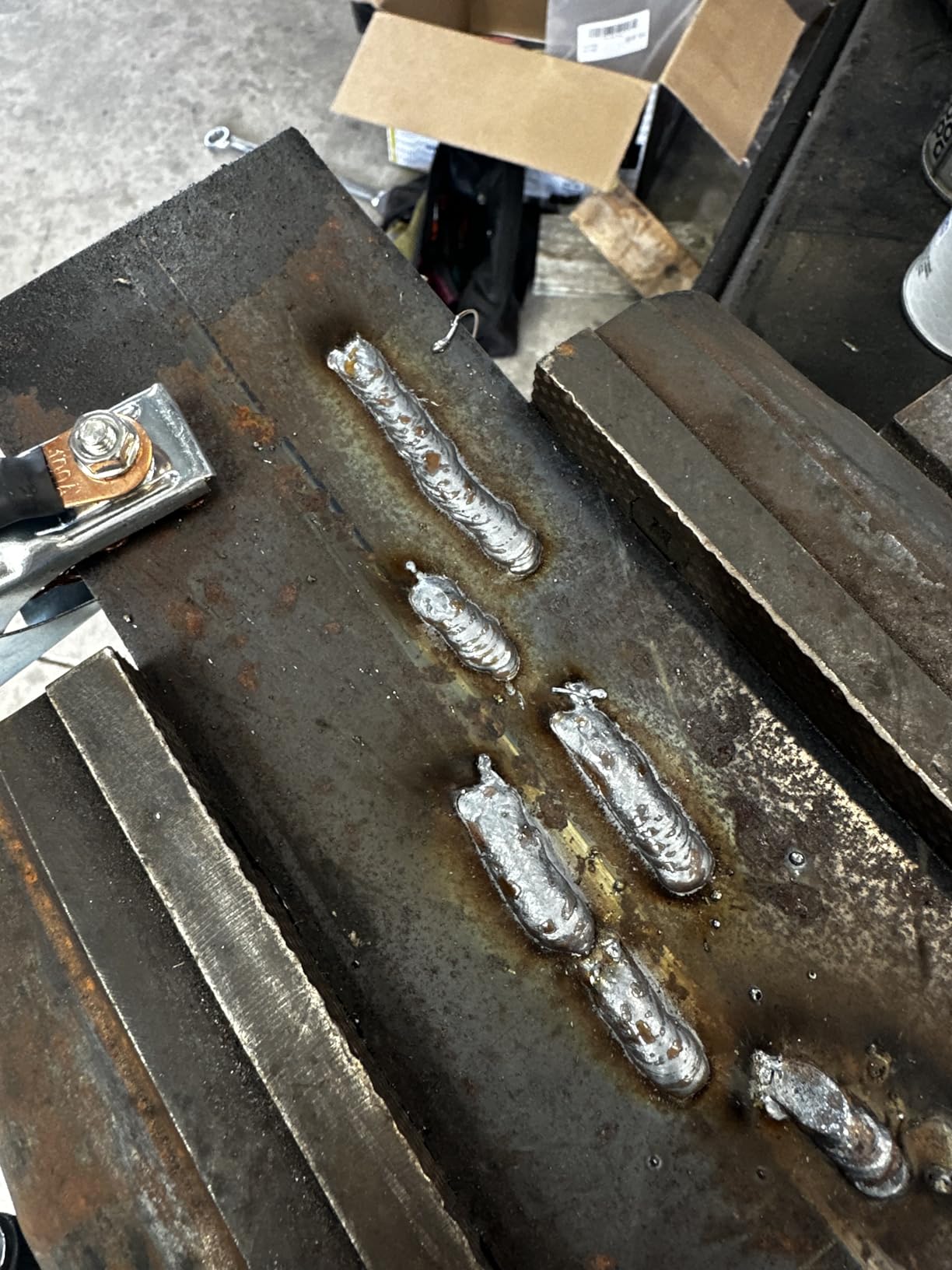
This is the machine we kept coming back to. Forney has built wire-feed welders for shops for a very long time, and that shows in the boring places: the drive rolls, the gun lead, the ground clamp and the all-metal case. Owners report running exhaust repairs, hitch work, trailer frames and general garage fabrication without drama.
The headline figure is 140 amps of output welding up to 1/4 in of mild steel. That is a genuinely useful ceiling for a home shop. Anything heavier than a quarter inch pushes you toward a machine in a different price bracket, and for most weekend projects you will never notice the difference.
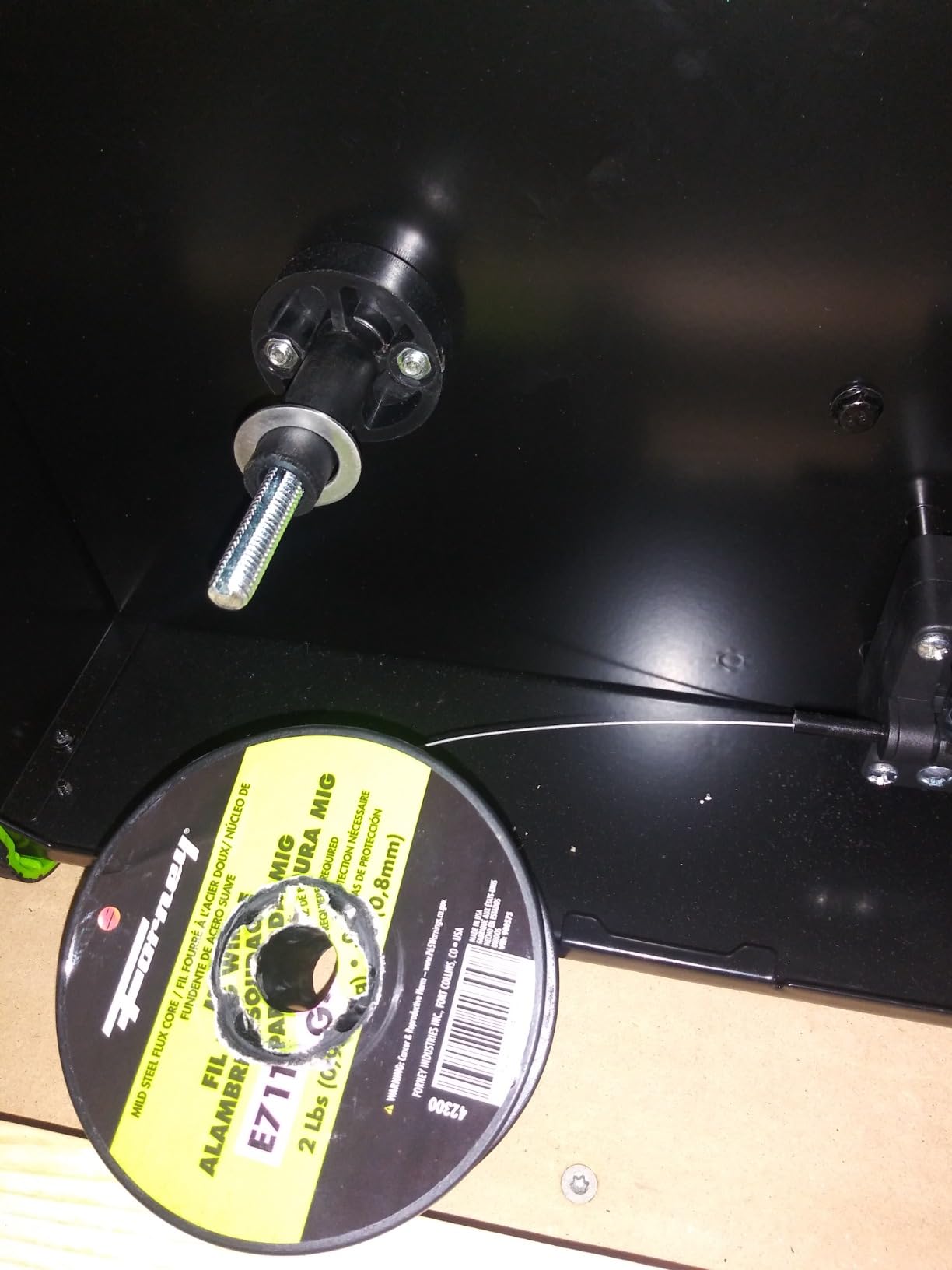
Two details separate it from cheaper flux-core boxes. The wire compartment accepts both 2 lb and 10 lb rolls, so you stop making small trips to the welding supply shop every few hours. The included kit covers the essentials, an 8 ft MIG gun, an 8 ft ground clamp and a 20A to 15A adapter, so you can start on a household circuit without a separate purchase.
Reviewers consistently describe the control panel as simple in a good way. You get two knobs, infinite voltage adjustment and a wire feed speed control, with no menu structure to fight. In the absence of a physical duty-cycle figure in the listing, that simplicity matters more than it would on a larger machine, because you are not trying to push the output past the machine’s thermal limit on a long production run.
Is the Forney Easy Weld 140 worth it for a first-time welder?
Yes, for structural and general mild steel work it is the easiest machine on this list to learn on. Flux core wire is self-shielding, so there is no gas cylinder, no regulator and no flowmeter to set up. You load the spool, set the polarity for flux core, dial in wire feed speed and voltage, and pull the trigger.
The learning curve is not in the machine, it is in the wire feed. Owners note that pushing the wire too fast on thin material causes burn-through, and going too slow causes a tall, shaky bead. That adjustment takes an afternoon of practice on scrap steel before it becomes automatic.
When should you skip this Forney welder?
Skip it if you plan to weld stainless or aluminum. Without shielding gas, corrosion-resistant metals are out of reach, and aluminum needs a spool gun that this class of machine cannot drive. Shop owners who need stainless capability will regret the single-process limitation within a month.
Skip it if you want visible, finished seams. Flux core is inherently spatter-prone and the bead needs grinding and finishing. For a trailer frame or a bracket, that is fine. For a coffee table, it is a problem no machine in this price range can solve, because it requires gas MIG and a dedicated finish allowance.
Forney also covers this one with a 12 month warranty, which is standard in this group. It is worth noting that the longest warranty in our lineup belongs to ARCCAPTAIN at two years, so warranty length alone does not settle the argument for Forney. The reason it wins here is review volume. At 3387 reviews, you have far more evidence about long-term reliability than any other product on this list.
2. ARCCAPTAIN 130A Flux Core – Best Value With a Two-Year Warranty
ARCCAPTAIN 130A Flux Core Welder MIG Welder 110V Gasless MIG Stick Lift TIG
- Three processes in one 110V machine
- Synergic control simplifies first-time setup
- Compact body with handle and shoulder strap
- 2-year manufacturer warranty
- Includes tips and wire plus brush and hammer
- 130A output limits thickness on heavier steel
- DC-only output rules out aluminum TIG
- Lift TIG torch sold separately
- Occasional wire feed jams at low settings on thin material
The ARCCAPTAIN is the pick if you want more than one process and a warranty that outlasts the machine’s likely service life. Gasless flux core MIG, lift TIG and stick share one 110V power source, and the manufacturer backs it for two years, the longest warranty we found in this roundup.
Synergic control is the feature owners mention most. The machine matches current and wire feed speed to the wire diameter automatically, so a beginner selects a setting rather than balancing two knobs by feel. A 10-speed variable wire feed control sits behind that for when you want to override it.
At 11.79 lb with a handle and a shoulder strap, this is a machine you carry to the yard or the driveway without a cart. That weight is one of the reasons it earns the second slot. Forney has more review history, but ARCCAPTAIN does more process work per pound.
What does a first-time welder gain from the ARCCAPTAIN 130A?
The three-process layout gives you a fallback when flux core is the wrong tool. Structural and thick mild steel goes to flux core. Thin sheet and some stainless jobs go to lift TIG, where you control heat by hand. Field repairs on farm or trailer equipment often go to stick, because a stick torch is more tolerant of dirty, rusted steel.
Stick mode is the underrated part. A lot of cheap hobby machines advertise three processes but cripple stick, and owners of those units complain about unstable arc. The ARCCAPTAIN handles 6010 and 6011 electrodes without the kind of hot-start frustration that makes beginners give up on stick entirely.
Where does the ARCCAPTAIN 130A fall short?
The 130A ceiling is the main constraint. It is enough for brackets, racks, gate hardware and trailer repairs but not enough for structural tube at heavier wall thickness. If your project list includes 1/4 in steel on a regular basis, look at the Lincoln Electric 90i FC or the FEMEROL 250A instead.
DC-only output means no aluminum TIG work, and the lift TIG torch is not included. Wire feed jams show up occasionally at the lowest settings on very thin material, and the fix is cleaning the feeder head and adjusting technique rather than replacing the machine.
Long-term owners on r/metalworking describe the ARCCAPTAIN as holding up over years of regular use, and one commenter mentioned four years of service before writing the recommendation. That kind of durability report matters more than the spec sheet, and it is why this machine sits at number two rather than further down.
3. YESWELDER 135A 3-in-1 – Best MIG Welder for Beginners Starting Out
YESWELDER 135A MIG Welder, 110V Flux Core Gasless MIG/Lift TIG/Stick 3-in-1
- Synergic auto-setting lowers the barrier for first-time users
- Three processes from one 110V machine
- LED display shows real-time current outdoors
- Includes .030 and .035 flux core wire plus torch and clamps
- Lift TIG requires a separately purchased torch
- DC-only so no aluminum TIG
- Included accessories are basic
- Synergic-only mode prevents manual voltage setting
The YESWELDER sells on approachability. Buyers report welding exhaust repairs, hitch work, thin auto body panels and garden equipment with it, and welding veterans judge the bead quality favorably against higher-priced Harbor Freight units. That comparison is unusual praise from the people who would notice the difference.
Its synergic control auto-matches voltage to wire feed speed with a ±3V manual trim. In practice you pick a material and thickness, and the machine sets the arc for you. The oversized LED display shows real-time current clearly, which is a genuine advantage when you are working in a dim garage or outside.
The 135A output welds mild steel up to 3/32 in. That is thinner than the Forney, so think exhaust tubing, patch panels, fender metal and hardware rather than frame sections.
Is the YESWELDER 135A too basic for real shop work?
No, for the amount of work most first welders do. At 2985 reviews and a 4.4 average, the machine has enough owner history to judge it, and the pattern is consistent. It runs, it is easy to start, and it does not do anything surprising.
The included wire is a real bonus. You get both .030 in and .035 in E71T-GS self-shielded wire in the box, which removes the first trip to a supply shop. The 3-in-1 layout also means one machine covers flux core, stick and lift TIG without a second purchase.
What should beginners know before buying the YESWELDER?
Two limits are worth planning around. Lift TIG mode needs a torch you buy separately, and the machine is DC-only, so you cannot run AC for aluminum TIG even if you buy the torch.
The synergic-only flux core mode means you cannot set voltage manually in that mode. Some experienced users find that limiting when tuning a bead on unusual material, but for a learner it removes an entire category of confusion. A minority of reviews also report units failing after extended use and one report of a missing power switch on arrival, which is worth knowing about but is not the dominant pattern.
4. PrimeWeld MIG180 – Best Budget MIG Welder With a Spool Gun
PrimeWeld MIG180 Mig Welder, 180 Amp Wire Feed Welding Machine with Dual Voltage 220v, 110v
- Only machine here that includes a spool gun for aluminum
- Highest average rating at 4.8 across 165 reviews
- Shop owners report steady beads on 220V with no thermal trouble
- Accepts standard Tweco consumables
- US-based parts and customer service
- Heaviest machine here at 55 lb
- Higher amperage wants a dedicated 240V circuit
- Optional 200A torch recommended for 5/16 in and thicker
- Needs a dedicated outlet rather than a household circuit
The PrimeWeld MIG180 is the only machine in this roundup that can push aluminum wire out of the box. A spool gun is in the package, which means you can weld aluminum without buying a separate feeder, a teflon liner and a learning curve on push-pull feeding. For anyone whose project list includes aluminum trailer trim, racks or boat hardware, that single feature changes the math.
It also carries the highest average rating we saw, 4.8 across 165 reviews. Those buyers are mostly experienced fabricators and shop owners running the machine daily on 240V, and they report consistent beads with no duty-cycle trouble, which says something about how the power source handles sustained load.
Consumables are another quiet strength. The machine ships with drive rollers for both MIG and flux core and accepts standard Tweco consumables, which are the most widely stocked wire feed parts in the country. When a contact tip wears out, you are not hunting for a proprietary part. Gun changes and wire changes are quick, according to owners who use the machine regularly.
Why does the spool gun make the PrimeWeld MIG180 worth stretching for?
Aluminum wire at 1/16 in cannot be pushed through a standard feeder that has a steel liner and a knurled drive roll. Aluminum is soft and it crumbles, which is what birdnesting looks like. A spool gun uses a four-drive-roll push-pull arrangement designed for the job, so the wire arrives straight and consistent.
Supporters of this tier on WeldingWeb describe the 700 to 1000 dollar range as the sweet spot for lifetime aluminum capability. That is a fair read of what we see here. Below this price, aluminum capability usually means a teflon liner workaround rather than a true spool gun, which works but adds friction.
What does owning the MIG180 cost you in inconvenience?
It weighs 55 lb, by far the heaviest machine in this group. It is a shop machine, not a job-site machine, and you will want a cart to move it around. Plan your outlet before you buy. Higher amperage wants a dedicated 240V circuit, and running it on a household outlet will trip the breaker or force you down to a lower output range.
Owners with heavy fabrication needs recommend stepping up to the optional 200A torch for 5/16 in and thicker material. At 180 amps the machine is solid for 1/4 in mild steel work, but it is not the thick-steel answer. There is also a mixed experience report about the bundled spool gun, with at least one owner in a PrimeWeld user group describing how poorly that spool gun performed, so plan on treating it as a starting point rather than a finished solution.
5. Bestarc 145A – Best 220V Dual Voltage Budget Welder
Bestarc 145A MIG Welder, Flux Core/Gas MIG Stick Lift TIG Welding, 110/220V
- Dual 110/220V operation with automatic input detection
- Four processes including gas MIG
- Synergic control with manual voltage trim
- Top-load spool and shoulder strap for easy moving
- Experienced reviewers praise bead quality
- Torch lead is short on early production
- No gas regulator included
- Spool tension not adjustable on some units
- Manual does not explain manual feed ratio adjustment
The Bestarc 145A solves a problem most machines in this price bracket ignore. It runs on 110V or 220V with automatic input detection shown on the panel, and that makes it the machine to buy if you move between a garage circuit, an RV, a farm building or a shop outlet. Gas MIG capability at this level is genuinely rare.
It is a 4-in-1: gas MIG with solid wire, gasless flux core, lift TIG and stick. Wire handling covers .030 in, .035 in and .040 in flux core plus .030 in solid wire, which is wide enough to keep a spool of one type running through most household work.
Reviewers with production MIG backgrounds compare bead quality favorably to more expensive flux-only machines, and they single out the ground clamp durability. Later-production units appear to ship with knurled drive rolls and longer torch leads that address the complaints owners had with early examples.
Is gas MIG worth buying a separate regulator for?
For anyone who wants stainless or better finish quality, yes. Gas MIG with solid wire and a 75/25 argon-CO2 mix gives a cleaner bead than self-shielded flux core, less spatter and no grinding pass. You need a cylinder, a regulator and a flowmeter, which adds setup cost and a place to store the bottle safely.
The thing to check is that no regulator is included. Several owners discovered that only after the machine arrived, so budget for it. The dual-voltage capability is the part that pays off faster, since it removes the question of whether a 220V circuit exists where you want to weld.
What are the Bestarc 145A complaints to know about?
The most common complaint is the short MIG torch lead on early units, roughly 5.5 ft, which is not enough reach for a car floor pan or a workbench. Later production runs improved this. Check what you receive rather than assuming the early version.
Documentation is thin. Owners report that the manual does not explain how to press the rotary knob for manual feed and voltage ratio adjustment, which matters if you outgrow synergic mode. Spool tension is also not adjustable on some units, and included wire quality is uneven.
6. Lincoln Electric 90i FC Weld-PAK – Best for Buyers Who Want a Name Brand
Lincoln Electric 90i FC Flux Core Wire Feed Weld-PAK Welder, 120V Welding Machine, Portable w/Shoulder Strap, Protective Metal Case, Best for Small Jobs, K5255-1
- Widely available standard consumables and service network
- Lightest 1/4 in capable machine in this group at 15 lb
- Clean two-knob control beginners dial in fast
- Inverter design gives smoother welds than transformer machines
- Highest average rating at 4.7 across 572 reviews
- Flux core only with no gas MIG
- stick or TIG mode
- Ground clamp braid is short and detaches easily
- Spatter needs finishing work
- Consumables and wire not included
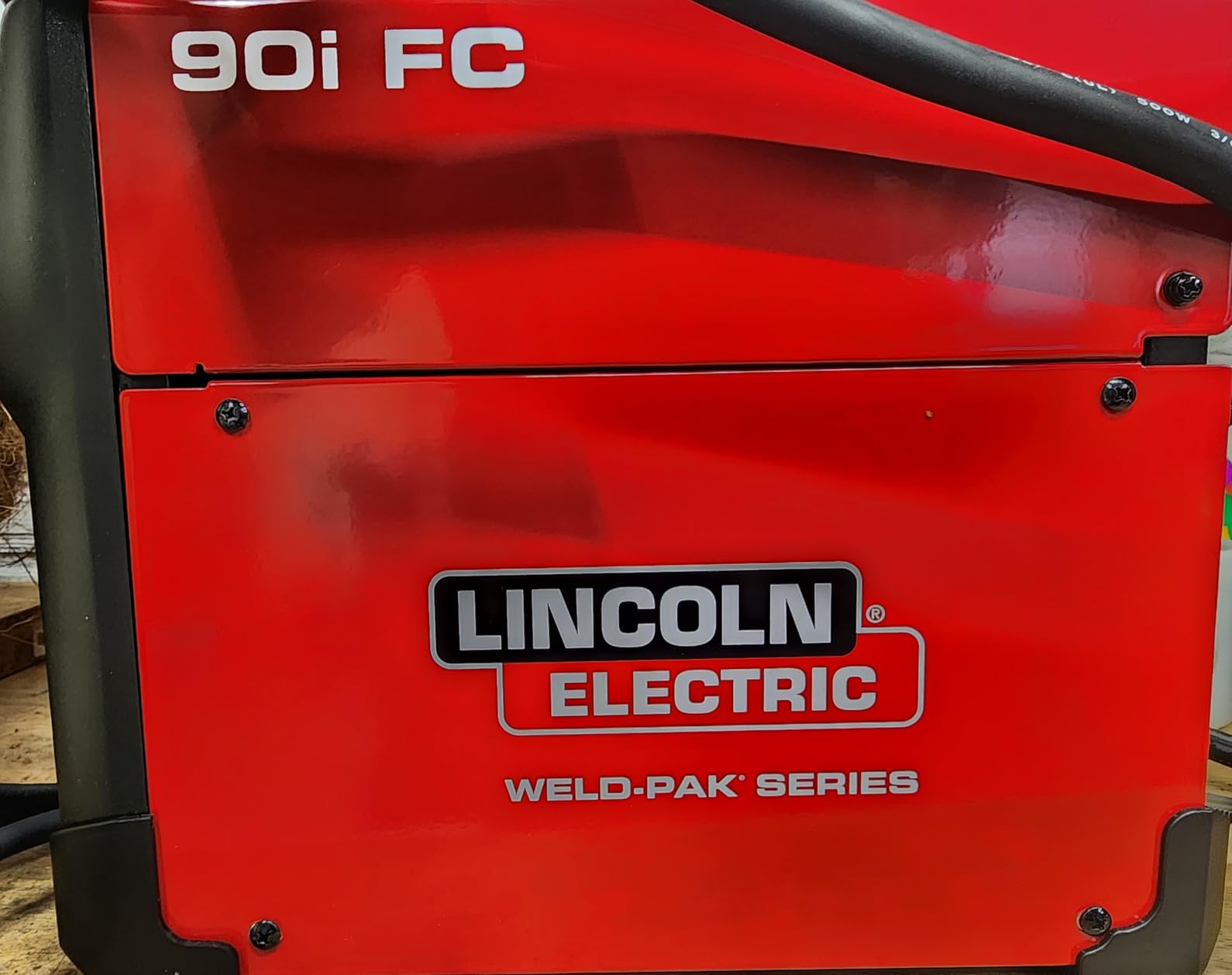
Forum consensus often splits between name brands and value machines, and the honest answer is that it depends on what you value. Owners who already use Lincoln professional equipment treat the 90i FC as a capable companion unit for thin-gauge sheet metal, stainless and small maintenance jobs. They note that it performs on par with larger machines for that class of work.
It welds up to 1/4 in material on 120V input, from an inverter power source rather than a transformer, which gives smoother weld characteristics. At 15 lb with a shoulder strap and a protective metal case, it is the most genuinely portable machine here that still handles quarter-inch steel.
The control layout is two knobs, wire speed and voltage, with infinite voltage adjustment. Novices describe it as the easiest machine they have used, and that simplicity is not a compromise here. There is no feature set to explore because there is no feature set.
Is the Lincoln Electric name worth the premium over a budget brand?
The premium buys three specific things. Consumables are stocked everywhere, so tips, nozzles and contact tips are a five-minute errand instead of a special order. Service and repair are handled by a known network. And resale holds up better when you eventually outgrow the machine.
That matters most if you are undecided about TIG. People on r/Welding who intend to weld MIG, TIG and stick often recommend Lincoln Electric or Miller specifically, because buying one process now and rebuilding the setup in two years is expensive. If your future plans include TIG work on aluminum, the sticker shock is smaller than it looks.
Where does the 90i FC fall short?
It is flux core only. There is no gas MIG, no stick and no TIG mode, so stainless welding depends on using flux core stainless wire, which works but is not the same as clean gas-shielded work. Cosmetic seams still need grinding.
The most repeated physical complaint is the ground clamp. Its bonding braid is short and poorly secured, so it detaches after a few welds. Plan to replace it early. Wire is not included either, so add a spool of .030 in self-shielded flux core to your first order.
7. FEMEROL 250A 6-in-1 – Best Multi-Process Machine in the Group
- Most process variety including spot weld and spool gun aluminum
- Owners verified near 250A output with an amp clamp
- Stable arc from .024 in to 1/2 in steel
- Aluminum work is good with the included teflon liner
- Two-year guarantee with responsive support
- Heaviest multi-process machine at 32.6 lb
- Supplied 120V plug and cord are undersized for 250A
- Cooling fan runs loudly and continuously
- No pulse MIG and no AC TIG
- Spool gun and TIG gun not included
The FEMEROL 250A is the most capable machine in this roundup and the one most likely to outgrow your garage. It is a 6-in-1: gas and solid wire MIG, gasless flux core MIG, stick, spot welding, lift TIG and spool gun compatible aluminum, with 250A output welding mild steel up to 14.0mm, which is a little over half an inch.
It is also the only machine here with a published duty cycle figure, 60 percent at full output. Owners verified the output with an amp clamp and read roughly 230 to 245A, and they report a stable arc from .024 in all the way to 1/2 in steel. One owner bought a second unit. That is the pattern you want to see from a machine at this capability level.
Aluminum works through a teflon feed tube or an optional spool gun. With the included teflon liner, owners report good results without birdnesting. The torch, ground clamp and stick cables are all around 9.5 ft, which is long enough to reach into a car floor pan.
Does the FEMEROL 250A really deliver 250 amps?
Owners who have measured it say yes, close to the nameplate, and that is the distinguishing factor versus machines in this group whose displayed amperage runs 20 to 30 percent below actual output. The 60 percent duty cycle figure also means it holds that output for six minutes in every ten at full power, which is what separates a shop machine from a hobby box.
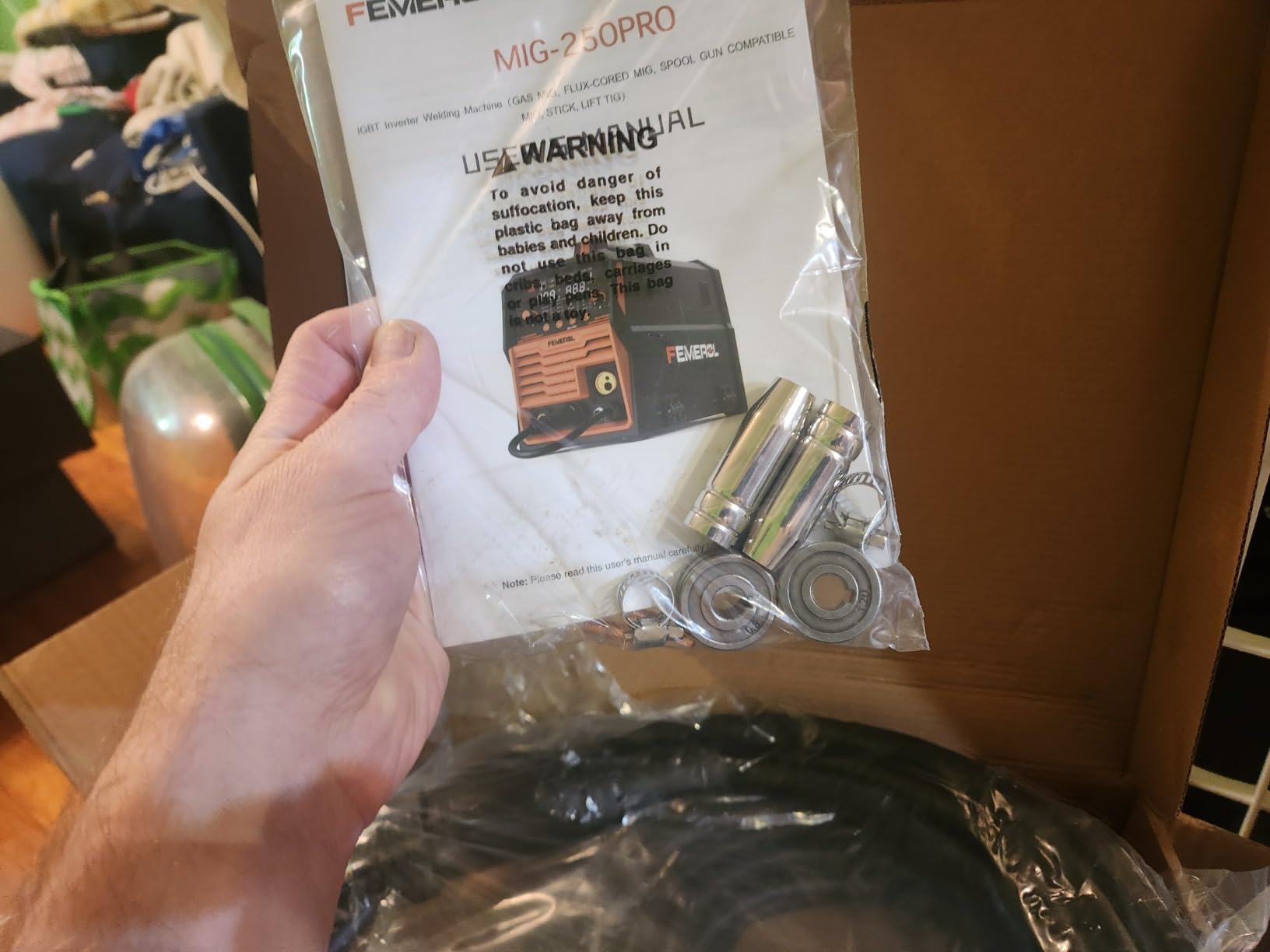
The catch is electrical. At 250A you need a proper 50A plug and heavier cord, and the supplied 120V plug and cord are undersized for that load. Owners recommend replacing both before heavy work. The cooling fan also runs continuously and loudly, which is normal for a machine in this class but worth knowing before you run it in a small workshop.
Is the 250A overkill for a home shop?
Probably, for most people. At 32.6 lb this is not a portable lunch-box machine, and it has no pulse MIG and no AC TIG, so it cannot do aluminum TIG either. The realistic case for it is a small shop doing mixed fabrication daily, where the 60 percent duty cycle and verified output are worth the weight.
The 4.3 rating reflects that. Owners rate the capability highly and criticize the included accessories rather than the machine, which is the usual pattern when a strong welder is bundled with undersized cords and missing torches. If you buy it, budget for a spool gun, a TIG gun and a proper plug before the first serious job.
8. HITBOX 200A 3-in-1 – Lightest Dual Voltage Pick for Small Jobs
HITBOX 200A MIG Welder, 110V/220V Flux Core MIG/Lift TIG/Stick 3-in-1
- Light 6.6 lb body with a built-in carrying handle
- Dual voltage capability at a low price
- Synergic control speeds up setup
- Reviewers report clean welds with little spatter and quiet operation
- Includes 8 ft torch and both .035 in wire and contact tips
- Fits a 2 lb spool only
- Some owners measured output 20 to 30 percent below displayed amperage
- Weak on stick with 6010 and 7018 electrodes and no hot start
- Ground clamp can warp quickly
- Instructions are hard to follow
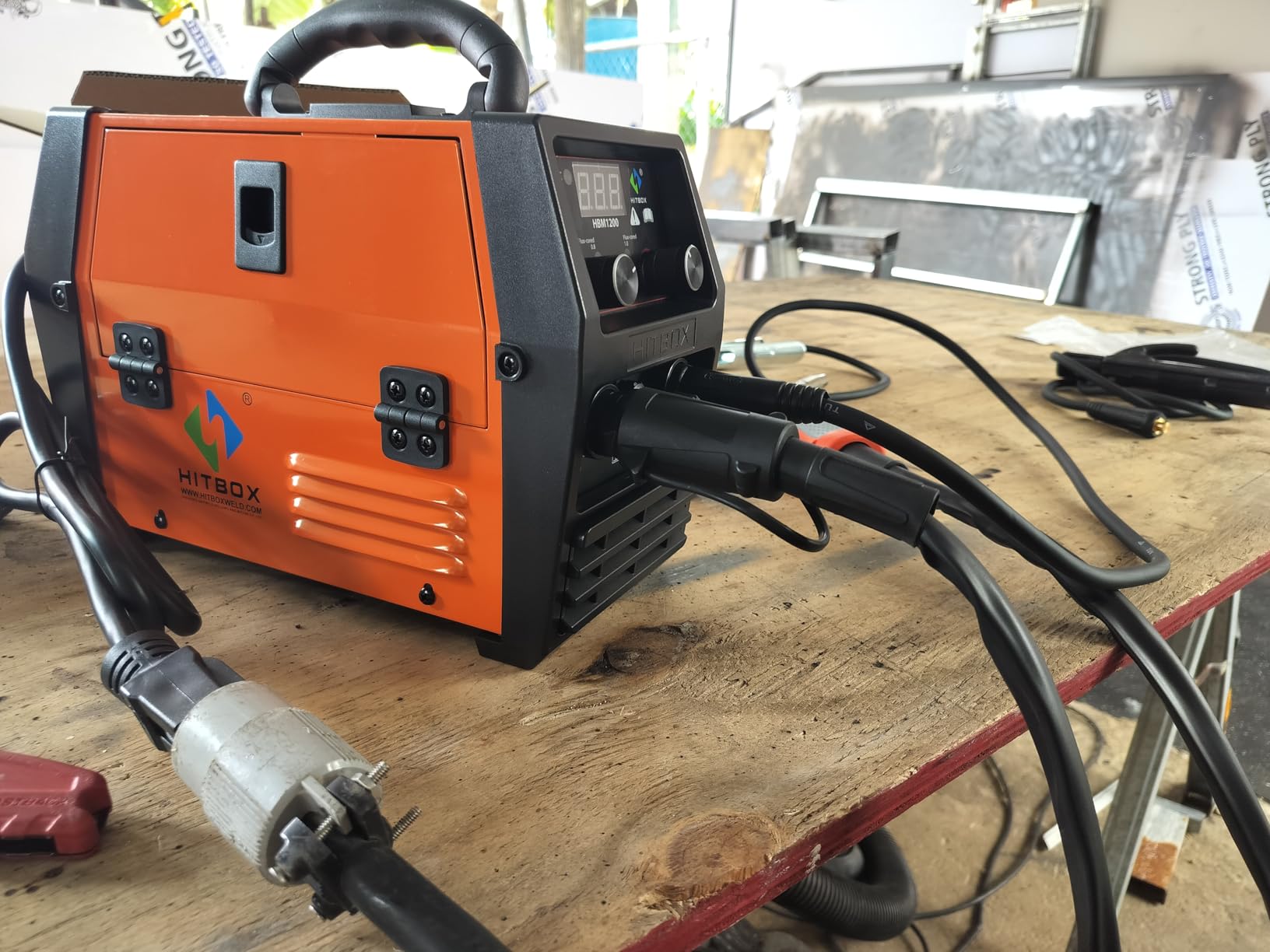
At 6.6 lb, the HITBOX is the lightest machine in the roundup and it does something unusual for its size. It offers dual 110V/220V operation with an IGBT inverter capable of up to 200A output. Genuine dual voltage at this level of capability is not common, and it makes the machine work in a garage, an RV or a shop without replanning your outlet.
Owners upgrading from larger budget machines describe the HITBOX as easier to set up, lighter and producing cleaner, quieter welds. Synergic control handles the wire and voltage matching, so a beginner gets a usable arc quickly.
Output reaches 4.0mm of mild steel, which is roughly 1/8 in. That covers exhaust tubing, brackets, gate hardware, repair patches and general fabrication work, but it is not a quarter-inch machine.
Is the HITBOX 200A accurate enough to trust its display?
This is the main caution. Some owners measured actual output running 20 to 30 percent below the displayed amperage, so treat the number on the panel as a relative setting rather than a measurement. In practice that means setting higher than you expect and verifying the result on scrap metal before committing to a part.
Stick mode is the second limitation. Owners report weak performance with 6010, 6011 and 7018 electrodes and no hot start, so stick is workable for light cleanup rather than production joints. MIG flux core mode is where this machine performs best.
What else should you know about the HITBOX?
It holds a 2 lb wire spool only, which means more frequent refills than the Forney or Lincoln. For a weekend hobbyist that is fine. For anyone running continuous wire through a project, it is an annoyance that shows up at the worst moment.
The included kit is reasonable: an 8 ft MIG torch, ground clamp, electrode holder, .035 in wire and two contact tips. Owners do warn that the ground clamp can warp quickly under repeated use and that the instructions are hard to follow, so budget a replacement clamp and expect to work out the wire feed settings on your own.
9. BESTMIG 135A – Best Starter Kit With Helmet and Gloves Included
- Only machine here that includes a welding helmet and gloves
- Very light at 10.71 lb with a compact footprint
- Full-color LED display with automatic parameter adjustment
- Complete accessory kit with torch
- electrode holder
- clamp
- wire and brush
- Three processes from a single 110V machine
- TIG torch not included so lift TIG needs a purchase
- Some units arrived without advertised accessories or with a mismatched connector
- 135A output limits work to about 1/8 in
- Supplied plug is not UK compatible
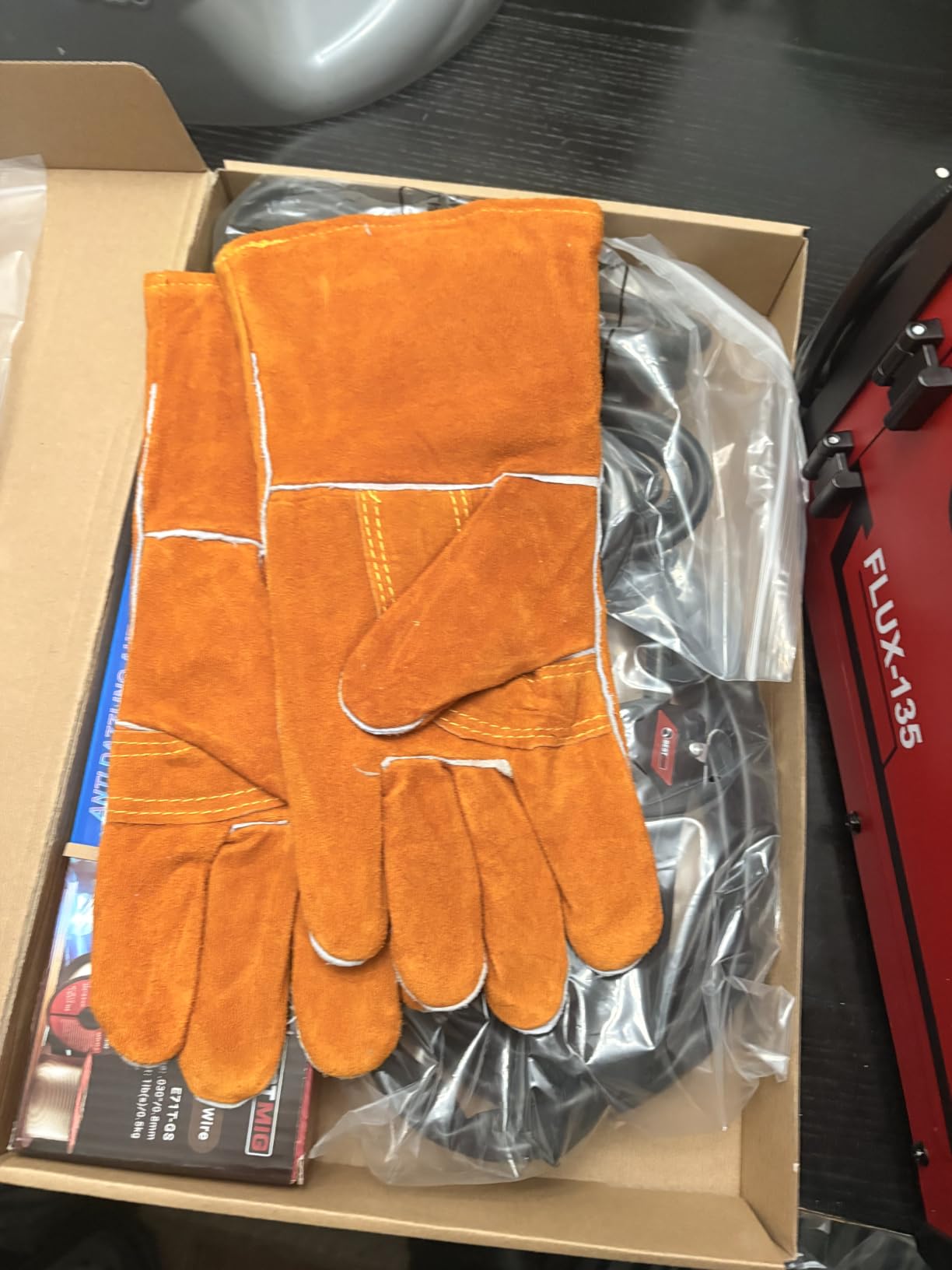
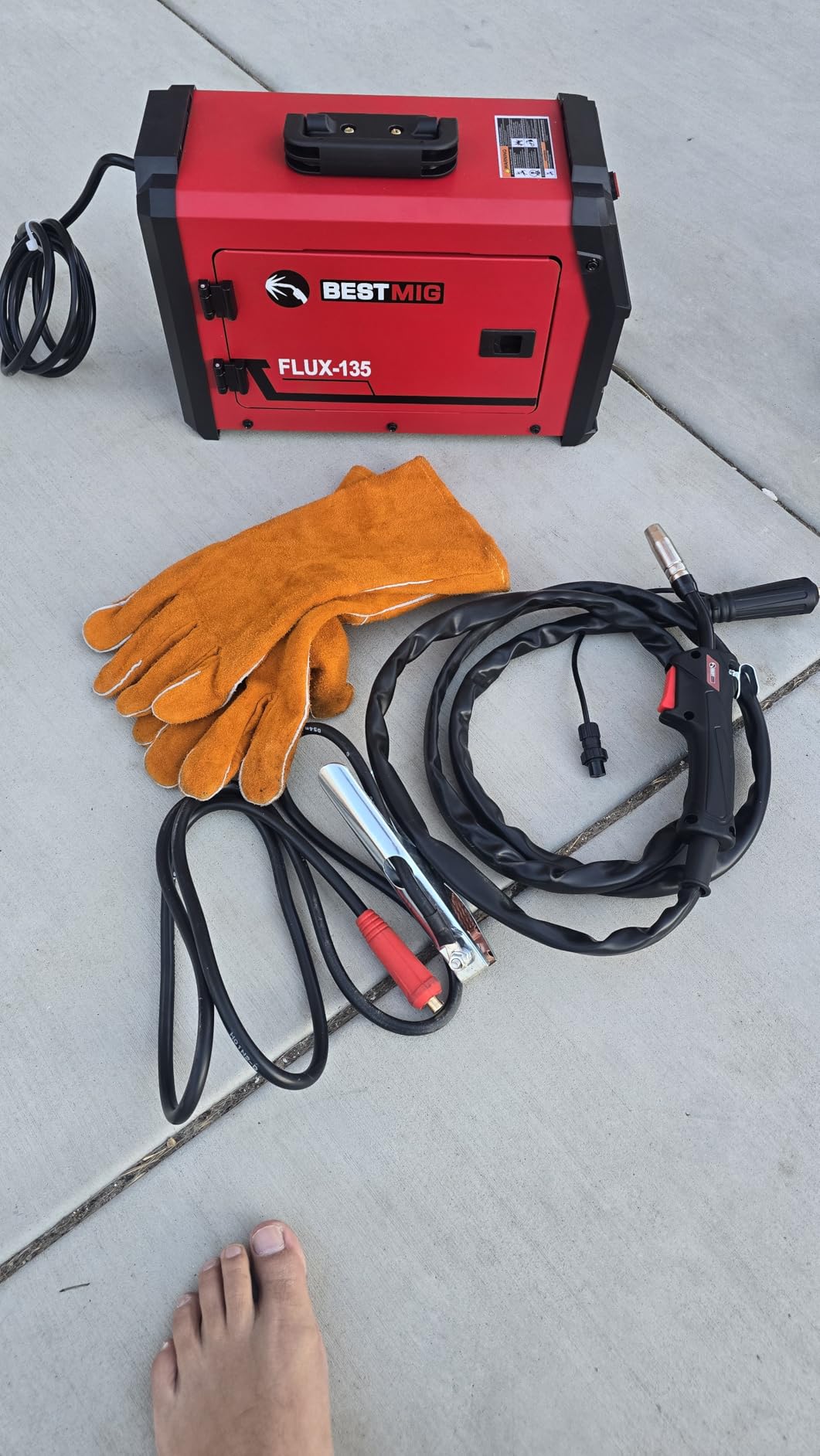
The BESTMIG 135A is the only machine in this roundup that comes with a welding helmet and gloves in the box. That is not a small thing for a first welder, because an auto-darkening helmet is the single most important safety purchase and the one most beginners skip.
It is a 3-in-1 on 110V, covering gasless flux core MIG, lift TIG and stick, with true 135A output for material up to 1/8 in thick. The full-color LED display shows parameters in real time and adjusts voltage and feed speed automatically based on current settings.
Owners largely frame this as a beginner package. Because the helmet and gloves are included, a new user can start welding the same day rather than making a second order first. Satisfaction is high on value and setup ease.
Is a bundled helmet as good as buying one separately?
Good enough to start, and that is the point. A bundled auto-darkening helmet gets you welding with face protection in place on day one. Later, upgrade to a helmet with a proper shade range and a lighter shell if you are doing hours of work.
At 10.71 lb with a 14.8 by 9.8 by 6.6 in footprint, this is also one of the most portable machines here. If your work happens on a job site, in a crawl space or at the far end of a property, the weight matters more than the process count.
What should you verify after the BESTMIG arrives?
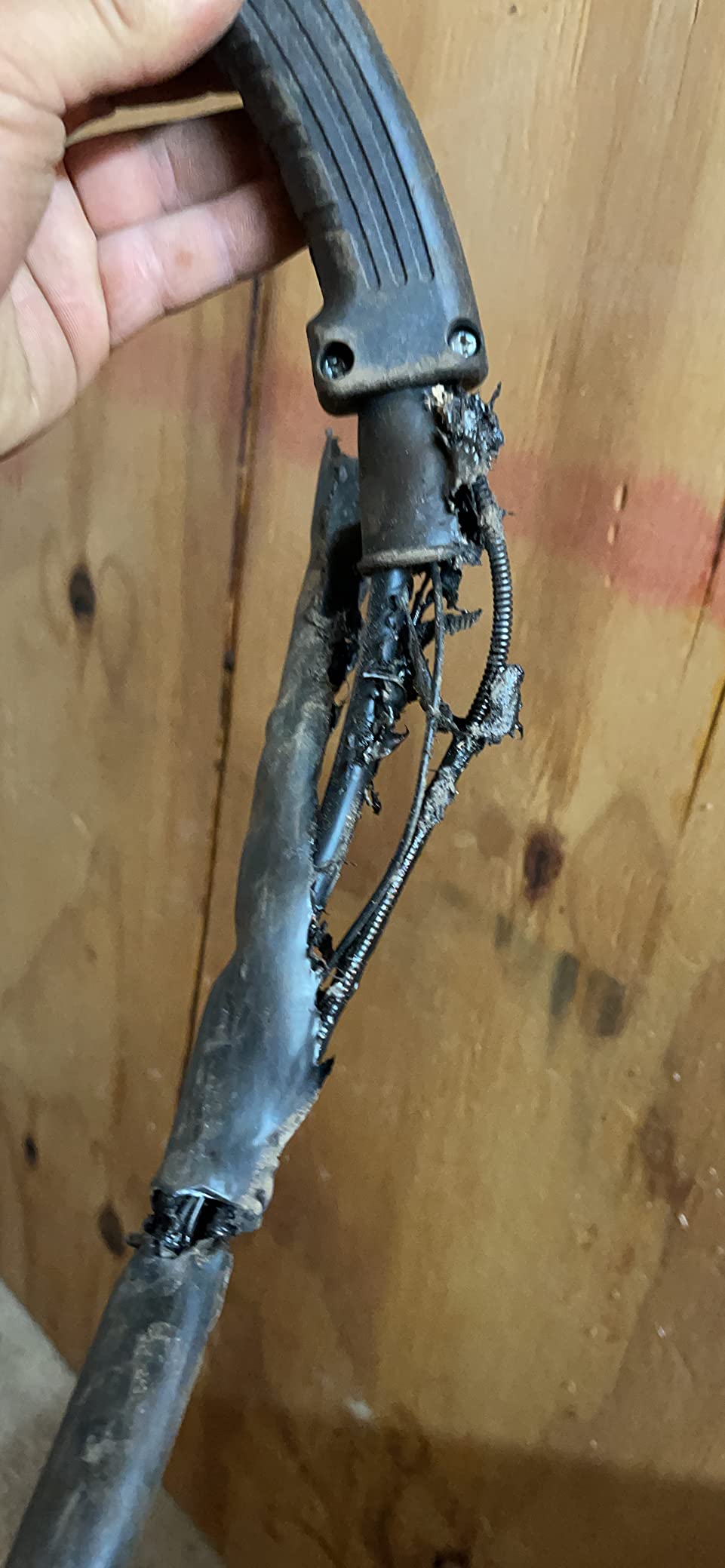
Check the contents. Some owners received machines missing advertised accessories or with a mismatched flux core cable connector, and a few reported delivery delays with unresolved customer service reimbursement. Confirm the torch, electrode holder, ground clamp, wire, brush, helmet and gloves are all present before you start.
Also note the supplied plug is not UK compatible, which matters only if you are outside the US. On capability, 135A and 1/8 in material is the ceiling, so treat this as a sheet metal and repair machine rather than a fabrication machine. The TIG torch is not included, so budget for that if you plan to use lift TIG.
10. AZZUNO MIG 130F – Best for Occasional Thin-Gauge Work
AZZUNO MIG Welder,Flux Core Welder Machine 110V 130Amp, Gasless MIG Welding Machine IGBT Inverter Welder Portable Wire Feed Welder (110V)
- Lowest entry cost in the group with a 4.5 average
- Simple voltage and wire speed knobs with synergic auto adjust
- Very light and compact for occasional use
- Includes torch
- ground clamp
- .030 in wire and two contact tips
- Overload and overheat protection
- Limited to thin-gauge work at 3.0mm maximum plate
- Handles 2.2 lb wire rolls only
- Single-process gasless flux core only
- Shortest warranty in the lineup at one year
The AZZUNO MIG 130F exists for a specific situation: you weld a few times a year and you want something that starts instantly without a gas bottle or a learning curve. It is a 130A IGBT inverter running gasless flux core with synergic control and manual voltage and wire speed trim.
Owners treat it as a starter or occasional-use machine and praise the straightforward controls and light weight. The listed portable weight is 8.6 lb, which makes it easy to carry to the work rather than storing it.
The ceiling is 3.0mm of mild steel plate. That is thinner than every other machine in this roundup, so think patch jobs, thin hardware, non-structural brackets and hobby craft rather than anything load-bearing.
Is the AZZUNO MIG 130F worth buying for occasional work?
If you weld twice a year, this is a reasonable answer. If you weld weekly, the money is better spent on the Forney or the Lincoln Electric, and the difference in warranty length and consumable support is worth more than the entry saving.
The 1-year manufacturer warranty is the shortest in this lineup, and it is the clearest signal of where this machine sits. Forney and Lincoln carry longer terms, and ARCCAPTAIN carries two years.
What are the AZZUNO 130F limits to plan around?
Three specific constraints. It is single-process gasless flux core only, so no stick and no lift TIG. It handles 2.2 lb wire rolls rather than the common 10 lb size, so you refill more often. And the 3.0mm plate limit rules out anything structural.
Owners also recommend watching feed speed on thin material, since pushing the wire too fast burns through and going too slow leaves an unstable bead. The included kit covers the basics, with a torch, ground clamp, 1 lb of .030 in wire and two contact tips, so you can start immediately.
How to Choose a MIG Welder Under 1000
The most common mistake in this price range is buying on headline amperage. Two machines both claiming 140A can behave completely differently, because one is running at full output and the other has throttled down. Four specifications actually decide whether a machine fits your work: power source voltage, process count, gas capability and duty cycle.
How do you read duty cycle on a welder spec sheet?
Duty cycle is the percentage of a standard ten-minute period that a welder can run its rated output before the thermal cutout trips. A 60 percent duty cycle means six minutes of arc time in every ten, followed by four minutes of cooling. A 20 percent duty cycle means two minutes on, eight off.
Converted to real time, a 60 percent duty cycle lets you weld for a full six minutes before stopping, which is several consecutive passes on a length of material. A 20 percent duty cycle machine gives you two minutes, which is enough for one short bead and then you wait. This is exactly why hobbyists buy a “140A” machine and stall out after a few minutes of thick material. The amperage is not the limit, the thermal design is.
At this price, most machines publish no duty cycle figure at all, which is a gap worth noting. The FEMEROL 250A is the exception in our roundup, publishing 60 percent at full output. When a listing does not state it, treat the machine as a light-duty unit and pace your work accordingly.
Should you buy a 110V or 220V MIG welder?
Buy 110V if your only option is a household outlet. A standard 15A circuit is what most garages have, and a machine that draws near its limit on that circuit will trip the breaker mid-bead, which is the single most repeated complaint in welder forums. The Forney, Lincoln Electric, BESTMIG and AZZUNO all run on 110V by design.
Buy dual voltage if you can. The Bestarc 145A and the FEMEROL 250A detect 110V or 220V automatically, which means you can start on a household circuit and move to a shop outlet when you need more output. The HITBOX also offers dual voltage at a much lower capability level.
Buy 220V if you already have a dedicated 30A or 50A circuit and you are doing thick material. The PrimeWeld MIG180 specifically wants a dedicated 240V supply, and pushing it on a household outlet will either trip the breaker or force you down to a lower output range.
On extension cords, use the shortest heavy-gauge cord you can find. Voltage drop over a long thin cord is what causes spatter and erratic arc behavior, not the welder. For 110V work, a cord over 25 ft should be avoided entirely.
Do you need gas for MIG welding?
Only for stainless and aluminum, and for cosmetic work. Solid wire MIG requires a shielding gas, usually a 75/25 argon-CO2 blend, at roughly 10 to 15 liters per minute. That gas protects the molten pool from air, which is what stops stainless from rusting at the weld and gives you a bead you do not have to grind.
Flux core wire is self-shielded. The flux in the core produces its own shielding gas as it burns, so no cylinder is needed. That is why most machines under 200 dollars are flux-core only, and why the Forney and Lincoln Electric earn their spots on simplicity rather than finish quality.
Budget for the real cost of gas MIG. A cylinder, a regulator and a flowmeter are separate purchases, and several machines in this roundup, including the Bestarc, do not include a regulator. If you already have gas set up, gas MIG changes what you can weld. If not, learn on flux core first and add gas later.
Can a 110V MIG welder weld 1/4 inch steel?
Some can, and the machines that do are worth the money. The Forney Easy Weld 140 welds up to 1/4 in of mild steel on standard household power, and the Lincoln Electric 90i FC matches that claim. Both are single-process flux core, so the bead needs finishing.
Others cannot. The BESTMIG, YESWELDER and ARCCAPTAIN top out around 1/8 in or 3/32 in. That covers exhaust work, patch panels and hardware, but not frame sections or heavier gate and trailer steel.
A rough rule of thumb: expect about 1 amp of output per .001 in of material thickness for a solid bead on mild steel, and more for flux core. That puts 1/4 in steel in the 250A range for a production weld, which is why thick-material work favors a 220V machine or a larger unit outside this budget.
Which MIG welder can weld aluminum?
Realistically, only one machine in this roundup does it properly out of the box. The PrimeWeld MIG180 includes a dedicated spool gun, which is the correct hardware for aluminum wire because it uses a push-pull feed arrangement that does not crush the soft wire the way a standard knurled drive roll does.
The FEMEROL 250A can weld aluminum with a teflon feed tube or an optional spool gun, and owners report good results without birdnesting using the included liner. The spool gun and TIG gun are not included, so that is an extra purchase.
Everything else in this roundup is effectively locked out of aluminum. If aluminum is a regular part of your work, budget past this price range for a dedicated machine, or plan on renting shop time for those jobs.
What should you skip when buying a budget MIG welder?
Skip 90 to 125A flux-core-only boxes if you can. The AZZUNO MIG 130F is honest about its limits at 3.0mm of plate, but other machines in this class advertise capacity they cannot deliver, and some display read 20 to 30 percent below actual output.
Skip listings with no stated warranty, no published output and no verifiable review count. Those machines exist, and owners of cheap accessories on the good machines learn the difference the hard way when a torch lead or a ground clamp fails in month two.
Skip unsupported pulse and double-pulse claims. Pulse MIG requires electronic control that these machines do not have, and a machine claiming 250A in a small plastic case on a 120V plug is telling you something about the nameplate versus the hardware.
Also weigh how much you will actually use it. Forum commenters frequently note that most buyers need far less than they expect, and that for many people a few hundred dollars covers everything they will ever weld. If your projects top out at 1/8 in mild steel, the ARCCAPTAIN or the Lincoln Electric 90i FC will serve you well, and a bigger machine is money spent on capability you will not use.
Frequently Asked Questions
What is the best MIG welder under 1000 dollars?
The Forney Easy Weld 140 Amp is the best overall pick in this range. It welds up to 1/4 in of mild steel on standard 110V household power, needs no gas cylinder, accepts both 2 lb and 10 lb wire spools, and carries a 4.6 star average across 3387 reviews.
What is the best MIG welder for the money?
For most home garage work the best value is the ARCCAPTAIN 130A, which adds stick and lift TIG modes to gasless flux core MIG and carries a two-year manufacturer warranty. If you want gas MIG and dual 110V/220V operation, the Bestarc 145A covers more ground for a similar outlay.
What is the best aluminum spool gun welder?
The PrimeWeld MIG180 is the only machine in this roundup that includes a spool gun, which is the correct hardware for aluminum wire because its push-pull feed does not crush the soft wire. The FEMEROL 250A is a second option, welding aluminum with a teflon feed tube or an optional spool gun.
Is 60 percent duty cycle good for a welder?
Yes. A 60 percent duty cycle means six minutes of welding at full output in every ten-minute period, followed by four minutes of cooling. That is enough for several consecutive passes on a length of material, which is why the FEMEROL 250A is the only machine in this group that can handle sustained shop work without stopping.
How long is a 20 percent duty cycle?
A 20 percent duty cycle gives you two minutes of welding at full rated output in every ten-minute period, followed by eight minutes of cooling. That is enough for one short bead before you must wait, which is why a 20 percent machine feels underpowered even when the amperage number looks impressive.
What safety gear do I need for MIG welding?
You need an auto-darkening welding helmet, welding gloves, a flame-resistant jacket or leather apron, safety glasses for grinding, and closed-toe boots. A respirator matters if you weld galvanized or stainless indoors. The BESTMIG 135A is the only machine in this roundup that includes a helmet and gloves in the box.
Conclusion
The Forney Easy Weld 140 Amp wins this roundup because it does one job, does it well, and has 3387 owner reviews behind it. It handles quarter-inch mild steel on a household outlet with no gas to buy or store. For a first machine in a home garage, that combination of proven reliability and zero setup friction is worth more than a longer feature list.
The rest of the lineup maps to specific needs. The ARCCAPTAIN 130A gives you three processes and a two-year warranty. The YESWELDER 135A is the gentlest machine to learn on. The PrimeWeld MIG180 is the only pick with a spool gun for aluminum. The Bestarc 145A handles gas MIG and dual voltage. The Lincoln Electric 90i FC buys you brand support and quarter-inch capability at 15 lb. The FEMEROL 250A is the real shop machine, and the HITBOX, BESTMIG and AZZUNO cover light and occasional work.
Before you commit, settle two questions honestly: what thickness of steel you actually weld, and whether you have a 220V circuit or a 15A outlet. Those two answers narrow the list of ten machines down to two or three real candidates. Everything in this guide stays inside our 1000 dollar ceiling for the best MIG welders under 1000 dollars in 2026, and the specifications were re-verified against manufacturer listings in September 2026.