
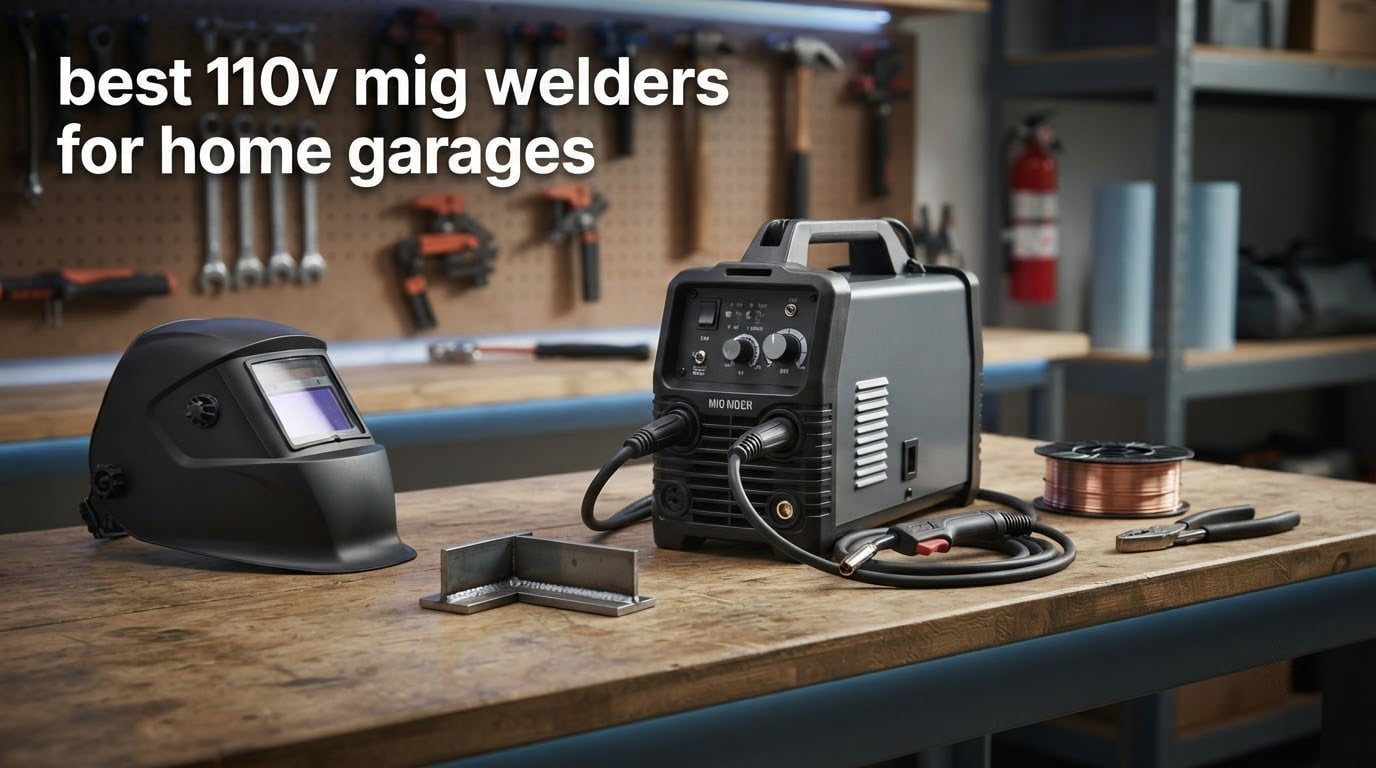
A 110V MIG welder is the default first machine for a home garage because it plugs into a standard 15A or 20A household circuit and welds the day you buy it, with no electrical upgrade. If you are searching for the best 110v mig welders for home garages, the deciding factor is rarely the biggest number on the box.
It is how low the machine can dial down, whether it can run gas-shielded wire, and whether its parts will still exist in ten years. I have spent weeks going through owner feedback across thousands of reviews for the eight machines below, weighing the spec sheets against what people actually say after living with them.
Are 110V welders any good? For a home garage, yes. They handle vehicle body panels, trailer hitches, brackets, patio furniture, exhaust work and general property maintenance. They are not shop machines, and a 140 amp rating on a 110V input does not mean 140 amps of usable welding power on your metal.
Are MIG welders good for beginners? MIG is the easiest arc process to learn, because the wire feeds itself and you only manage two or three controls. The mistake beginners make is buying a machine with a low minimum output, which burns straight through 18 or 20 gauge sheet before you can adjust it. That is exactly the problem I sorted for in this roundup.
Table of Contents
Top 3 Picks for 110V MIG Welders (October 2026)
Forney Easy Weld 140
- 140A 120V flux core
- Welds mild steel to 1/4 in
- Infinite voltage and feed control
- 2 lb and 10 lb spools
YESWELDER 135A
- 135A 110V gasless MIG
- Stick and lift TIG
- Synergic with 3V micro-adjust
- Wire included in the box
ARCCAPTAIN 130A
- 130A multi-process
- Accepts .030 .035 .040 wire
- 11.79 lb with shoulder strap
- Two-year warranty
Quick Overview: All 8 Welders Side by Side in 2026
| Product | Specifications | Action |
|---|---|---|
| Forney Easy Weld 140 Flux-Core |
|
Check Latest Price |
| YESWELDER 135A 3-in-1 |
|
Check Latest Price |
| ARCCAPTAIN 130A 3-in-1 |
|
Check Latest Price |
 HITBOX 200A Dual-Voltage HITBOX 200A Dual-Voltage |
|
Check Latest Price |
 AZZUNO MIG 130F AZZUNO MIG 130F |
|
Check Latest Price |
 Bestarc 145A Dual-Voltage Bestarc 145A Dual-Voltage |
|
Check Latest Price |
 Lincoln Electric 90i FC Lincoln Electric 90i FC |
|
Check Latest Price |
 BILT HARD 135A 3-in-1 Kit BILT HARD 135A 3-in-1 Kit |
|
Check Latest Price |
What a 110V Welder Can and Cannot Weld in Practice
A 110V welder handles 16 gauge through about 1/4 inch mild steel comfortably, plus 20 to 24 gauge sheet metal if the machine can reduce output to roughly 25 to 30 amps. Anything heavier than 1/4 inch needs multiple passes or a 220V machine, and stainless or aluminum needs a machine that runs gas-shielded wire.
How the gauge changes what you can do:
24 gauge (about 0.020 in) – the hardest job for any 110V unit. You need a machine that dials down to 25-30 amps, and .023 solid wire with 75/25 argon-CO2 gives the most control.
20 gauge (about 0.036 in) – car body panel and sheet metal work. Reachable at low settings on gas-shielded machines, risky on high-output flux-core boxes.
16 gauge (about 0.065 in) – the sweet spot. Every machine in this roundup handles it without drama.
1/8 in (0.125 in) – structural work, brackets and frames. Comfortable across the list.
1/4 in (0.25 in) – the practical ceiling for single-pass 110V work. The Forney and the Lincoln 90i FC are both rated to this thickness, and Bestarc, ARCCAPTAIN, YESWELDER, HITBOX and AZZUNO reach it with multiple passes or with a thinner effective gap.
One number explains most of the disappointment: a machine rated 140 amps on 120V delivers far less than 140 amps of usable arc once the circuit is loaded. The gap between maximum output and minimum output is the spec that decides whether you can weld a car door skin without melting it.
1. Forney Easy Weld 140 – Best Overall 110V MIG Welder
FORNEY Easy Weld 140 Amp 120-Volt Flux-Cored Wire Feed Welder (No Gas Needed)
- Runs on a standard 20A household circuit with no gas cylinder
- Infinite voltage and wire feed speed control for dialing in beads
- All-metal case built for daily use
- Accepts both 2 lb and 10 lb wire rolls
- Includes MIG gun ground clamp and adapter lead
- Flux-cored only with no gas MIG
- TIG or stick mode
- Flux-core wire not included in the box
- Flux-core spatter needs cleanup
This is the machine I keep coming back to. Forney has been making welders for decades, the 140 amp output covers the full range of home garage work, and the 4.6 rating across 3387 reviews is the deepest well of real-world feedback in this group. Owners describe consistent beads on mild steel and describe the controls as genuinely easy to learn.
The infinite voltage and wire feed speed control is the feature that separates it from the bargain boxes. You can creep the wire feed down for 20 gauge work instead of waiting for a machine with only five fixed speed steps. It also takes both 2 lb and 10 lb rolls, so wire cost per pound stays low once you get past the learning stage.
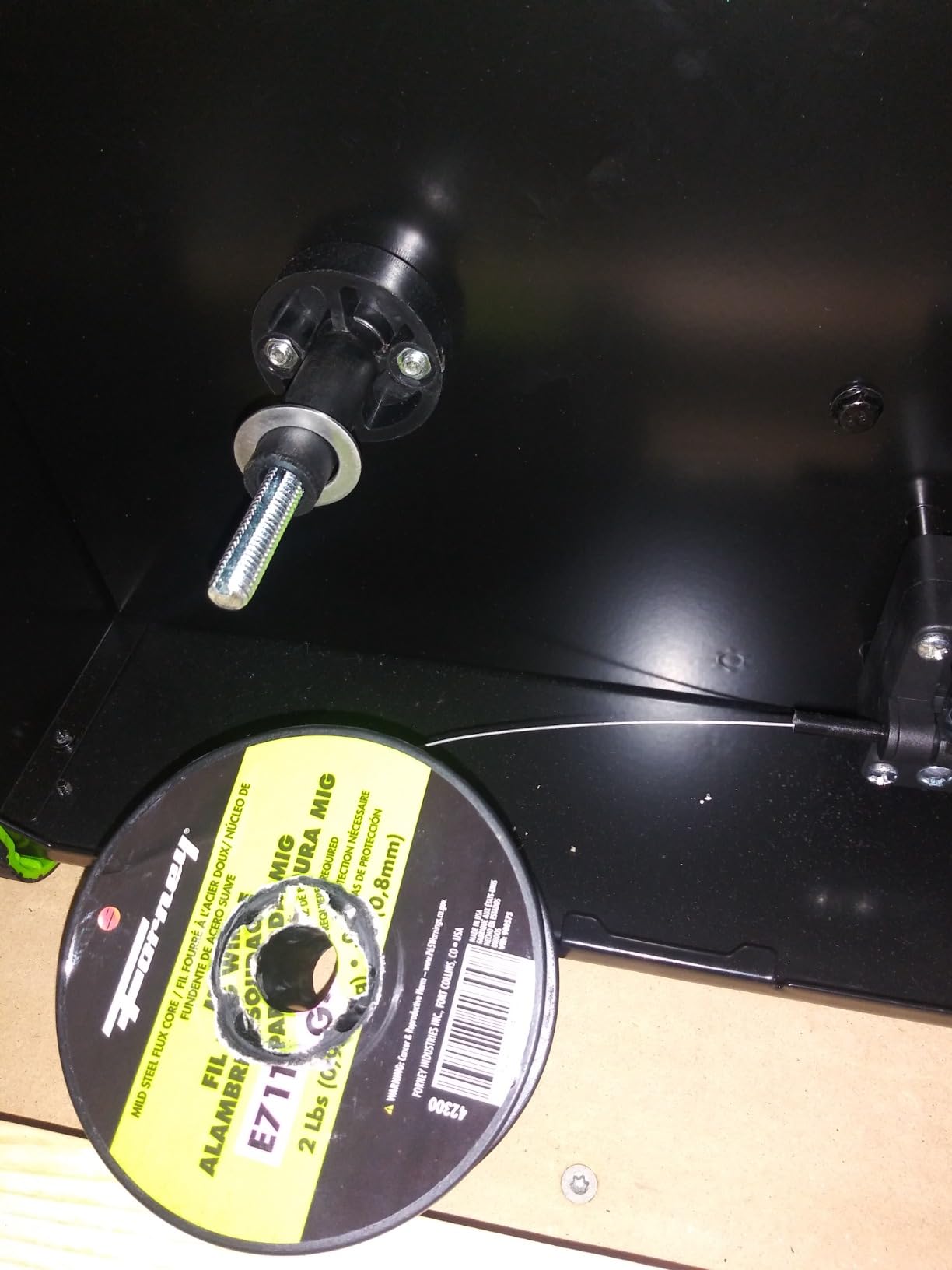
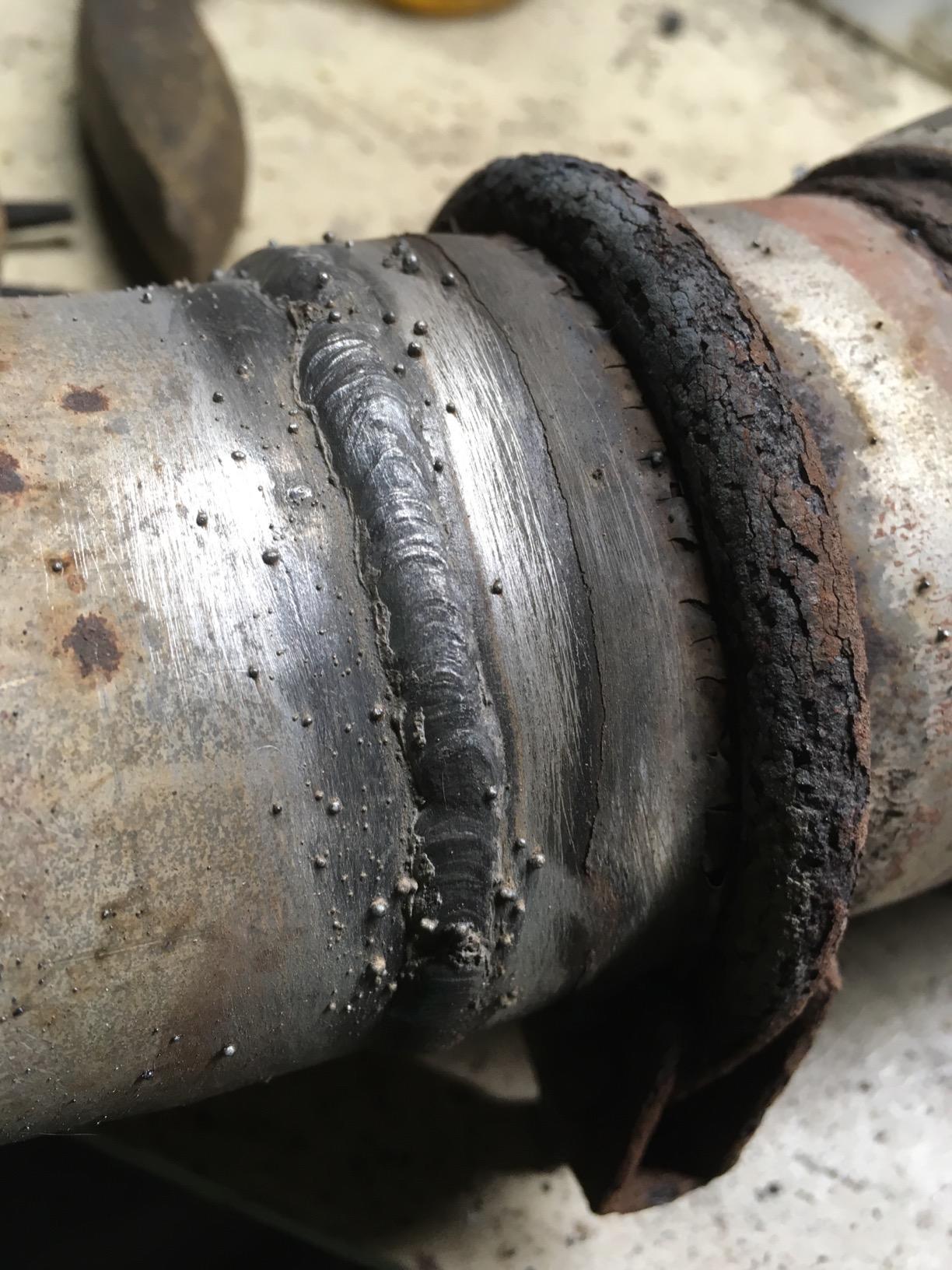
What catches people out is that this is a flux-core-only machine. There is no gas-shielded MIG, no lift TIG and no stick mode, so it cannot weld aluminum with a spool gun, and it cannot weld outside on a windy day without dealing with spatter. The spatter is real and regular, and you will be grinding before you are done.
The included ground clamp is the standard stamped piece, so plan on replacing it. That is true of every machine here, and owners on the forums make the same recommendation across brands.
Where the Forney 140 earns its spot in your garage
It suits anyone doing vehicle repair, trailer hitches, gate and fence work, or heavy bracket fabrication. If your work is mostly mild steel in the 16 gauge to 1/4 inch range, the 140 amp ceiling is genuinely useful rather than theoretical.
It also suits owners who want replaceable consumables and a manufacturer that answers the phone. Drive rollers, contact tips, nozzles and gun cables are standard parts, and the brand builds a support network rather than disappearing in a decade.
Where it will frustrate you
If you plan to weld aluminum, stainless or thin 20 gauge body panels indoors, the lack of gas-shielded mode is a hard stop. The same applies to anyone who wants stick capability for outdoor repairs where flux core is not ideal.
You will also buy wire separately, and the total package costs more once the first spool and a proper ground clamp are added.
2. YESWELDER 135A – Best 110V Welder for Beginners
YESWELDER 135A MIG Welder, 110V Flux Core Gasless MIG/Lift TIG/Stick 3-in-1
- Ready to weld with .030 and .035 flux-core wire included
- Very light at 11.4 lb with a carrying handle
- Three processes in one 110V unit
- Synergic control with plus or minus 3V micro-adjust helps stop burn-through
- LED display readable in bright outdoor light
- DC output only so no aluminum TIG
- Lift TIG torch sold separately
- Voltage is synergic only in flux-core mode
This is the first welder I would hand to someone who has never welded. It comes with flux-core wire, a torch, an electrode holder and a ground clamp, so there is nothing to buy before the first bead. Nearly 3000 reviews sit behind a 4.4 rating, and experienced hobbyists report it lays consistent beads on mild steel and exhaust work.
Synergic control handles the voltage automatically once you set wire feed speed, and the plus or minus 3V micro-adjust is the dial that saves you when a bead starts to wander on thin material. The LED display is genuinely bright enough to read in daylight, which matters if you are welding outside.
At 11.4 pounds, this is the machine you carry out to the driveway, the fence line or the tractor. That portability is not a gimmick in home use, because half of what a property owner does happens away from the bench.
There are limits to be honest about. Voltage is set by the synergic system in flux-core mode, so you cannot hand-trim it on a big plate. The stick readout runs 10 to 15 amps below the actual output, and a minority of owners report units arriving with a missing power switch or failing early.
Why beginners land on this machine
Nothing is missing from the box, and the two-knob-plus-trigger workflow is the least intimidating version of MIG welding you can buy. The protection circuits mean a beginner learning on thin material is less likely to cook the power source.
Three processes in a 110V box also means you are not locked in. If a job calls for stick on a trailer frame, the electrode holder is already in the box.
Where beginners outgrow it
The 135 amp ceiling and the 3/32 inch mild steel rating make it a light-gauge and thin-section machine. Heavier plate and long continuous seams push it to its duty limit and it will need cooling breaks.
It is DC only, so aluminum TIG is off the table permanently. If aluminum is on your project list, skip straight to a dual-voltage gas-shielded machine.
3. ARCCAPTAIN 130A – Best Value Multi-Process 110V Pick
ARCCAPTAIN 130A Flux Core Welder MIG Welder 110V Gasless MIG Stick Lift TIG
- Three processes in a single 110V unit
- Accepts .030 .035 and .040 flux-core wire
- Weighs 11.79 lb and works with a shoulder strap
- Package includes torch plus clamps plus 2 lb of wire and tips
- Two-year manufacturer warranty
- Lift TIG torch sold separately
- 130A class limits material thickness
- No gas-shielded MIG mode
Roughly 80 percent of the 1831 reviews for this machine are five star, which is a strong signal for a budget unit. Synergic control matches current and wire feed speed to the wire diameter you select, and a 10-speed feed control gives more range than most machines in this price bracket.
The accessory package is the differentiator. You get the MIG torch, ground clamp, electrode holder, 2 lb of .030 wire, contact tips, brush and hammer, plus a two-year manufacturer warranty that is longer than most competitors offer. That warranty length matters more than buyers expect, because a budget machine that fails in month 14 is where the cost of cheap shows up.
Like the YESWELDER, it handles .030, .035 and even .040 flux-core wire, and at 11.79 pounds it moves between the bench and the yard without a cart.
Why this one over the other budget multi-process boxes
The 10-speed wire feed control and the wider wire diameter range give you more headroom than a basic two-speed budget unit. Combined with the two-year warranty, it is the sturdiest entry point here for someone who wants stick capability now and may want more later.
It also suits a mixed workload. Carbon steel, thicker steel and the odd stainless repair are all within reach when you have three wire diameters available on the same drive system.
Where the value runs out
The 130A output class caps material thickness compared with a 145A or 140 amp machine, and there is no gas-shielded MIG mode at all. Aluminum and stainless are off the table, and 20 gauge body panel work will test your patience.
Over-current, over-load and overheat protection extends machine life, but it does not replace a ground clamp upgrade or decent wire. Both are cheap and both matter more than the accessories in the box.
4. HITBOX 200A – Best for a Future 220V Outlet
HITBOX 200A MIG Welder, 110V/220V Flux Core MIG/Lift TIG/Stick 3-in-1
- Dual 110V and 220V input in a light package
- Very light at 8.6 lb with a built-in carrying handle
- Owners report cleaner and less spattery welds than cheaper budget units
- Quiet inverter operation with quick arc response
- Metal housing with over-current over-load over-voltage and overheat protection
- Stick mode struggles with 6010
- 6011 and 7018 electrodes
- Output measures 20 to 30 amps below the dial reading
- Only accepts 2 lb spools
This is the rare budget machine that will not box you in. The 200A IGBT inverter runs on 110V or 220V, so if you ever pull a 240V circuit into the garage for a plasma cutter or a larger welder, this machine grows with you instead of becoming dead weight.
At 8.6 pounds it is among the lightest units here, and reviewers single out the arc quality and low spatter as noticeably better than the cheapest alternatives. Synergic control keeps setup simple, and the metal housing with four protection circuits feels more substantial than the plastic cases in this bracket.
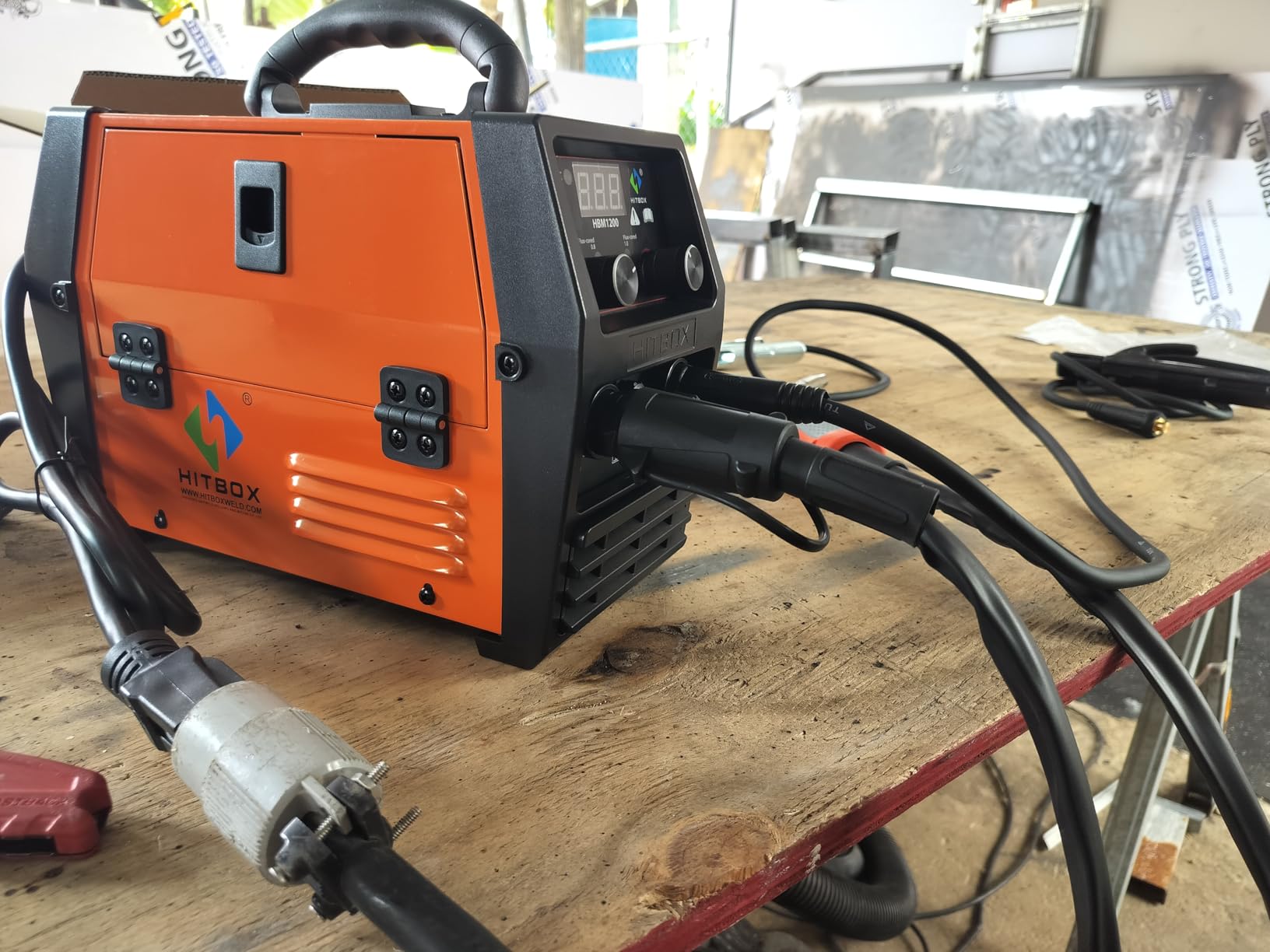
Users consistently report quiet inverter operation and quick arc response, which sounds like trivia until you are welding all weekend in a shared space.
The stick side has real limits. Owners report trouble holding an arc with 6010, 6011 and 7018 electrodes, and there is no hot start on that mode. The displayed amps read 20 to 30 high, which means you need to set by feel rather than by number at first.
Why dual voltage is worth hunting for
Dual voltage is the feature that separates a starter machine from a keeper. Welding the same machine on a 220V circuit roughly doubles its usable output, which means thicker plate in fewer passes and a much less frustrating first year of fabrication.
Two-pound spools keep the wire cost per session down, and the 8.6 pound body means the 220V advantage is available in a package you can still lift alone.
Where the tradeoffs show
Only 2 lb spools fit, so the per-pound wire cost is higher than on a machine that takes 10 lb rolls. Documentation is thin, the ground clamp is soft and can warp, and the display knob doubles as the wire feed control, which confuses new users until they learn the sequence.
For anyone doing production welding, the stick electrode limitations and the output reading that runs high make this a home machine rather than a shop tool.
5. AZZUNO MIG 130F – Simplest Single-Process Way to Start Welding
- Entry-level pick with a 4.5 rating from 890 reviews
- Compact 8.6 lb body with a comfortable hand grip
- Separate voltage and wire speed knobs make dialing in straightforward
- Handles 2.2 lb rolls which are larger than most machines at this level
- Torch plus clamp plus wire plus tips included
- Flux-core only with no stick
- TIG or gas-shielded MIG
- 3.0 mm plate limit is modest
- One-year warranty
If the question is simply how do I start welding with the least fuss, this is the shortest path. The 4.5 rating across 890 reviews is unusually strong for a single-process machine, and reviewers single out how easy it is to learn.
Unlike the synergic-only budget units, the AZZUNO gives you a dedicated voltage knob and a separate wire feed speed adjustment. That is a real advantage when you are learning what each control does, because you can see the effect of one change at a time.
It also takes 2.2 lb rolls, which are larger than the 2 lb spools common at this price level and keep the per-pound cost down. Overload and overheat protection is standard, and the package includes the torch, ground clamp, 1 lb of .030 wire, two contact tips, brush and hammer.
What you give up is process flexibility. This is flux core and nothing else, so there is no stick, no lift TIG and no gas-shielded MIG. The 130A output handles mild steel plate to 3.0 mm, which is thin-gauge and light-fabrication territory.
Who this machine is right for
It suits a homeowner doing exhaust hangers, shelf brackets, small repair pieces and light fabrication where the plate is 16 gauge or thinner. The 8.6 pound body and hand grip make it easy to carry to the work instead of dragging the machine around.
It also suits anyone who wants to learn on a machine with manual controls rather than a black box. Understanding the voltage and feed relationship early pays off on every machine you own later.
Where you will feel the ceiling
Single-process means every job that needs stick or TIG is a different tool. The 3.0 mm plate limit rules out heavier structural work, and a one-year warranty is short enough that a failure in the second year is a real cost.
Buy a second spool of wire and a better ground clamp in the same order, and this machine will outlast your expectations for light work.
6. Bestarc 145A – Best for Clean Gas-Shielded MIG
Bestarc 145A MIG Welder, Flux Core/Gas MIG Stick Lift TIG Welding, 110/220V
- Only unit here that also runs gas-shielded MIG for clean low-spatter beads
- 4-in-1 capability in a single machine
- 110V and 220V auto-detect with the voltage shown on the panel
- Synergic control with minus 3V to plus 3V fine trim
- Wire plus tips plus feed rollers plus gas hose included
- No gas regulator included
- Short leads on early units
- Spool holder spring tension is fixed and too tight
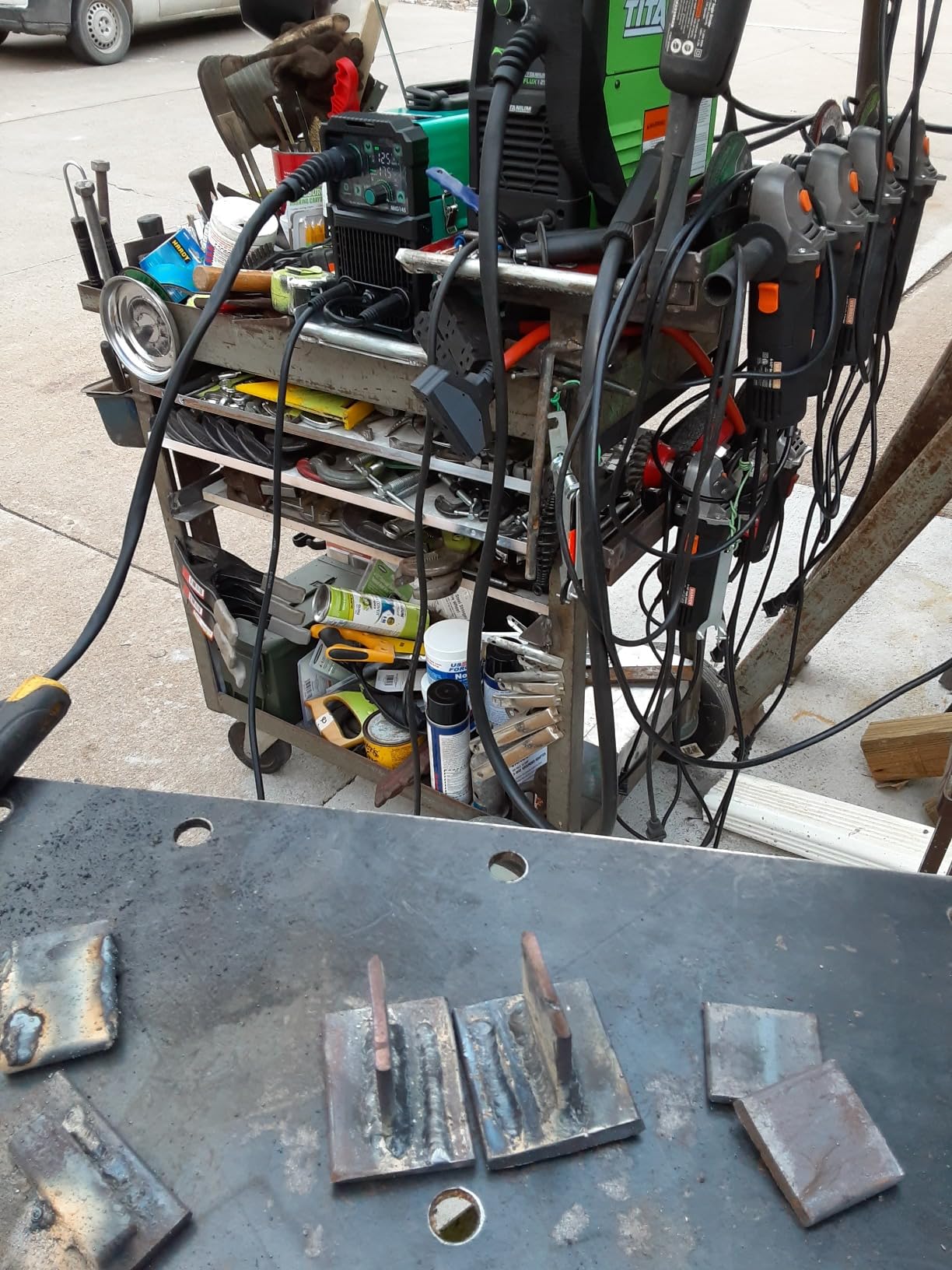
This is the only machine in the roundup that does true gas-shielded MIG alongside flux core, and that single fact changes what you can weld. Gas-shielded wire with a 75/25 argon-CO2 mix gives the cleanest, most controllable arc on thin metal, and it is the path to aluminum once you add a spool gun.
Experienced production welders rate it highly for penetration and bead quality, with one reviewer reporting a better result than a 30-year-old shop machine. The 110/220V auto-detect shows the active input on the front panel, and the plus or minus 3V fine trim is the control that makes 20 and 24 gauge work predictable.
At 13.7 pounds with an included shoulder strap, it is portable enough for field work while carrying more process capability than anything else here. E71T-GS flux core and ER70S-6 solid wire are both supported, with .030, .035 and .040 flux core and .030 solid.
The complaints cluster on early production units: leads around 5.5 feet, plain V-groove drive rolls instead of knurled ones, and a spool holder spring set too tight. The manufacturer revised those, and owners who later bought the updated version raised their ratings to five stars.
Why gas-shielded capability is worth the extra hardware
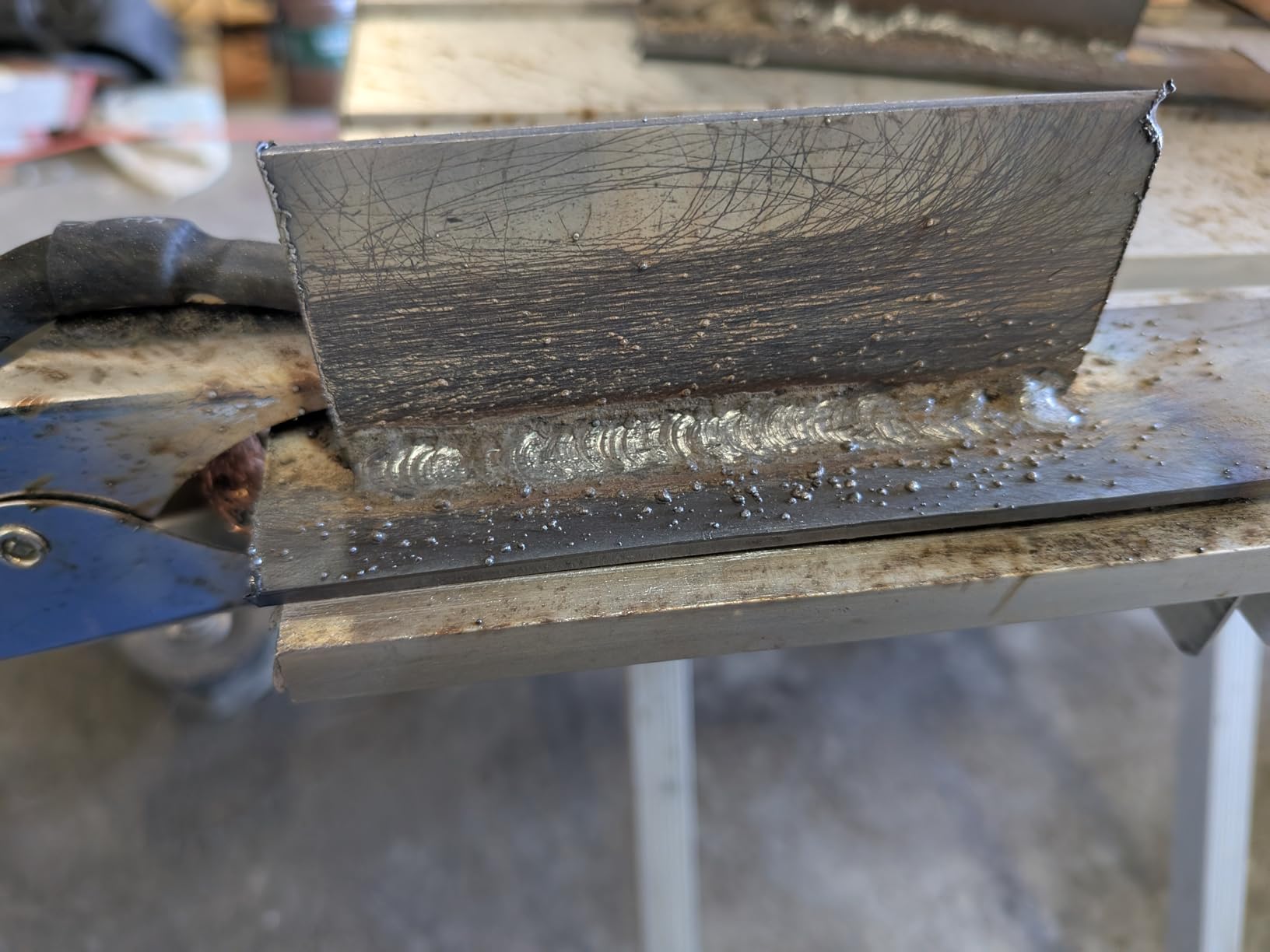
Flux core is spattery and needs a drag technique, while gas MIG pushes and lays a flat, clean bead with far less cleanup. For sheet metal, stainless and aluminum, that difference is the whole ballgame.
The included 2 m gas hose saves a purchase, though you still need a regulator and a cylinder. Treat that as your next project cost rather than a surprise.
Where the compromises are
Buy the later revision if you can. The plain V-groove drive rolls on early units make flux core arc stability noticeably worse, and the included .040 spool can flatten and jam if you do not swap to wire you trust.
The push-on nozzle is not a flux-core style nozzle, and the missing regulator means gas MIG is not ready on day one. Check the drive rolls are knurled before you start.
7. Lincoln Electric 90i FC – Best for Parts Support and Resale
- Highest rated in the group at 4.7 from 572 reviews
- Only 15 lb thanks to an inverter supply instead of a heavy transformer
- Handles material to 1/4 in and does 3/16 in in multiple passes
- Two-knob interface with infinite voltage control
- Consumables are easy to source
- Ground braid on the earth clamp is short and can loosen
- Flux-core spatter is noticeable
- Flux core only with no gas stick or TIG
Lincoln Electric is the name in this roundup with the deepest parts and service infrastructure, and the 90i FC is the machine I would pick for that reason alone. It carries a 4.7 rating across 572 reviews, the highest average in the group, and 84 percent of those reviews are five star.
The inverter power source is why it weighs only 15 pounds. Transformer machines of this class are heavy, and this one carries on a shoulder strap to a job site. Owners report weld quality equal to or better than the much larger Lincoln 140 transformer machine.
It handles material up to 1/4 inch and moves through 3/16 inch easily with multiple passes, which puts real structural work within reach. The two-knob interface with infinite voltage is the easiest layout in this roundup, and consumables for the model are widely available years later.
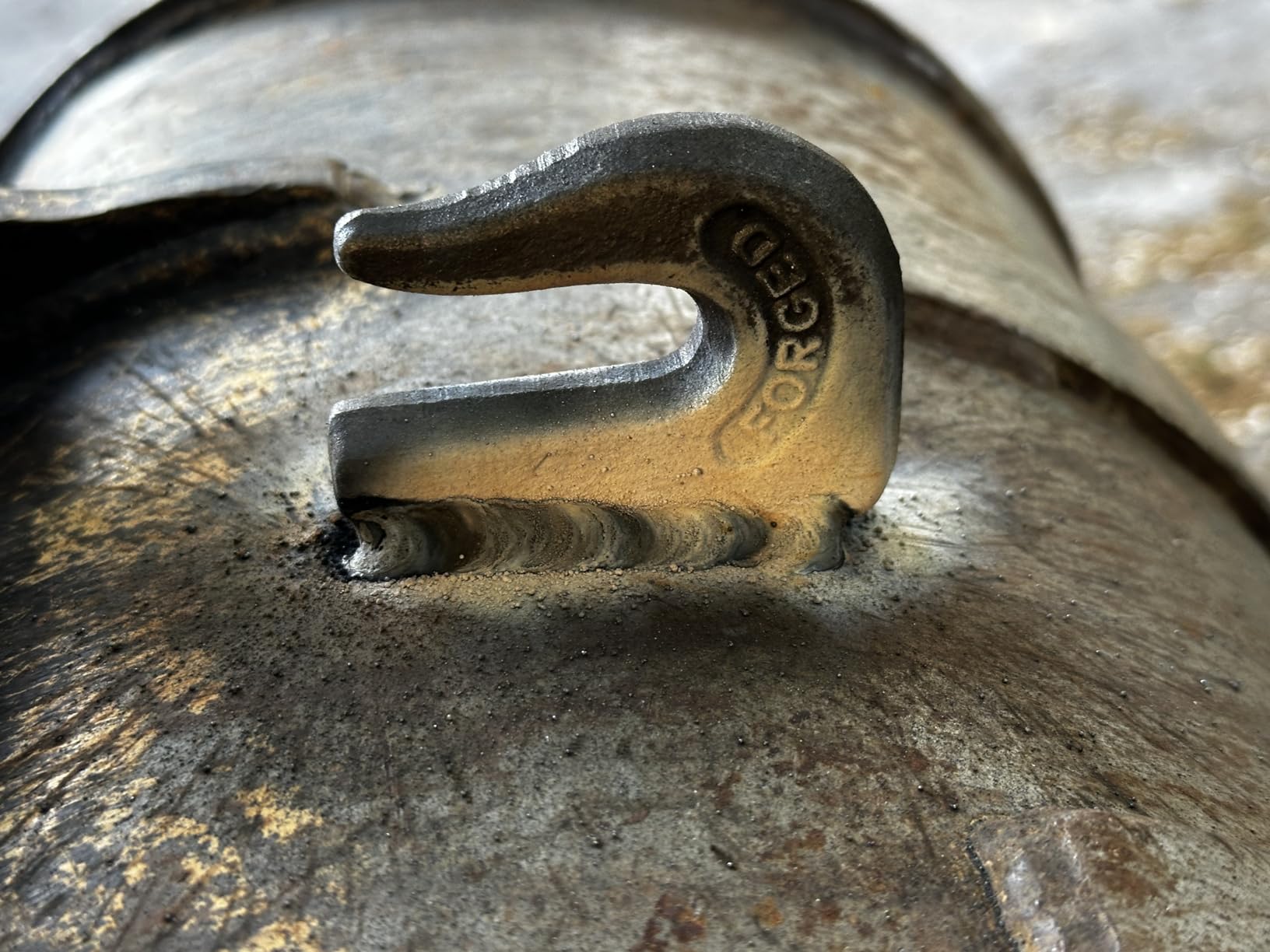
The negatives are consistent and mostly cosmetic. Flux-core spatter is noticeable and means grinding and repainting afterward, the ground braid on the clamp is short and can work loose, and no wire is included. A few owners tripped a breaker on 1/4 inch work, though they had other loads on the same circuit.
Why the brand matters for a garage owner
Parts availability is the underrated advantage. A gun cable, drive roller, contact tip or clamp is a ten-minute fix with standard parts, and that keeps a small machine in service for decades instead of turning it into scrap.
It also holds resale value better than unbranded budget boxes, and the metal case plus strap make it a genuine second tool for anyone already running shop equipment.
Where the name does not help
Being Lincoln Electric does not add a gas mode, a stick mode or a TIG mode. This is flux core and nothing else, so outdoor and aluminum work are off the table no matter what the badge suggests.
At 90 amps the output is modest, so heavy plate means many passes. If your work is mostly thick material, a 130A to 145A class machine will be less frustrating.
8. BILT HARD 135A – Best All-in-One Kit for a Complete Starter Setup
- Only kit here that includes a solar welding helmet plus gloves plus 2 lb of wire
- LED display with error codes at this level is unusual
- Three processes plus 2T and 4T and spot trigger modes
- Well packed with a generous accessory set
- Manual explains which outlet rating each mode needs
- Lift TIG torch sold separately
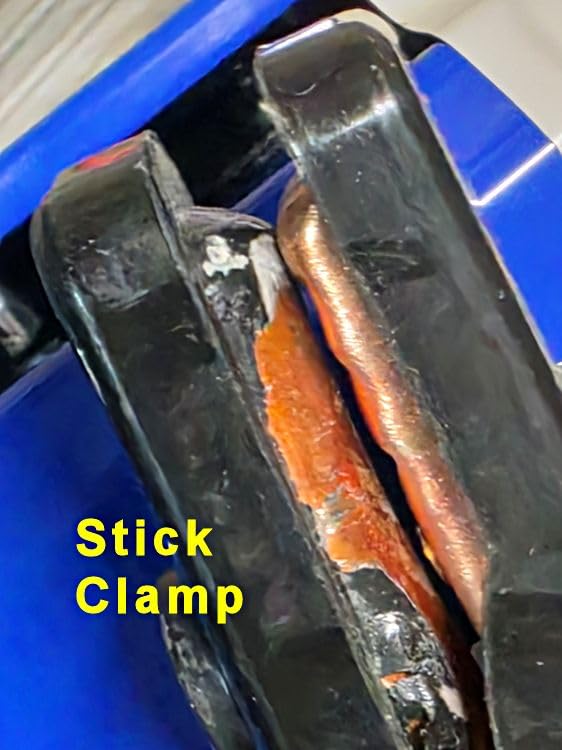
- Included stick electrode clamp is weak
- Duty cycle is limited so long jobs need breaks
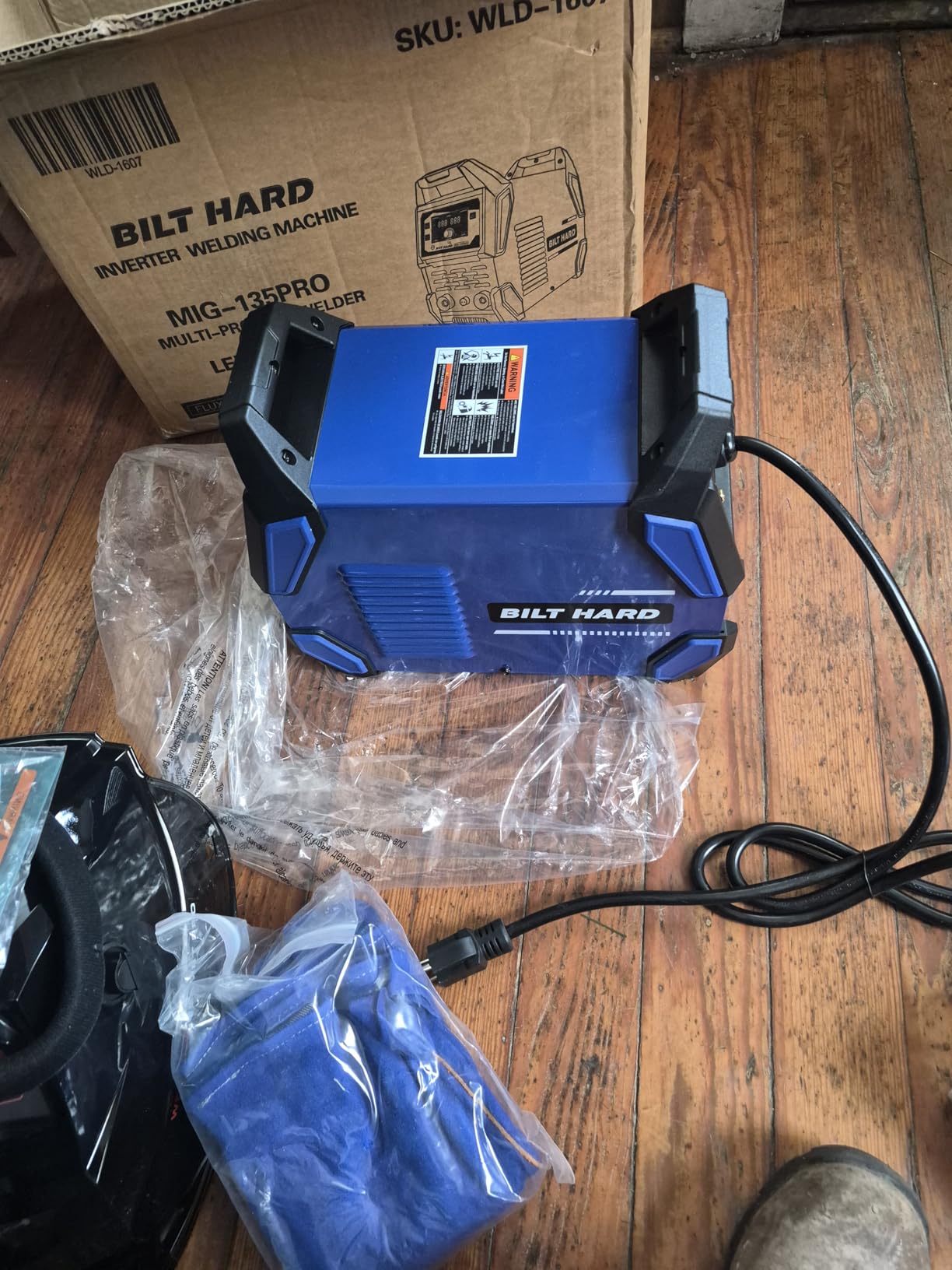
Every beginner needs a helmet before the first arc, and this kit includes a solar-powered one along with gloves, a 6.6 foot MIG gun, a 10 foot ground clamp, 2 lb of flux-core wire, a spare .035 tip, brush and hammer. Owners who expected a toy report being surprised by the build quality and the screen menu.
The trigger modes are the part that interests me most. The 2T setting suits quick fixes, 4T locks the trigger for long seams without hand fatigue, and spot mode is genuinely useful for tacking a bracket or a chassis panel before a final pass.
The LED display tracks real-time voltage, current and wire feed speed, and the machine shuts down with E1 overcurrent or E2 overheat error codes, running the fan for a minute or two before a safe restart. That level of feedback is rare at this level.
It is a 135A unit, so realistically it tops out around 3/16 inch to 1/4 inch, and the duty cycle is limited enough that long continuous jobs need breaks. Reviewers report handles exhaust pipe and rebar bracket work well for a first-time welder, which is exactly the use case.
Why the included safety gear is the real value
A solar helmet that assembles in about five minutes removes the excuse not to weld the first day. Buyers who already own a helmet still benefit from the wire, the tips and the organized accessory bag.
Reviewers also note the manual clearly explains which outlet rating each mode needs, which prevents the most common beginner mistake of tripping a breaker mid-bead.
Where the kit quality drops off
Accessory quality is the weak point. The helmet shade adjustment knob turns too easily and drifts between welds, the included gloves are stiff, and the chipping hammer and brush are poor. The stick electrode clamp is weak too.
Some units arrive without the 2 lb spool, and the supplied spool spindle is too short for the provided wingnut. Check the box before you walk out to the driveway.
How to Choose a 110V MIG Welder: 7 Specs That Matter
Minimum output decides whether you can weld thin metal. This is the most overlooked spec in the entire category, and it separates a machine that handles 20 gauge car body panels from one that melts them. Anything that will not reduce output to roughly 25 to 30 amps is a poor fit for sheet metal, no matter how good its maximum number looks.
Input voltage and circuit capacity come next. Every machine here runs on a standard household outlet, but a 20A circuit on its own gives you more headroom than a 15A circuit shared with a welder, a space heater and a shop vac. A machine rated 140 amps on 120V delivers considerably less at the torch once the circuit is loaded.
Gas MIG versus flux core is the decision most first-time buyers get wrong. Flux core, or self-shielded wire, needs no cylinder and works outdoors in wind, but it is spattery, uses a drag technique and cannot weld aluminum. Gas-shielded MIG pushes, lays cleaner beads and handles thin and stainless work, at the cost of a cylinder, a regulator and refills. Only the Bestarc 145A in this roundup does both.
If you plan to run a generator for field work, check the welder’s generator compatibility, and pair that decision with a solid [generator guide for home use](https://www.smashingrobotics.com/best-generators-for-home-use/) rather than a marginal unit.
Wire drive and spool size affect running cost more than almost any other feature. A machine limited to 2 lb spools raises your per-pound wire cost permanently, while the Forney 140 takes 10 lb rolls. An all-metal drive system is the other tell for long-term reliability, because it handles .030, .035 and .040 wire without the slip and drag that wears drive rollers.
Duty cycle is the real-world hours rating, expressed as welding minutes in a ten-minute cycle at a given amperage. Read it at your working amperage rather than the headline number, and treat any machine with a limited duty cycle as a job-sized tool rather than an all-day one.
Process capability, weight and parts support round out the decision. Stick and lift TIG modes add flexibility, and spool gun readiness is the gate to aluminum later. Weight matters more than people expect, because a machine you can carry to the driveway gets used more often. On parts, a dealer and service network plus standard consumables is what turns a purchase into a tool that lasts, and the same logic applies if you are [planning garage power for the whole shop](https://www.smashingrobotics.com/best-home-battery-backup-systems/).
Year-One Checklist: Wire, Gas, and the Upgrades Worth Buying
Two upgrades get recommended over and over by experienced owners, and neither is expensive. The first is a proper ground clamp, because the stamped clamps that come in the box warp, overheat and cause arc problems that beginners usually blame on the machine. The second is a good MIG gun with a liner that matches your wire diameter.
Beyond that, buy wire before you buy accessories. A 10 lb spool of .030 flux-core wire gets you through the learning stage at the lowest per-pound cost, and a 2 lb spool of .030 solid wire with a 75/25 argon-CO2 mix is the upgrade that unlocks clean sheet metal and stainless.
If you go the gas route, budget for a cylinder, a regulator and a flow gauge, and store the cylinder upright and secured. Owners who skip the flow gauge usually end up with a porous weld they do not understand.
Do not forget the safety kit beyond a helmet. A welding jacket, leather gauntlet gloves and a respirator for galvanized or coated material protect you on the days you are grinding out spatter in a closed garage.
Finally, think about the rest of the property while the garage is being set up. Sensor-driven monitoring that tracks humidity, flooding and power loss gives you early warning before a corroded breaker or a wet floor ruins a fresh machine, and the same home automation hubs that manage lighting can flag a tripped circuit. If that is on your list, our [smart home hub picks](https://www.smashingrobotics.com/best-smart-home-hubs/) are worth a look alongside the welder shortlist.
Frequently Asked Questions
How thick of metal can a 110 volt welder weld?
A 110V MIG welder handles 16 gauge mild steel easily and reaches 1/4 inch in a single pass on the higher-output machines, including the Forney Easy Weld 140 and the Lincoln 90i FC. Below 16 gauge, your limiting factor is minimum output. Machines that reduce to 25-30 amps can weld 20 or 24 gauge sheet without burning through. Anything over 1/4 inch needs multiple passes or a 220V machine.
Is it better to weld with 110 or 220?
For home garage work, 110V is enough for vehicle repair, hitches, brackets, furniture and 16 gauge to 1/4 inch mild steel. A 220V machine roughly doubles the usable output of the same welder, so it reaches thicker plate in fewer passes and controls thin material far better. If you may add a 240V circuit later, buy dual voltage now. The HITBOX 200A and Bestarc 145A both run on 110V and 220V.
Are 110V welders any good?
Yes, for home garage use they are genuinely capable, and they need no electrical upgrade. The tradeoff is output: a machine rated 140 amps on 120V delivers considerably less usable arc once the circuit is loaded, and duty cycle at working amperage is more limited than the headline number suggests. They are not production shop machines, and heavy continuous plate work is where 220V wins.
Can you MIG weld with 110V?
Yes, every machine in this roundup runs on 110 or 120 volts. Most budget units are gasless flux-core only, which works outdoors in wind and needs no cylinder but is spattery and cannot weld aluminum. If you want clean gas-shielded MIG on 110V, the Bestarc 145A is the only pick here that does gas MIG, flux-core MIG, lift TIG and stick with 110/220V auto-detect.
What is the best entry-level MIG welder for beginners?
The YESWELDER 135A is the most beginner-friendly pick because it includes flux-core wire, a torch, an electrode holder and a ground clamp, so you can weld the day it arrives. It offers synergic control with plus or minus 3V micro-adjust, a bright LED display and three processes, including stick and lift TIG. The BILT HARD 135A kit is the alternative if you also want a helmet and gloves in the box.
Conclusion: Which 110V MIG Welder Should You Buy in 2026
The Forney Easy Weld 140 is our pick for the best 110v mig welders for home garages. It has the highest output in the group, the deepest review history, infinite control on both voltage and wire feed speed, and the ability to run 10 lb spools so your wire costs stay low. For a brand that will still sell you parts in a decade, the Lincoln 90i FC is the alternative.
Go multi-process and beginner-friendly with the YESWELDER 135A or the ARCCAPTAIN 130A, choose the Bestarc 145A if you want clean gas-shielded MIG, and pick the HITBOX 200A if a 220V circuit is somewhere in your future. Whichever you choose, replace the ground clamp first and buy your wire before anything else.