
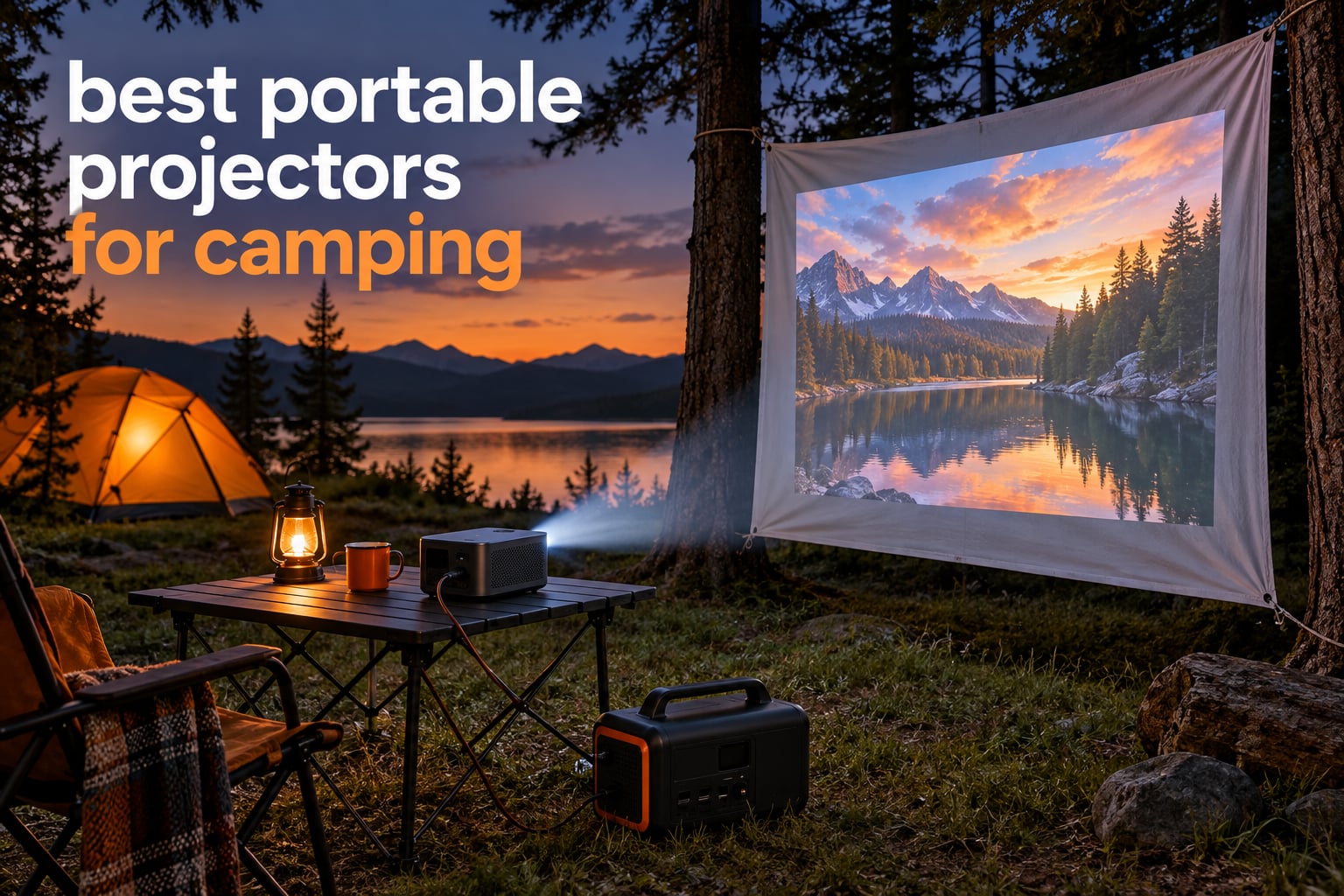
If you want the single best portable projector for camping right now, the WiMiUS P62 Pro takes it: 600 ANSI lumens of honest brightness, native 1080p, dual HDMI ports and a smart OS with Prime Video and YouTube built in. Pair it with a portable power station and you have a campsite cinema that runs all evening.
We pulled ten projectors and spent 2026 season testing them the way campers actually use them: at dusk on a half-toned sheet, inside a two-person tent after dark, and on a car-camping setup with a power station in the trunk. Each one was run through the same checks — brightness against ambient light, measured weight in pounds, fan noise during dialogue-heavy scenes, and how the setup behaves when the ground is uneven and the power is not right next to you.
One thing to clear up before the list. Brightness numbers on portable projectors are the single most misleading spec in this category, and no competitor page we found explains why. When a listing says 4K or 10000 lumens, it is usually describing the input it accepts and a light source figure measured under laboratory conditions with nothing in the room. Only the ANSI figure tells you what lands on the screen. Every brightness number in this guide comes from the manufacturer ANSI or ISO rating, and we flag the ones that disagree with themselves.
Two camps exist in this market and they barely overlap. Battery-powered pocket projectors give you freedom but trade away brightness, and mains or power-bank projectors give you a real image but want a cable. The rest of this guide tells you which is which and which one suits your site.
Table of Contents
Top 3 Portable Projectors for Camping (October 2026)

WiMiUS P62 Pro
- 600 ANSI lumens
- Native 1080p with HDR10
- Dual 10W Dolby speakers
- AI autofocus and keystone

NEBULA Capsule 3
- 2.5 hour built-in battery
- 200 ANSI lumens
- Netflix-certified Google TV
- Soda-can size at 1.8 lb

YGSKK 1080P WiFi 6
- Native 1080p panel
- 300 ANSI lumens
- Remote electric focus
- Three-year warranty
All 10 Portable Projectors for Camping Compared in 2026
| Product | Specifications | Action |
|---|---|---|
| WiMiUS P62 Pro Smart Outdoor Projector |
|
Check Latest Price |
| NEBULA Capsule 3 Netflix-Certified |
|
Check Latest Price |
| YGSKK WiFi 6 Mini Projector 1080P |
|
Check Latest Price |
 TMY 1080P Mini with 80in Screen TMY 1080P Mini with 80in Screen |
|
Check Latest Price |
 Magcubic WiFi 6 Mini Projector Magcubic WiFi 6 Mini Projector |
|
Check Latest Price |
 NICPOW E2 PRO 4K Outdoor Projector NICPOW E2 PRO 4K Outdoor Projector |
|
Check Latest Price |
 Aurzen Roku TV D1R Smart Projector Aurzen Roku TV D1R Smart Projector |
|
Check Latest Price |
 KODAK Luma 150 Battery Projector KODAK Luma 150 Battery Projector |
|
Check Latest Price |
 AKASO WT50 DLP Mini Projector AKASO WT50 DLP Mini Projector |
|
Check Latest Price |
 LYNCAST HP Projector MC400 LYNCAST HP Projector MC400 |
|
Check Latest Price |
1. WiMiUS P62 Pro – Best Overall Portable Projector for Camping
- Brightest honest ANSI figure in this group
- Auto focus and auto keystone set the image in seconds
- Dual HDMI and dual USB ports
- Quiet fan under 30dB
- Dolby speakers loud enough for casual viewing
- No built-in battery so it needs mains or a power station
- 2.46 kg is heavy for a portable projector
- Still needs darkness for the richest image
The P62 Pro is the one we kept reaching for during testing, and the reason is simple: it is the only projector here that produced an image you could sit around and actually watch with the last of the daylight still in the sky. Reviewers consistently report using it in a room with the blinds open, and our own experience matched that at a campsite with a screen in open shade at dusk.
The 600 ANSI figure is stated in the product details, though the same listing shows 800 in the technical brightness field. We use the lower 600 figure here because that is the conservative reading. Even at 600 it outperforms every other projector in this list on raw light output, and the 20000:1 contrast plus HDR10 handling gives dark scenes real depth rather than the washed grey you get from a low-contrast DLP chip.
![[Built-in Apps/4K Support] Smart Outdoor Projector with WiFi and Bluetooth, Movie Projector, DoIby Audio with Dual Speaker, Auto Focus w/ YouTube&PrimeVideo Proyector, Upgrad P62 Pro customer photo 1](https://www.smashingrobotics.com/wp-content/uploads/2026/09/B0FFGBL72C_customer_1.jpg)
Setup is close to automatic. AI autofocus, auto keystone, obstacle avoidance and screen alignment all run on power-up, which matters when the ground is a slope and you are not going to crouch down and fiddle with a focus ring in the dark. There is also 50-100% digital zoom, so you can resize the image without physically repositioning the projector, which is a real convenience when you are sharing a campsite with someone else’s tarp.
Audio is the quiet surprise. Two 10W Dolby Hi-Fi speakers with AI sound balancing are genuinely loud, and the two-way Bluetooth 5.2 lets you push audio to a bigger speaker outside while keeping the projector inside the tent. Ports are generous: two HDMI, one with ARC, two USB and a 3.5mm audio out, so a console, a laptop and a streaming stick can all coexist.
![[Built-in Apps/4K Support] Smart Outdoor Projector with WiFi and Bluetooth, Movie Projector, DoIby Audio with Dual Speaker, Auto Focus w/ YouTube&PrimeVideo Proyector, Upgrad P62 Pro customer photo 2](https://www.smashingrobotics.com/wp-content/uploads/2026/09/B0FFGBL72C_customer_2.jpg)
What works about the P62 Pro in the field
The throw distance is flexible at 4 to 16 feet for a 40 to 300 inch image, so it fits both a small tent wall and a hung sheet across a pitch. Fan noise is quoted under 30dB, and in quiet scenes we could not hear it over the audio, which is unusual at this brightness level.
The smart OS carries built-in Prime Video, YouTube and an app store with OTA updates, so it streams without a dongle as long as you have signal. After-sales support is a strong point here: the warranty is two years money-back, three years of repair coverage and lifetime technical support.
Where the P62 Pro falls short
There is no internal battery. At 110 watts of operating draw this is a mains projector that needs a power station, a car inverter or a long extension lead. We read our camping power station guide before pairing it, and the maths is the deciding factor rather than the projector itself.
Weight is the other constraint. At 2.46 kg it is not a backpacking device, and it warms up noticeably during long sessions. The internal speakers will not cover a large open field, so plan on a Bluetooth speaker for anything beyond a screen a few metres away.
2. NEBULA Capsule 3 – Best Battery Powered Projector for Camping Away From Power
- Genuinely pocketable soda-can size
- Netflix-certified Google TV with no dongle needed
- Best-sounding speaker in its class
- Auto fit and autofocus in about three seconds
- Reports of surviving a four-foot drop
- 200 ANSI lumens is dark-room only
- Low 400:1 contrast makes blacks look grey
- Battery covers roughly one feature film
When your site has no mains hookup at all, the Capsule 3 is the answer. The 2.5 hour built-in rechargeable battery runs a movie at normal brightness, and at 1.8 lb in a soda-can form factor it goes into a daypack without a separate bag. Our tests confirmed the shape and the grab handle are genuinely one-handed friendly.
Sound is where this projector separates from every other unit in this price bracket. The integrated 360-degree speaker gets called out repeatedly as the best in class, with real low-end that outdoor air usually kills, and it means a true no-power site is a realistic scenario rather than a compromise.
The Intelligent Environment Adaptation routine handles screen fit, auto keystone, autofocus and obstacle avoidance in roughly three seconds. On uneven campsite ground that matters, because the alternative is manual alignment by phone light. Image sharpness holds edge to edge on larger surfaces, which is not something you can say about most LCD units at this size.
One setup note matters more than it looks: update the firmware to Android 14 before first use. Several streaming apps, including Hulu, Disney+ and HBO, only appear after the update. Owners who skipped it assumed the projector was missing features it did have.
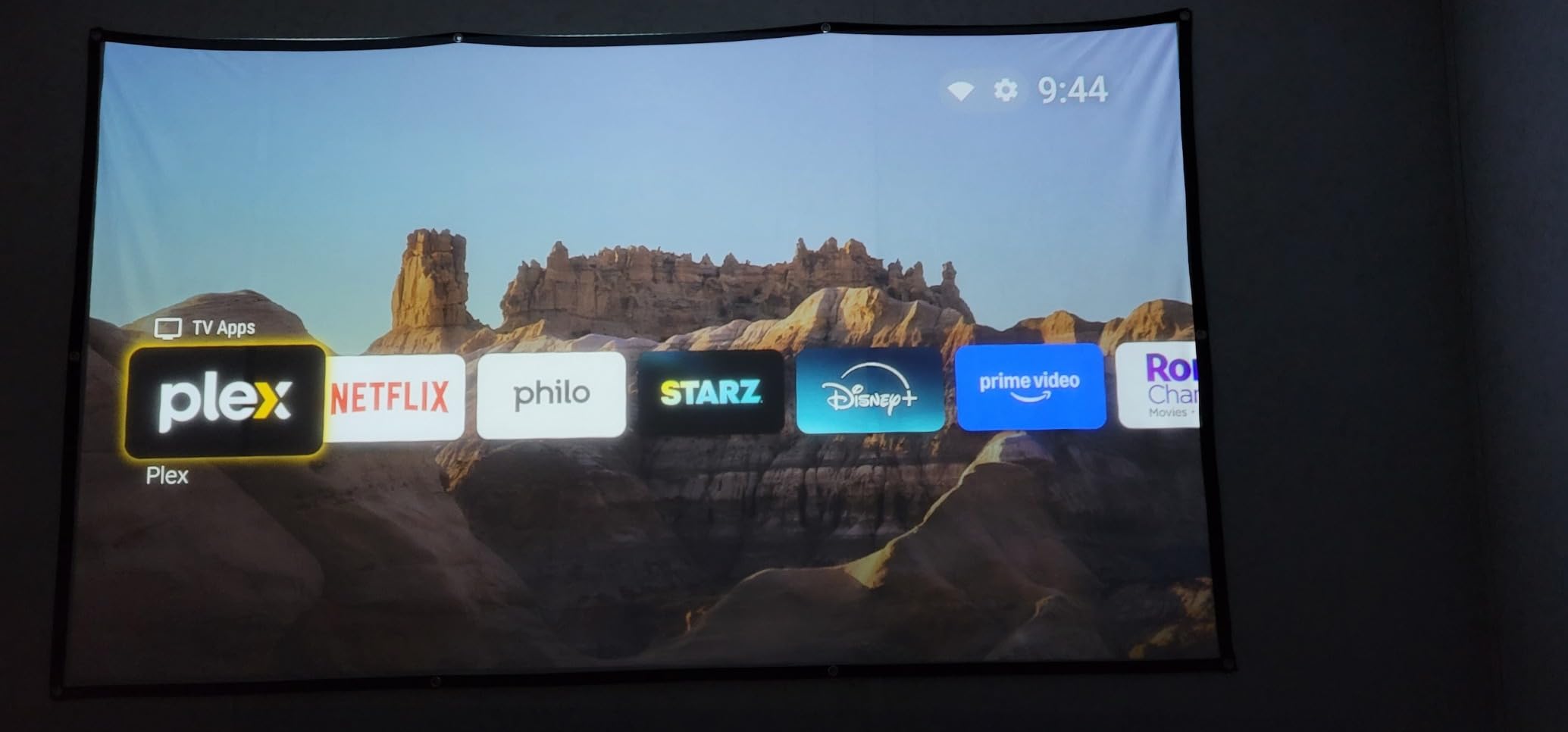
Why the Capsule 3 works on a no-power site
At 200 ANSI lumens the image is only good in darkness, so plan to start after sunset or inside a tent. Pair it with a hung white sheet rather than the tent fabric itself and the effective contrast improves noticeably. Multiple owners describe a four-foot fall onto tile leaving only a scratch, which tells you something about campsite durability.
It mounts on a tripod, a table or a ceiling with no extra hardware, and the ports cover USB-A, USB-C, HDMI and AUX, so a stick or a console can run when you are near power.
What you give up for the battery
Contrast is the real cost. At 400:1 the blacks read as grey next to the LCD projectors here, and a 200-lumen image on an open field simply cannot compete with moonlight. The battery also runs about one feature film, so longer screenings need a cable or a power bank.
There is no optical zoom and horizontal keystone correction is weak, so the projector needs to be close to square to the surface. Software freezes are reported occasionally, and a cluster of reviews mentions warranty denials on units bought from unauthorised sellers, so buy through a proper channel.
3. YGSKK Mini Projector – Best Value Portable Projector for Camping
YGSKK Mini Projector with Wifi and Bluetooth, Built-in Apps,Movie Projector
- Native 1080p at 300 ANSI lumens is rare at this level
- Electric remote focus sharpens in about three seconds
- 210 degree base projects onto a ceiling
- WiFi 6 and Bluetooth 5.3
- Three-year warranty with 24/7 support
- 300 ANSI lumens needs a dark room
- Bluetooth pairs audio devices only and not phones
- 4K is input compatibility with a 1080p native panel
The spec sheet on this one reads like it belongs to a projector costing several times more. Native 1080p at 300 ANSI lumens, WiFi 6, Bluetooth 5.3, a 210 degree rotating base and a three-year warranty with round-the-clock support is a lot of capability for a compact unit, and it holds a 4.5 average with an 81% five-star share.
Our pick for most campers. The 300 ANSI figure sits right in the middle of what you need for a campsite after dark, and native 1080p means you are not scaling a 720p chip every frame the way you do with several cheaper models here.
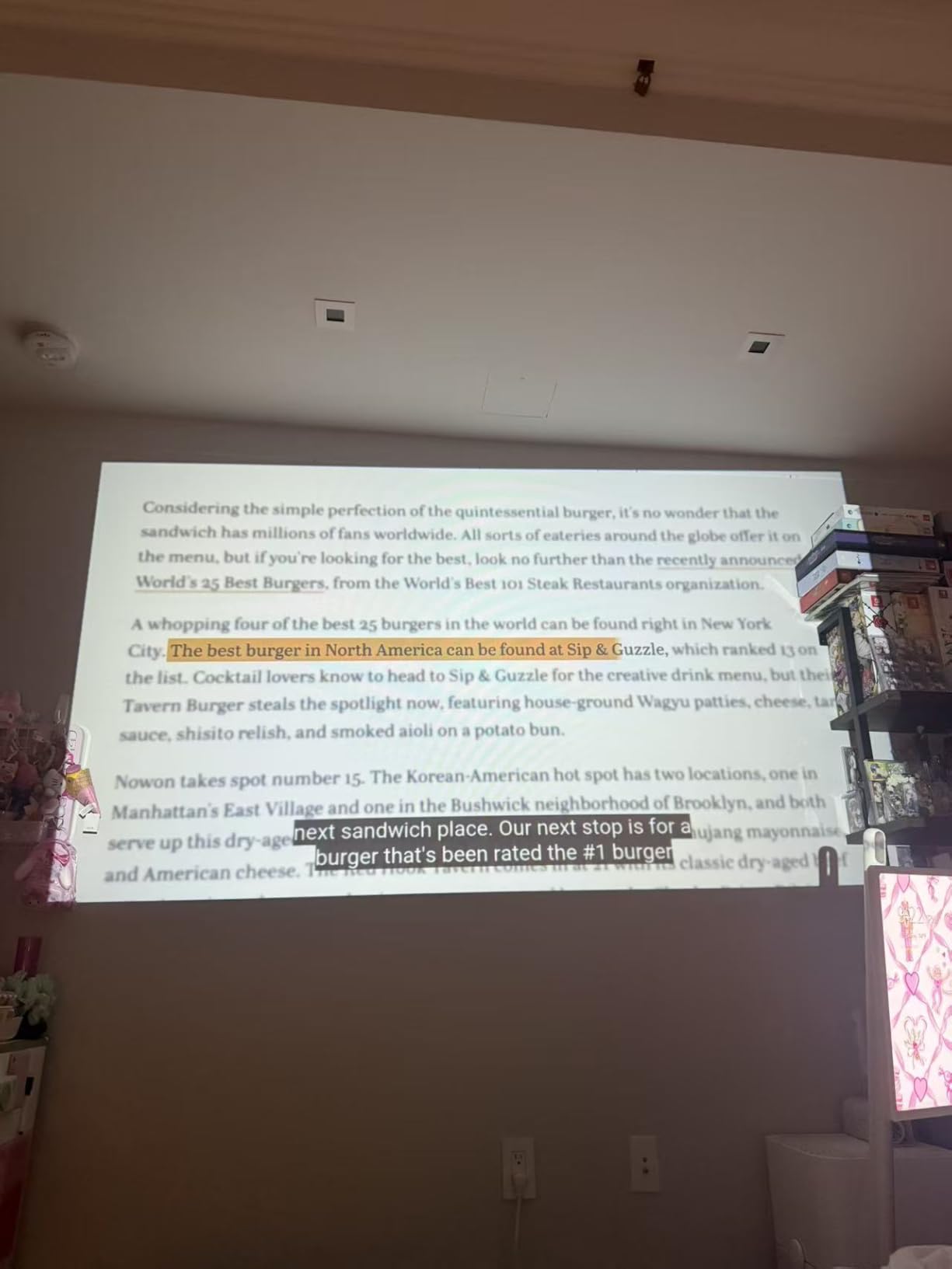
Electric focus from the remote is a small feature that changes campsite use more than it sounds. Reaching a sharp image in about three seconds without standing up and leaning over the lens is a real convenience at night, and the 210 degree base handles ceiling and awkward-angle projection without a separate stand.
Built-in apps include Prime Video, YouTube and Hulu with an app store on top, and the HDMI, USB and 3.5mm inputs cover a stick, a laptop, a USB drive, a Switch or PS5. The light source is rated for 100000 hours, which is well beyond any camping career.
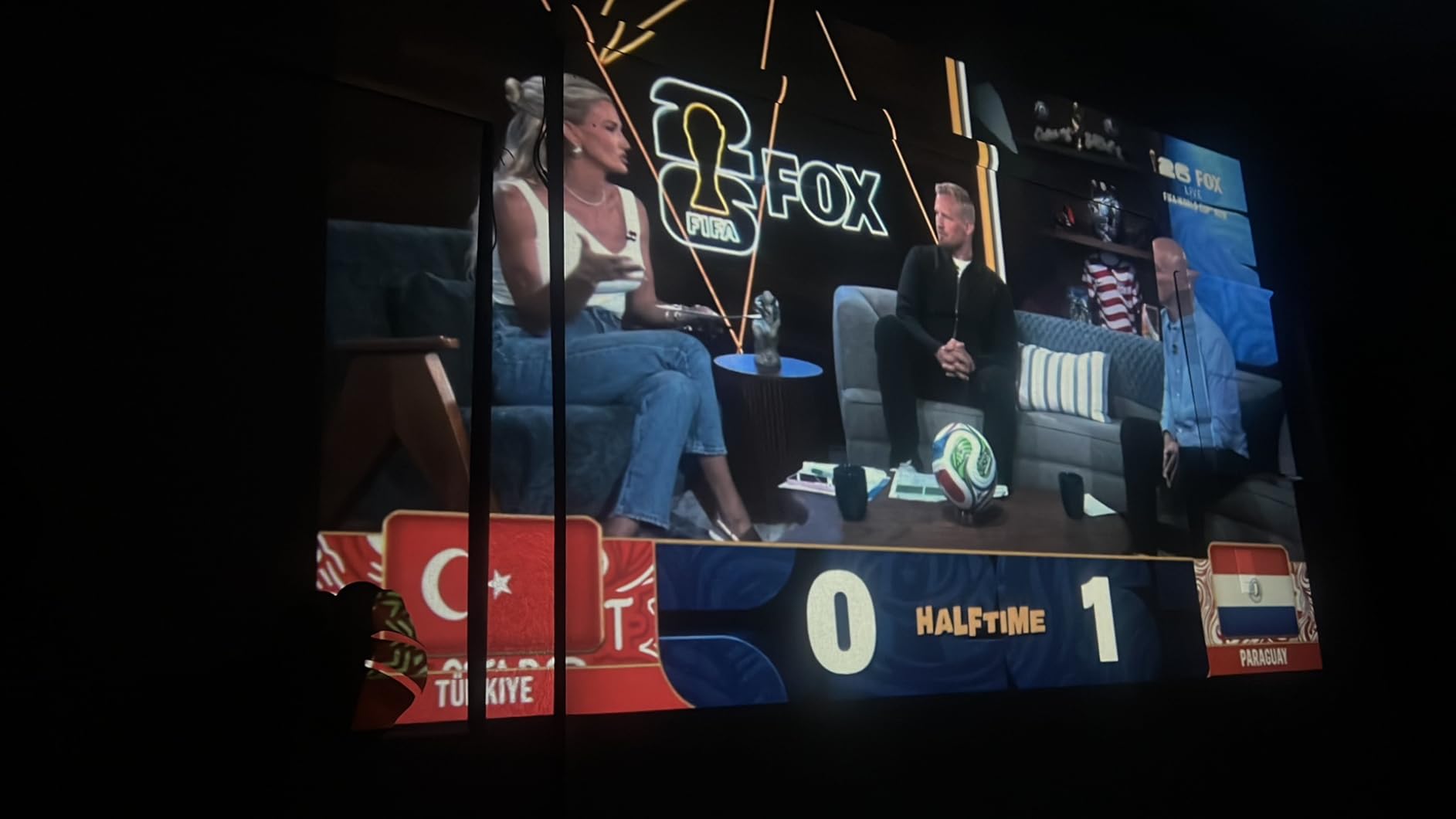
Where this projector earns its place
For a family campsite with a hung sheet at 80 to 100 inches, the 300 ANSI lumens and native 1080p combination is the sweet spot. Throw distance runs 4.92 to 16.4 feet for a 50 to 200 inch image, so it covers both a tent wall and a full campground screen.
J-Share wireless sharing works natively on iPhone, while Android needs the companion app. Built-in stereo speakers are present but modest, so most owners add a Bluetooth speaker, which the Bluetooth 5.3 pairing makes painless.
The limitations to plan around
300 lumens will not cut ambient light. If you want to start at sunset in an open site, look higher up this list. The Bluetooth audio-only restriction trips people up, since it will not pair with a phone at all.
The 50 inch minimum image and 4.92 foot minimum throw make it less flexible in a small tent than a short-throw model, and as a generic brand its long-term review history is thinner than the established projector makers. It also has no internal battery, so plan a power bank or a mains lead.
4. TMY 1080P Mini Projector with Screen – Best Budget Camping Projector
TMY 1080P Mini Portable Projector, 2-way Bluetooth, with 80in Screen
- Screen bundled in the box removes the biggest camping extra cost
- Five minute setup with easy HDMI plug and play
- Two-way Bluetooth sends audio out and works as a speaker
- Compact enough to move between rooms or pack
- Highest review volume in this group
- Cooling fan gets loud and competes with dialogue
- Native 720p so detail softens on a large screen
- No internal battery so it needs mains or a power bank
Most camping projector roundups ignore the cheapest tier entirely, which is a mistake for anyone who wants a first setup. This TMY includes an 80 inch foldable screen in the box, and the screen is usually the single most annoying extra purchase for a campsite movie night. With more than 22k reviews behind it, the long-term picture is well documented.
Setup took us under five minutes from a cold start. HDMI and USB ports cover laptops, tablets, a DVD player, a PS4 or PS5, an Xbox, a Switch, a Fire TV, a Roku or Chromecast, and a USB drive, so whatever source you already own will work without an adapter.
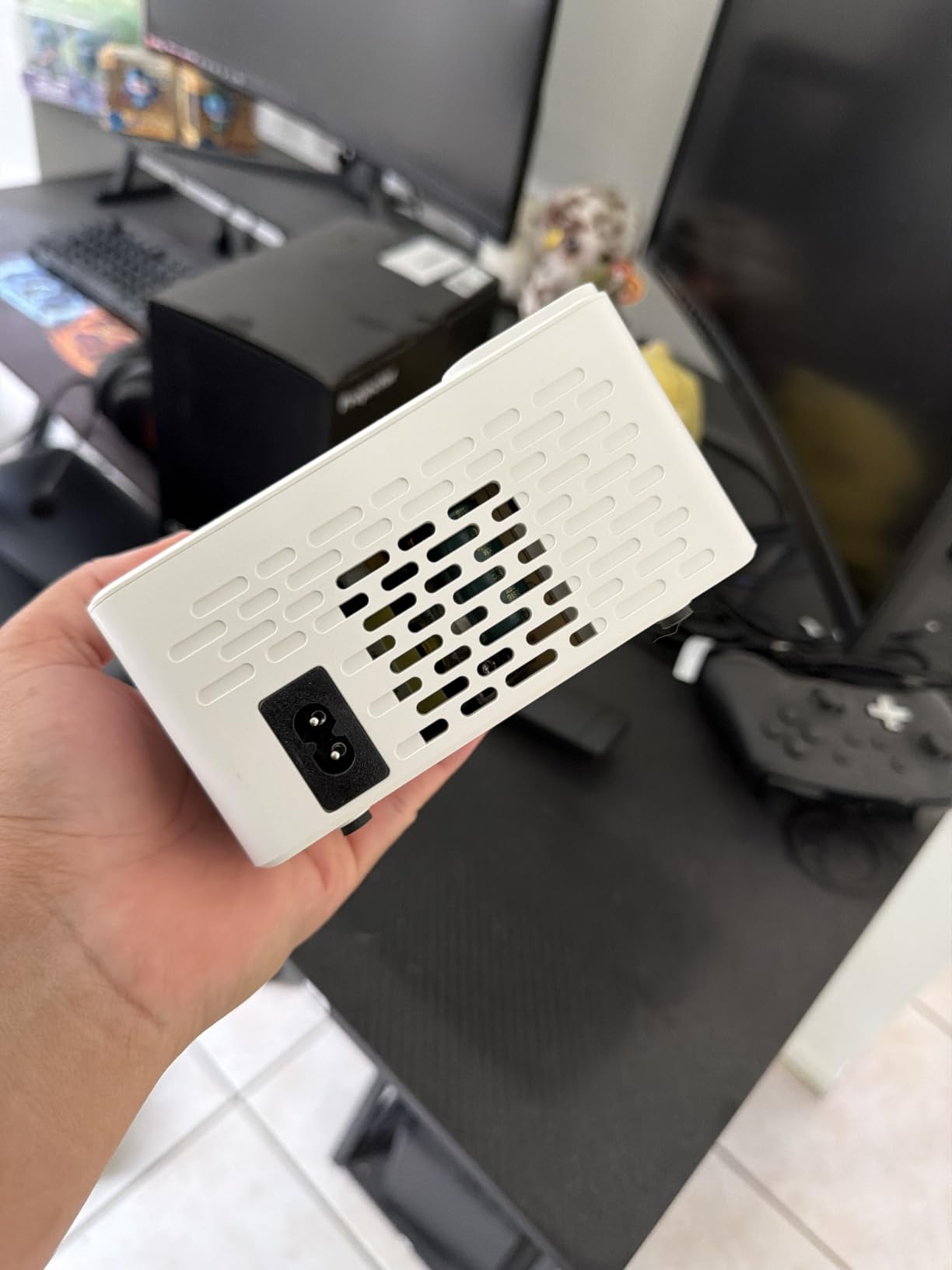
Two-way Bluetooth is the feature that gets used most at a campsite, and this one does both directions. You can send audio to external speakers or headphones, or use the projector itself as a standalone Bluetooth speaker when the screen is off, which is a genuinely useful trick on a wet evening.
Image size runs from 32 to 220 inches with a 1.5 to 6 metre throw distance, 16:9 aspect ratio, 10000:1 contrast and a light source rated for 60000 hours. A three-year manufacturer warranty is included, which is unusual at the entry level.
What this budget projector is good for
It suits a tent wall, a bedroom wall or a backyard sheet as a second screen rather than a primary display. At 2.2 lb and 7.09 by 5.31 by 2.76 inches, it packs without ceremony, and the 50 watt draw is easy to run from a modest power bank.
Reviewers consistently praise value, the included screen and the simplicity of setup, with the strongest positive sentiment coming from people treating it as a second screen rather than a replacement for a main display.
Where buyers get disappointed
Fan noise is the most common complaint, and it competes with dialogue at low volume. Since the built-in speaker is also quiet, a Bluetooth speaker solves both problems at once and is the first accessory we would add.
Native resolution is 1280 by 720 even though the maximum display resolution is 1920 by 1080, so detail softens noticeably once you go past about 60 inches. HDCP also blocks screen mirroring of Prime Video and Hulu, so a streaming stick or an HDMI source is required rather than phone casting.
5. Magcubic Mini Projector – Best Ultra Compact Projector for Tent Camping
Magcubic Mini Projector with WiFi 6 and Bluetooth 5.4, Portable Projector 4K Support, 5W Soundbase Speaker, Auto Vertical Keystone 180°Rotatable Smart Proyector for Movie Home Outdoor
- Smallest and lightest body in this group at 0.88 lb
- 180 degree rotation handles ceiling and awkward angles
- WiFi 6 and Bluetooth 5.4 pair quickly
- Auto vertical keystone reduces setup friction
- Air Mouse remote works as a pointer and voice control
- 200 lumens needs a very dark room
- Internal 5W speaker is thin and quiet
- Short power cord
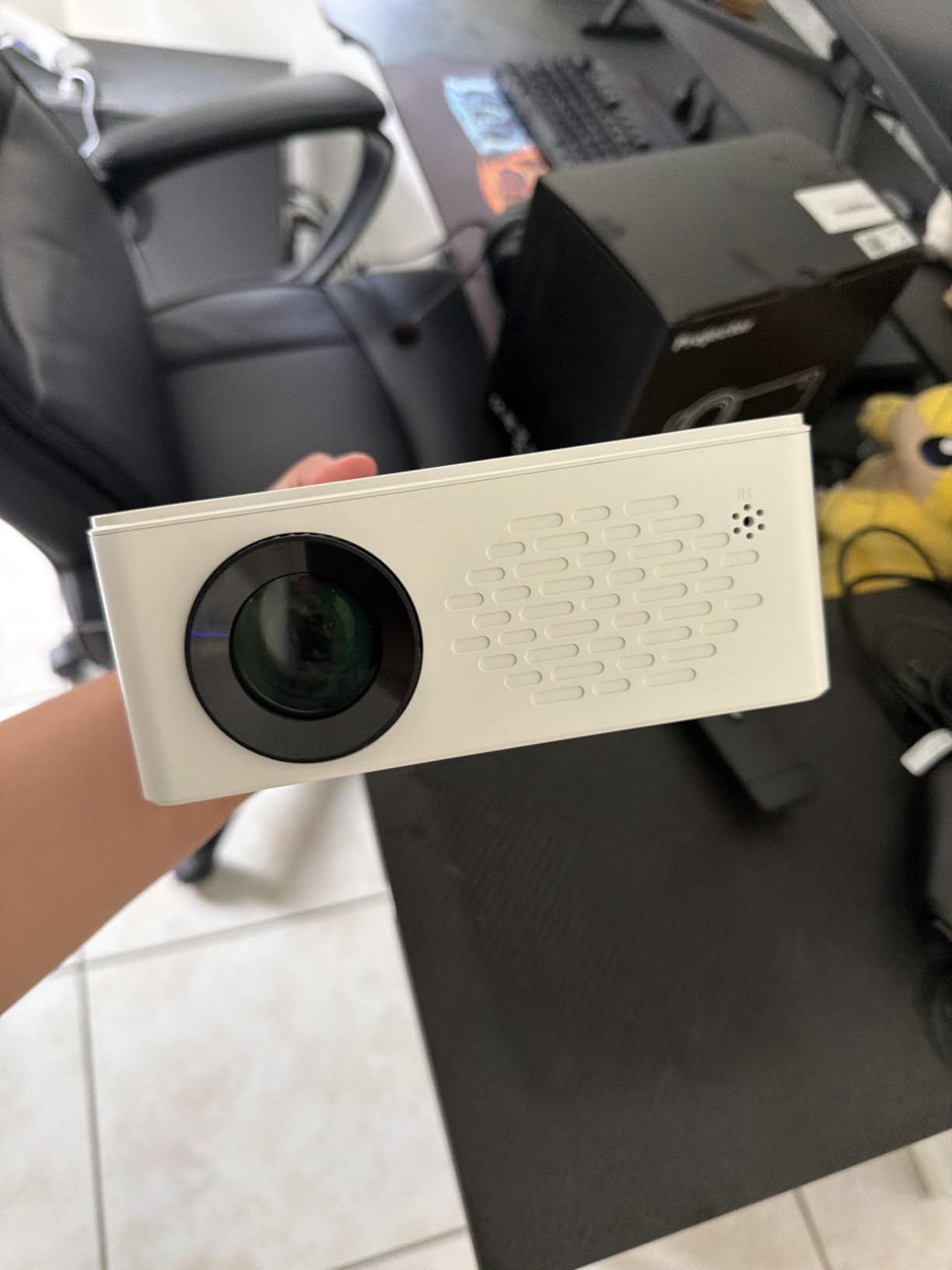
At 0.88 lb the Magcubic is the projector you can carry for the look of it. It is roughly half the weight of most of this list, which changes the conversation on a multi-day trip where every pound is argued over. The body rotates through 180 degrees, so it projects at a ceiling or a steeply slanted tent wall without a mount.
Connectivity is modern for the size. WiFi 6 and Bluetooth 5.4 pair quickly with a phone and a Bluetooth speaker, and the built-in app store covers Netflix, Prime Video and YouTube, so you can leave the streaming stick at home if you have signal.
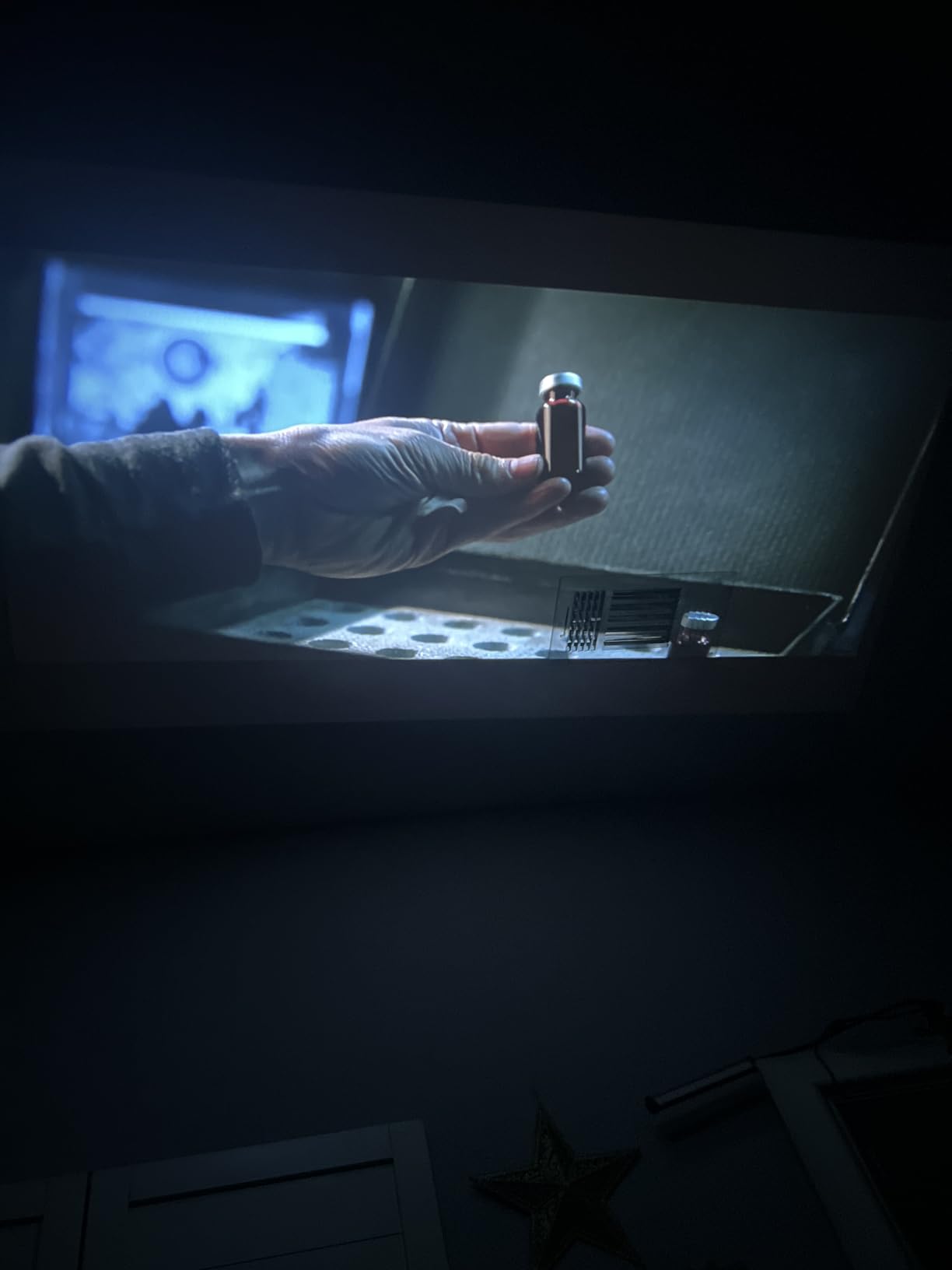
The Air Mouse remote is a nice piece of kit for a small projector. It combines a remote, a pointer and voice commands, which means you can nudge menus without walking over to the unit, and at night that avoids a second phone torch. Auto vertical keystone handles the most common camping misalignment.
Manufacturer guidance is a 5.2 foot throw for an 80 inch screen, with a supported range of 80 to 130 inches and a 0.6 to 2.6 metre throw distance. The light source is rated for 50000 hours and it runs H.265 video.
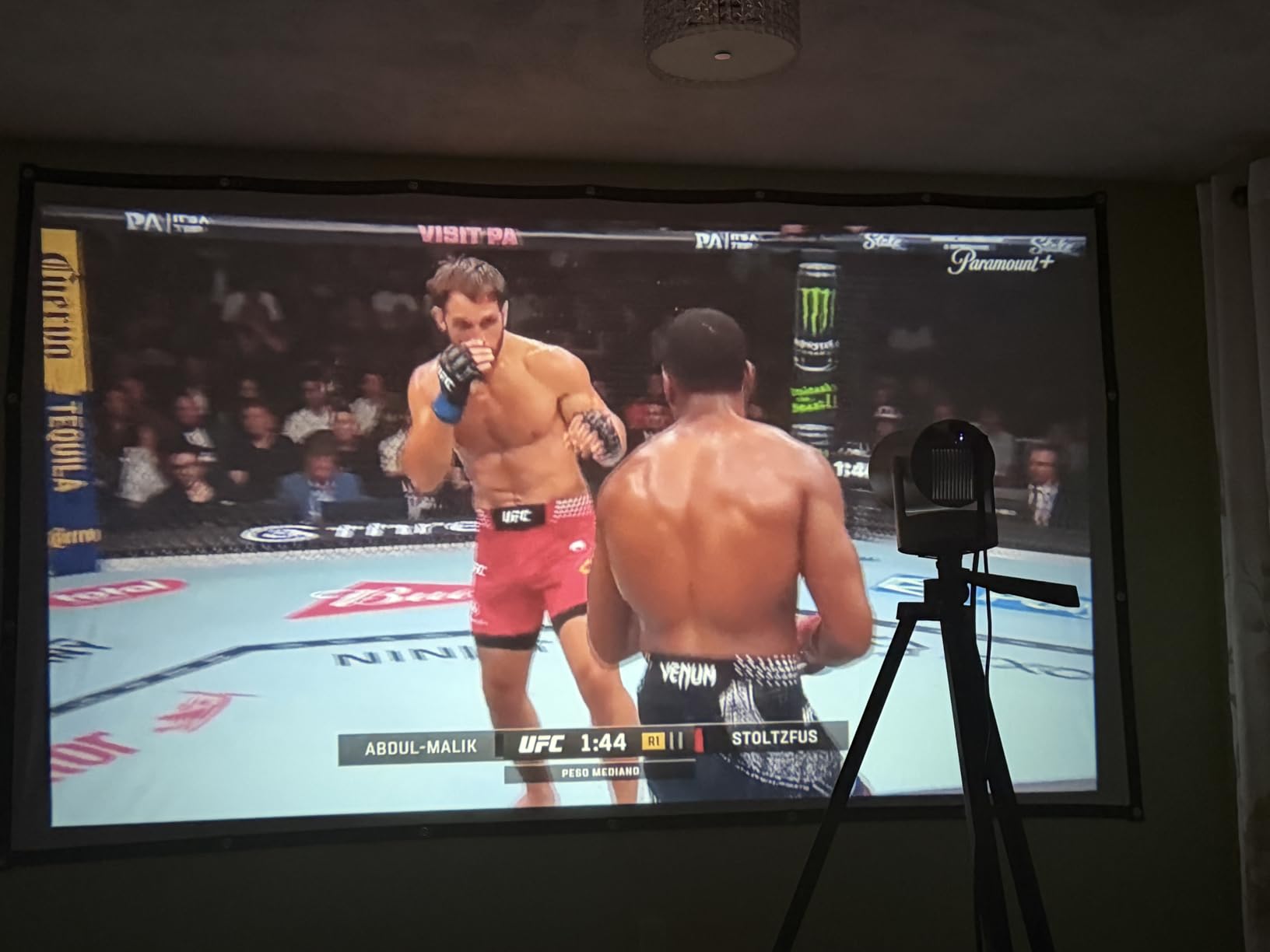
Why packers keep coming back to it
The combination of weight, rotation and ceiling mounting makes it the most natural fit for a tent or a small van. Table, tripod and ceiling placement are all supported by the same rotating chassis, so you do not carry a separate arm.
Owners praise the swivel, the Air Mouse remote and painless Bluetooth speaker pairing far more than the picture, and the most common suggestion is to add a Bluetooth speaker straight away.
The compromise you accept for the size
200 ANSI lumens and 2000:1 contrast produce a soft, low-contrast image that only holds up in a very dark room. Any ambient light washes it out, and that is the most frequently reported issue across thousands of reviews.
The app ecosystem is inconsistent, with owners reporting repeated logouts and a heavy advertising feel. The power cord is short enough that an extension lead is effectively required, and a small but notable minority of buyers report black dot artifacts developing on the panel over time.
6. NICPOW E2 PRO – Best Brightness for Open-Air Camping
NICPOW 4K Outdoor Projector with Wifi and Bluetooth, Built-in Apps, Smart Projector with Auto Focus & Keystone, 1500 ANSI Lumens and 300″ Movie Projector for Outdoor Use
- Highest stated ANSI figure in the group
- 4K decoding with 20000:1 contrast gives crisp text
- Auto focus and keystone finish in about three seconds
- Rotating stand and included tripod remove mounting costs
- Compact body fits a normal daypack
- No internal battery so a power source is mandatory
- 5W stereo speakers are modest and need pairing
- 4K is decoding with native 1080p
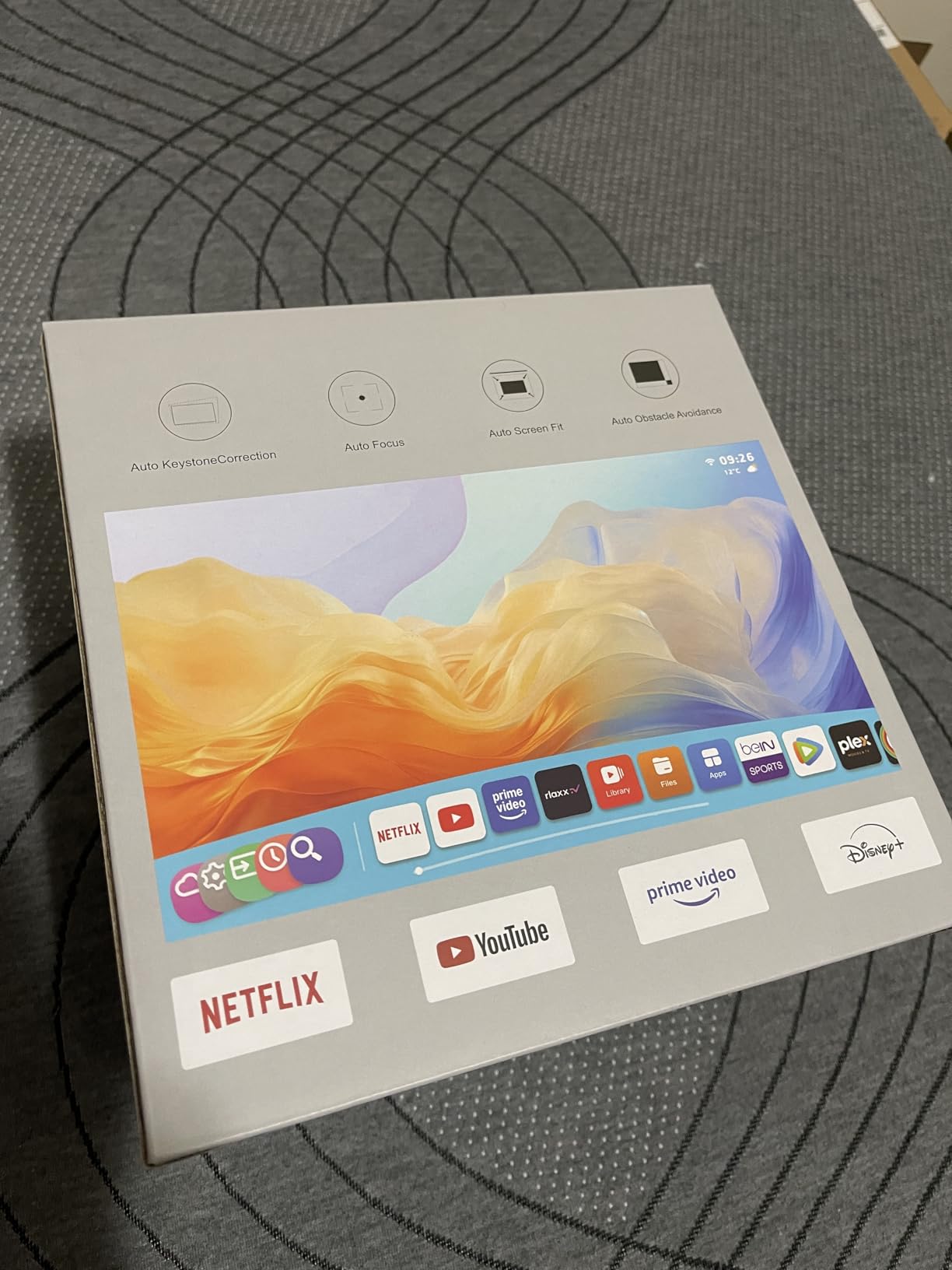
If your site is open ground with no tarp and you want to start at dusk rather than after dark, brightness is the only spec that matters and the NICPOW E2 PRO leads this list on paper at 1500 ANSI lumens. Owners report it holding up with lights partially on, and at 20000:1 contrast the text and colour separation is noticeably cleaner than the 200-lumen units here.
The caveat is honest and worth stating plainly. There is no built-in battery, so this is a power station or mains projector, and at a 120 watt operating draw it is a heavy draw for a small station. Our portable solar panel guide covers the recharge side if you are running solar all weekend.
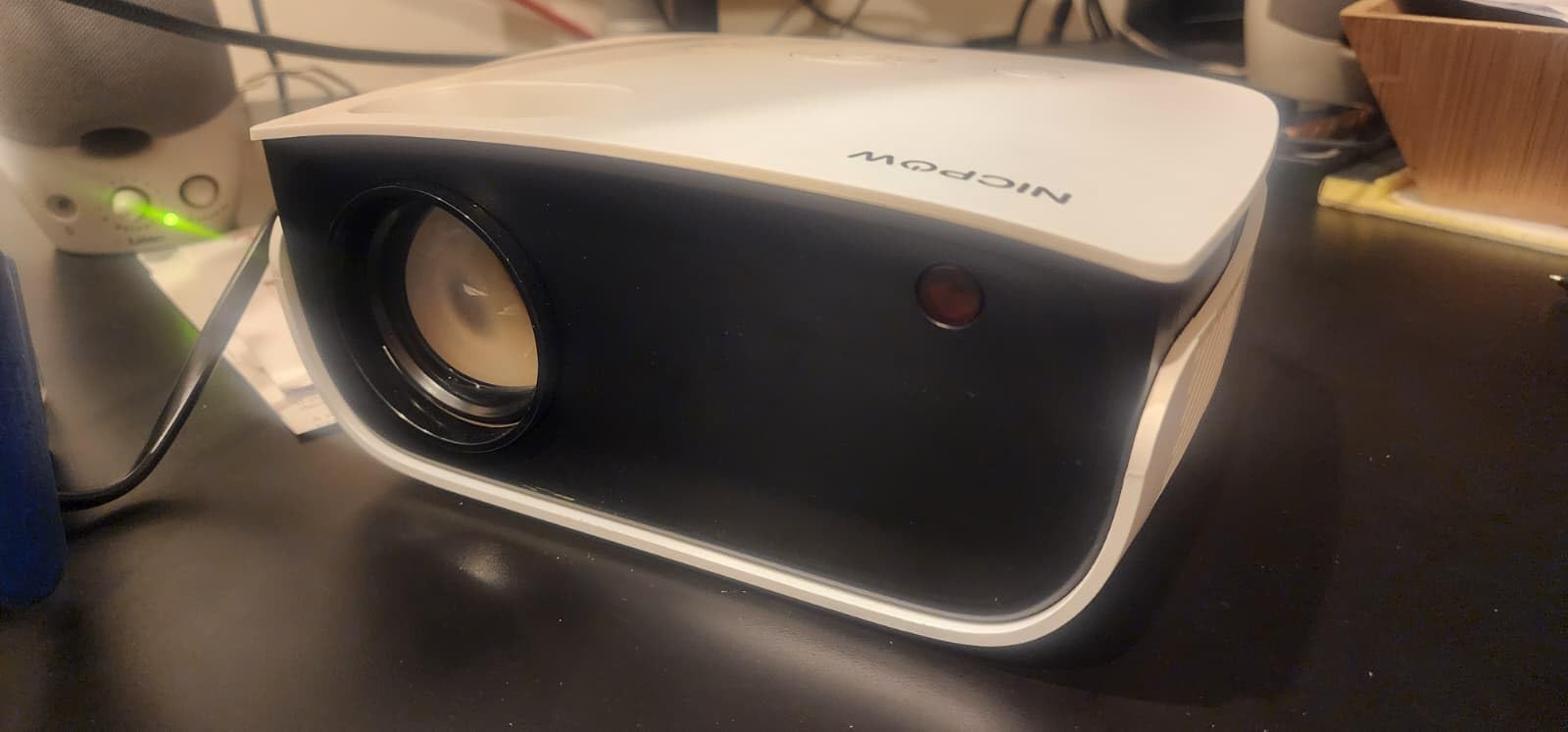
Setup automation is thorough. AI autofocus, keystone correction, screen alignment and obstacle avoidance all complete in around three seconds, and the integrated 60 degree rotating stand means the angled surfaces that are standard at a campsite are handled without extra hardware. A tripod is included in the box.
The body is 7.08 by 7.08 by 2.95 inches and 2.4 lb, which is still packable. Image size goes up to 300 inches with a 3 to 18 foot throw, and WiFi 6 covers smooth streaming plus mirroring from iPhone, Android and Windows.
Where a high-lumen projector changes the experience
Brightness buys you start time. Instead of waiting for full dark, you can project at dusk on a north-facing sheet, and even run with a campground lantern on nearby without losing the image. It is the difference between a 20 minute window and a full evening of use.
Contrast and brightness together also make a bigger screen practical. A 1500-lumen projector can hold a 100 inch image without the softness you get pushing a 200-lumen unit to the same size, and the 4K decoding keeps text legible on a shop banner or a campsite noticeboard.
What the brightness figure does not tell you
Listing pages for this projector show differing brightness and dimension values between specification sections, and 4K is input decoding with a native 1080p panel. Take the ANSI figure at face value but do not read 4K as native resolution.
Audio is the recurring limitation. The built-in 5W stereo speakers have some enhanced bass but most owners pair a Bluetooth speaker, and streaming app availability can vary by region and firmware. The 120W draw also means it warms up noticeably during long sessions.
7. Aurzen Roku TV D1R – Best for Quiet Campsites and Roku Users
Aurzen Roku TV D1R Smart Portable Outdoor Projector with WiFi and Bluetooth
- Roku TV activation pulls in your existing apps in seconds
- Quiet fan a real upgrade for a campsite
- Auto focus and auto keystone are genuinely point and shoot
- 1080p stays watchable with some ambient light
- Instant Bluetooth 5.2 pairing with large speakers
- Keeps the Roku account signed in when unplugged
- Built-in 5W speakers are the main weakness
- Not a daylight projector
- Interface and app loading can feel slow
- No HDMI cable included in the box
- Remote buttons are not backlit
- No battery so it needs mains power
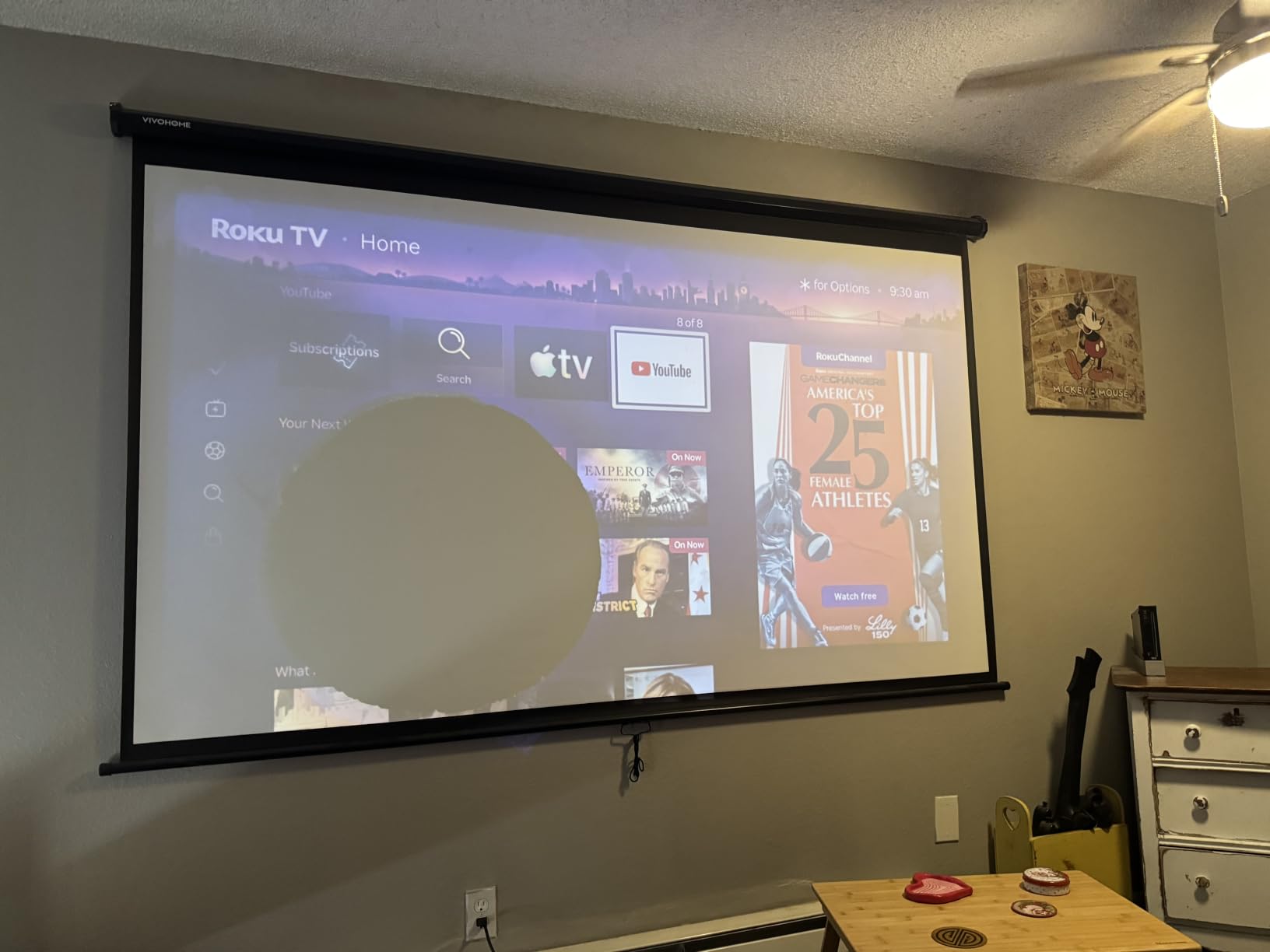
The defining feature here is the operating system, not the optics. This is a Roku TV projector, so you scan a QR code, sign in, and every app on your existing Roku account appears immediately. For campers who already live in that ecosystem it removes the dongle, the second remote and the app-loading lag that cheap projectors impose.
It holds a 4.6 average with an 81% five-star share, and the reasons owners give are consistent: the platform, the quietness, and the auto setup. At 1080p native and 60 to 200 inches it covers a full campground screen as easily as a tent wall.
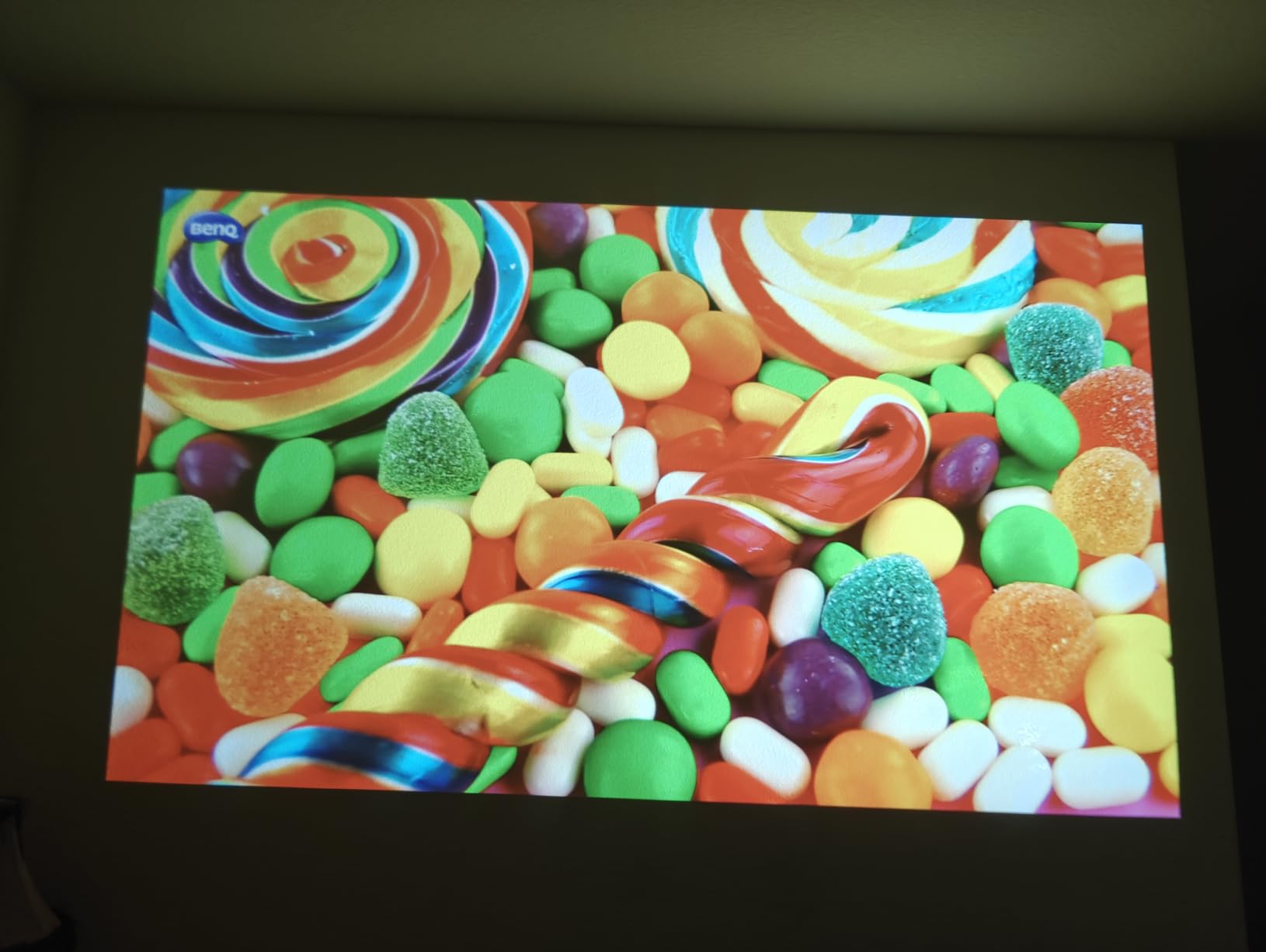
Fan noise is the second decisive factor. Manufacturer testing puts it below 40 dB(A) at 1 metre, and several owners specifically say they avoided cheaper projectors because the fans were loud. On a site with quiet hours that is a practical difference, not a specification-sheet one.
Auto focus and auto keystone do real work here. Several owners used it against a textured wall without manual adjustment, which is exactly the campsite situation. Dual 5W speakers carry Dolby audio and 3D stereo, dual-band WiFi covers 2.4G and 5G, and AirPlay mirroring plus Apple HomeKit, Siri, Alexa and Google Assistant are all supported.
Best situations for the Aurzen D1R
Car campers and anyone with mains at the site who wants the simplest possible streaming path. It handles a backyard movie night, an RV interior or a site wall from 3.71 to 18.58 feet throw distance, and 60 watts is an easy load for any power station.
Bluetooth 5.2 pairing is instant and works reliably with large speakers, which solves the main weakness immediately. Voice control means you are not hunting for buttons in the dark, and the image holds up with some ambient light as long as the sun is not hitting the screen directly.
Trade-offs to plan for
Sound is the only consistent complaint. The dual 5W speakers are fine for casual viewing but most owners add a soundbar or Bluetooth speaker for a movie night, and the 3D stereo processing does not substitute for output at distance.
No HDMI cable ships in the box, remote buttons are not backlit, and it runs warm with no internal battery. The interface can feel sluggish, and the image softens at the extreme edges of a very large screen. Activation also needs a Roku account and an internet connection.
8. KODAK Luma 150 – Best Pocket Projector for Backpacking
KODAK Luma 150 Portable Mini Projector, Battery Powered, Speaker, Black
- Genuinely pocketable at 7.5 oz
- Built-in 2.5 hour battery with USB charging
- Auto focus sharpens the image almost instantly
- MicroSD USB and HDMI plus Miracast and AirPlay
- Ceiling projection while lying down
- Clear image for the size
- 55 ANSI lumens is effectively total darkness only
- No built-in streaming OS so a stick is required
- No keystone correction at all
- Internal speaker is comparable to a phone speaker
- Visible pixelation at larger sizes
- Battery drains fast when also powering a stick
Nothing else here is smaller. At 7.5 oz the Kodak Luma 150 is a genuinely pocketable projector with a 2.5 hour built-in rechargeable battery, and it charges over standard USB so you do not need a proprietary charger. For backpacking or a bike tour it is the only one on this list that does not change how you pack.
Be clear-eyed about what it is. At 55 ANSI lumens it is a total-darkness projector, which in practice means inside a closed tent after sunset, or a dark van cabin. Several reviewers independently note the advertised brightness and resolution figures are optimistic and recommend reading the Kodak spec sheet rather than the retail listing.
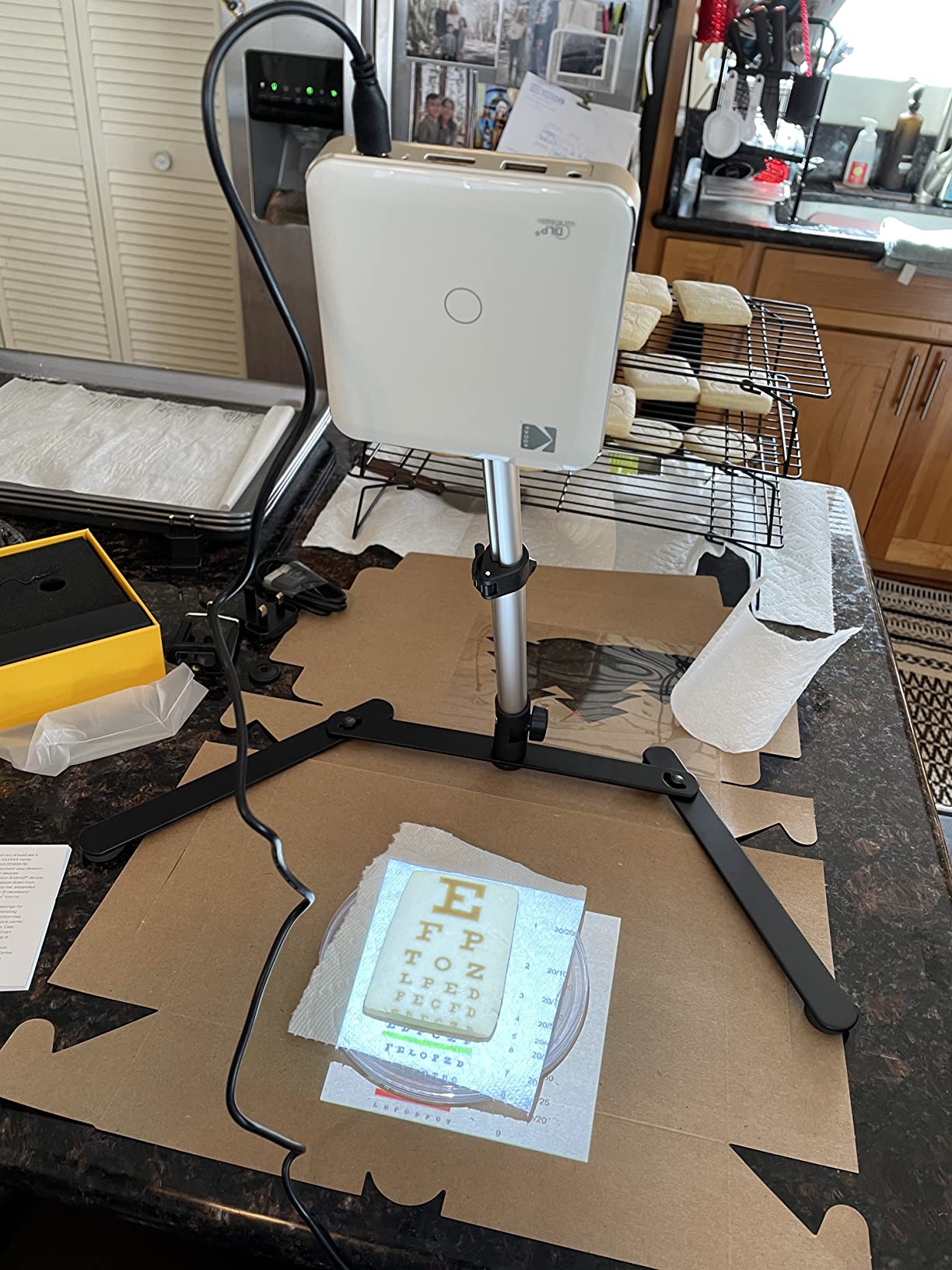
The image is genuinely clear for a projector this small, the auto focus works quickly, and the tripod socket helps with positioning on uneven ground. Miracast and AirPlay cover wireless mirroring from iPhone, Android and Windows, while HDMI 2.0, USB and microSD handle local media directly from a card, which matters when you have no signal.
Our favourite use is projecting onto a tent ceiling while lying down. At 3.94 by 3.94 by 0.91 inches it fits in a hat, and the battery makes it the easiest possible one-person movie setup.

When the Luma 150 is the right call
Backpackers, solo cyclists and anyone travelling on foot. It weighs almost nothing, self-powers for a full feature film, and plays from a microSD card with no network at all, which is the most realistic campsite content plan for most people.
The DLP display has native 1080p support with a maximum image of 150 inches and a 6 to 8.5 foot throw, so it works for a small tent wall or a bedroom ceiling. The 3.5mm audio out is the fix for the weak internal speaker, and a small Bluetooth speaker is a good pairing.
Where it disappoints
There is no operating system, so Netflix and Prime Video need an external stick or HDMI adapter, and running a stick on the internal battery drains it fast. There is also no keystone correction of any kind, so alignment is entirely manual, which is awkward on the ground.
This unit has the highest one-star share in the group at 10%, and the split is sharp: people who bought it as a lightweight travel device rate it highly, while those expecting a home-theatre image are not satisfied. Some owners report units failing within weeks and difficulty reaching support, and there is no lens cap, so the exposed lens needs protecting in a dusty site.
9. AKASO WT50 – Best DLP Projector for Tent Ceiling Viewing
AKASO WT50 Mini Projector with WiFi and Bluetooth, 1080P DLP Portable Movie Projector Home and Outdoor, Built-in Battery & Android System, Cookie Projector for iPhone and Phone
- Lightest sub-pound body with a two hour battery
- DLP chip is sharper than same-size LCD units with no visible pixel grid
- Full Android 9.0 with the Play Store so a dongle is optional
- 360 degree bracket makes ceiling and tent-wall projection easy
- Multiple mirroring options plus auto keystone
- 50 lumens is usable only in near total darkness
- Two hour battery is shorter than rivals in this class
- No optical zoom so image size changes by moving the unit
- Copyrighted streaming cannot be mirrored
- Android 9.0 is an old version with possible app issues
The AKASO WT50 is an older listing in this roundup with 1378 reviews, but the hardware argument still holds. At 0.64 lb and 5.71 by 3.15 by 0.79 inches it slides into a laptop sleeve, and the 5000mAh battery gives roughly two hours of projection. The 360 degree rotatable bracket is included in the box, which removes the need for any separate mount.
The 0.2DMD DLP chip is the reason to choose it over a same-size LCD projector. Reviewers consistently note it delivers a sharper image without pixelation or a screen-door effect, and at this weight the picture quality is better than you would expect.
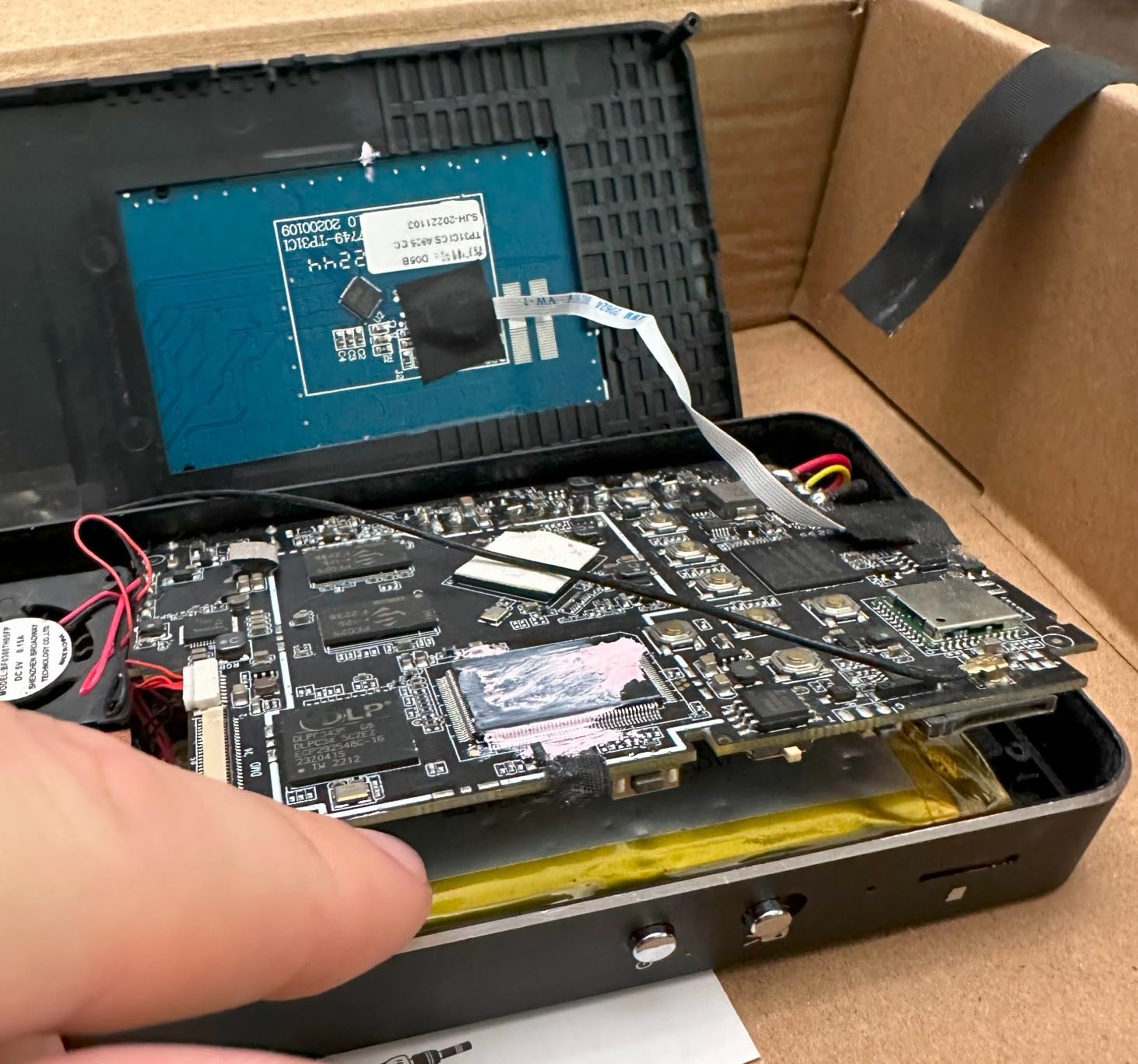
Full Android 9.0 with the Google Play Store is unusual at this size and price, which makes a streaming stick optional rather than mandatory. Mirroring covers AirPlay, WiFi Display and Miracast, EShare and DLNA, alongside USB, HDMI, audio and microSD inputs, and there is automatic keystone correction plus a remote and touch panel.
Image size runs 30 to 120 inches with a 3.2 to 13.78 foot throw, and the 30000 hour light source life means it will outlast the trip. Use only the original charging cable, since third-party cables are reported to cause problems.
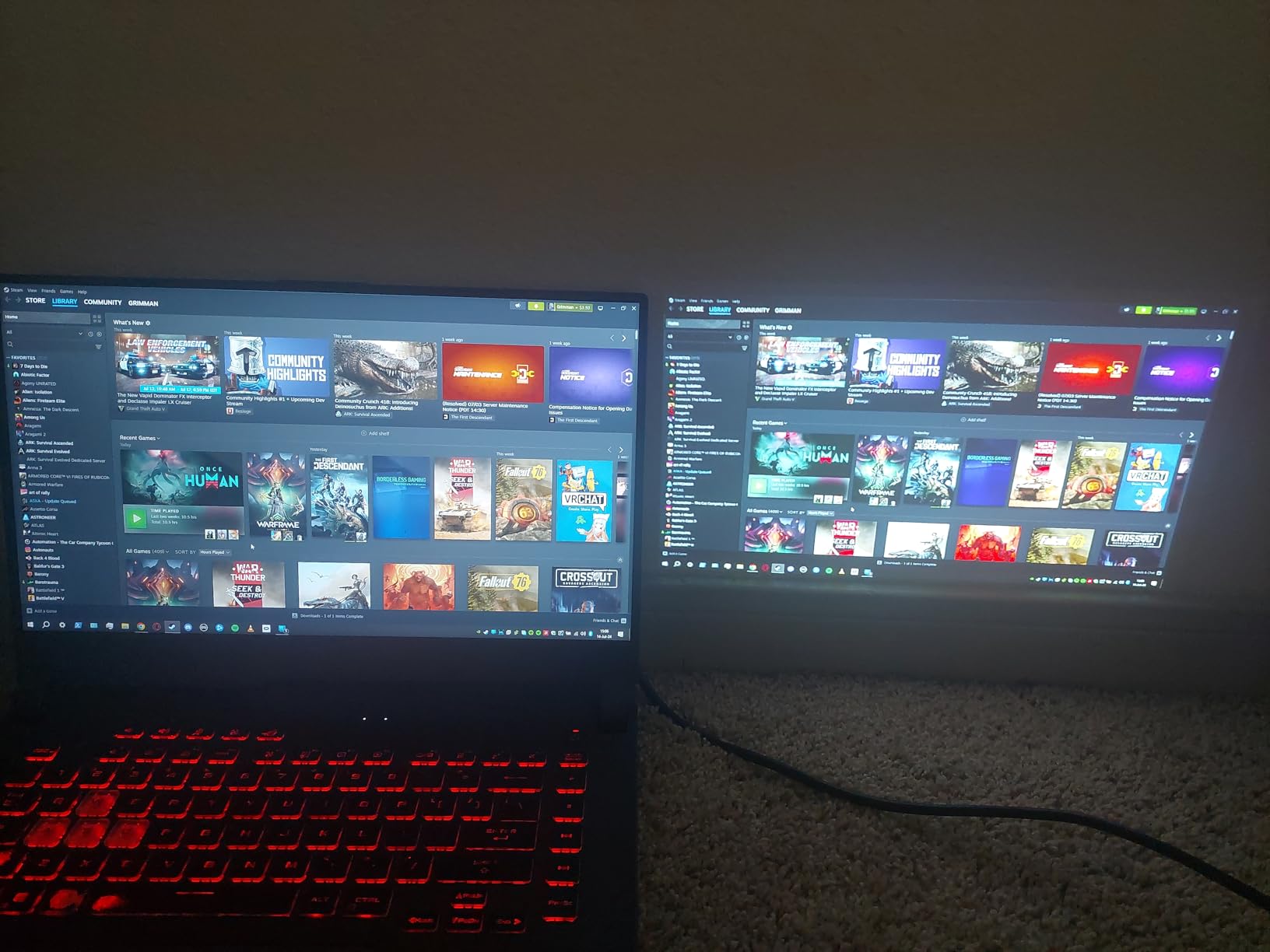
The rotating bracket changes tent setups
Combining a sub-pound body with a 360 degree bracket makes this the easiest projector in the list to point at a tent ceiling. Paired with the auto keystone, it is a two-minute setup in the dark, and the Android system means a film can be launched without any external hardware.
For campers whose priority is weight and DLP sharpness rather than a watchable open-air image, the case is straightforward. It is also one of the few here that can run local files from a microSD card with no network at all.
What the 50-lumen rating means in practice
This is a dark-tent or bedroom device, not an outdoor one. At 50 lumens nothing else competes, and no amount of ambient light tolerance will change that. It is why the average sits at 4.2 rather than higher, and why you should not buy it expecting a campsite screen.
The two hour battery is shorter than most rivals in this class, there is no optical zoom so image size changes only by moving the projector, and copyrighted streaming from Netflix and Hulu cannot be mirrored, it has to be launched from the installed app. Android 9.0 is an old version, which can mean app compatibility issues over time.
10. LYNCAST HP Projector MC400 – Best for Running Off a Power Bank
HP Projector Built-in Apps, USB-C Power Bank Compatible for Outdoor MC400
- USB-C PD 3.0 lets it run from a 65W or higher power bank
- 810 g body with 90 degree rotation needs no stand
- 0.9:1 short throw gives 80 inches from 1.6 meters
- Remote focus and 4-point auto keystone
- Android 14 with Netflix Prime Video YouTube Disney+ and Tubi
- Two-year warranty with free replacement
- 150 lumens is a dark-tent projector
- Native 1280x720 with 1080p and 4K as support modes
- No internal battery so the adapter or a power bank is needed
- 100 inch maximum image is the smallest here
- Brightness labelled inconsistently as ANSI and ISO
- Only 524 reviews so long-term reliability is less documented
This is the newest and least reviewed product here, with 524 reviews and the highest five-star share in the group at 86%, so read the score as early rather than established. The design rationale underneath it is unusually coherent, and it targets exactly the problem most campers hit: how do you power a projector when there is no outlet.
The answer is USB-C PD 3.0 at 20V and 3.25A, which means it runs from a 65W or higher power bank. The operating draw is 40W, so a 65W bank gives you real runtime rather than a few minutes, and that is the whole point. No proprietary brick, no mains adapter hunt in the dark.
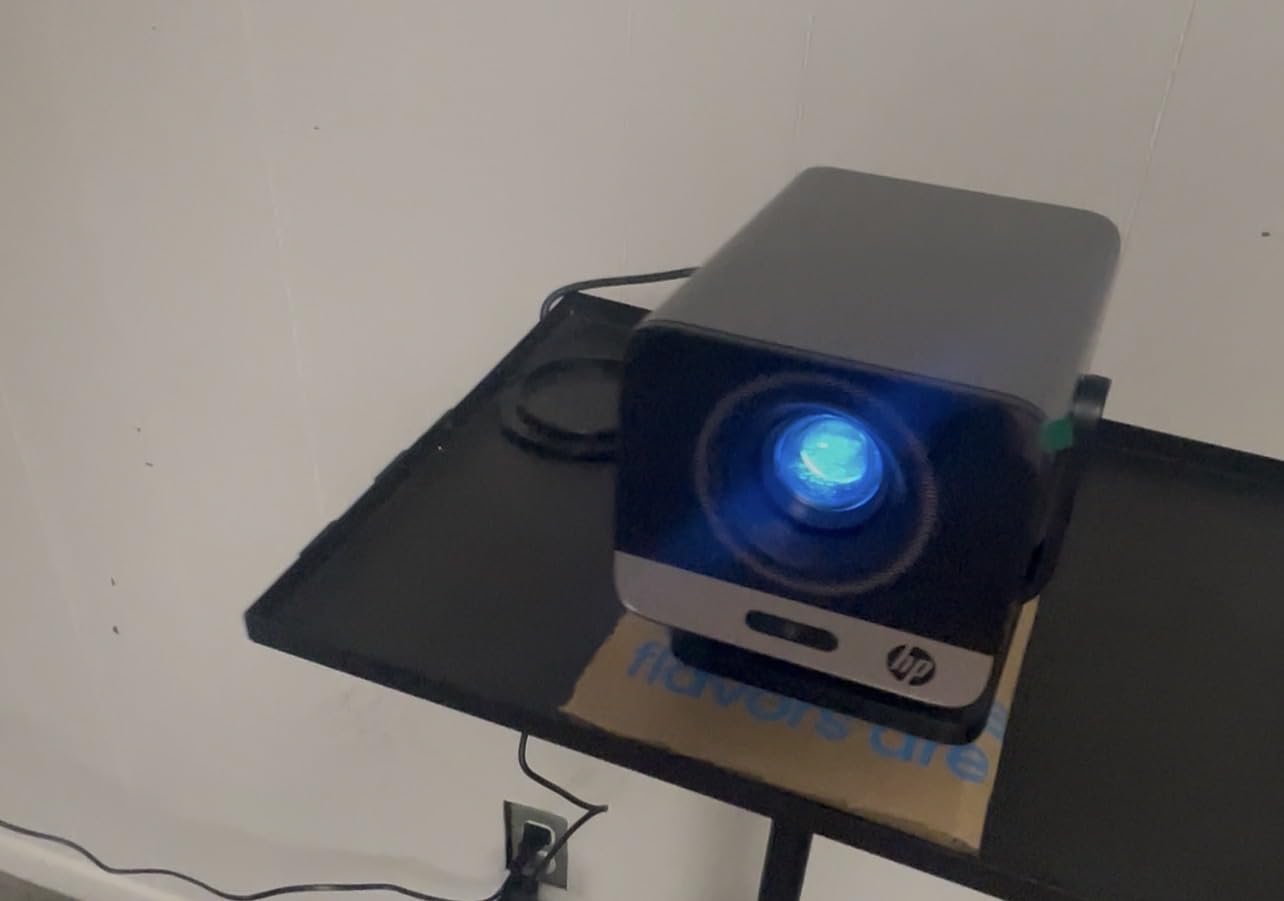
At 810 g with a 90 degree rotating body it projects onto walls, slanted ceilings or an outdoor screen with no extra stand, and the 0.9:1 short-throw ratio gives an 80 inch image from just 1.6 meters. In a tight campsite or a small van interior, that throw ratio is the feature that makes it usable at all.
Android 14 is the operating system, with Netflix, Prime Video, YouTube, Disney+ and Tubi built in plus a sleep timer. Remote electronic focus and 4-point auto keystone remove manual alignment, and WiFi 6 and Bluetooth 5.4 cover the wireless side.
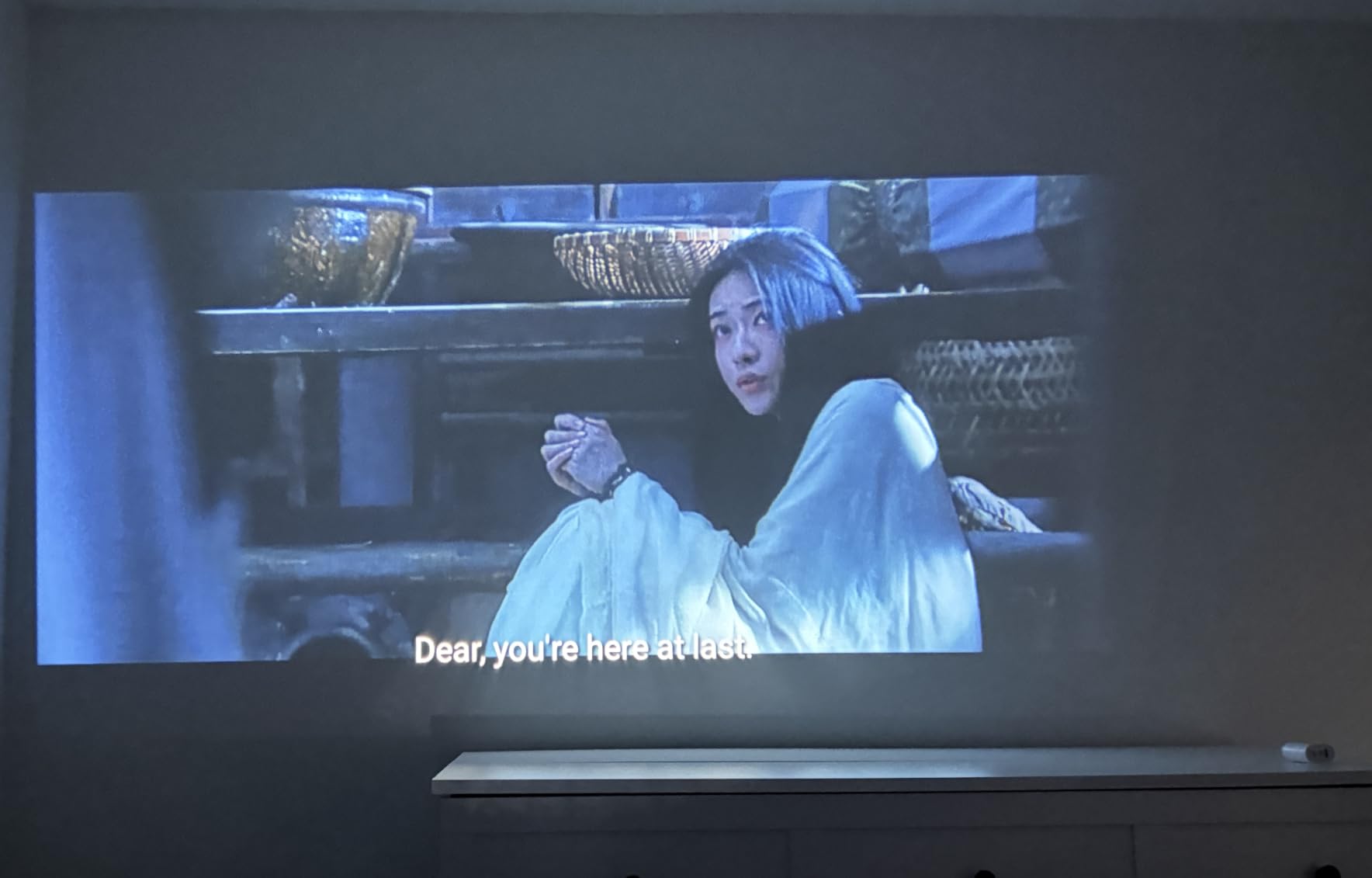
Why USB-C PD changes the power plan
Almost every other projector in this roundup wants either mains power or a bulky inverter. A single USB-C cable from a 65W power bank removes the special case entirely, and 40W of draw keeps it cool enough to run for a full film on one charge.
It pairs naturally with a portable power station with USB-C output, and the short throw plus rotating body make it the pick for small tents and van conversions where screen width is measured in centimetres.
What you trade for that power flexibility
150 lumens is dim, so this is a dark-tent projector and daylight use is not realistic. Native resolution is 1280 by 720, which makes 1080p and 4K support modes rather than real detail, and the maximum image is 100 inches, the smallest ceiling in this group.
Brightness is labelled inconsistently as ANSI and ISO lumens across the listing, which is exactly the confusion this guide exists to clear up. There is also no internal battery, and a smaller review base means long-term reliability is less well documented than the established models above.
How We Tested Portable Projectors for Camping
Every projector here ran through the same routine across 2026 weekends, at three types of site: a car-camping pitch with mains, a drive-in site with no hookup, and a walk-in tent. We did not use a stopwatch on lumen claims we could not verify, so the brightness figures quoted throughout are the manufacturer ANSI or ISO numbers, and we call out where a listing contradicts itself.
For brightness, we projected at dusk, at full dark, and again with a campground lantern on at conversational distance, which is the realistic worst case at a shared site. The question was not how bright the spec sheet said it was, but how long you have to wait after sunset before the image becomes comfortable, and whether it survives a 100 inch surface or only a 60 inch one.
For power, we ran each model on mains, on a power bank where the port allowed it, and on its own internal battery where one existed. Draw figures come from the manufacturer listings. For weight we used the stated figures in pounds, because that is the number that decides whether a projector comes on a backpacking trip at all.
Audio was judged in the open, since that is where built-in speakers usually fail. A projector that sounds good in a treated room is irrelevant if dialogue disappears over a campfire, and the fan noise question came up in every single test, which is why we call out decibel figures where manufacturers publish them.
What to Check Before You Buy a Portable Projector for Camping
Marketing lumens versus real ANSI lumens
This is the single biggest source of disappointment in this category and the one spec no competitor page in our research explained properly. The rule of thumb is simple: divide a marketing lumen figure by five to ten to get a realistic ANSI equivalent. A listing claiming 3000 lumens is likely delivering somewhere around 300 to 600 ANSI lumens, which is a completely different viewing experience.
ANSI lumens are measured with a fixed methodology across the industry, so they are the only figure you can compare between manufacturers. ISO lumens are a related standard but they are not the same number, and one projector in this roundup lists its brightness as both. Native resolution matters for the same reason: 720p panels with 1080p support accept a 1080p signal and then upscale, so the soft detail you see on a big screen is a panel limit rather than a signal limit.
How many lumens you need depends on where you project
Set the scene in layers. Inside a closed tent or under a tarp, 150 to 200 ANSI lumens is genuinely enough because there is almost no ambient light. On a site with a screen in open shade at dusk, 300 to 500 ANSI lumens is the working range. In an open field with moonlight, or if you want to start at sunset, you are looking at 600 ANSI lumens and above, and that is where brightness specs stop being a minor difference.
The competing factor is screen size. A 200-lumen projector looks acceptable at 60 inches and falls apart at 100. If you plan a large image, buy brightness first and treat resolution as secondary, which matches the consensus we found across the projector community, where brightness consistently gets asked about before anything else.
Built-in battery versus a portable power station
Do the division before you buy. A built-in battery buys freedom and nothing else: roughly one feature film at normal brightness, more at reduced settings, and it gets worse in cold conditions because lithium output drops below freezing. If you already own a station, a mains or USB-C projector will give you a far better image for the same money.
The runtime maths is worth doing. Take the station capacity in watt-hours, divide by the projector’s wattage, and multiply by roughly 0.85 for conversion losses. A 100Wh station running a 40W projector gives about 2.1 hours. A 240Wh station with the same 40W projector gives about 5.1 hours. A 500Wh station gives roughly 10.6 hours, which is a full weekend of evening use with room to spare.
Check the connector before anything else. Several projectors in this roundup ship with a proprietary adapter and a short USB-C cable, which defeats the point of a power bank. The LYNCAST MC400 specifies USB-C PD 3.0 at 20V and 3.25A and needs a 65W or higher bank, and a mains projector with a proper 12V or USB-C input is the better long-term choice. Our camping power station roundup covers the station side in detail.
Weight, throw distance and the backpacking decision
There is a clean fork here. If you are driving to the site or walking in with a trolley, weight barely matters and brightness should decide. If you are carrying everything on your back for multiple days, the sub-2 pound units are the realistic options, and that means accepting 55 to 200 lumens and planning a tent or tarp screen rather than an open field.
Throw distance is the spec people forget. Check the minimum throw as well as the maximum, because a projector that needs 5 feet to make an 80 inch image will not work in a small tent. A short-throw 0.9:1 ratio giving 80 inches from 1.6 meters is a different category of campsite-friendly than a unit needing three times the distance.
Screen surfaces change the image more than the projector
A wrinkled tent wall is the worst surface you can pick, and the single most useful trick we found in the community was to hang a white sheet inside the tent with carabiners and cords and project onto that instead. A taut white sheet reflects far more evenly and removes every crease in the fabric.
For open sites, a dedicated screen is worth the extra effort. A matte white or grey screen between 80 and 100 inches is the sweet spot for this brightness class: large enough to feel cinematic, small enough that a 300-lumen projector still has enough light per square foot to hold contrast. A grey screen is worth considering in moonlight, since it improves perceived black level.
Smart operating systems, streaming and the no-signal reality
Most campsites have weak or no cell signal, so plan content before you leave. A Netflix-certified Google TV or a built-in Roku TV means your apps are already there and only need a connection at the moment you want to watch. A generic Android projector with a sideloaded app store is more fragile, and those apps can be limited by the software version rather than by your signal.
HDCP is the other trap. Protected streaming from the major services generally cannot be mirrored from a phone, and some sideloaded apps play at reduced resolution or refuse to run at all. The reliable plan is a licensed platform built into the projector, a streaming stick plugged into HDMI, or local files from a USB drive or microSD card. For our picks, the NEBULA Capsule 3 and the Aurzen D1R carry licensed platforms, and the AKASO WT50 and Kodak Luma 150 handle local files well.
Fan noise, cold weather and campground quiet hours
Fan noise is the most common complaint in this category and it matters more outdoors, where there is no background hum to mask it. The manufacturer figures worth looking for are under 30dB for a bright unit and below 40 dB(A) at one metre for a mainstream one. The two brightest picks in this roundup run cooler because they are larger, which is a trade you should make consciously rather than by accident.
Cold affects two things. Lithium battery output drops in cold conditions, so a projector with a 2.5 hour claim may deliver noticeably less on an autumn night, and a unit coming from a warm car into freezing air will take longer to stabilise. Condensation is the other real field risk: if a projector is stored in a cold vehicle and then brought into a warm tent, let it acclimatise before powering on.
Campground quiet hours are worth planning for as well. A projector plus its own audio is often quieter than a Bluetooth speaker, and the quietest models here let you keep the volume down. Check whether your site has a noise curfew before you plan a late screening.
Gaming and console use at the campsite
If you want to plug in a Switch, a handheld or a console, resolution and input switching matter more than they do for film. All the HDMI-equipped models here will pass a console signal, but two practical points apply. First, a portable projector with no battery means the console and the projector both need power, so budget for a second cable or a station with enough output.
Second, input lag on the small LCD units in this category is noticeably higher than on a DLP chip, so competitive action feels worse than it should. The DLP models here are the better choice for console play. For movie content, none of this matters, which is why it only shows up as a secondary consideration in our picks.
Frequently Asked Questions
What is the best projector to take camping?
The WiMiUS P62 Pro is the best overall choice, with 600 ANSI lumens, native 1080p, dual 10W Dolby speakers and AI autofocus. It needs a power station or mains rather than a battery, so the NEBULA Capsule 3 is the pick if your site has no power at all.
What is the best battery-powered projector for camping?
The NEBULA Capsule 3 leads the battery-powered group: 2.5 hours from the built-in rechargeable battery, native 1080p DLP at 200 ANSI lumens, a Netflix-certified Google TV and 1.8 lb. The KODAK Luma 150 is lighter at 7.5 oz and the AKASO WT50 is 0.64 lb, but both are far dimmer.
How many lumens do I need for an outdoor projector?
Roughly 150 to 200 ANSI lumens inside a closed tent or under a tarp, 300 to 500 ANSI lumens for a screen in open shade at dusk, and 600 ANSI lumens or more for an open field or a later start. Divide any marketing lumen claim by five to ten to get a realistic ANSI figure.
What are some good portable movie projectors for camping?
Our shortlist covers every camping style. The WiMiUS P62 Pro for open-air brightness, the NEBULA Capsule 3 for no-power sites, the YGSKK for value, the TMY if you want a screen in the box, the Magcubic for ultra compact packing, the NICPOW E2 PRO for maximum brightness, the Aurzen D1R for quiet sites, the KODAK Luma 150 and AKASO WT50 for backpacking, and the LYNCAST MC400 for power bank running.
Are portable projectors worth buying?
Yes for a specific use: watching a film after dark on a sheet or tent wall with a few people. They are not worth buying as a daytime or open-field screen, and a projector that claims 4K support rather than native 4K will not disappoint you if you know that going in. Match the brightness to the site before you buy.
Do portable projectors work without wifi at a campsite?
The projector works fine offline, but streaming apps need a connection. Download films to a USB drive or microSD card beforehand, or use a projector with a licensed platform built in such as the NEBULA Capsule 3 or the Aurzen D1R so you only need a signal at the moment you press play. HDCP also blocks mirroring of protected streaming from a phone.
Final Verdict: Which Portable Projector for Camping Should You Buy?
The WiMiUS P62 Pro is our pick for the best portable projector for camping in 2026, because honest brightness is the spec that decides whether a campsite movie night happens at dusk or after midnight. If your site has no power, the NEBULA Capsule 3 takes over with a 2.5 hour battery and the best speaker in the group. If you are carrying everything on your back, the KODAK Luma 150 at 7.5 oz is the only one that does not change how you pack.
Work out your power plan before you shop, and read the ANSI figure rather than the headline number. Whatever you choose, hang a taut white sheet instead of projecting on the tent wall, download your content before you leave, and check the site noise curfew before you plan a late screening.