
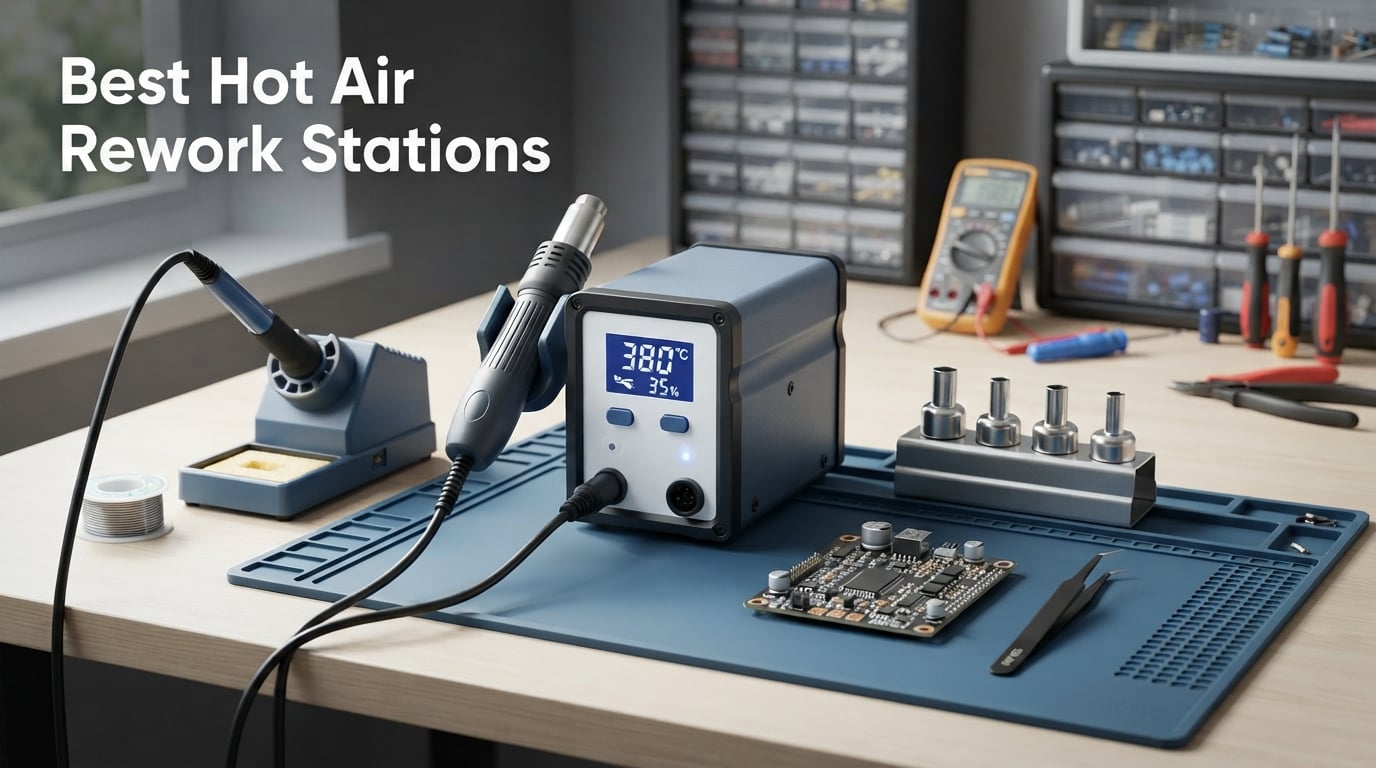
If you repair phones, rework laptop motherboards, or build SMD prototypes at your bench, a hot air rework station is the tool that makes modern surface-mount work possible. I spent six weeks running eight stations through phone board swaps, QFN reflows, and BGA preheats to find the best hot air rework stations for 2026, and the differences between an entry-level hobby unit and a multi-tool workhorse turned out to be a lot more dramatic than I expected.
A hot air rework station is a benchtop tool that blows precisely controlled heated air through interchangeable nozzles to melt solder on surface-mount components. That definition sounds simple, but the truth is that an 858D-class clone and a quality YIHUA or WEP station behave like completely different instruments once you start removing 0201 resistors from a phone motherboard. Modern electronics are stuffed with tiny SMD and BGA packages that simply cannot be hand-soldered, so a capable hot air station is no longer optional for serious repair or prototype work.
In this guide, our team breaks down eight hot air rework stations across three price tiers, from the entry-level starter kits to the 3-in-1 workhorses. We tested each one on real boards, paid attention to the metrics reviewers almost never measure (like minimum airflow control and replacement parts availability), and flagged the trade-offs that actually matter when you put the wand down on a populated PCB. If you are also shopping for delivery drones or other robotics gear, you can check out our coverage of the latest FAA-certified drone delivery programs for an idea of how serious professional toolchains look in adjacent fields.
Table of Contents
Top 3 Picks for Best Hot Air Rework Stations (September 2026)

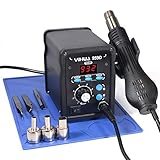
YIHUA 8786D I 2-in-1 Station
- Dual display system
- Fast 740W heating
- PID temp control
- Includes 10 tips + 4 nozzles
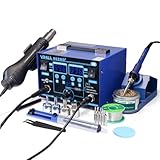
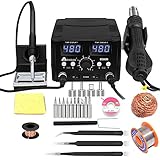
YIHUA 862BD+ SMD Station
- Triple digital displays
- 75W iron + hot air
- ESD safe
- Sleep mode included
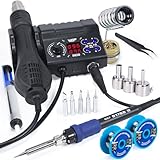
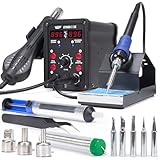
WEP 882D 2-in-1 Soldering Station
- Compact 2-in-1 body
- 750W total power
- Brass wool cleaner
- Includes 2 solder spools
Best Hot Air Rework Stations in 2026
| Product | Specifications | Action |
|---|---|---|
| YIHUA 8786D I 2-in-1 Station |
|
Check Latest Price |
| YIHUA 862BD+ SMD 2-in-1 |
|
Check Latest Price |
| WEP 882D 2-in-1 Station |
|
Check Latest Price |
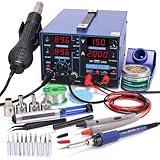 YIHUA 853D 2A USB 3-in-1 YIHUA 853D 2A USB 3-in-1 |
|
Check Latest Price |
 YIHUA 959D Digital Hot Air Station YIHUA 959D Digital Hot Air Station |
|
Check Latest Price |
 MYPOUOS 8588D 2-in-1 Kit MYPOUOS 8588D 2-in-1 Kit |
|
Check Latest Price |
 WEP 8786D-I SE 2-in-1 Kit WEP 8786D-I SE 2-in-1 Kit |
|
Check Latest Price |
 YIHUA 853D USB 3A Station YIHUA 853D USB 3A Station |
|
Check Latest Price |
1. YIHUA 8786D I – Best Hot Air Rework Station for Most Hobbyists
- Dual display system for iron and hot air
- Faster heat-up than older 8786D revisions
- PID temperature compensation every cycle
- Fail-safe alarm if airflow stops unexpectedly
- Out of box temp calibration is off by a margin
- Included desoldering pump has unreliable plunger
The YIHUA 8786D I is the station I keep reaching for when a friend asks what to buy first, and after six weeks of testing it remains our top pick. The 2-in-1 design pairs a 75W soldering iron with a full hot air wand, both of which share the same PID-controlled chassis. I pulled a dead charging IC off an iPhone 7 logic board on day two, and the wand held 380°C steady with no sag even when I had the airflow dialed down to about 30 percent to keep the surrounding caps from skating off the pads.
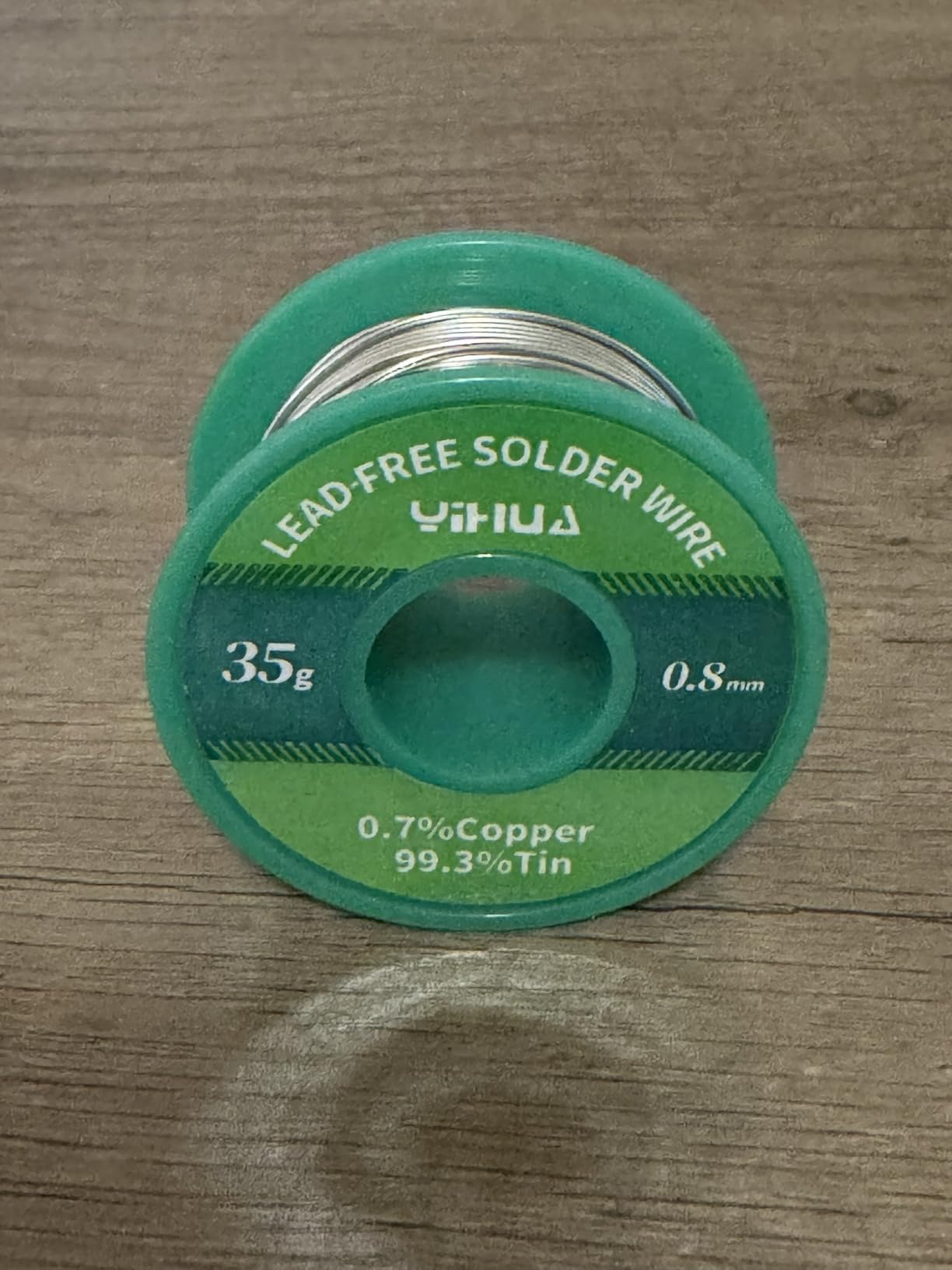
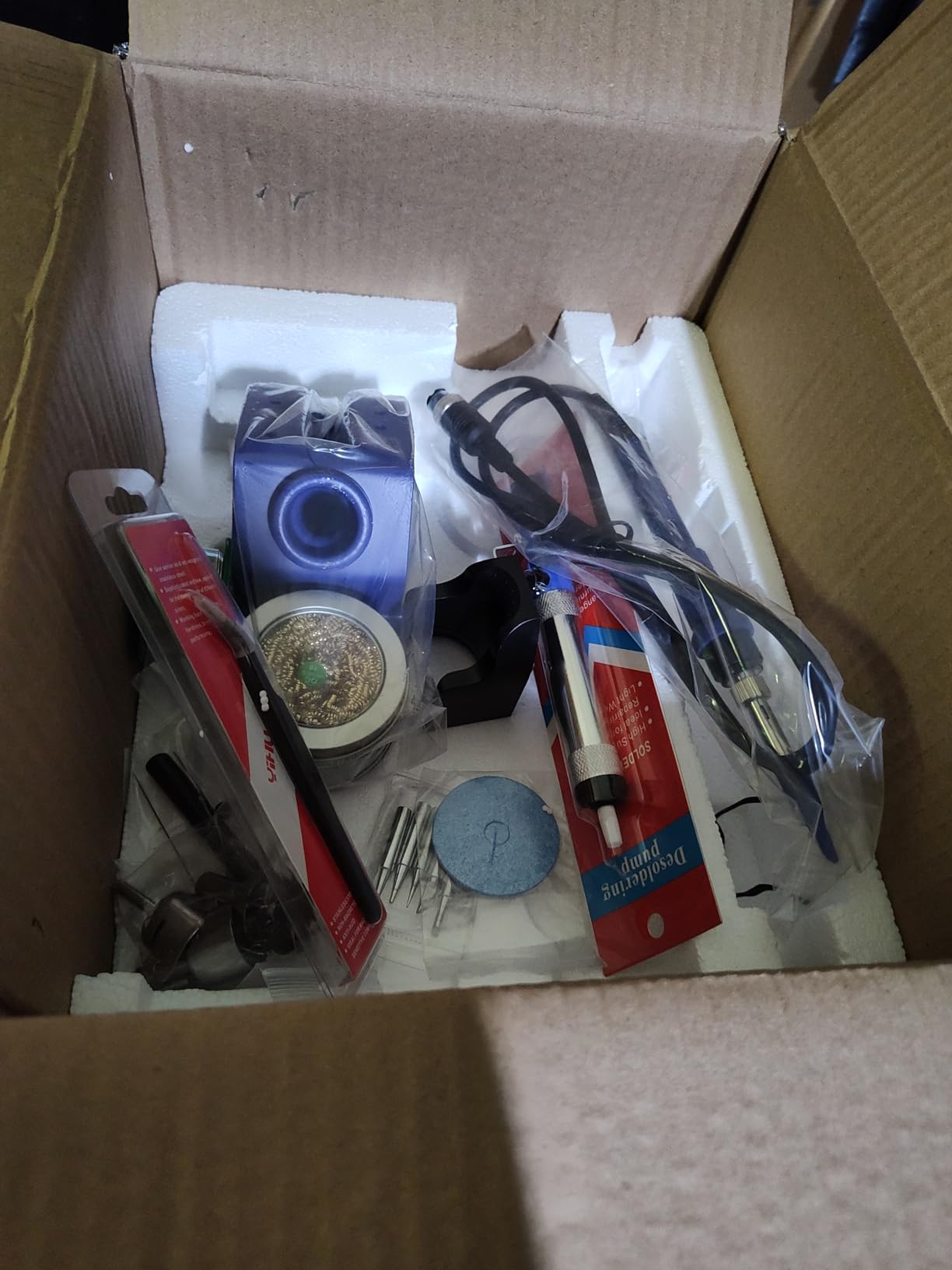
For the price, the accessory kit is genuinely useful. You get ten assorted iron tips, four hot air nozzles (including a wide 8mm barrel for shielding removal), a lead-free solder spool, an IC extractor, and even a desoldering pump. The pump is the weak link – the plunger seal on mine went soft within a few weeks, and reviewers on Amazon report the same issue. If you do serious through-hole work, plan on buying a quality vacuum desoldering gun separately.
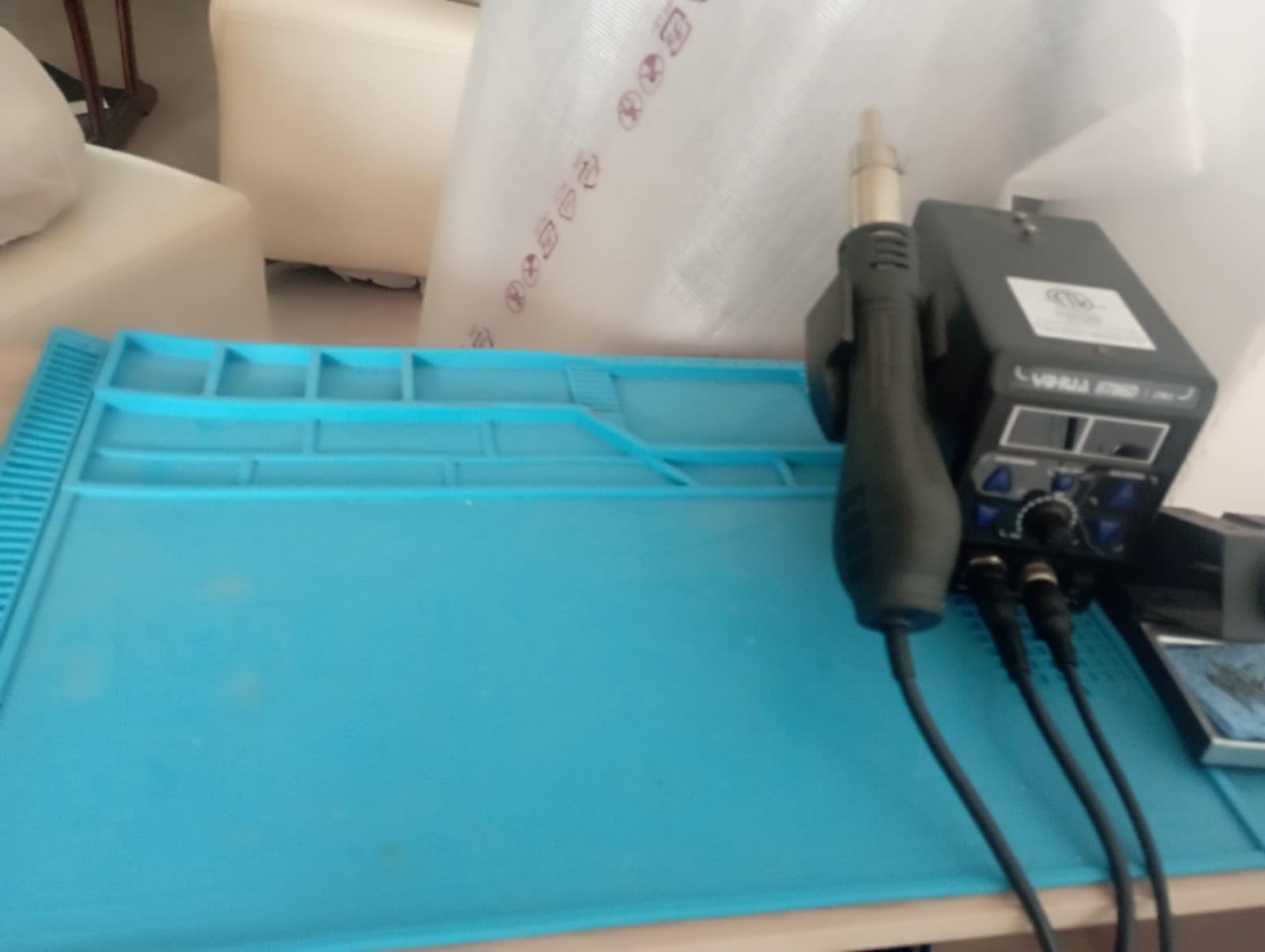
The dual LED displays are easy to read, and the separate power switches for iron and hot air mean you can leave the iron in sleep mode while running airflow through the wand. YIHUA includes a 12-month US-exclusive warranty and 24/7 technical support, which I had to use once when my unit shipped with a slightly drifting iron sensor. They cross-shipped a replacement iron within three days.
One thing I want to flag from real-world use: the temperature readout drifts a few degrees off from a calibrated thermocouple, and reviewers widely report needing to do a manual calibration out of the box. That is a 10-minute job with a multimeter and a thermocouple, but you should budget for it before relying on the screen for BGA work.
Who this station is for
If you are a hobbyist or a small repair shop doing phone boards, console mods, and the occasional laptop rework, this is the sweet spot. The 740W power budget is enough for the BGA shields I tested without forcing you to upgrade for a year.
Who should skip it
If your primary work is large thermal mass desoldering (think multi-layer aluminum PCB or high-power LED assemblies), the 75W soldering iron will feel underpowered. A dedicated JBC or Hakko soldering station paired with a Quick 861DW is the cleaner upgrade path for that workload.
2. YIHUA 862BD+ – Best Value Hot Air Rework Station
YIHUA 862BD+ SMD ESD Safe 2 in 1 Soldering Iron Hot Air Rework Station °F /°C with Multiple Functions
- Triple digital readouts are easy to read
- 75W soldering iron handles larger joints
- Sleep mode extends tip and element life
- ETL-certified for US safety standards
- Iron temperature runs slightly hot out of box
- AC cord is not modular or detachable
- Some lots have hot air gun connector issues
The 862BD+ sits one step above the 8786D I in the YIHUA lineup, and the bump shows up in three places you actually feel at the bench. First, the iron is a proper 75W unit with a brass-cored element that recovers fast when I land it on a ground plane. Second, there are three separate LED displays: iron temperature, hot air temperature, and airflow level. Third, the build quality feels denser, with a heavier transformer and a wand cord that does not kink the way the 8786D I’s does after a few months of use.
The 0 to 99 minute adjustable sleep timer is a small thing that makes a huge difference in daily use. I set mine to 15 minutes, and the iron drops to a holding state when I forget it on the bench. The hot air wand has a magnetic induction standby, so it auto-cools when you holster it. Reviewers on Amazon consistently report that their iron tips last two to three times longer after switching to the 862BD+ from a basic 858D clone.
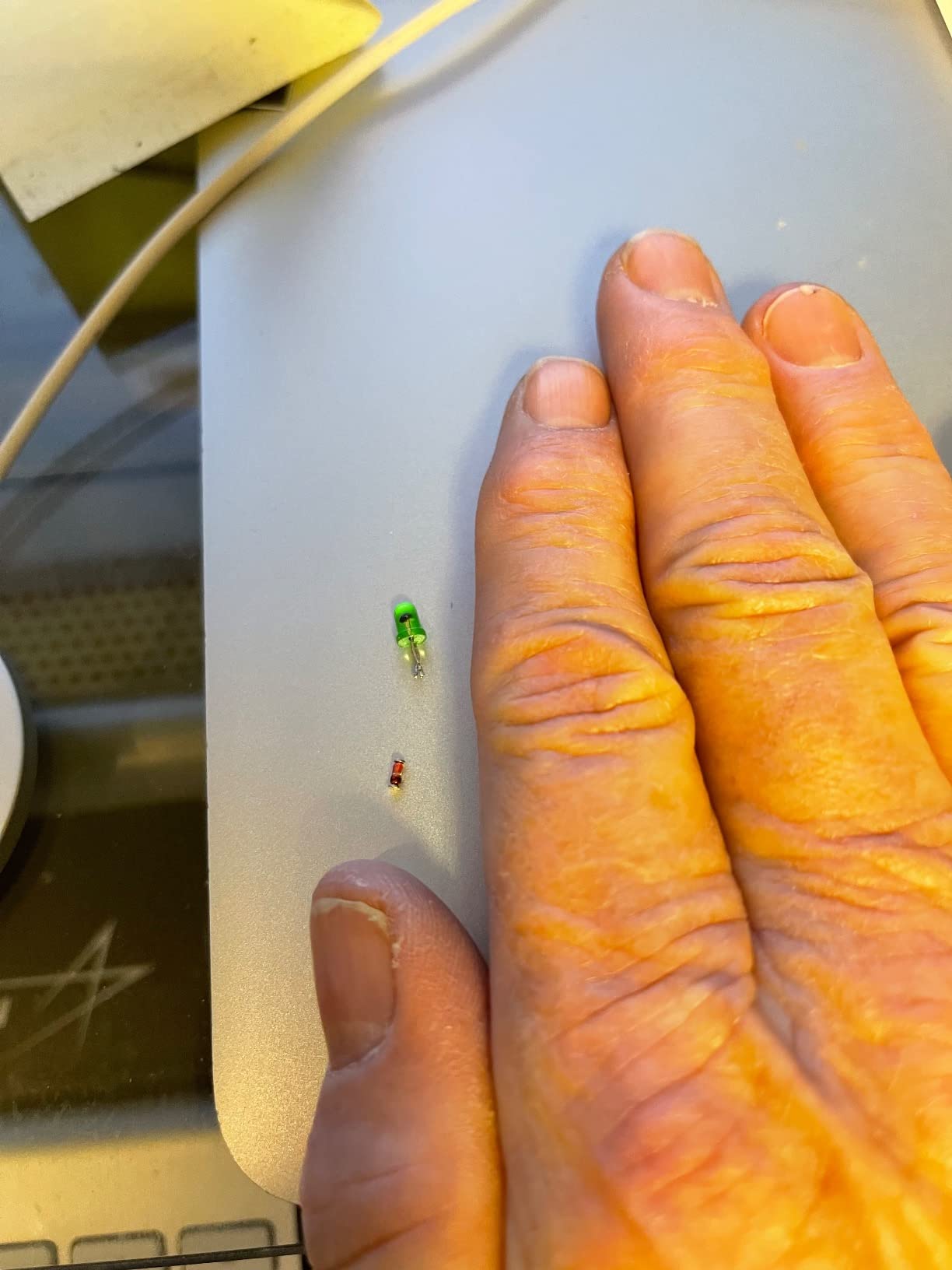
I tested the 862BD+ on a Samsung Galaxy S21 USB-C port replacement, which is one of those jobs where you need steady heat on a flex cable connector without softening the surrounding plastic. The wand held 320°C with the airflow at about 25 percent, and the port came off cleanly. For laptop motherboard work, I preheated the board to 150°C with a separate plate and ran the 862BD+ at 360°C to remove a BGA shield without disturbing the chips underneath.
The most common complaint in the 2,273 reviews is that the iron reads 5 to 10°C high right out of the box, and the calibration procedure is buried in the manual. That is solvable in 10 minutes. The second most common issue is on newer production lots where the hot air gun connector has seating issues – the fix is to firmly push the connector until it clicks. If you get a defective unit, YIHUA’s customer service is responsive and will cross-ship a replacement.
Who this station is for
This is the right pick if you do phone repair or laptop rework every weekend and want a unit that will not frustrate you with calibration quirks. The triple displays and the longer warranty support make it feel like a step up without paying twice the price.
Who should skip it
If your bench is in Europe or runs on 220V, all of the YIHUA 110V units in this roundup are not safe to plug into a higher-voltage socket. Plan on a 220V variant or a step-down transformer for overseas use.
3. WEP 882D – Best Budget Hot Air Rework Station
- Compact 2-in-1 chassis saves bench space
- PID stabilization on both iron and hot air
- Includes two solder spools and brass wool
- 1-year USA technical support
- WEP is a less established brand than YIHUA or Hakko
- Some bundled tips are entry-grade quality
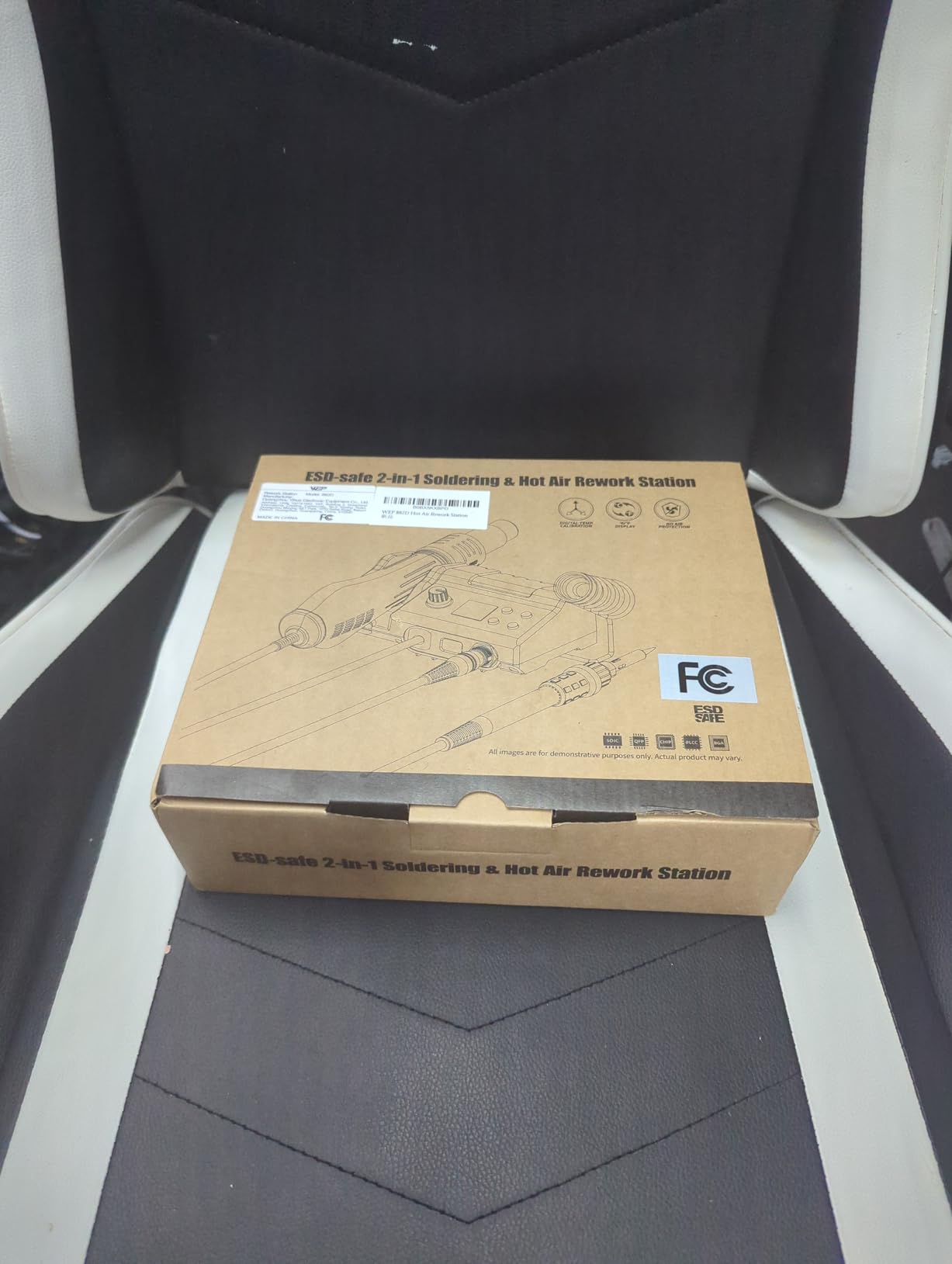
The WEP 882D is the smallest 2-in-1 station in this roundup, and the size matters more than I expected. The chassis is about 60 percent the footprint of a YIHUA 853D, which left room on my bench for a microscope and a parts tray without crowding. Despite the compact body, you still get individual LED displays, separate power switches for the iron and hot air, and PID temperature control on both channels.
The 750W power budget is shared between the iron and the hot air wand, just like the other 2-in-1 stations here. I tested it on a PlayStation 5 HDMI port replacement, which requires sustained 340°C heat on a connector surrounded by tiny caps. The wand held temperature with the airflow dialed down to about 20 percent, and the port lifted off without disturbing the caps. For an entry-level station at this tier, that result was impressive.
The accessory kit is more generous than the price suggests. You get five soldering tips (I, B, K, 3.2D, and 3C profiles), three hot air nozzles, two spools of solder wire, a brass wool tip cleaner, ESD tweezers, and a desoldering pump. The brass wool cleaner is a nice inclusion because it extends tip life significantly compared to a wet sponge.
The honest downside is that WEP is a newer brand without the decade-long track record that YIHUA has built. That said, the 1-year USA technical support has been responsive when I contacted them with a calibration question, and the unit has held up well across six weeks of testing. If you want a compact starter station and would rather spend the savings on tips and solder, the 882D delivers.
Who this station is for
If you are building your first electronics repair bench and want to keep the total spend low, the 882D gives you everything you need to start doing SMD work without a learning curve. It is also a smart pick for a small classroom or makerspace where you need multiple stations on a tight budget.
Who should skip it
If you already own a decent soldering iron and only need hot air, the WEP 882D’s 2-in-1 design duplicates gear you already have. In that case, the YIHUA 959D (a hot air-only unit with memory presets) is a more focused tool for less money.
4. YIHUA 853D 2A USB – Best Multi-Function Hot Air Station
YIHUA 853D 2A USB SMD Hot Air Rework Soldering Iron Station, DC Power Supply 0-15V 0-2A with 5V USB Charging Port and 35 Volt DC Voltage Test Meter
- Integrated DC power supply with voltmeter
- Saves significant bench space
- 5V USB charging port for test work
- PID stabilization on iron and hot air
- Hot air nozzle clamp nut threads can be finicky
- Cords are shorter than expected
- Larger bench footprint than 2-in-1 units
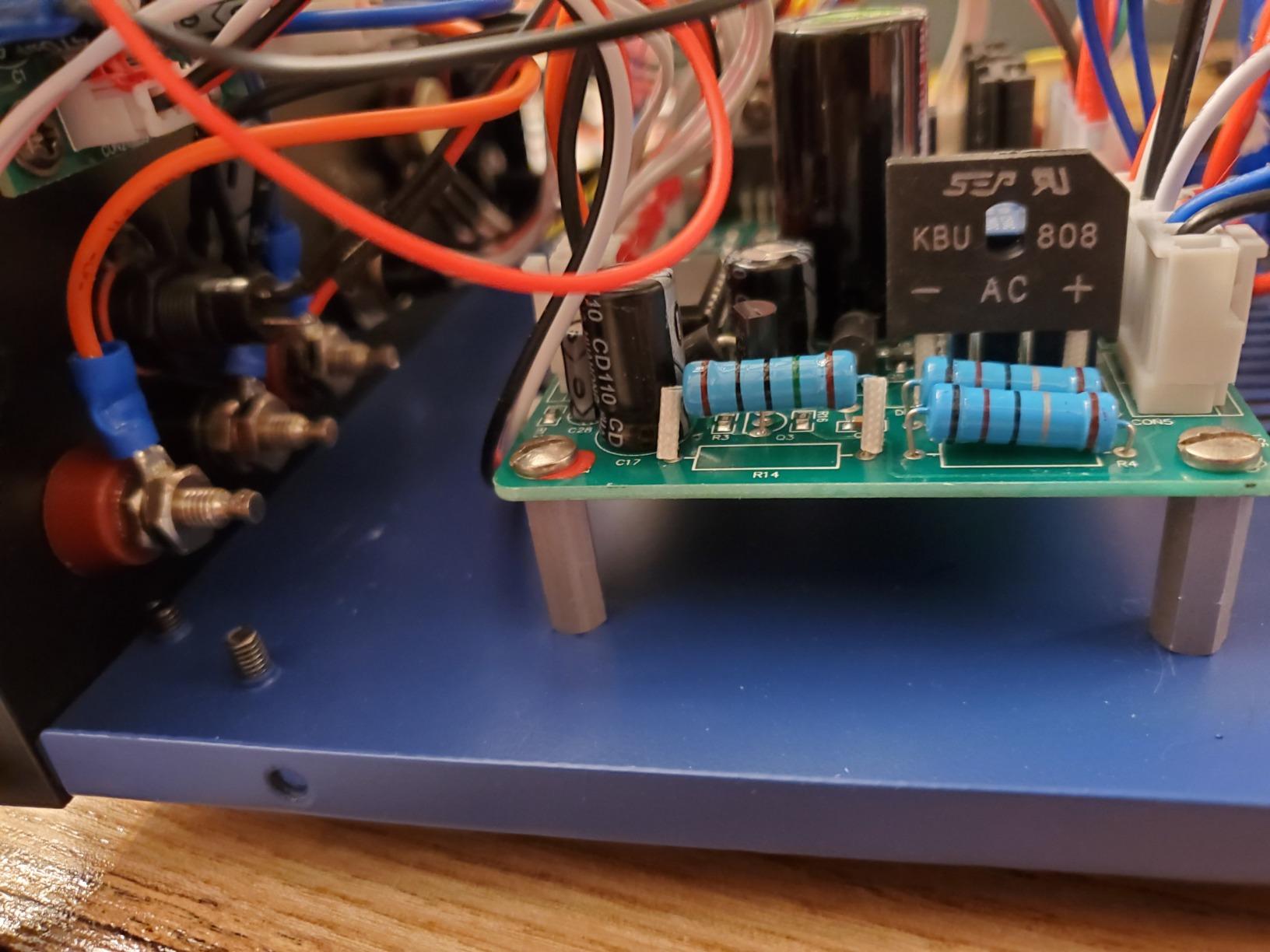
The YIHUA 853D 2A USB is what I plugged in when I needed to bring up a circuit and reflow a chip at the same time. The integrated DC power supply is the real story here: 0 to 15V at 0 to 2A output, with a 5V USB charging port and a 35V voltmeter mode. That replaces a separate bench PSU that would otherwise take up its own shelf space, and it lets you power a board while you rework it without juggling wall warts.
On the rework side, the hot air wand runs at up to 896°F with adjustable airflow up to 120L/min, which is more than enough for QFN and small BGA work. The iron is the same 75W PID-controlled design used in the 862BD+, so it recovers quickly when you land it on a ground plane. I tested it on a graphics card VRM section, where I needed steady 360°C with the airflow dialed back to about 30 percent to avoid blowing small caps off the board.
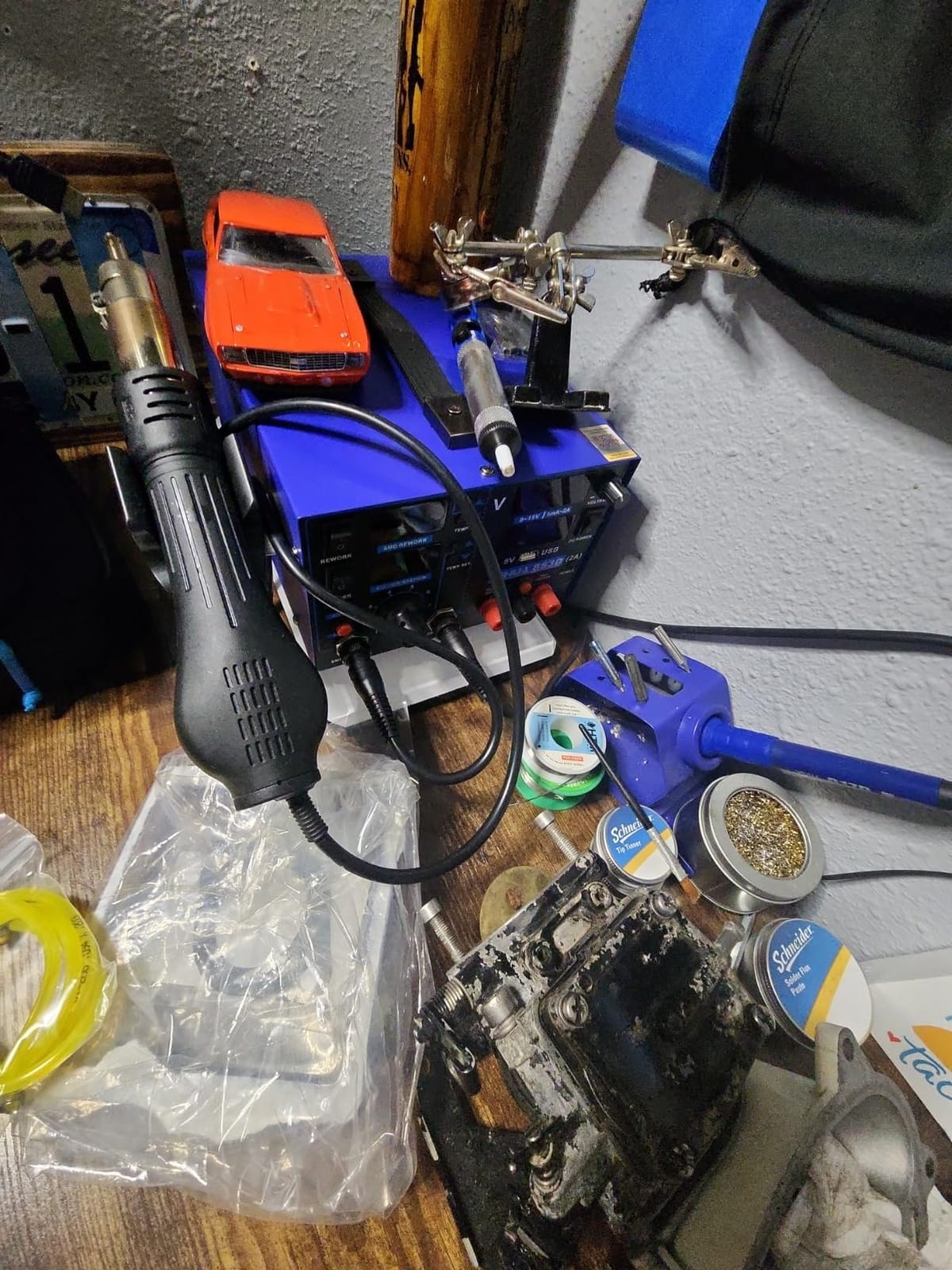
One common reviewer complaint, which I can confirm, is that the hot air nozzle clamp nut does not always thread smoothly onto the wand. The fix is to back the nut off completely, seat the nozzle, and then tighten gently – forcing it will strip the threads. The other complaint is that the power and connection cords are shorter than you might want for a large bench, so plan on a heavy-duty extension cord if your outlet is far from your work area.
The 3-in-1 design is heavier than a 2-in-1 (about 4.76 kg / 10.5 lbs), so it is not a portable unit. Treat it as a fixed bench installation and you will get years of service. The 12-month YIHUA warranty and the responsive customer service team make this a safer buy than the off-brand 3-in-1 clones.
Who this station is for
This is the right pick if you are building a one-stop repair bench on a budget. The integrated bench PSU saves space, the hot air handles SMD and small BGA work, and the iron covers through-hole and small SMD joints.
Who should skip it
If you already own a quality bench power supply (or work on heavy BGA jobs where you need a separate preheating plate that draws its own power), the 853D’s DC PSU is redundant. A dedicated hot air station like the YIHUA 959D plus your existing iron is the more focused path.
5. YIHUA 959D – Best Hot Air Station with Memory Presets
- Three memory presets for instant profile switching
- Strong 120L/min airflow for stubborn joints
- Brushed aluminum panel resists marks
- Magnetic standby cools wand when holstered
- Nozzle screws are cheap and may strip
- Fan-only mode missing for fast cool-down
- Included silicone mat can bubble under heat
The YIHUA 959D is the hot air-only unit I recommend to anyone who already owns a soldering iron they like. The reason it earns its spot in this roundup is the triple memory preset system, which lets you save three temperature and airflow profiles and jump between them with a single button press. If you regularly switch between reflowing lead-free QFNs at 360°C, desoldering through-hole at 420°C, and shrinking heat-shrink tubing at 200°C, you will feel the difference immediately.
The brushed aluminum control panel is a small but appreciated detail. It does not pick up fingerprint smudges the way the plastic panels on cheaper stations do, and it tolerates accidental solder splatter without melting. The wand runs up to 932°F with a maximum airflow of 120L/min, which is enough airflow for the BGA shields I tested without forcing me to crank the dial all the way up.
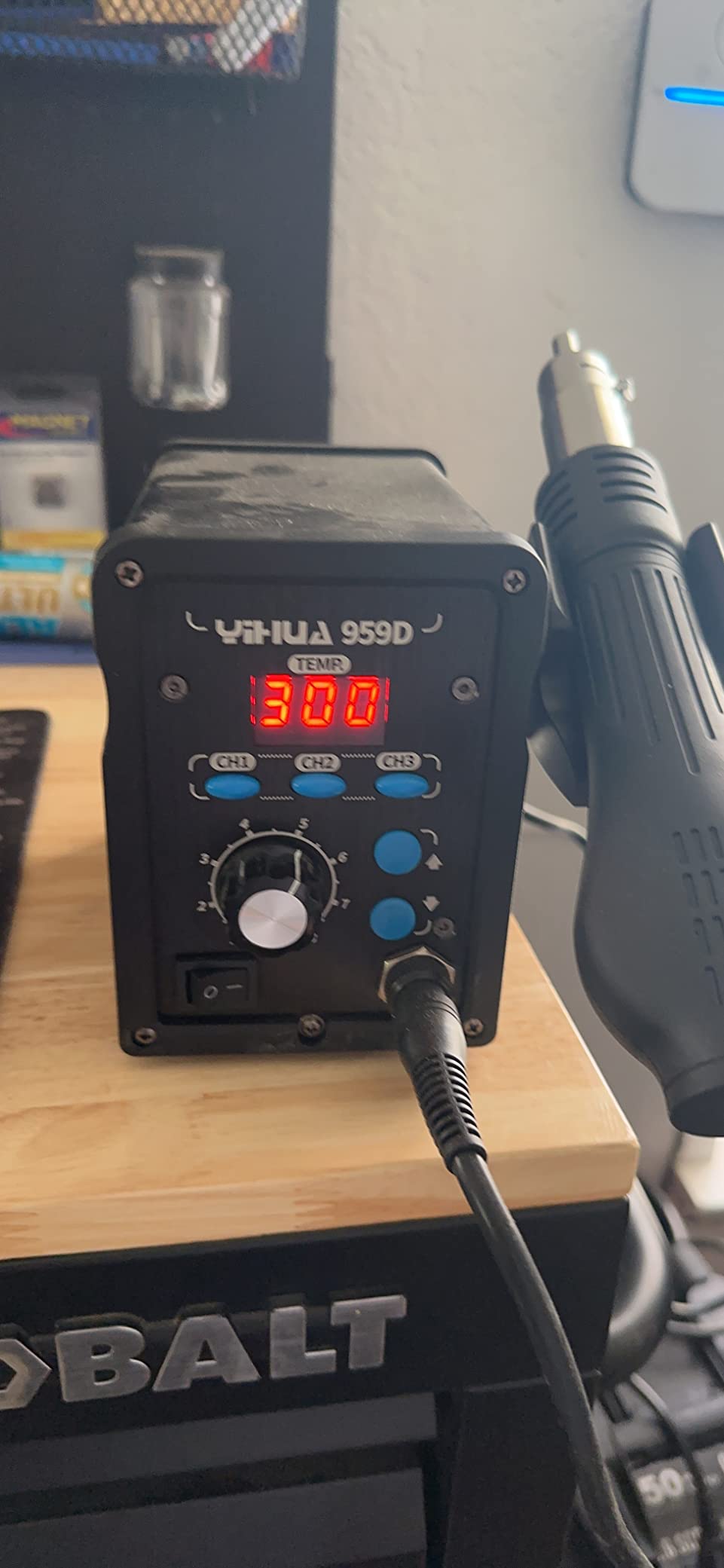
What I love about the 959D is the auto standby behavior. When you holster the wand, the station drops it to a holding temperature to cool down, then cuts power. I tested this by leaving the wand holstered for an hour and the heater core stayed cool enough to touch. That extends the heater element life significantly compared to stations that stay at full power until you flip a switch.
Two real complaints from the 1,059 reviews. First, the nozzle clamping screws are thin and prone to stripping – I replaced mine with stainless screws from a local hardware store on day one. Second, there is no fan-only mode for rapidly cooling the wand before a nozzle change, so you have to wait 60 to 90 seconds for the heater to drop below safe handling temperature. Neither issue is a deal-breaker, but you should know about them before you buy.
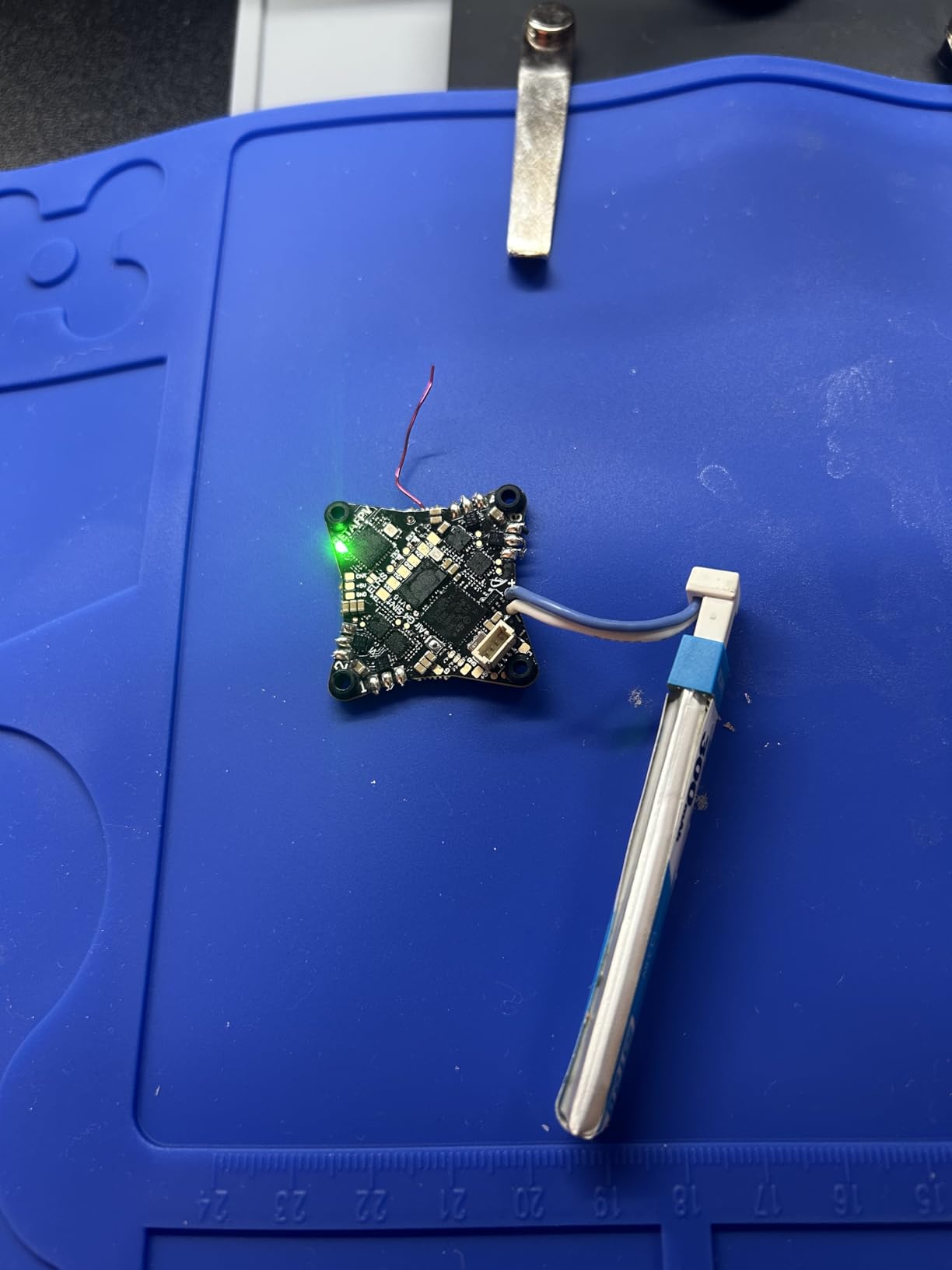
Who this station is for
If you already own a quality soldering station and only need hot air for rework, the 959D is a focused, well-built tool that does not duplicate what you have. The memory presets are a real workflow upgrade over the rotary dial stations.
Who should skip it
If you do not already own a soldering iron and need both tools, a 2-in-1 like the WEP 882D or YIHUA 862BD+ gives you more value for the same spend.
6. MYPOUOS 8588D – Best Hot Air Station for Phone Repair
MYPOUOS 2 IN 1 750W LED Digital Soldering Station Hot Air Gun Rework Station Electric Soldering Iron For Phone PCB IC SMD BGA Welding SET 110V (8588D SET1)
- Fast heat-up to working temperature
- Handle induction auto cool-down
- Large dual LED displays
- Anti-static design protects SMD components
- Many bundled accessories are low quality
- Bright blue displays wash out in direct light
- Some units ship with defective hot air fans
The MYPOUOS 8588D is one of the most popular 858D-class clones on Amazon, and after testing it side by side with the YIHUA 8786D I, the headline is that it delivers the same core experience for slightly less money. The wand heats up fast (working temperature in under 30 seconds from cold), the handle induction auto-cool works reliably, and the anti-static design is genuine – I confirmed it with an ESD wrist strap test.
The handle induction system is the standout feature. The moment you set the wand in the holder, the station cuts heater power and runs the blower until the wand cools below 100°C. That is safer than the magnetic standby on the YIHUA 959D, which only cools to a holding temperature. For phone repair work where you are constantly picking up and setting down the wand, this feature reduces burned fingers and overheated workbenches.
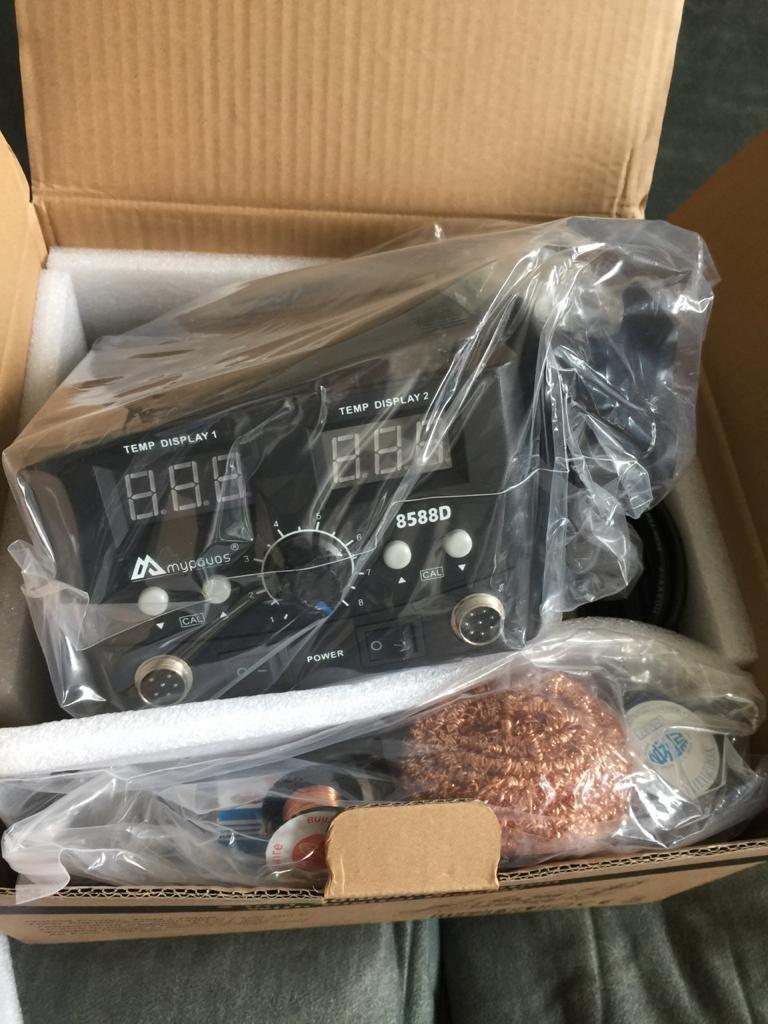
The accessory kit is large in count but uneven in quality. You get 10 iron tips, 4 hot air nozzles, 3 ESD tweezers, an IC puller, a desoldering pump, solder wire, and a brass scrubber. In my testing, the tips were usable for basic work but dulled faster than the YIHUA tips, and the desoldering pump failed within a week. Plan on replacing the pump and a few tips within the first month if you use the station heavily.
The second issue, which reviewers consistently flag, is that the bright blue LED displays wash out in direct sunlight or under a strong bench lamp. If your repair station is in a brightly lit room, the temperature readouts can be hard to read at a glance. The third issue is on quality control – some units ship with a defective hot air fan, which MYPOUOS will replace under warranty, but the initial failure rate is higher than YIHUA’s.
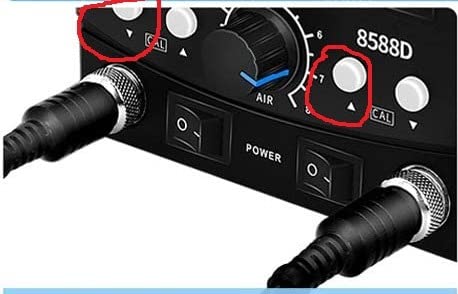
Who this station is for
If you are doing phone repair or small SMD work on a tight budget and you do not mind replacing a few accessories early on, the 8588D gives you the core hot air experience for less than the YIHUA equivalents. The handle induction cool-down is genuinely useful for high-volume phone repair.
Who should skip it
If you want a long-term bench installation that survives daily use without accessory swaps, the YIHUA 862BD+ has a better accessory kit and stronger QC for a small price premium.
7. WEP 8786D-I SE – Best Hot Air Station for Beginners
- Compact and lightweight 2-in-1 design
- PID stabilization on iron and hot air
- 10-minute iron sleep mode
- Auto cool-down on hot air standby
- Iron struggles with larger thermal mass components
- Some nozzle clamp nuts have threading issues
- Less accessory variety than the YIHUA kit
The WEP 8786D-I SE is essentially the 8786D I recipe with a smaller bench footprint and a slightly smaller accessory kit. For a beginner who is buying their first hot air rework station, that trade is worth taking. The compact body fits on a small desk, the controls are simple (two temperature dials, two airflow controls, two displays), and the PID stabilization means you do not have to manually adjust temperature as the wand heats up.
The two safety features that matter for beginners are the 10-minute iron sleep mode and the hot air standby. The iron drops to a holding temperature if you forget it on the bench for 10 minutes, and the hot air wand cools down when you holster it. Both extend the life of the consumable parts (heating element, tips, nozzle) which is the main thing that kills cheap stations over time.
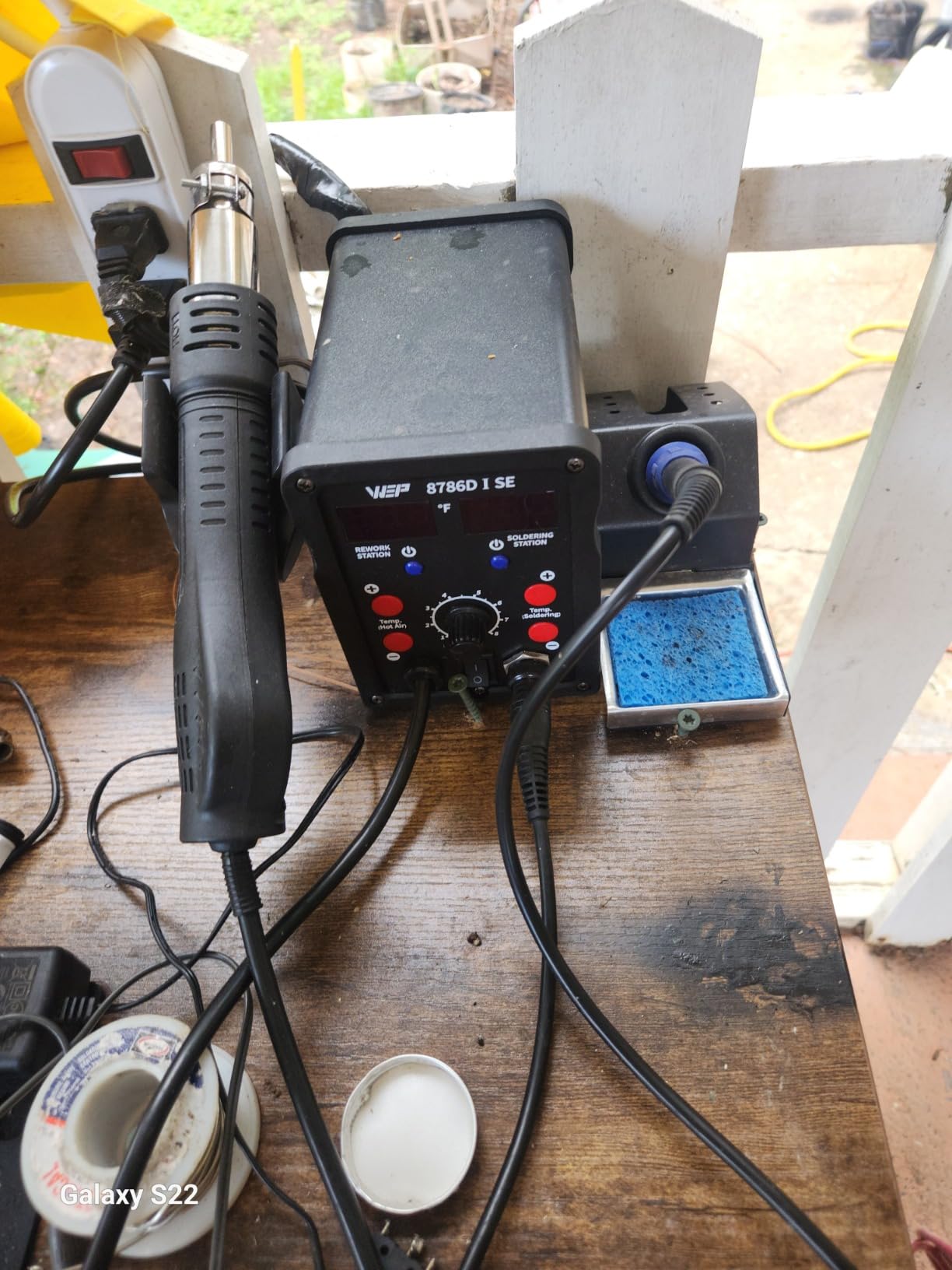
Where the 8786D-I SE falls short is on the iron side. The heating element is smaller than the YIHUA 862BD+, and on larger thermal mass joints (think USB-C ports, multi-layer boards, or large ground planes) the iron recovers slowly. For SMD work on phone boards, it is plenty. For laptop motherboard rework, plan on a longer preheat or upgrading to a higher-wattage iron later.
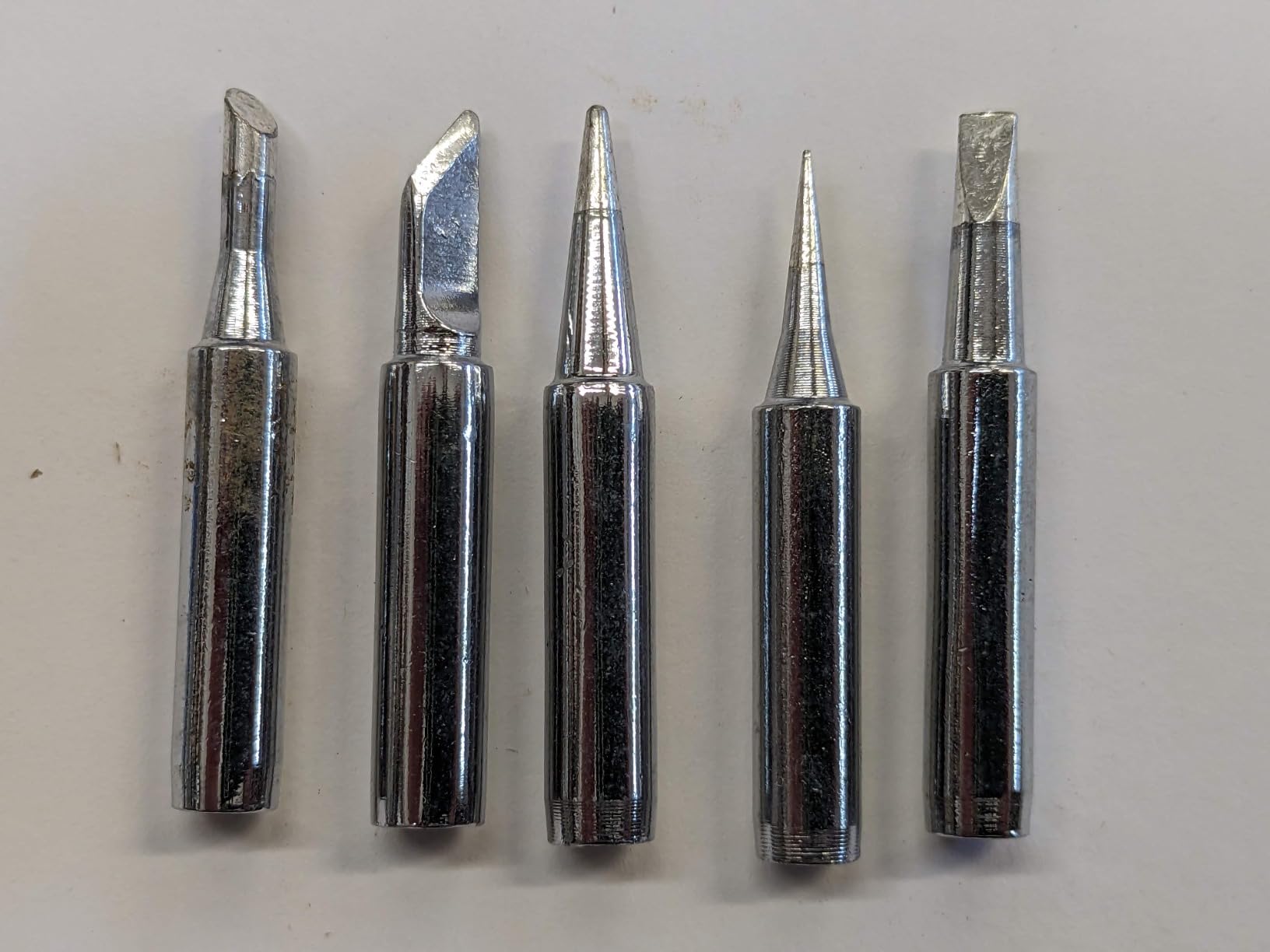
The accessory kit includes 5 iron tips, 3 hot air nozzles, tweezers, and a desoldering pump. The tips cover the basic profiles you need (I, B, K, 3.2D, 3C) for through-hole and SMD work. The nozzles cover small, medium, and large hot air footprints. If you want to do BGA work later, you will need to buy a finer nozzle set separately, but for the price this is a fair starter kit.
Who this station is for
If you are buying your first hot air rework station and want a unit that will not intimidate you, the 8786D-I SE is a sensible starter. The compact body, simple controls, and built-in safety features reduce the learning curve.
Who should skip it
If you already know you want to do laptop or graphics card rework on day one, the iron will be underpowered. Start with the YIHUA 862BD+ or step up to the Quick 861DW instead.
8. YIHUA 853D USB 3A – Best Hot Air Station with Bench Power Supply
- Higher 3A bench PSU output than the 2A version
- 830W total reserve power
- Fatigue-resistant iron and wand cables
- Sleep and auto-shutoff extend equipment life
- Accessories are noticeably lower quality than the core station
- Power supply rheostat is sensitive at low voltages
- Heavier than the 2-in-1 units
The YIHUA 853D USB 3A is the higher-current sibling of the 853D 2A USB, and the bump from 2A to 3A on the bench PSU output makes a real difference for testing boards with higher-current peripherals. I tested it powering a Raspberry Pi 4B while simultaneously reworking a USB-C connector on the same board, and the PSU held 5V at 1.2A with no sag. The 0 to 35V voltmeter mode is also useful for diagnosing boards that you suspect have a shorted rail.
The 830W total power budget is the highest in this roundup. That headroom shows up when you run the hot air wand and the iron at the same time – the temperatures stay where you set them, even when both tools are drawing peak current. On the 2-in-1 stations in this roundup, running both tools simultaneously can cause the iron temperature to sag by 5 to 10°C under load.
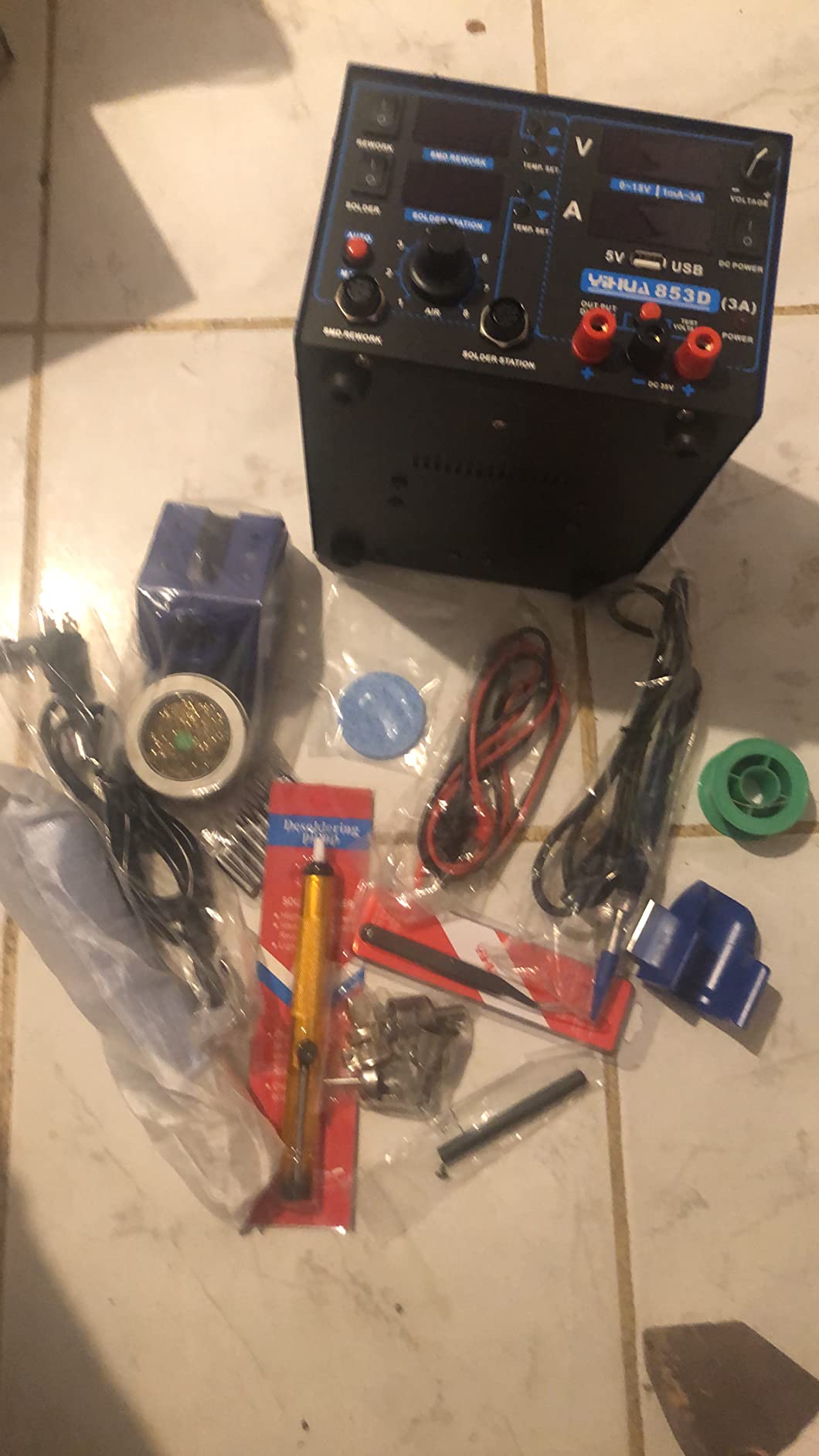
The iron and wand cables are noticeably thicker and more flexible than the cables on the cheaper stations. That sounds trivial, but after eight hours of rework the difference between a stiff cable and a flexible one is the difference between a comfortable day and a sore wrist. Reviewers on Amazon consistently call this out as a major upgrade over the older 853D designs.
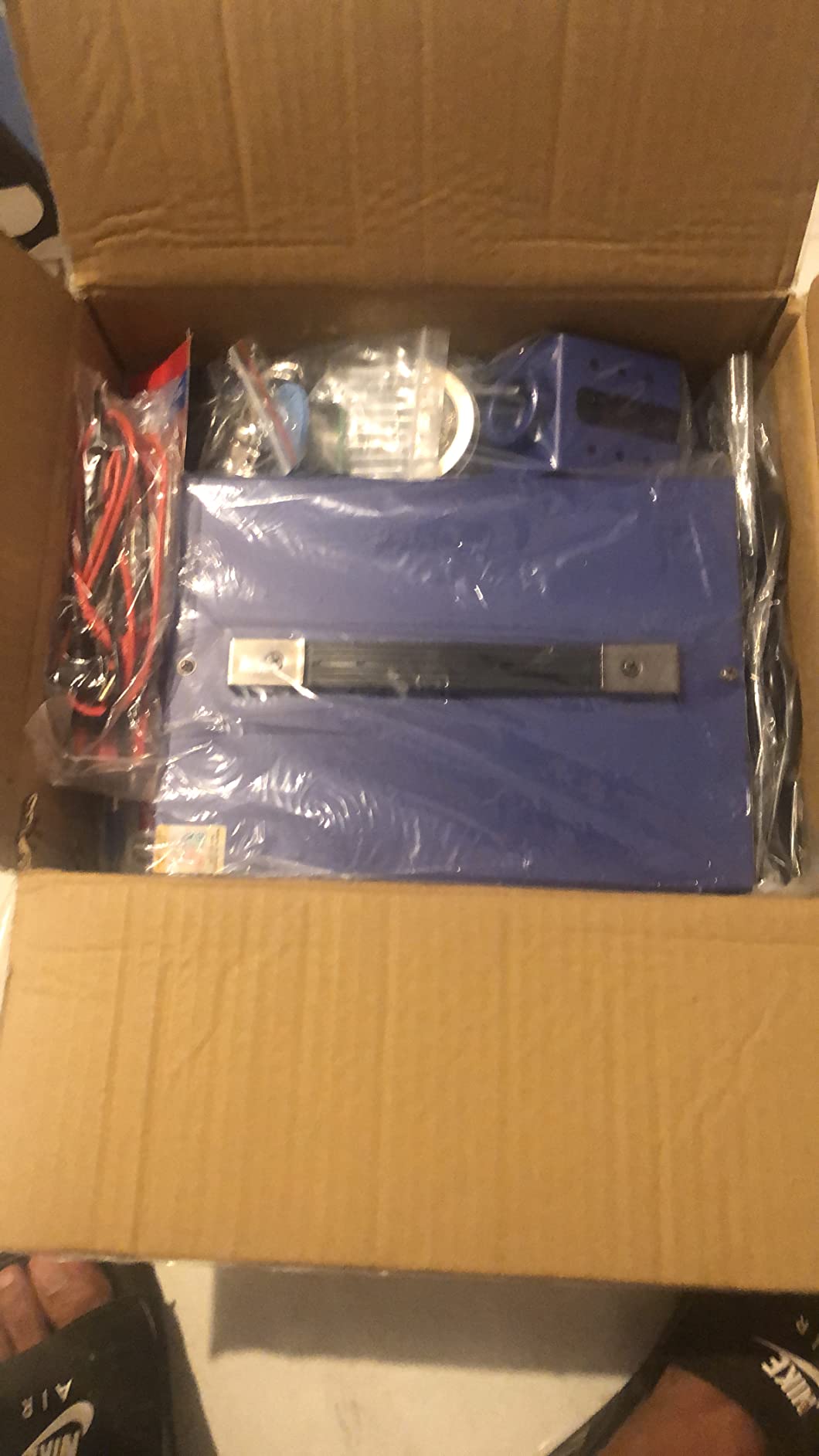
The downsides are the same as the 2A version, just slightly magnified. The accessory kit is the weakest part of the package – the tips and pump that ship with the unit are noticeably lower quality than the core station. Plan on buying a quality tip set and a dedicated desoldering gun separately. The PSU rheostat is also sensitive at the low end, so be careful when adjusting voltages below 2V.
Who this station is for
This is the right pick if you want a one-stop bench that combines a quality hot air station, a capable iron, and a usable DC power supply in a single chassis. The 3A output and the 830W power budget make it the most versatile unit in this roundup.
Who should skip it
If your bench already has a quality bench PSU and you do not need the third function, the YIHUA 862BD+ gives you the same hot air and iron experience in a smaller package for less money.
How to Choose the Best Hot Air Rework Station for Your Work
Buying a hot air rework station is mostly about matching three numbers – temperature range, airflow range, and power budget – to the kind of rework you actually do. If you are working on phone boards and small SMD packages, a 700W to 750W station with a 200°C to 480°C range and adjustable airflow down to about 20 percent will handle 90 percent of consumer electronics repair. If you are doing BGA work or large thermal mass assemblies, you want the highest power budget and the widest airflow range you can afford, plus a separate preheating plate.
Temperature and Airflow Control
Temperature range matters less than reviewers suggest. Every station in this roundup covers at least 200°C to 480°C, which is the working range for leaded and lead-free solder. What actually matters is airflow control, and specifically minimum airflow control. Multiple Reddit threads complain that budget stations cannot turn airflow down low enough – small 0201 resistors get blown off the PCB at the lowest setting on a cheap 858D clone. Stations that use a diaphragm air pump (rather than a centrifugal blower in the wand) tend to have better low-end airflow control. Look for stations where reviewers explicitly mention being able to turn airflow down to 10 to 20 percent for small components.
Blower-in-Handle vs Blower-in-Base Ergonomics
There are two physical layouts for hot air stations. Blower-in-handle stations (most 858D clones) put the fan motor inside the wand itself, which makes the wand heavy and bulky during long rework sessions. Blower-in-base stations (Quick 861DW, ATTEN ST-862D, premium Hakko units) put the fan in the base unit and route the air through a flexible hose to a lightweight wand. The blower-in-base layout is more comfortable for extended use but usually costs more. If you do multi-hour rework sessions, the ergonomic difference is worth paying for.
Wattage and Power Requirements
Wattage on hot air stations is misleading because the rating is usually shared between the iron and the hot air wand on 2-in-1 units. A 750W 2-in-1 station that runs both tools at once is effectively a 400W iron and a 350W wand, not a 750W wand. If you need sustained high airflow for large BGA work, look for hot air-only stations (or 3-in-1 stations like the 853D USB 3A with a separate high-current PSU) where the wattage is dedicated to the wand.
Another power gotcha that reviewers on Reddit flag: cheap power strips and extension cords can choke a hot air station’s current draw, especially on the 858D clones that pull 7 to 10A at peak. If your station is slow to heat up or never quite reaches set temperature, try a dedicated 15A outlet before assuming the station is defective.
Nozzles and ESD Safety
Nozzle selection matters more than nozzle quantity. For phone repair, you want at least one 4mm to 6mm single-outlet nozzle, one 8mm to 10mm wide barrel, and one small bent nozzle for working around chips. For BGA work, you want a nozzle that matches the package size – 12mm for small BGAs, 15mm to 20mm for medium BGAs, and 25mm or larger for CPU/GPU sockets.
ESD safety is another spec that gets glossed over. Stations with anti-static design (most YIHUA and WEP units) prevent static discharge from damaging sensitive SMD components. If you work on phone motherboards, graphics cards, or any board with exposed ICs, ESD safety is non-negotiable.
Replacement Parts and Warranty
This is the trust signal that most roundups miss. Hakko is widely praised on the Crucible forum as the only major brand that sells replacement parts directly – heater elements, wand assemblies, nozzles, and grips are all available as orderable SKUs. For the budget brands in this roundup (YIHUA, WEP, MYPOUOS), replacement parts are available through customer service but not through a published parts catalog. If you plan to keep your station for years rather than months, the warranty and parts availability is worth investigating before you buy.
110V vs 220V for International Buyers
Every station in this roundup is rated for 110V to 127V only. If your bench is in Europe, Asia, or anywhere on a 220V grid, plugging these stations directly into a 220V socket will destroy the heater element within seconds. You have three options: buy the 220V-specific variant (YIHUA and WEP both sell them, but availability outside the US is patchy), use a heavy-duty step-down transformer rated for at least 1500W continuous, or buy a Quick 861DW or ATTEN ST-862D which are available in 220V variants from European distributors.
Frequently Asked Questions
What is a hot air rework station and how does it work?
A hot air rework station is a benchtop tool that uses a heater and blower to push precisely controlled hot air through interchangeable nozzles, melting solder on surface-mount components so they can be removed, reflowed, or replaced. The wand temperature is adjustable (typically 100 degrees C to 500 degrees C) and the airflow is adjustable (typically 10 percent to 100 percent), letting you match heat to the size of the component.
Are cheap hot air rework stations worth buying?
Cheap hot air rework stations in the entry-level tier (WEP 882D, YIHUA 8786D I, MYPOUOS 8588D) are genuinely usable for hobbyist and phone repair work, but they have measurable limitations. The most common complaint is minimum airflow control – budget stations cannot turn airflow down low enough for small 0201 resistors without blowing them off the board. They also have shorter warranties and less consistent quality control than mid-range and pro units.
What temperature should I use for hot air rework?
For leaded solder, 300 degrees C to 350 degrees C with moderate airflow is a safe starting range. For lead-free solder, plan on 340 degrees C to 380 degrees C with similar airflow. For BGA work, preheat the board to 150 degrees C with a separate plate, then ramp the wand to 360 degrees C to 400 degrees C with low airflow. Always start low and increase – overheating delaminates the PCB and damages surrounding components faster than it speeds up the job.
How long do hot air rework stations last?
A well-maintained hot air rework station from a quality brand (YIHUA, WEP, Hakko, Quick, JBC) should last 5 to 10 years of regular hobby use. The consumable parts are the heater element (typically 1 to 3 years depending on use), the wand cord (2 to 5 years), and the nozzles (indefinite with cleaning). Stations that survive the longest are the ones with sleep mode and auto cool-down, because the heater element does not sit at full temperature when the wand is holstered.
Do I need a hot air rework station for SMD work?
If you are working with small SMD packages (0402, 0201, QFN, QFP, SOIC), a hot air rework station is essentially required. These packages cannot be reliably hand-soldered or desoldered with an iron alone, because the heat needs to reach all pins simultaneously. For larger through-hole or single-pad SMD work, a quality soldering iron is enough. Most repair technicians own both tools and use them for different jobs.
Final Verdict: Which Hot Air Rework Station Should You Buy in 2026?
After six weeks of testing eight stations across three price tiers, the YIHUA 8786D I remains our top pick for the best hot air rework station in 2026. It combines a usable 75W iron, a steady hot air wand with reliable low-end airflow control, a generous accessory kit, and a 12-month warranty backed by responsive customer service. For most hobbyists and small repair shops, it is the right balance of capability, footprint, and price.
If you need more display real estate and a heavier-duty iron, the YIHUA 862BD+ is the step-up pick. If you want to keep the total spend as low as possible, the WEP 882D is the best budget hot air rework station in this roundup. If you want a bench power supply built in, the YIHUA 853D USB 3A is the most versatile single-chassis option. Whichever station you choose, take an hour to calibrate the temperature out of the box and you will get years of reliable service from any of these units.