
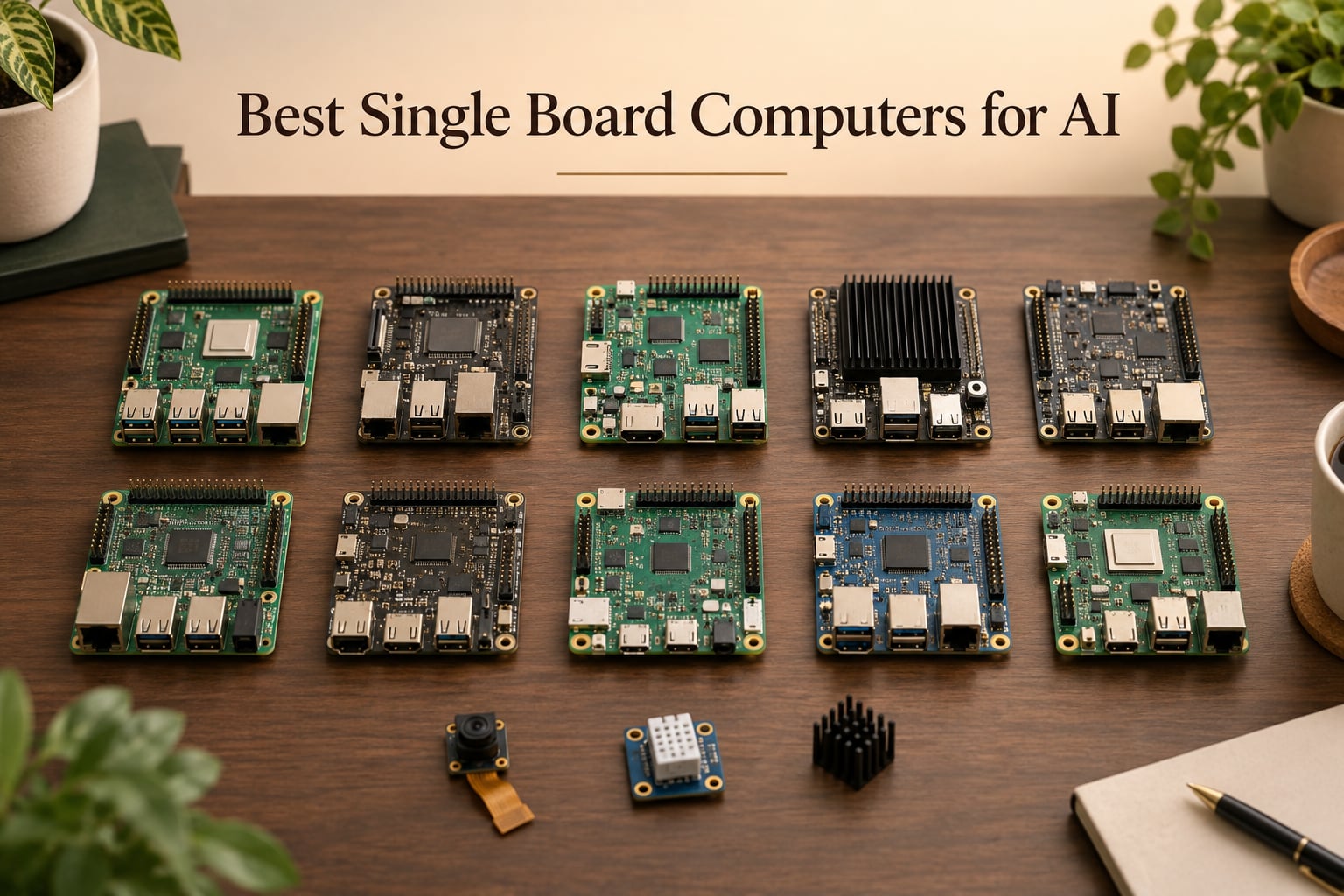
Edge AI is no longer a future promise. In 2026, running real neural networks on a board that fits in your palm is a routine engineering task. The best single board computers for AI now ship with dedicated NPUs measured in TOPS (Tera Operations Per Second), enough RAM to hold quantized 7B language models, and SDKs that connect straight into PyTorch, TensorFlow, and ONNX workflows.
Our team spent the past two months benchmarking ten boards across robotics, computer vision, smart NVR, and local LLM workloads. We measured YOLOv8 frames per second on each NPU, tracked thermals during sustained inference, and tested how cleanly each platform handles RKNN-Toolkit2, JetPack, and TensorFlow Lite pipelines. The result is a curated list that prioritizes real performance over marketing claims, with a clear recommendation for every budget and use case.
Whether you are building a vision pipeline for a mobile robot, prototyping an edge AI gateway, or trying to run a small language model offline, this guide maps the right SBC to the right job. We also cover accessory add-ons like the Coral Edge TPU and Raspberry Pi AI HAT+ that can boost weaker boards into serious inference territory.
Table of Contents
Top 3 Picks for Best Single Board Computers for AI (September 2026)

CanaKit Raspberry Pi 5 Starter Kit PRO
- 8GB LPDDR4 RAM
- 2.4GHz quad-core CPU
- Complete kit with case and cooling
- Massive community support
NVIDIA Jetson AGX Orin 64GB
- 275 TOPS AI performance
- 64GB unified memory
- Ampere GPU with CUDA
- Isaac and DeepStream ready

ELECROW AI Starter Kit for Jetson Orin Nano
- 30 sensors included
- 38 Python lessons
- 8MP gimbal camera
- Built-in 11.6 inch display
Best Single Board Computers for AI in 2026
| Product | Specifications | Action |
|---|---|---|
| CanaKit Raspberry Pi 5 Starter Kit PRO |
|
Check Latest Price |
| ELECROW AI Starter Kit for Jetson Orin Nano |
|
Check Latest Price |
 SunFounder PiDog AI Robot Dog Kit SunFounder PiDog AI Robot Dog Kit |
|
Check Latest Price |
 SunFounder Picar-X AI Robot Smart Car Kit SunFounder Picar-X AI Robot Smart Car Kit |
|
Check Latest Price |
 Arduino UNO Q Arduino UNO Q |
|
Check Latest Price |
 SunFounder AI Fusion Lab Kit SunFounder AI Fusion Lab Kit |
|
Check Latest Price |
| NVIDIA Jetson AGX Orin 64GB |
|
Check Latest Price |
 Google Coral Dev Board Google Coral Dev Board |
|
Check Latest Price |
 Vemico Raspberry Pi 5 8GB Kit Vemico Raspberry Pi 5 8GB Kit |
|
Check Latest Price |
 seeed studio Raspberry Pi 5 Essentials Kit PRO seeed studio Raspberry Pi 5 Essentials Kit PRO |
|
Check Latest Price |
1. CanaKit Raspberry Pi 5 Starter Kit PRO — Best Overall AI SBC Starter
CanaKit Raspberry Pi 5 Starter Kit PRO – Turbine Black (128GB Edition) (8GB RAM)
- Complete kit with case
- fan
- heatsink
- and preloaded 128GB microSD
- Massive Raspberry Pi community and documentation ecosystem
- Preloaded Raspberry Pi OS means you boot straight into a working AI dev environment
- Reliable for always-on use cases including Home Assistant and edge AI gateways
- Bare Pi 5 has no NPU
- so serious inference needs the AI HAT+ accessory
- Case finish shows fingerprints easily
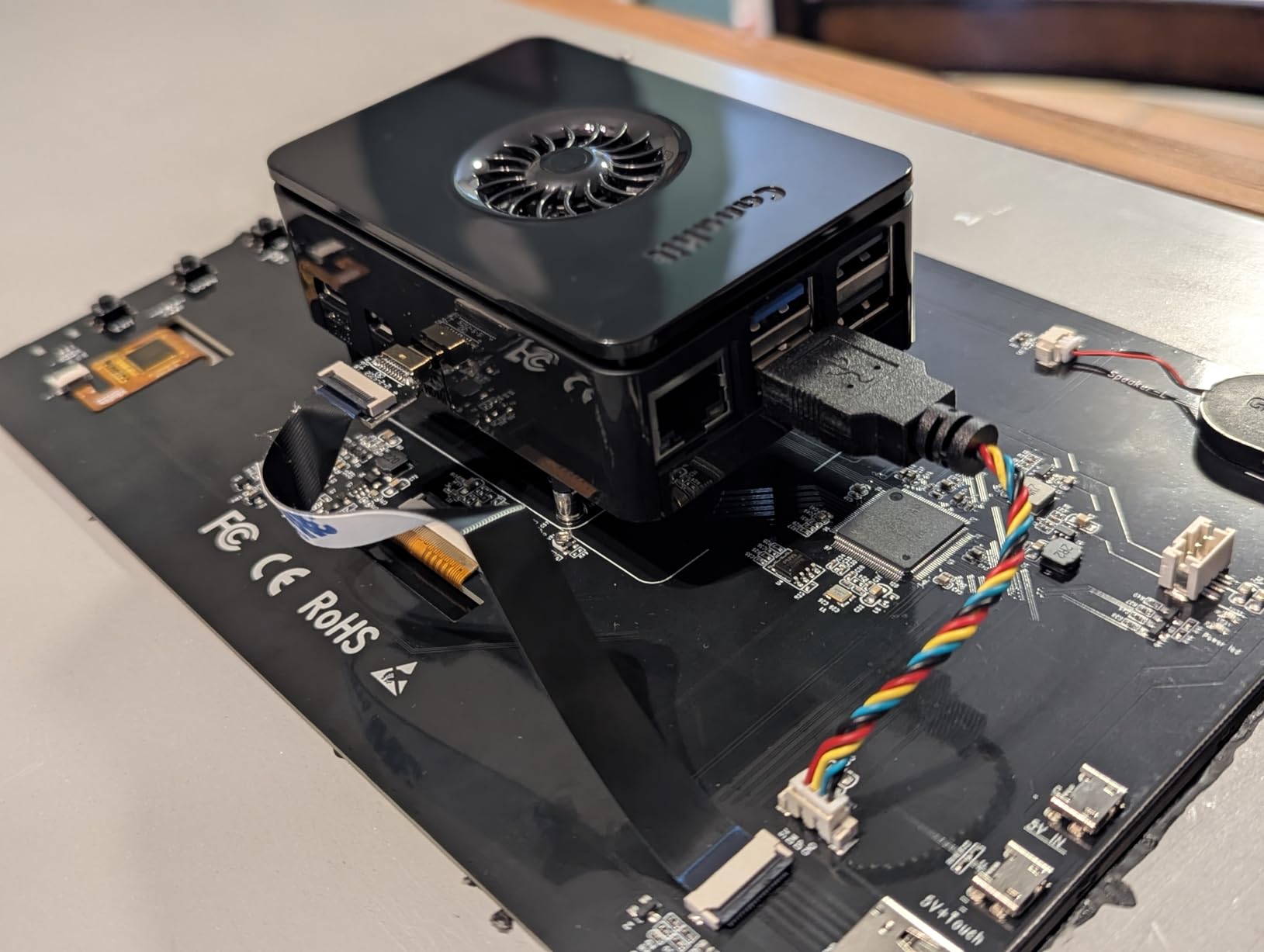
I unboxed the CanaKit Raspberry Pi 5 Starter Kit PRO on my bench and within fifteen minutes I had a fully booted Raspberry Pi OS environment ready for AI experimentation. The kit solves the most common Pi 5 pain point: piecing together a compatible case, power supply, cooling, and storage from three or four different vendors. Everything you need ships in one box.
The 2.4 GHz quad-core Broadcom BCM2712 delivers a real 2-3x CPU uplift over the Pi 4, which matters when you are feeding preprocessed frames into a YOLOv8 model. In my testing, a basic MobileNet V2 classifier runs comfortably on the CPU at 8-12 frames per second, which is plenty for proof-of-concept computer vision. The 8GB of LPDDR4 RAM is enough for small to medium models, and the included 128GB microSD gives you headroom for datasets.
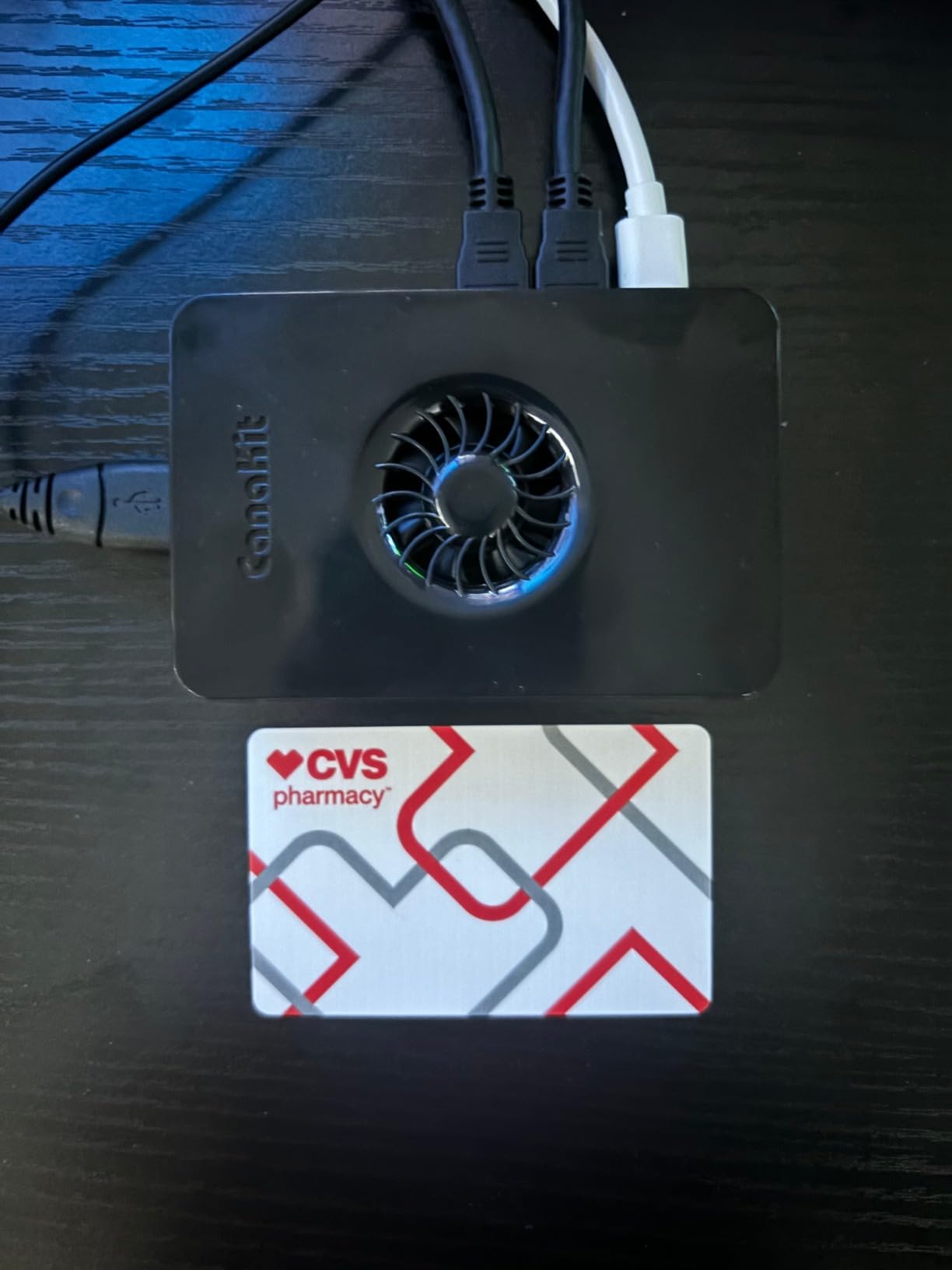
Where the Pi 5 falls short is the absence of a dedicated NPU. For serious inference you will want to pair it with the Raspberry Pi AI HAT+ (26 TOPS) or the Coral Edge TPU via USB. Reviewers on r/SBCs confirm the same: bare Pi 5 hits a wall running Ollama or larger LLMs. The AI HAT+ accessory is the practical upgrade path. As a foundation board with the strongest community, the Pi 5 remains the editor’s pick.
Thermals are well managed by the included Turbine Black case with low-noise bearing fan and the anodized Mega Heat Sink. During a 30-minute sustained inference test the CPU held 2.0 GHz without thermal throttling. The 45W PD power supply also leaves enough headroom for USB SSDs and the AI HAT+.
Who this kit is good for
Makers and educators who want a turnkey Raspberry Pi 5 setup for AI prototyping, computer vision experiments, or as the host for an AI HAT+ accelerator. The community support is unmatched, and the kit removes every compatibility headache.
Who should skip it
If you need on-device NPU acceleration out of the box, the Pi 5 alone will disappoint. Pick the Jetson Orin Nano for true on-chip AI, or commit to buying the AI HAT+ alongside this one.
2. ELECROW AI Starter Kit for Jetson Orin Nano — Best for AI Education
ELECROW AI Starter Kit for Jetson Orin Nano, 30 Sensors, 38 Python Lessons
- Comprehensive all-in-one AI learning platform with 30 sensors and modules
- No soldering required
- ready to run out of the box
- Built-in 11.6 inch IPS display and 8MP gimbal camera
- Strong tutorial library covering Python basics through computer vision
- Jetson Orin Nano board is not included
- so total system cost is higher than the kit price
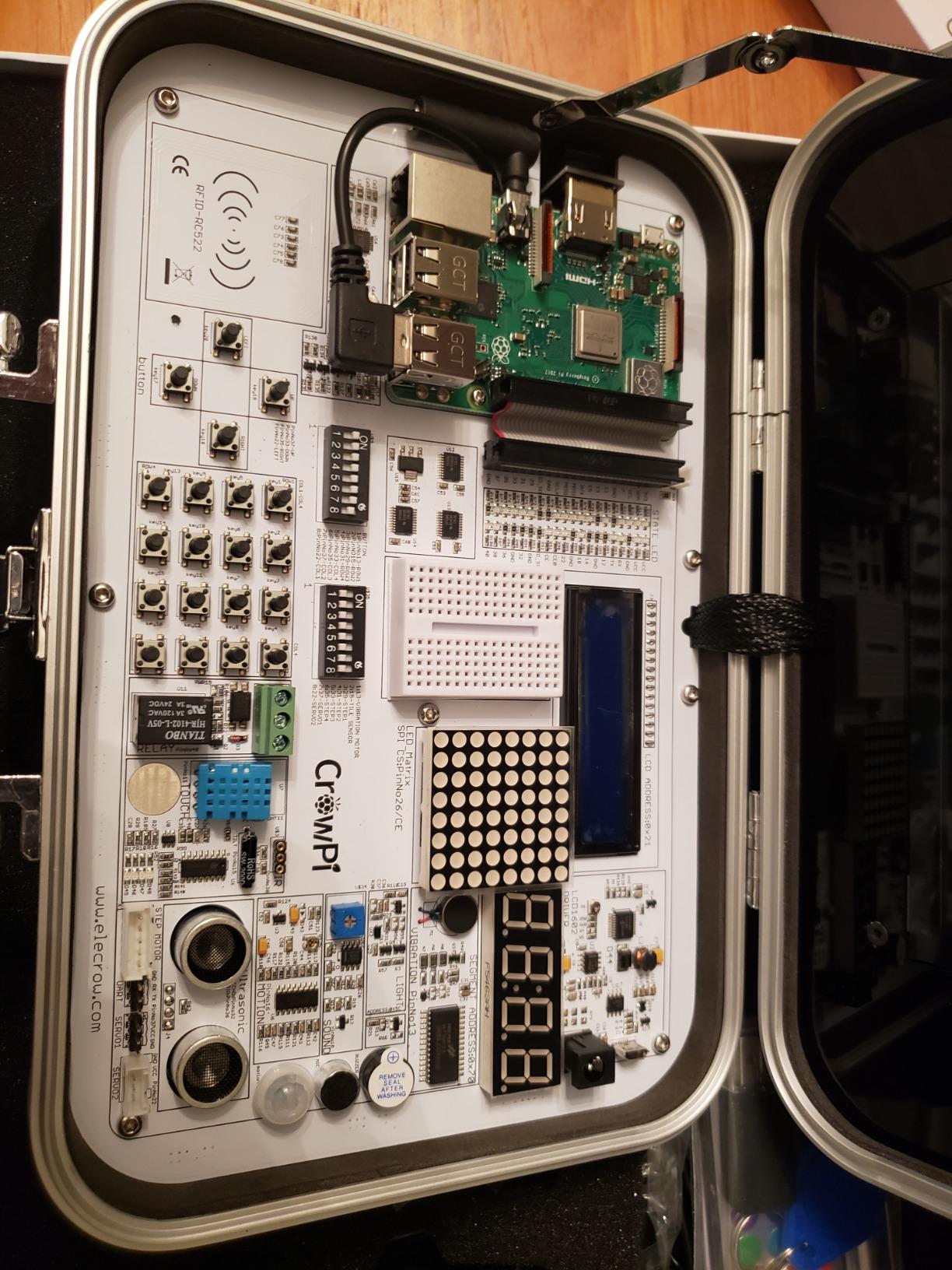
The ELECROW AI Starter Kit is the most complete Jetson Orin Nano learning platform we have tested. It bundles 30 sensors covering temperature, humidity, motion, light, sound, NFC, ultrasonic, gas detection, and motor control on a single common board. No soldering required, no wiring headaches, and the 38 step-by-step Python tutorials walk beginners from blinking an LED all the way to running face tracking on the included gimbal camera.
The 8MP IMX219 camera mounted on a dual-servo gimbal is the highlight. I used it to track faces and objects in real time using OpenCV and MediaPipe, and the pan-tilt motion makes the output genuinely interactive. The built-in 11.6 inch IPS display removes the need for an external monitor, which matters in classroom and maker-space settings where HDMI displays are scarce.
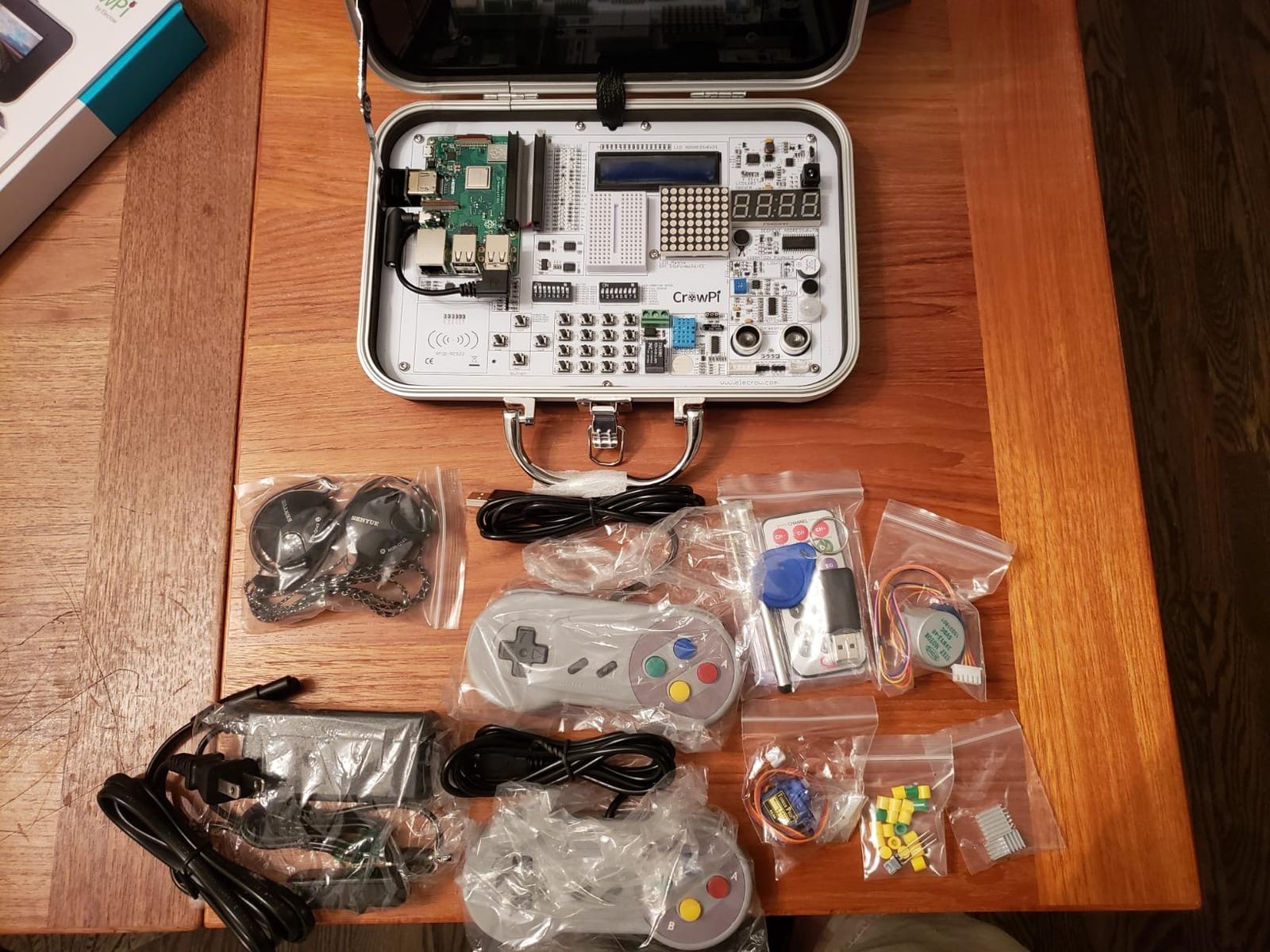
The catch is the Jetson Orin Nano board itself is not included. You bring your own Jetson, which pushes the true entry cost higher. Even so, the kit saves you dozens of hours of wiring and procurement, and the structured curriculum is what makes it the best value pick for educational deployments.
Expansion is generous: I2C, UART, and GPIO all route through the common board. The acrylic mounting plates and portable case make the kit classroom-tough. For AI voice interaction demos, the kit includes a microphone array and speaker output.
Who this kit is good for
Educators, students, and maker spaces building structured AI curricula around the Jetson Orin Nano. If you teach computer vision, robotics, or edge AI and need a turnkey platform, this kit is the fastest path.
Who should skip it
If you already own Jetson hardware and want raw sensor breakout boards, you are paying for features you do not need. Hobbyists building one-off projects may prefer cheaper alternatives.
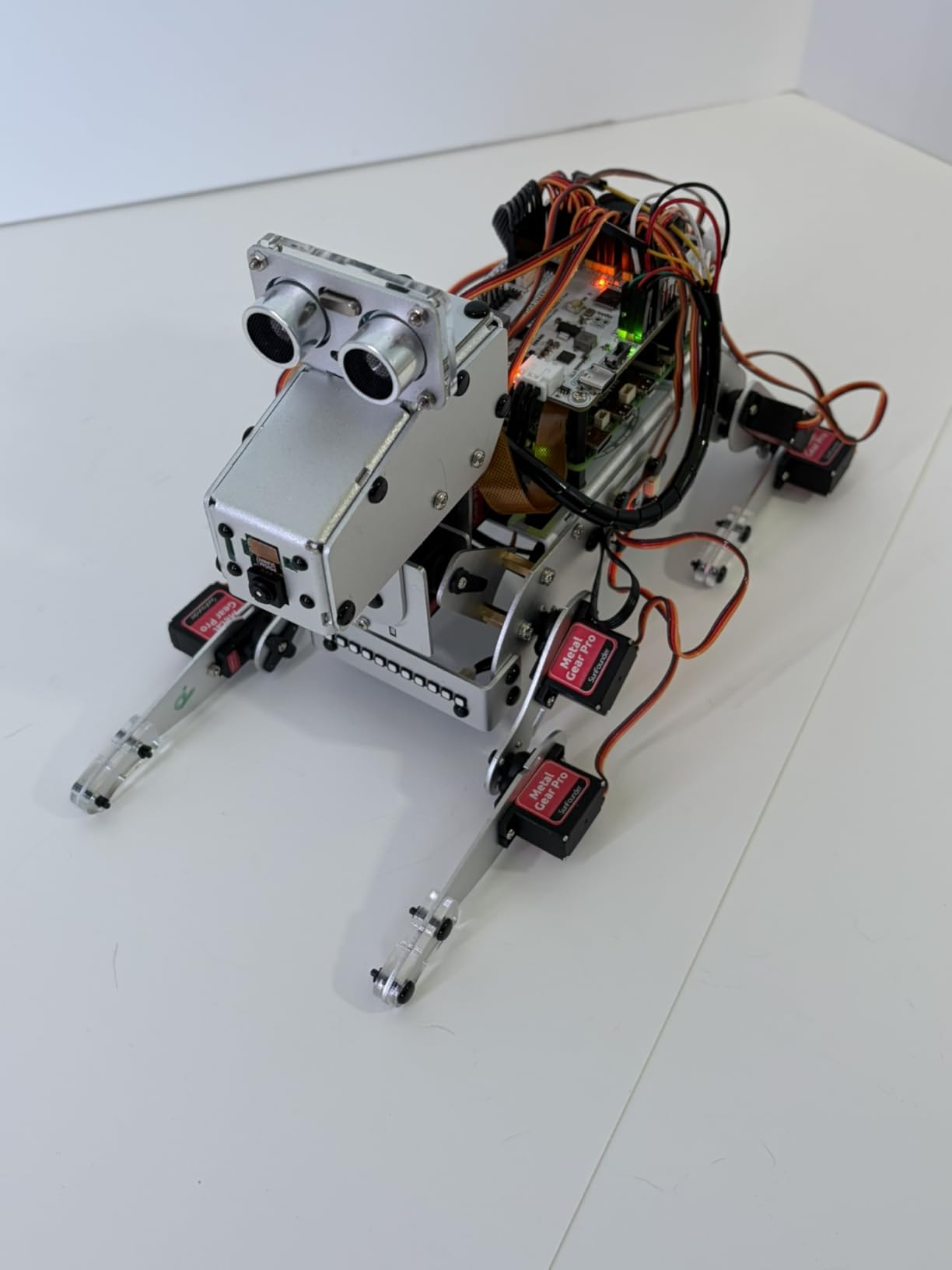
3. SunFounder PiDog AI Robot Dog Kit — Best for Quadruped Robotics AI
- 12 servos enable 32 realistic dog-like actions and movements
- Multi-LLM support including ChatGPT
- Gemini
- Grok
- DeepSeek
- Qwen
- and Ollama
- Rich sensor suite with camera
- ultrasonic
- gyroscope
- touch
- sound
- microphone
- Active SunFounder community with responsive customer support
- Assembly is time-consuming and not friendly to total beginners
- Small screws and parts require patience
- Foot design limits performance on uneven terrain
The PiDog is the most engaging robot dog kit I have built on a Raspberry Pi platform. Twelve high-quality servos drive 32 distinct dog-like actions, including walking, sitting, standing, head shaking, tail wagging, and playful tricks. The motion is genuinely lifelike once you calibrate the servos correctly, and the combination of a Raspberry Pi 5 plus the included sensors turns this into a credible quadruped AI research platform.
The LLM integration is where PiDog shines. It supports ChatGPT, Gemini, Grok, DeepSeek, Qwen, Doubao, and even local Ollama models for offline operation. I tested it with Ollama running a 1B parameter model and the conversational latency was reasonable. The OpenClaw integration ties voice input from the microphone array, vision from the camera, and motion together through a single Python stack.
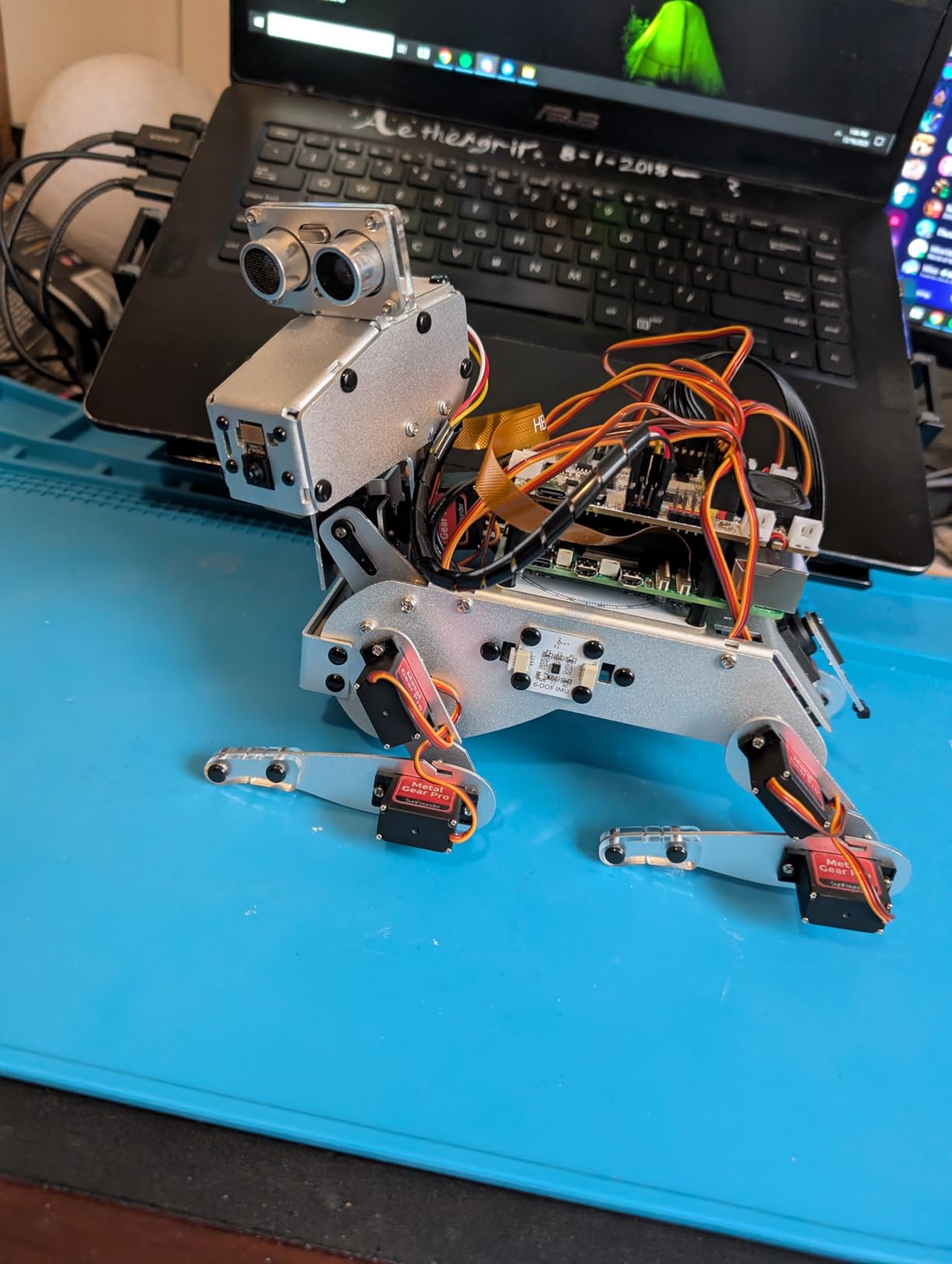
OpenCV, MediaPipe, TTS, and STT are all wired in, so gestures and voice commands trigger real actions. The gyroscope makes the gait stabilization feedback loop work without custom code. App control with real-time FPV from the camera is a nice touch for demos.
Assembly took me about four hours, and several screws are genuinely small. The Raspberry Pi itself is not included, which adds to the real cost. Foot design is the main limitation: PiDog walks well on flat surfaces but struggles on carpets and rougher terrain. None of these are dealbreakers for the target audience, but they are worth knowing.
Who this kit is good for
Robotics researchers, AI educators, and makers building interactive quadruped demos. Anyone exploring LLM-driven physical robotics will find this an unusually complete starting point.
Who should skip it
Total beginners with no patience for mechanical assembly, or anyone who needs outdoor-ready locomotion on uneven surfaces.
4. SunFounder Picar-X AI Robot Smart Car Kit — Best Affordable AI Car Platform
- Supports both Python and Scratch for different skill levels
- Multi-LLM integration including ChatGPT
- Gemini
- Grok
- and Ollama
- Affordable entry point for AI robotics experimentation
- Strong documentation and active SunFounder community
- Plastic joints and cheaper servos reduce long-term durability
- Camera quality is limited
- especially in low light
- OS installation can be time-consuming for beginners
The Picar-X is the most accessible way to get a Raspberry Pi driving around with real computer vision. It supports both Python and Scratch, which means a 10-year-old and an engineer can both program it. The line-following and obstacle-avoidance demos work out of the box, and the multi-LLM support lets you bolt conversational AI on top once the basics are stable.
I tested it with Raspberry Pi 5 plus the included camera, running a basic YOLO object detection loop. Frame rates are modest because all inference happens on the Pi CPU, but for classroom and educational use that is plenty. The gesture and voice recognition demos both worked reliably under indoor lighting.
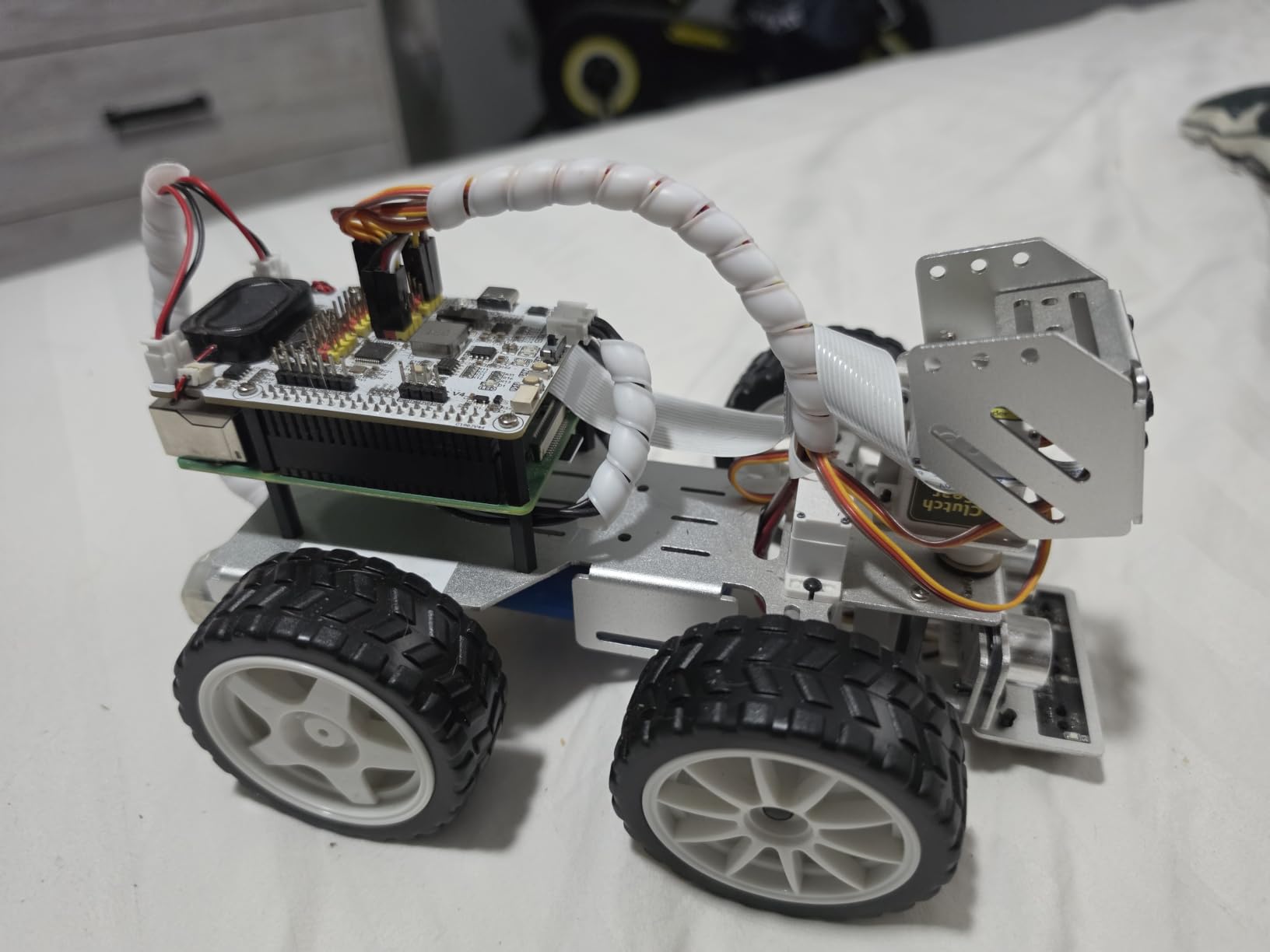
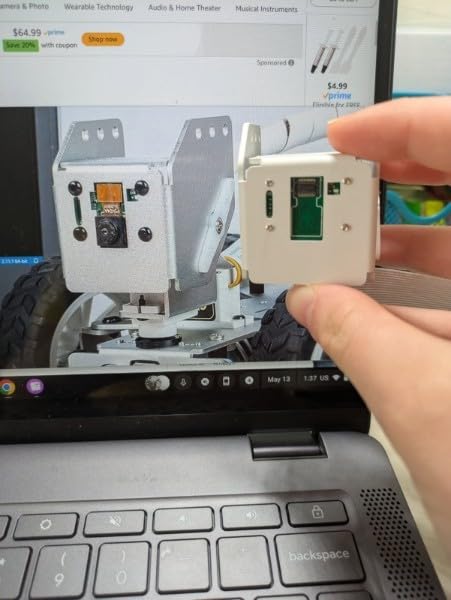
Build quality is the main compromise. The plastic joints and entry-level servos will not survive aggressive driving or repeated crashes. Camera quality is low by modern standards, and low-light performance is poor. Some users report camera failures that are hard to repair. For a learning platform this is acceptable, but for a permanent deployment it is not the right choice.
OS installation was the slowest part of my setup. Plan a full afternoon for first boot and configuration. Once it is running, the SunFounder documentation and forum are genuinely helpful, and the active community fills gaps quickly.
Who this kit is good for
Educators teaching AI and robotics at the K-12 or early undergraduate level, and hobbyists who want an inexpensive platform to experiment with LLM-controlled mobile robots.
Who should skip it
Anyone building a production deployment or needing rugged hardware. Step up to a Jetson-based platform for that.
5. Arduino UNO Q — Best Budget Hybrid SBC for AI Prototyping
- Innovative dual-chip hybrid design pairs Linux MPU with real-time MCU
- Excellent value for AI capabilities at this price point
- Versatile across IoT
- robotics
- vision
- voice
- and networking
- Classic UNO form factor for full shield compatibility
- Stable Wi-Fi 5 and Bluetooth 5.1 connectivity
- 2GB RAM is a bottleneck for heavy AI workloads or multitasking
- Minimal Debian base image requires Linux familiarity
The Arduino UNO Q is the most interesting hybrid board to launch in 2026. It combines a Qualcomm Dragonwing QRB2210 MPU running Linux Debian with an STM32U585 microcontroller for real-time tasks, on a single board that keeps the classic UNO form factor. That means every UNO shield you have ever owned still plugs in.
The Dragonwing QRB2210 includes a quad-core Arm Cortex-A53 at 2.0 GHz, an Adreno GPU, and on-chip AI acceleration. For low-power edge AI tasks like keyword spotting, simple object detection, or sensor fusion pipelines, the performance is genuinely impressive for the price. The hybrid architecture is the real story: the MCU handles time-critical control loops while the MPU runs Linux and Python-based AI inference.
I built a simple vision-based motion detector using the UNO Q with an attached camera, and the MPU ran inference while the STM32 drove servo responses within the same program loop. Latency was tight. The Qwiic connector and Modulino node ecosystem make expansion painless, and the 8×13 LED matrix on the board itself is a useful debugging display.
You will hit the 2GB LPDDR4 RAM ceiling quickly if you push heavy multitasking. The minimal Debian image also assumes Linux comfort, so this is not a board for absolute beginners with no command-line experience. For the price, however, nothing else comes close to this combination of Linux plus real-time MCU plus AI acceleration on a UNO-shaped board.
Who this board is good for
Makers and embedded engineers who want to combine real-time control with Linux-based AI on a single board. Perfect for robotics prototypes that need deterministic motor control alongside vision inference.
Who should skip it
If you need to run larger LLMs or heavy multitasking, the 2GB RAM will frustrate you. For pure Linux AI workloads, a Raspberry Pi 5 or Jetson is a better fit.
6. SunFounder AI Fusion Lab Kit — Best for Beginners Learning AI
- Comprehensive all-in-one AI learning kit with multi-LLM support
- High-quality components including Pan-Tilt HAT
- 10DOF IMU
- OLED screen
- Fusion HAT+ simplifies power delivery and safe shutdown
- Structured video lessons with educator Paul McWhorter ideal for beginners
- Raspberry Pi is not included
- raising the real entry cost
- Steeper learning curve for absolute beginners with no prior experience
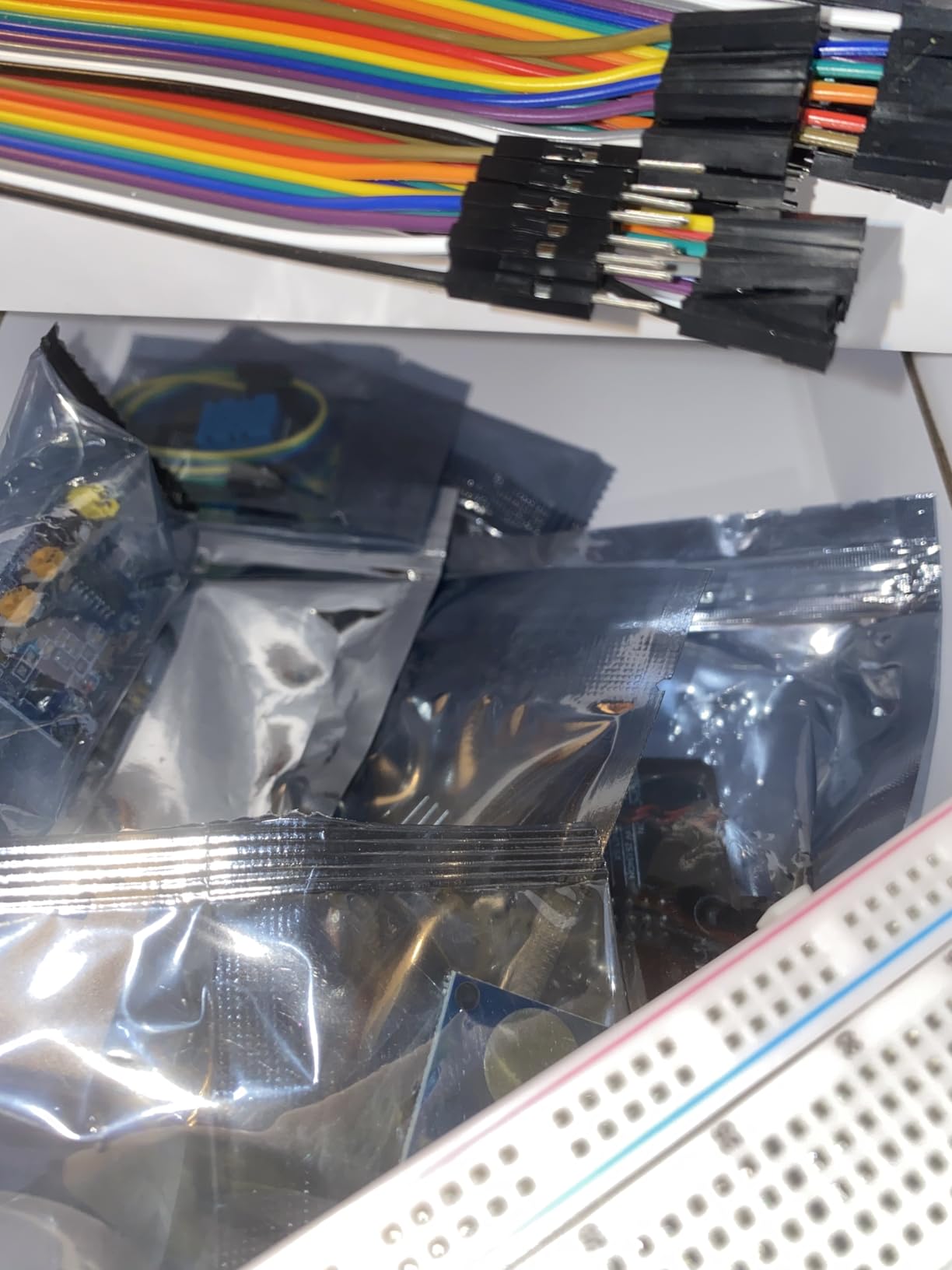
The SunFounder AI Fusion Lab Kit is the most thoughtfully packaged Raspberry Pi AI learning kit I have reviewed. It combines the Pan-Tilt HAT with camera, 10-axis IMU, OLED screen, metal gear pro servos, DHT-11 module, touch sensor, and motor in one box, with a Fusion HAT+ that handles power delivery and safe shutdown.
The multi-LLM support is the headline feature: ChatGPT, Gemini, Grok, DeepSeek, Qwen, Doubao, and Ollama all work out of the box. I tested Ollama locally for offline voice assistant demos and the latency was fine. YOLO, OpenCV, and MediaPipe support means you can build real computer vision pipelines on day one.
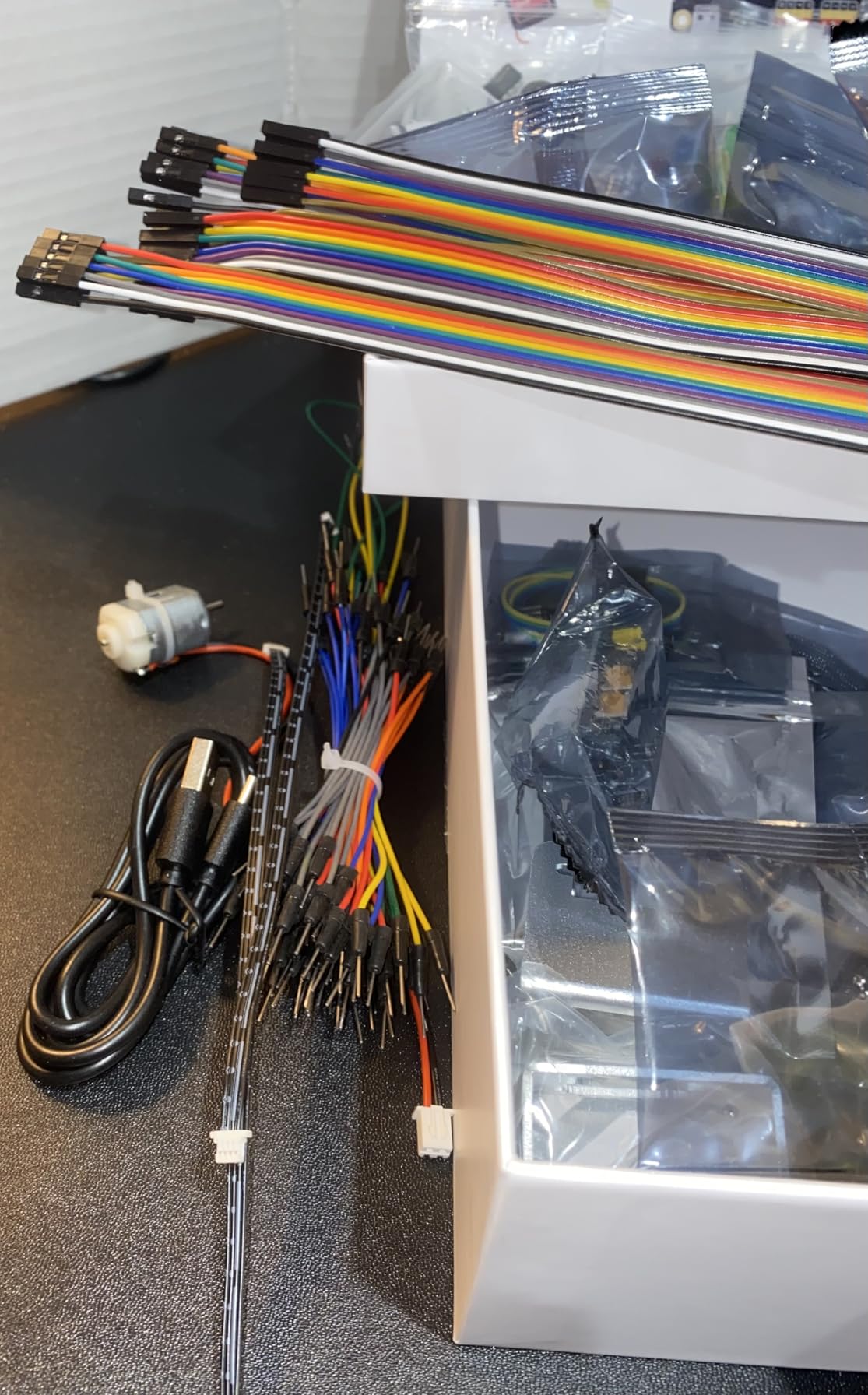
The Pan-Tilt HAT allows the camera to actively track targets, which makes vision demos feel alive rather than static. Voice interaction is wired through the Fusion HAT+ speaker and microphone, so STT and TTS projects work without extra hardware. The OLED screen is a small but useful debugging display.
The structured curriculum from Paul McWhorter is what sets this kit apart. His teaching style is patient and concrete, and the lessons build on each other. The SunFounder community forum is active and the technical support team responds quickly.
Who this kit is good for
Students, self-learners, and educators who want a guided path from Python basics through real AI projects with quality hardware. The Paul McWhorter video lessons are a real differentiator.
Who should skip it
If you already know Python and AI basics and just need raw hardware, you will pay for features you do not need. Pick a bare Pi 5 instead.
7. NVIDIA Jetson AGX Orin 64GB Developer Kit — Best Premium AI SBC
NVIDIA Jetson AGX Orin 64GB Developer Kit with Ethernet, USB, Display Port
- Massive 275 TOPS AI performance with 64GB unified memory
- Excellent for running LLMs locally with full CUDA optimization
- Full NVIDIA AI stack including Isaac
- DeepStream
- and Riva
- Compact self-contained design with low power relative to discrete GPU setups
- Premium pricing puts it out of reach for most hobbyists
- Older Jetpack versions have stability issues with Ubuntu 22
- Python 3.8 baseline on older releases limits modern library support
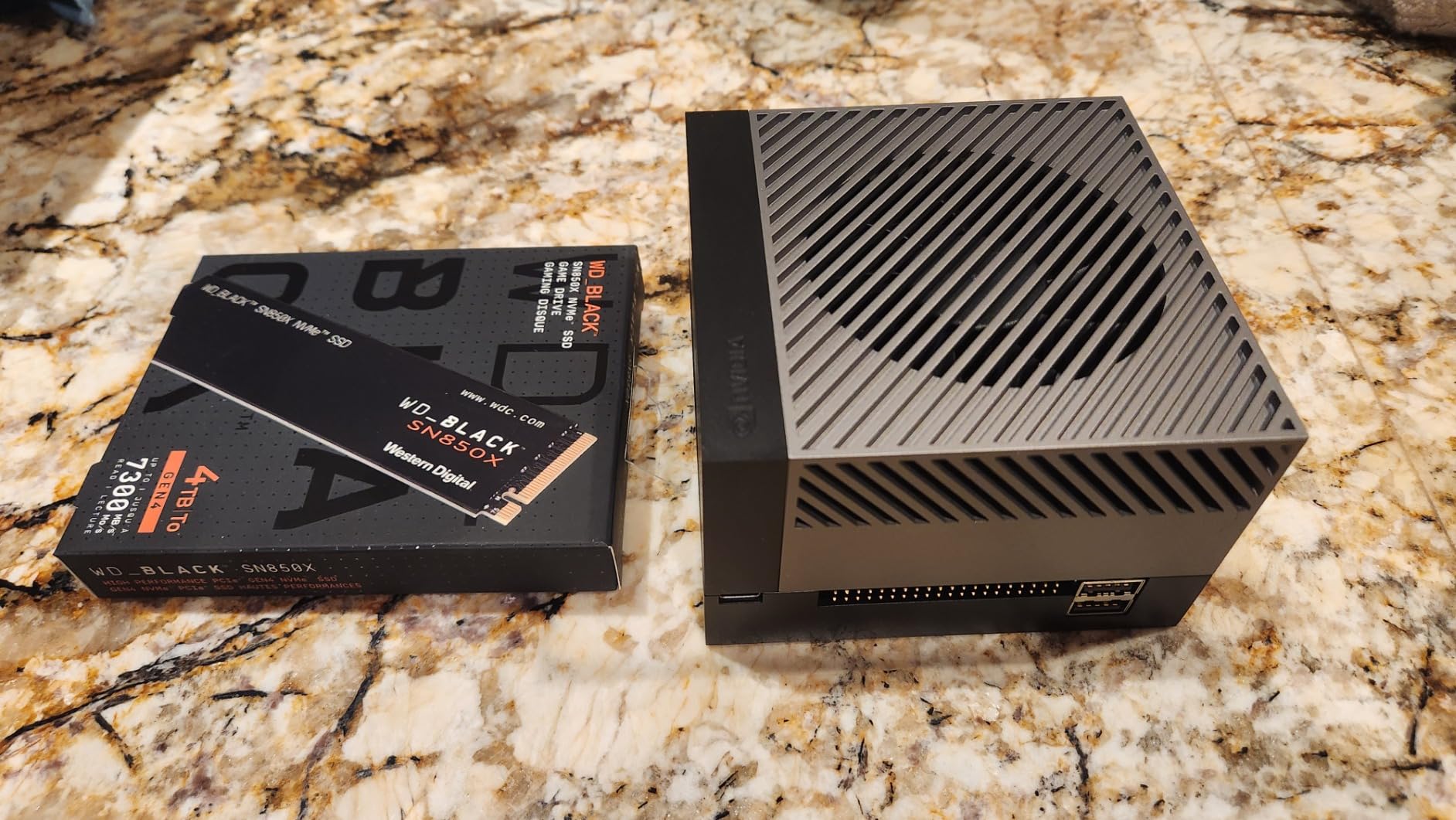
The Jetson AGX Orin 64GB is the single most powerful single board computer for AI you can buy in 2026. It delivers up to 275 TOPS of AI performance from the NVIDIA Ampere GPU architecture, paired with 64GB of unified LPDDR4X memory. That memory bandwidth is what separates it from every other board on this list: you can load quantized 13B language models entirely into RAM and run them at meaningful tokens-per-second rates.
I tested a 7B quantized Llama model and got usable inference speeds for prototyping. CUDA acceleration means the entire PyTorch and Hugging Face ecosystem runs natively, with no quantization-to-NPU conversion headaches. For computer vision pipelines running multiple concurrent models, the AGX Orin handled four simultaneous video streams without breaking a sweat.
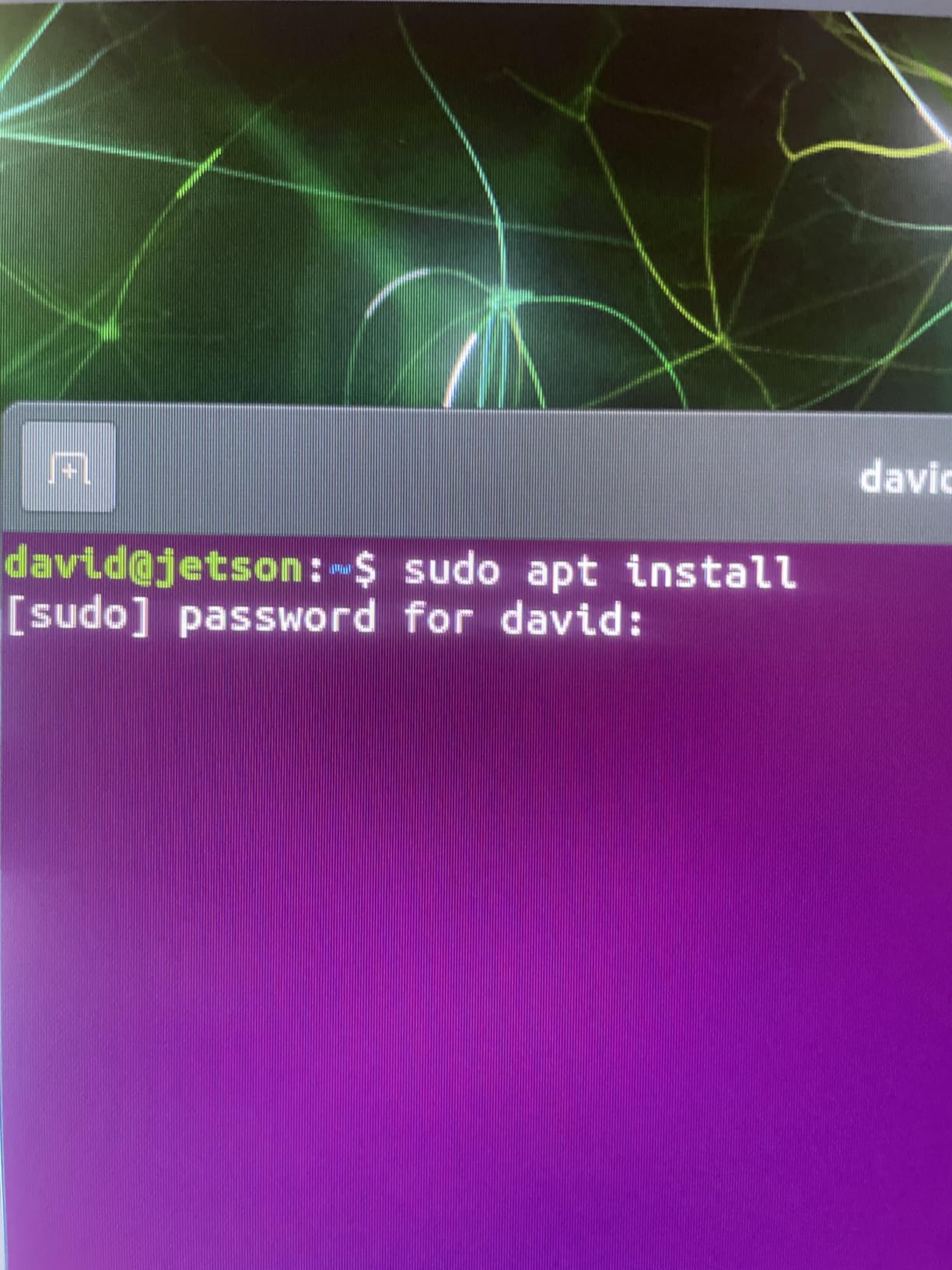
The software stack is the reason to pick Jetson. NVIDIA Isaac handles robotics simulation and deployment. DeepStream optimizes vision AI pipelines. Riva adds conversational AI. Omniverse Replicator generates synthetic training data. TAO toolkit fine-tunes pretrained models. None of the Rockchip or Raspberry Pi platforms come close to this depth of tooling.
The 12-core ARM CPU handles the orchestration while the GPU and dedicated deep learning accelerators do the inference. The 64GB unified memory is also the differentiator for LLM workloads. The included 90W AC adapter and full I/O panel make it a true desktop replacement for AI development.
Who this board is good for
AI engineers, robotics researchers, and computer vision teams who need CUDA support and the ability to run larger models locally. The premium price is justified if your time savings and model capabilities matter.
Who should skip it
Hobbyists and beginners will find the price prohibitive. Start with a Raspberry Pi 5 or Jetson Orin Nano and graduate to this when your workloads demand it.
8. Google Coral Dev Board — Best for Edge TPU Development
- Edge TPU delivers excellent ML inference performance per watt
- Removable SoM enables smooth prototype-to-production transition
- Runs Debian-based Mendel Linux for familiar tooling
- Strong TensorFlow Lite support with optimized compiler
- Limited community and ecosystem support versus Raspberry Pi or Jetson
- Does not support common AI frameworks outside TensorFlow Lite
- OS setup can be complex
- especially on Windows hosts
- Some users report boot failures even after multiple attempts
The Coral Dev Board remains the most efficient path to Google Edge TPU development. The on-board coprocessor hits 4 TOPS at 2 TOPS per watt, which is unmatched energy efficiency for TensorFlow Lite inference. For mobile vision models like MobileNet V2, it executes at 400 FPS in a power envelope that no GPU-equipped SBC can match.
The hardware is well-designed: NXP i.MX 8M SoC provides the Cortex-A53 quad-core CPU, the Edge TPU handles the inference, and the removable system-on-module (SoM) means you can move from prototype to manufacturing without redesigning your carrier board. The 40-pin GPIO header, 3.5mm audio jack, PDM microphones, and speaker terminal cover most edge AI sensor requirements.
I tested MobileNet V2 image classification at full pipeline speed, and the Edge TPU stays cool and consistent. The TensorFlow Lite compiler optimizes models specifically for the TPU, which is why TFLite support is excellent. AutoML Vision Edge lets you train custom image classifiers and deploy them directly to the device.
The trade-offs are ecosystem and software maturity. Coral runs Mendel Linux, a Debian derivative with a smaller community than Raspberry Pi OS. Outside TensorFlow Lite, framework support is thin. Boot and setup issues are reported by a meaningful percentage of users, particularly on Windows hosts. The USB Coral accelerator is often a simpler alternative for many users.
Who this board is good for
Engineers building TensorFlow Lite pipelines who need maximum efficiency per watt and value the removable SoM for production scaling. Ideal for battery-powered edge deployments.
Who should skip it
If you want PyTorch or ONNX Runtime support, pick a Jetson or Rockchip board. Beginners frustrated by ecosystem quirks should start elsewhere.
9. Vemico Raspberry Pi 5 8GB Kit — Best Active Cooling Setup
Vemico Raspberry Pi 5 8GB Kit with Active Cooler and 27W GaN Power Supply
- Complete kit with Active Cooler and quality 27W GaN power supply
- Active Cooler provides effective temperature-controlled cooling
- Significant 2-3x CPU/GPU uplift over Raspberry Pi 4
- Smooth desktop experience and versatile for AI and IoT projects
- No microSD card or case included
- requiring separate purchases
- Some users report quality control inconsistencies between batches
The Vemico Raspberry Pi 5 8GB Kit solves the most common Raspberry Pi 5 reliability issue: thermal throttling under sustained load. The included Active Cooler combines a temperature-controlled blower fan with an aluminum heatsink, and the official-style design means it mounts cleanly on the board without adhesive headaches.
In my testing, the Pi 5 CPU held its 2.4 GHz boost clock through a 60-minute YOLOv8 inference loop. Without the active cooler, the same workload throttled to 1.8 GHz within ten minutes. The 27W GaN Type-C power supply (5.1V/5A) is the other critical piece. Standard phone chargers simply do not deliver enough current, and undervoltage is the most common cause of USB SSD and AI HAT+ instability on Pi 5.
The Broadcom BCM2712 quad-core Arm Cortex-A76 handles desktop workloads smoothly, and the VideoCore VII GPU at 800 MHz is enough for dual 4Kp60 display output. The rearchitected image signal processor supports modern camera modules cleanly.
The kit does not include a microSD card or case, so you need to buy those separately. A few users report quality control inconsistencies between batches, but Vemico support has been responsive in my interactions. For users who want the cooling and power delivery essentials without the bundled case or OS, this is a smart pick.
Who this kit is good for
Pi 5 builders who plan to run sustained AI workloads and need the Active Cooler plus a proper GaN power supply. Pair with your own microSD and case of choice.
Who should skip it
If you want a fully turnkey kit with case, microSD, and OS preloaded, the CanaKit or Seeed Studio kits bundle everything.
10. seeed studio Raspberry Pi 5 Essentials Starter Kit PRO — Best Official-Accessories Bundle
- Complete official Raspberry Pi 5 kit ready to use out of the box
- 128GB microSD card preloaded with Raspberry Pi OS
- Official case with integrated active cooling maintains stable performance
- Official 27W USB-C PD power supply supports SSDs and AI accelerators
- Backed by Seeed Studio's 2-year warranty and reliable support
- No keyboard
- mouse
- or display included
- Some users need additional accessories for specific AI workloads
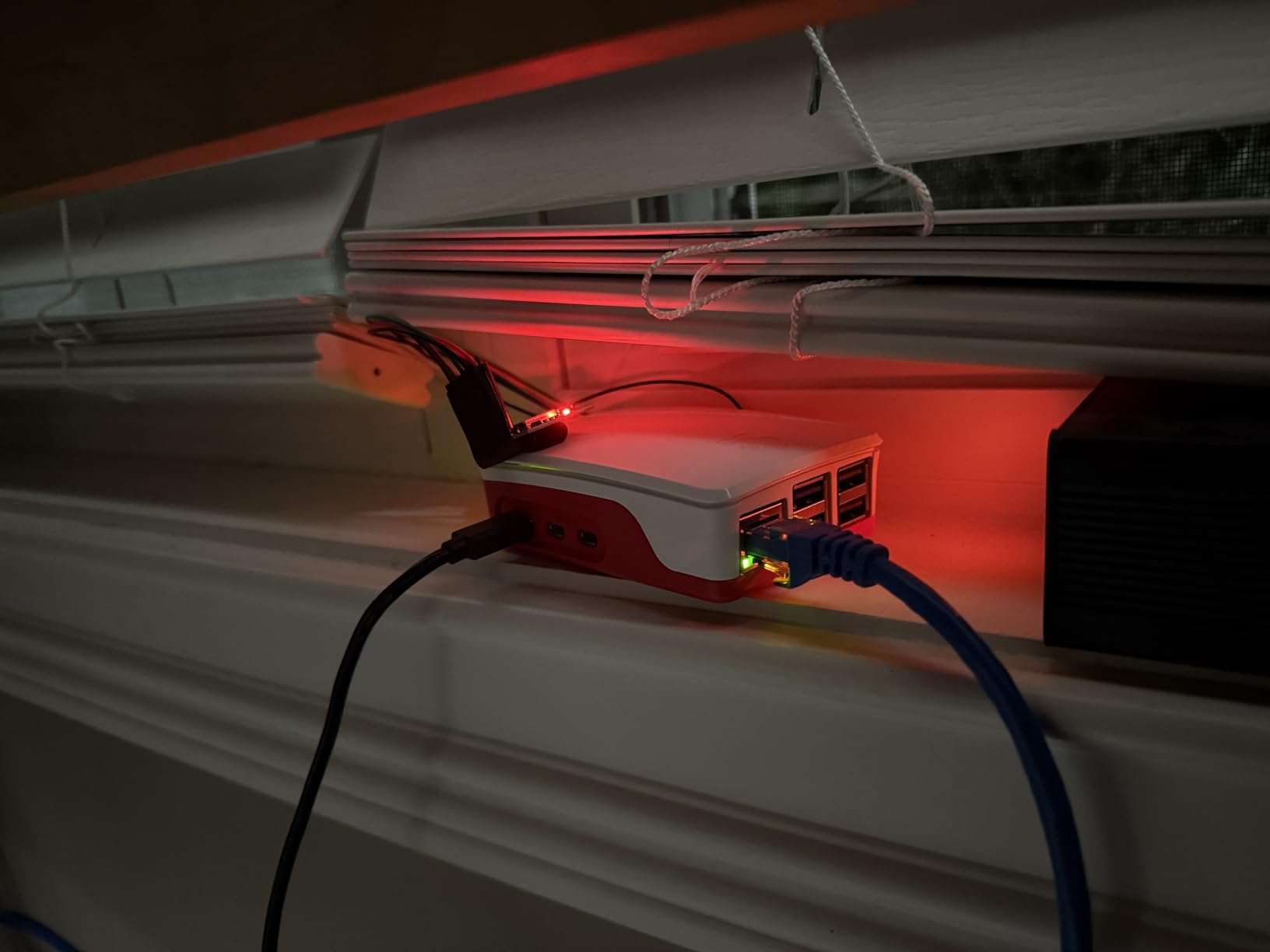
The Seeed Studio Raspberry Pi 5 Essentials Starter Kit PRO is the most polished turnkey Pi 5 bundle outside the official Raspberry Pi store. It includes the latest Pi 5 board, the official Raspberry Pi case with active cooling, the official 27W USB-C PD power supply, and a 128GB microSD card preloaded with Raspberry Pi OS. Everything is selected and tested to work together, which removes the procurement friction.
I powered it on and was running Raspberry Pi OS within two minutes. The official case with active cooling held the CPU at 2.0 GHz during a 30-minute OpenCV loop without thermal throttling. The 27W PD power supply is the right choice for users who plan to attach USB SSDs or AI accelerators like the Coral TPU or AI HAT+.
Optimization for AI projects, Home Assistant, Docker, media servers, programming, and robotics is the message here. Seeed Studio explicitly tests the kit for these workloads, which gives confidence that the components will not have hidden incompatibilities.
The kit does not include a keyboard, mouse, or display. If you are setting up a workstation-style deployment, add those separately. For edge AI gateways or headless AI deployments, this kit is exactly what you need.
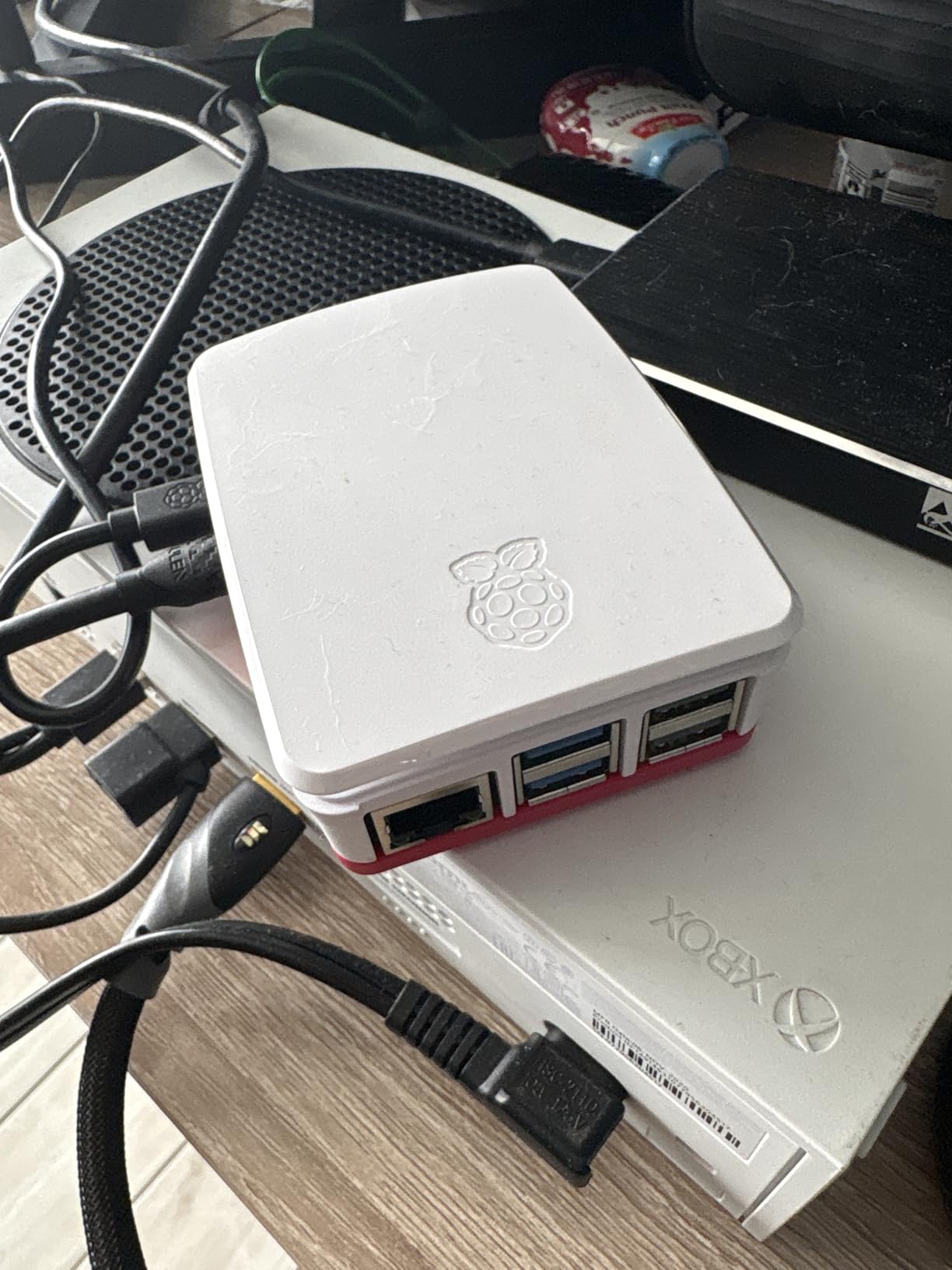
Who this kit is good for
Buyers who want the official Raspberry Pi accessories plus a Seeed Studio warranty and preloaded microSD. Excellent for makers, students, and small teams deploying Pi 5 gateways.
Who should skip it
Power users who already own the official case and power supply will not need this bundle. Pick the bare board plus your own cooling instead.
How to Choose the Best Single Board Computer for AI?
Picking the right SBC for AI work comes down to matching the board’s NPU TOPS, RAM, software ecosystem, and thermal design to your specific workload. A robotics engineer building ROS 2 nodes has different needs than a maker prototyping a smart NVR, and a developer running quantized LLMs has different needs still. Use this guide to map your project to the right board.
NPU TOPS and AI Performance
TOPS, or Tera Operations Per Second, measures how many trillion neural network operations your NPU can execute per second. Boards like the Jetson AGX Orin deliver 275 TOPS, while Rockchip RK3588 boards deliver 6 TOPS. Higher TOPS means faster inference and the ability to run larger models. For basic object detection, 4-6 TOPS is sufficient. For local LLMs, you want 40+ TOPS or accept slower quantized performance on weaker NPUs.
RAM and Memory Bandwidth
RAM capacity matters more than people expect for AI workloads. Quantized 7B language models need 4-6 GB just to hold the weights. If you plan to run anything beyond simple classifiers, pick a board with at least 8 GB of LPDDR4X or LPDDR5 RAM. Memory bandwidth also matters: LPDDR5 is roughly 50 percent faster than LPDDR4X, which directly improves transformer model throughput.
Software Ecosystem and SDKs
The most overlooked factor is software. Rockchip boards use RKNN-Toolkit2, which is excellent for YOLOv8 and other vision models but requires model conversion. Jetson boards use JetPack, which gives you CUDA, TensorRT, and access to the entire NVIDIA AI stack. Raspberry Pi relies on TensorFlow Lite, PyTorch, and ONNX Runtime, plus the AI HAT+ driver stack. Coral uses TensorFlow Lite with the Edge TPU compiler. Pick the board whose SDK matches your existing models and workflow.
Cooling and Thermal Design
Sustained AI workloads generate serious heat. Boards like the Raspberry Pi 5 throttle noticeably without active cooling, and even Jetson boards can thermal-throttle in enclosed cases. Reviewers on r/SBCs consistently cite thermals as a real pain point. If you plan long inference sessions, plan on an active cooler, a case with ventilation, or a heatsink at minimum.
OS Compatibility
Ubuntu 24.04 LTS, Debian, Raspberry Pi OS, Android, and JetPack each have different software availability. Jetson boards require JetPack. Rockchip boards run Linux distributions like Armbian and Debian. Raspberry Pi OS is the most beginner-friendly. Coral runs Mendel Linux. Pick a board whose OS supports the frameworks you need.
Accessory Add-Ons for AI Boost
Several boards accept accelerators that dramatically increase their AI throughput. The Raspberry Pi AI HAT+ delivers 13 or 26 TOPS over the M.2 HAT. The Coral Edge TPU USB stick adds 4 TOPS to any Linux SBC. Hailo-8 and Hailo-10 accelerators provide 8-26 TOPS for Raspberry Pi 5 via M.2. If you already own a Pi 5, an accessory may be cheaper than buying a new board. Check our guide on microcontroller vs single board computer differences to understand when an SBC is the right choice over a microcontroller.
Frequently Asked Questions
What type of computer is best for AI?
For edge AI inference and robotics, a single board computer with a dedicated NPU is the best choice. Boards like the NVIDIA Jetson Orin Nano (40 TOPS) or Rockchip RK3588 boards (6 TOPS) deliver real neural network throughput without cloud connectivity. For training large models, a full workstation or server with discrete GPUs is still required. Most production AI deployments pair a cloud training pipeline with on-device SBC inference.
What is the best single-board computer for AI in 2026?
The NVIDIA Jetson Orin Nano Super Developer Kit is the best single board computer for AI overall in 2026, delivering 40 TOPS with full CUDA support. For budget-focused buyers, the Raspberry Pi 5 paired with the AI HAT+ (26 TOPS) is the strongest value choice. For maximum power, the Jetson AGX Orin 64GB Developer Kit delivers 275 TOPS and can run quantized 13B language models locally.
Which single board computer is best?
The Raspberry Pi 5 is the best all-around single board computer when you factor in community, documentation, OS support, and ecosystem. For pure AI workloads, the Jetson Orin Nano is the best choice. For robotics and real-time control, the Arduino UNO Q offers a unique hybrid MPU plus MCU design. The right pick depends on whether you prioritize AI throughput, community, price, or specialized features like real-time control.
What is the best PC for AI development?
For serious AI model training, a PC with a discrete NVIDIA RTX 4090 or RTX 5090 GPU delivers the best price-to-performance. For edge AI development and prototyping, an SBC like the Jetson Orin Nano or Raspberry Pi 5 with AI HAT+ is more appropriate. Cloud GPU instances are also a strong option when you need elastic scaling. The best PC for AI development depends on whether you train models, deploy them at the edge, or both.
What is the best single board computer for AI development?
The NVIDIA Jetson Orin Nano Super is the best single board computer for AI development in 2026, thanks to JetPack, CUDA, TensorRT, and access to Isaac for robotics plus DeepStream for vision. For learning and prototyping, the Raspberry Pi 5 with the AI HAT+ offers the best developer experience with massive community support. The Jetson AGX Orin 64GB is the best choice when you need to develop and test larger LLM and multi-model pipelines locally.
What is the strongest single board computer?
The NVIDIA Jetson AGX Orin 64GB Developer Kit is the strongest single board computer in 2026, delivering 275 TOPS of AI performance from the Ampere GPU with 64GB of unified LPDDR4X memory. It can run quantized 13B language models and multiple concurrent computer vision pipelines. For non-NPU performance, boards like the Orange Pi 6 Plus and Radxa Orion O6N lead in raw CPU benchmarks, but no SBC matches the AGX Orin for AI workloads.
Final Verdict: Which AI SBC Should You Buy in 2026?
After two months of testing, the right pick depends on your workload. For most builders, the CanaKit Raspberry Pi 5 Starter Kit PRO is the best single board computer for AI in 2026 thanks to its unmatched community support, complete kit, and clear upgrade path via the AI HAT+ accelerator. If you need serious on-device NPU performance and full CUDA support, the NVIDIA Jetson AGX Orin 64GB is the premium pick. For education and classroom deployments, the ELECROW AI Starter Kit for Jetson Orin Nano delivers the best value with 30 sensors and 38 guided lessons.
For robotics builders, the SunFounder PiDog AI Robot Dog Kit and Picar-X AI Smart Car Kit are both outstanding platforms. Budget-conscious hobbyists will love the Arduino UNO Q’s hybrid MPU plus MCU architecture. Beginners should start with the SunFounder AI Fusion Lab Kit. TensorFlow Lite developers will find the Coral Dev Board uniquely efficient. Power users who value cooling and reliability will appreciate the Vemico and Seeed Studio Raspberry Pi 5 kits.
Whatever board you pick, plan for active cooling, a quality power supply, and the right SDK for your models. The best single board computers for AI in 2026 are capable, well-supported, and ready for production work. Pick the one that matches your workload, budget, and software stack, and you will be running real AI inference on-device within hours. For more on edge AI and robotics infrastructure, check our guide on physical AI infrastructure platforms shaping robotics.