
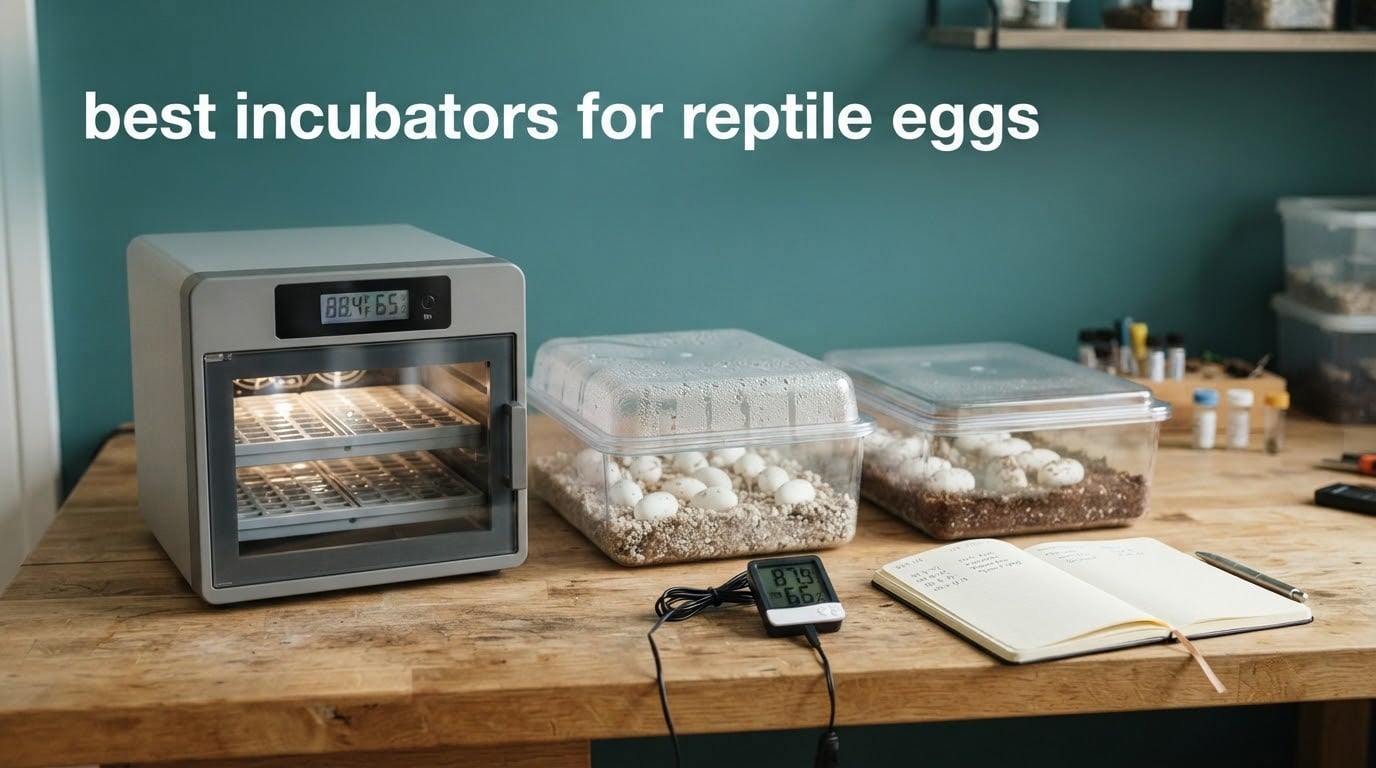
Choosing among the best incubators for reptile eggs comes down to one question: can the box hold a narrow temperature and humidity band steady for six weeks without anyone opening the lid? Most home environments cannot do that, and that is the whole reason an incubator exists.
Reptile eggs fail in predictable ways. A warm night pushes the box two degrees and the embryos slow down. A dry week dents the eggs inward. A fan that rotates the eggs the way a poultry incubator rotates bird eggs can wreck an entire clutch. So the hardware matters more here than in almost any other hobby, and the cheapest box on the shelf is often the wrong tool.
We lined up ten of the most widely reviewed incubators and boxes available in 2026 and compared them on the four criteria that decide a hatch: real temperature range, whether they cool as well as heat, whether humidity is under any kind of control, and whether anything in the box will move your eggs. Two different product families show up in the results, and the right one for you depends on how many clutches you run at once.
Before the list, three questions narrow the field fast: what species are the eggs, how warm does the room get in July, and how many clutches do you need to incubate at the same time? Two eggs and twenty eggs need completely different hardware.
Table of Contents
Top 3 Incubator Picks for Reptile Eggs (September 2026)

OMEM Reptile Breeding Box
- 14 egg slots in 8 groups
- Transparent cover
- Suspended tray incubation

AKSDSGA 23L Cabinet Incubator
- 50-104F heating and cooling
- Four tier shelf space
- LED readout for monitoring
Best Incubators for Reptile Eggs in 2026: Full Comparison
Every unit below appears with the specs that actually change a hatch rate. The passive boxes hold eggs and separate them from wet substrate, but they do not control anything, so the temperature and humidity come from whatever you put them inside. The cabinet incubators run a thermostat cycle and, in most cases, cool as well as heat.
| Product | Specifications | Action |
|---|---|---|
| OMEM Reptile Breeding Box, 14 Egg Hatchery Box |
|
Check Latest Price |
 DOHO Reptile Breeding Box, 14 Egg Incubator DOHO Reptile Breeding Box, 14 Egg Incubator |
|
Check Latest Price |
| AKSDSGA 23L Cabinet Incubator, Heating and Cooling |
|
Check Latest Price |
 Repti-Hatch Snake Egg Incubation Tray, 10 Eggs Repti-Hatch Snake Egg Incubation Tray, 10 Eggs |
|
Check Latest Price |
 PLOCVB 23L Scientific Lab Incubator Cabinet PLOCVB 23L Scientific Lab Incubator Cabinet |
|
Check Latest Price |
 Groveland Geckos 12 Egg Incubation Container Groveland Geckos 12 Egg Incubation Container |
|
Check Latest Price |
 Ynomdusa 23L Reptile Scientific Lab Incubator Ynomdusa 23L Reptile Scientific Lab Incubator |
|
Check Latest Price |
 nfvkldfoi 23L Incubator with Humidity Control nfvkldfoi 23L Incubator with Humidity Control |
|
Check Latest Price |
| BYOIPLOI 23L Cabinet Incubator, 70W |
|
Check Latest Price |
 Lemnestie 16 Grid Reptile Breeding Box Lemnestie 16 Grid Reptile Breeding Box |
|
Check Latest Price |
1. OMEM Reptile Breeding Box – Best Overall Pick for Small Clutches
- Most reviews of any box in this roundup
- Clear cover for daily embryo checks
- Eggs sit off wet substrate
- Easy to rinse and reuse
- No temperature or humidity control of its own
- Slot size suits smaller eggs only
This is the box I keep coming back to for gecko and small lizard clutches. It holds fourteen eggs across eight slot groups, and the group layout means you can incubate a partial clutch without eggs rattling into each other all season.
The design detail that matters is the suspended tray. Rather than burying eggs in damp vermiculite where they pick up mould at the contact point, the tray holds them just above the substrate with air moving around all sides. Breeders on the forums describe the same principle when they move eggs off the media entirely, and this box builds it in.
Measure your eggs before you order. Slots are 1.57 by 0.8 inches, so this suits gecko, small lizard and similar clutch sizes. A ball python or a large bearded dragon egg will not fit, and no amount of adjusting will change that.
Be clear about what you are buying. This is an incubation box, not an incubator, and it has no heating element, no thermostat and no hygrometer. You place it inside whatever holds your temperature: a rack, a hot box, a climate-controlled room. The 256 reviews behind its 4.0 rating reflect the box doing its one job reliably, not climate control.
When this box makes sense
If you run one to three small clutches a season, a rack, a foam cooler or a controlled room is the working environment and the box is the right layer on top of it. It is also the easiest thing to swap out and sanitise between clutches, which matters in a humid setup where mould lives.
When it will not be enough
If your room swings more than a few degrees between night and afternoon, you need a cabinet that runs its own thermostat. Buyers who expected a self-heating unit report disappointment for a simple reason, and those reviews are the main reason the rating sits at 4.0 rather than higher.
2. DOHO Reptile Breeding Box – Best Value Passive Hatchery
DOHO Reptile Breeding Box Reptile Egg Incubator Hatchery Box Suitable for Hatching Gecko Lizards Lions Mane
- Food grade materials
- Light enough to move between rooms
- Clear walls for monitoring
- Same 14 egg capacity as larger brands
- Shallow tray limits substrate depth
- Eggs can dry out without frequent misting
- Hatch success reports are mixed
The DOHO box is the one I recommend to first-time breeders, mostly because it removes almost every decision. Same footprint as the OMEM at 7 by 5.1 by 2 inches, same fourteen egg capacity, and the manufacturer states the plastic is food grade.
Food grade matters more than it sounds. Eggs sit directly against whatever lines the container for eight weeks in a humid environment, and plastic that outgasses or sheds residue is a risk you do not need to take with a valuable clutch.
Where it differs from the OMEM is depth. The tray sits low, which means less substrate above the eggs and a shallower reservoir for moisture. Several owners report that eggs dry out and need misting more often than they would in a taller box.
On hatch outcomes the feedback is genuinely mixed. Owners using hognose, leopard gecko and similar small clutches tend to be positive, while a smaller group reports mediocre results, most often pointing at moisture retention rather than the box itself.
For a single small clutch
Two to fourteen small eggs in a controlled environment is exactly what this handles well. The clear walls let you check development daily without rearranging anything, and at 4.52 ounces you can carry the whole box to wherever the stable spot is.
For a room that heats up
Humidity is the weak point here. If your summer afternoons push the room warm and dry, a shallow passive box loses moisture fast, and you will be chasing a spray bottle for six weeks. Pick a cabinet with humidity control for that situation.
3. AKSDSGA 23L Cabinet Incubator – Best for Multi-Clutch Batches
- Cools as well as heats
- Four levels of shelf space
- LED readout without opening the door
- Removable shelves wipe clean
- Only 15 reviews so far
- Weighs 20.94 pounds
- Interior shelves and glass door need regular cleaning
This is the first unit in the list that actually controls the environment, and for anyone running more than one clutch at a time it changes the whole workflow. Twenty-three litres, or 6.08 gallons, with three removable metal shelves creating four working levels.
The range runs 50 to 104F, and the cabinet cools as well as heats. That is one of the more useful specs on this page. Most budget boxes and even some poultry-style cabinets only add heat, which means a hot room in July leaves you with no way to bring the temperature down.
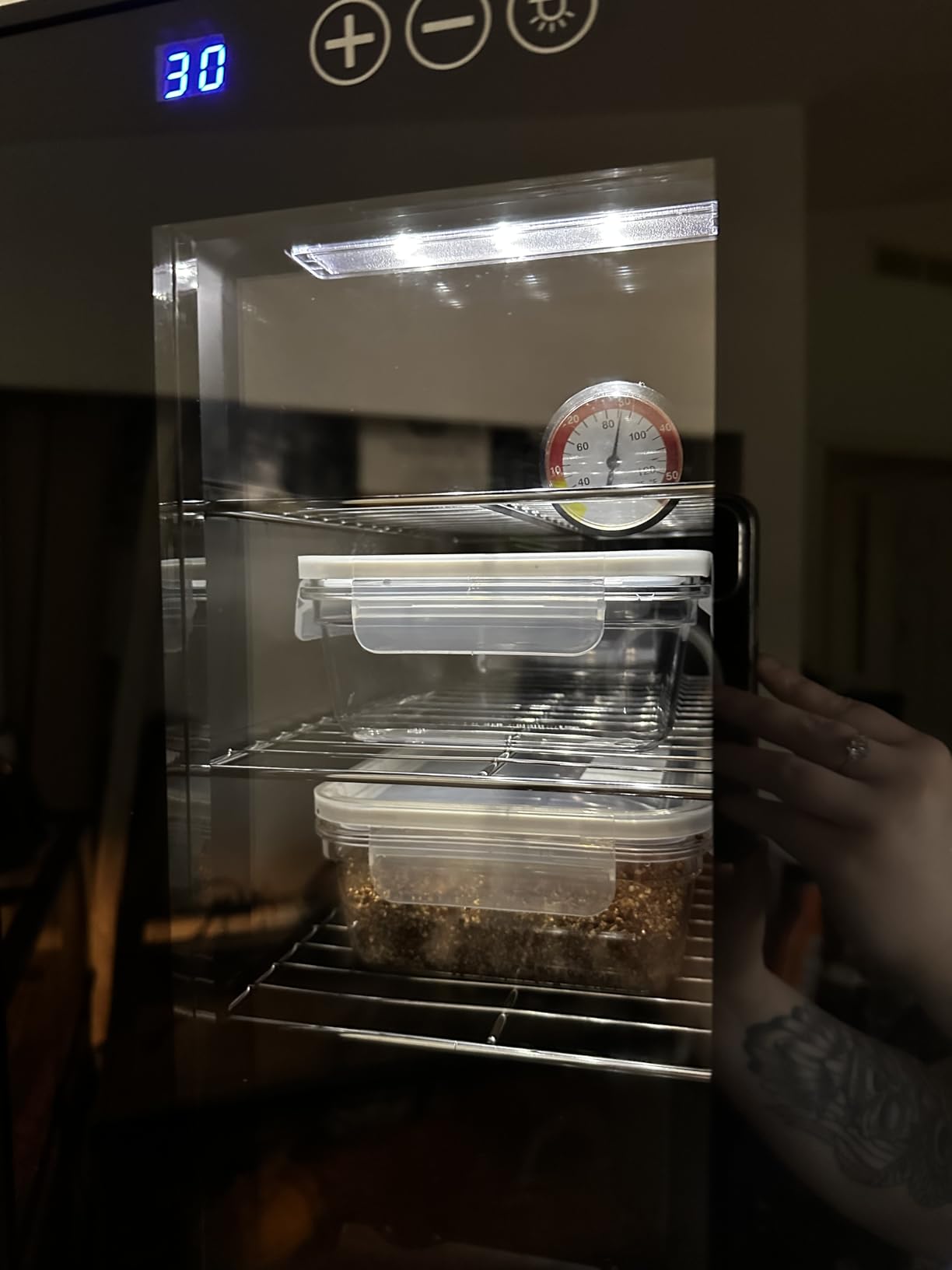
Sensor-based monitoring feeds an LED display so you can read the chamber temperature without cracking the double-layered glass door. Opening the door is the fastest way to lose a set point, and the double glazing limits how much you lose even when you do.
Ventilation holes and a built-in cooling fan move excess heat out, which is what keeps the cabinet usable in a warm room rather than a garage.
With only 15 reviews on file, treat the 4.2 rating as early rather than settled. What we can say from the specification is that it covers a wide temperature band, both directions, in a cabinet big enough to stagger clutches.
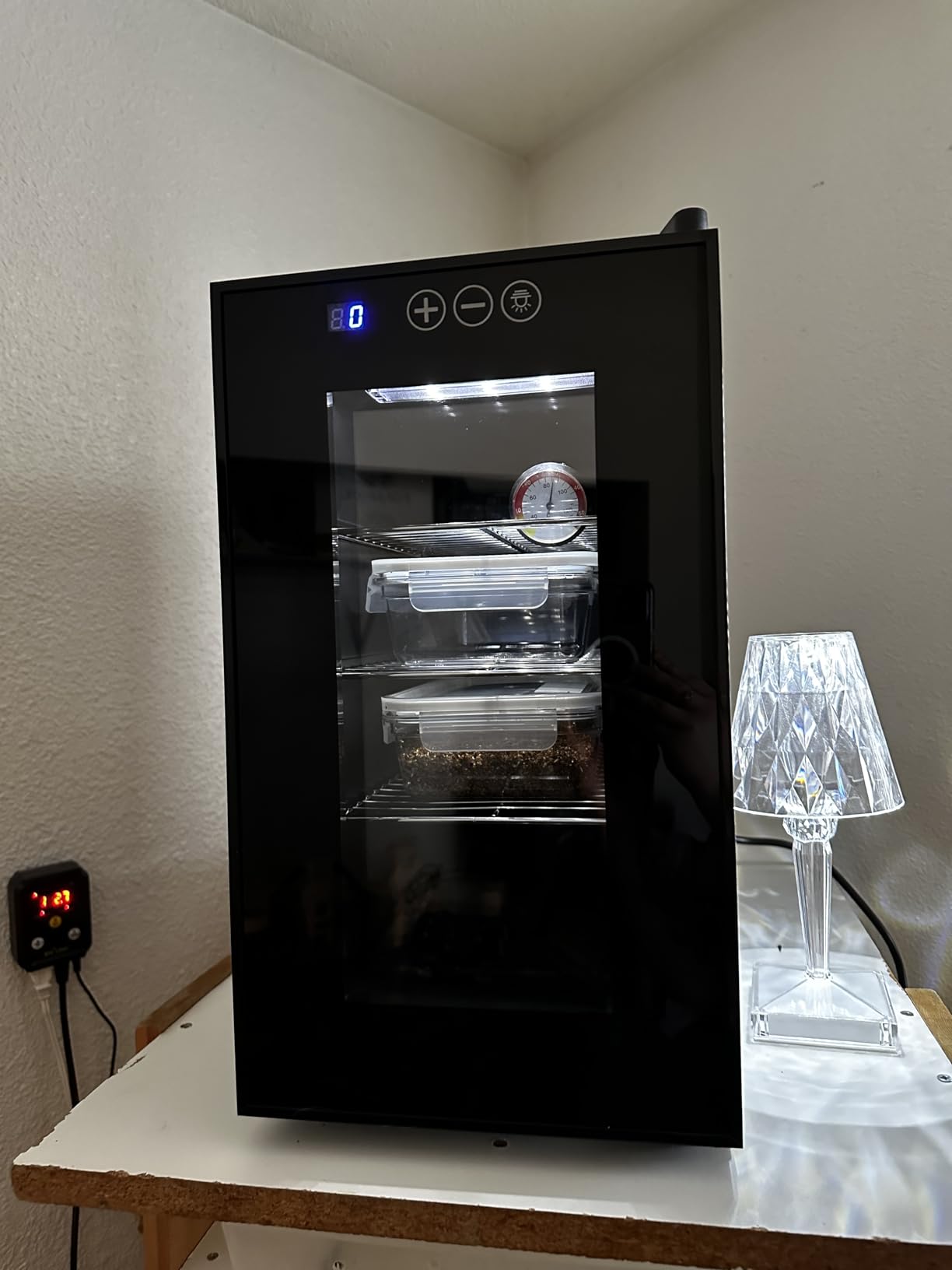
Staggering clutches across species
Four shelf levels is the reason to buy a cabinet this size. Gecko and lizard eggs at the low end of the range and snake eggs at the high end can run in the same room without sharing a thermostat, and clutches at different days of incubation can sit on separate shelves without one batch dictating conditions for the other.
What to check before loading eggs
A multi-shelf cabinet can hold a temperature gradient, with the top shelf warmer than the bottom. Put an independent thermometer on each level, run the cabinet empty for 48 hours, and see how much the readings diverge before you commit a clutch to it.
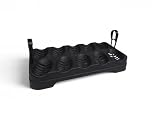
4. Repti-Hatch Snake Egg Incubation Tray – Best No-Roll Egg Cradles
Groveland Geckos Repti-Hatch Snake Egg Incubation Tray Snake Lizard Leopard Gecko Ball Python Bearded Dragon
- Grooves stop eggs rolling into each other
- Elevated design keeps eggs off wet media
- Airflow between every egg
- Reusable and easy to rinse
- Only 12 reviews
- Needs your own container
- Ten egg limit per tray
The Repti-Hatch tray solves one problem better than anything else in this roundup: eggs rolling. Each egg sits in a precision-moulded cradle, so a nudged box or a hatchling moving next door does not send eggs into each other mid-incubation.
It is also the most flexible option here. The tray fits standard 6 QT containers, which means you can drop it into a rack, a hot box, a drawer or a cabinet, and you choose the container based on where your eggs need to go that season.
Works with vermiculite and perlite underneath, keeps the eggs elevated rather than resting in wet media, and the spacing between cradles is designed to keep air moving around every egg. It rinses clean in seconds, which matters more than it sounds after a season of mould remediation.
The 5.0 rating comes from 12 reviews. That is a small sample and we would treat it accordingly, but there is nothing in the design we would flag as questionable.
Best for breeders using a hot box
For a two to ten egg clutch, a tray inside a controlled container beats buying a cabinet. Several experienced keepers make the same argument about small clutches, and this tray is the piece of hardware that makes that setup practical.
What it does not do
It sets no temperature and holds no humidity. If you are relying on the tray to create conditions, you will be disappointed; if you already have a working hot box, this is the internal layout that stops eggs rolling and keeps them drier.
5. PLOCVB 23L Scientific Lab Incubator – Best for Precise Temperature Control
Cabinet Incubators for Hatching Eggs, 23L Scientific Lab Incubator Reptile Egg Incubator for Hatching Chicks, Reptile Incubator Cooling and Heating 10-40°C Temperature Control for Turtle Lizard Snake
- Stated accuracy figure
- the tightest published here
- Heats and cools automatically by season
- Drain hole and external tray for condensate
- LED interior lighting behind double glass
- Only 6 reviews
- No published weight figure
- Vibration-free start is unverified at this sample size
The PLOCVB cabinet publishes a temperature accuracy figure: plus or minus 1.5C, adjustable from 10 to 40C at the control panel. For species with temperature-dependent sex determination, a stated tolerance is worth more than a generous-sounding range.
TSD is the reason precision gets so much attention among breeders. Eggs incubated a few degrees higher can skew the sex ratio of the clutch, and you cannot undo that after they hatch, so a thermostat that actually holds its set point is the whole game.
It heats in winter and cools in summer automatically, which is what you want in a room with seasonal swings. A bottom drain hole handles condensate and keeps air moving through the chamber, and the external tray collects it for cleaning rather than letting it sit under the eggs.
The 4.7 rating rests on 6 reviews, so treat it as promising rather than proven. The specification sheet is the more reliable part of this listing.
For breeders working with TSD species
Bearded dragons, leopard geckos, crested geckos and several chameleons fall into this category. If you are running a pairing specifically to produce a sex ratio, the narrow tolerance and published figure make this the safer cabinet of the group.
Where the gradient question comes back
Twenty-three litres across removable mesh shelves means a top-to-bottom temperature difference is possible even in a well-controlled cabinet. Measure each level with your own thermometer before you decide how to distribute clutches across them.
6. Groveland Geckos 12 Egg Incubation Container – Best for Small Clutches
- Built-in tray separates each egg
- Rectangular shape wastes less shelf space
- Watch hatchlings without opening
- Cleans and reuses easily
- Only 4 reviews
- Too small for larger adult dragon eggs
- Limited to smaller clutch sizes
This container is shaped for efficiency. The rectangular footprint means you can fit more containers into a given rack or cabinet space than round boxes allow, which quietly determines how many clutches you can run at once.
Eggs are elevated above the substrate in individual tray spaces, which limits the surface touching wet media and improves airflow around each one. For bearded dragon, leopard gecko and crested gecko eggs it is a well-matched size.
Visibility is the other argument. The clear polypropylene walls mean you can watch pipping and emergence without lifting the lid, so you check on the clutch without dropping the temperature and humidity every time.
With 4 reviews behind the 4.5 rating, this is a new product and the feedback is thin. One reviewer specifically notes it is too small for larger adult dragon eggs, so check egg dimensions against your own pairing.
Fitting more clutches into a fixed space
If your limiting factor is rack space rather than budget, this is the pick. A dozen eggs in a compact rectangle means you can scale up the number of containers in the same footprint, and each one holds its eggs separately and evenly.
When size rules it out
Not much room, and that is fine, but a large species egg simply will not sit in the tray. Measure first, and if the eggs overhang the cradles, move up to a box with deeper slots.
7. Ynomdusa 23L Reptile Scientific Lab Incubator – Best Wide-Range Cabinet
- Full 50-104F range with air cooling
- Advanced sensors and LED readout
- Automatic seasonal heating and cooling
- External drain tray for condensate
- Only 3 reviews
- 24.2 pounds is heavy to move
- Published accuracy figure looks like a listing error
The Ynomdusa cabinet covers the same 50 to 104F span as the other 23L units, with an air cooling system, LED screen control panel and automatic seasonal switching between heating and cooling. The 6.08 gallon chamber takes several clutches at once.
One detailed owner review reports holding target temperatures across three different species groups, including bearded dragons in the low eighties, corn snakes in the mid eighties and leopard geckos around 88F. That is a useful check of the thermostat, though it comes from a single reviewer.
Condensate handling is a real strength here. The bottom drainage hole discharges into an external tray, which keeps standing water away from the substrate and makes cleanup a matter of emptying a tray instead of scrubbing the cabinet floor.
The listing states temperature accuracy of plus or minus 34.7F, which is almost certainly a measurement error on the seller’s part rather than a real specification. Do not read that number as a promise; verify with your own thermometer instead.
For rooms with big seasonal swings
Automatic heating below set point and cooling above it is the feature that matters in a room that changes a lot across the year. It means one cabinet can serve a cool spring and a hot August without manual adjustment.
Before you trust the sensor
Three reviews is a very thin base, and the accuracy figure in the listing is self-evidently wrong. Run the cabinet empty for 48 hours with an independent thermometer at egg height and decide for yourself how close it lands.
8. nfvkldfoi 23L Incubator with Humidity Control – Best for Humidity Control
Reptile Incubator 23L, Egg Incubator with Humidity Control, Cooling Heating
- Only cabinet here listing humidity control
- Three removable chrome racks
- Soft blue LED for checking eggs
- Built for quiet rooms
- Only 2 reviews
- Newest design in the set
- Package dimensions differ from the unit
Humidity is where most reptile clutches are lost, and this is the only 23L cabinet in the set that lists humidity control alongside temperature. Every other unit here manages moisture through a water channel, a reservoir you refill by hand, or the substrate itself.
It also holds a 10 to 40C range, heats in cold months and cools in summer, and uses three removable chrome racks inside a galvanized steel body with a powder coat. The double-layer glass door carries a 220 degree hinge and a soft blue LED that lets you check the eggs without glare.
At 21.85 pounds and 32 dB it is built to live in a room you actually use rather than a workshop. That combination of quiet operation and glass viewing is what makes daily checks realistic.
Two reviews, both 5-star, is not enough to call this proven. What makes it worth your attention is the specification, not the rating: humidity control is a genuine gap in every other cabinet we looked at.
When humidity is your main worry
Snake eggs generally want a relative humidity in the mid to upper fifties, and many species tolerate a wider band than breeders assume. Managing that automatically is easier than maintaining it by hand through a room with dry winter air.
What the two reviews tell us
Owners single out quiet operation, the wide range and the solid feel of the cabinet. None of them reports long-term behaviour, so pair it with an external hygrometer and check the reading against the chamber rather than the display alone.
9. BYOIPLOI 23L Cabinet Incubator – Best for Lowest Power Draw
- 70W figure published
- Three removable shelves create four levels
- UV protection in the double glazing
- Galvanized body resists corrosion
- Only 3 reviews
- No humidity control
- Accuracy figure in the listing looks wrong
This cabinet publishes a 70W power figure, and for anyone running an incubator continuously through a sixty-day incubation that is a number worth knowing. Power draw is the ongoing cost of incubation, and it is rarely listed anywhere else.
Otherwise it is a conventional 23L design: 10 to 40C adjustable, advanced sensors, LED readout, three removable metal shelves creating a four-tier space, and a galvanized plate body with a spray coating for wear and corrosion resistance.
The double-layered glass does double duty. It holds temperature and gives you a view of the clutch, and the listing states it also filters harmful ultraviolet light, which is a reasonable claim for anyone incubating outdoors or in a bright room.
Seasonal adaptation is described as manual adjustment rather than fully automatic, so this unit wants a check when the weather turns. The stated accuracy of plus or minus 37.4F has the same measurement problem we flagged on the Ynomdusa listing.
For year-round electricity cost
A thermostat cycles the compressor and heater rather than running either continuously, so the 70W is a ceiling rather than a constant draw. Even so, it is the only figure in the roundup you can actually calculate a running cost from.
Where it sits against the others
Compared with the nfvkldfoi cabinet, this one gives up humidity control and does not publish a wattage comparison to beat it, so choose it for the shelves and the power figure rather than for climate features.
10. Lemnestie 16 Grid Reptile Breeding Box – Best for 16-Grid Organisation
16 Grids Reptile Breeding Box, Professional Reptile Egg Incubation Box for Breeding and Hatching
- Highest grid count of the passive boxes
- Each egg separated from the bottom
- Food grade and washable
- Works for pet shops and study use
- Only 4 reviews
- Smaller than some buyers expect
- No temperature or humidity control
Sixteen separate grids is the highest count of any passive box here, and grid layout is genuinely useful when a clutch varies in size. Eggs sit in their own cells rather than sharing slots, so a smaller egg is not pushed against a larger one all season.
As with the other boxes in this group, eggs are suspended on the tray and do not touch the bottom, which limits mould at the contact point and lets air circulate underneath. The plastic is food grade, durable and washable in water.
It is also the most explicitly multi-use of the three passive boxes, with the manufacturer listing pet shops, home hatching, farms, zoos and classroom study as intended applications. For anyone incubating more than one species in the same stable environment, the grid separation helps.
At 7.05 by 6.61 by 2.95 inches it is compact, and one reviewer found it smaller than expected. Check the grid pitch against your eggs before committing.
For mixed-species batches
When a box holds gecko, lizard and amphibian eggs in the same stable environment, individual cells stop the eggs from contacting each other and from rolling into clusters that dry unevenly.
Keeping it in rotation
Rinse with water, dry in the sun, and it is ready for the next clutch. That maintenance routine matters more with a passive box than a cabinet, because the whole reliability story rests on the container being clean and intact between loads.
How to Choose a Reptile Egg Incubator
Start with heat and cool, or just heat. Every cabinet in the second half of this list runs a 50 to 104F range and most also cool, and cooling is what lets you incubate in a room that gets hot. Heating-only hardware gives you no way to bring a warm room down to 80F, and that quietly rules out whole species groups.
Second, never turn reptile eggs. Bird eggs need rotation to keep the embryo oriented and to prevent sticking, and that habit transfers badly to reptiles. Mark the top of each egg with a small dot at lay and keep every egg in the same orientation for the entire incubation. If you buy a poultry-style unit, confirm the turner can be disabled and the fan switched off, because fan-driven airflow across a clutch encourages condensation and mould.
Third, run any new incubator empty for 48 hours before you trust it. Put an independent thermometer and hygrometer at egg height, not at the top or the back where the built-in sensor usually sits, and check the reading at each shelf. The most common cause of a lost clutch is not a broken unit, it is a cabinet that holds a gradient you did not know about.
Fourth, match capacity to the number of clutches. Two to ten eggs in a hot box or controlled container is a sensible setup and several experienced breeders argue for it over a full cabinet. Past roughly a dozen eggs per batch, shelf space starts to matter, and a 23L cabinet with four working levels earns its footprint. A multi-shelf cabinet also lets you stagger clutches at different temperatures, which no single-box setup can do.
Fifth, check egg size against the slots. Passive boxes here run 1.57 by 0.8 inch slots, which suits geckos and small lizards. Ball python and large bearded dragon eggs need a different box entirely, and buying the wrong one is the most common purchasing mistake we see in this category.
Lastly, think about temperature-dependent sex determination. In species where it applies, a couple of degrees of drift changes the sex ratio of the clutch, and you cannot correct it after hatching. A unit with a published accuracy figure, or at least a stable set point you have verified yourself, is worth extra in those pairings.
Frequently Asked Questions
Can I use a chicken incubator for reptile eggs?
Yes, but only with adjustments. Poultry incubators rotate eggs, and reptile eggs should not be rotated, so you need a unit where the turner can be disabled and the fan switched off. You also need a thermostat that reaches down to the low 80F range for geckos and turtles. The larger risk is condensation, which a poultry-style water pan makes worse in a reptile clutch.
Do reptile eggs need to be turned?
No. Unlike bird eggs, reptile eggs are not rotated during incubation. Mark the top of each egg when it is laid and keep every egg in the same orientation until hatching. Rotation can shift the embryo away from the air cell and is one of the most common ways a valuable clutch is damaged by a well-meant keeper.
What temperature do snake eggs need to hatch?
Most snake eggs incubate in the range of 99 to 100F, with many breeders working close to 99.5F. Leopard geckos and crested geckos sit lower, generally in the high eighties, while bearded dragons and turtles run in the low to mid eighties. This is why an adjustable range matters more than a single set point.
Will eggs hatch at 98 degrees?
For most species, no. Snake eggs incubated near 99.5F would sit below target at 98F, which slows development and can affect hatch rates. For bearded dragons, turtles and tortoises, 98F is too warm rather than too cool. The right way to read any number is against the target range for your specific species.
What is the best humidity level for an egg incubator?
Snake eggs generally do best around 55 to 60 percent relative humidity, while gecko, bearded dragon and turtle clutches tolerate a wider band and are often run higher. Watch the eggs rather than the gauge. Plump and firm means humidity is right, dented or collapsing means it is too low, and condensation on the shells means it is too high.
How big an incubator do I need for my clutches?
For a single clutch of small eggs, a passive box inside a controlled room or hot box is enough and a full cabinet is disproportionate. Past roughly a dozen eggs per batch, shelf space becomes the constraint and a 23L cabinet with four working levels makes sense. A multi-shelf cabinet also lets you run clutches at different temperatures side by side.
Which Incubator Fits Your Clutches
For a small clutch of gecko or lizard eggs in a room you already keep stable, the OMEM box at the top of this list is the pick, with the DOHO box a close alternative and the Lemnestie grid box worth a look if you run mixed species together. None of them control anything on their own, and that is exactly the right level of hardware for the job.
For several clutches at once, a 23L cabinet is where the control finally earns its keep. The AKSDSGA unit is our pick there, the PLOCVB cabinet suits breeders who need a stated accuracy figure for temperature-dependent sex determination, and the nfvkldfoi model is the one to choose when humidity is the thing you cannot keep on top of by hand.
Whatever you buy, run it empty for 48 hours with your own thermometer and hygrometer before a clutch goes in, and never rotate the eggs. Those two habits account for more failed incubations than any brand on this list. Our picks and the 2026 comparison above are meant to get you to the right hardware, not to skip the verification step.