
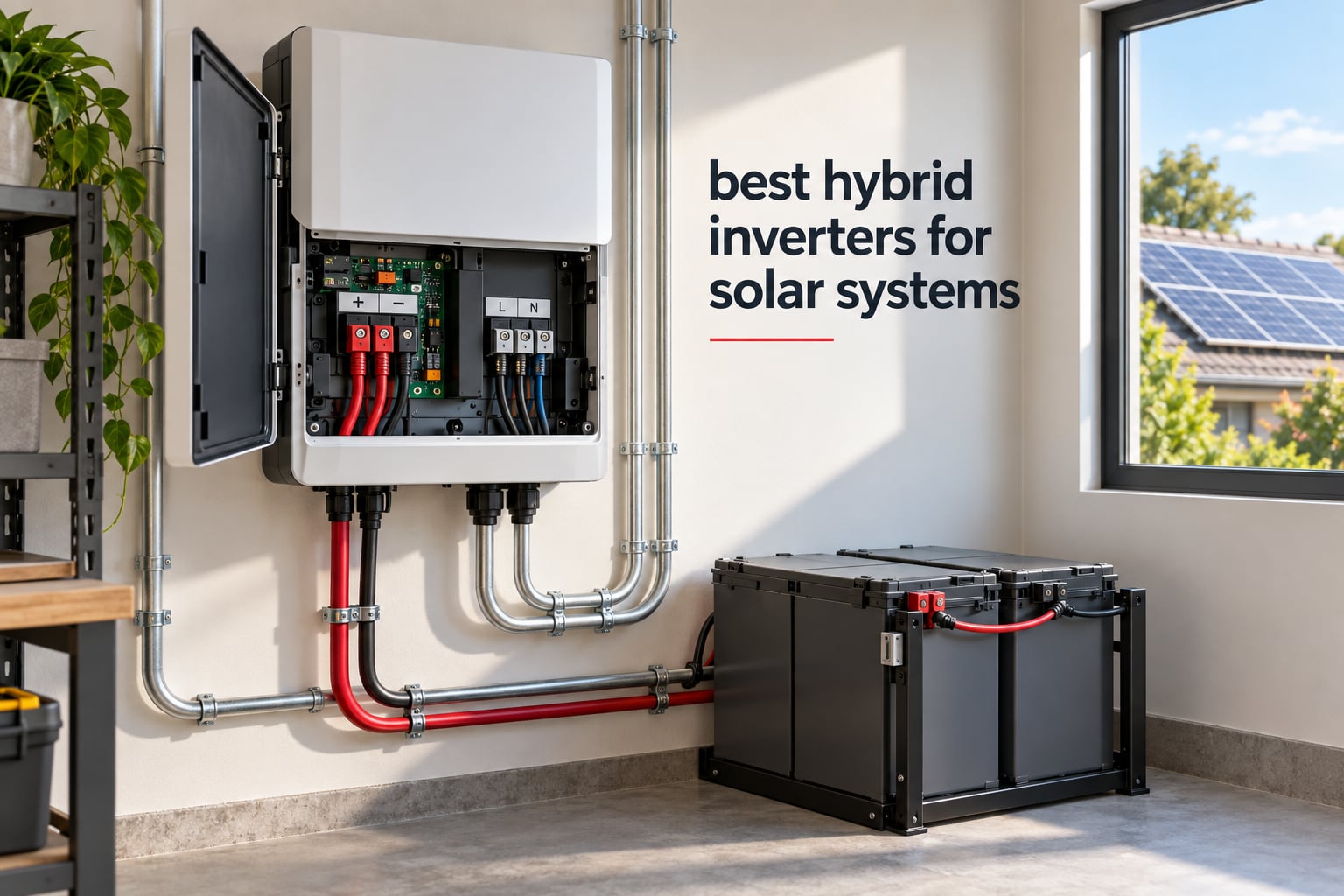
Short answer: for most homes in 2026, the SUMRY 4000W is the best hybrid inverter for solar systems because it is one of the few units in this class that has a large body of real owner feedback behind a 4.7 star average. The SUNGOLDPOWER 10000W is the pick if you need 240V split-phase output, and the VEVOR 3000W covers small 24V systems on a tight budget.
A hybrid solar inverter is a single box that converts your panels’ DC output into usable AC power while also charging and discharging a connected battery bank, which replaces the separate charge controller you would otherwise need. The MPPT trackers harvest maximum power from the array, route it to your home and the battery, and when the grid fails the built-in transfer switch isolates the unit so it runs the house from the battery until power returns.
That single box decides how much power your system delivers continuously, how much it pushes through a startup surge, and which battery ecosystem you are locked into for the next decade. Get it wrong and the fix means new wiring, new batteries and new permitting. Over the past several months our team read the owner reports on twelve of the best-selling hybrid inverter charger models, compared their spec sheets line by line, and cross-checked what installers argue about in DIY solar forums.
If you are still narrowing the field, our guides to inverters for home backup and solar generators cover the wider backup picture beyond the models below.
Table of Contents
How We Ranked These Hybrid Inverters
Three factors decided the order, and none of them is price. First, continuous output against real household load, because a unit with a headline wattage that collapses the moment a compressor starts is not a 10kW inverter. Second, battery ecosystem and warranty length, since a two-year warranty is a statement about how long the manufacturer expects the unit to last. Third, depth of field reporting, because spec sheets are written by sellers and reviews are written by people who had to wire the thing up.
We also weighted real-world friction heavily. A unit that throws Error 53 during commissioning and leaves you with an unanswered support message is a worse product than a slightly less powerful unit with a clear manual, even when the two are within a watt of each other.
Top 3 Picks for Hybrid Solar Systems (September 2026)
SUMRY 4000W 24V Hybrid Inverter
- 4000W rated and 8000W peak output
- 140A MPPT built in
- Works with or without a battery
- 1-year warranty

SUNGOLDPOWER 10000W 48V
- 10000W rated and 20000W peak
- 2 MPPT with 500VDC input
- 200A battery charging
- Split-phase 120V/240V

VEVOR 3000W 24V Hybrid
- 3000W rated and 4000W peak
- 100A MPPT built in
- Built-in WiFi module
- 24V DC to 120V AC
All 12 Hybrid Inverters at a Glance
| Product | Specifications | Action |
|---|---|---|
| SUMRY 4000W 24V Hybrid Inverter |
|
Check Latest Price |
| SUNGOLDPOWER 10000W 48V Split Phase |
|
Check Latest Price |
| VEVOR 3000W 24V Hybrid Inverter |
|
Check Latest Price |
 ECO-WORTHY 5000W 48V Inverter Charger ECO-WORTHY 5000W 48V Inverter Charger |
|
Check Latest Price |
 POWLAND 12000W Split Phase Inverter POWLAND 12000W Split Phase Inverter |
|
Check Latest Price |
 Ampinvt 5000W 48V All-in-One Ampinvt 5000W 48V All-in-One |
|
Check Latest Price |
 Anjfylque 12KW 48V Split Phase Anjfylque 12KW 48V Split Phase |
|
Check Latest Price |
 LiTime 3500W 48V Inverter Charger LiTime 3500W 48V Inverter Charger |
|
Check Latest Price |
 ECO-WORTHY Liber 10000W 48V ECO-WORTHY Liber 10000W 48V |
|
Check Latest Price |
 Y&H 6.2KW 48V 220V Inverter Y&H 6.2KW 48V 220V Inverter |
|
Check Latest Price |
 SUNGOLDPOWER 5000W 48V SUNGOLDPOWER 5000W 48V |
|
Check Latest Price |
 GROWATT 10000W 48V Split Phase GROWATT 10000W 48V Split Phase |
|
Check Latest Price |
1. SUMRY 4000W 24V Hybrid Inverter – The One With the Deepest Owner Track Record
SUMRY Hybrid Solar Inverter, 4000W DC24V to AC120V Pure Sine Wave Power
- Largest review base in this category at 4.7 stars
- Built-in 140A MPPT removes the need for a separate controller
- Runs loads with or without a battery connected
- 6.25 inch touch LCD is easy to read in daylight
- Compact and light for a 4kW unit
- Cooling fans are louder than competing units
- One reported unit never pulled PV charge current
- 120V-only output with no split-phase option
- Only a 1-year manufacturer warranty
This is the unit we kept coming back to while reading owner reports. The SUMRY HGX-4KW has 437 reviews averaging 4.7 stars, and that is roughly six times the field history of most units in this list. When something goes wrong with a lesser-known Chinese-built inverter you are guessing; when something goes wrong here, someone has almost certainly posted about it already.
Under the hood it is a straightforward 24V system: 4000W rated, 8000W peak, pure sine wave output, and a 140A MPPT charge controller built into the same chassis. That MPPT accepts up to 5600W of PV at a 350VDC maximum open-circuit voltage, which is a genuinely useful ceiling for a 24V bank. Listed max conversion efficiency is 98%.
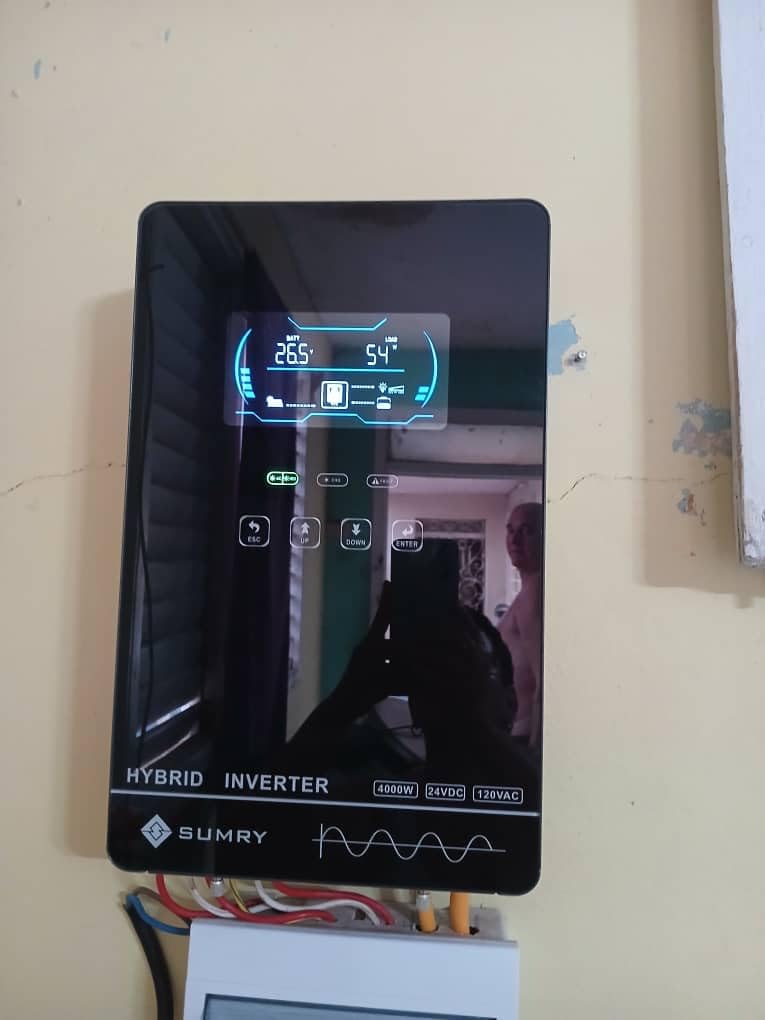
The feature that separates it from a plain inverter is battery flexibility. It runs daytime loads straight off PV current when no battery is connected, and it accepts AGM, gel, lead-acid, lithium-ion and LiFePO4 packs once you do connect one. Charging and output priority is configurable between solar, battery and utility, which is what makes it usable as a time-of-use device rather than only as an emergency box.
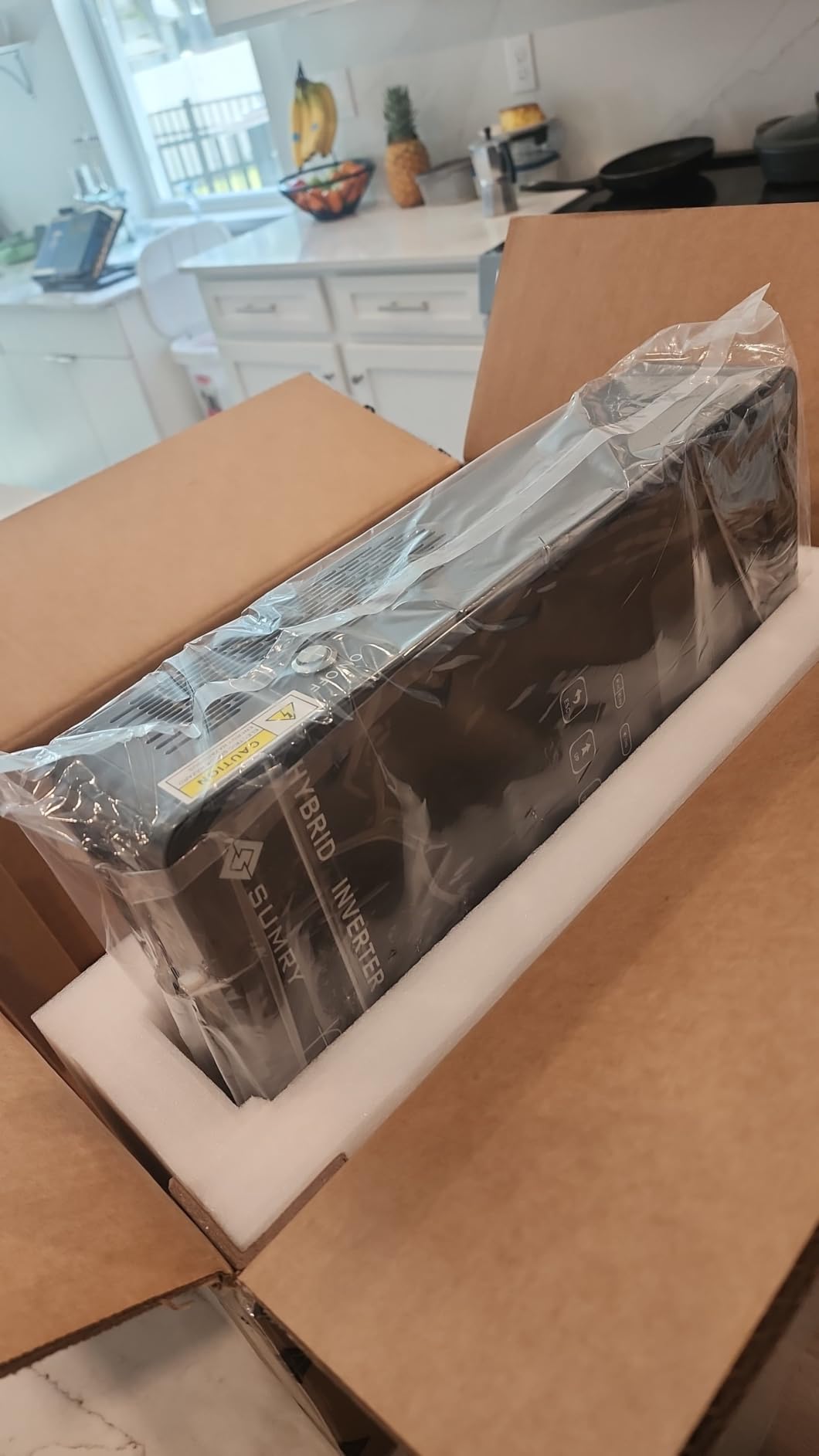
The build is compact at 13.78 by 4.33 by 16.54 inches and 7.5 kg, so wall mounting in a garage or an RV is realistic. The 6.25 inch LCD sits under a tempered glass cover with touch buttons, and the screen shows input and output power, charge current and energy priority. Three cooling fans handle thermal load, backed by overload, overheat, over current and short circuit protection plus a one-key reset to factory settings.
Battery Setup and Voltage Limits
Because this is a 24V unit, your battery bank sits at roughly 24 to 28 volts and everything downstream is sized around that. A 24V LiFePO4 pack of about 100Ah gives you usable storage in the range of 2.5kWh, which will carry a refrigerator, some lighting and a few hours of a small office but will not run central air.
It also works with no battery at all, which is unusual in this category and genuinely useful for a first build where you want solar production now and storage later.
Output and Surge Behavior
Rated output is 4000W and peak is 8000W, so a 2x surge ratio. That covers refrigerators, well pumps of modest size and small air conditioners, but a large compressor or a shop table saw can pull you toward the ceiling during startup.
Because output is 120V only, any 240V load in the house needs a separate path. For a home with an electric range, a clothes dryer or a 240V well pump, this is the wrong box and you should look at one of the 120V/240V split-phase models further down.
2. SUNGOLDPOWER 10000W 48V – The Split-Phase Workhorse
- Huge 10000W continuous with 20000W surge and 6HP motor capacity
- Dual MPPT removes the need for a second charge controller
- Parallel operation up to six inverters
- Time-slot scheduling for peak and valley tariffs
- Detailed PDF manual with wiring diagrams
- Battery cables not included
- Each split-phase leg caps near 5000W so legs need balancing
- BMS comms settings can silently cut charge current
- Two-year warranty
- Needs a jumper between L1 and L2 for 120V grid input
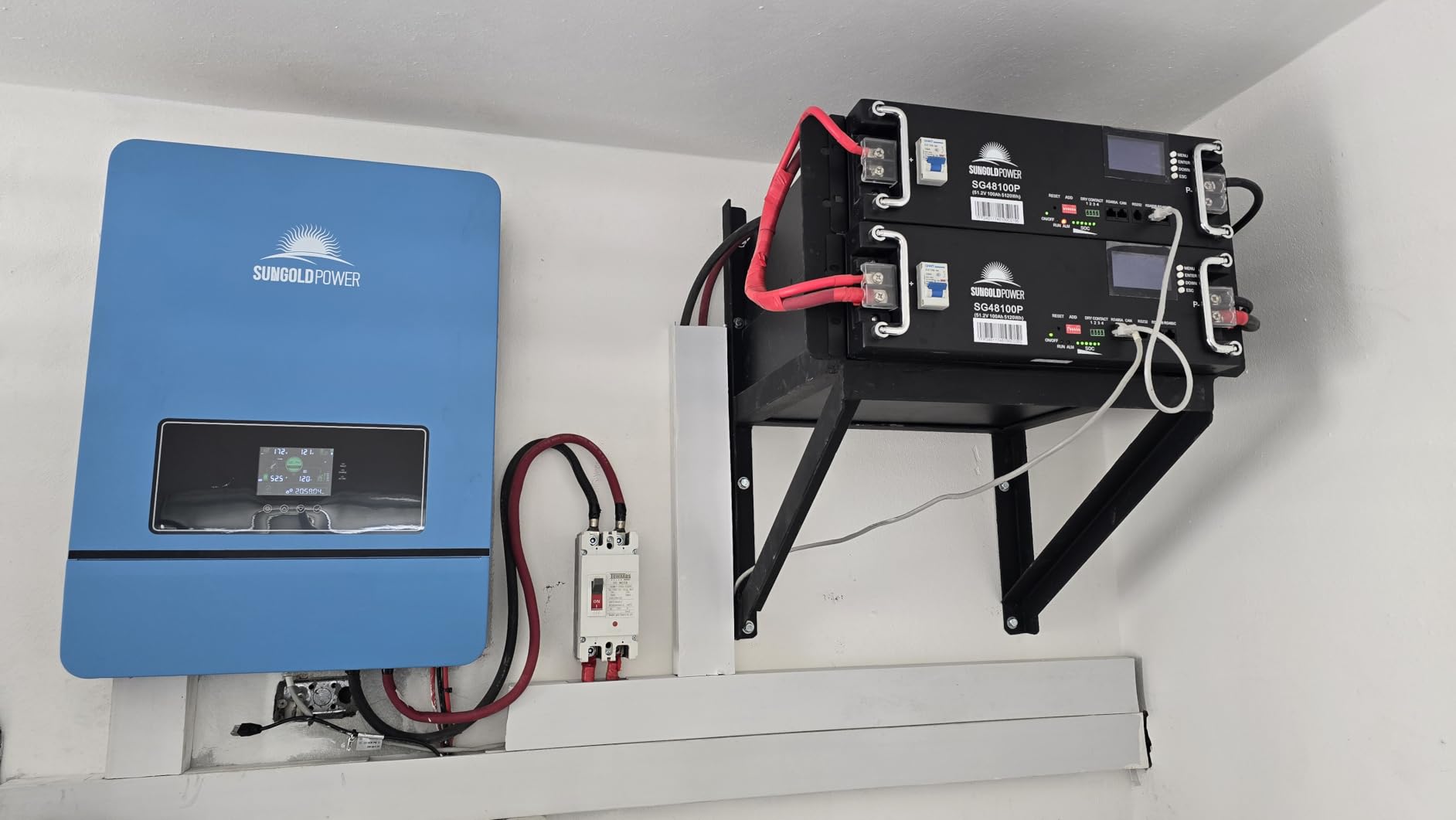
Owners running this model tend to describe it the same way: it is the first inverter in their build that stopped being the bottleneck. The SUNGOLDPOWER SPH10K48SP-P puts out 10000W rated and 20000W peak, and it carries a 6HP loaded motor capacity rating, which is a real number rather than a marketing approximation.
Two independent MPPTs accept arrays up to 500VDC open circuit, and battery charging goes to 200A. That combination means a large residential array and a fast-charging bank can hang off the same chassis without adding a second charge controller or a second inverter.
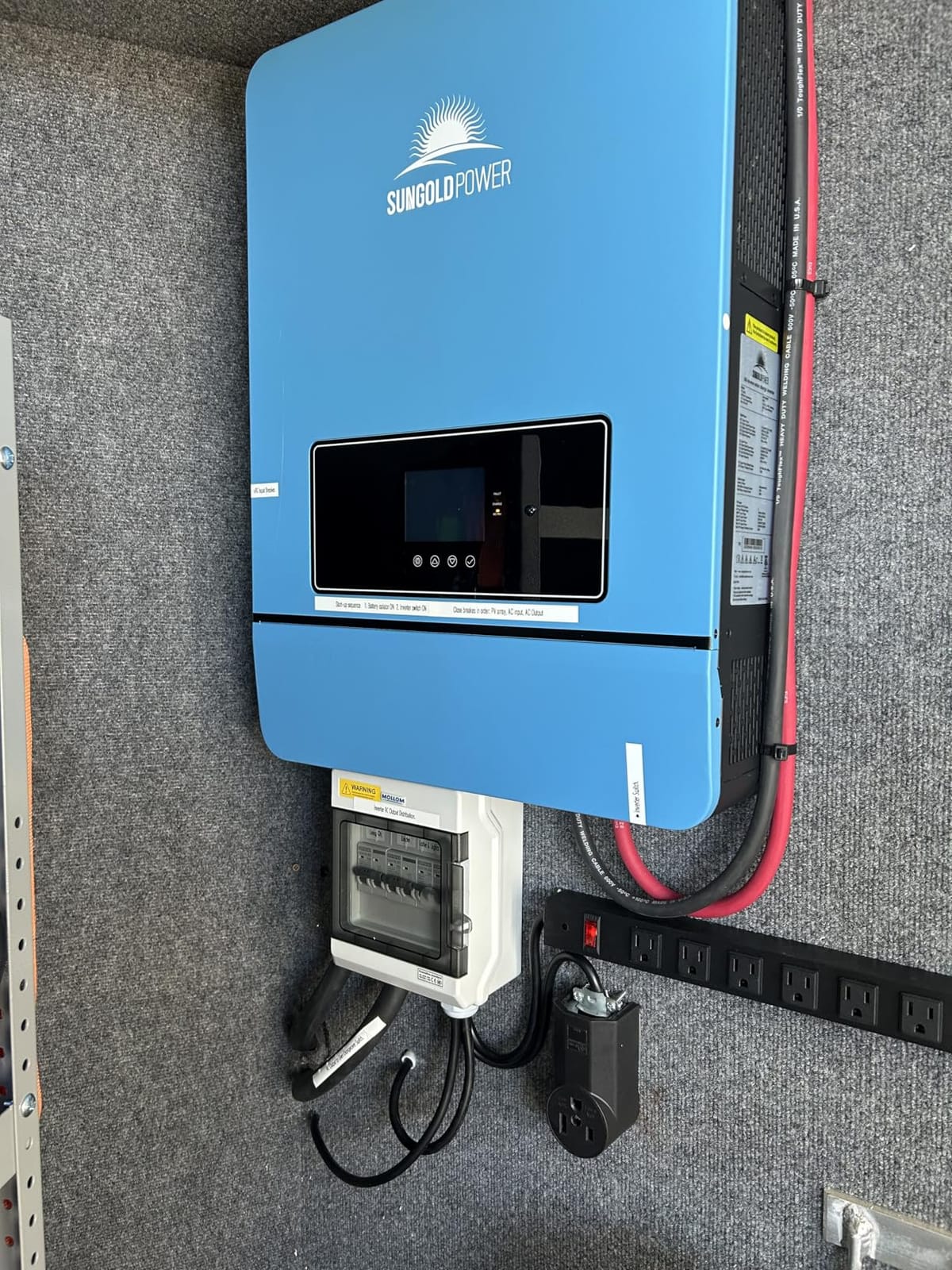
Output is configurable as split-phase 120V/240V or single-phase 120V, which makes it one of the few units here that covers both North American panel configurations in a single product. There are four charging modes and four output modes, including time-slot scheduling for peak and valley tariffs, and up to six units can be run in parallel over CAN, USB or RS485.
Support is one of the stronger points in this category, with a responsive US-based team reachable by email and phone, and the manual includes real wiring diagrams. It sits at 54 pounds and 26 by 17.9 by 4.9 inches, so plan for two people and a sturdy shelf.
Why BMS Communication Settings Matter Here
The single most common configuration complaint on this unit is that enabling BMS communication can override your user-configured charge current and drop the bank to a very low charge rate with no obvious error. It is a protocol mismatch rather than a hardware fault, and it clears once the correct communication setting is selected for your battery.
If your installer has not worked with this brand before, raise the charge limits and the comms protocol explicitly before commissioning day rather than after.
Load Balancing on the Two Legs
Each split-phase leg carries roughly 5000W of the 10000W total, which means load balancing between L1 and L2 is not optional. A house with two electric water heaters on the same breaker, or a main panel with heavy loads bunched on one side, will trip a leg before it trips the whole unit.
There is also a jumper requirement for 120V single-phase grid input, and the unit gives no error code when that jumper is absent. Budget a callout to your electrician for this one.
3. VEVOR 3000W 24V – Best Value for a Small 24V System
- Inverter and MPPT in one compact unit
- 100A MPPT with a wide 60V-500V PV input window
- WiFi module included rather than sold separately
- Several charging and output modes to choose from
- Light at 15.2 pounds for a 3kW all-in-one
- WiFi app samples every five minutes
- 120V single-phase only with no split-phase option
- 3000W is modest for whole-home loads
- No warranty term is listed in the product data
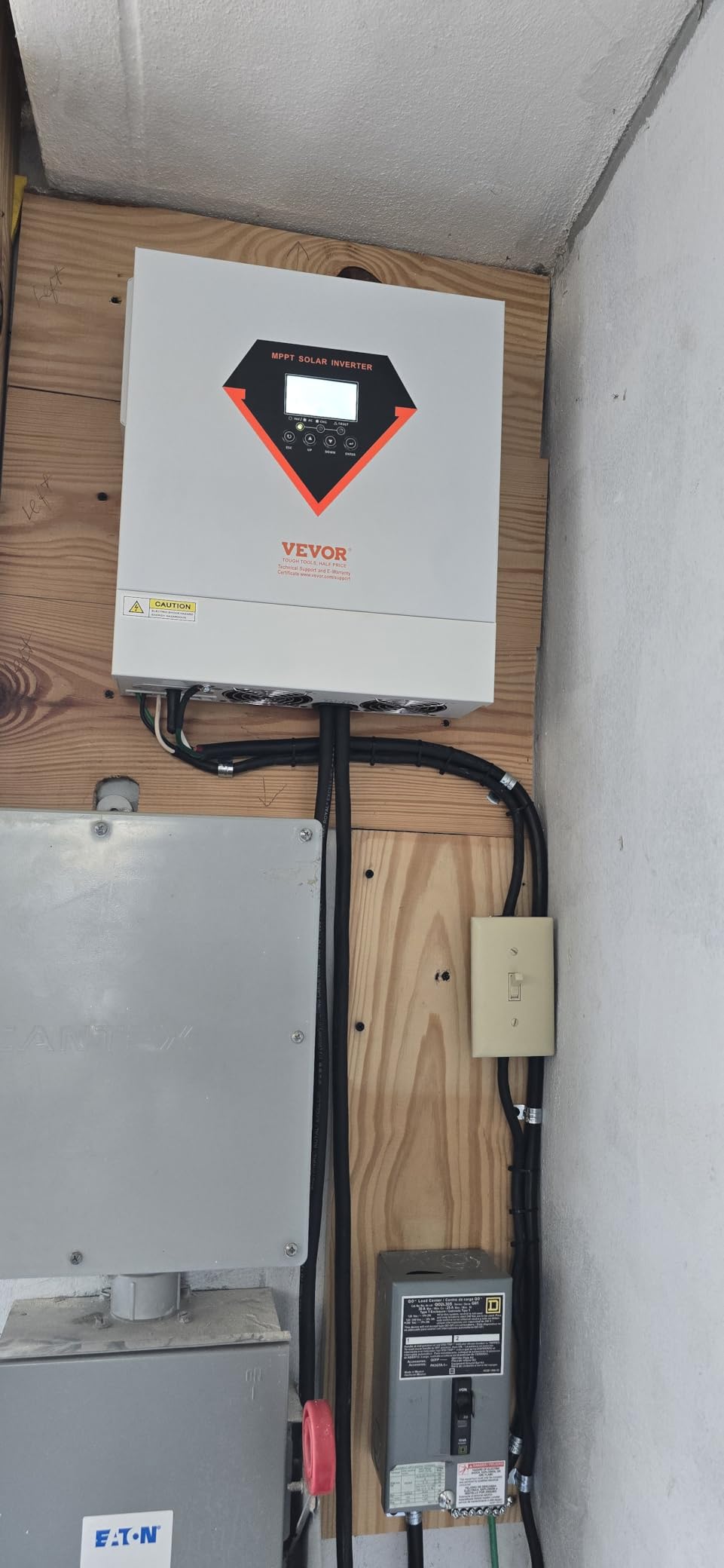
The VEVOR LVM3000-24L is the pick if your system is a workshop, a cabin, a small shop or a partial-panel backup circuit rather than a whole home. It combines a 3000W pure sine wave inverter with a 100A MPPT charge controller in one 12.2 by 4.2 by 14.4 inch box that weighs 15.2 pounds, so one person can mount it.
Two things stand out for the price tier. The 100A MPPT accepts a 60V to 500V PV window, which is unusually wide and means you can string panels in configurations most small inverters reject. And the WiFi module is included in the box rather than sold as an add-on.
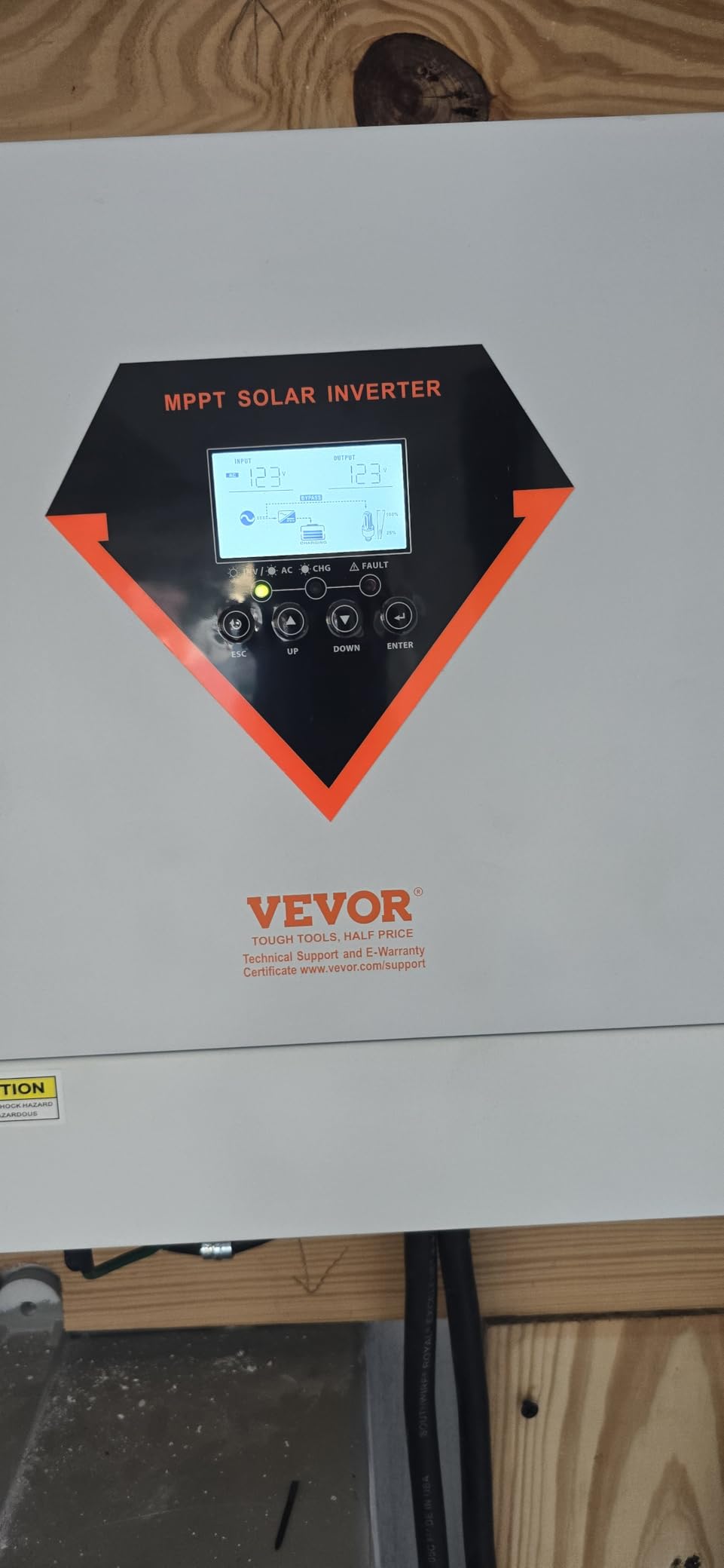
Charging modes cover Solar Only, Mains Only and Solar and Mains, while output modes include UTL, SOL, SBU and SUB, giving real control over where power comes from at any moment. Protection covers over-temperature, over current, over voltage, under voltage, short circuit and overload. The unit is built around 24V systems and supports lithium, lead-acid and custom battery profiles with a lithium activation function.
Owners rate it at 4.4 stars across 63 reviews, with 74% five-star. The value argument holds up because two separate components become one purchase, one mounting footprint and one set of wiring terminations.
What 3000W Actually Covers
Rated 3000W with 4000W peak, this is a circuit-level unit. It will run a refrigerator, a freezer, lights, networking and a few smaller loads, and it can pick up a small air conditioner. It will not carry a central air system, an electric water heater and a laundry dryer at the same time.
Its 90% listed MPPT conversion efficiency is also a step below the 98% to 99.9% figures some competitors claim, which costs you a modest amount of array energy on a small system and almost nothing on a large one.
Remote Monitoring Expectations
The WiFi module samples data roughly every five minutes rather than streaming in real time. That is fine for checking state-of-charge overnight and for confirming the system is producing, and it is not fine if you expect to catch a load spike as it happens.
Set expectations accordingly: this is a status display, not a live operations console.
4. ECO-WORTHY 5000W 48V Inverter Charger – The Balanced 48V Starter
ECO-WORTHY UL1741 5000W 48V Solar Inverter Charger, 48V DC to 120V AC,Inversor Solar Built in 100A MPPT Solar Charge Controller,40A AC Charger,Work with Lead Acid/LiFePO4,Home Backup
- Three functions in one chassis: inverter
- MPPT and AC charger
- Solar-priority mode with shore power fallback extends battery life
- Time-slot scheduling cuts off-peak charging costs
- Quieter than older EG4-class units while MPPT tracking improves
- Can grid tie for net metering
- Not true split phase without a second inverter
- Draws about 468W from utility in AC-priority bypass mode
- Internal clock does not handle daylight saving time
- WiFi dongle missing from at least one box
- Runs warm and fans cycle noisily
- 1-year warranty
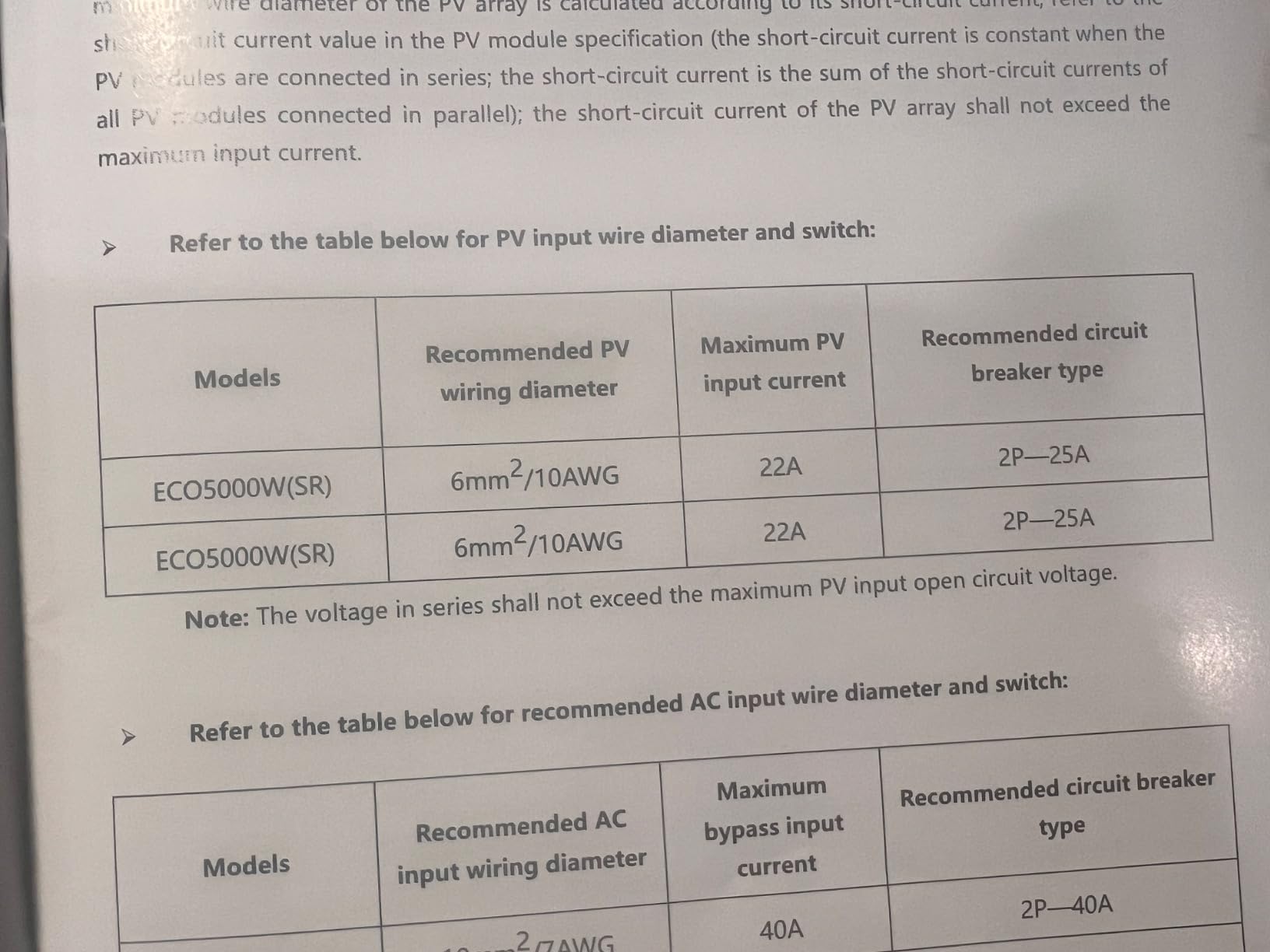
This is a genuine 3-in-1 design: a 5000W pure sine wave inverter, a 100A MPPT controller and a 40A AC battery charger that can deliver up to 100A in hybrid mode. For a new 48V build, that is three devices collapsed into one purchase and one set of high-current terminations.
Output is 10000W at peak, PV input spans 120V to 500V DC, and two or more units can be paralleled to output 120V, 208V or 240V. Three output modes and four charging modes are available, with programmable mains charge and discharge windows for peak and off-peak tariffs.
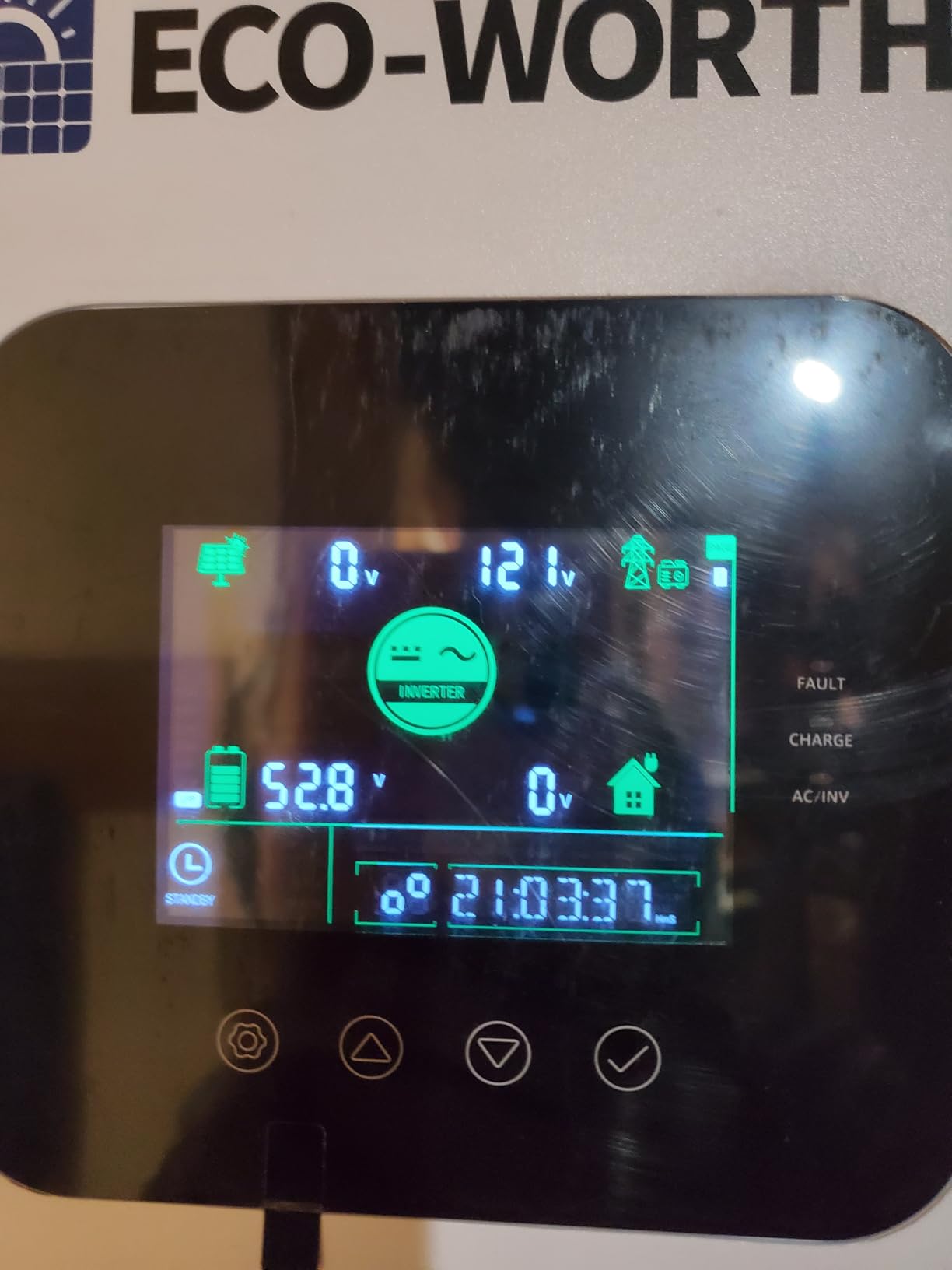
Owners like the solar-priority behavior, where surplus array energy goes to the bank first and shore power only fills the gap, which measurably extends battery life compared with constant AC charging. Reviewers also report noticeably better MPPT tracking and lower noise than earlier EG4-class units in the same power band.
The rating is 4.0 across 45 reviews with 62% five-star, and reliability feedback is genuinely split, which is why this sits in the middle of the roundup rather than higher.
The 468W Idle Draw You Should Plan For
In AC-priority bypass mode this unit pulls roughly 3.9A, about 468W, from the utility while idling. On a battery-backed system that is a meaningful parasitic load, and on a time-of-use tariff charged at peak rates it works directly against the savings the inverter is supposed to produce.
Confirm which output mode you are actually in after commissioning. Solar-priority mode eliminates most of this draw at the cost of switching behavior during outages.
Getting 240V Output From This Unit
On its own it is single phase. You need at least two units in parallel to produce 120V, 208V or 240V output, which turns a 5kW purchase into a 10kW purchase plus a second set of AC connections.
There is also a clock quirk: the internal scheduler does not handle daylight saving time, so programmed charge windows shift by an hour twice a year unless you correct them manually.
5. POWLAND 12000W – The Most Continuous Power for a Whole Home
- 12000W of continuous output
- unusual for the class
- Dual 200A MPPT accepts large arrays up to 500VDC
- Battery-free mode can cut storage cost substantially
- Runs whole homes with central AC
- split units and cooktops
- 45dB dual-fan cooling is quieter than competitors
- WiFi module and two CT modules included
- Steep commissioning curve with a thin manual
- Error 53 and Error 49 both needed grounding and protocol changes
- Some units showed phantom battery discharge
- Technical support is weak and the app often posts no data
- Requires high-current breakers and fuses
- 2-year warranty
Twelve kilowatts of continuous output from a 48V inverter is unusual, and it is why the POWLAND shows up in whole-home discussions. Output is pure sine wave at 120V plus 5%, with 120V/240V split phase available, and the dual 200A MPPT trackers accept up to 5500W each across a 90V to 500VDC input window.
The battery-free design is the quiet differentiator. With an optional CT sensor, the unit can push excess solar to the home and the grid with no battery fitted, which lets you install the full array now and add storage later without replacing the inverter.
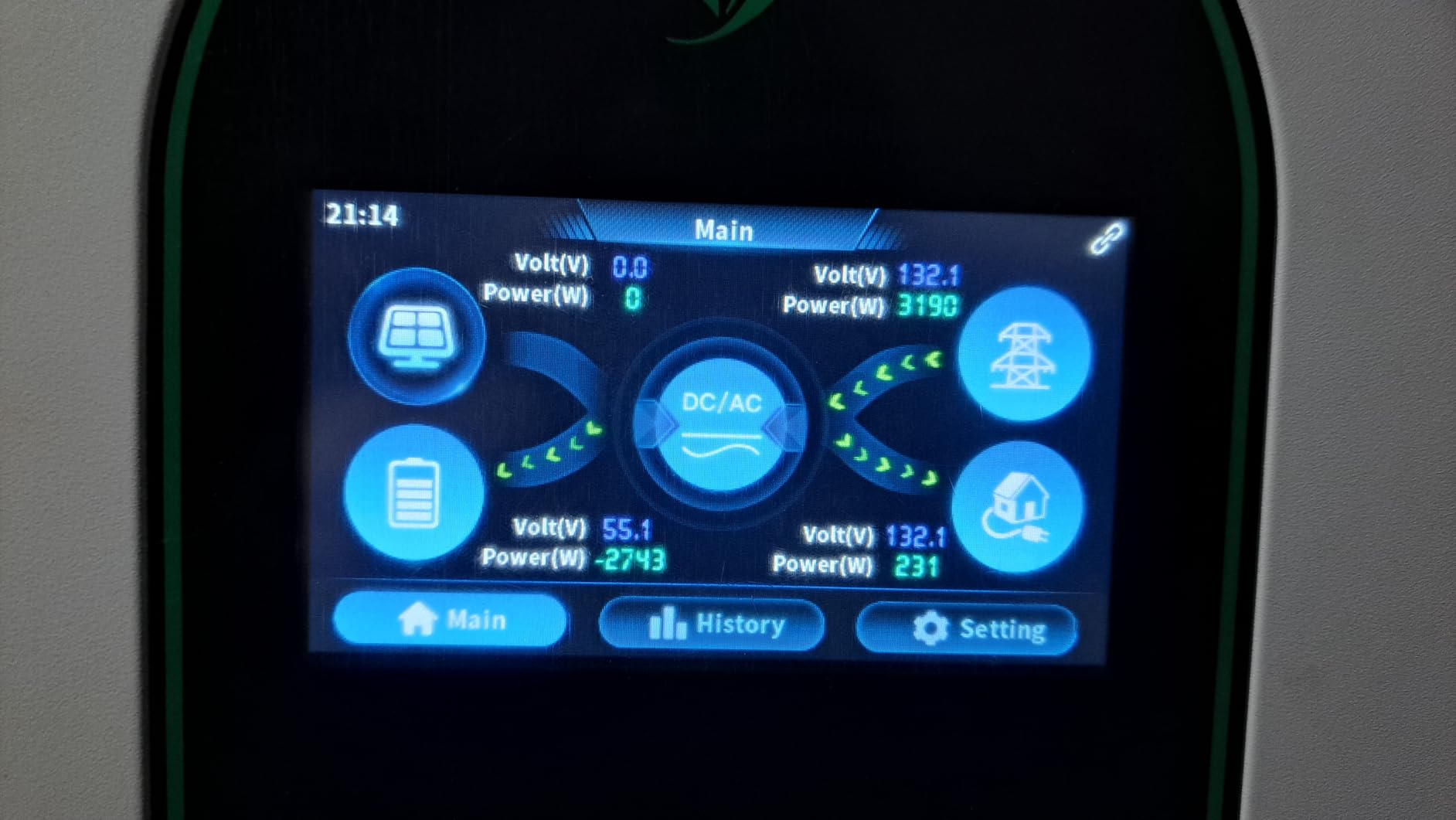
Owners report running central air, split units, electric cooktops and water heaters, and the 45dB dual-fan cooling is measurably quieter than most units in this power range. The IP65 enclosure means it can live outside, and parallel expansion reaches six units for 72000W. Rated 4.0 across 44 reviews, with 61% five-star and a 12% one-star share that reflects real problems.
Those problems cluster in commissioning rather than in the hardware. Error 53 and Error 49 both cleared for owners after grounding and battery protocol changes, and the manual is thin on exactly the troubleshooting steps you would want.
Commissioning Errors You Should Expect
Error 53 and Error 49 are the two codes that come up repeatedly on this model. In the reports we read, both cleared once the grounding arrangement and the battery communication protocol were corrected, not by replacing hardware. Have your installer verify ground bonding and the BMS protocol setting before the unit is accepted.
Some units also showed constant phantom battery discharge with all household loads switched off, which points at load-threshold calibration rather than a battery fault.
Support Quality and Accessories in the Box
This is the weakest part of the package. Technical support is described as unresponsive, with sellers ignoring messages and the WiFi app frequently posting no data. One buyer received a unit with a missing WiFi module and a missing fuse nut.
The good news is that the WiFi module and two CT modules are listed as included, so a complete box is the expectation, not an upsell. Wiring is not beginner work either, since the unit needs high-current breakers and fusing.
6. Ampinvt 5000W 48V – Four Functions and a Generator Input
Ampinvt Solar Inverter 5000 Watt 48V to 120V, inbuilt 100A MPPT Solar Charger, Max PV Input 5500W 500Vdc,Off Grid Pure Sine Wave Inverter Support up to 6 in Parallel for Lead Acid Lithium Battery
- Four functions combined in a single 48V unit
- 100A MPPT with 98% tracking efficiency and a 60V-500V window
- Supports split-phase and three-phase output configurations
- Dry contact generator start and stop based on battery voltage
- Parallel operation up to six inverters
- Two-year warranty
- RS485 and WiFi monitoring modules are optional add-ons
- USB PC configuration needs a CH340T driver installed
- Thin review base means limited long-term reliability data
The Ampinvt TEL-48502M100 packs four functions into one 48V chassis: the pure sine wave inverter, the AC battery charger, the MPPT solar charge controller and the AC auto-transfer switch. That fourth function is what separates it, because most competitors leave the transfer switch external.
Output supports single-phase, split-phase and three-phase 120V, 208V and 240VAC configurations with transfer efficiency above 92%. The 100A MPPT tracks at up to 98% efficiency, accepts up to 5500W of PV across a 60V to 500V window, and charges 48V lead-acid in all four flavours plus LiFePO4.
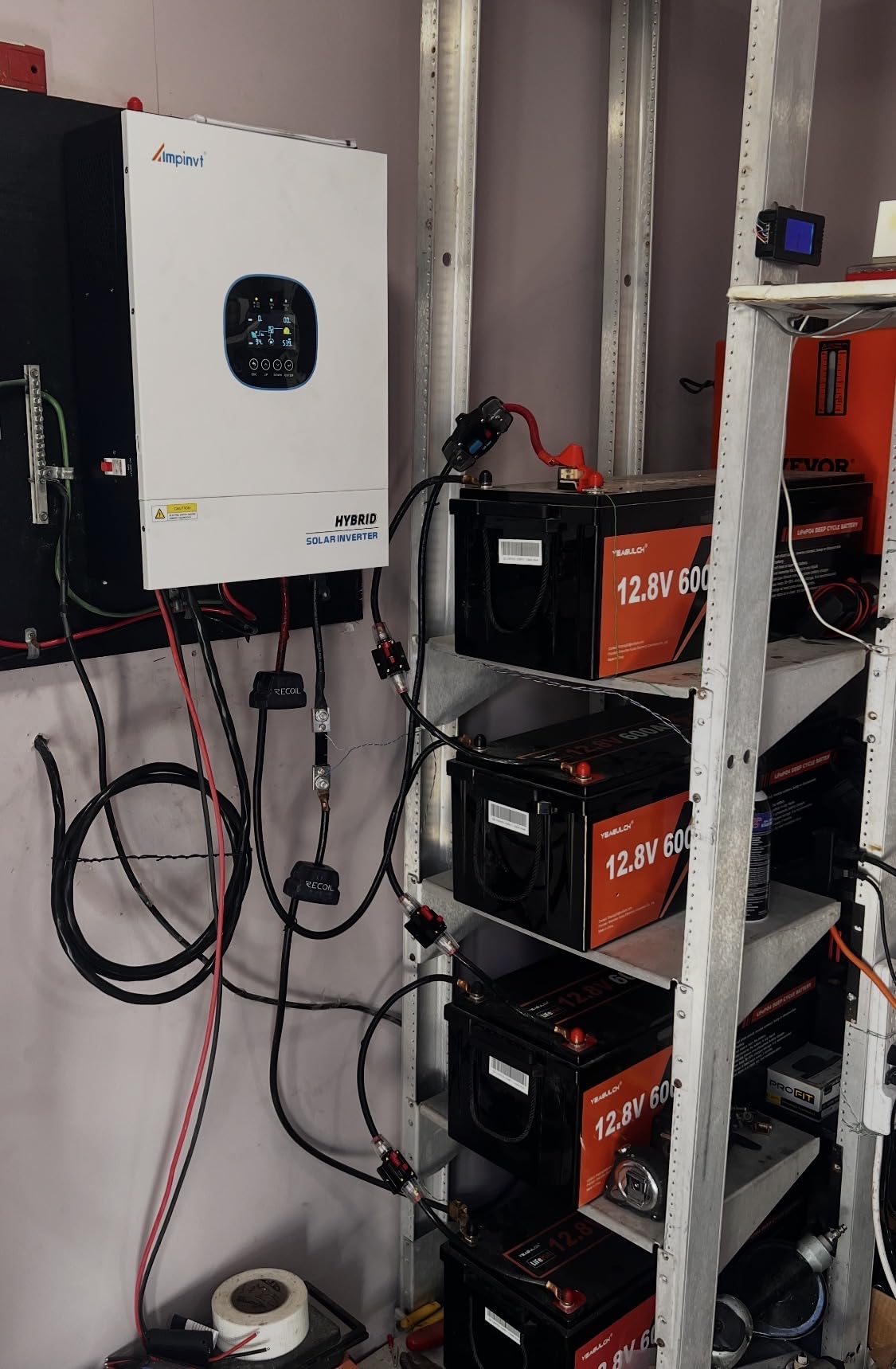
Three work modes and four charging modes give good control over source priority, and the dry contact output will start and stop a diesel generator automatically based on battery voltage, rated to 125VAC/1A, 230VAC/1A or 30VDC/1A. That is a genuine off-grid feature, not a marketing line, and it is the reason this unit shows up in off-grid cabin threads.
Owners rate it 4.4 across 43 reviews with 69% five-star. The main reservations are that monitoring modules are optional purchases rather than included, and that the review base is small enough that long-term reliability data is thinner than for ECO-WORTHY or SUNGOLDPOWER.
Generator Start Control in Practice
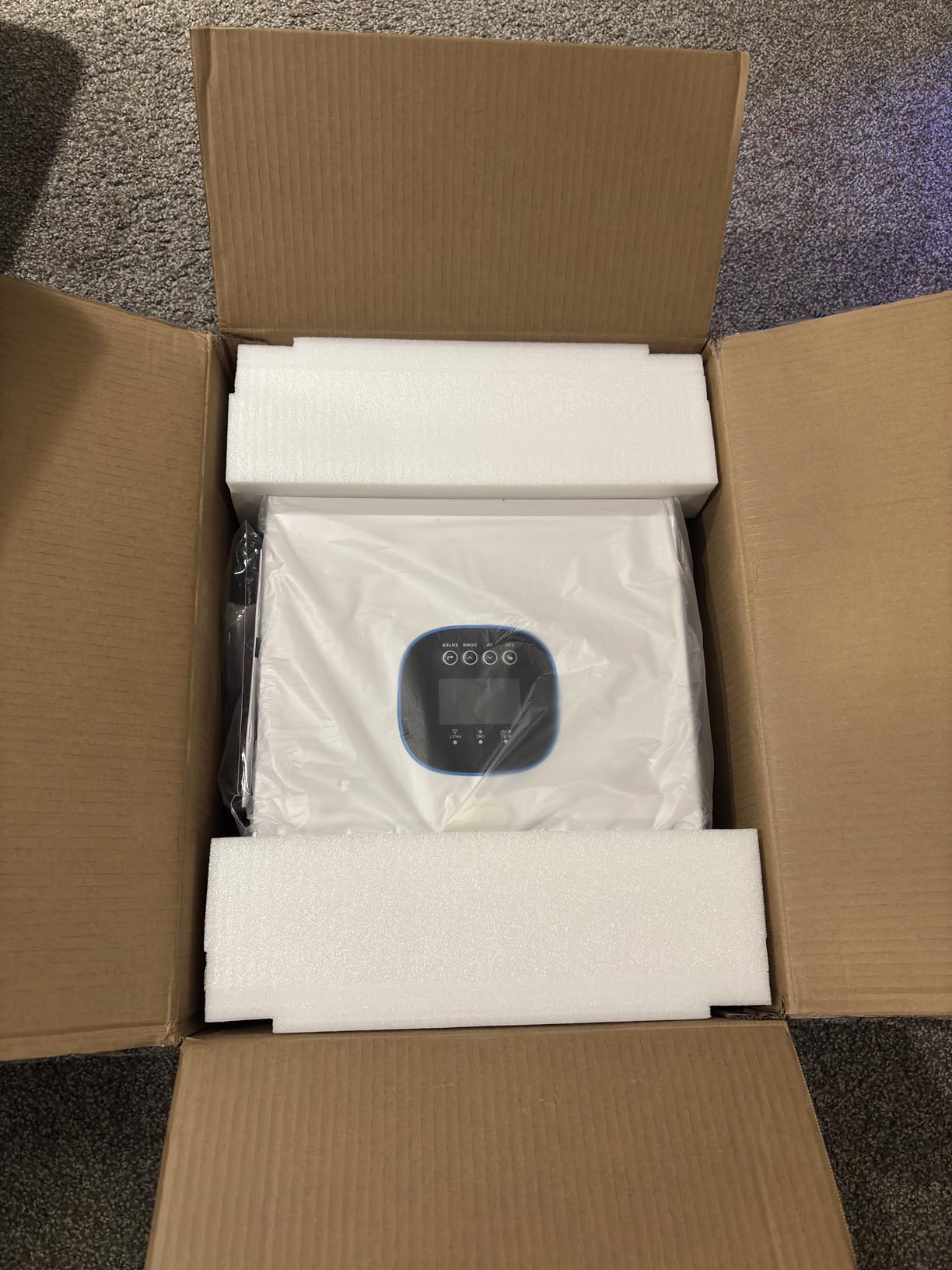
The dry contact closes based on battery voltage thresholds you set, so the generator starts on a low-voltage event and stops once the bank is charged. Rated at 1A per contact, it is designed to trigger a generator control module rather than carry generator current directly.
Get the thresholds wrong and you will either cycle the generator too often or let the bank sit too deep before backup power arrives.
Monitoring Is an Extra Purchase
RS485 and WiFi communication modules for monitoring hosts, lithium BMS and the mobile app are optional. USB configuration to a PC is included but requires installing a CH340T driver first, which is a small annoyance that catches people out on the first commissioning attempt.
Budget for a monitoring module if you want remote visibility, and factor the install time for the driver into your first setup session.
7. Anjfylque 12KW 48V – Split Phase in a Single Box
12KW Hybrid Solar Inverter 48V DC to 120/240V AC Split Phase, Pure Sine Wave Inverter with Dual MPPT 500V PV Input, 220A Charging, Parallel Ready for Home Backup Off-Grid Solar System
- True 120/240V split-phase output in a single unit at 12000W
- 4.6 average rating with 80% five-star reviews
- Dual MPPT with 500V PV input and 220A charging headroom
- Five-year warranty is generous for the category
- Parallel ready for scaling past one unit
- Lesser-known brand with a small volume of owner feedback
- Some spec fields in the listing do not match the 12KW model
- Product information beyond the headline feature is limited
The headline here is simple: genuine 120V/240V split-phase output from a single 48V unit rated at 12000W continuous and 18000W peak. That combination usually means either buying two single-phase inverters and paralleling them or moving to a high-voltage architecture, and this unit skips both steps.
Dual MPPT trackers accept arrays up to 500V PV input and battery charging goes to 220A, which is high headroom for a single unit and means a large bank charges at a useful rate without a second charger.
The warranty is the other differentiator. Five years sits between the one-year terms on most budget imports and the ten-year terms on tier-one hardware, and it is a reasonable signal of how long the manufacturer expects the unit to last.
Owner sentiment is strongly positive at 4.6 stars with 80% five-star and 9% four-star, concentrated on the split-phase capability for home backup. What you do not get is depth: 42 reviews is not much field history, and the listing data itself carries some inconsistency where spec fields do not clearly match the 12KW model.
Verify the Model Before You Order
The listing carries a model number that does not clearly correspond to the 12KW split-phase description. If a spec sheet and a model number disagree, that is a signal to ask the seller for a written confirmation of continuous wattage, peak wattage and output configuration before you commit.
That five-minute exchange is worth it, because continuous output is the one number you cannot upgrade later without replacing the whole unit.
Charging Headroom and Battery Sizing
220A of charging current at 48V is roughly 10.5kW of charge power, which will push a large LiFePO4 bank quickly and puts real heat into the room. Plan the battery room ventilation before you fill it with cables and racks.
Parallel readiness is a genuine advantage here. If your load grows later, adding a second unit is a path the design supports rather than something you have to redesign around.
8. LiTime 3500W 48V – Fast Transfer for Sensitive Electronics
LiTime 3500W Solar Inverter Charger, All-in-One 48V DC-120V AC, 80A MPPT
- Compact all-in-one chassis saves a lot of installation space
- Millisecond UPS switchover protects sensitive electronics
- Four charging modes and three output priorities
- RS485 battery monitoring integrates with the LiTime battery range
- Clear LCD for battery
- solar and AC status
- Only a 1-year warranty
- 3500W continuous is modest for whole-home backup
- 120V single-phase output only
- Smaller review base than the established inverter brands
If your outage concern is a home office, a network rack or medical equipment rather than a whole house, transfer speed matters more than wattage. The LiTime L-HYBINV-48V3KW-S switches to battery backup in milliseconds, which keeps a desktop, a router and a NAS running through a flicker that would reset a conventional transfer switch.
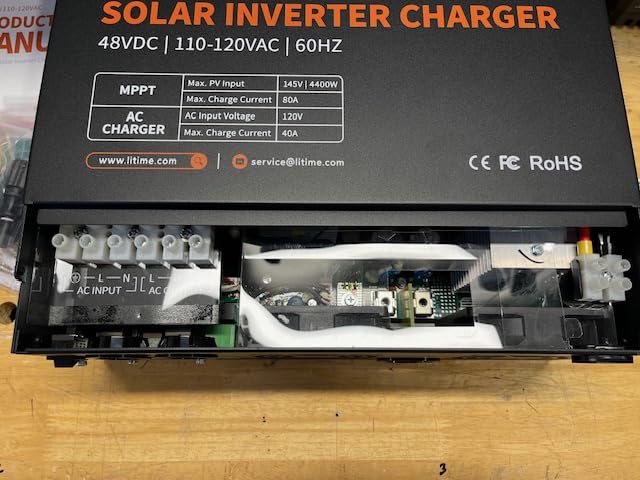
It puts out 3500W continuous and 6000W peak as pure sine wave from a 48V system, with an 80A MPPT charge controller integrated into the same chassis at 16.77 by 13.22 by 4.88 inches and 23.1 pounds.
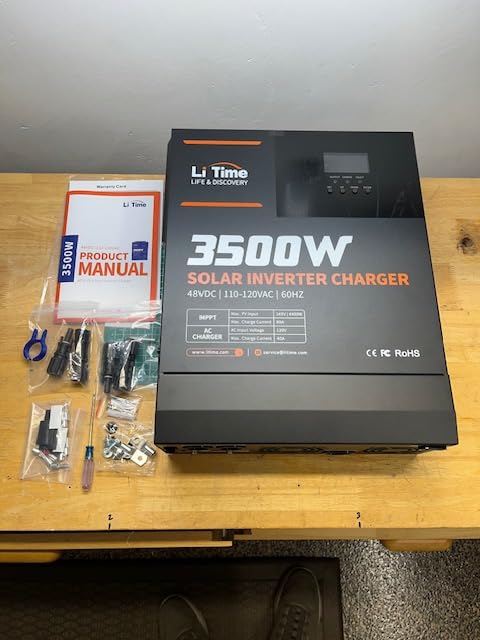
Four charging modes cover Solar Only, Utility Priority, Solar Priority and Hybrid, with output priorities for Inverter, PV and Utility. RS485 battery monitoring ties into the LiTime 51.2V 100Ah ComFlex battery range, and the built-in LCD shows live battery, solar and AC status. Product liability insurance through AIG took effect in 2026, which is a small but real difference in this category.
Owners rate it 4.2 across 29 reviews with 61% five-star. The reservations are predictable: a one-year warranty is short, 3500W will not carry a whole home, and 120V single-phase rules out 240V loads.
Where Millisecond Transfer Pays Off
Millisecond switchover matters for anything that treats a 100ms interruption as a fault. Network switches and storage arrays, desktop computers, cash registers and some medical devices all log events on a brief dropout even when they recover in the same second.
For a whole-home backup application the same speed is nice but not decisive, since lights and a refrigerator do not care which side of a second the grid came back on.
Warranty Length Versus Ecosystem Fit
A one-year warranty is the shortest meaningful signal on this list. It is partly offset by the RS485 integration with the LiTime battery line, which removes a whole class of BMS protocol guesswork, and by the product liability coverage.
If you are buying standalone without a matching LiTime battery, the warranty term is the weaker argument and you should price that in against a longer-warranty alternative.
9. ECO-WORTHY Liber 10000W 48V – The Largest PV Input in the Set
- Dual MPPT with 11kW total PV input and 500VDC Voc
- Runs an entire home including a clothes dryer on split phase
- Low idle consumption with up to 200A charging
- Time-of-Use scheduling reduces peak-rate costs
- UL1741 certified with 14 protection functions
- Off-grid only
- cannot grid tie or export to the utility
- Dense menu with vague manual descriptions
- WiFi data logger has Bluetooth pairing problems
- Android app cannot change settings remotely
- Email support responses are slow
- 1-year warranty
This is the unit to look at if your roof can produce far more than your inverter can use. Two independent MPPT controllers accept 5500W each for 11kW of total PV input at a 500VDC maximum, on a 10000W inverter. Ratio aside, that headroom means a south-facing array and a west-facing array can sit on separate trackers without a combiner.
Output is 10000W at 120V/240V split phase or 120V single phase, charging goes to 200A, and up to six units can be paralleled for 60kW. Battery support covers AGM, gel, flooded and lithium 48V packs with CAN, USB and RS485.
The critical line in the documentation is the first bullet point: this model is off-grid use only and is not grid-tie capable. If you have a utility connection and you want to export surplus or participate in net metering, this is the wrong unit and no firmware update will change that.
Owners do report real performance on the loads that matter: whole-home running including older appliances such as a dryer, with low idle draw. The 4.1 rating across 22 reviews comes with 62% five-star and 10% one-star.
Confirm Off-Grid Only Before You Buy
This is the single mistake we would guard against here. Buyers who expected a grid-tie unit and discovered the limitation after panel installation are the source of the one-star reviews on this model. If your site has a grid connection and you want export or load-shedding against a utility bill, pick a unit that states grid-tie capability explicitly.
For a true off-grid cabin, a remote workshop or a farmstead with no utility service, that limitation disappears and the large PV input becomes the main event.
Commissioning Friction and App Limitations
The menu is dense and the manual describes several settings in vague terms, which pushes setup toward live support. The WiFi data logger also has Bluetooth pairing problems and is hard to pair from an outbuilding, and the Android app will not let you change parameters remotely.
Budget extra time for commissioning, and prefer a logger you can physically reach during setup.
10. Y&H 6.2KW 48V – Built for 220V Single-Phase Homes
Y&H 6.2KW Solar Hybrid Inverter 48V AC220V On/Off-Grid Solar Inverter Built-in MPPT 120A Solar Charger, Two Load Output Power Max PV Power 6500W Input, Supports Batteryless
- 4.5 average rating with 76% five-star reviews
- 120A MPPT in a compact all-in-one chassis
- Dual load outputs keep critical circuits alive when the battery sags
- Supports battery-free operation for immediate solar use
- Cold start at 46V with automatic restart when AC returns
- On-grid and off-grid modes with four charging options
- 220V single-phase only
- 120V appliances need a step-down transformer that is not included
- Two-year warranty is short for this class
- Only 26 reviews means limited long-term field data
This model is built for a different electrical region than most of this list, and that is the whole point of it. The Y&H 6.2KW outputs single-phase 230VAC/220V, which is the standard residential supply across much of Europe, Asia and other 220V markets rather than the North American 120/240V split phase.
On the solar side it is strong for the class: a 120A MPPT with up to 6500W of array, 450VDC maximum open circuit, a 60V to 450V tracking window and a cold start function at 46V.
The feature we like most is the dual load output. The second output port keeps supplying power when battery voltage drops below a cutoff you set anywhere from 40.0V to 46.0V in 0.1V steps, which lets you reserve stored capacity for a freezer or a medical device while a less critical circuit shuts down. That is a form of load shedding built into the hardware.
On-grid and off-grid modes both work, four charging modes are offered, and a one-key restore returns every setting to factory default. The rating is 4.5 across 26 reviews with 76% five-star.
North American Buyers Need a Transformer
If you are in the United States or Canada, this unit will not run your appliances directly. A step-down transformer from 220V to 110V or 120V is required for 120V loads and it is not included in the box, which adds both cost and an efficiency loss on every watt you use.
North American buyers should look at the 120V/240V split-phase models in this roundup instead.
Using the Adjustable Cutoff for Load Shedding
Setting the second output cutoff between 40.0V and 46.0V gives you a real, hardware-enforced priority scheme. Put the well pump and lighting on the primary output and a freezer or communications equipment on the second, and you get a shallow-discharge reserve without any monitoring software.
It is an underrated feature, and one of the better arguments for a 220V-market buyer to pick this unit.
11. SUNGOLDPOWER 5000W 48V – The Cleanest Owner Feedback in the Set
SUNGOLDPOWER UL1741 5000W Hybrid Solar Inverter,48V DC to 110V/120V AC,All in One,80A MPPT Solar Charger and 40A AC Battery Charger Pure Sine Wave for Off Grid System(NO Parallel)
- Strongest review sentiment in the set at 4.6 with 82% five-star and no one-star ratings
- Powers 15-amp power tools and a small air compressor
- Durable metal case with straightforward mounting
- Under 10ms UPS transfer keeps electronics running
- Manual explains each setting clearly
- UL1741 listed by ETL with lifetime technical support
- Does not support parallel operation
- 120V single-phase output only
- High-inrush motor loads may still need a soft-start device
- Setup is menu-number based so the manual is easy to lose
What stands out about the SUNGOLDPOWER SPH504880A is the distribution of its reviews, not just the average. It holds 4.6 stars with 82% five-star and 7% four-star, and zero one-star ratings out of 23. That is the cleanest sentiment profile of any unit we reviewed, and with only 23 reviews it means every rating comes from an owner who chose to return to the listing.
On paper it delivers 5000W rated and 10000W peak as pure sine wave at 110V/120V, with a built-in 80A MPPT charging a 5500W array at up to 500V, plus a 40A AC battery charger for solar plus mains charging.
Loaded motor capacity is rated at 4HP, and owners confirm it runs 15-amp power tools and a small air compressor. The case is metal, mounting is straightforward, and the manual explains each setting rather than just listing numbers.
Transfer to battery takes under 10ms when mains or a generator drops, and an RS485 port handles BMS communication with a 40V to 60V charging range. The unit is UL1741 listed by ETL.
No Parallel Support Is a Real Limit
Despite the brand offering larger models that do parallel, this specific unit does not. If your load grows past 5kW you are looking at a different product, not a second identical box.
For most shops, cabins and single-family backup circuits that ceiling is fine. For anyone planning to grow, it is worth confirming before installation rather than after.
Surge Behavior for Motor Loads
A 10000W peak rating against 5000W continuous is a 2x surge ratio, and 4HP loaded motor capacity is a real number. Even so, owners note that pump and compressor loads with high inrush can still benefit from a soft-start device.
For a garage or workshop with a compressor, a well pump and a saw, budget for a soft starter on the worst load rather than assuming the surge rating covers everything.
12. GROWATT 10000W 48V Split Phase – The Only Ten-Year Warranty Here
GROWATT 10000W Hybrid Solar Inverter 48V Split‑Phase Three Phase
- Perfect 5.0 average rating across all 10 reviews
- Tier-1 certifications including UL1741 SA/SB and IEEE 1547 with AFCI and Type II surge
- 10-year warranty with US-based support and phone technical assistance
- Three MPPTs handle multi-orientation arrays up to 15kW
- Fast sub-10ms transfer ran central AC and a 32kWh bank
- True 120/240V split phase with a generator input on dual AC ports
- Highest price point in the roundup
- Manual is generic and omits a critical neutral-to-ground bonding note
- App refresh is slow and does not allow real remote parameter changes
- One buyer received a faulty unit and had to go through replacement
- Very heavy at 107.8 pounds
- Only 10 reviews so the track record is short
Warranty length is the clearest differentiator on this unit. Ten years, with US-based after-sales support and one-on-one phone technical assistance, against one or two years on most of the budget imports in this roundup. Buyers treat warranty length as a proxy for manufacturer confidence, and in this category that proxy holds up well enough to plan around.
The hardware is tier-1 as well: 10kW split-phase pure sine wave output at 120/240V or 120/208V, 50A output and under 3% total harmonic distortion, with efficiency up to 97.5% and backup transfer under 10ms.
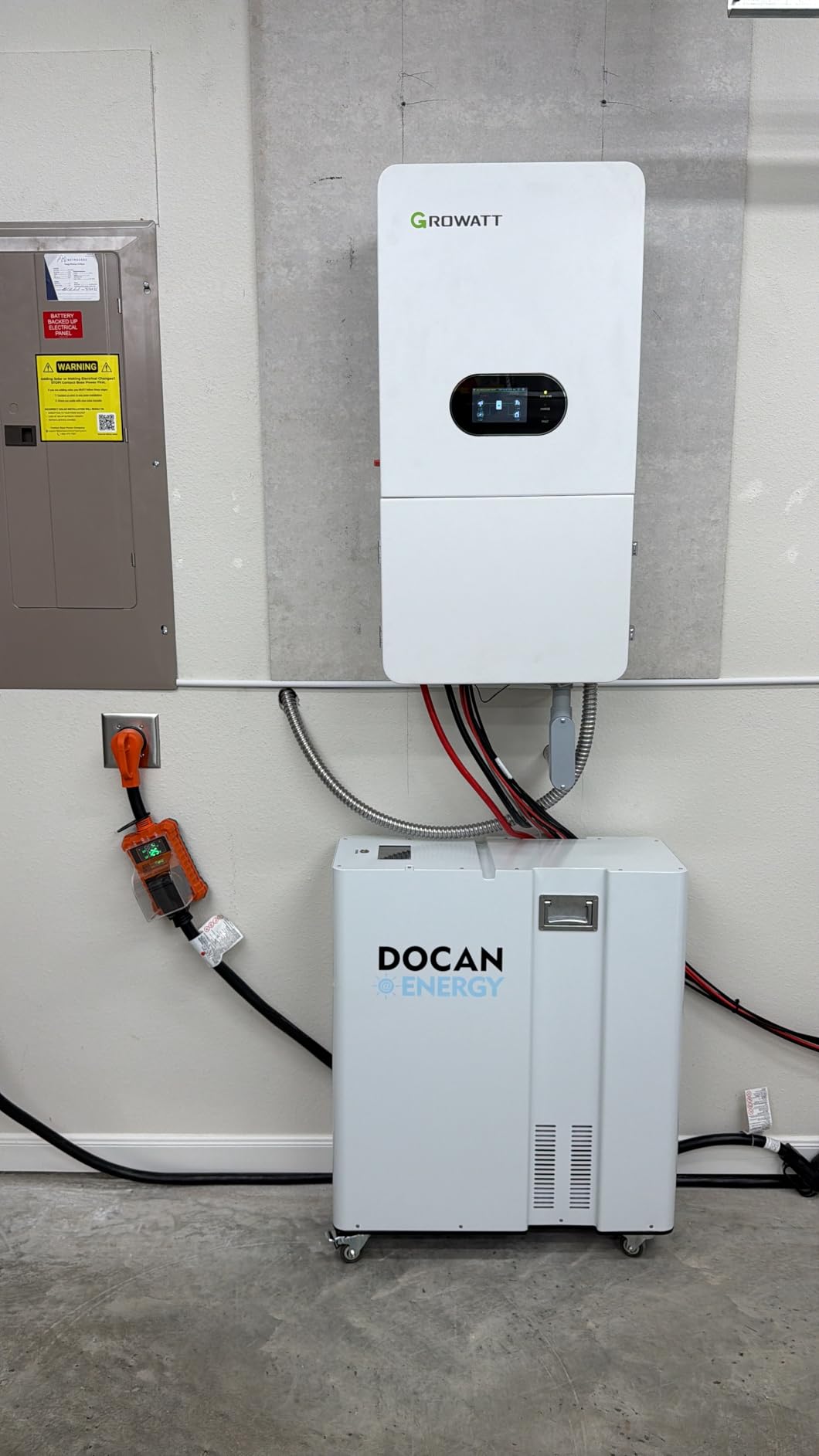
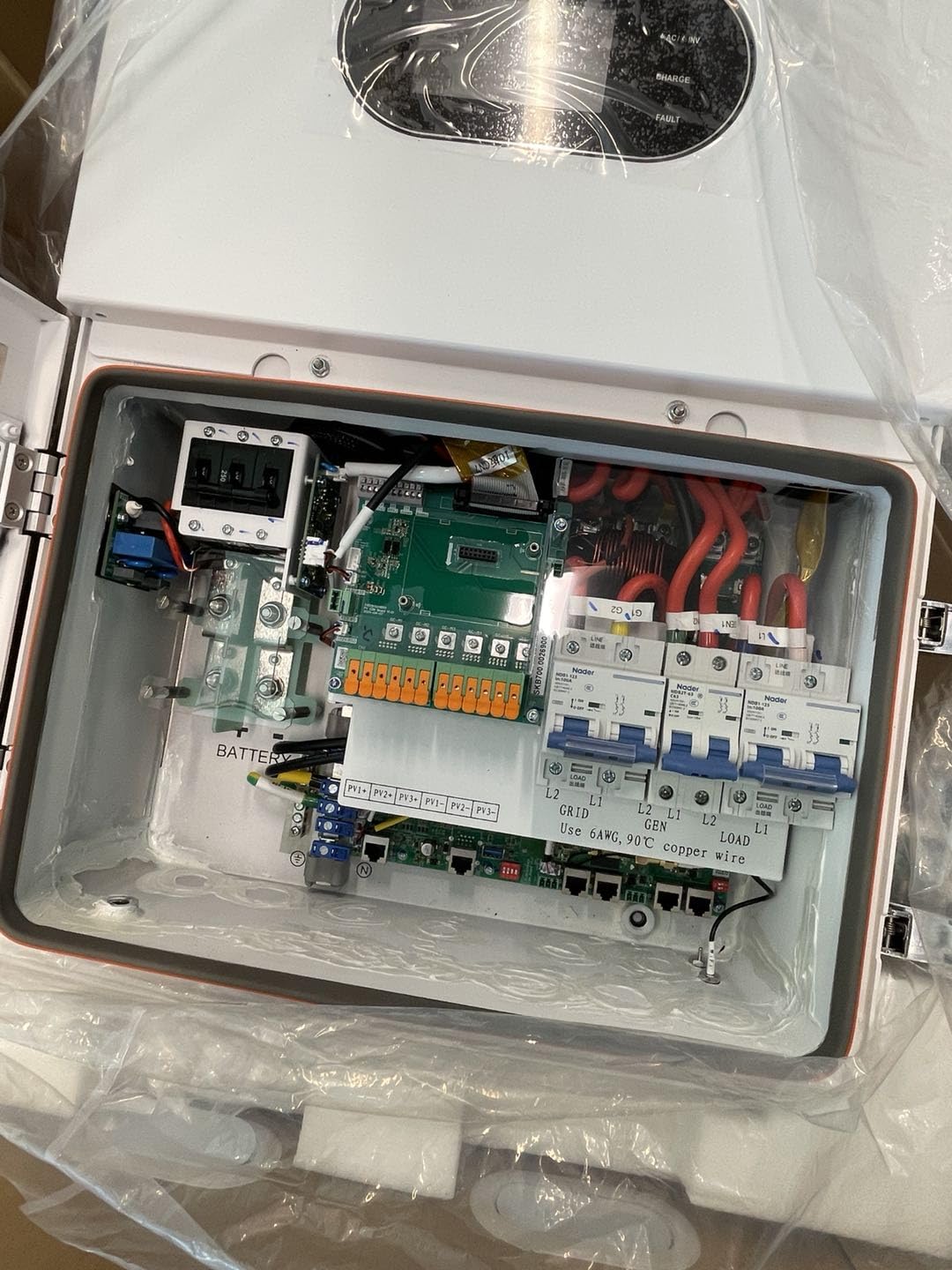
Three built-in MPPT trackers with two strings per tracker accept up to 15,000W of solar input across a 150V to 450V MPPT range, with 525V maximum DC. That is the largest array capability in this roundup and it comfortably handles multi-orientation roofs where east and west arrays shade each other at different times of day.
Dual AC inputs accept both grid and generator, dual battery ports allow flexible configurations, and 48V lithium or lead-acid banks are supported at up to 200A charge and discharge with CAN and RS485. Parallel operation reaches six inverters for 60kW.
Documentation and App Quality Are the Weak Spots
The manual is generic and does not clearly cover menu options, including a neutral-to-ground bonding note that installers need. Have your electrician handle the bonding configuration rather than relying on the printed guide.
The app is also the weak point: it refreshes slowly, sometimes lagging several minutes, and it does not actually allow remote parameter changes despite appearing to offer that option.
Weight, Install and Certification
At 107.8 pounds and 28.34 inches tall, this is a two-person install and a deliberate mounting decision. In return you get UL1741 SA/SB and IEEE 1547 certification, AFCI, Type II surge protection and an IP65 enclosure, which is a different certification tier from everything else on this list.
WiFi, Ethernet and optional cellular connectivity cover long-run monitoring, and pairing with the Growatt ALP 5.0L LV-US battery allows expansion to 40kWh.
How to Size a Hybrid Inverter
Sizing mistakes show up in forums more than any other topic in this category, and almost all of them come from skipping the first step. Work through these four in order and the wattage picks itself.
Step 1: List the loads that must run in an outage. Not your whole consumption profile, only the circuits you intend to back up. Add up the running watts of each simultaneously, because the inverter has to hold the sum, not the peak of any single one.
Step 2: Add surge headroom. Motors and compressors draw several times their running wattage at startup. A 3,000W well pump can pull 9,000W briefly, and a 2,000W compressor can pull 6,000W. This is the step buyers skip, and it is the number that decides between a 5kW and a 12kW unit.
Step 3: Match PV input to the array. A 100A MPPT on a 48V bank can absorb substantially more panel wattage than a 100A MPPT on a 24V bank. Check both the amperage and the maximum open-circuit voltage, because exceeding the Voc limit damages trackers.
Step 4: Confirm the battery voltage architecture. 24V, 48V or high voltage. This is not a detail you can defer, because the choice determines which batteries you can buy for the next ten years.
A worked example: a family wants to back up a refrigerator, a freezer, a well pump, five lighting circuits, a home office and a gas furnace blower. The steady running load is about 1,100W. The well pump adds roughly 3,000W running and 9,000W surge. That pushes continuous demand to about 4,100W and instantaneous demand to about 10,100W, which points at a 10kW to 12kW inverter rather than the 5kW that feels sufficient on paper.
That is the gap that divides the “3kW to 8kW is plenty for most homes” advice from the “10kW to 15kW if you have a well pump and electric heat” advice. Both are right, for different houses. The surge requirement, not the running requirement, is what moves you between them.
48V Low-Voltage vs High-Voltage Battery Architecture
Every unit in this roundup is a low-voltage design, either 24V or 48V DC, and that is a deliberate category choice rather than an accident. High-voltage systems, typically around 400V DC, need a different class of battery management, different fire code compliance and different service tooling.
Low-voltage buys you three things: cheaper and far more available batteries, a much simpler replacement path when a pack fails, and the ability to work on most of the system without specialty training. It costs you current, because moving the same power at 48V requires roughly ten times the amperage of a 400V system, which is why 48V units need heavy busbars and high-current fusing.
The tradeoff that bites later is battery ecosystem lock-in. Closed-loop BMS communication means the inverter and the battery negotiate over CAN or RS485, and that negotiation is brand-specific. A unit with a documented protocol list is easy to expand around; a unit with a vague user mode is easy to get running and hard to expand.
Practically, choose low voltage if you are DIYing, replacing batteries yourself, or installing something rural where shipping a 400V pack is a logistics problem. Choose high voltage if you are installing a large commercial array, have a certified installer, and have the service access to maintain it.
Where Hybrids Lose to String and Microinverters
Hybrids are not the right answer in three situations, and pretending otherwise costs money.
No storage intent at all. If you have a simple grid-tie array and no plan to add a battery, a hybrid inverter is buying capability you will never use, with a charge controller and transfer relay you will never rely on.
Severe shading or a complex roof. Module-level electronics, which is what microinverters provide, handle partial shading far better than a single central tracker. One shaded panel drags down a whole string on a string inverter, and a hybrid inherits that weakness.
Small grid-tie-only economics. On a simple residential array, a plain string inverter is cheaper per watt and does one job well. The hybrid premium only pays back if you actually dispatch stored energy, either for outages or for time-of-use arbitrage.
There is a fourth, quieter downside: complexity. A hybrid has more failure modes than a string inverter because it has a battery management system, a transfer switch, a scheduler and multiple source priorities, and every one of those is something that can be configured wrong on day one.
Failure Modes Worth Checking Before You Buy
Forum threads on this topic cluster around a small number of recurring problems, and all four are avoidable if you know about them in advance.
BMS communication drops. The most common complaint across this class. When closed-loop comms negotiate badly, some units silently limit charge current to very low levels with no error code. Ask the manufacturer for the supported protocol list and confirm your battery model appears on it, or plan to use a user-defined charge profile instead.
Low-voltage cutoff trips. Adjustable cutoffs around 40V to 46V on a 48V LiFePO4 pack determine when loads disconnect. Set too high, you lose usable capacity on every cycle. Set too low, you deep-discharge cells on a cold morning. Some units, like the Y&H in this roundup, let you set this in 0.1V increments, which is worth paying attention to.
Firmware and app lockouts. Several units here have apps that look like they support remote configuration but do not, and firmware update paths that are thinly documented. A unit whose only configuration route is a menu numbered by code, with a manual you have to keep on hand, is a real maintenance cost.
Warranty and support reachability. The gap between a two-year term and a ten-year term on similar hardware is the clearest reliability signal available to you before purchase. Parts availability and a support contact in your region matter just as much, and honest disclosure about who contracts-manufactures the unit is a good sign rather than a bad one.
One more practical check: confirm whether the unit is grid-tie capable before you install. The ECO-WORTHY Liber in this roundup is explicitly off-grid only, and that single line in the documentation determines whether you can export surplus or participate in net metering.
For sizing context on the panels side, our guide to portable solar panels covers array output assumptions that feed into PV input sizing here.
Frequently Asked Questions
Which solar hybrid inverter is best for a home?
For most homes, the SUMRY 4000W is the strongest general pick because it has the deepest owner feedback in the category at 4.7 stars from 437 reviews. If your home needs 240V loads, choose a 120V/240V split-phase unit such as the SUNGOLDPOWER 10000W or the Anjfylque 12KW. Homes with a well pump or central air need 10kW to 12kW of continuous output plus surge headroom.
Which 48V inverter is the best?
Among the 48V models here, the SUNGOLDPOWER 10000W is the most capable with dual MPPT, 200A charging and split-phase output, while the SUNGOLDPOWER 5000W has the cleanest owner feedback at 4.6 stars with no one-star ratings. For large PV arrays the ECO-WORTHY Liber 10000W accepts 11kW of solar input across two trackers.
What are the downsides of a hybrid inverter?
The main downsides are complexity, cost per watt when you never dispatch stored energy, and worse performance on shaded roofs than microinverters. A hybrid adds a battery management system, transfer switch and source scheduler, each of which is another thing that can be misconfigured. If you have no storage intent and a simple grid-tie array, a plain string inverter is the better tool.
How big should my hybrid inverter be?
Add up the running watts of every load you want to back up, then add surge headroom for motors and compressors. A 3,000W well pump can pull roughly 9,000W at startup, which often moves a project from a 5kW unit to a 10kW or 12kW unit. Then confirm the PV input amperage and open-circuit voltage will accept your array.
Is a 2-year warranty inverter worth it versus a 10-year warranty unit?
Warranty length is the clearest pre-purchase reliability signal available, and a two-year term against a ten-year term on similar hardware tells you what the manufacturer expects. The GROWATT 10000W carries a ten-year US-backed warranty, while several budget units here carry one or two years. If the inverter sits next to your main panel with no easy replacement path, the longer term is worth planning around.
The Verdict for 2026
There is no single winner among the best hybrid inverters for solar systems, but there is a clear map. If you want the best-supported general unit in the category, the SUMRY 4000W is our pick: 437 reviews, a 4.7 average and a 140A MPPT that removes a whole piece of hardware from the build. If your home needs 240V, the SUNGOLDPOWER 10000W handles split phase, 6HP motors and 20kW of surge in one chassis. If you are wiring a workshop or cabin, the SUNGOLDPOWER 5000W has the cleanest owner feedback of anything we reviewed, and the VEVOR 3000W covers a small 24V build for less.
Pick on surge rating before you pick on continuous wattage, confirm the battery communication protocol before you order, and treat warranty length as your best available signal about how the unit will age. Installers on r/SolarDIY and diysolarforum reach the same conclusion from opposite ends of the price range, and that is the most consistent thing we found across this roundup.