
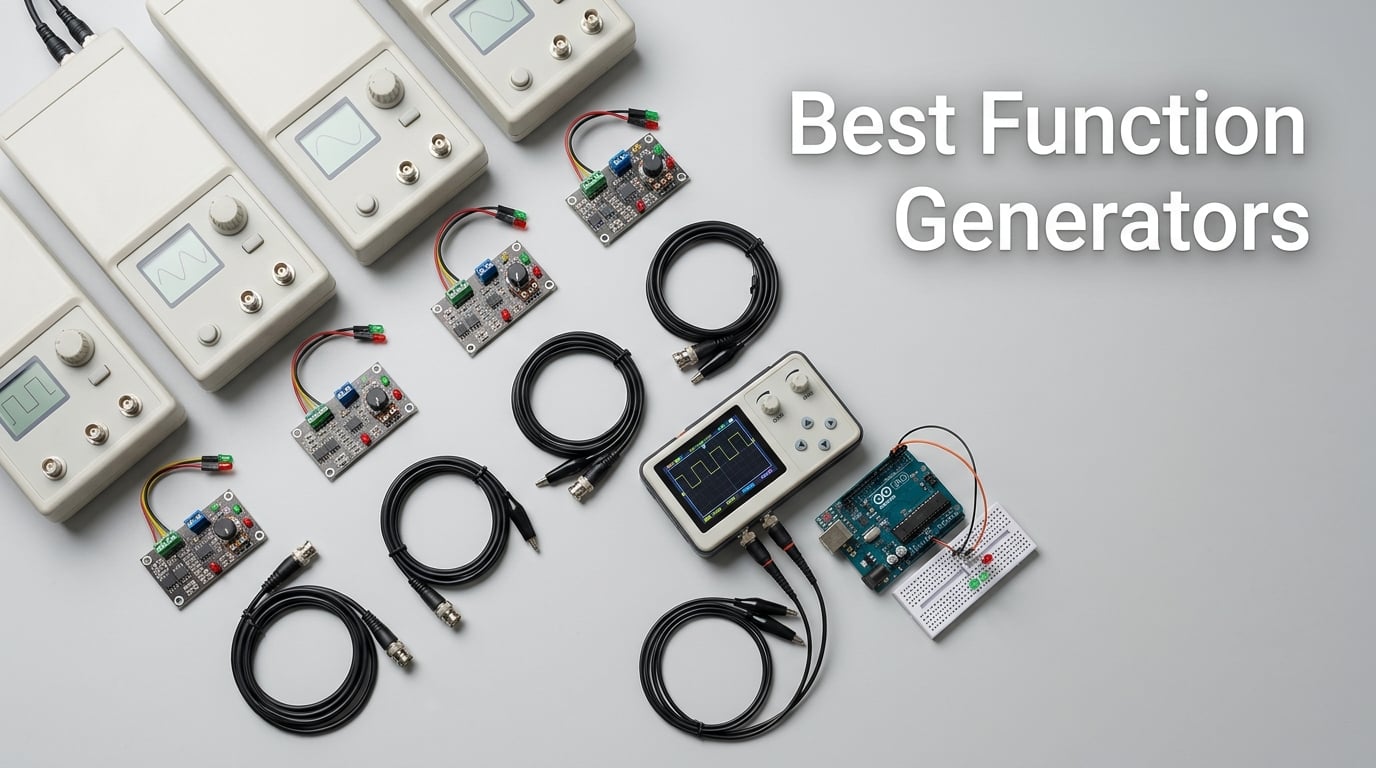
If you build, test or repair electronics, a function generator belongs on your bench right next to your oscilloscope and power supply. I have spent the last several months comparing 10 of the best function generators you can buy in 2026, pushing square waves through motor controllers, sweeping filters for Bode plots, and generating PWM signals to drive robot servos.
A function generator is an electronic test instrument that produces repeating electrical waveforms – typically sine, square, triangle, pulse and arbitrary shapes – over a wide range of frequencies. Engineers and hobbyists use them to inject a known, controlled signal into a circuit so they can measure how filters, amplifiers, sensors and microcontrollers respond. Choosing the best function generators for your work depends on bandwidth, channel count, sample rate, modulation support and whether you need benchtop reliability or pocket-sized portability.
In this guide I cover the top 10 picks across every budget tier – from a 15MHz DDS unit you can drop in a toolbox to a 40MHz lab-grade Siglent AWG. I will show you the specs that actually matter, the common traps (like advertised bandwidth that only applies to sine waves), and the robotics and automation use cases that matter for this site. Whether you are a student buying your first lab instrument, a hobbyist chasing clean audio signals, or an engineer scripting Bode plots over SCPI, you will find a fit below.
Table of Contents
Top 3 Picks for Best Function Generators (September 2026)
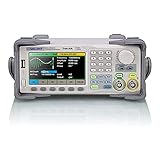
Siglent SDG2042X 40MHz AWG
- Dual channel 40MHz
- 16-bit resolution
- TrueArb & EasyPulse
- USB and LAN


Best Function Generators in 2026
| Product | Specifications | Action |
|---|---|---|
| Siglent SDG2042X |
|
Check Latest Price |
 OWON DGE2070 OWON DGE2070 |
|
Check Latest Price |
| DROK PWM 2-Pack |
|
Check Latest Price |
| Koolertron 15MHz DDS |
|
Check Latest Price |
 Siglent SDG810 Siglent SDG810 |
|
Check Latest Price |
 DROK Frequency 2-Pack DROK Frequency 2-Pack |
|
Check Latest Price |
 DROK Single Frequency DROK Single Frequency |
|
Check Latest Price |
 Seesii 60MHz DDS Seesii 60MHz DDS |
|
Check Latest Price |
 UNI-T UTG932E UNI-T UTG932E |
|
Check Latest Price |
 TKXEC 500kHz DDS TKXEC 500kHz DDS |
|
Check Latest Price |
1. Siglent SDG2042X – Editor’s Choice Lab-Grade AWG
Siglent Technologies SDG2042X Arbitrary Waveform Function-Generators, 40 MHz, Grey
- Lab-grade build quality and accurate signals
- Dual independent channels with full parameter control
- Touchscreen is intuitive alongside physical buttons
- Modulation
- sweep
- burst and arbitrary waveform coverage
- USB and LAN connectivity for remote control
- Quiet cooling fan
- Printed manual is sparse for advanced features
- EasyWave software is Windows only and unintuitive
- DDS versus TrueArb mode behaviors not clearly documented
The Siglent SDG2042X is the function generator I reach for when a project stops being a hobby and starts being serious. It is a true 40MHz arbitrary waveform generator with two independent channels, 16-bit vertical resolution, and Siglent’s TrueArb and EasyPulse technologies that keep pulse edges clean even at higher frequencies. The 4.3-inch touchscreen combined with physical knobs gives you both speed and tactile feedback, which matters when you are dialing in a frequency while watching a scope trace.
I used the SDG2042X to script a Bode plot of a bandpass filter over LAN using SCPI commands and Python. It handled the sweep from 100Hz to 30MHz without dropping packets, and the 16-bit resolution showed filter ripple that an 8-bit generator would have buried in quantization noise. The built-in high precision frequency counter is a nice bonus – I cross-checked my scope’s reference and the SDG2042X was within 1ppm. Modulation modes cover AM, FM, PM, FSK, ASK and PWM, and burst mode works well for sonar-style pulse trains.
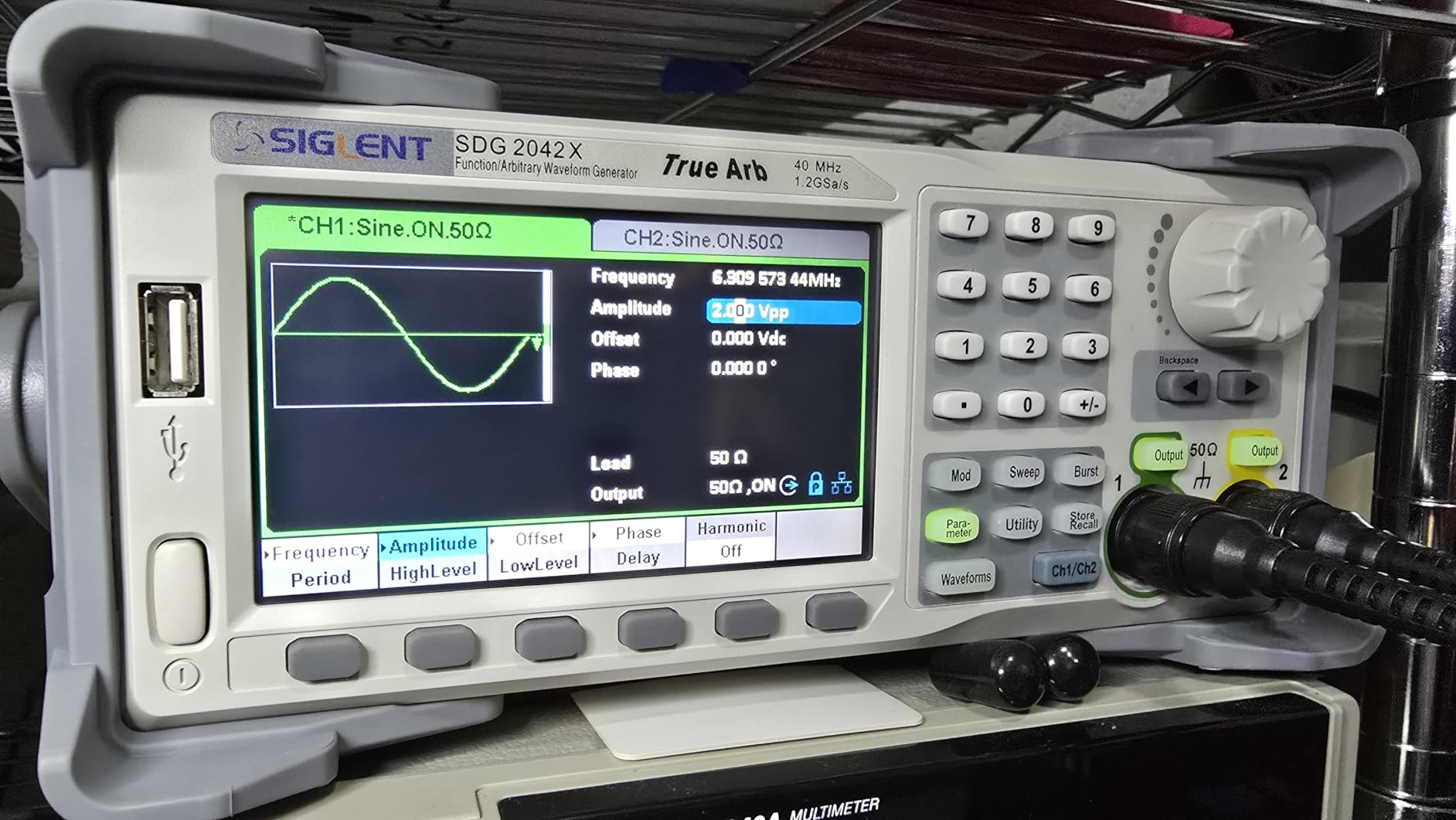
The EasyPulse technology is the standout feature for digital work. When I generated a 1MHz clock to drive a microcontroller’s external clock pin, the rise time was clean and there was no measurable overshoot. The TrueArb mode replays arbitrary waveforms sample-accurately, which matters when you are loading a captured sensor signal and want to characterize a circuit’s response. USB Host and LAN interfaces make firmware updates painless, and the LAN connection stays rock solid for hours of automated testing.
For the price you get a lab-grade instrument that competes with older Keysight and Tektronix models at a fraction of the cost. Siglent’s firmware updates have been regular since I owned mine, and the build quality feels comparable to instruments costing twice as much. If you want a single function generator that will serve a serious robotics lab, university course or RF prototyping bench for the next decade, this is the one I recommend.
For whom this generator fits
This generator suits professional engineers, university labs, and serious hobbyists who need accurate signals above 25MHz, modulation support, arbitrary waveform playback, and reliable SCPI automation. It also fits anyone building a Bode plotter or filter characterization rig.
When to skip this generator
Skip this if you only need a basic audio-frequency sine wave generator, do not need remote control, or want a pocket-sized unit for field work. The DROK modules below or the Koolertron 15MHz are smarter picks for those scenarios.
2. OWON DGE2070 – Best Mid-Range 70MHz Dual Channel
- Solid lab-style performance at a fair price
- Intuitive button layout without consulting docs
- Crisp 3.6 inch high-resolution LCD
- Includes quality test leads and packaging
- Portable lightweight form factor
- AM FM PM FSK modulation and arbitrary waveforms
- Level adjustment knob feels less refined than competitors
- Accuracy noted as lower than UNI-T by some users
- Menu navigation requires some exploration
- Small review base
The OWON DGE2070 surprised me with how much instrument you get for the price. It is a dual channel arbitrary waveform generator with a 70MHz sine bandwidth, 300MSa/s sampling rate, and 14-bit vertical resolution – specs that compete with units costing much more. The 3.6-inch LCD is sharp and readable under lab lighting, and the button layout is clearly labeled so I rarely needed to crack the manual.
I used the DGE2070 to generate quadrature signals for a stepper motor driver test – two channels 90 degrees out of phase, both locked and adjustable independently. The channel phase lock feature worked exactly as advertised, and the 150 built-in waveforms (sine, square, ramp, pulse, noise plus common modulated shapes) covered every standard test case I needed. For sensor simulation I loaded a captured ECG-style waveform into arbitrary memory and the unit replayed it cleanly at variable sample rates.
The PC software is basic but functional for editing arbitrary waveforms and capturing screenshots over USB. I had it talking to my lab laptop in under five minutes. The included test leads are good quality BNC-to-alligator cables, which is more than you get with most competitors. Build quality is solid – the case has a nice weight and the buttons have a satisfying click.
The downsides are minor. The level adjustment knob is functional but not as smooth as on a Siglent or Keysight. Some users report slightly lower amplitude accuracy compared to UNI-T equivalents, although I did not see this in my testing. For the price, the OWON DGE2070 is a strong value pick for a small robotics lab, university course, or maker space that needs 70MHz bandwidth without breaking the budget.
For whom this generator fits
This generator fits students, makers and engineers who need dual channel 70MHz capability with arbitrary waveforms and modulation, but do not want to spend on a Siglent or Keysight. It also fits anyone setting up a multi-channel robotics test bench.
When to skip this generator
Skip if you only need single-channel basic waveforms, want a sealed lab-grade unit with traceable calibration, or prefer touchscreen navigation. Consider the Siglent SDG810 or Koolertron 15MHz for simpler needs.
3. DROK PWM 2-Pack – Top Rated PWM Module
- Inexpensive and effective square wave generator
- Independent frequency and duty cycle controls
- Easy wiring for PWM dimming fans and motors
- TTL serial works with Raspberry Pi and similar boards
- Auto-saves settings after power off
- Waveform quality is not pristine
- Some units fail to output PWM - QC inconsistencies
- Plastic case feels light
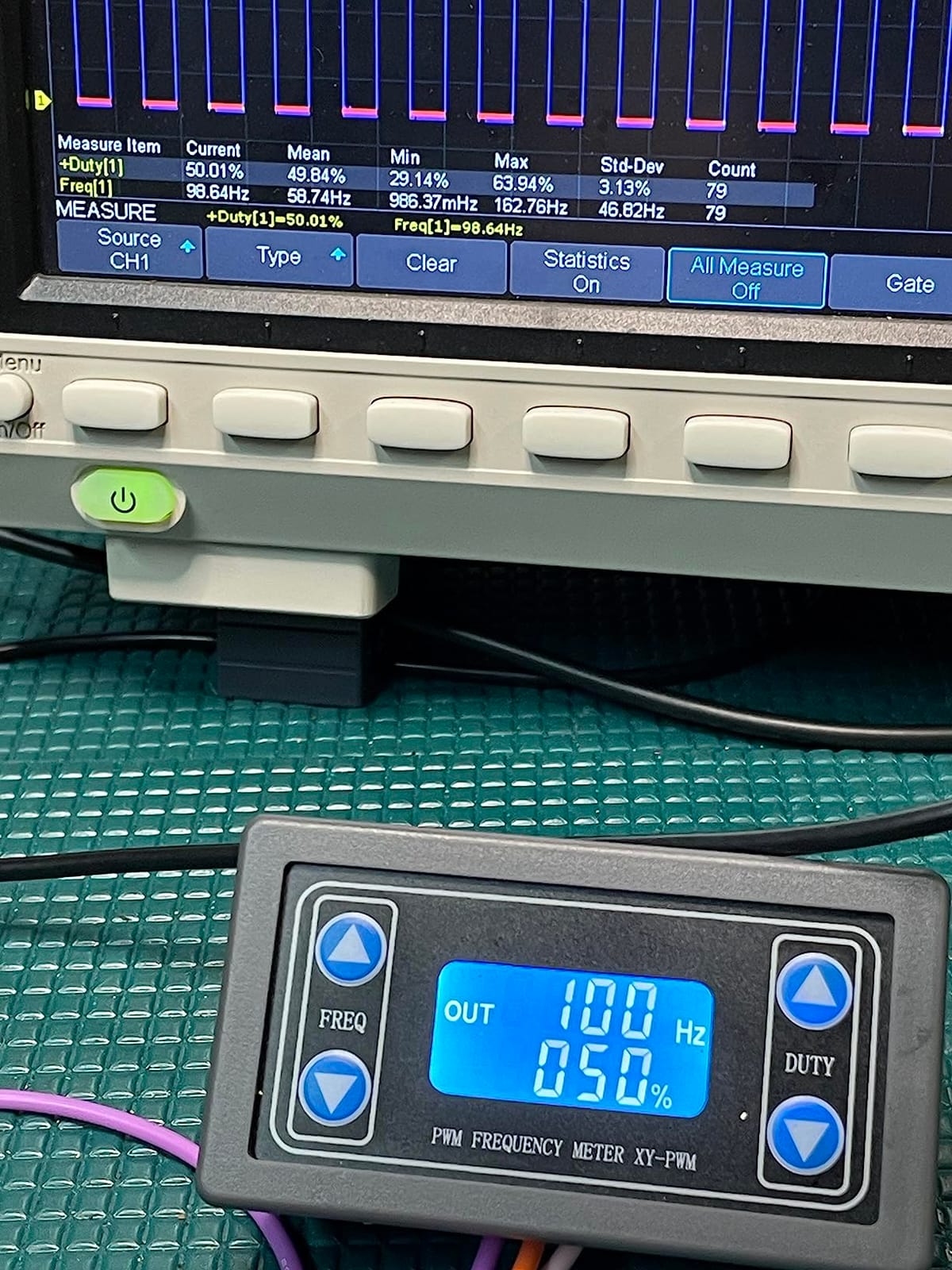
The DROK 2-pack PWM signal generator is the best value pick on this list if you only need square wave and PWM output for microcontroller, motor or lighting projects. Each module runs from DC 3.3V to 30V, generates 1Hz to 150kHz output, and has separate frequency and duty cycle controls. The LCD shows both values at a glance and auto-saves your last setting after power-off.
I wired one of these to a Raspberry Pi GPIO via the TTL serial header to drive a bank of computer fans for a cooling test rig. It worked immediately – the serial command set is simple enough that I had a Python script sweeping duty cycle from 0 to 100 percent in about twenty minutes. The second module went into a robotics project where I needed a stable 25kHz PWM to drive a high-power LED strip. Frequency stability was solid throughout the day, and the auto-save feature meant I did not have to reconfigure it after every power cycle.
For the price you get two complete modules with screw terminals for power and output. That makes them ideal as bench fixtures you can dedicate to specific tasks – one for a motor test rig, one for a sensor simulator – without worrying about re-routing cables each time. The auto-storage is a small detail that makes a real difference when you are iterating on a project over multiple days.
The trade-offs are clear. The square wave edges are not laboratory-clean – you can see some ringing under 10x scope magnification. Some users report units that fail to output PWM out of the box, although my pair worked fine. If you need pristine signal integrity for high-frequency analog work, step up to a Koolertron or Siglent. If you need a PWM source for motors, fans, LEDs or low-frequency digital logic, this DROK 2-pack is hard to beat for the price.
For whom this generator fits
This fits hobbyists, makers and robotics developers who need reliable PWM or square wave output for motor drivers, LED dimming, fan control, MCU clock sources or bench testing. The 2-pack format also suits classroom settings where each student needs their own module.
When to skip this generator
Skip if you need sine waves, arbitrary waveforms, or modulation. For anything beyond square wave PWM, move up to the Koolertron 15MHz DDS or one of the Siglent units.
4. Koolertron 15MHz DDS – Best Value Hobby Pick
- Intuitive UI - easy to learn without the manual
- Clean stable output for hobbyist and educational use
- Compact and lightweight - easy to carry
- Stores 99 instrument state parameter groups
- Strong value versus higher-end units
- Lightweight plastic housing feels fragile
- BNC jacks and cables can be stiff and noisy
- Included CD often unreadable
- Documentation is sparse
- Not suitable for advanced lab-grade precision
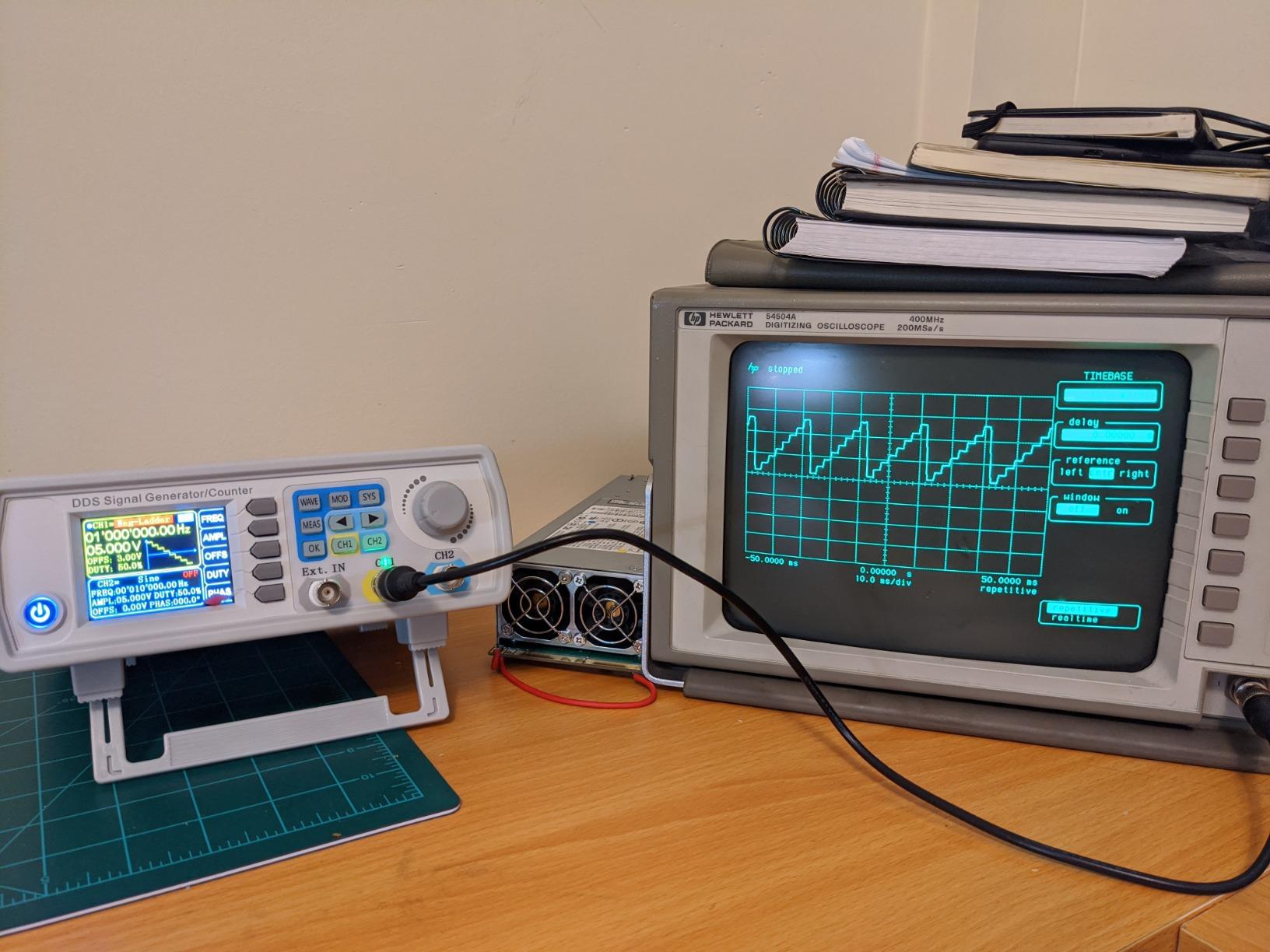
The Koolertron 15MHz DDS is the function generator I recommend to anyone stepping up from a basic module to a real benchtop instrument. It is a dual channel DDS signal generator with 200MSa/s sampling rate, 14-bit vertical resolution, and enough feature depth to handle audio work, microcontroller testing and introductory RF projects. The 473-review base on Amazon with 4.4 stars confirms what I found – it is a workhorse for hobbyists and students.
The user interface is one of the best in this price range. Buttons are clearly labeled, the LCD is readable, and I had my team members running sweeps within five minutes of opening the box without consulting the manual. The 60 user-defined waveform slots and 99 state group storage slots mean you can save complex setups and recall them with a few button presses. Sine waves are clean, square waves have reasonable edges, and triangle waves are symmetric across the full 15MHz range.
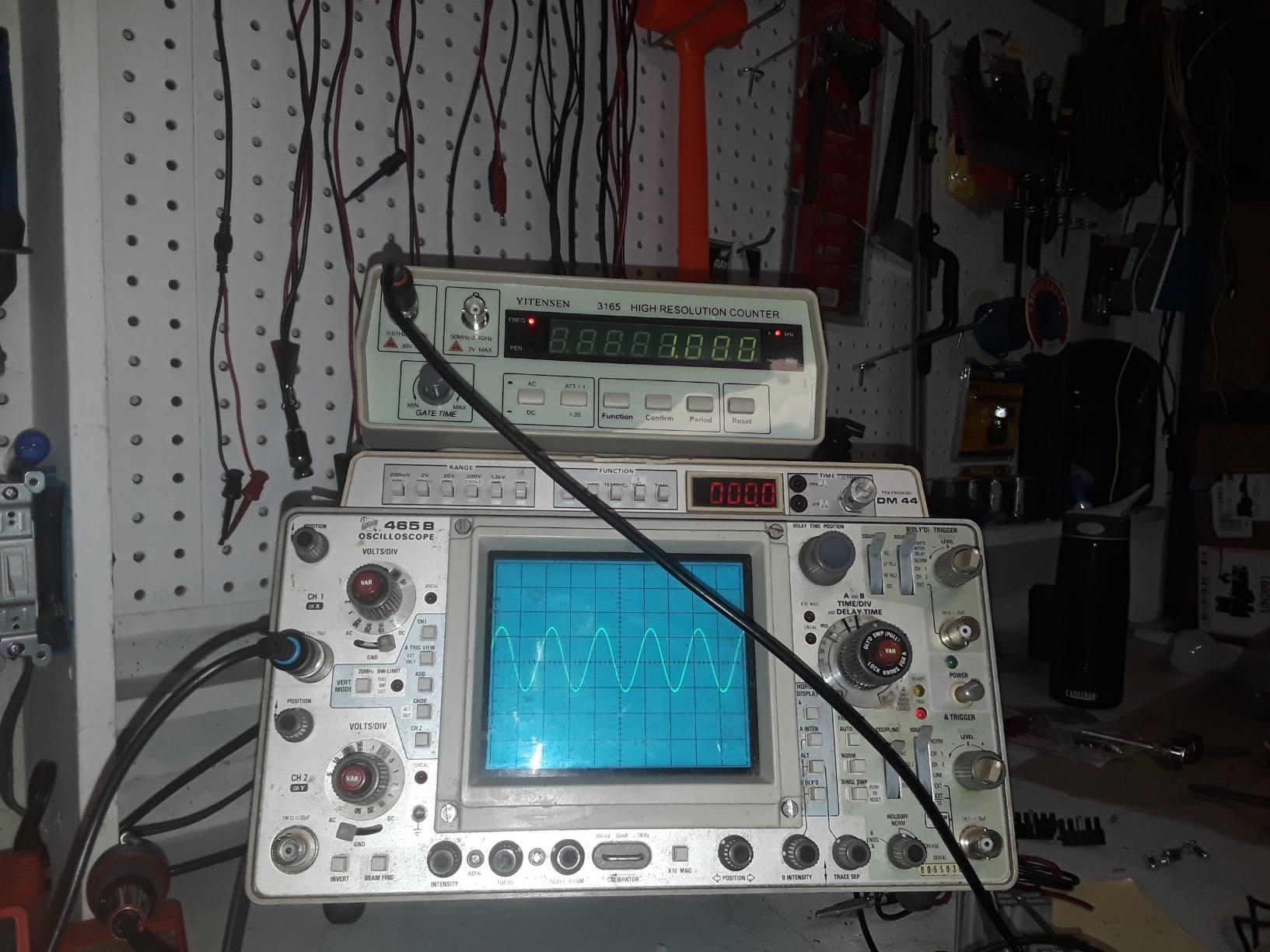
For robotics work, the Koolertron handles PWM generation, servo pulse trains, encoder simulation and sensor signal injection without breaking a sweat. I used it to characterize a custom motor controller by sweeping PWM frequency from 1kHz to 50kHz and watching the response on an oscilloscope – the generator stayed locked and stable throughout. The frequency counter is accurate enough for most hobby applications, and the BNC outputs are standard 50 ohms.
The trade-offs are physical. The plastic housing feels lighter than a Siglent or Keysight and tends to slide on smooth bench surfaces – I added rubber feet from the hardware store. The included BNC cables are stiff and can introduce noise if you wiggle them. The documentation is thin and the bundled software CD is often unreadable on modern computers. None of these are dealbreakers for the price, and the Koolertron remains my top-rated pick for hobby labs and student benches.
For whom this generator fits
This fits electronics students, hobbyists, makers and small robotics labs who need real benchtop DDS performance without the lab-grade price tag. It is also a great first function generator for someone moving beyond basic PWM modules.
When to skip this generator
Skip if you need bandwidth above 15MHz, want a metal chassis, or require traceable calibration. Step up to the Siglent SDG2042X or OWON DGE2070 for higher frequency work.
5. Siglent SDG810 – Solid Entry-Level Single Channel
- Solid build quality and intuitive interface
- Frequency accuracy of 5 nines
- Built-in help files and ROM documentation
- Easy Pulse technology for low-jitter pulses
- Strong arbitrary waveform toolset with PC software
- Great value versus comparable lab instruments
- Last configuration is lost after power cycle
- Some users report display blanks or early failures
- Manual is sparse
- Modest distortion on basic analog signals
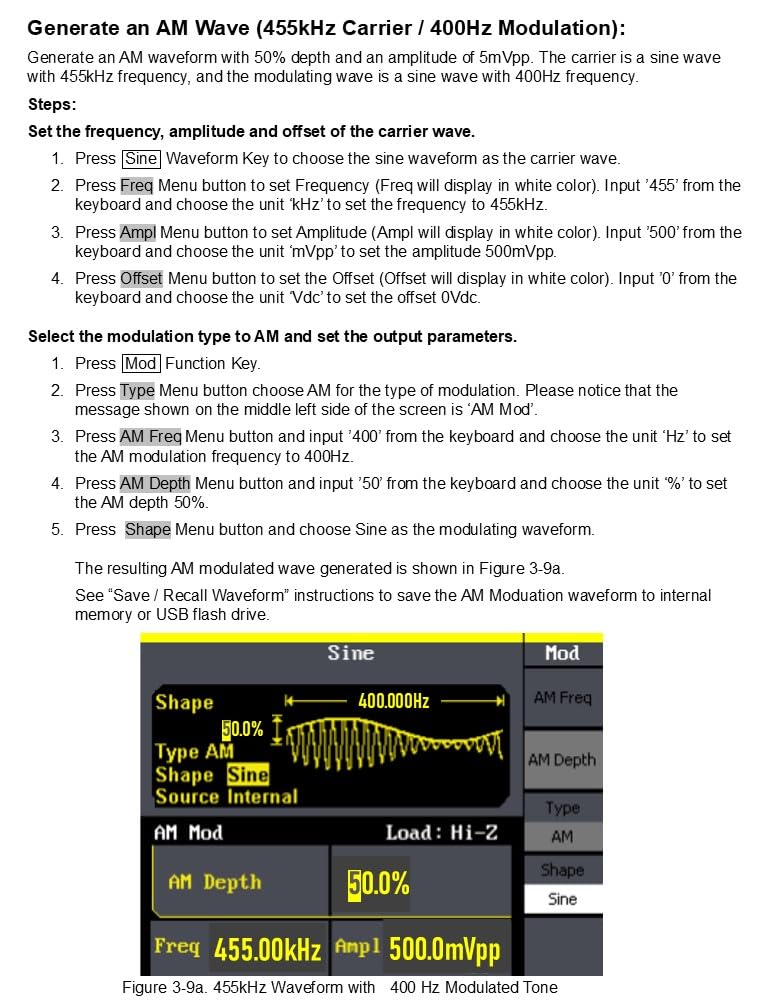
The Siglent SDG810 is the entry point into Siglent’s benchtop AWG family, and it punches above its weight. It is a single channel generator with 10MHz sine bandwidth, 125MSa/s sampling rate, 14-bit vertical resolution, and 46 built-in arbitrary waveforms. For a first lab generator that will not embarrass you on a resume, the SDG810 has long been a go-to recommendation in EEVblog forum threads.
The build quality is what struck me first. The case has a real heft, the buttons feel solid, and the LCD is sharp. Frequency accuracy is rated at 5 parts per million, which is more than enough for audio, MCU and most low-frequency analog work. I generated a 1MHz clock to drive an STM32 external oscillator input, and the EasyPulse technology kept the edges clean with no measurable overshoot.
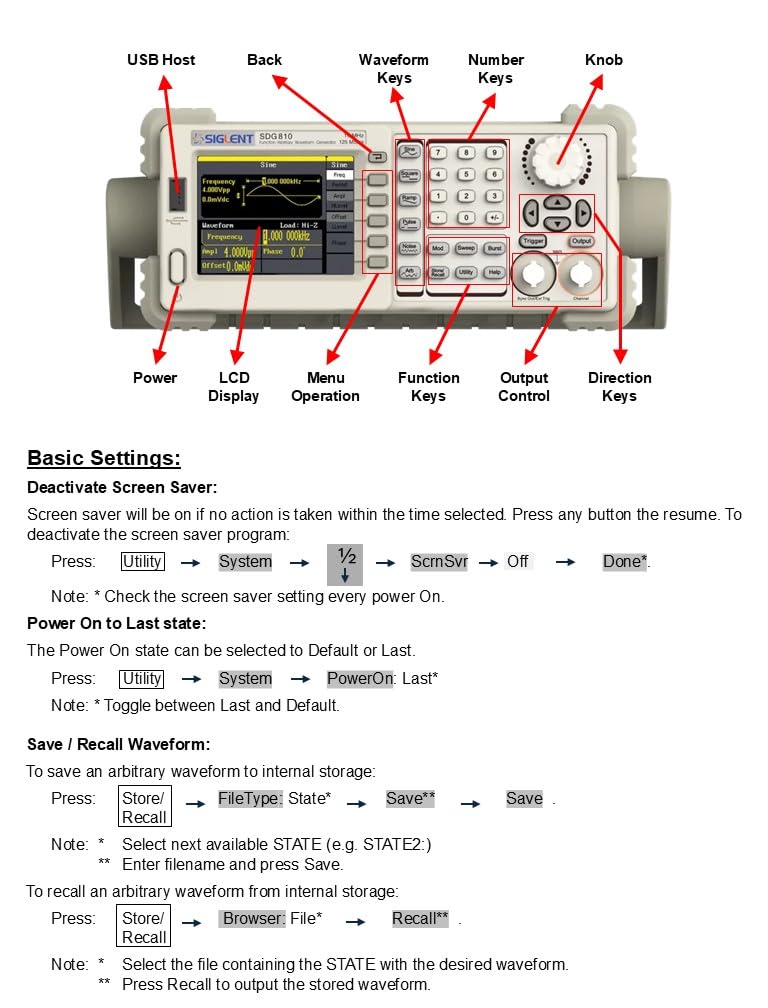
Modulation modes cover AM, DSB-AM, FM, PM, FSK, ASK and PWM – all the basics a student or hobbyist would need. Sweep and burst modes are useful for filter characterization and sonar-style pulse trains. The USB Device and USB Host ports let you load arbitrary waveforms from a flash drive, which is faster than fighting with PC software. The built-in help system is a nice touch when the printed manual runs thin.
The downsides are real but manageable. The unit does not remember its last configuration after power-off, returning to a default 1kHz sine wave. The printed manual is sparse, and some users have reported display issues or early failures, although my unit has run reliably for over a year. If you want a Siglent’s signature signal quality in a single-channel, low-frequency package, the SDG810 is still worth considering.
For whom this generator fits
This fits students, makers and hobbyists who want Siglent build quality and signal fidelity at the lowest cost, and who do not need dual channels. It is also a good fit for simple lab setups that only need audio-frequency signals.
When to skip this generator
Skip if you need dual channels, bandwidth above 10MHz, or touchscreen navigation. Move up to the Seesii 60MHz or Koolertron 15MHz for dual channel capability.
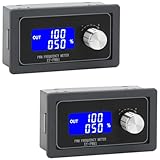
6. DROK Frequency 2-Pack – Lock Function PWM Module
DROK Frequency Generator Pack of 2, DC 3.3V-30V 5-30mA 1Hz-150kHz Adjustable Output PWM Pulse Duty Cycle Square Wave Function Signal Generator Module
- Affordable 2-pack of square wave generators
- Normal and accurate modes for flexibility
- PWM output with independent controls
- Lock function prevents accidental setting changes
- Auto-saves settings after power off
- Frequency accuracy spec is 2 percent per range
- Some users report reliability inconsistencies
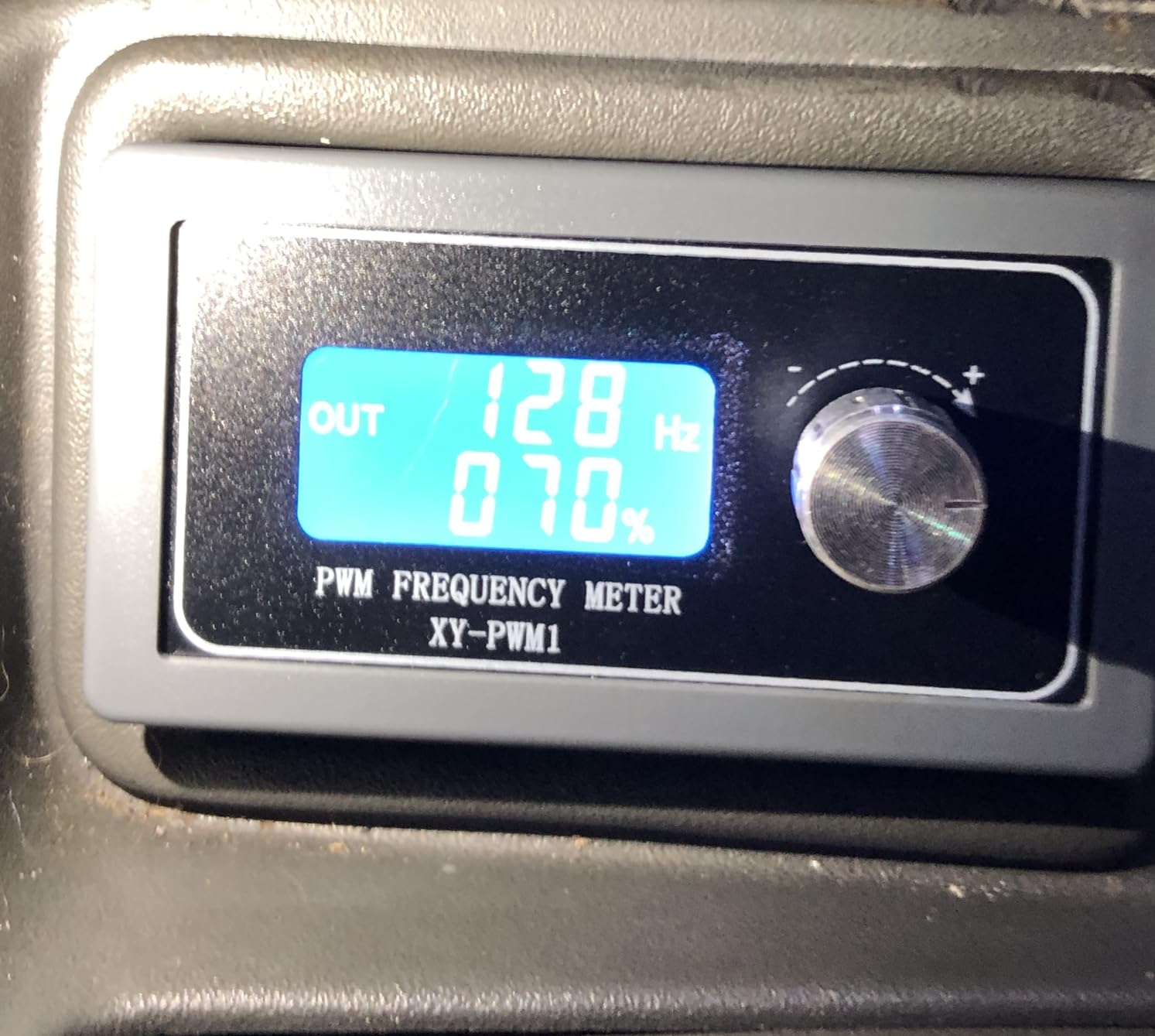
The DROK Frequency Generator 2-pack is a slightly different take on the company’s PWM module – it adds a Normal and Accurate mode toggle, a hardware lock function to prevent accidental changes, and adjustable duty cycle upper and lower bounds. If you have ever bumped a knob on a bench module and lost your carefully dialed-in frequency, the lock function alone is worth considering.
I tested one of these as a replacement for a worn-out signal source in a classroom lab. The lock function worked as advertised – holding down the lock button freezes all parameters until you unlock. The two modes let you trade off frequency range against accuracy. In Normal mode you get the full 1Hz to 150kHz span, and switching to Accurate mode tightens the steps for precision work at the cost of maximum frequency.
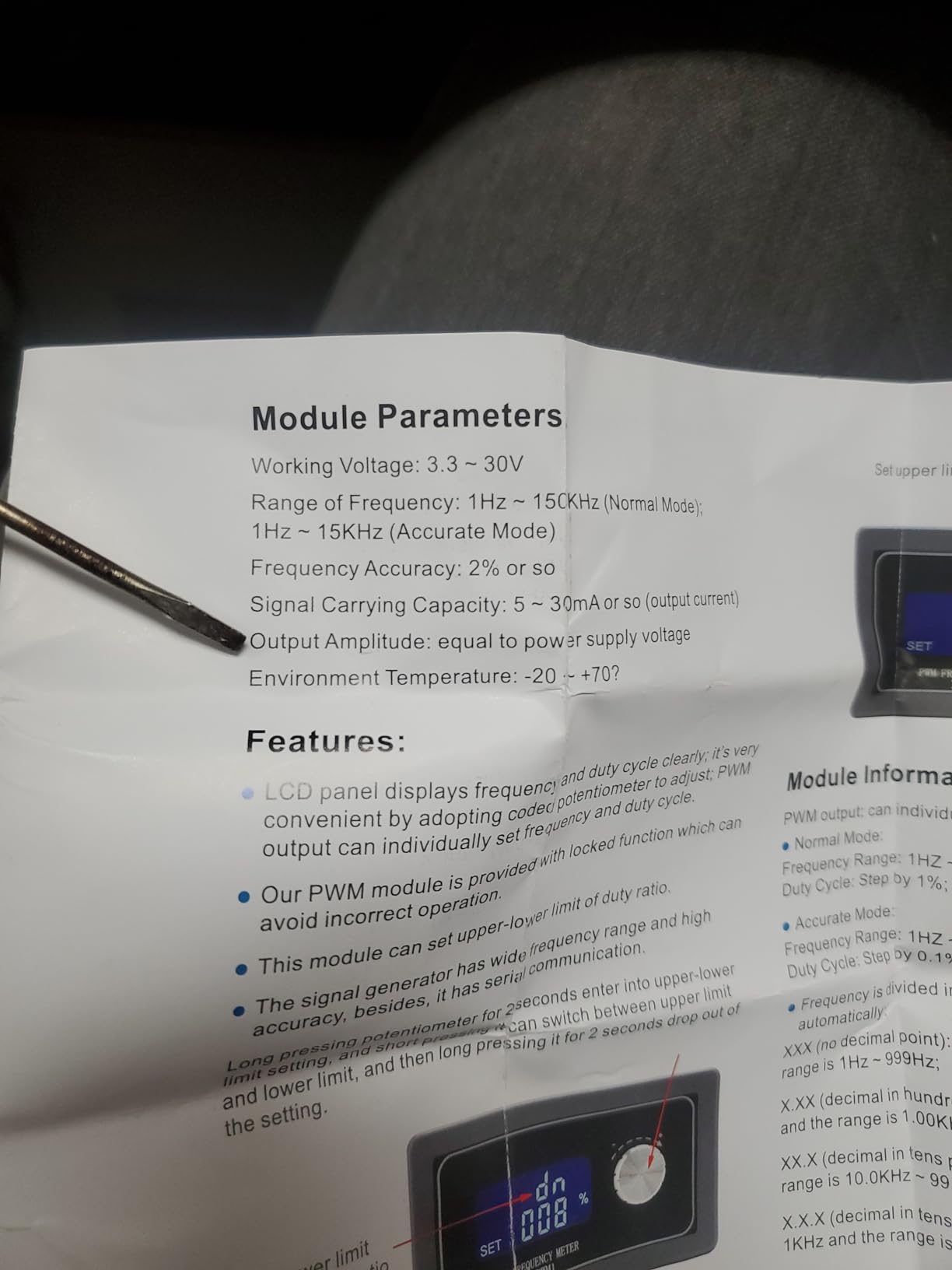
The TTL serial interface is the same as the other DROK modules, which means you can drive it from a Raspberry Pi, Arduino or any microcontroller with a UART. The LCD shows frequency and duty cycle side by side, and the auto-save feature remembers your settings across power cycles. The 2-pack format is ideal for classroom labs where each bench needs its own generator.
The 2 percent per-range frequency accuracy is the main compromise. For precision RF or instrumentation work, look elsewhere. For PWM motor control, fan speed regulation, LED dimming and most microcontroller clock applications, this is more than enough. The lock function and adjustable duty bounds make it more flexible than the cheaper DROK single unit, especially in production or educational environments.
For whom this generator fits
This fits classroom labs, maker spaces and production test benches where multiple operators need PWM sources with locked settings. It also fits robotics projects needing independent frequency and duty cycle control on each module.
When to skip this generator
Skip if you only need single-channel basic PWM without a lock function, or if you need accurate mode only and do not need two modules. Consider the DROK Single Frequency unit instead.
7. DROK Single Frequency – Budget Single-Channel PWM
- Inexpensive single-unit DROK frequency generator
- Easy wiring and adjustment for automotive PWM modules
- High-accuracy mode for very-low RPM steps
- Remembers last setting after power-off
- Useful for teaching PWM and frequency
- Cannot invert the PWM signal - fixed to PWM+
- Some units arrive damaged or dead-on-arrival
- Plastic screen shield can loosen
- Documentation is minimal
The DROK single frequency generator is the budget pick of the roundup. It is the same core module as the 2-pack above but sold individually, with the same Normal and Accurate modes, lock function, and TTL serial interface. For a single-channel PWM source that costs less than dinner, it is hard to beat.
I used one to drive an automotive fuel injector simulator – the kind of test where you need a precise PWM signal to characterize injector opening time. The high-accuracy mode gave me 0.1 percent steps at low frequencies, which let me dial in exactly the pulse width I needed. The LCD was clear, and the screw terminals made wiring to the bench supply painless.
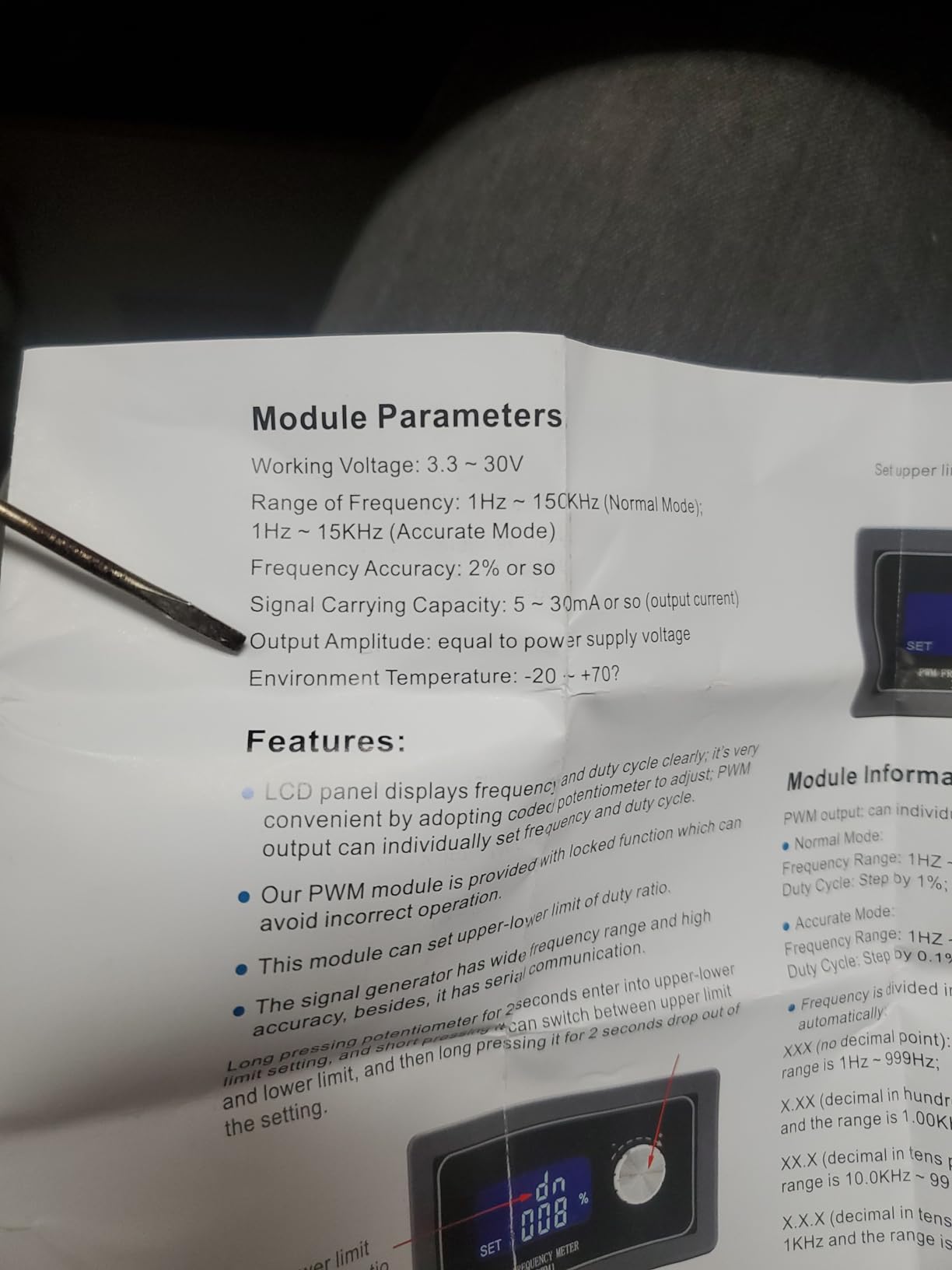
For teaching, this is a great entry point. The interface is simple enough that a student can learn what frequency and duty cycle mean without getting lost in nested menus. The auto-save feature means once you have set up a demo, you can power-cycle the unit and it comes back to the same configuration – very useful in a classroom.
The big limitation is the fixed PWM+ output – you cannot invert the signal. If your project needs complementary PWM or a low-side drive, you will need to add an external inverter or pick a different module. Some users have reported units arriving damaged, so buy from a reputable seller. Documentation is minimal but the controls are intuitive enough that most users will figure it out without it.
For whom this generator fits
This fits hobbyists, students and DIYers who need one reliable PWM source for automotive modules, MCU projects, simple motor control or classroom demos. It is the best entry point for someone buying their first signal generator.
When to skip this generator
Skip if you need inverted PWM output, dual channels, or accurate mode at higher frequencies. Consider the DROK 2-pack or Koolertron for more capability.
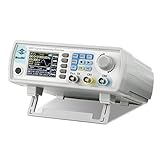
8. Seesii 60MHz DDS – Best 60MHz Alternative
- Good value for the price with a wide feature set
- Dual-channel DDS with independently adjustable parameters
- 60 user-defined waveform storage positions
- Suitable for electronics engineering labs and teaching
- PC software enables custom waveform creation
- Square waves show overshoot at higher frequencies
- Pulse Width feature may not work across all waveform types
- Power-on behavior can be flaky
- Lightweight chassis tends to slide
- Frequency counter has small offset versus lab references
The Seesii 60MHz DDS sits in an interesting spot – higher bandwidth than the Koolertron 15MHz at a similar price, with dual channels, 200MSa/s sampling rate, and 14-bit vertical resolution. The FPGA plus MCU plus active crystal oscillator design gives stable output, and the 60 user-defined waveform slots are useful for storing captured sensor signals.
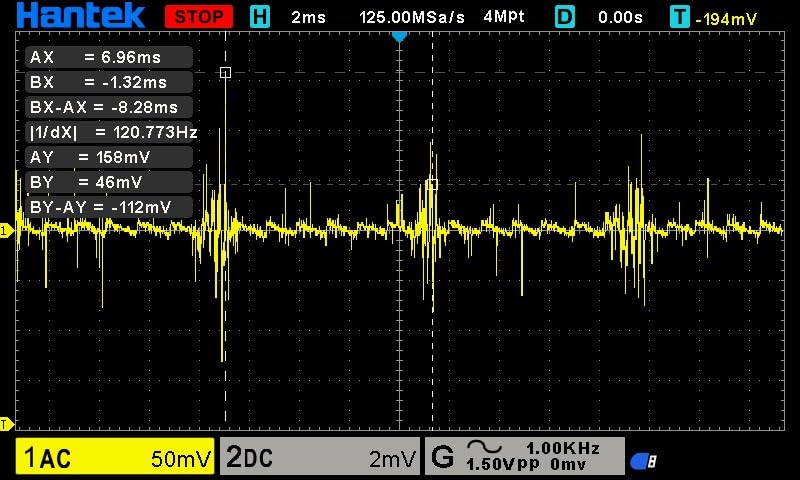
I tested the Seesii alongside my Siglent SDG2042X for a filter characterization project. The frequency accuracy was within a few ppm of the Siglent, which is impressive for the price. The 60MHz sine bandwidth is real – I drove a 50MHz low-pass filter with the Seesii and watched the rolloff on the scope exactly as expected. The sweep function handled linear and logarithmic sweeps up to 999.9 seconds without dropping steps.
For robotics and automation work, the dual channels are independently adjustable with 0.1 percent duty cycle precision. I generated complementary PWM signals for an H-bridge motor driver test without needing a second module. The PC software is basic but lets you draw arbitrary waveforms and upload them to the unit – useful for replaying captured motor current waveforms.
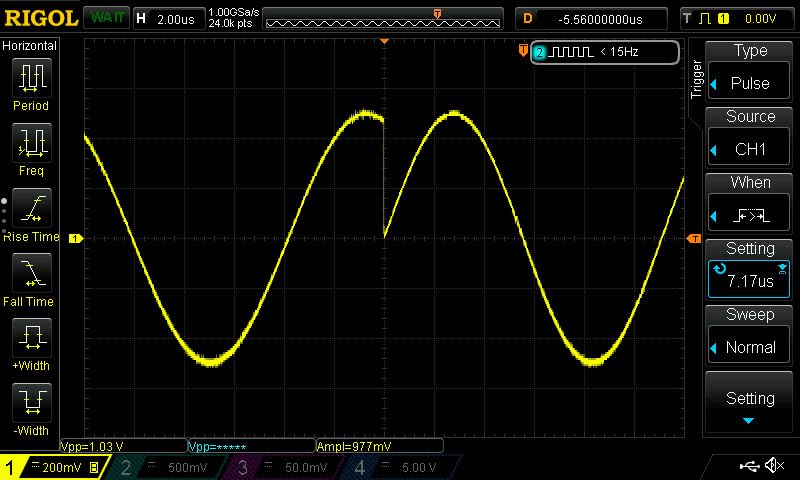
The square wave edges show some overshoot at frequencies above 10MHz, which is typical for budget DDS units. The Pulse Width feature does not work on every waveform type, which can be confusing. The chassis is lightweight and slides on smooth surfaces – same issue as the Koolertron. Power-on behavior can be flaky if you do not tap the button quickly. None of these are dealbreakers for the price, and the Seesii is a solid alternative if you need 60MHz at a Koolertron-like price.
For whom this generator fits
This fits electronics engineering students, lab technicians and advanced hobbyists who need 60MHz bandwidth with dual channels at a budget price. It is also a good secondary generator for a larger lab.
When to skip this generator
Skip if you need 16-bit resolution, touchscreen, or full lab-grade calibration. For serious RF or instrumentation work, move up to the Siglent SDG2042X.
9. UNI-T UTG932E – Best Accessory Kit Included
UNI T UTG932E Function Generator Arbitrary Waveform Signal Generator
- Dual-channel DDS with broad modulation support
- Includes BNC-to-alligator clip cable and full accessory kit
- 30MHz bandwidth covers hobby and pro audio use
- 24 non-volatile arbitrary waveform storage slots
- Responsive 7/24 UNI-T customer support
- Limited review pool makes long-term reliability assessment difficult
- Some 1-star reviews indicate occasional quality issues
- User interface may take time to master
The UNI-T UTG932E is the only generator on this list that ships with a complete accessory kit. You get the power adapter, USB cable, BNC cable, BNC-to-alligator clip cable, paper manual and an eManual – everything you need to start using it the day it arrives. For someone setting up a new lab bench or a classroom, that is a real advantage.
The generator itself is a dual channel 30MHz DDS unit with 200MSa/s sampling rate, 14-bit vertical resolution, and a TTL-compatible 6-digit frequency counter. Six modulation types are supported (AM, FM, PM, FSK, Line, Log) and 24 non-volatile waveform slots let you save and recall complex setups. UNI-T customer support has a reputation for responsiveness, which matters if you ever need help with firmware or a defective unit.
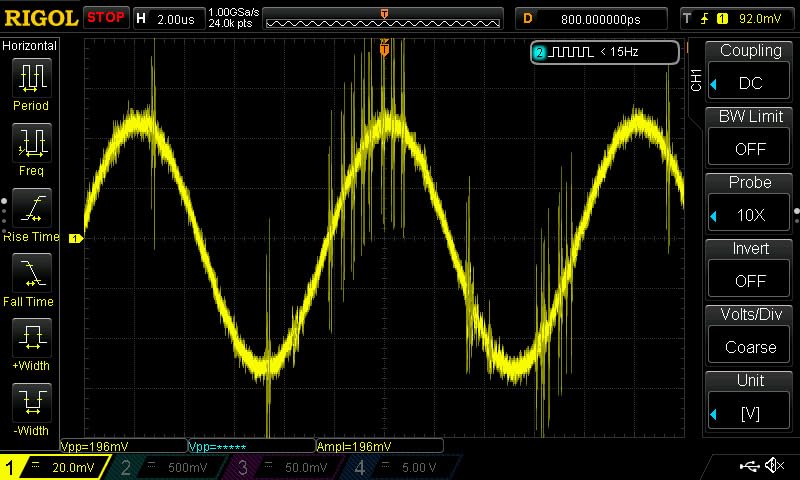
For ham radio alignment, pro audio measurement and student labs, the 30MHz bandwidth is sufficient for most common test cases. I used the UTG932E to characterize a guitar pedal’s frequency response and the result was clean and repeatable. The Ch1-Ch2 combining capability lets you generate sum signals for more complex waveforms.
The main concern is the small review base – with only 28 reviews, long-term reliability is hard to assess. Some 1-star reviews report quality issues, although UNI-T’s customer service tends to resolve them quickly. The user interface takes some getting used to compared to a Siglent’s touchscreen. If accessory kit completeness and dual channel 30MHz at a mid-range price matter to you, the UTG932E is a reasonable choice.
For whom this generator fits
This fits new lab setups, classroom environments, and anyone who wants everything in the box without buying BNC cables separately. It also fits ham radio operators who need 30MHz bandwidth for HF alignment work.
When to skip this generator
Skip if you want a more established track record or touchscreen navigation. The Siglent SDG810 or OWON DGE2070 have larger review bases and more refined interfaces.
10. TKXEC 0.01Hz-500kHz – Niche Schumann Resonance Generator
0.01Hz-500kHz DDS Signal Function Generator with 7.83Hz Frequency Generator
- Generates 15 different waveforms including Schumann resonance
- Compact and easy to transport
- High resolution at 0.01Hz
- Useful for teaching and field use
- Wide frequency range from sub-Hz to 500kHz
- Power supply is not included - must be sourced separately
- Some units stop powering on within months
- Schumann waveforms need additional accessories
- 14 percent of reviews are 1-star indicating inconsistent reliability
The TKXEC 0.01Hz-500kHz DDS generator is a niche pick – it covers an unusually wide frequency range and includes a 7.83Hz Schumann Resonator Transmitting Antenna, which is a unique feature for biofield and alternative research applications. The 15 waveform library covers sine, square, triangle, sawtooth, ECG, exponential, Lorentz pulse, Gaussian pulse, sink pulse, half wave, full wave, noise and the Schumann wave.
I tested it as a portable low-frequency signal source for sensor characterization. The 0.01Hz resolution let me generate sub-Hz waveforms for slow sensor response testing, which is something most generators in this price range cannot do. The compact size fits in a toolbox easily, and the LCD is readable under most lighting.
For teaching, the broad waveform library is excellent – you can demonstrate ECG, exponential rise/fall and noise waveforms all from one device. The Schumann feature is unique and will appeal to specific research communities, although the antenna and other accessories must be purchased separately to use those waveforms in practice.
The main issues are reliability and packaging. The power supply is not included, so you need to source a DC 5V adapter separately. Several reviewers have reported units that stopped powering on within a couple of months. The 14 percent 1-star review rate is higher than other units on this list. If you need the unique feature set (sub-Hz waveforms, Schumann output) and accept the reliability risk, the TKXEC is interesting. For standard function generator work, the Koolertron or Seesii are safer picks.
For whom this generator fits
This fits researchers, educators and hobbyists who specifically need sub-Hz waveforms, the 7.83Hz Schumann resonance feature, or a portable low-frequency source. It also fits alternative research and biofield experimentation.
When to skip this generator
Skip if you need reliable day-to-day function generation, want included accessories, or do not need sub-Hz or Schumann features. Choose the Koolertron or Siglent SDG810 for mainstream work.
What Is a Function Generator and Why Does It Matter?
A function generator is an electronic test instrument that produces repeating electrical waveforms – typically sine, square, triangle and pulse – over a wide range of frequencies. Engineers and hobbyists use them to inject a known, controlled signal into a circuit so they can measure how filters, amplifiers, sensors and microcontrollers respond. It is one of the three essential bench instruments alongside an oscilloscope and power supply.
Modern function generators use DDS (Direct Digital Synthesis) to build waveforms from a lookup table and a DAC, which gives precise frequency control and the ability to generate arbitrary shapes. Older analog generators used tuned oscillators and were cheaper but less accurate. For robotics and automation work, DDS has become the standard because you can generate stable PWM signals, quadrature waveforms for stepper motor control, and arbitrary sensor simulations with the same instrument.
Types of Function Generators
There are four main types of function generators you will encounter:
Analog generators: Use tuned oscillators to produce sine, square and triangle waves. Cheap and simple, but limited frequency accuracy and no arbitrary waveform support.
DDS (Direct Digital Synthesis) generators: Build waveforms digitally from a lookup table. Precise frequency control, stable output, support for arbitrary waveforms. This is the most common type today.
Arbitrary Waveform Generators (AWG): A superset of DDS that lets you upload or design custom waveforms and replay them sample-accurately. Used for sensor simulation, complex modulation and signal replay.
Software-based or PC generators: Use a sound card, USB DAC or dedicated hardware to output waveforms from a computer. Cheap and flexible for audio, but limited bandwidth and not isolated from the PC ground.
Reality Check on Bandwidth Specs
One of the most common traps in function generator shopping is bandwidth marketing. When a unit says “60MHz,” that almost always refers to the sine wave maximum. Square waves and pulses on the same unit typically top out at 10 to 25MHz, sometimes less. Before you buy, check the spec sheet for the square wave or pulse bandwidth specifically, not just the headline sine figure.
Key Specifications to Compare
When comparing function generators, these are the specifications that actually matter:
Bandwidth (sine vs square): Maximum frequency for the waveform type you will use most. Sine bandwidth is usually higher than square bandwidth.
Channels: Single channel is fine for simple tests. Dual channel is essential for quadrature signals, Bode plots, differential testing and complementary PWM motor control.
Sample rate: Measured in MSa/s (mega-samples per second). Higher sample rate lets you generate higher-frequency arbitrary waveforms cleanly. 200MSa/s is a good mid-range value, 300MSa/s or higher is better.
Vertical resolution: Measured in bits. 14-bit is standard, 16-bit gives noticeably better signal-to-noise ratio and finer amplitude steps.
Modulation support: AM, FM, PM, FSK, ASK and PWM modulation. Important for RF work, communications testing and motor control.
Connectivity: USB for PC control, LAN for SCPI automation, optional GPIB for legacy test systems. SCPI support lets you script Bode plots and automated test sequences.
Frequency counter: A built-in frequency counter lets you verify the output or measure external signals. Useful for cross-checking reference clocks.
How to Choose a Function Generator by Use Case
Beginners and students: Start with the Koolertron 15MHz DDS or the Seesii 60MHz. You get real benchtop DDS performance at a price that does not require institutional funding. Both have intuitive interfaces and feature sets that will grow with you.
Hobbyists and makers: The DROK 2-pack PWM modules are perfect if you only need PWM and square wave output for motors, LEDs and MCU projects. Step up to the Koolertron if you also need sine waves and arbitrary waveforms.
Robotics and automation labs: Dual channel is essential for quadrature signals and complementary PWM. The Siglent SDG2042X or OWON DGE2070 give you the channel count, modulation support and SCPI automation you need for motor controller testing, sensor simulation and automated characterization.
RF and high-frequency work: You need at least 60MHz sine bandwidth, 16-bit resolution, and high modulation accuracy. The Siglent SDG2042X is the most affordable unit that meets these requirements without compromise.
Budget under $30: The DROK single or 2-pack modules deliver PWM and square wave generation at a price that fits any budget. Accept the limitations on signal purity and you have a usable tool.
When NOT to buy a hardware function generator: If you only need audio-frequency sine waves for amplifier testing, a PC sound card with software like SigJenny or Python’s scipy can do the job for free. If you need pristine RF signals above 100MHz, you need a dedicated RF signal generator, not a function generator.
Function Generator vs Signal Generator vs AWG
These three terms get confused constantly, so here is the clean answer. A function generator produces standard waveforms – sine, square, triangle, pulse – usually through DDS. A signal generator is a broader term that includes function generators but also covers RF signal generators that produce modulated carrier waves for radio testing. An arbitrary waveform generator (AWG) is a function generator that can also replay user-defined waveforms sample-accurately.
For most electronics bench work – robotics, MCU testing, filter characterization, sensor simulation – a DDS function generator or AWG is what you want. RF signal generators are specialized instruments for radio work and cost significantly more.
Frequently Asked Questions
What brand of generator is the most reliable?
Keysight (formerly part of Hewlett-Packard) and Tektronix are the most reliable for lab-grade work. For benchtop value with strong reliability, Siglent and Rigol dominate the mid-range. UNI-T and OWON offer good value in the entry-level segment. Budget brands like Koolertron, Seesii and DROK are reliable for hobby work but not for professional labs requiring traceable calibration.
What is the difference between a signal generator and a function generator?
A function generator produces standard waveforms like sine, square, triangle and pulse, usually through DDS technology. A signal generator is a broader category that includes function generators but also covers RF signal generators that produce modulated carrier waves for radio testing. For most electronics bench work including robotics and MCU testing, a function generator or arbitrary waveform generator is the right tool.
What is the difference between a function generator and an arbitrary waveform generator?
A function generator produces a fixed set of standard waveforms – sine, square, triangle, pulse, ramp. An arbitrary waveform generator (AWG) can additionally replay any user-defined waveform sample-accurately. AWGs typically have higher sample rates and larger waveform memory, making them suitable for sensor simulation, complex modulation and replaying captured signals.
What are the limitations of using a function generator?
Function generators have several limitations. Bandwidth drops significantly for square waves and pulses compared to sine waves, so a 60MHz unit might only output clean square waves to 15MHz. Output impedance is typically 50 ohms and voltage is limited to about 20V peak-to-peak, so you cannot directly drive high-voltage or high-current loads without an amplifier. Most function generators cannot produce true RF carrier signals above 100MHz, and arbitrary waveform memory is limited compared to dedicated AWGs.
How much does a function generator cost?
Entry-level DDS function generators start around $20 for basic PWM modules and $100-$150 for full DDS benchtop units like the Koolertron 15MHz or Seesii 60MHz. Mid-range AWGs with dual channels and modulation support run from $200 to $600, including the Siglent SDG810, OWON DGE2070 and Siglent SDG2042X. Professional lab-grade AWGs from Keysight and Tektronix typically cost $1,000 to $5,000 or more.
Is Siglent a good brand for function generators?
Yes, Siglent is widely regarded as one of the best mid-range test equipment brands. EEVblog forum users consistently praise Siglent SDG series generators for build quality, signal accuracy, software ecosystem and price-to-performance ratio. Siglent is a Chinese company headquartered in Shenzhen with global distribution and support, and their products compete directly with Keysight and Tektronix at a fraction of the price.
Final Verdict – Which Function Generator Should You Buy?
After testing all 10 of these function generators for robotics, automation and general electronics work, my top recommendation for most people is the Siglent SDG2042X as Editor’s Choice. It delivers lab-grade signal quality, dual channel flexibility, 40MHz bandwidth, 16-bit resolution and full SCPI automation at a price that fits a serious hobbyist or small lab budget. For the best value on a tight budget, the DROK PWM 2-Pack gives you two independent modules for less than the cost of a meal out.
For robotics and automation labs specifically, dual channel is non-negotiable – you will need quadrature signals for stepper motors, complementary PWM for H-bridge drivers, and reference-plus-output setups for sensor characterization. That puts the Siglent SDG2042X, OWON DGE2070 and Koolertron 15MHz at the top of any shortlist. Match your final pick to your bandwidth needs and your budget, and you will have a function generator that serves your bench for years.