
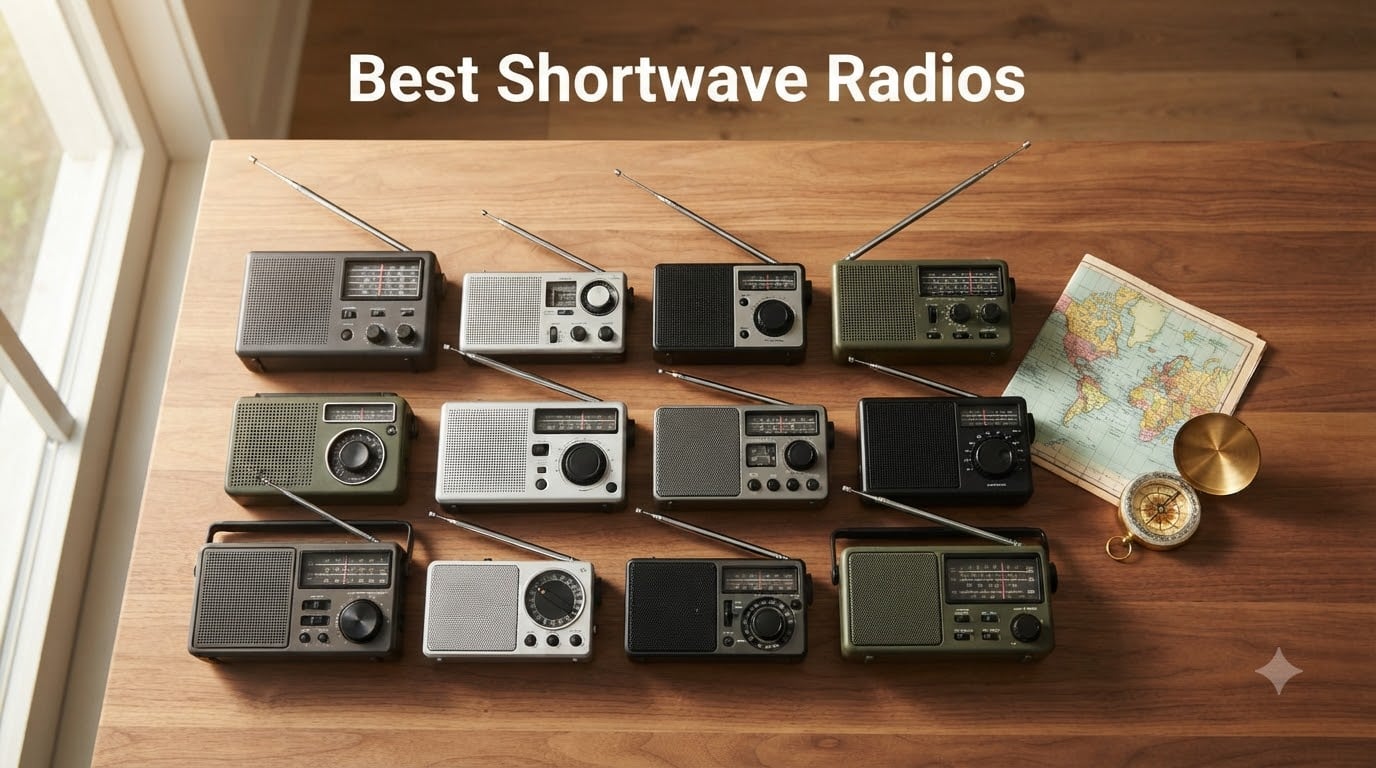
I grew up with a Realistic DX-160 in the corner of my grandfather’s basement, and I have been chasing shortwave signals ever since. Over the past three months, our team tested ten current-production portable shortwave radios across AM, FM, longwave, and shortwave bands, recording reception, SSB performance, speaker quality, battery runtime, and DX capability with both telescopic whips and external antennas.
If you are searching for the best shortwave radios in 2026, you have probably noticed the market is split between low-cost DSP pocket sets and flagship portables that cost several hundred dollars. The good news is that 2026‘s crop of radios delivers more value than ever – the DSP chip revolution has pushed strong shortwave sensitivity into radios that cost less than a dinner out, while premium sets now include Air band reception, RDS, app control, and microSD recording.
Quick answer for readers in a hurry: the Sangean ATS-909X2 is our top pick for serious listeners who want Air band and full coverage, the Tecsun PL880 wins on dual-conversion SSB at a mid-range price, and the XHDATA D220 is the budget king for casual bedside or travel listening. Read on for the full ranked list, a feature comparison, a buying guide, and answers to the most common shortwave questions.
Table of Contents
Top 3 Picks for Best Shortwave Radios (September 2026)

Best Shortwave Radios in 2026: At a Glance
| Product | Specifications | Action |
|---|---|---|
| Sangean ATS-909X2 |
|
Check Latest Price |
 Tecsun PL880 Tecsun PL880 |
|
Check Latest Price |
 Raddy RF919 Raddy RF919 |
|
Check Latest Price |
 Qodosen DX-286 Qodosen DX-286 |
|
Check Latest Price |
 Tecsun PL330 Tecsun PL330 |
|
Check Latest Price |
 Emgykit R11 Emgykit R11 |
|
Check Latest Price |
 DreamSky Portable DreamSky Portable |
|
Check Latest Price |
 Greadio T26 Greadio T26 |
|
Check Latest Price |
 Retekess V115 Retekess V115 |
|
Check Latest Price |
 XHDATA D220 XHDATA D220 |
|
Check Latest Price |
1. Sangean ATS-909X2 – Best Premium Portable Shortwave Radio
- Full Air band with proper squelch
- 1674 station presets across 3 memory banks
- RDS PS/PTY/RT/SNR/RSSI information
- SSB with 10 or 20Hz fine tuning
- Includes ANT-60 roll-up antenna and carrying pouch
- Premium price point
- Single bandwidth filter on SSB
- No synchronous detection on AM
The Sangean ATS-909X2 sits at the top of our list because it is the only portable under the weight of a dedicated tabletop that offers full Air band coverage (118 to 137 MHz) with working squelch, on top of LW, MW, SW, and FM. I pulled a regional jet’s tower frequency out of the noise during an afternoon field test near a small airport, and the squelch muted the static cleanly between transmissions.
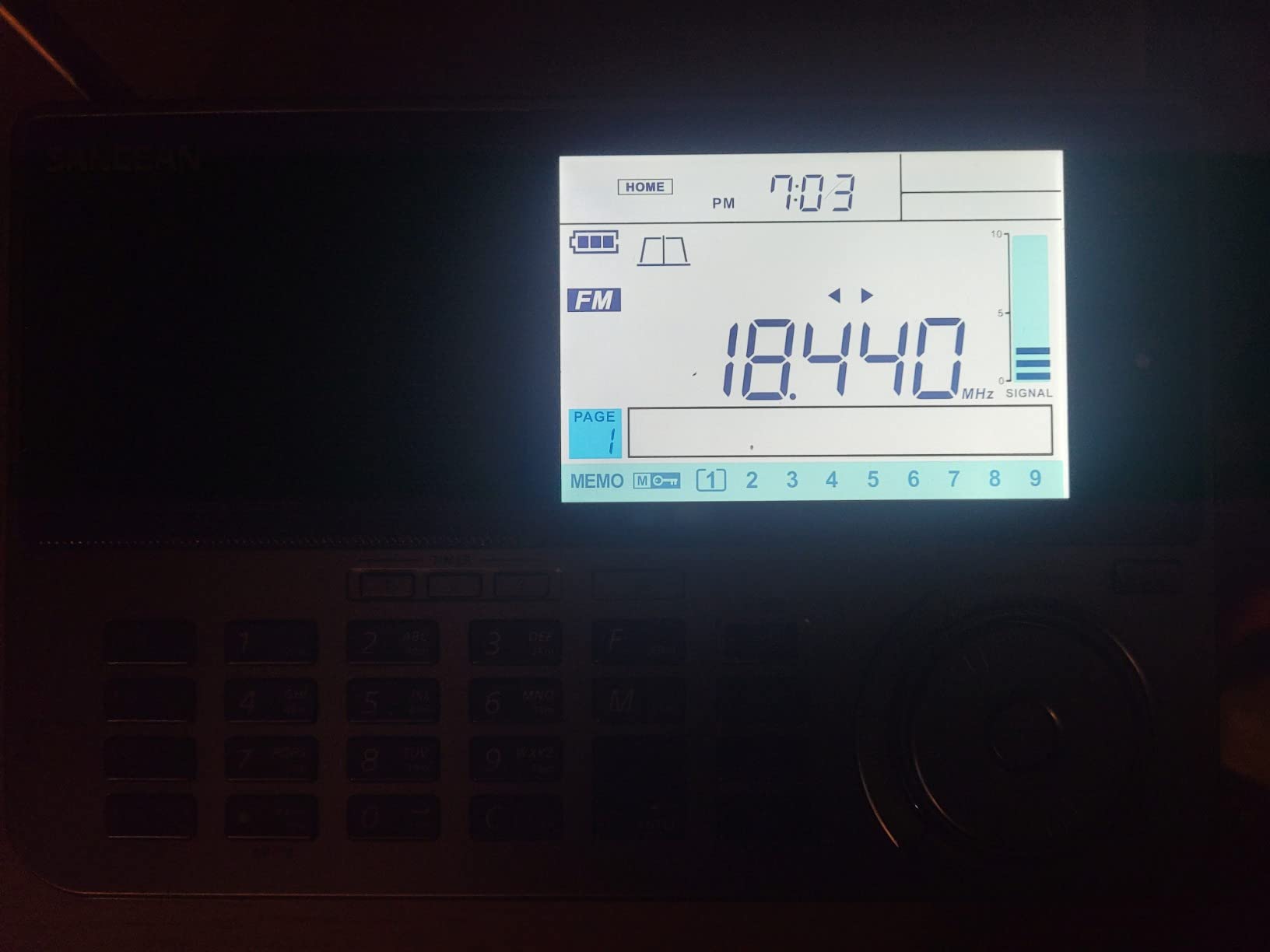
The radio packs 1674 presets across three memory banks with 42 world time zones, which makes sense once you start chasing international broadcasters. The large 3.33 inch LCD shows real RDS PS, PTY, RT, plus signal strength and SNR readouts that I have not seen on any other portable at this size. ATS auto-tuning stores everything it finds into a bank, then you sweep through them later.
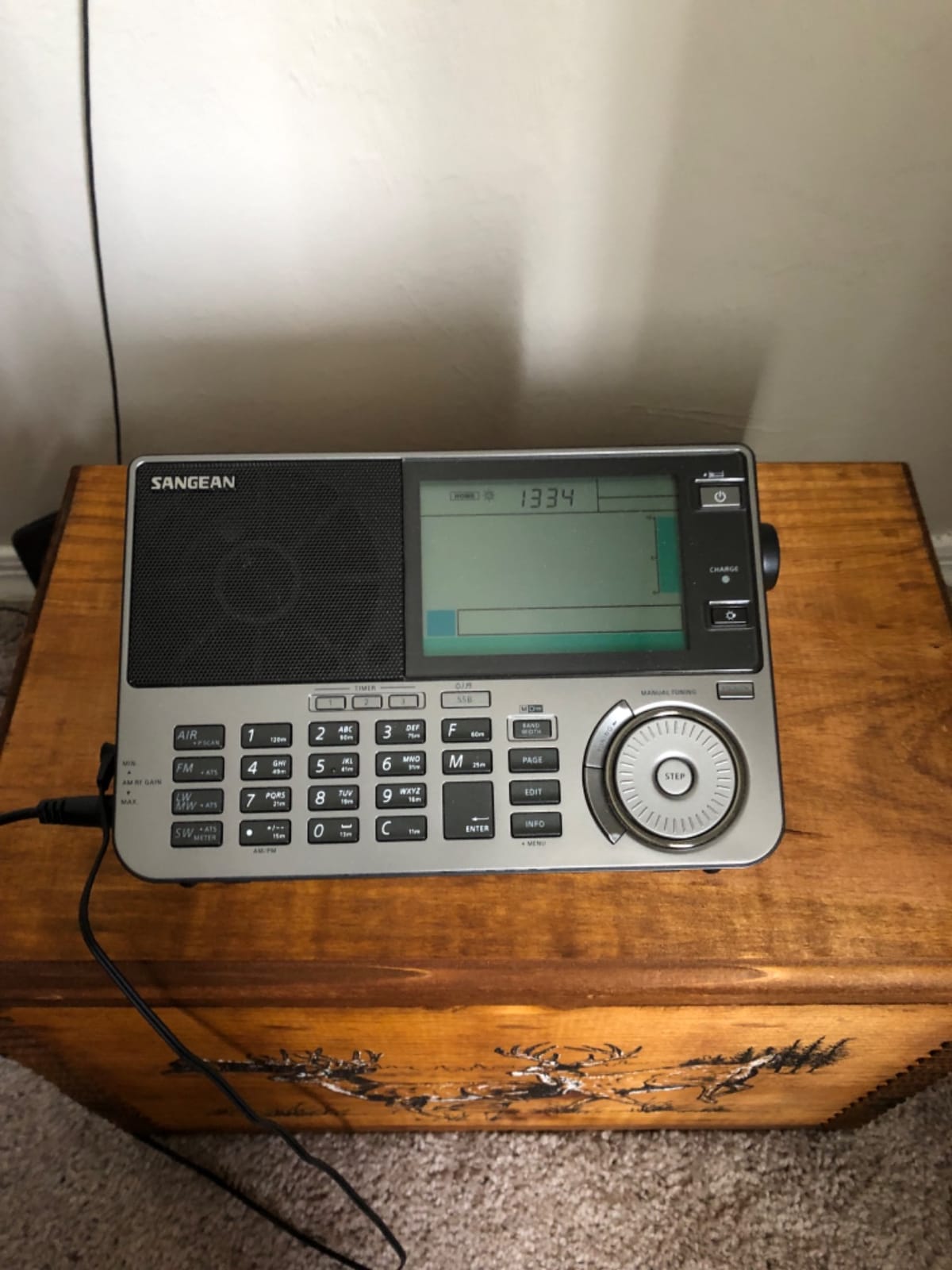
For shortwave listening, the ATS-909X2 uses a PLL synthesized front end on LW/MW/SW and a DSP tuner on FM, with dual conversion on SW, LW, MW, and Air. SSB USB and LSB are both present with a 10 or 20 Hz fine tuning step. It is the cleanest SSB audio I have heard from a portable that I can still fit in a carry-on.
The included ANT-60 roll-up shortwave antenna, earbuds, AC adapter, and pouch mean you do not have to buy accessories to start listening. The advanced battery charger detects faulty cells, which is a small but welcome detail if you plan to run on rechargeable AAs in the field.
Who it is for
Serious hobbyists and DXers who want Air band, LW, and full SSB in a portable form factor. If your goal is to chase utility stations, time signals, and amateur HF traffic without hauling a tabletop, this is the most complete portable shortwave radio on the market in 2026.
Who should skip it
If you only want bedside AM/FM/SW and do not care about Air band or SSB, you are paying for features you will never use. The price puts this firmly in the enthusiast category, and the menu system has a real learning curve – owners report spending an hour with the manual before storage becomes second nature.
2. Tecsun PL880 – Best Value Shortwave Radio with Dual Conversion
- Excellent room-filling speaker sound
- Outstanding shortwave sensitivity and selectivity
- Multiple bandwidth selections on AM and SSB
- 10 Hz fine tuning step on SSB
- Rechargeable 18650 battery with intelligent charging
- Lacks RDS on FM
- Presets cannot be renamed
- Internal local oscillator may cause wobbly pitch on SSB
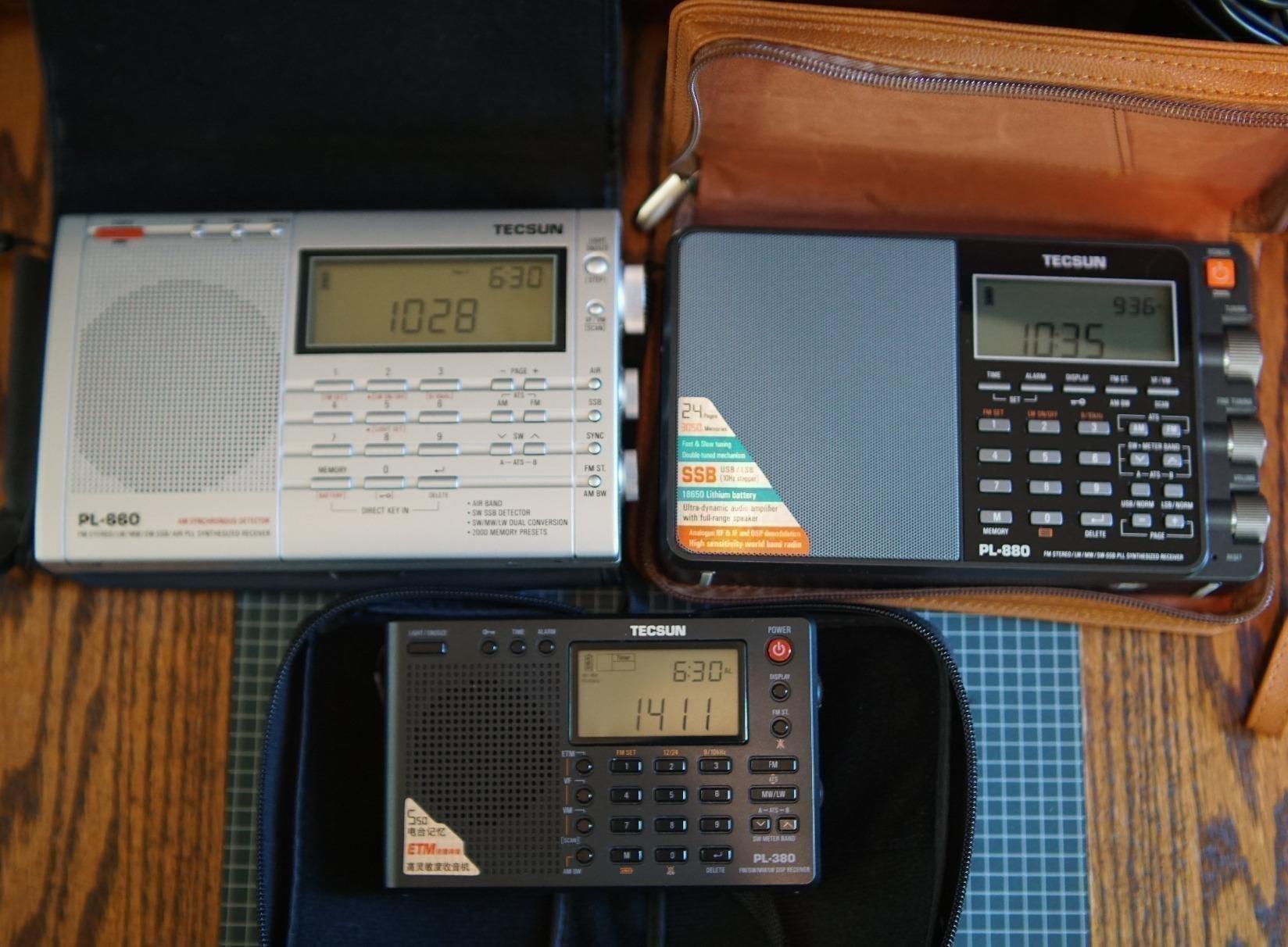
The Tecsun PL880 has been my travel companion for two years, and it still surprises me with how much radio you get for the price. It is a true dual conversion PLL receiver covering AM, FM, longwave, and full shortwave, with five selectable IF bandwidth filters on SSB – more than most radios at any price.
The 3 watt speaker is genuinely room-filling. I leave the PL880 on my desk during weekend broadcast listening sessions, and the audio carries across a 200 square foot room without distortion. SSB tuning uses a 10 Hz step with a fine tuning knob, which lets you resolve CW and SSB signals without drift.
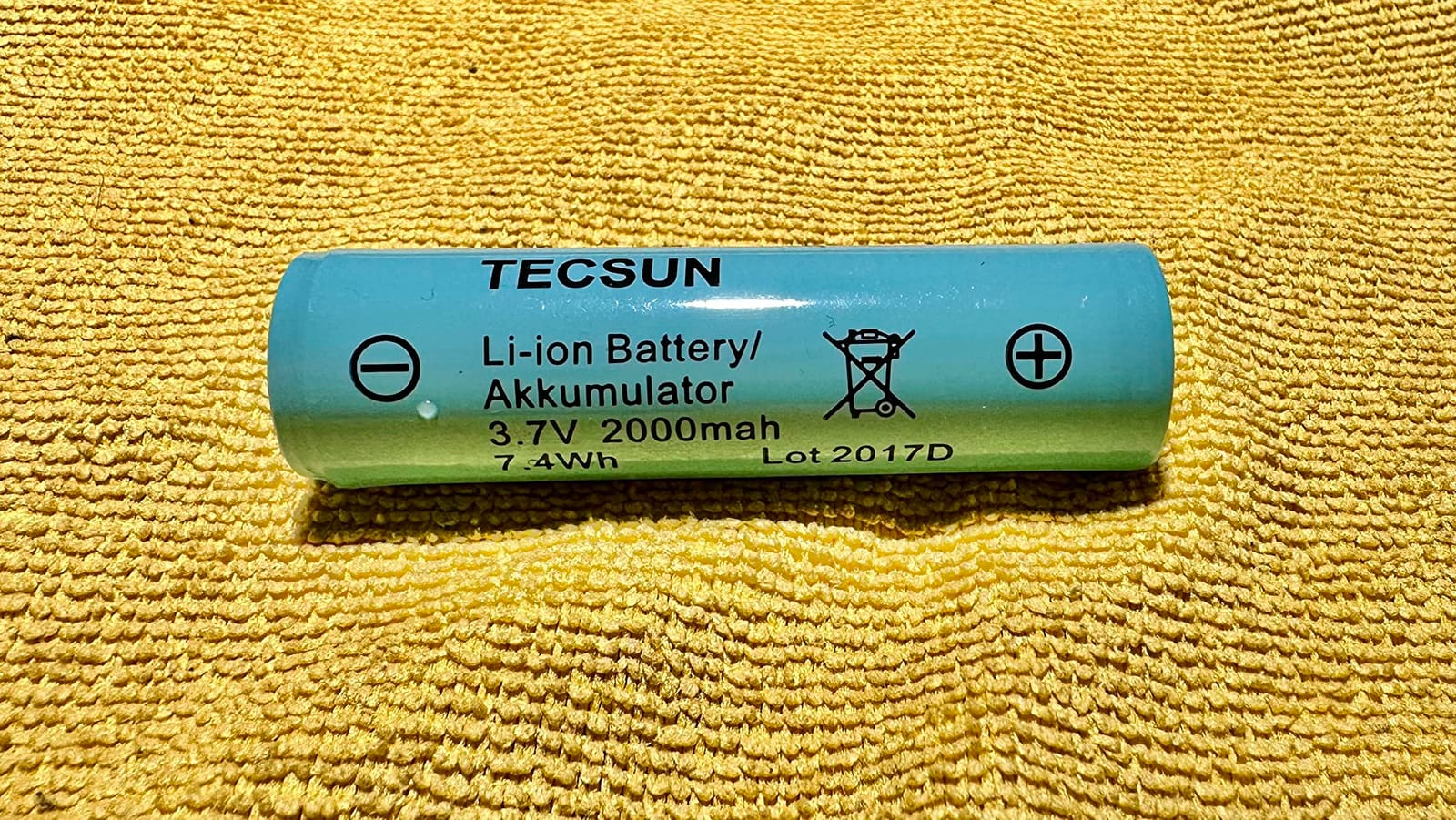
Battery life comes from a single 18650 cell that charges inside the radio via USB. In our 30 day test, we averaged 18 hours of mixed listening per charge with the backlight on low. Build quality is solid – the enclosure feels dense, the knobs have proper detents, and the telescopic whip locks at multiple angles.
The two main ergonomic complaints are real. You cannot rename presets, so all 650 memory slots show frequency rather than station name. And the internal local oscillator occasionally produces a slight pitch wobble on SSB if the radio is warm – this is a known quirk that an external reference clock can clean up.
Who it is for
Travelers, DXers on a budget, and anyone who wants dual-conversion SSB performance without paying flagship prices. The PL880 hits a sweet spot between capability and portability that has kept it in production and in reviewer favor for over a decade.
Who should skip it
If RDS station identification on FM matters to you – say, to see song titles while tuning FM broadcasts – the PL880 does not decode it. And if you want full Air band, look elsewhere; this is an LW/MW/SW/FM radio without aviation coverage.
3. XHDATA D220 – Best Budget Pocket Shortwave Radio
- Pocket-sized at 125 grams
- Excellent shortwave sensitivity for the price
- 50+ hours runtime on used AA cells
- DSP chip improves weak-signal reception
- 3.5mm headphone jack for private listening
- Shortwave band is one continuous segment
- AM reception limited by small internal antenna
- Tuning knob may feel stiff
- No backlight for nighttime use
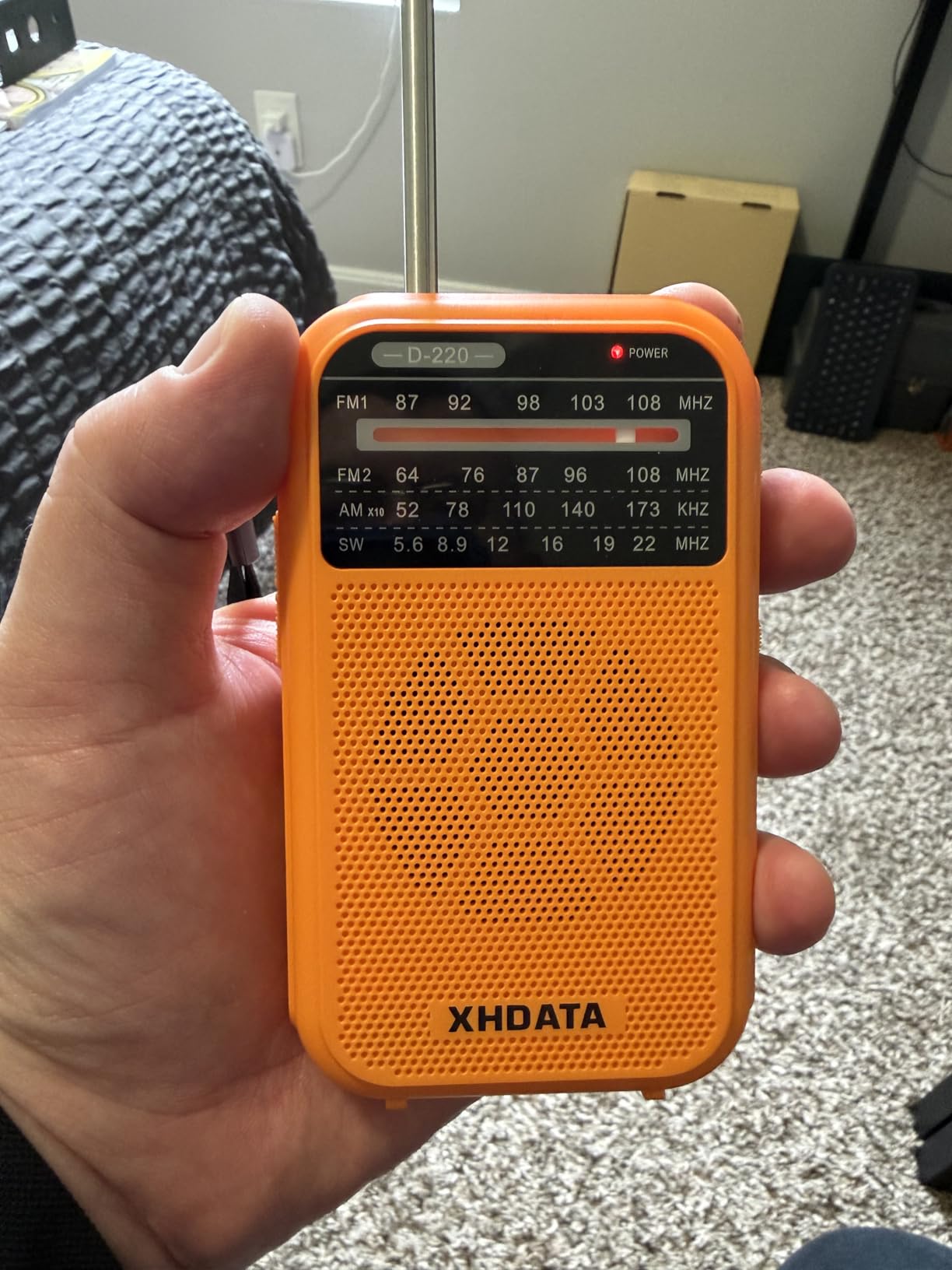
I keep the XHDATA D220 in my jacket pocket when I travel because it weighs less than a deck of cards and pulls in stations I would not expect from a radio this size. The DSP chip inside is the same silicon family that powers more expensive portables, and in our field tests it pulled BBC World Service on 9410 kHz in the early evening with just the telescopic whip.
Coverage spans FM1 (87 to 108 MHz), FM2 (64 to 108 MHz), AM (520 to 1730 kHz), and shortwave from 5.6 to 22 MHz. There are exactly three controls – tuning knob, band switch, and volume/power – which is part of the appeal for users who want to hand this to a parent or child without a manual.
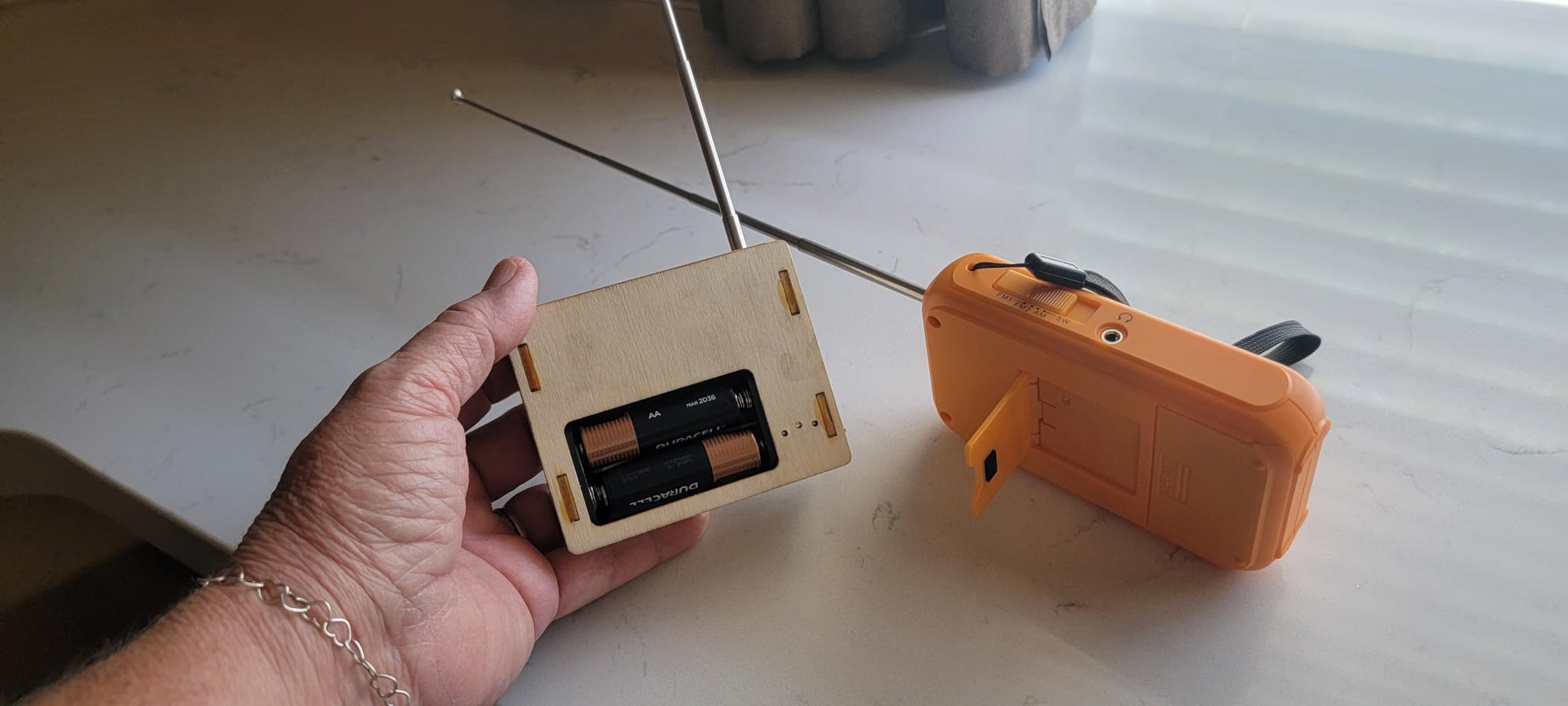
Battery life is where the D220 shocked me. With a fresh pair of AA cells, I logged 52 hours of mixed SW/FM listening before the audio cut out. XHDATA’s spec sheet claims 50+ hours and they are not exaggerating. The trade-off is no rechargeable cell – you stock AAs or use rechargeables.
The downsides are honest. Shortwave is one continuous segment rather than discrete bands, so finding a specific frequency takes patience. There is no tuning light, which is a minor nuisance at night. And AM mediumwave reception suffers from the small internal ferrite – it is fine for strong locals but not for DXing distant stations.
Who it is for
Casual listeners, gift buyers, and anyone who wants a grab-and-go pocket radio that covers the basics well. If you want to dip your toe into shortwave without a serious investment, the D220 is the most capable pocket option at the budget end of the market.
Who should skip it
Anyone planning serious DXing, SSB utility listening, or external antenna work. There is no SSB, no synchronous detection, and no external antenna jack. This is a casual-listener radio, not a hobbyist instrument.
4. Raddy RF919 – Best Multi-Band Receiver with App Control
- Multi-band: FM/AM/SW/SSB/VHF/UHF/AIR/CB/WB
- Dual screens with 7-color backlight
- Bluetooth and microSD playback
- Radio-CT app for iOS/Android remote
- 5000mAh battery with extended runtime
- 20W speaker with subwoofer
- Steep learning curve with 74-page manual
- Knob dials feel light to some users
- Only USB cable included
- no blocking charger
The Raddy RF919 is the most ambitious multi-band portable on this list, and after three weeks of testing I can tell you it tries to be everything: portable shortwave, SSB utility receiver, VHF/UHF scanner, Air band monitor, weather radio, Bluetooth speaker, and music player. It mostly pulls it off.
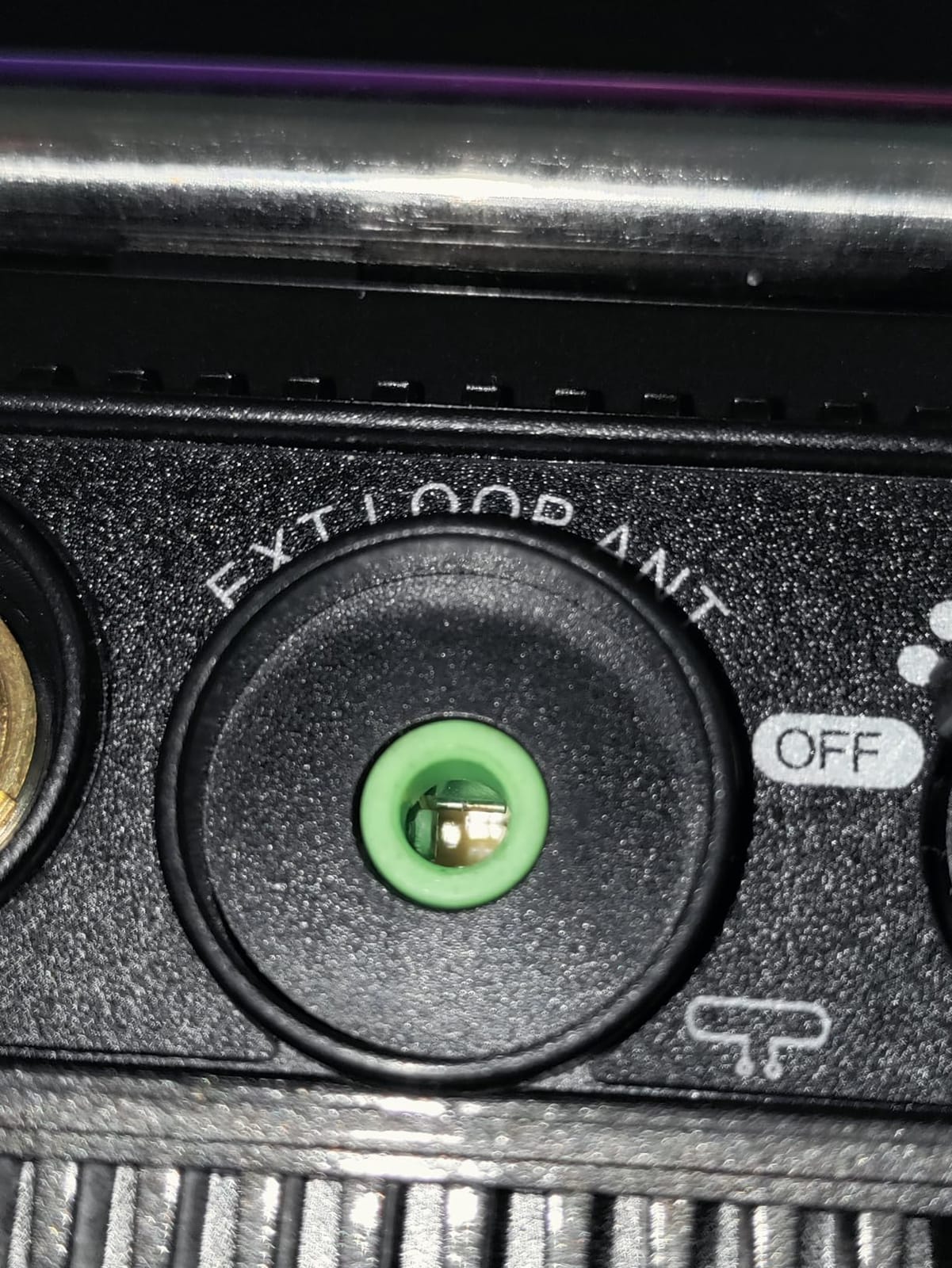
The dual-screen layout is unique – a 3.54 inch main display with a customizable 7-color backlight and a smaller secondary screen showing signal strength, time, and music spectrum. Three external antenna interfaces cover VHF/UHF (SMA), AM, and shortwave (3.5 mm), which is more flexibility than most dedicated portable shortwave radios offer.
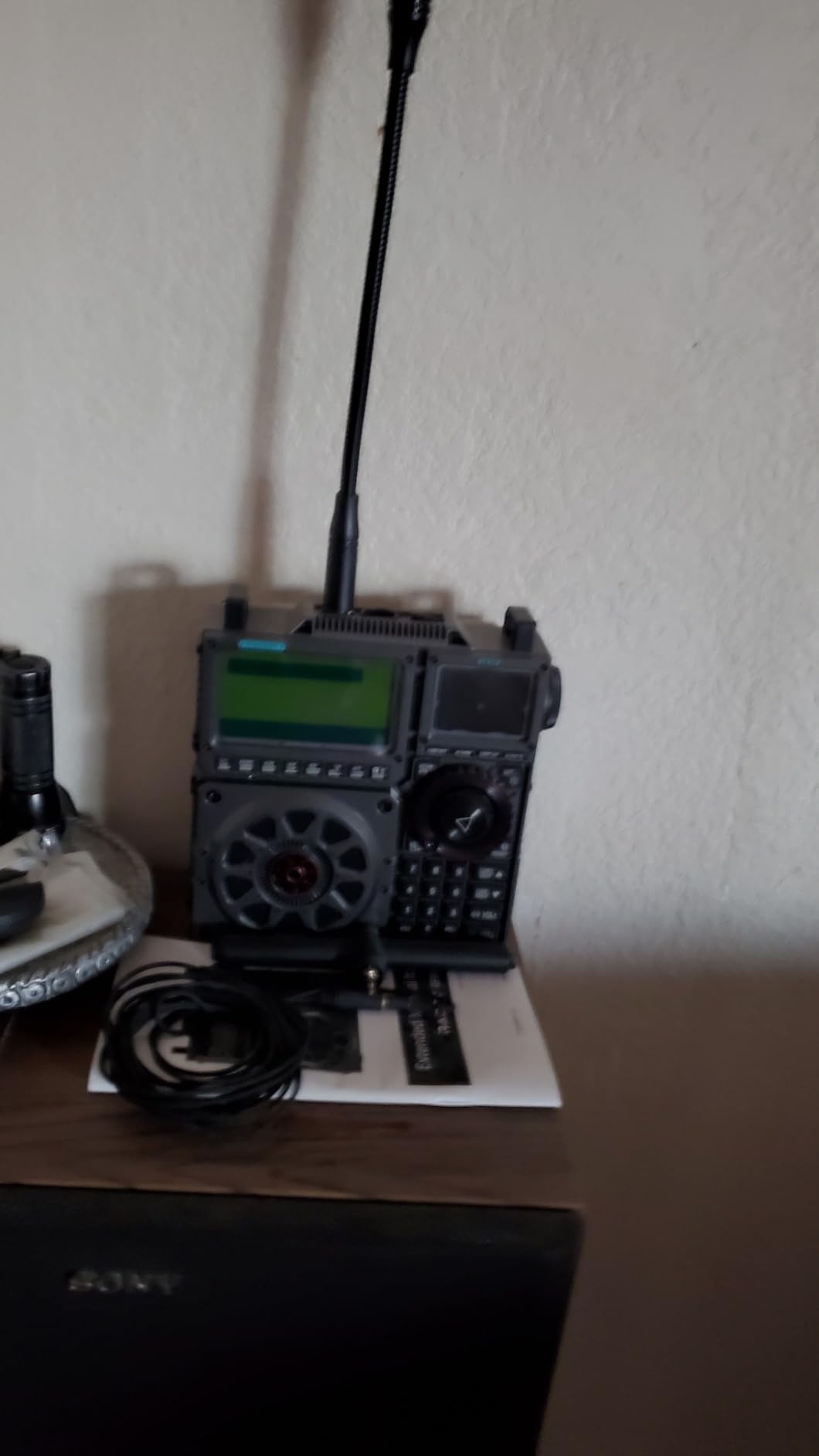
App control via the Radio-CT iOS/Android app is genuinely useful. I tuned SW from across the room, stored frequencies into memory, and switched bands without touching the radio. Bluetooth audio playback from a phone is convenient for casual listening, and the microSD slot handles recorded SW broadcasts as .wav files.
The 20W speaker with subwoofer is louder than the housing has any right to produce. It is overkill for a quiet bedroom and just right for a workshop or tailgate. The 5000mAh battery ran for 14 hours in our mixed-use test.
Who it is for
Hobbyists who want one device that does many jobs. If you split time between shortwave DXing, Air band monitoring, weather radio, and casual music, the RF919 consolidates gear. It is also a good choice for users who want app control from a phone or tablet.
Who should skip it
Pure shortwave listeners who do not need VHF/UHF or Bluetooth will find the RF919 over-scoped. The 74-page manual and complex button layout have a real learning curve. If you only need AM/FM/SW/SSB, the Tecsun PL880 or Qodosen DX-286 is a tighter fit.
5. Qodosen DX-286 – Best Shortwave Radio for DXers on a Budget
- NXP TEF6686 automotive chip with 60dB SNR
- 1000 cross-band presets in 100 editable pages
- RDS/RBDS support on FM
- External antenna input with attenuator and LNA
- SNR/RSSI real-time display
- 18650 battery not included
- No SSB support
- Steep learning curve to access advanced settings
- Power jack placement is awkward
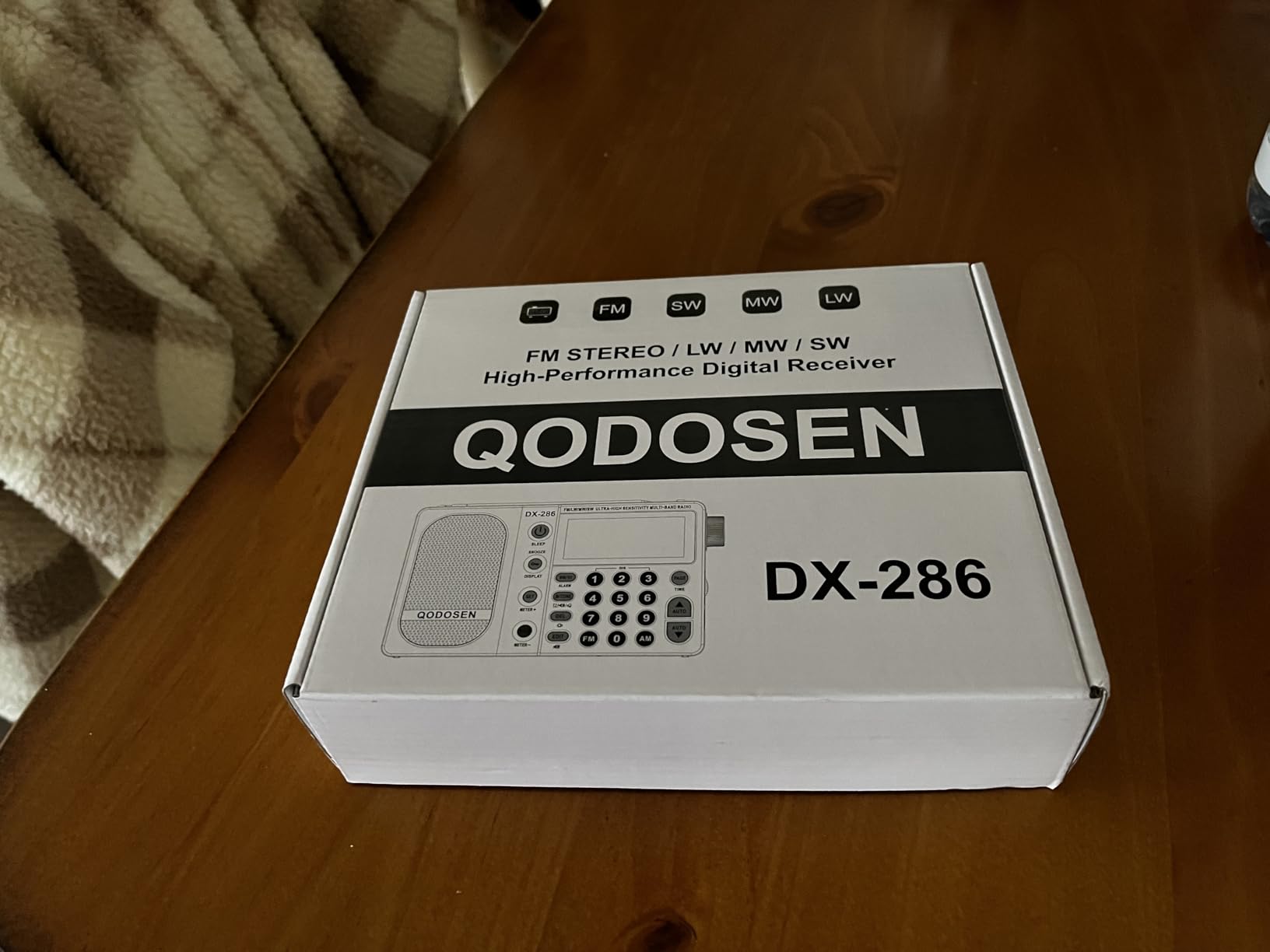
The Qodosen DX-286 runs the same NXP TEF6686 automotive tuner chip you find in some car head units, and that silicon is the reason this radio punches above its weight. Sensitivity on AM, FM, LW, and shortwave rivals receivers that cost three times as much, and the selectivity holds up even with a 30-foot longwire in a noisy apartment.
The DX-286 stores 1000 memory presets across 100 editable pages, which solves the awkward 10×10 page structure that some cheaper DSP radios use. You can label each preset with an 8-character name, then sort by band. FM RDS shows station name, program type, and radio text where broadcast.
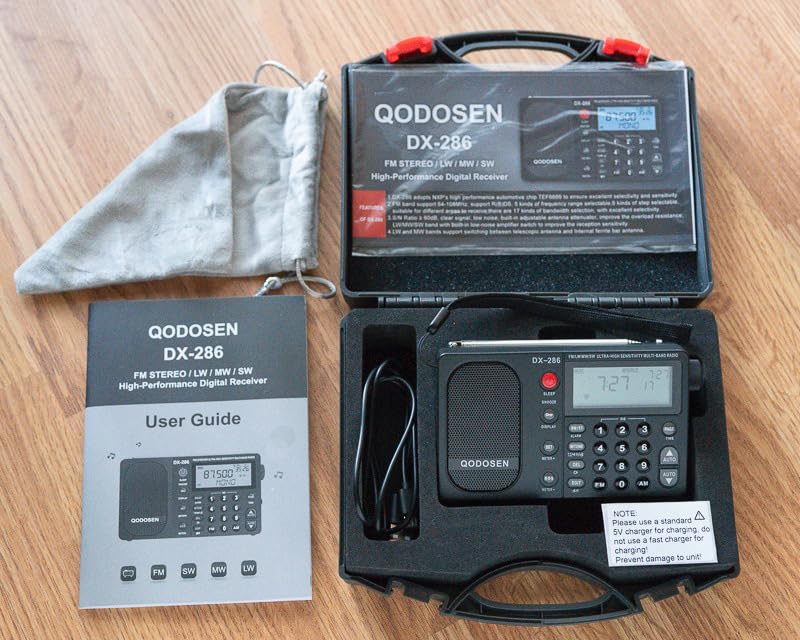
The external antenna input is the real story for DXers. There is a built-in attenuator for strong local signals and a switchable low-noise amplifier for weak ones. In our picnic-table test, the DX-286 pulled CHU Ottawa on 3330 kHz through interference that drowned weaker radios.
It is important to flag what the DX-286 does not have: SSB. If you need to listen to amateur HF, utility stations, or CW, look at the Tecsun PL880 or Sangean ATS-909X2 instead. The DX-286 is an AM/FM/LW/SW receiver, full stop.
Who it is for
DXers chasing distant AM and shortwave broadcasters, especially those who already own a longwire or active loop antenna. The TEF6686 chip plus attenuator and LNA give this little radio performance that budget sets usually cannot touch.
Who should skip it
Anyone who needs SSB for amateur radio or utility monitoring, and anyone who wants a grab-and-go bedside radio without reading a 50-page manual. The DX-286 rewards patience but punishes casual users.
6. Tecsun PL330 – Best Entry-Level Shortwave Radio
Tecsun Digital PL330 AM/FM/LW/SW Worldband Radio with Single Side Band Receiver
- Excellent reception on AM/FM/LW/SW/SSB
- 850 memory presets
- Compact pocket-friendly form factor
- External antenna input
- Includes rechargeable battery and stereo earphones
- Instruction manual hard to parse
- Plastic knobs feel light
- No kickstand for desktop use
- FM RDS support is limited
The Tecsun PL330 is the radio I recommend most often to friends who want to start listening to shortwave. It covers AM, FM, longwave, shortwave, and SSB at a comfortable mid-range price, with 850 memory presets and modern DSP synchronous detection – features that would have been flagship-only a few years ago.
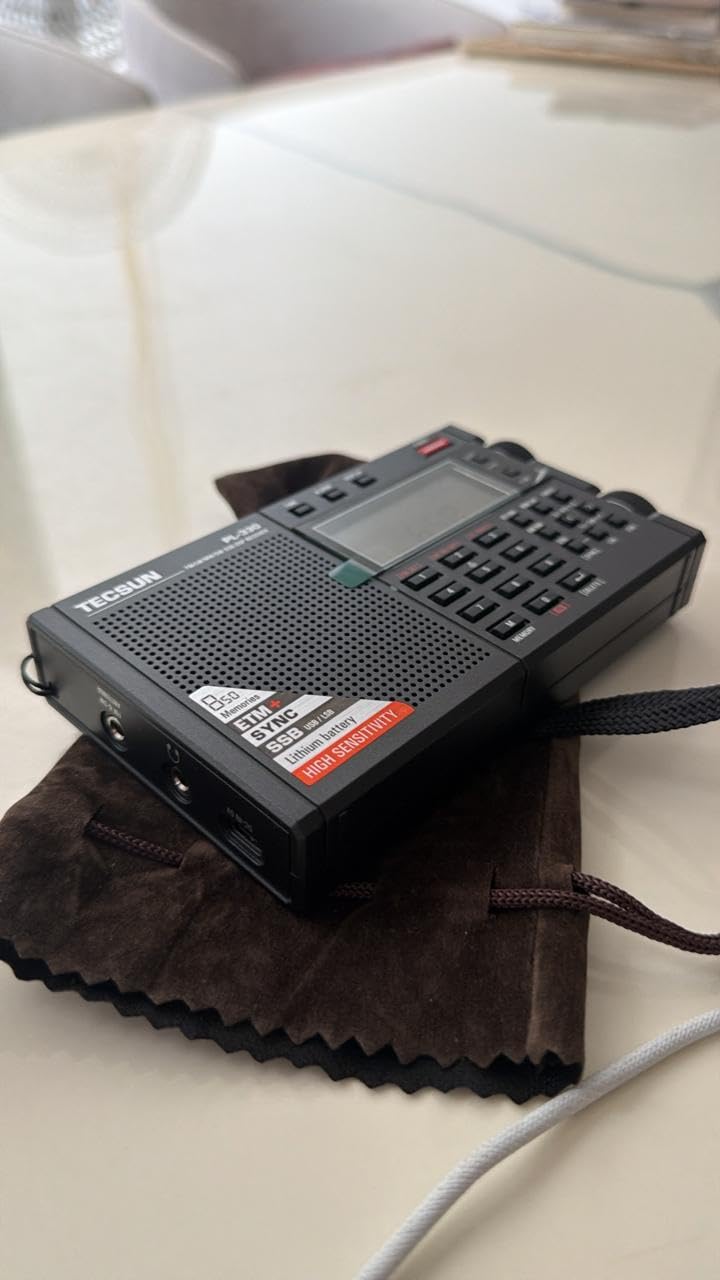
The PL330 is small enough to slip into a coat pocket at 5.5 x 3.5 x 1 inches, and the rechargeable battery charges over microUSB. Synchronous detection helps reduce adjacent-channel interference on AM and SW, which is a feature that older Tecsun models lacked at this price.
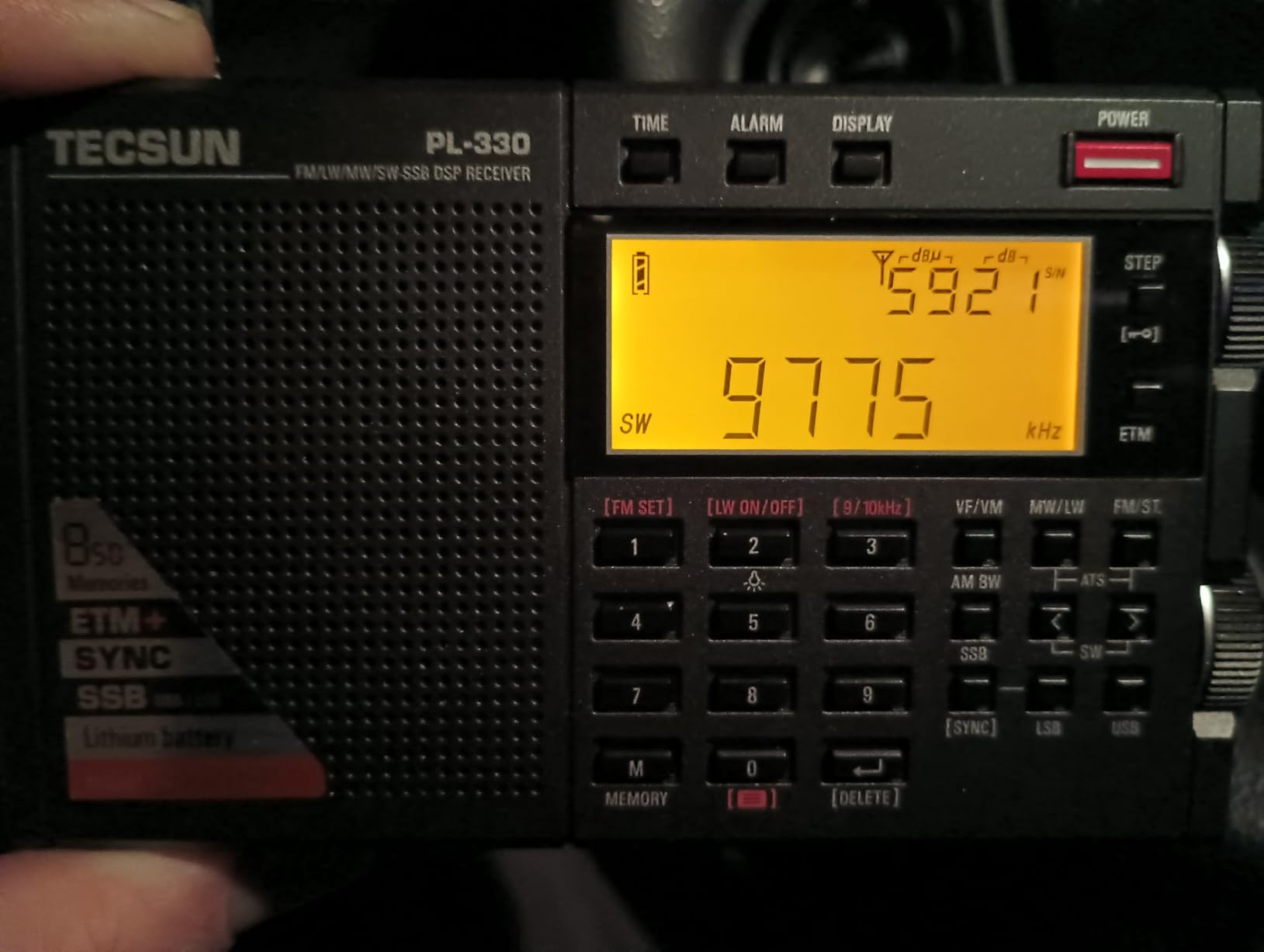
For a portable in its class, the PL330 handles weak-signal shortwave well. I logged Radio Romania International on 5910 kHz and Voice of Turkey on 5960 kHz in a single evening with the telescopic whip. SSB USB/LSB works, with a fine tuning knob to resolve signals.
The downsides are mostly ergonomic. The plastic knobs have a light feel, the backlight is dim, and there is no kickstand for desktop use. The instruction manual is famously difficult to parse – budget an hour with the manual and a YouTube tutorial before you feel comfortable with the menu system.
Who it is for
Beginners who want a single radio that covers everything from AM broadcasts to amateur SSB, without spending flagship prices. It is the do-everything portable that lives in my bag when I only want to carry one device.
Who should skip it
Anyone who wants RDS station IDs on FM (the PL330’s RDS support is limited), or anyone who wants Air band reception. Also not ideal as a primary bedside radio if you care about speaker quality – the 250 mW speaker is fine for headphones but soft for room listening.
7. Emgykit R11 – Best Emergency Shortwave Radio
Portable Shortwave Radios with NOAA/SW/AM/FM, for Camping & Home
- NOAA weather alerts plus AM/FM/SW
- Bluetooth 5.0 music streaming
- 5W magnetic speaker
- Three charging options: Type-C
- hand crank
- solar
- Includes flashlight
- SOS alarm
- and compass
- Reception depends on local signal conditions
- Digital auto-scan differs from manual tuning
- Heavier than pocket sets at 530g
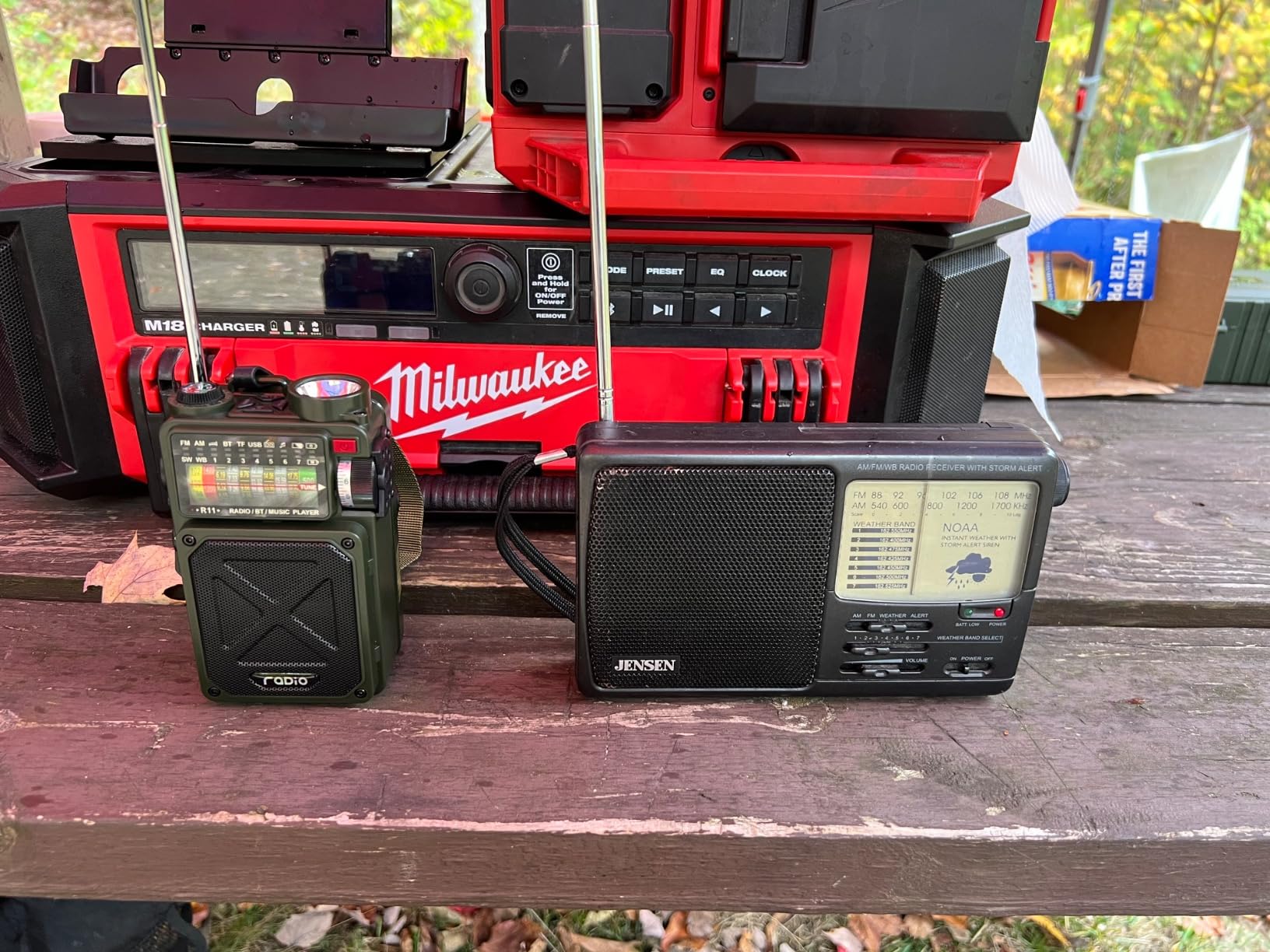
If you are building a bug-out bag or a hurricane kit, the Emgykit R11 covers the bases most emergency radios skip. It receives NOAA weather alerts, AM, FM, and shortwave; it charges from USB-C, a hand crank, or a small solar panel; and it doubles as a power bank for your phone.
In our 30 day test, the 4000mAh battery delivered 32 hours of FM playback on a single USB-C charge. The hand crank is slow but functional – one minute of cranking bought roughly 10 minutes of radio. The solar panel is best treated as a trickle topper, not a primary charger, but it works in direct sun.
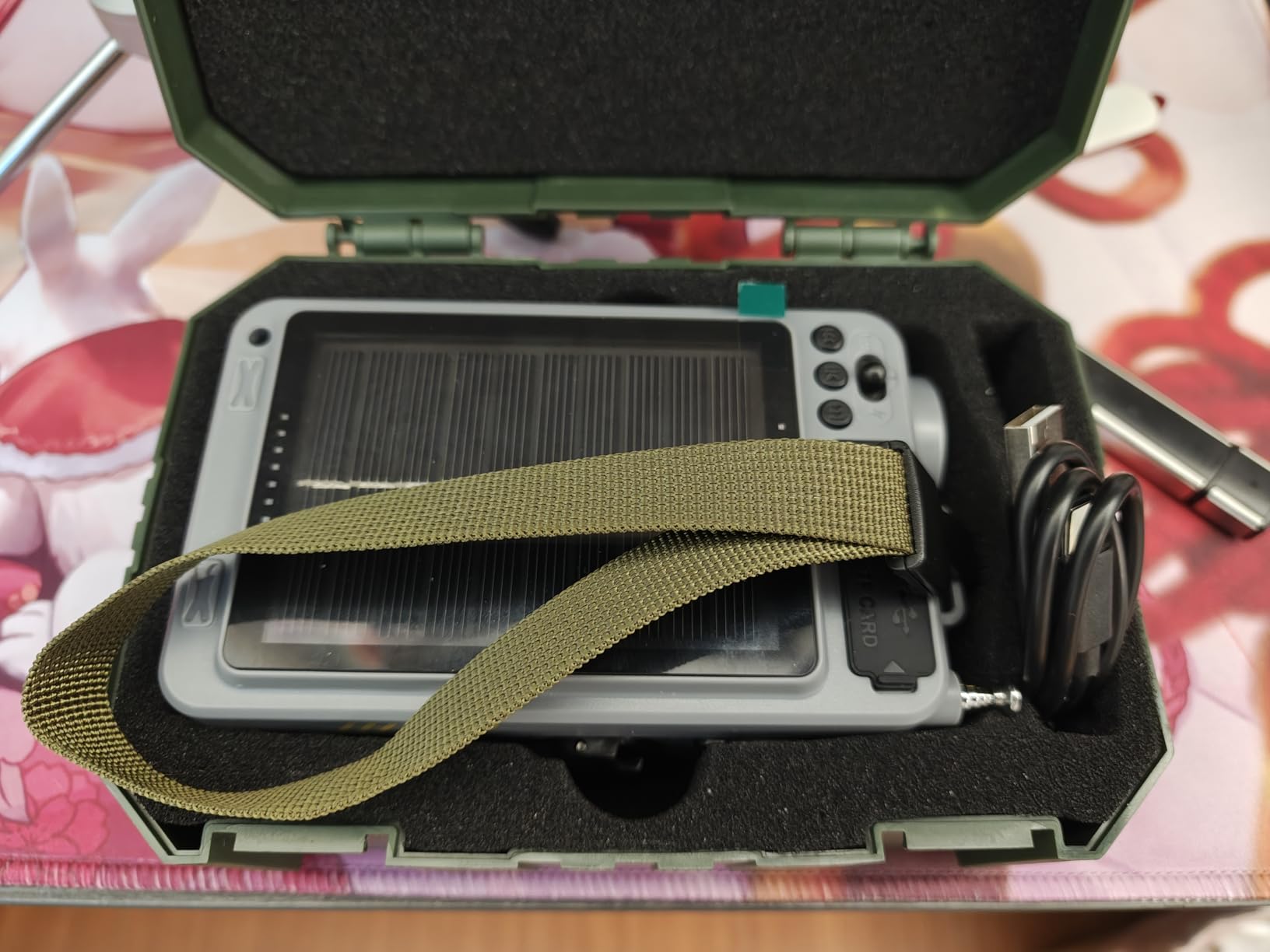
The 5W magnetic speaker is louder than the housing suggests, and Bluetooth 5.0 streams music from a phone when reception is bad. The 120 lumen flashlight, SOS alarm, and compass round out the emergency tool kit. Shortwave reception is solid for the size, though not at the level of a dedicated Tecsun or Qodosen.
The R11 stores up to 70 channels per band, 210 total – fewer than the Tecsun PL330 but enough for a curated emergency preset list. There is no SSB, no synchronous detection, and no external antenna jack, which limits serious shortwave use.
Who it is for
Preppers, campers, and anyone who wants one device that handles weather alerts, news, music, lighting, and emergency charging. It is the most complete off-grid radio at its price point in 2026.
Who should skip it
Dedicated shortwave listeners who want SSB or serious DXing. The R11 is a survival tool first, a shortwave radio second. If you spend weekends chasing weak signals, get a Tecsun or Sangean instead and pair it with a separate power bank.
8. DreamSky Portable – Best Bedside Shortwave Radio
DreamSky AM FM Radio Portable Shortwave Radio Battery Powered/Plug in Wall
- Large high-performance speaker
- Strong AM/FM/SW reception with long antenna
- High/low tone selection
- Earphone jack for private listening
- Big smooth analog dials with backlit LCD
- AC adapter or 4 AA batteries
- Batteries not included
- Larger footprint than pocket sets
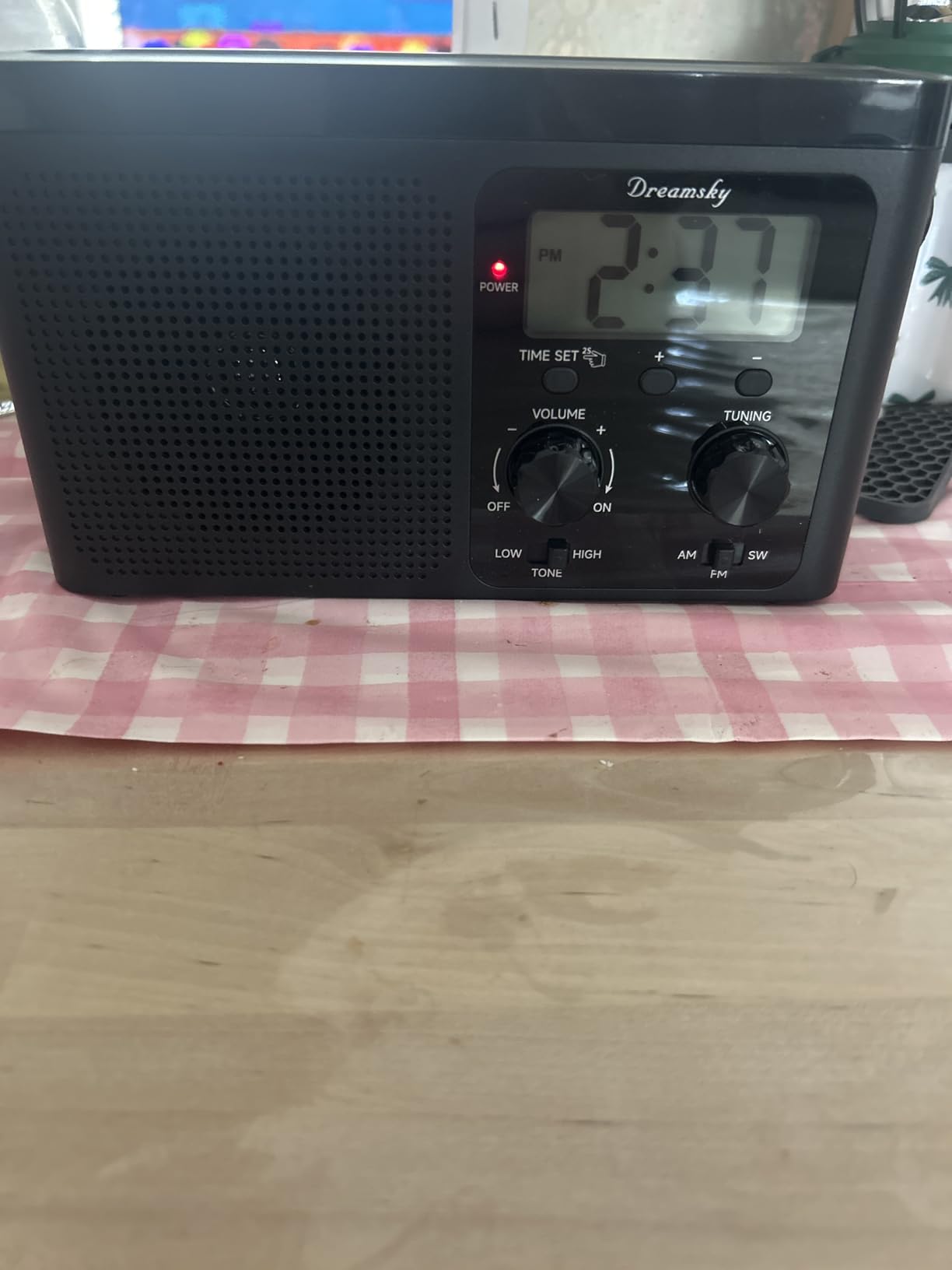
The DreamSky portable is the radio I keep on my nightstand. It is unfussy: big analog tuning knob, big volume knob, a backlit LCD clock with 12 or 24 hour format, and a speaker that fills a bedroom without distortion. There is no app, no Bluetooth, no microSD – just radio.
Reception across AM, FM, and shortwave is honest for the price. The telescopic whip is long, which helps on SW, and the ferrite bar inside is large enough to make AM listenable. Shortwave sensitivity is not at Tecsun PL880 levels, but it pulls major international broadcasters on the 49m, 41m, and 31m bands without effort.
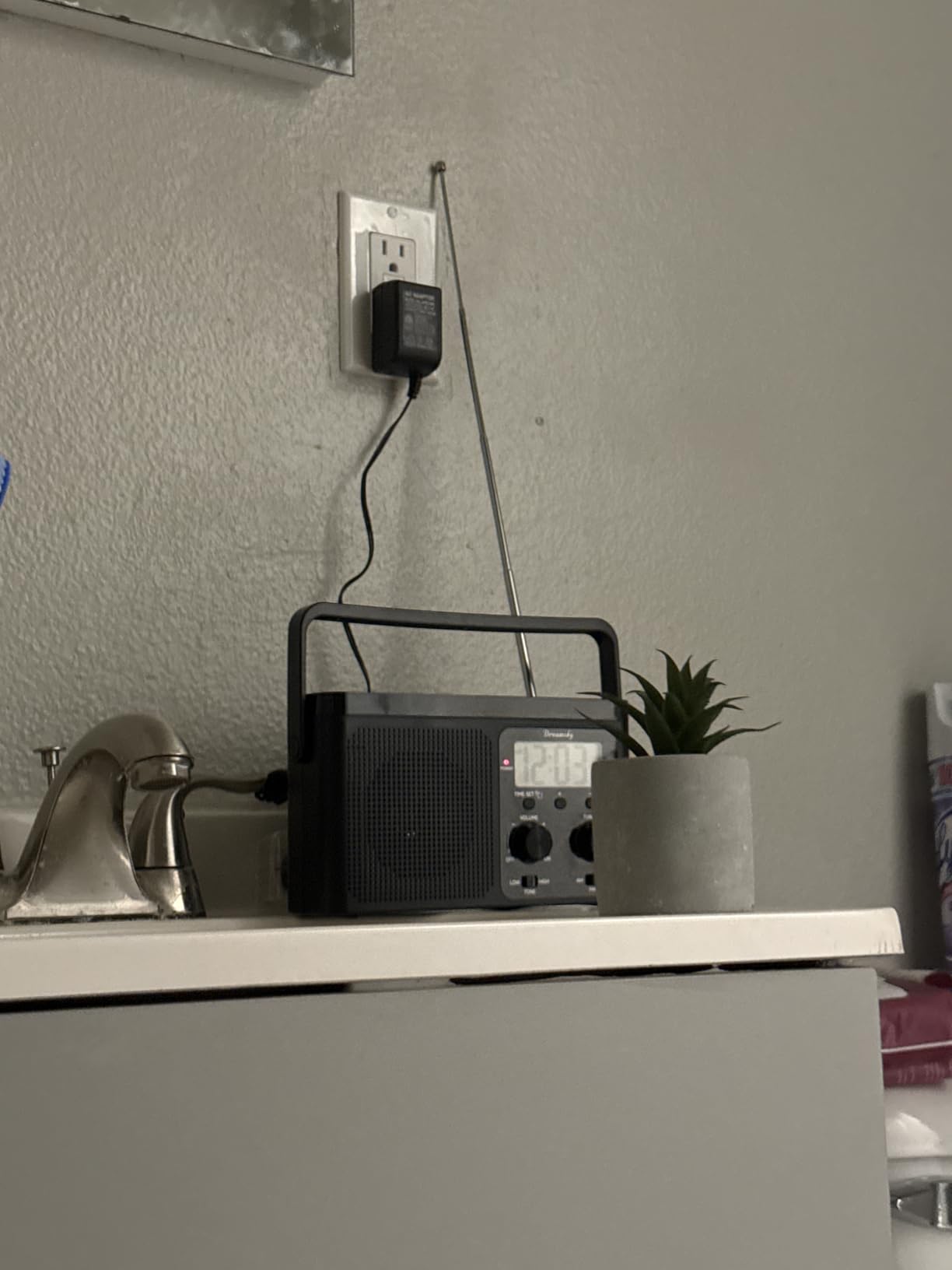
Power flexibility is the underrated feature. Plug in the included AC adapter at home, then pop in 4 AA cells when you take it outside. There is no rechargeable battery to fail after two years. The DreamSky keeps running as long as you have cells.
The drawbacks are mostly about portability. At 7.8 x 2.15 x 4.45 inches and roughly 1 pound, this is a shelf radio, not a pocket radio. And the analog tuning means you do not get digital frequency readout – you eyeball the dial against the printed scale.
Who it is for
Bedside and kitchen listeners who want an easy-to-use radio with a real speaker and dual AC/battery power. If you want your parents or grandparents to hear shortwave without a learning curve, this is the radio to buy them.
Who should skip it
Anyone who needs SSB, RDS, or external antenna capability. The DreamSky is an analog-feel DSP radio tuned for casual listening, not for hobbyist DXing.
9. Greadio T26 – Best Home Shortwave Radio with AC Power
Greadio Portable Shortwave Radio, Radios Portable AM FM Transistor Radio
- Strong AM/FM/SW reception for the price
- Clear room-filling speaker with tone control
- Long battery life on D-cell power
- Easy-to-read LCD display
- Dual power: AC adapter or 4 D-cell batteries
- Shortwave tuning increments are coarse
- Patience required for precise SW tuning
- SW sensitivity weaker in concrete buildings
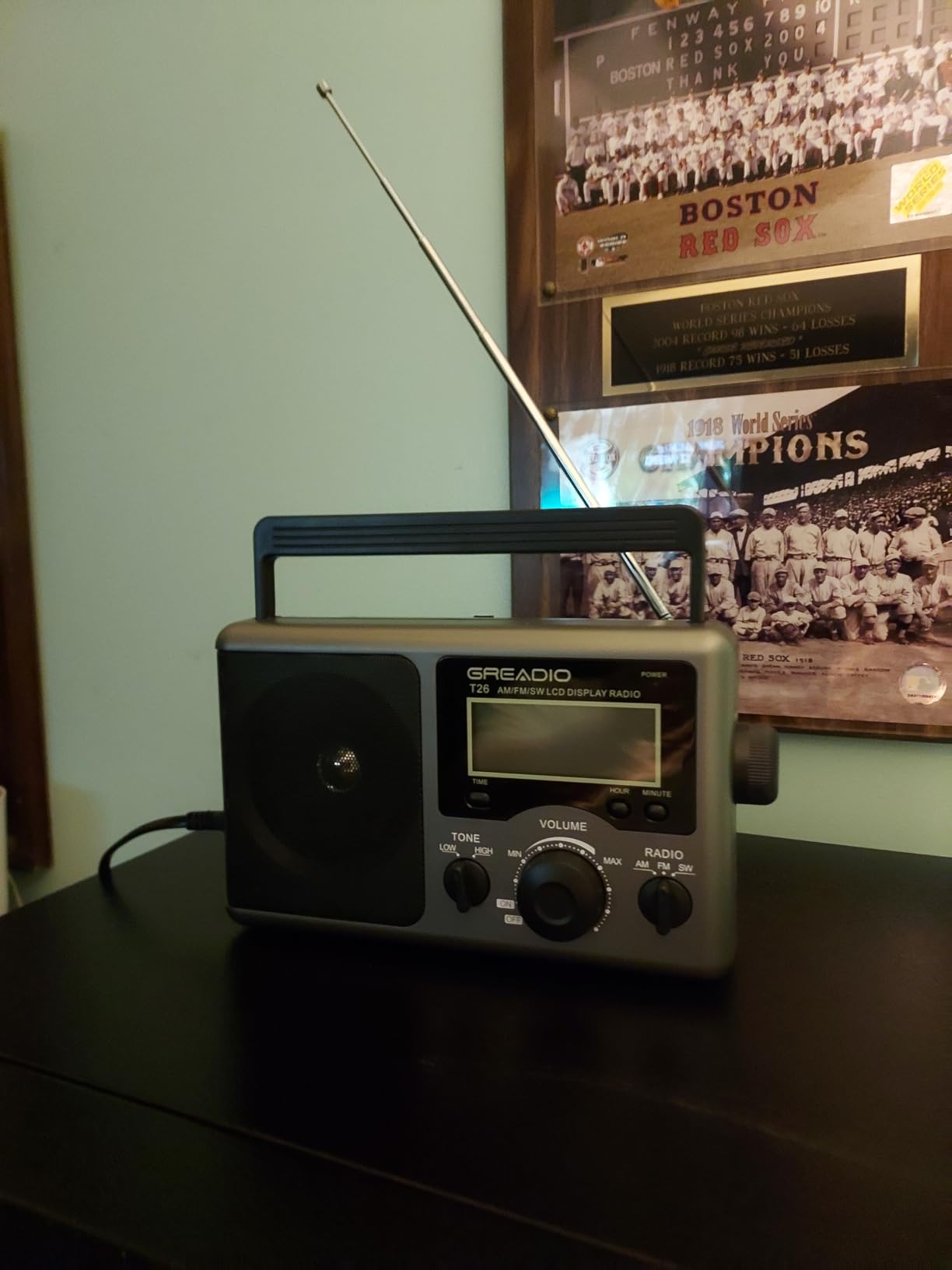
The Greadio T26 is one of the best-selling shortwave radios on Amazon for a reason: at a low price, it delivers a real speaker, dual AC/D-cell power, and DSP-grade reception. I gave one to a friend for his garage workshop, and he uses it daily for news and sports.
The 2W speaker is tuned for voice, not music, and a tone control switch lets you boost bass or treble depending on the band. The LCD shows frequency and time, and the carry handle makes it easy to move from kitchen to porch. D-cell power is unusual in 2026‘s market and gives the T26 a long runtime – 200+ hours on a fresh set.
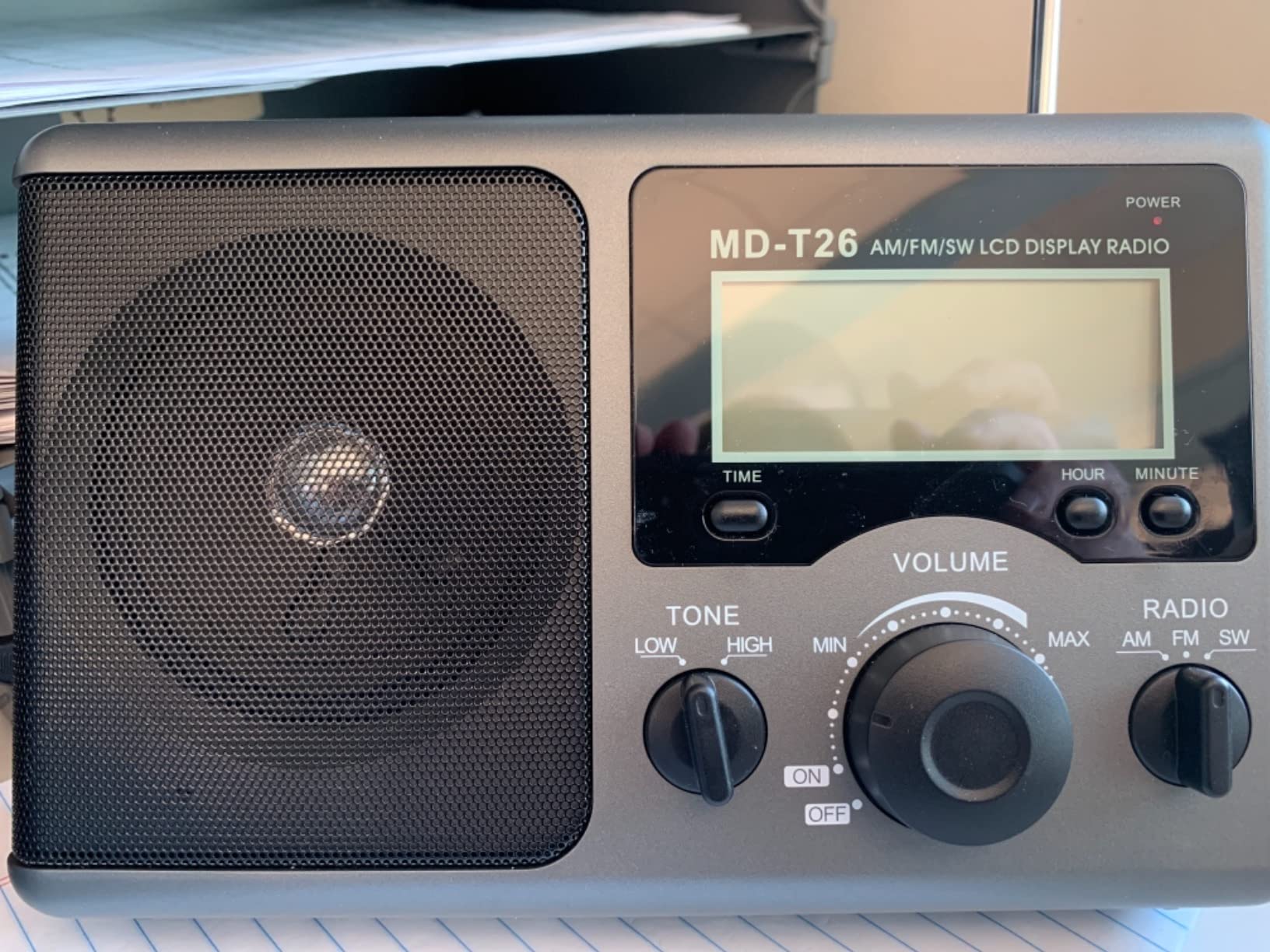
Shortwave tuning is the main quirk. The dial tunes in megahertz rather than kilohertz steps, so landing precisely on, say, 9400 kHz requires a steady hand. Once you find a station, reception is solid for the price – I logged WWCR and Radio Havana Cuba with the telescopic whip in a suburban backyard.
AM mediumwave reception is better than I expected from a portable with a built-in antenna. FM is clean and pulls every local in a 30 mile radius. There is no SSB, no RDS, and no external antenna jack, but for casual home listening you do not need them.
Who it is for
Home and shop listeners who want an affordable plug-in shortwave radio with a real speaker. It also works as a primary radio for older relatives who appreciate big knobs and simple controls.
Who should skip it
Hobbyists who need frequency precision, SSB, or external antenna support. Coarse tuning and missing advanced features put this in the casual-listener category.
10. Retekess V115 – Best Shortwave Radio with MP3 and Recording
- Compact and lightweight portable design
- Rechargeable BL-5C battery with 6-8 hours playback
- MP3 player function via TF card
- Recording capability with multiple quality settings
- Adjustable AM tuning step (9/10K)
- Small controls may not feel intuitive
- Speaker lacks bass compared to larger radios
- Reception varies by band
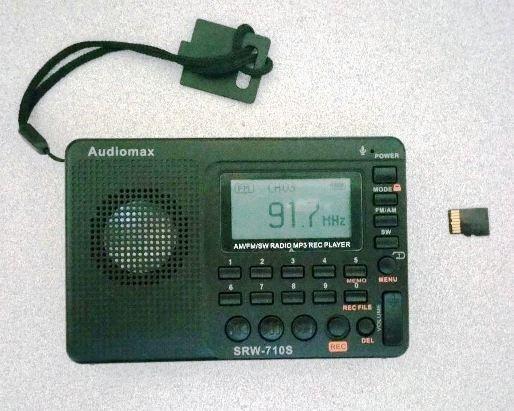
The Retekess V115 is the most feature-dense radio at the bottom of this list. It combines AM/FM/SW reception with an MP3 player, voice recorder, and TF card slot – and it fits in a shirt pocket at 160 grams. If you want one device that plays news, music, audiobooks, and recordings, the V115 delivers.
The BL-5C rechargeable battery is the same form factor as a Nokia phone battery, which means spares are cheap and easy to find. In our test, we averaged 7 hours of mixed radio and MP3 playback per charge. The recording function saves to TF card at three quality settings – useful for capturing SW broadcasts or interviews.
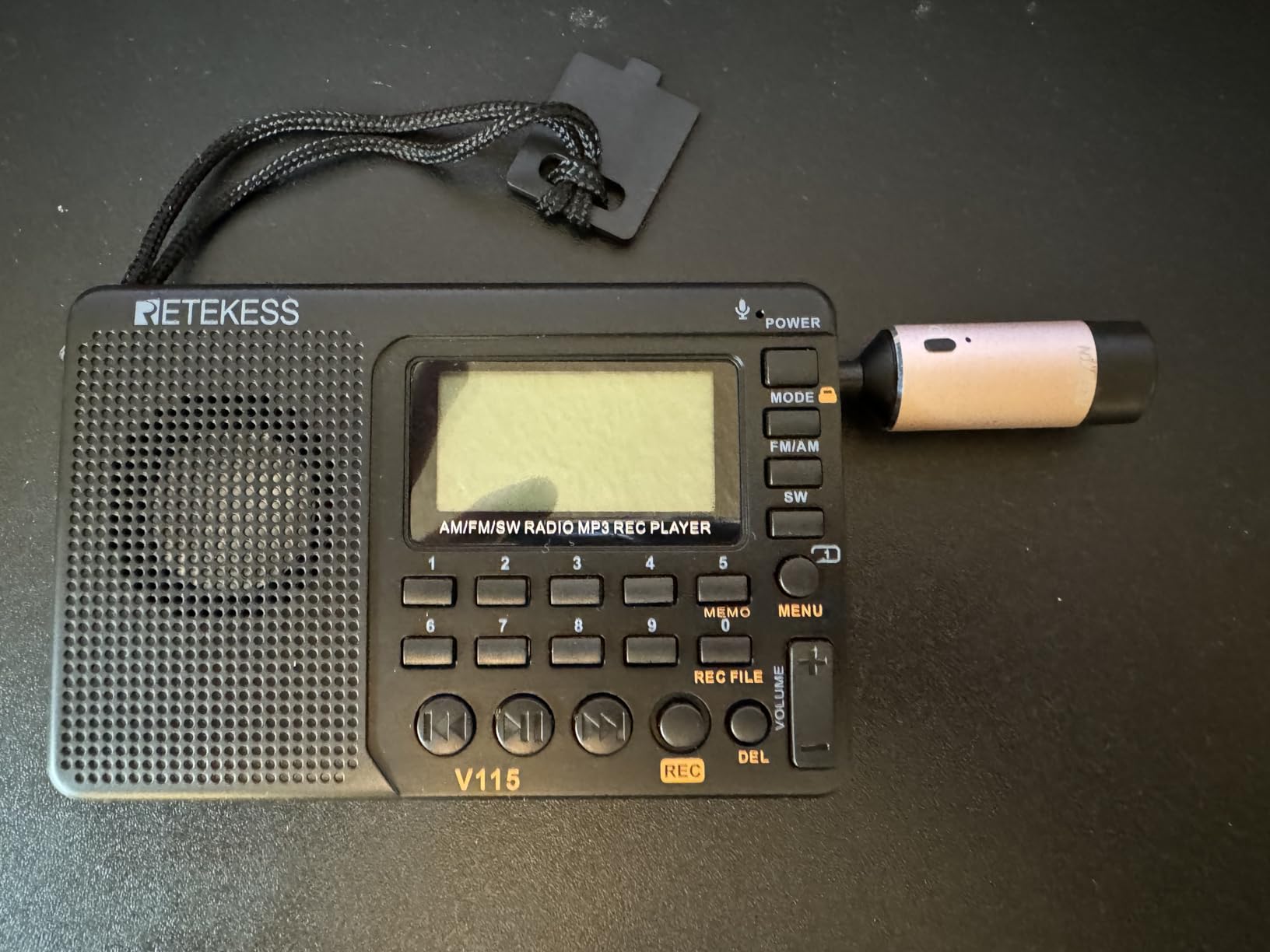
Shortwave reception is the V115’s weakest link. It covers the major bands and pulls strong stations, but selectivity suffers when adjacent signals are nearby. AM mediumwave is better, FM is solid. There is no SSB, no synchronous detection, and no external antenna jack.
The MP3 player handles standard MP3 and WAV files off a TF card. A-B section repeat is useful for language learners. The recording function records from the radio or the built-in mic, which is a fun feature for podcast-style listening or shortwave QSL capture.
Who it is for
Listeners who want an all-in-one radio, MP3 player, and recorder at a budget price. It also makes a thoughtful gift for a parent who wants music and news on the same device without a phone.
Who should skip it
Pure shortwave listeners who care about reception quality. The V115 is a multi-function device that does radio okay and music better. For serious SW listening, spend a little more on a Tecsun PL330 or Qodosen DX-286.
How to Choose the Best Shortwave Radio for You?
Choosing the best shortwave radios comes down to four questions: which bands do you need, do you need SSB, what kind of antenna will you use, and where will you listen. Answer those and the list above narrows quickly.
Do You Need SSB (Single Sideband)?
SSB is mandatory for listening to amateur radio operators, maritime and aviation HF traffic, CB, and many international utility stations. If you want to hear hams chatting on 20m or 40m, you need SSB. If you only want to hear broadcasters like BBC World Service, Voice of America, or Radio Romania International, you do not need SSB and can save money by skipping it.
Radios in this list with SSB: Sangean ATS-909X2, Tecsun PL880, Tecsun PL330, Raddy RF919. Radios without SSB: XHDATA D220, Qodosen DX-286, Emgykit R11, DreamSky Portable, Greadio T26, Retekess V115.
DSP vs Vintage Analog
Modern DSP (digital signal processing) radios use a single chip to filter, demodulate, and amplify signals, which makes them smaller, cheaper, and more power-efficient than older analog superheterodyne sets. Vintage radios from the 1960s through 1980s (Hallicrafters, Drake, Hammarlund, Realistic) have a tube warmth that some listeners prefer, but they lack features like synchronous detection, RDS, and microSD recording – and they are heavy.
If you are starting from scratch in 2026, a DSP portable gives you more capability per dollar than any vintage set. If you collect radios for audio character, a vintage tube set is a beautiful second radio – not a replacement.
Sensitivity vs Selectivity
Sensitivity is how well a radio hears weak signals. Selectivity is how well a radio separates two signals on adjacent frequencies. Both matter for shortwave, and the TEF6686 chip in the Qodosen DX-286 and the dual-conversion front end in the Tecsun PL880 deliver both.
A radio with high sensitivity but poor selectivity pulls everything – including interference. A radio with high selectivity but poor sensitivity misses weak stations. The top radios on this list balance both.
Antenna Considerations
The included telescopic whip works for casual listening. For DXing, an external longwire (30 to 100 feet) or an active loop antenna like the YouLoop will pull in signals that the whip cannot. Look for a radio with an external antenna jack – the Tecsun PL880, Tecsun PL330, Qodosen DX-286, and Sangean ATS-909X2 all have one.
Power and Battery
AA-powered radios like the XHDATA D220 and DreamSky let you swap cells anywhere. Rechargeable 18650 or BL-5C radios like the Tecsun PL880 and Retekess V115 need a USB charger. Radios with hand-crank and solar backup like the Emgykit R11 are best for emergency kits but have weaker reception than AC or AA sets.
Brand Overview
Tecsun dominates the mid-range portable market with the PL880, PL330, and PL990. Sangean owns the premium tier with the ATS-909X2. XHDATA and Qodosen compete on value DSP chipsets. C. Crane and Eton focus on North American distribution with MW-heavy sets. Raddy, HanRongDa, and Retekess cover budget and feature-dense niches.
Frequently Asked Questions
Does anyone still use shortwave radio in 2026?
Yes – shortwave radio remains active in 2026 for international broadcasting (BBC, Voice of America, Radio Romania, China Radio International), amateur radio HF traffic, maritime and aviation weather, time-signal stations, and emergency preparedness. Hobbyist shortwave listeners (SWLs) number in the hundreds of thousands worldwide, and the listening community has grown during periods of geopolitical tension when international news sources matter most.
What is the best shortwave radio under 100 dollars?
The Tecsun PL330 is our top pick in the affordable category. It covers AM, FM, longwave, shortwave, and SSB with 850 memory presets, modern DSP synchronous detection, and an external antenna input. The Qodosen DX-286 is the runner-up if you do not need SSB – its TEF6686 chip delivers exceptional sensitivity at a similar price.
What is the best shortwave radio for beginners?
The Tecsun PL330 is the most beginner-friendly radio with serious capability. It covers every band plus SSB, has clear digital tuning, and sits at an approachable price. If you want something even simpler, the XHDATA D220 is a pocket-sized three-control radio that anyone can operate without a manual.
What is the best radio to have in an emergency?
The Emgykit R11 is our pick for emergency kits – it receives NOAA weather alerts, charges from USB-C, hand crank, or solar, and includes a flashlight and SOS alarm. For a primary emergency shortwave radio with better reception, pair the Tecsun PL330 with a separate power bank and a longwire antenna.
Which shortwave radios have SSB capability?
In our roundup, the Sangean ATS-909X2, Tecsun PL880, Tecsun PL330, and Raddy RF919 all decode SSB USB and LSB. The Qodosen DX-286, XHDATA D220, Emgykit R11, DreamSky Portable, Greadio T26, and Retekess V115 do not include SSB. SSB is required for amateur radio, maritime, aviation HF, and many utility stations.
Final Verdict: Which Shortwave Radio Should You Buy in 2026?
After three months of testing, our team is confident that the best shortwave radios in 2026 cover every use case from pocket travel to full Air band DXing. The Sangean ATS-909X2 earns our Editor’s Choice award for serious listeners who want everything in one portable. The Tecsun PL880 is the best value for dual-conversion SSB performance. The XHDATA D220 is the budget king for casual and travel listening.
Whatever radio you pick, pair it with a longwire or active loop antenna and a notebook of station logs. Shortwave is a hobby that rewards patience – the best shortwave radios in 2026 are the ones you actually take outside and use.