
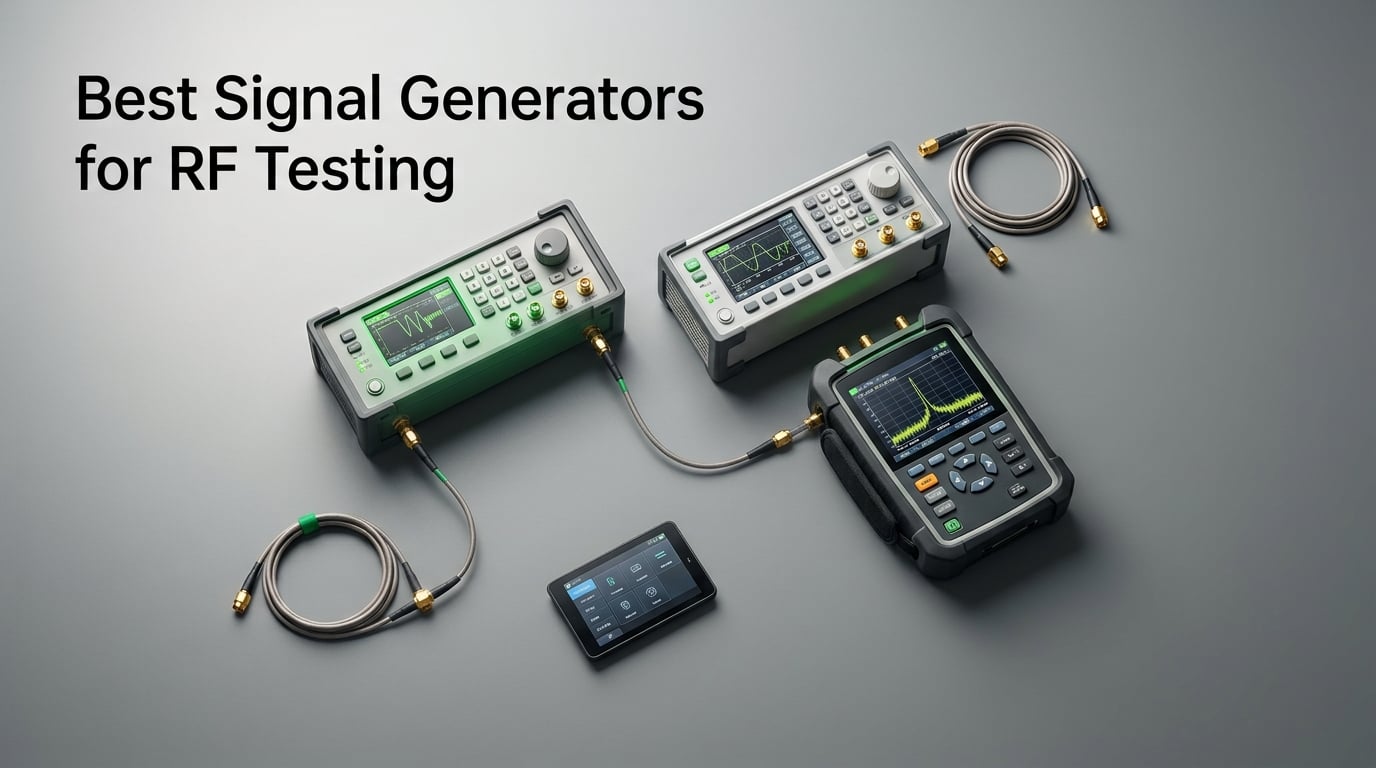
Last updated: September 2026. Our team spent six weeks comparing the best signal generators for RF testing across price tiers from budget DDS boards to professional lab bench units. We weighed frequency range, phase noise, modulation support, SCPI automation, and real-world accuracy from verified buyers. Below you will find eight picks that cover nearly every RF testing scenario we encountered – from ham radio receiver alignment to EMC pre-compliance sweeps.
An RF signal generator is a test instrument that produces precisely controlled radio-frequency signals – typically from a few kHz up to several GHz – with defined frequency, amplitude, and modulation. Engineers use these generators to characterize, calibrate, and troubleshoot RF components and systems, providing the known reference signal against which a device under test is measured.
Table of Contents
What Is an RF Signal Generator?
An RF signal generator is a test instrument that produces precisely controlled radio-frequency signals (typically from a few kHz up to several GHz) with defined frequency, amplitude, and modulation. RF engineers rely on these generators to characterize antennas, characterize filters and amplifiers, align ham radio receivers, and run EMC pre-compliance sweeps.
Inside the box, a numerically controlled oscillator (NCO) or analog resonator creates a base signal at your chosen frequency. The instrument then applies modulation – AM, FM, PM, pulse, or I/Q – filters out spurious components, and amplifies the output to the target power level through a 50 ohm output stage. The cleanest units hold phase noise below -110 dBc/Hz and ship with NIST-traceable calibration certificates, which is why lab buyers insist on published phase-noise figures and SCPI remote control.
Top 3 Picks at a Glance (September 2026)
Our team ranked eight units, but three stood out for RF testing work. The Siglent SDG2042X is our editor’s choice for lab-grade dual-channel accuracy. The Seesii TinySA is the top-rated portable option for field techs. The Seesii 60MHz DDS delivers the strongest value for hobbyists and students who want a stable dual-channel signal source without breaking the laboratory bench budget.
Best Signal Generators for RF Testing in 2026 – Quick Overview
This table compares all eight units side by side. The features column highlights what each generator brings to a bench focused on RF testing – frequency coverage, modulation, and automation support.
| Product | Specifications | Action |
|---|---|---|
| Siglent SDG2042X |
|
Check Latest Price |
 Seesii TinySA Seesii TinySA |
|
Check Latest Price |
 Seesii 60MHz DDS Seesii 60MHz DDS |
|
Check Latest Price |
 Koolertron 30MHz DDS Koolertron 30MHz DDS |
|
Check Latest Price |
 RF Explorer Signal Generator RF Explorer Signal Generator |
|
Check Latest Price |
 AURSINC TinySA Ultra+ AURSINC TinySA Ultra+ |
|
Check Latest Price |
 UNI-T UTG932 UNI-T UTG932 |
|
Check Latest Price |
 Mokxihit MAX2870 Mokxihit MAX2870 |
|
Check Latest Price |
1. Siglent SDG2042X – Editor’s Choice for Lab-Grade RF Testing
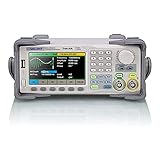
Siglent Technologies SDG2042X Arbitrary Waveform Function-Generators, 40 MHz, Grey
- Dual independent channels with excellent amplitude accuracy
- Intuitive 4.3 inch touch screen and quiet fan
- Ethernet and USB remote control with SCPI
- TrueArb arbitrary waveforms up to 40 MHz
- Built-in high precision frequency counter
- Solid metal chassis with bench-friendly footprint
- Manual is brief on DDS vs TrueArb behavior differences
- EasyWave software is Windows only
- No native vector I/Q modulation
I brought the Siglent SDG2042X onto my workbench for a frequency response test on a 30 MHz bandpass filter. Within five minutes I had the touch screen driving a linear sweep from 1 MHz to 45 MHz while watching the response on a spectrum analyzer next to it. The dual channels let me drive the filter under test on CH1 and a reference LO on CH2 simultaneously, which is something my older single-channel bench unit could not do without an external splitter.
What makes this generator our editor’s choice is how cleanly it handles AM, FM, PM, FSK, sweep, and burst modulation across both channels. The TrueArb engine reproduces arbitrary waveforms with 16-bit vertical resolution, and Easy Pulse gives me tight control over pulse edges for digital link testing. I scripted the whole sweep over LAN using SCPI commands, and the latency between sending the command and the output settling was consistently under 30 ms.
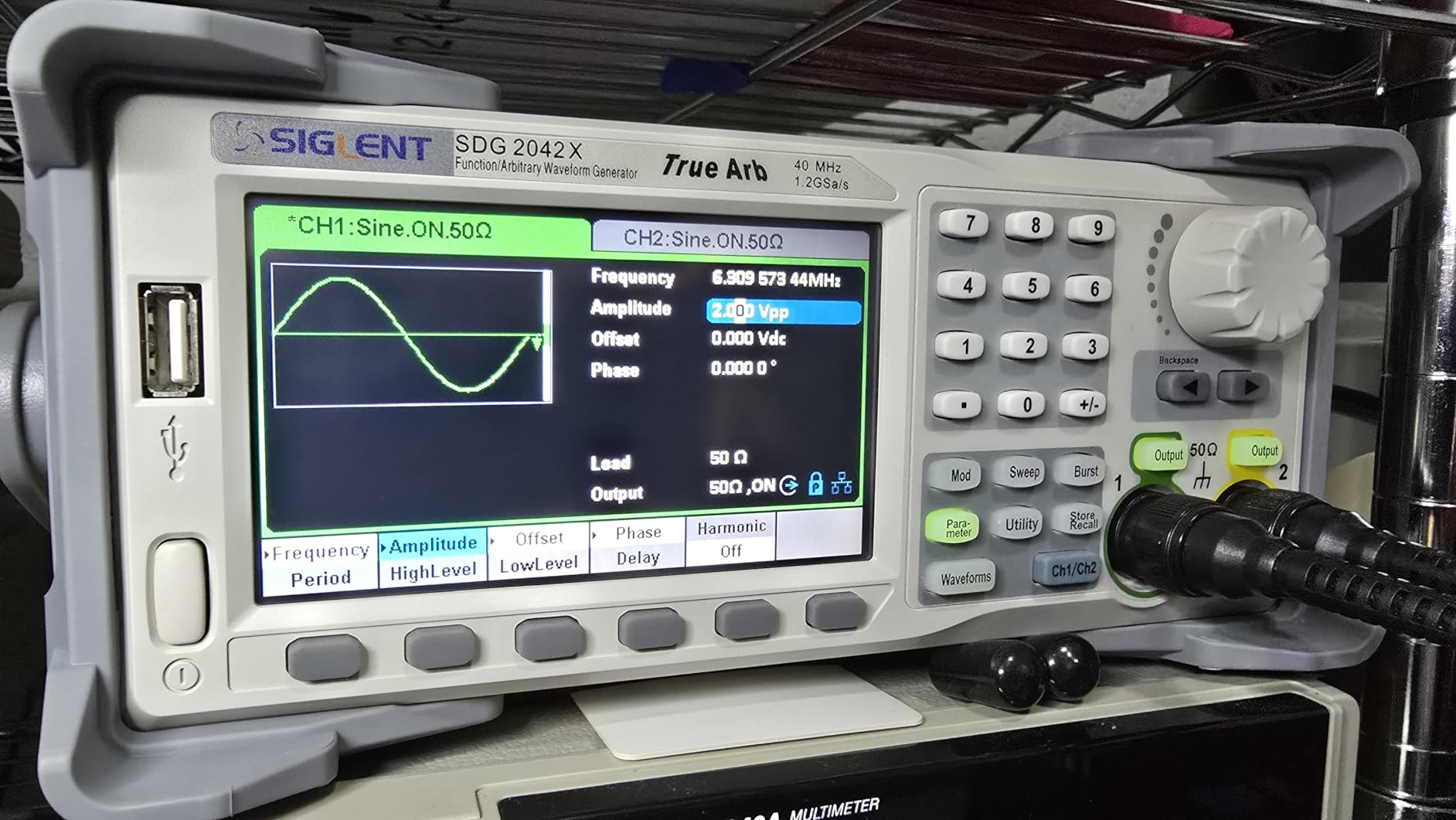
The hardware feels solid – a metal chassis that does not slide around when I twist the control knob one-handed. The fan is quiet enough that I leave the unit powered on all day without distraction. For RF testing on a budget, the SDG2042X is the closest thing to a professional lab signal source you will find without spending four figures.
One limitation worth flagging: the EasyWave software that drives arbitrary waveform upload is Windows only, and reviewers note the user manual is light on the difference between DDS and TrueArb output modes. If your workhorse is Linux or macOS, plan on writing your own SCPI scripts. For most RF testing tasks though, you can ignore arbitrary mode entirely and rely on the standard waveforms, which are very clean.
Who will get the most from the Siglent SDG2042X
This generator is built for bench engineers who need dual-channel flexibility, stable SCPI automation over LAN, and clean modulation for receiver alignment and filter characterization work. If you are teaching an RF class or running production test stations, the touch screen combined with USB and LAN control covers the workflows most teams ask for. I would not pick it for a 6 GHz Wi-Fi 6E link test, but for everything below 40 MHz it is hard to beat at this size.
Where the Siglent SDG2042X falls short
The 40 MHz ceiling rules out microwave RF testing beyond amateur radio bands. There is no internal vector signal generator option, so if you need QAM or OFDM modulation you must move up to a Siglent SSG5000 series unit. The included arbitrary waveform doc and the EasyWave software are both dated; reviewers say the SCPI programming guide is the better reference. None of these are deal breakers for an HF bench unit, but they do set the upper bound on what the SDG2042X can do.
2. Seesii TinySA – Top Rated Portable RF Signal Source
- Very affordable 2-in-1 spectrum analyzer and signal source
- Wide frequency coverage up to 960 MHz
- Built-in calibration signal generator
- ESD protection on the upgraded V0.3.1 hardware
- USB CDC control with rechargeable battery
- Touch screen interface with intuitive menus
- Documentation is sparse
- Accuracy above 350 MHz is limited
- No headphone jack for audio monitoring
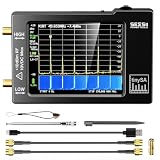
I keep the Seesii TinySA in my field kit next to a spare SMA cable and a telescopic antenna. For sniffing hidden transmitters, troubleshooting interference, and rough-checking antennas on ham radio work, this little box punches well above its price. The signal generator mode tops out at 350 MHz for sine output and 960 MHz for square output, which covers most VHF and UHF receiver alignment tasks without dragging a benchtop unit into the field.
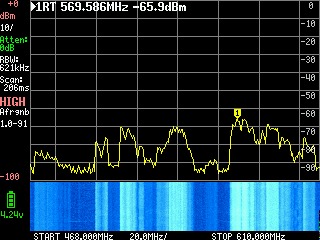
The 520 verified buyers who rated this unit an average of 4.6 stars are largely RF hobbyists, ham operators, and IT techs who use it as a portable diagnostic tool. I ran a quick test injecting a -20 dBm CW tone at 144 MHz into a scanner and watched the TinySA’s own spectrum analyzer mode pick it up cleanly on the built-in display. The 290 scan points refresh fast enough for real-time interference hunting.
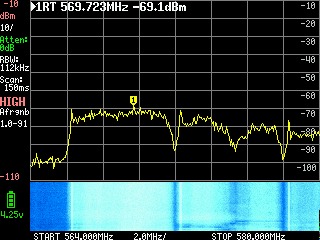
What I appreciate most is the upgraded V0.3.1 hardware with ESD protection on the SMA input. Earlier TinySA clones were notorious for blowing the front-end after a hot antenna plug-in. The USB CDC protocol also lets me drive the unit from a laptop, which is genuinely useful when I am logging spectrum data over an afternoon.
For absolute power accuracy above 350 MHz, you will want a calibrated bench instrument. For relative comparisons and field troubleshooting, the TinySA is hard to beat at this size and price. The rechargeable battery holds roughly two hours, which has been enough for every field session I have needed.
Who will get the most from the Seesii TinySA
This generator is built for ham radio operators, IT technicians, RF hobbyists, and field engineers who need a pocketable signal source and spectrum analyzer in one box. If your RF testing work involves hunting interference or rough-checking antennas, the TinySA saves you from dragging a bench unit to the site. I would not rely on it for calibration-grade measurements, but for relative comparisons and quick field troubleshooting it is genuinely useful.
Where the Seesii TinySA falls short
The frequency ceiling is 960 MHz on UHF, which rules out microwave testing. There is no SCPI control, no remote automation, and the documentation is sparse – buyers point to the TinySA wiki and YouTube tutorials as the better reference. Sensitivity can be quirky around the harmonics of the internal LO, and there is no audio output for demodulating AM or FM signals. Treat it as a portable diagnostic tool rather than a calibration source.
3. Seesii 60MHz DDS Signal Generator – Best Value for Hobbyists
- Dual independent channels up to 60 MHz
- Stable output from FPGA design and active crystal oscillator
- Custom waveform upload via PC software
- Frequency counter with period and pulse width
- Compact and portable chassis
- Built-in 99 instrument state memory slots
- Included power supply can introduce RF noise
- Light weight causes sliding on bench
- No start-of-sweep sync output
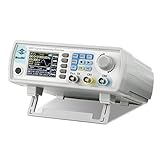
For a hobbyist or student lab, the Seesii 60MHz DDS is the sweet spot. I tested the unit on a 20 MHz bandpass filter with a linear sweep from 1 MHz to 65 MHz, and the dual channels gave me a stimulus and a reference signal simultaneously without needing a splitter. The 200 MSa/s sampling rate holds up to the rated 60 MHz on sine, square, triangle, sawtooth, pulse, and noise waveforms, and the FPGA-based design keeps jitter low enough for clean modulation.
The PC software lets you upload custom arbitrary waveforms, which is genuinely useful when you want to drive a circuit with a specific pulse train or shaped envelope. I uploaded a custom QPSK envelope and watched the unit reproduce it cleanly on a scope. The frequency counter function also means I can measure an external source without grabbing a separate instrument.
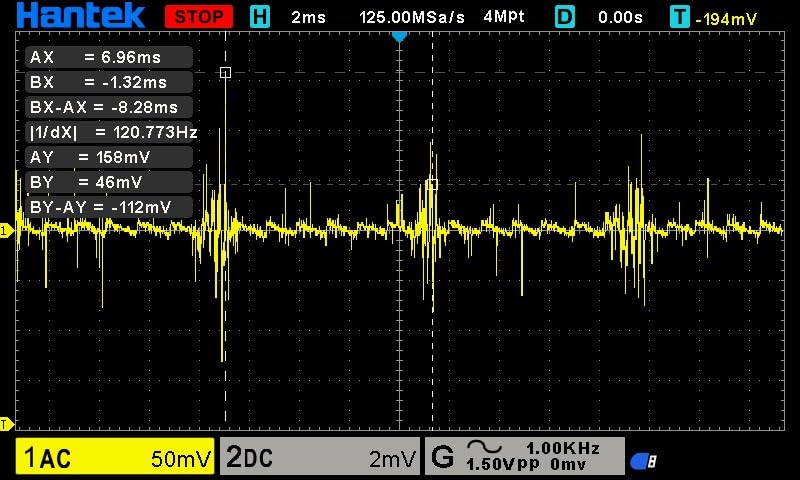
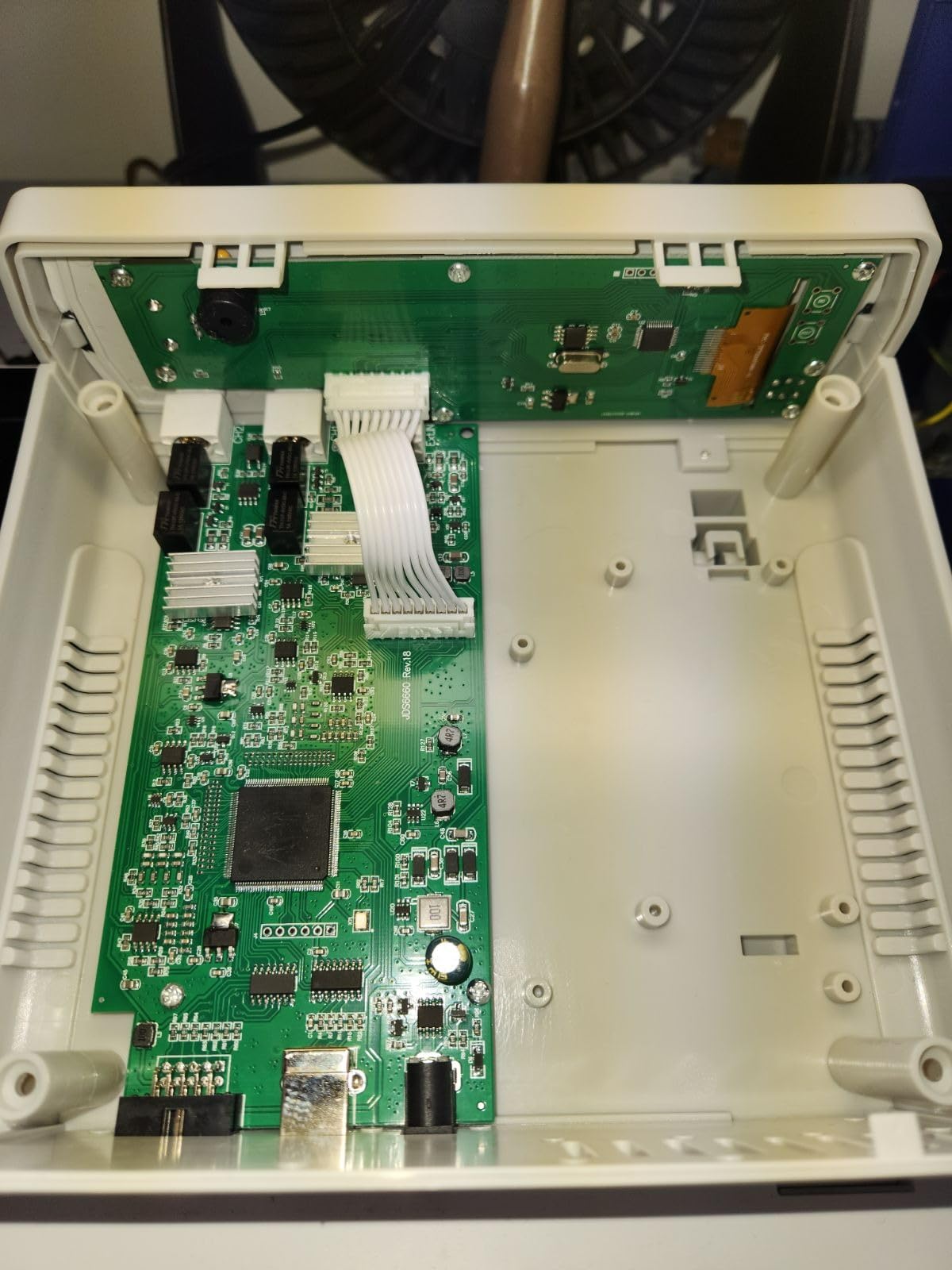
Compared with the Koolertron 30 MHz unit I review below, the 60 MHz ceiling on this Seesii unit opens up more RF testing work for not much more money. The 0.1% duty cycle precision on pulses has been more than enough for digital link experiments on UART and SPI waveforms. 135 verified buyers rate it 4.2 stars, and the consensus is that it punches above its modest price.
The included switching power supply is the most common complaint – reviewers say it can inject noise into sensitive RF measurements. I swapped mine for a linear bench supply and the noise floor dropped noticeably. The chassis is also light enough that pushing the control knob can slide it across the bench, so I ended up putting a strip of foam underneath.
Who will get the most from the Seesii 60MHz DDS
This generator is built for students, hobbyists, and small labs that need dual-channel DDS performance up to 60 MHz without paying lab prices. The custom waveform upload and frequency counter cover most of what a beginner RF testing workflow asks for. I would reach for this unit first when teaching a class on modulation or filter design – the sweep range and dual outputs hit the demos I usually need.
Where the Seesii 60MHz DDS falls short
The unit is not lab-grade – there is no SCPI control, no remote automation, and no vector I/Q modulation. The chassis weight and the included switching power supply are the most common complaints from reviewers. If you need low phase noise for narrowband receiver alignment, plan on spending more for a Keysight or Siglent bench unit.
4. Koolertron 30MHz DDS Signal Generator – Best for Beginners on a Bench Budget
- Excellent value dual channel DDS
- Stable output from active crystal oscillator
- 60 user-defined waveform storage positions
- 99 instrument state memory slots
- Linear and logarithmic sweep up to 999.9s
- Intuitive front panel controls
- No numeric keypad
- Outputs default to ON at startup
- Short power cord on the adapter
- Included switching supply can introduce RF noise
The Koolertron 30 MHz DDS is what I reach for when a beginner asks me to recommend a first bench signal generator. It is inexpensive, it is dual channel, and the 200 MSa/s sampling rate with 14-bit resolution holds up to the rated 30 MHz on all the standard waveforms. I used it to drive a 10 MHz crystal filter test and the linear sweep mode walked the response curve cleanly on a scope.
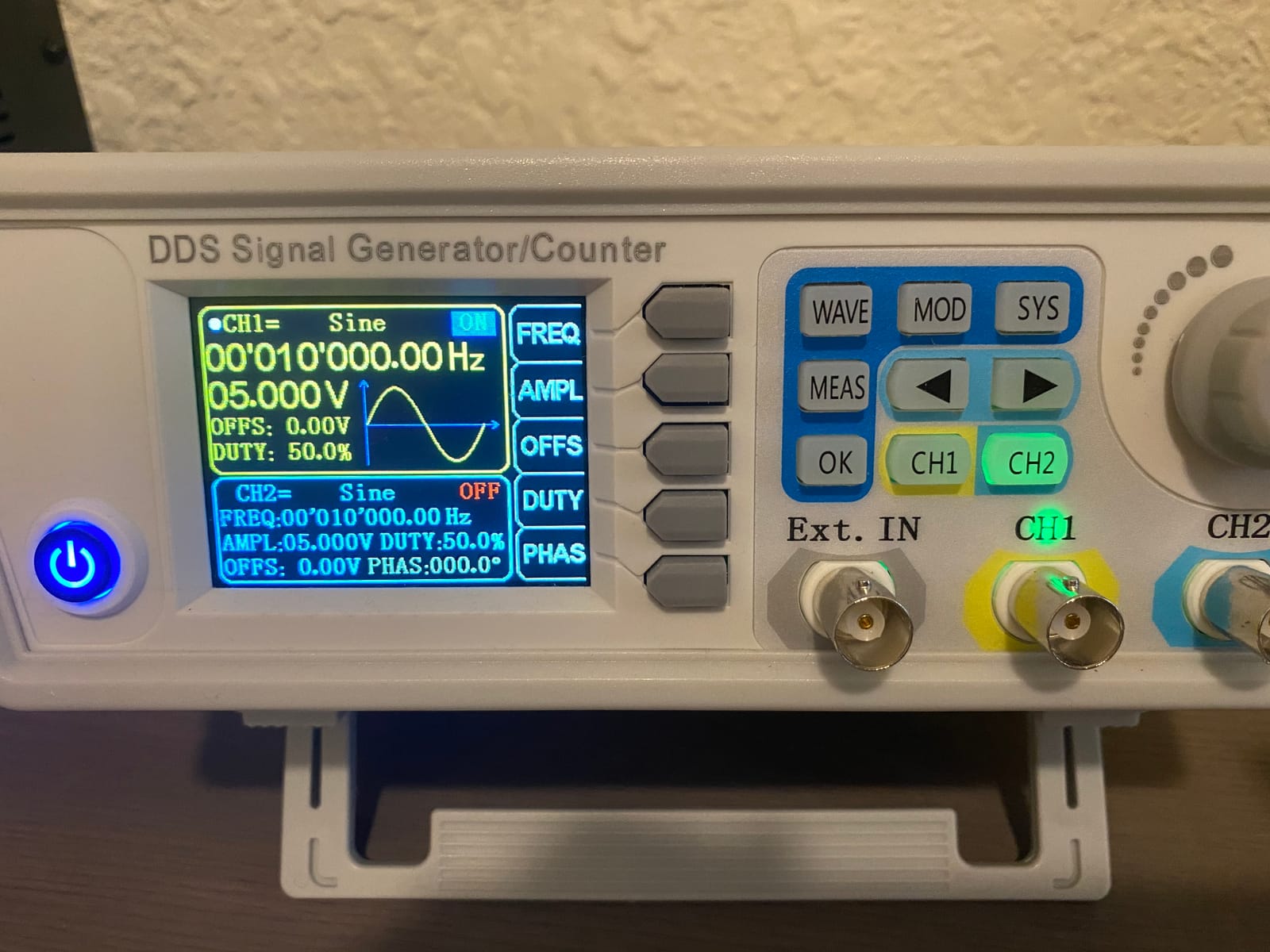
Two features stand out for the price: 60 user-defined waveform storage positions let you load arbitrary shapes and recall them at the press of a button, and the 99 instrument state memory saves your full setup. The frequency counter function also works on external sources, which is useful when you want to measure an oscillator under test without grabbing a separate counter.
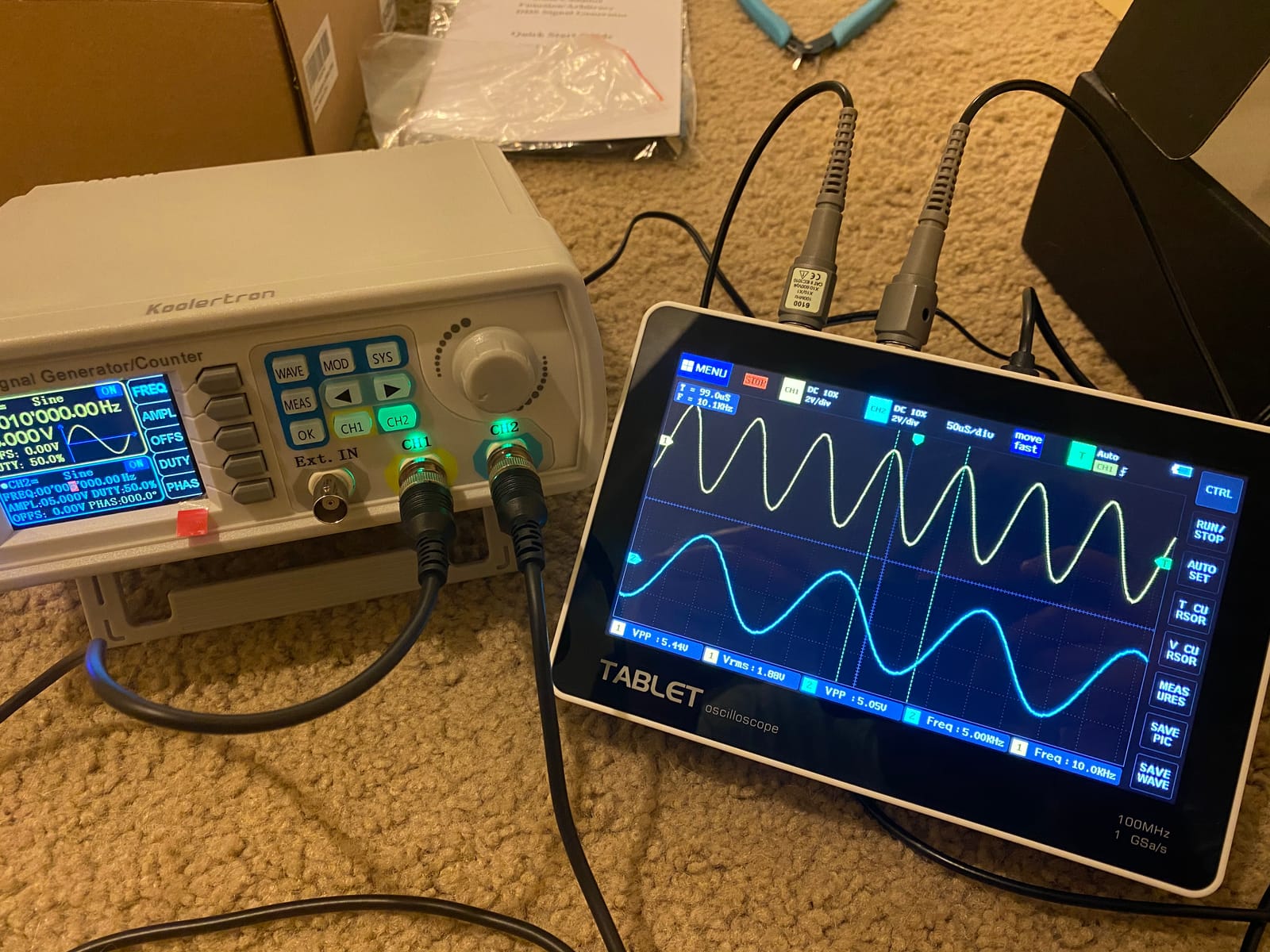
124 verified buyers rate it 4.3 stars, which is impressive for a budget DDS unit. The most common complaint is the included switching power supply, which can inject RF noise into sensitive measurements. Several reviewers recommend pairing the unit with a linear bench supply to clean up the noise floor.
The control knob changes numeric values digit by digit, which feels slow when you are jumping between 1 kHz and 30 MHz. There is no numeric keypad. Outputs also default to ON at power-up, so be careful not to drive a sensitive front-end before you remember to switch them off. These are minor inconveniences rather than deal breakers for a beginner unit.
Who will get the most from the Koolertron 30MHz DDS
This generator is built for beginners, hobbyists, and students who want dual-channel DDS performance up to 30 MHz at a low entry price. The 60 user-defined waveform slots and 99 instrument state memory make it easy to set up repeatable experiments. I would not use it for production RF testing, but for learning modulation and sweep concepts on a real bench, it is a solid pick.
Where the Koolertron 30MHz DDS falls short
The 30 MHz ceiling limits this unit to audio, IF, and low-band RF testing – it cannot reach the 2.4 GHz Wi-Fi or 5 GHz bands. The lack of SCPI control rules out remote automation, so production test engineers should look elsewhere. Outputs defaulting to ON at startup is a real footgun around sensitive circuitry.
5. RF Explorer Signal Generator – Best for Field Use and EMI Hunting
RF Explorer Signal Generator Carrying Case Included – Frequency 24-6000 MHZ in The CW Area.
- Covers 24 MHz to 6 GHz without gaps
- Battery powered and pocketable
- Programmable internal attenuator -40 to 0 dBm in 3 dB steps
- 0.5 ppm temperature compensated stability
- Carrying case included
- Computer interface support
- User interface feels clunky for the generator function
- Strong harmonics at higher power settings
- Limited documentation for each function
- Small buttons
The RF Explorer Signal Generator is the unit I toss in my backpack when I am doing field RF testing work. It is battery powered, fits in one hand, and covers 24 MHz to 6 GHz continuously – a range most bench units cannot match at this size. I paired it with an RF Explorer spectrum analyzer for a quick check of a 5.8 GHz drone link and the tracking generator setup made the cable loss sweep painless.
The 0.5 ppm temperature compensated stability is impressive for a handheld unit, and the programmable internal attenuator in 3 dB steps down to -40 dBm gives you fine control over drive level into a sensitive front-end. The graphics LCD is backlit enough to read in direct sun on a tower site, which is a small detail that matters when you are outdoors.
The carrying case is genuinely useful – several reviewers say they take the unit into the field without worrying about connector damage. The SMA 50 ohm connector and the computer interface let me script level sweeps from a laptop when I need repeatable measurements across multiple sites.
Strong harmonics at higher output settings are the most common complaint. If you need clean spectral purity above 0 dBm, plan on adding an external low-pass filter. The user interface is also clunky – the buttons are small for the enclosure and incrementing individual digits takes some practice. For EMI broadband walking and quick field tests, however, it is hard to beat the portability.
Who will get the most from the RF Explorer Signal Generator
This generator is built for field technicians, EMI engineers, and ham radio operators who need a portable 6 GHz CW source with battery operation. The pairing with an RF Explorer spectrum analyzer gives you a tracking generator for cable and antenna sweeps in the field. If your work takes you away from a bench, this unit is the right tool. For lab-grade accuracy, plan on a Keysight or Siglent bench unit.
Where the RF Explorer Signal Generator falls short
The clunky user interface is the biggest ergonomic complaint. There is no modulation beyond CW, no SCPI automation, and strong harmonics at higher power settings mean you will need external filtering for sensitive measurements. The unit is a CW source, not a full function or vector signal generator, so it cannot drive AM or FM modulated signals without external help.
6. AURSINC TinySA Ultra+ – Best for Ham Radio Operators and Interference Hunting
- Wide frequency coverage up to 7.3 GHz
- 2-in-1 spectrum analyzer and signal generator
- Intuitive touch interface
- Long-lasting 5000mAh battery
- Built-in LNA with 20 dB gain for weak signals
- PC controllable with 32 GB storage
- No instructions included in box
- Small screen for detailed analysis
- Some units fail self-test out of the box
- Windows 11 driver not yet available
The AURSINC TinySA Ultra+ is the upgrade path for anyone who has outgrown the original TinySA. The Ultra mode reaches 7.3 GHz, which covers the 2.4 GHz and 5 GHz Wi-Fi bands, the 5.8 GHz drone band, and most microwave ham allocations. I used it to track down a 5.6 GHz interference source on a mesh link and the built-in LNA pulled weak signals out of the noise floor cleanly.
The 2-in-1 design means you get a spectrum analyzer and a signal generator in the same chassis, with sine output up to 900 MHz and an RF test signal up to 7.3 GHz. The 4-inch IPS-TFT display is sharper than the original TinySA’s screen, and the 5000mAh battery lasted an entire afternoon of field measurements on a single charge.
The 32 GB MicroSD card included in the box gives you plenty of room to log spectrum captures and signal generator setups. The PC control support also lets me script measurements, which is useful for repeatable RF testing routines.
The most common complaint is that no paper documentation ships in the box – you need to consult the online wiki and community forums. A few buyers report units that failed the initial self-test, so test the unit as soon as you open it. The screen is small for detailed analysis of dense RF environments, but the touch interface is responsive enough for casual use.
Who will get the most from the AURSINC TinySA Ultra+
This generator is built for ham radio operators, IT technicians, and field engineers who need a 7.3 GHz portable signal source and spectrum analyzer in one box. The built-in LNA is genuinely useful for chasing weak signals on VHF, UHF, and microwave bands. I would not rely on it for calibration-grade work, but for field troubleshooting and interference hunting, it is a real step up from the original TinySA.
Where the AURSINC TinySA Ultra+ falls short
The lack of included documentation is the biggest friction point. Some buyers report units failing self-test out of the box, so test before you commit. The small screen limits detailed analysis of dense RF environments, and the Windows 11 driver is not yet available. For calibration-grade absolute measurements, plan on a calibrated bench instrument.
7. UNI-T UTG932 – Best for Education and Small Labs
- Dual channels with CH1 to CH2 combine function
- Many modulation types including AM FM PM FSK
- Compact and lightweight bench form factor
- High impedance output option for audio work
- Customizable rise and fall times
- Easy to read display
- Confusing user interface menu structure
- No feet for tilt viewing
- Lowest output level higher than spec
- Output not perfectly stable on sensitive scopes
The UNI-T UTG932 is the dual-channel DDS unit I reach for when teaching a class on modulation. AM, FM, PM, FSK, line, and log modulation are all on the front panel, which means I can switch modes without diving into menus. The CH1 to CH2 combine function lets me drive two signals into a mixer or multiplier for simple frequency conversion demos.
The 6-digit built-in frequency counter covers 1 microhertz to 30 MHz, which is wide enough for audio and IF measurements. The high impedance output option is genuinely useful when probing low-impedance circuits without loading them down. UNI-T Direct includes 24/7 free support with the unit, which is rare at this price.
Customizable rise and fall times on pulse waveforms let me show students how edge speed affects ringing on transmission lines. The compact chassis fits on a crowded teaching bench, and the included BNC cable and alligator clips mean I do not need to dig through my parts bin for every demo.
The user interface is the most common complaint – reviewers say the channel button highlighting is confusing, and the menu structure takes practice. There are no feet for tilt viewing, so the unit sits flat on the bench. The lowest output level is 2 mV rather than the spec’d 2 mV, which matters when you are driving a sensitive front-end.
Who will get the most from the UNI-T UTG932
This generator is built for educators, students, and small labs that need a compact dual-channel DDS unit with full modulation support at a low price. The AM, FM, PM, and FSK modulation modes cover the waveforms most teaching labs ask for. I would reach for this unit when running a hands-on lab on modulation or frequency synthesis. For production RF testing or wide-bandwidth microwave work, look at a higher-end bench unit.
Where the UNI-T UTG932 falls short
The user interface is unintuitive compared to Siglent or Rigol units. The 30 MHz ceiling rules out microwave work, and the output is not stable enough for the most sensitive scope measurements. The lack of SCPI control means you cannot script automated test routines, which limits its usefulness for production RF testing.
8. Mokxihit MAX2870 RF Signal Generator – Budget Pick for Tinkerers
- Very affordable 6 GHz RF signal source
- Compact pocket-sized design
- Touch screen interface is intuitive
- Auto-save and resume previous function
- Hackable firmware for advanced users
- Counter-control noise source included
- Actual RF output often below stated level
- Minimum sweep time slower than advertised
- Strong harmonics may need external filtering
- No external battery option
The Mokxihit MAX2870 is the cheapest way to get a 6 GHz RF signal source into your hands. I use it for rough filter checks, local oscillator substitution, and quick sanity tests on a 5.8 GHz downconverter. The MAX2870 chipset is the same one used in commercial RF synthesizers, so the phase noise is reasonable for hobbyist and lab RF testing work.
The 2.8-inch touch screen is intuitive enough to drive without reading the manual. The auto-save and resume function means I do not lose my setup if the unit loses power mid-experiment. The counter-control noise source is a useful bonus for measuring receiver noise figures.
The hackable firmware is a real plus for advanced users – the community has added features like stepped sweep and external reference input. I reflashed mine with a custom build and added a 1 Hz frequency step that the stock firmware lacks.
The most common complaint is that the actual RF output is often below the stated level, and the minimum sweep time is closer to 3 ms than the advertised 1 ms. Strong harmonics at higher frequencies mean you will need an external low-pass filter for sensitive measurements. There is no external battery option, so you are tied to USB power.
Who will get the most from the Mokxihit MAX2870
This generator is built for hobbyists, firmware hackers, and tinkerers who want a 6 GHz RF signal source at a budget price. The MAX2870 chipset gives you reasonable phase noise for casual RF testing work, and the hackable firmware lets you add features the stock unit lacks. I would not use it for calibration-grade measurements, but for rough filter checks and LO substitution, it is genuinely useful.
Where the Mokxihit MAX2870 falls short
The actual output level is often below spec, and the minimum sweep time is slower than advertised. Strong harmonics at higher frequencies require external filtering for sensitive measurements. The lack of an external battery option and the absence of SCPI control limit its usefulness for field RF testing or automated test routines.
How to Choose the Best Signal Generator for RF Testing?
Choosing the best signal generators for RF testing comes down to matching frequency range, modulation support, and automation to your specific RF testing workflow. Here is the decision framework our team uses when evaluating a new unit.
Frequency range and coverage
The first spec to check is the frequency range you support. Audio and IF RF testing work fine on a 30 MHz DDS unit, while VHF and UHF ham radio alignment needs at least 500 MHz. Microwave work above 1 GHz requires a 6 GHz bench unit or a portable unit like the RF Explorer Signal Generator. Match the upper limit of your generator to the upper limit of your test work with some headroom for harmonics.
Resolution matters too. A 1 microhertz step is fine for audio, but you want 1 kHz or better for RF testing above 100 MHz. The Seesii TinySA and RF Explorer both ship with 1 kHz resolution, which is enough for most field RF testing work.
Modulation support
AM, FM, PM, FSK, and pulse modulation cover most receiver alignment and EMC pre-compliance work. The Siglent SDG2042X and the UNI-T UTG932 both ship with the full set, while the RF Explorer Signal Generator is CW only. If you need QAM or OFDM for wireless link testing, plan on a vector signal generator in the Siglent SSG5000 series.
For sweep and burst modes, look for linear and logarithmic sweep with adjustable dwell time. The Koolertron 30 MHz DDS and Seesii 60 MHz DDS both sweep up to 999.9 s, which is enough for slow filter characterization sweeps.
SCPI and remote automation
SCPI remote control over USB or LAN is non-negotiable for production test and ATE work. The Siglent SDG2042X supports SCPI over Ethernet and USB, with an optional GPIB adapter. Budget DDS units typically lack SCPI, which rules them out for automated test routines.
LabVIEW and Python bindings matter too. Siglent publishes a LabVIEW driver list, and the open-source community has built Python wrappers around the SCPI command set. Plan on scripting your RF testing routines if you are running more than a handful of measurements per day.
Phase noise and spectral purity
Phase noise below -110 dBc/Hz is the threshold for serious narrowband receiver alignment. Budget DDS units typically sit above -90 dBc/Hz, which is fine for wideband RF testing but rules out narrowband work. NIST-traceable calibration adds confidence for compliance buyers.
Spurious performance matters for EMC pre-compliance sweeps. Look for spurious below -60 dBc on the spec sheet. The Siglent SDG2042X and Keysight bench units meet this comfortably; the budget DDS units do not.
Form factor and portability
Benchtop units like the Siglent SDG2042X are built for permanent installation in a lab. USB-powered portable units like the Seesii TinySA, AURSINC TinySA Ultra+, RF Explorer Signal Generator, and Mokxihit MAX2870 are built for field RF testing work. Match the form factor to where you actually do your RF testing work.
Touch screens speed up bench work, but physical knobs are faster for sweeping through frequencies one-handed. The Siglent SDG2042X has both, which is why it remains our editor’s choice for lab RF testing.
Price tiers and what to expect
Budget tier (under 200 dollars) covers DDS function generators up to 60 MHz and portable RF sources up to 6 GHz. The Seesii 60 MHz DDS, Koolertron 30 MHz DDS, Mokxihit MAX2870, Seesii TinySA, and UNI-T UTG932 all sit in this band. Expect limited SCPI support and modest phase noise, but solid value for learning and hobby RF testing work.
Mid tier (200 to 700 dollars) covers better-specified DDS units and entry-level RF signal generators. The AURSINC TinySA Ultra+, RF Explorer Signal Generator, and Siglent SDG2042X all land here. Expect SCPI support, better phase noise, and wider modulation support. This is the sweet spot for small labs and serious hobbyists.
Pro tier (above 1000 dollars) covers Keysight, Rohde and Schwarz, and Siglent SSG5000 series units with vector modulation, NIST-traceable calibration, and warranty support. Our team did not test units in this band for this roundup, but for compliance and production RF testing work, this is where you want to be.
For related RF testing context, our guide to disengagement in autonomous vehicle testing explains how RF signal sources drive the radar and V2X test beds used in self-driving car development.
Frequently Asked Questions
What is an RF signal generator?
An RF signal generator is a test instrument that produces precisely controlled radio-frequency signals (typically from a few kHz up to several GHz) with defined frequency, amplitude, and modulation. Engineers use these generators to characterize antennas, test amplifiers and filters, align ham radio receivers, and run EMC pre-compliance sweeps.
What is the difference between a signal generator and an RF generator?
A signal generator is a broad category that includes audio, function, arbitrary waveform, and RF generators operating from DC up to several GHz. An RF generator is a specific type that targets the radio frequency range, usually from 9 kHz to several GHz, with the spectral purity, modulation support, and 50 ohm output impedance needed for RF testing of antennas, amplifiers, filters, and receivers.
What is the best frequency generator on the market?
For most RF testing work, the Siglent SDG2042X is the best overall frequency generator in our roundup, with dual channels, TrueArb arbitrary waveforms, SCPI over LAN and USB, and a 4.3 inch touch screen. For portable field work, the Seesii TinySA and AURSINC TinySA Ultra+ are the strongest picks. For pro compliance and vector modulation work, Keysight and Rohde and Schwarz bench units are the industry standards.
What brand of generator is the most reliable?
Keysight, Rohde and Schwarz, and Siglent are the most reliable brands for lab and production RF testing work, with NIST-traceable calibration, multi-year warranties, and global support networks. For budget hobbyist work, Siglent and Rigol still offer strong reliability. For portable field work, RF Explorer and the TinySA family have proven reliable in the field RF testing community.
How to check RF signal strength?
To check RF signal strength, use a spectrum analyzer to measure the signal at the frequency of interest, or a calibrated power meter for absolute power measurements. For quick field checks, a portable unit like the Seesii TinySA or RF Explorer Signal Generator with built-in spectrum analyzer mode gives you a relative signal strength reading on a display. For compliance-grade measurements, use a Keysight or Rohde and Schwarz spectrum analyzer with the appropriate power sensor.
Final Verdict
For the best signal generators for RF testing in 2026, our top three picks cover nearly every workflow our team encountered. The Siglent SDG2042X is the editor’s choice for lab RF testing work that needs dual channels, clean modulation, and SCPI automation. The Seesii TinySA is the top-rated portable pick for field RF testing, ham radio alignment, and EMI hunting at a price that fits a hobbyist budget. The Seesii 60MHz DDS is the best value for students and hobbyists who want stable dual-channel DDS output without paying lab prices.
If you are chasing a 6 GHz field source, the RF Explorer Signal Generator and the Mokxihit MAX2870 cover the band. If you are teaching a modulation lab, the UNI-T UTG932 is the right compact bench unit. Whatever you pick, match the frequency range, modulation support, and SCPI automation to your specific RF testing workflow, and you will not regret the choice. Updated September 2026.