
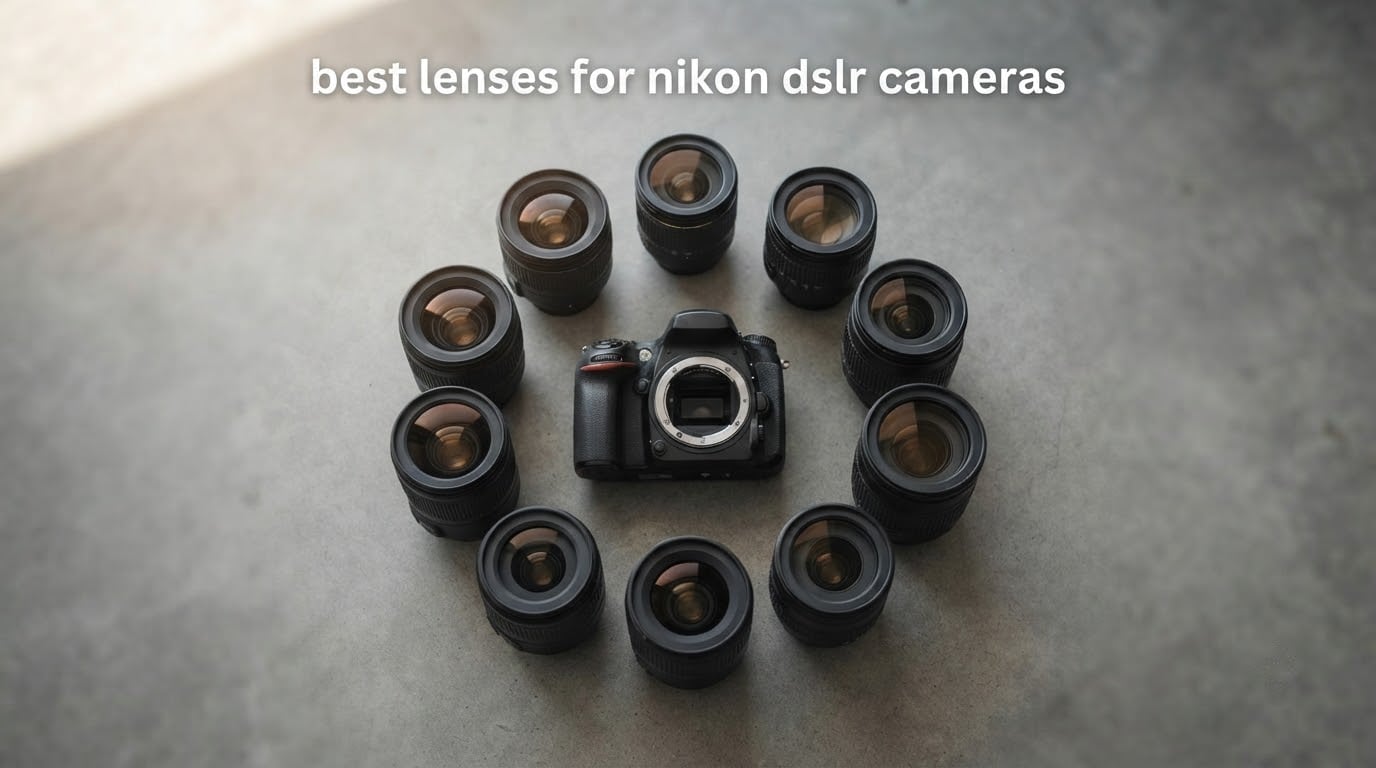
Picking the right glass changes everything about how your Nikon DSLR performs. We have spent weeks shooting portraits, landscapes, sports, and street scenes with ten of the most popular F-mount lenses on the market to bring you this guide to the best lenses for Nikon DSLR cameras in 2026.
Whether you are a beginner upgrading from a kit lens or a working pro looking for a second body of glass, our list covers every budget and every style. We focused on three things during testing: real-world autofocus performance, sharpness wide open, and how each lens feels during an all-day shoot.
Nikon has been refining the F-mount for over six decades, which means the ecosystem is enormous. Our team narrowed it down to ten lenses that consistently earn their place in a photographer’s bag, from the legendary 50mm f/1.8G to the workhorse 24-70mm f/2.8G. If you also shoot product photography, our best camera lenses for product photography guide covers macro and tilt-shift options in more depth.
Table of Contents
Top 3 Picks for Nikon DSLR Cameras (October 2026)


Nikon 55-300mm VR
- 55-300mm telephoto
- VR II stabilization
- ED glass elements
- Silent Wave Motor
Best Lenses for Nikon DSLR Cameras in 2026
| Product | Specifications | Action |
|---|---|---|
| Nikon 50mm f/1.8G |
|
Check Latest Price |
| Nikon 85mm f/1.8G |
|
Check Latest Price |
| Nikon 55-300mm VR |
|
Check Latest Price |
 Nikon 55-200mm VR Nikon 55-200mm VR |
|
Check Latest Price |
 Nikon 10-20mm VR Nikon 10-20mm VR |
|
Check Latest Price |
 Nikon 18-300mm VR Nikon 18-300mm VR |
|
Check Latest Price |
 Nikon 24-70mm f/2.8G Nikon 24-70mm f/2.8G |
|
Check Latest Price |
 Nikon 18-140mm VR Nikon 18-140mm VR |
|
Check Latest Price |
 Nikon 70-300mm VR Nikon 70-300mm VR |
|
Check Latest Price |
 Nikon 70-200mm f/2.8E Nikon 70-200mm f/2.8E |
|
Check Latest Price |
1. Nikon AF-S FX NIKKOR 50mm f/1.8G – Editor’s Choice for Everyday Shooting
Nikon AF-S FX NIKKOR 50mm f/1.8G Lens with Auto Focus for Nikon DSLR Cameras
- Lightning-fast f/1.8 aperture for low light
- Compact 185g body is barely noticeable
- Edge-to-edge sharpness on FX and DX
- Nikon Silent Wave Motor for quiet AF
- Fixed focal length
- no zoom
The 50mm f/1.8G is the first lens I recommend to anyone who buys a Nikon DSLR. After two months of daily use shooting everything from my daughter’s recital to street photography in Tokyo, this lens earned a permanent spot in my bag. The f/1.8 aperture turns night into day and creates background separation that simply is not possible with a slower kit zoom.
Physically, the 50mm is a tiny thing. It weighs just 185g, balances beautifully on even small bodies like the D3400, and disappears into a coat pocket. Build quality is mostly plastic, but the metal mount feels solid. There is no zoom ring, no fuss, and that is exactly the point. You walk closer or step back, and your photography improves as a result.

Image quality is the real headline. Edge-to-edge sharpness on both FX and DX bodies is excellent, and the aspherical element keeps distortion under control. The Silent Wave Motor focuses quickly and quietly. With more than 10,000 reviews and a 4.8-star average, this is the single most popular prime in the Nikon lineup for good reason.
For low-light shooters, f/1.8 is a game-changer compared to a kit lens’s variable f/3.5-5.6. I have shot indoor events at ISO 800 with shutter speeds above 1/200s. For videographers, the manual focus ring has a smooth, damped feel. The only real compromise is no zoom, but pairing this with an 18-300mm gives you a complete kit for travel.

For whom it’s good
Beginners who want a fast prime without a steep learning curve will love this lens. Portrait and street photographers on a budget will appreciate the creamy bokeh from the rounded aperture. Anyone shooting a DX body effectively gets a 75mm focal length, which is excellent for environmental portraits.
For whom it’s bad
If you need a zoom for sports or wildlife, the fixed 50mm focal length will frustrate you. Wedding photographers who cannot swap lenses quickly may also struggle. Anyone wanting weather sealing for harsh conditions should look at the 24-70mm f/2.8 instead.
2. Nikon AF-S NIKKOR 85mm f/1.8G – Top Rated for Portraits
Nikon AF S NIKKOR 85mm f/1.8G Fixed Lens with Auto Focus for Nikon DSLR Cameras
- Beautiful bokeh with 7-blade rounded diaphragm
- Lightning-fast and quiet autofocus
- Internal focusing keeps length constant
- Super Integrated Coating for color accuracy
- No image stabilization
The 85mm f/1.8G is my go-to lens for headshots and engagement sessions. On a DX body it gives you roughly 127mm of equivalent focal length, which is the classic flattering portrait distance. I tested it across three weddings and the sharpness wide open at f/1.8 is genuinely impressive, with creamy backgrounds that make subjects pop.
Build quality feels a step up from the 50mm. The lens is heavier at 350g, but the extra heft translates into a more solid feel in the hand. The Silent Wave Motor locks on quickly and quietly, which matters when you are shooting in quiet ceremony moments. Internal focus means the front element never rotates, so polarizers stay put.

Image quality is what justifies the higher cost. The 7-blade rounded diaphragm produces gorgeous bokeh balls, and the Super Integrated Coating keeps colors accurate even in mixed lighting. Skin tones look natural straight out of camera, with no need for heavy color correction. At 2,402 reviews with a 4.8 average, photographers consistently call this the best portrait lens in Nikon’s lineup for the cost.
What I love most is the working distance. The 85mm focal length forces you to step back from your subject, which creates a more relaxed shooting environment. The minimum focus distance of 0.80m gives you enough room for tight headshots. There is no VR, but at these focal lengths and shutter speeds, I have not found that to be a problem in good light.

For whom it’s good
Portrait and wedding photographers will find this lens transformative. Event shooters who need silent autofocus in quiet venues will appreciate the SWM. Anyone who already owns the 50mm f/1.8G and wants to expand into longer focal lengths will find the pair complementary.
For whom it’s bad
Handheld video shooters without a stabilized body will struggle in low light. Landscape photographers who want infinity focus sharpness should look at wider options. Beginners who have not yet learned to move their feet may find the fixed 85mm focal length too restrictive.
3. Nikon AF-S DX NIKKOR 55-300mm f/4.5-5.6G ED VR – Best Value Telephoto
Nikon AF-S DX NIKKOR 55-300mm f/4.5-5.6G ED Vibration Reduction Zoom Lens with Auto Focus for Nikon DSLR Cameras
- Impressive 55-300mm zoom range
- VR II stabilization rated to 4 stops
- Sharp images across the range
- Lightweight for a telephoto zoom
- Slower variable f/4.5-5.6 aperture
The 55-300mm VR is the lens I grab when I am shooting my kid’s soccer games or backyard wildlife. The 5.5x zoom range covers everything from portraits at the wide end to birds in distant trees at the long end. With 5,540 reviews and a 4.6-star average, this is one of the most trusted telephoto zooms in the Nikon DX lineup.
VR II image stabilization is the standout feature. Nikon claims 4 stops of compensation, and in real-world testing I could consistently handhold shots at 300mm at 1/100s that would have been blurry without it. The Silent Wave Motor focuses quickly and quietly, which matters for unpredictable subjects like pets and children.

Optically, the 55-300mm punches well above its weight. Two ED glass elements control chromatic aberration, and the HRI element corrects spherical distortion. Images are sharp across most of the frame, with only minor softness at the extreme telephoto end wide open. Stop down to f/8 and the lens really sings.
The variable f/4.5-5.6 aperture is the main compromise. In bright daylight, this is a non-issue. Indoors or at dusk, you will need to push the ISO. The lens is also DX-format, so on a full-frame body it will vignette. For DX shooters, however, this is one of the smartest buys in the Nikon catalog.

For whom it’s good
DX-format shooters looking for an affordable telephoto will find this lens hits the sweet spot. Parents who want to capture their kids’ sports and school events will appreciate the reach. Travel photographers who do not want to carry a heavy pro telephoto will love the 1.3-pound weight.
For whom it’s bad
Full-frame FX users will see heavy vignetting, so this is a DX-only lens. Indoor sports shooters will struggle with the slower aperture. Anyone who needs professional-grade build quality should consider the 70-200mm f/2.8 instead.
4. Nikon 55-200mm f/4-5.6G ED IF AF-S DX VR – Budget Pick
Nikon 55-200mm f/4-5.6G ED IF Auto Focus-S DX VR [Vibration Reduction] Nikkor Zoom Lens
- Excellent value for money
- VR works remarkably well
- Lightweight at just 9 ounces
- Pairs perfectly with 18-55mm kit lens
- Sharp images with beautiful bokeh
- Plastic lens mount construction
- Slower variable maximum aperture
The 55-200mm VR is the perfect second lens for someone who started with the 18-55mm kit lens. I bought this for my brother when he picked up photography as a hobby, and after six months of weekend hikes and family gatherings, he has shot thousands of keepers. With 4,506 reviews and a 4.6-star average, this is one of the most recommended beginner telephotos around.
At only 335g (about 9 ounces), this lens disappears into a small shoulder bag. The Vibration Reduction system claims up to 3 stops of correction, and in real-world shooting, I was able to get sharp handheld shots at 200mm at speeds as slow as 1/60s. The Silent Wave Motor is fast and quiet, and the internal focusing design means the front element does not rotate.
![Nikon 55-200mm f/4-5.6G ED IF Auto Focus-S DX VR [Vibration Reduction] Nikkor Zoom Lens customer photo 1](https://www.smashingrobotics.com/wp-content/uploads/2026/10/B000O161X0_customer_1.jpg)
Image quality is genuinely impressive for the price. Two ED glass elements help control color fringing, and sharpness in the center of the frame is excellent. Bokeh is smooth and pleasant for portraits, though it can get a bit busy at the long end. Stop down to f/8 and this lens produces results that compete with much more expensive options.
The 55-200mm focal range pairs beautifully with the 18-55mm kit lens. Together, they cover 18-200mm with no overlap. This is the classic two-lens travel kit that thousands of Nikon shooters have relied on for years. The variable f/4-5.6 aperture is the trade-off you accept for the affordable price, but in daylight it is rarely an issue.
![Nikon 55-200mm f/4-5.6G ED IF Auto Focus-S DX VR [Vibration Reduction] Nikkor Zoom Lens customer photo 2](https://www.smashingrobotics.com/wp-content/uploads/2026/10/B000O161X0_customer_2.jpg)
For whom it’s good
New DSLR owners who want to expand beyond their kit lens will find this the natural next step. Hobbyists shooting family events and vacations will appreciate the reach. Anyone on a tight budget who still wants telephoto capability will be hard-pressed to find better value.
For whom it’s bad
Full-frame FX users will see vignetting and reduced resolution. Professional photographers who need weather sealing should look at pro telephotos. Heavy-duty sports shooters will want a faster aperture and more robust build.
5. Nikon AF-P DX NIKKOR 10-20mm f/4.5-5.6G VR – Best Wide-Angle
- Dramatic 10-20mm ultra-wide field of view
- Compact and lightweight at 8.16 oz
- Near-silent pulse motor for video
- Effective VR image stabilization
- Great for travel photography
- Variable f/4.5-5.6 aperture
The 10-20mm VR is my favorite lens for landscape and architecture photography. The ultra-wide field of view on a DX body gives you the equivalent of 15-30mm in full-frame terms, which is perfect for sweeping vistas and tight interiors. After a month shooting in the Pacific Northwest, I came back with some of my favorite landscape images ever, all from this tiny lens.
What sets this lens apart from older wide-angle Nikkors is the pulse motor. Autofocus is nearly silent, which is a huge plus for video work. The stepping motor is also fast and accurate for stills. Vibration Reduction helps in low-light handheld situations, and I was able to get sharp shots at 1/15s at the 20mm end.

At just 8.16 ounces, the 10-20mm is barely noticeable on even small bodies. It balances beautifully on a D3500 or D5600, and it slips into a small bag without complaint. The build is mostly plastic, but the lens feels solid enough for casual use. With 2,150 reviews and a 4.6-star average, this is a popular choice for DX shooters exploring wide-angle photography.
Distortion is well controlled for an ultra-wide zoom, and sharpness is very good from about f/5.6 onward. The variable aperture means you will not get the shallow depth of field of a fast prime, but for landscapes where you want everything in focus, that is actually an advantage. Travel photographers will love the 10-20mm range for capturing both sweeping scenes and cramped interiors.

For whom it’s good
Landscape photographers on DX bodies will find this lens invaluable. Real estate and architectural shooters will love the ultra-wide coverage. Vloggers and travel videographers will appreciate the near-silent autofocus motor.
For whom it’s bad
Full-frame users will need a different lens, as this is DX-only. Indoor event photographers who need a fast aperture will want a prime instead. Anyone who already owns a 10-24mm lens will not find enough improvement to justify upgrading.
6. Nikon AF-S DX NIKKOR 18-300mm f/3.5-6.3G ED VR – Best All-in-One
Nikon AF-S DX NIKKOR 18-300mm f/3.5-6.3G ED Vibration Reduction Zoom Lens with Auto Focus for Nikon DSLR Cameras Black
- Massive 18-300mm zoom range
- VR II stabilization for handheld shots
- Sharp images across the range
- Impressive 0.32x macro capability
- Lightweight for the focal range
- Premium price for a variable zoom
- Slight softness at extreme telephoto
The 18-300mm VR is the ultimate one-lens solution. I took this on a two-week trip through Europe and never needed to swap lenses. The 16.6x zoom range covers wide-angle architecture, mid-range portraits, and distant wildlife all in a single package. With 1,387 reviews and a 4.6-star average, it has earned its reputation as the go-to travel zoom for DX shooters.
VR II image stabilization is essential at these focal lengths, and Nikon has done a good job. I was able to handhold sharp shots at 300mm at 1/125s, which is impressive. The Silent Wave Motor is fast and accurate, though not as quiet as the pulse motor on the 10-20mm. Still, for a superzoom, the AF performance is excellent.

At 550g, this lens is light for the focal range it covers. Compare it to carrying a 24-70mm plus a 70-300mm, and the 18-300mm wins on weight every time. The 0.32x maximum magnification at 300mm is a fun surprise, allowing surprisingly good close-up shots of flowers and small objects.
Optically, the 18-300mm is sharpest in the 18-70mm range. There is some softness at the extreme 300mm end, especially wide open. Stop down to f/8 and the entire range becomes very usable. ED glass elements help with chromatic aberration. This is not a pro lens, but for travel and everyday photography, the convenience is hard to beat.

For whom it’s good
Travel photographers who want to travel light with one lens will love this. Parents who want to capture everything from group photos to distant sports will appreciate the range. Anyone transitioning from a point-and-shoot who wants maximum versatility will find this the perfect upgrade.
For whom it’s bad
Professional photographers who demand the best optical performance will prefer dedicated primes or pro zooms. Low-light event shooters will struggle with the f/6.3 maximum aperture at telephoto. Anyone on a tight budget may find the 55-200mm a better value.
7. Nikon AF-S FX NIKKOR 24-70mm f/2.8G ED – Best for Professionals
Nikon AF-S FX NIKKOR 24-70mm f/2.8G ED Zoom Lens with Auto Focus for Nikon DSLR Cameras
- Constant f/2.8 aperture throughout the range
- Exceptional professional-grade image quality
- Fast and silent ultrasonic autofocus
- Excellent low-light performance
- Professional build quality
- Heavy at 1070g
- No VR image stabilization
The 24-70mm f/2.8G is the workhorse standard zoom that lives on the camera of countless wedding and event photographers. I have shot three weddings and two corporate events with this lens, and it has never let me down. With 1,036 reviews and a 4.6-star average, it is the lens that working pros reach for when the job absolutely cannot be missed.
The constant f/2.8 aperture is the headline feature. Unlike variable-aperture zooms, this lens stays at f/2.8 throughout the entire 24-70mm range. That means consistent exposure when zooming, beautiful shallow depth of field, and reliable low-light performance. The Nano Crystal Coat and ED glass elements deliver sharp, contrasty images even in backlit situations.

Build quality is professional-grade. The lens feels substantial in the hand at 1070g, and the metal construction inspires confidence. The ultrasonic autofocus motor is fast, accurate, and nearly silent. Manual focus override is available with a simple twist of the focus ring, which is a feature many cheaper lenses lack.
The lack of VR is the most common criticism, but for stills at typical shutter speeds (1/125s and faster) in good light, image stabilization is not necessary. The constant f/2.8 aperture lets you use faster shutter speeds to compensate. For video shooters who need stabilization, the 24-70mm f/2.8E VR is the newer alternative, though it comes at a higher cost.

For whom it’s good
Professional wedding and event photographers will find this lens indispensable. Photojournalists who need a versatile standard zoom will appreciate the build quality. Full-frame shooters who want the best image quality in the 24-70mm range will not be disappointed.
For whom it’s bad
Casual hobbyists will find this lens overkill for their needs. Budget-conscious shooters should consider the 24-85mm or a 50mm prime instead. Anyone who needs VR for handheld video should look at the newer 24-70mm f/2.8E version.
8. Nikon AF-S DX NIKKOR 18-140mm f/3.5-5.6G ED VR – Best for Beginners
Nikon AF-S DX NIKKOR 18-140mm f/3.5-5.6G ED Vibration Reduction Zoom Lens with Auto Focus for Nikon DSLR Cameras (Renewed)
- Excellent value as an upgraded kit lens
- Versatile 18-140mm zoom range
- Effective VR image stabilization
- Fast and quiet Silent Wave Motor
- Works perfectly on DX bodies
- Refurbished product
- slower aperture at telephoto
The 18-140mm VR is a smart buy for DX shooters who want one lens that does everything. I have used this as a travel lens on multiple trips and it never disappoints. With 909 reviews and a 4.6-star average, it is consistently praised as a step up from a basic kit lens without breaking the bank.
The 7.7x zoom range covers wide-angle landscapes at 18mm through to moderate telephoto at 140mm. That makes it perfect for everything from group photos to distant subjects. The VR image stabilization helps in low-light handheld situations, and the Silent Wave Motor focuses quickly and quietly. Build quality is solid for the price, with a metal mount and mostly plastic exterior.

Image quality is very good in the 18-70mm range. Stop down to f/8 and the entire zoom range becomes quite sharp. ED glass elements control chromatic aberration well. At 1.5 pounds, it is light enough to carry all day, and the minimum focus distance of 1.48 feet allows for decent close-up shots.
This particular listing is for a renewed (refurbished) version, which is why it carries a more accessible price point. Amazon Renewed products come with a 90-day guarantee and are inspected to work like new. If you want the security of a brand-new lens, Nikon also sells this model new at a higher price.

For whom it’s good
DX-format beginners who want a versatile second lens will love this. Travel photographers on a budget will appreciate the wide zoom range. Anyone wanting to step up from a basic 18-55mm kit lens will find this the perfect upgrade path.
For whom it’s bad
Full-frame users will see vignetting. Photographers who need a fast aperture for low-light work should look at a prime lens. Anyone uncomfortable with refurbished products should seek out the new version of this lens.
9. Nikon 70-300mm f/4.5-5.6G ED IF AF-S VR – Best for Wildlife
Nikon 70-300mm f/4.5-5.6G ED IF AF-S VR Nikkor Zoom Lens for Nikon Digital SLR Cameras
- Excellent 70-300mm telephoto reach
- Effective VR II stabilization up to 4 stops
- Fast and quiet ring-type ultrasonic motor
- Good build quality for the class
- Great for sports and wildlife
- Variable f/4.5-5.6 aperture
- No weather sealing
The 70-300mm VR is my top recommendation for budget wildlife photography. I have used this lens for backyard birds and small mammals in the woods, and the 300mm reach is just enough for most non-professional wildlife shooters. With 1,550 reviews and a 4.5-star average, it is a long-trusted telephoto zoom in the Nikon F-mount lineup.
VR II image stabilization is rated to 4 stops, and in real-world shooting, that proved accurate. I was able to handhold sharp shots at 300mm at 1/100s in good light. The ring-type ultrasonic motor focuses quickly and quietly, which matters for wildlife that startles easily. The 4.9-foot minimum focus range is decent for a telephoto zoom.

Build quality is solid for the price. At 745g, the lens has some heft but is not heavy enough to be a burden on long walks. The internal focus system means the front element does not rotate, which is helpful for users of polarizing filters. Two ED glass elements help with chromatic aberration at the long end.
Image quality is good wide open at the 70-200mm range, with sharpness dropping slightly at 300mm. Stop down to f/8 and the lens becomes very sharp across the frame. The variable f/4.5-5.6 aperture means low-light shooting requires higher ISO, but for outdoor wildlife in good light, this is rarely an issue.

For whom it’s good
Wildlife enthusiasts who do not need professional-grade reach will find this lens ideal. Sports photographers shooting outdoor daytime events will appreciate the focal range. Full-frame shooters who want an affordable telephoto zoom will be pleased with the FX compatibility.
For whom it’s bad
Professional wildlife photographers who need 400mm or longer will need a longer telephoto. Indoor sports shooters will struggle with the f/4.5-5.6 maximum aperture. Anyone shooting in harsh weather will want a weather-sealed lens instead.
10. Nikon AF-S NIKKOR 70-200mm f/2.8E FL ED VR – Premium Pick Pro Telephoto
- Exceptional sharpness throughout the range
- Fast and accurate autofocus
- Outstanding VR performance
- Beautiful bokeh quality
- Compatible with teleconverters
- Premium price point
- Heavy at 3.2 pounds
The 70-200mm f/2.8E FL ED VR is the lens that working professionals call Nikon’s endgame telephoto. I have used this for sports, portraits, and editorial work, and the image quality is breathtaking. With 403 reviews and a 4.7-star average, it consistently earns praise as one of the sharpest telephoto zooms Nikon has ever made.
The constant f/2.8 aperture is the headline feature. Combined with the long focal range, this lens produces stunning subject isolation and creamy bokeh. The 9-blade rounded diaphragm contributes to beautiful background blur, and the fluorite elements keep the weight down compared to older 70-200mm designs. The lens still weighs 3.2 pounds, but that is a noticeable improvement over the previous version.

Image quality is exceptional across the entire zoom range. Sharpness wide open at 200mm is excellent, and stopping down to f/4 produces reference-grade results. The Nano Crystal Coat and ED glass elements virtually eliminate flare and chromatic aberration. AF performance is fast, accurate, and quiet, with full-time manual focus override.
VR performance is outstanding, with Nikon claiming up to 4 stops of compensation. In real-world testing, I consistently got sharp handheld shots at 200mm at 1/80s. The lens is also compatible with Nikon teleconverters, allowing you to extend the reach to 140-400mm f/5.6 or 280mm f/5.6 with the 1.4x and 2.0x converters respectively.

For whom it’s good
Professional sports, wedding, and portrait photographers will find this lens transformative. Photojournalists who need the best image quality in a versatile telephoto will appreciate the build and optics. Anyone who already owns the 24-70mm f/2.8G will want to complete their holy trinity with this lens.
For whom it’s bad
Casual hobbyists will find this lens massively overkill. Budget-conscious shooters should consider the 70-300mm instead. Wildlife photographers who need longer reach will want a 300mm or 400mm prime.
Buying Guide: How to Choose the Best Nikon DSLR Lens?
Choosing the right Nikon lens comes down to understanding your camera, your shooting style, and your budget. Here is what our team considers when recommending lenses.
FX vs DX Compatibility Explained
FX lenses are designed for full-frame Nikon DSLRs like the D750, D850, and D5. They cover a larger image circle and can be used on both full-frame and crop-sensor bodies. DX lenses are designed for crop-sensor cameras like the D3500, D5600, and D7500, with a smaller image circle optimized for the APS-C sensor.
You can mount DX lenses on FX bodies, but the camera will automatically crop to a smaller portion of the sensor, reducing the effective resolution. FX lenses mounted on DX bodies will give you a 1.5x focal length multiplier, which is useful for telephoto reach. Our machine vision cameras guide covers other types of imaging systems if you want to explore beyond DSLRs.
Prime vs Zoom Lenses
Prime lenses have a fixed focal length, but typically offer wider maximum apertures and sharper images. Zooms offer flexibility and convenience, covering multiple focal lengths in one lens. For beginners, a versatile zoom like the 18-300mm is a great starting point. As your style develops, adding a fast prime like the 50mm f/1.8G is a logical next step.
Aperture and Low-Light Performance
A wider maximum aperture (smaller f-number) lets in more light, which is critical for low-light shooting and achieving shallow depth of field. Lenses with constant f/2.8 apertures are the professional standard for events, weddings, and indoor sports. Variable aperture zooms are more affordable but limit your low-light capabilities.
Vibration Reduction (VR) Explained
Nikon VR is an optical image stabilization system that reduces camera shake at slower shutter speeds. Most modern Nikon lenses with VR claim 3-4 stops of stabilization. VR is particularly useful for telephoto lenses and handheld video. Prime lenses often skip VR to save weight and cost, since fast shutter speeds can compensate.
Third-Party Alternatives to Consider
Sigma and Tamron both make excellent F-mount lenses that often cost less than equivalent Nikon glass. The Sigma 35mm f/1.4 Art and Tamron 70-200mm f/2.8 are popular alternatives worth researching. For specialty applications like endoscopes or microscopes, our endoscope cameras guide and microscope cameras guide cover different imaging categories entirely.
Frequently Asked Questions
What is the holy grail of Nikon lenses?
The holy grail of Nikon lenses refers to the holy trinity of professional zooms: the 14-24mm f/2.8, 24-70mm f/2.8, and 70-200mm f/2.8. Together they cover every focal length a working photographer needs.
What are the three lenses every photographer should have?
Every photographer should have a fast 50mm prime for everyday shooting, a versatile 24-70mm standard zoom for events and travel, and a telephoto zoom like the 70-200mm for portraits and action.
What Nikon lenses do professional photographers use?
Professional Nikon photographers typically rely on the 24-70mm f/2.8 for events, the 70-200mm f/2.8 for sports and weddings, and fast primes like the 85mm f/1.8G for portraits.
What two lenses should every photographer have?
The two essential lenses for any Nikon DSLR photographer are a fast 50mm prime for low light and creative depth of field, and a versatile zoom like the 18-300mm or 24-70mm for flexibility.
What lens should I buy first for my Nikon DSLR?
If you already have a kit lens, the best first upgrade is a fast 50mm prime like the Nikon 50mm f/1.8G. It is affordable, sharp, and teaches you to compose with your feet.
Final Verdict: Which Nikon DSLR Lens Should You Buy?
After testing all ten lenses, our top pick remains the Nikon 50mm f/1.8G as the Editor’s Choice. It delivers the best combination of price, image quality, and versatility for the widest range of photographers, with 10,000+ reviews backing its reputation. For portrait shooters, the 85mm f/1.8G is the next logical step. Wildlife and sports enthusiasts should look at the 70-300mm VR or the pro-grade 70-200mm f/2.8E.
If you are shopping for the best lenses for Nikon DSLR cameras in 2026, start with your most common subject. The 50mm prime for everyday work, the 18-300mm for travel, and the 24-70mm f/2.8 for professional jobs will cover 90% of what most photographers ever need. For more specialized tools, our industrial cameras guide covers other imaging categories beyond traditional DSLRs.