
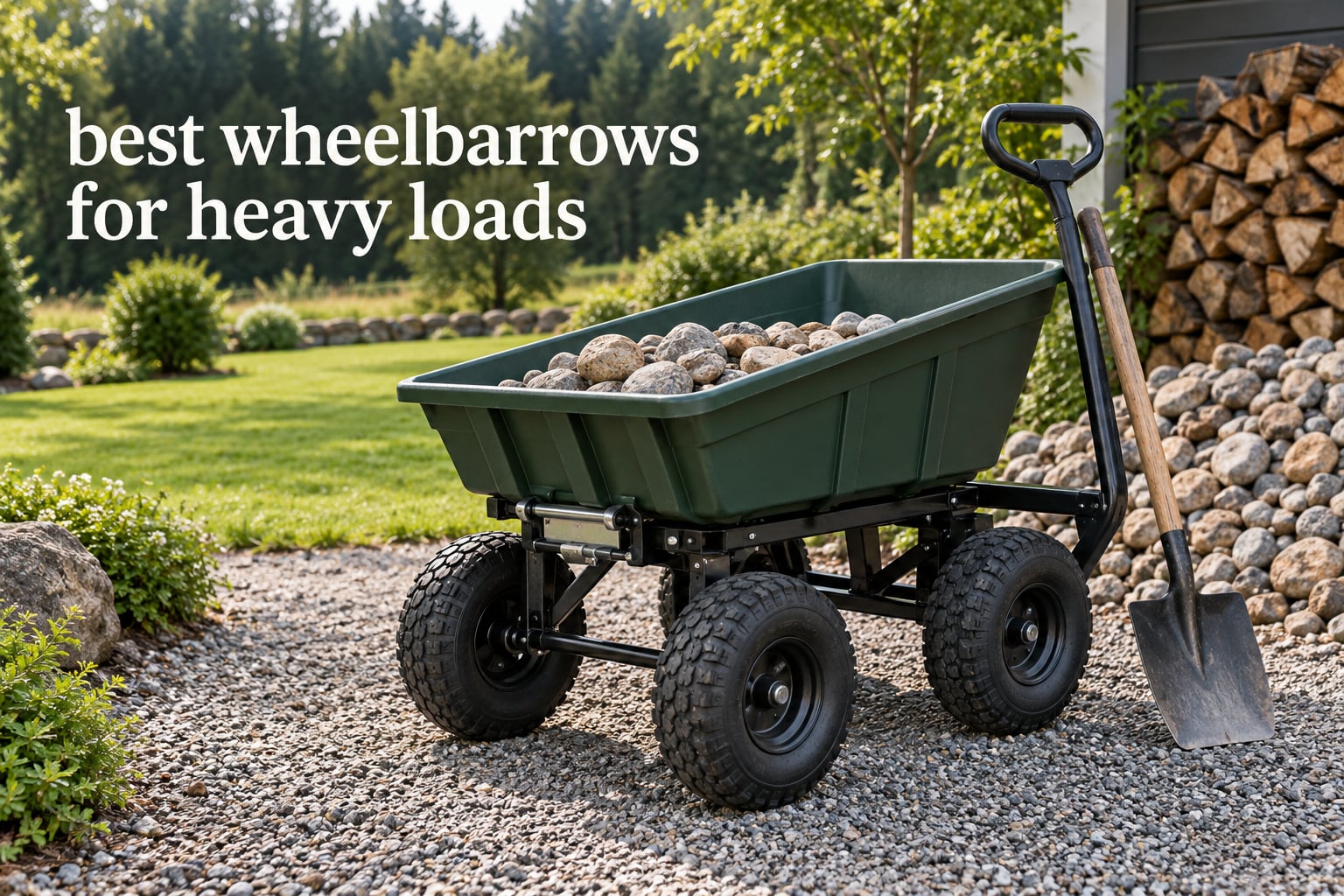
Most wheelbarrows sold in 2026 are rated 300 to 330 pounds, and most people quietly ignore that number. A 6 cubic foot tray filled level with wet mortar weighs more than 700 lb, so a cheap barrow is not just wobbly under a real load. It bends the frame, splits the handles and puts the whole dump on the ground.
This is a roundup of the best wheelbarrows for heavy loads we could find, all ten of which publish a real weight rating rather than a marketing number. We grouped them by what they actually do: bulk hauling carts for gravel and firewood, steel-tray barrows for mortar and concrete, and lighter two-wheel carts for mulch and yard debris.
We also spent time on the number nobody else explains. Capacity in cubic feet is close to meaningless on its own, because a cubic foot of mulch and a cubic foot of river rock differ by more than 100 lb. By the end of this guide you should be able to look at any wheelbarrow spec sheet and know in about five seconds whether it can take the load you are planning to move.
Last updated for 2026. We refreshed the list against current listings and current customer review data, and we flag the failure modes that show up repeatedly in reviews rather than the marketing language on the box.
Table of Contents
Top 3 Picks for Heavy Loads (October 2026)
If you want the short version: the Gorilla Carts GOR4G-COM is the one we would buy, the WORX Aerocart is the one we would buy if our back hurts, and the BILT HARD is the one we would buy to avoid ever pumping a tire again.

Gorilla Carts GOR4G-COM
- 600 lb capacity
- Quick-release dump
- 10 inch pneumatic tires
- 36 by 20 inch poly bed
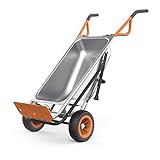

BILT HARD GCB-1101
- 600 lb capacity
- 4 cu ft poly bed
- 10 inch no-flat tires
- 180 degree handle
How We Evaluated These Wheelbarrows
Every model here was judged on published weight rating, tray material and volume, wheel and tire configuration, frame construction, and how the product holds up under dense material in customer reviews.
We weighted the weight rating most heavily, because a barrow that fails at 350 lb is not a heavy-duty barrow no matter what the box says. We also read the one-star reviews, since assembly complaints, cracked poly lips and rusted welds are the things that show up in real use and never in a spec sheet.
Quick Comparison of All 10 Picks (October 2026)
Every model listed here publishes a capacity in pounds. Volume in cubic feet is included where the manufacturer states it.
| Product | Specifications | Action |
|---|---|---|
| Gorilla Carts GOR4G-COM Poly Yard Dump Cart |
|
Check Latest Price |
| WORX Aerocart WG050 |
|
Check Latest Price |
 Best Choice Products Dual-Wheel Cart Best Choice Products Dual-Wheel Cart |
|
Check Latest Price |
| BILT HARD GCB-1101 |
|
Check Latest Price |
 VEVOR 1200 lb 7 Cu Ft Dump Cart VEVOR 1200 lb 7 Cu Ft Dump Cart |
|
Check Latest Price |
 VEVOR 600 lb Poly Dump Cart VEVOR 600 lb Poly Dump Cart |
|
Check Latest Price |
 Rubbermaid Commercial 8.75 Cu Ft Cart Rubbermaid Commercial 8.75 Cu Ft Cart |
|
Check Latest Price |
 CAMMOO TF-S900 CAMMOO TF-S900 |
|
Check Latest Price |
 True Temper 6 Cu Ft Steel Wheelbarrow True Temper 6 Cu Ft Steel Wheelbarrow |
|
Check Latest Price |
 Amazon Basics 330 lb Wheelbarrow Amazon Basics 330 lb Wheelbarrow |
|
Check Latest Price |
Load Capacity vs Volume: What a Cubic Foot Really Weighs
Here is the part most buying guides skip. Volume tells you how big the pile is. Weight tells you whether the barrow survives. These are very different numbers for the same tray.
The figures below are approximate bulk weights for common jobsite and yard materials, and the right-hand column is what a 6 cubic foot tray holds when filled level rather than heaped.
Dry mulch: about 15 lb per cubic foot, so roughly 90 lb in a 6 cu ft tray
Split firewood, stacked: about 35 lb per cubic foot, roughly 210 lb
Screened topsoil, dry: about 80 lb per cubic foot, roughly 480 lb
Sand: about 95 lb per cubic foot, roughly 570 lb
Gravel: about 100 lb per cubic foot, roughly 600 lb
River rock: about 110 lb per cubic foot, roughly 660 lb
Wet concrete or mortar: about 120 lb per cubic foot, roughly 720 lb
That is the whole problem in one line. A barrow can be full of mulch at 90 lb and feel empty, then get two thirds full of gravel and be sitting on 400 lb. Volume never tells you which of those two situations you are in.
The practical rule our team uses: multiply your material weight per cubic foot by the tray volume, then stay at or under the published pound rating. If the math lands above 400 lb, buy a four-wheel cart rated 600 lb or more instead of a steel barrow rated 300 lb.
1. Gorilla Carts GOR4G-COM Poly Yard Dump Cart: Best Overall for Heavy Loads
- Patented quick-release dump unloads fast
- 600 lb rating with a roomy 36 by 20 in poly bed
- Pneumatic tires steer tightly over uneven ground
- Steel frame and rust-resistant tub hose clean
- Straight pull handle is comfortable on long hauls
- Pneumatic tires need periodic inflation
- Four-wheel layout is bulkier than a single-wheel barrow
This is the barrow we kept coming back to. With over 30,000 reviews and a 4.7 average, it has the most owner history of anything in this guide, and the review pattern is unusually consistent. People buy it for the 600-pound rating and stay because of the dump mechanism.
Lifting the handle releases the tub forward, which means you are not fighting a latch with a gloved hand while standing in mud. On a job where you run twenty loads, that mechanism is the difference between a barrow you use and one you let your crew take instead.
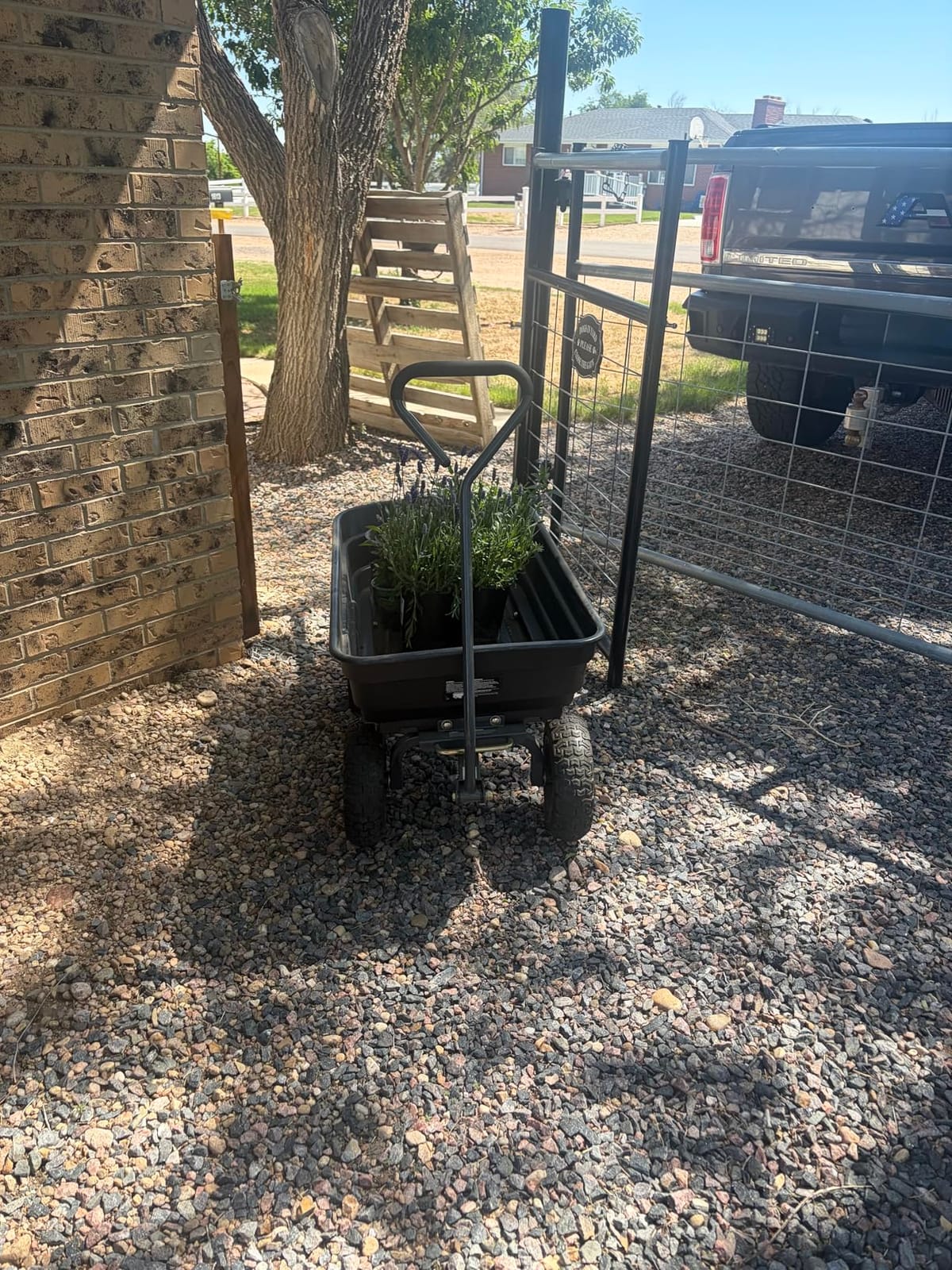
The 10-inch pneumatic tires are the right call for uneven ground, which is most ground. They soak up ruts and soft spots that a solid tire would just bounce off, and reviewers repeatedly mention how tightly it steers despite being four wheels wide.
The poly tub will not rust, and it wipes clean after a mortar day in a way a steel tray never will. The 36 by 20 inch bed is shallow relative to its width, which keeps the center of gravity low and the barrow planted when you tip it forward to spread gravel.
Who should buy the GOR4G-COM
Landscapers, contractors and serious homeowners hauling mulch, gravel, firewood and yard waste in bulk. If your loads are bulky more than they are dense, this is the right shape.
It is also the model most often recommended on gardening forums for anyone moving bagged soil or rolled sod, because the straight pull handle keeps the load level while you steer.
Who should skip it
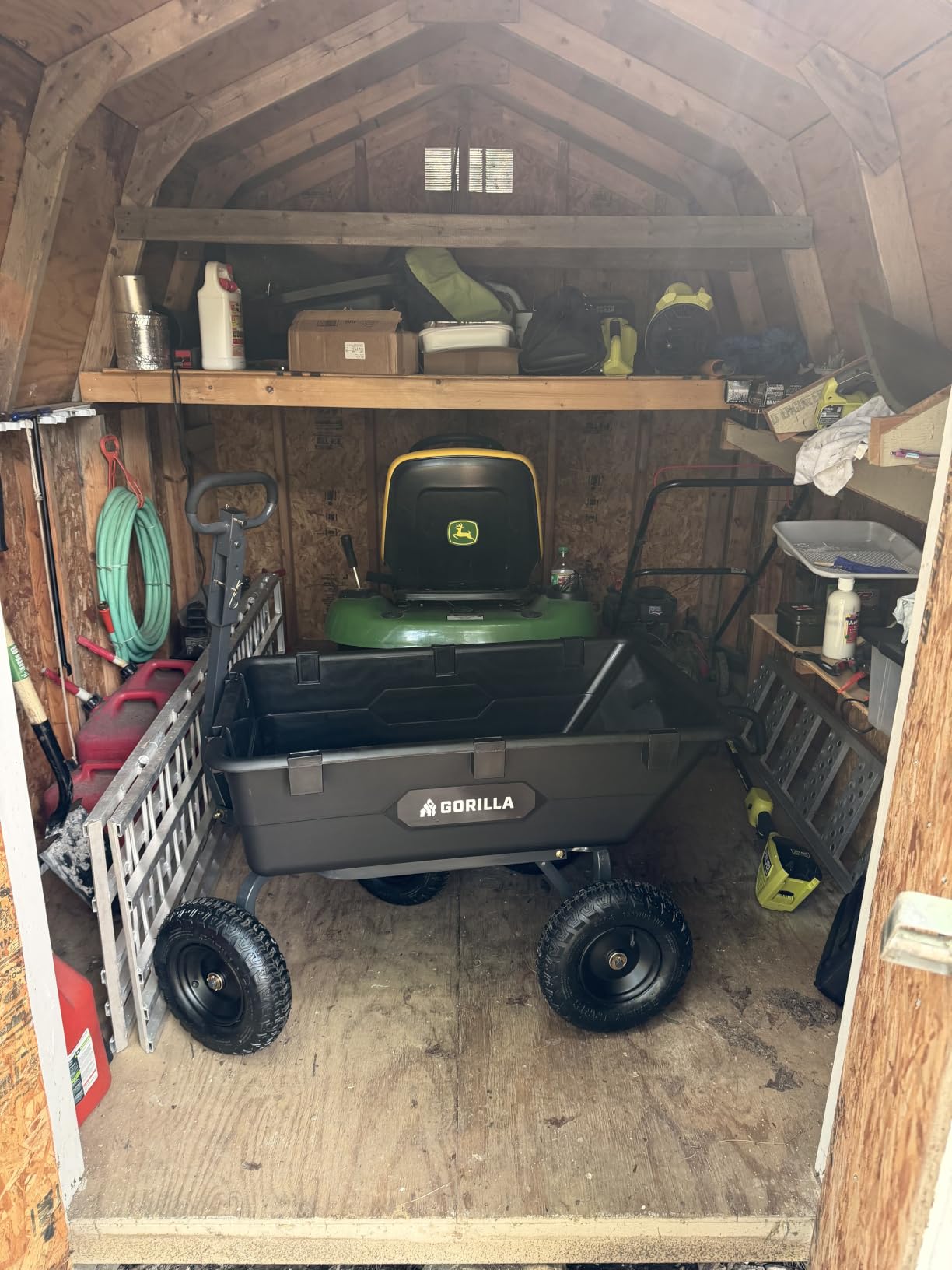
Anyone who will constantly load sharp debris or concrete rubble into the tub, since a poly bed will crack eventually where steel would dent. Also skip it if you have nowhere to store a 38 inch cart, since it does not knock down the way a barrow does.
And if you refuse to check tire pressure, look at the flat-free options further down. Pneumatic tires are the one recurring maintenance complaint on this cart.
2. WORX Aerocart WG050: Best Value for Heavy Loads With a Bad Back
- Turbo Lift geometry makes heavy loads feel far lighter
- Converts between barrow hand cart and dolly
- All-metal corrosion-resistant construction
- Flat-free tires need no inflation
- Includes bag holder cylinder holder and rock mesh
- Tub is smaller than a full-size wheelbarrow
- Rigid flat-free tires add effort on soft ground
- Finish shows rust when stored outdoors
This is the only product in the roundup that describes itself as a heavy-duty wheelbarrow and is not one. The WORX Aerocart is a two-wheel convertible cart, and the reason it makes this list is the way it handles weight rather than how much of it it carries.
The Turbo Lift geometry changes the balance point so the load rides over the axle instead of behind it. Owners describe carrying a 200 lb load that feels like a fraction of that, and with 6,385 reviews at a 4.5 average, that effect is not just a brochure claim.
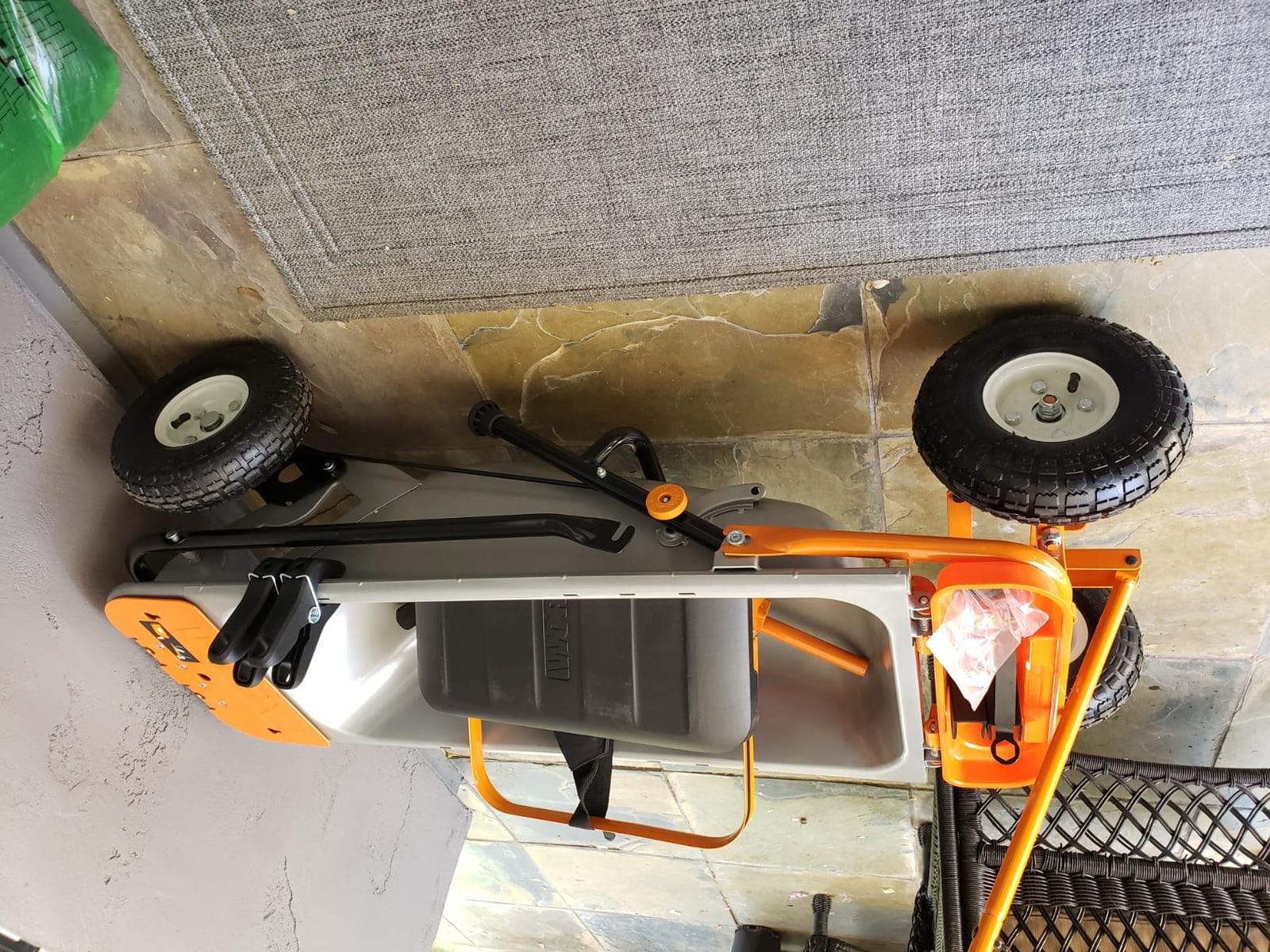
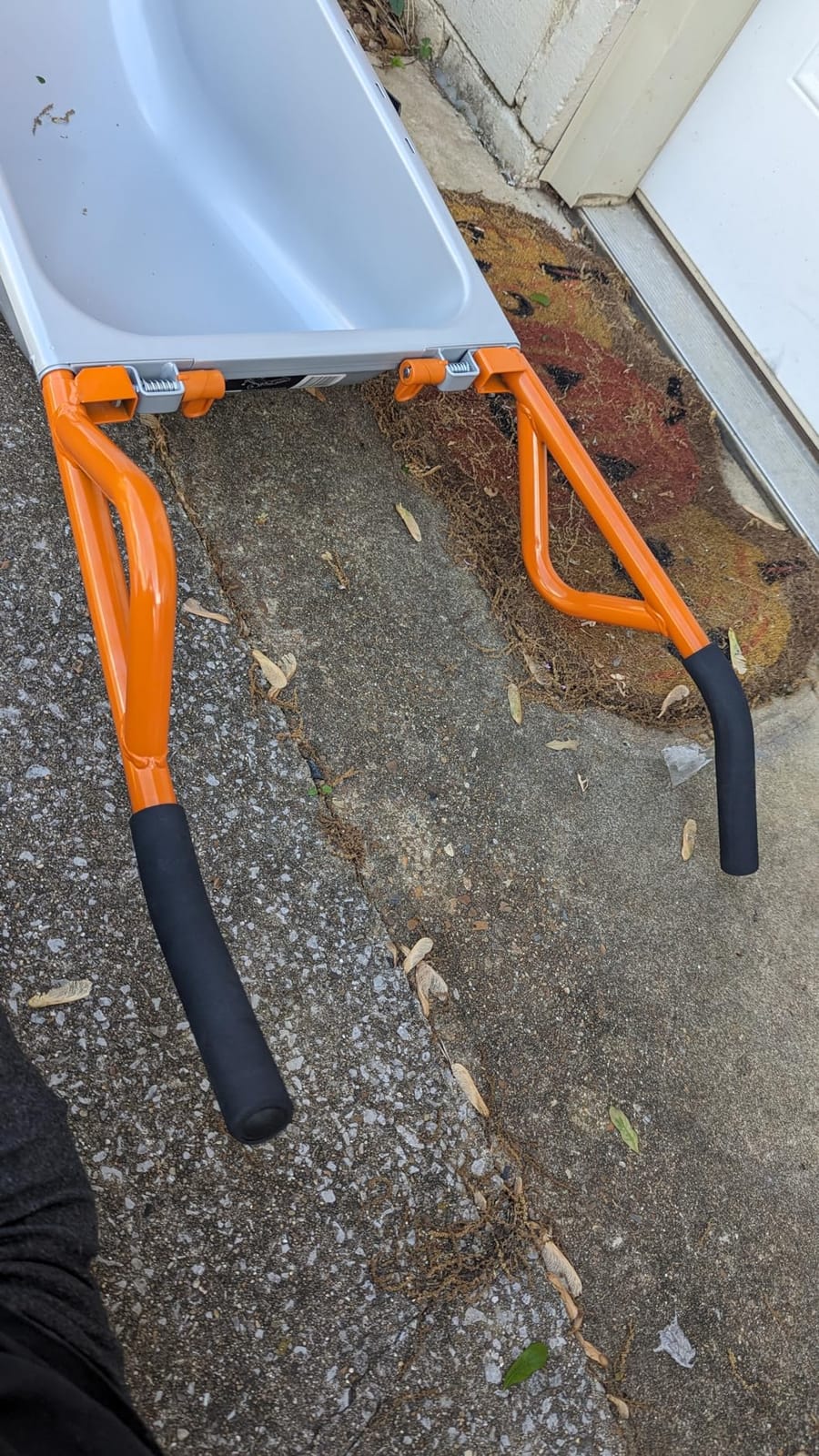
The 8-in-1 design is genuinely useful rather than marketing filler. The same frame becomes a plant mover, a firewood hauler with the mesh attachment, and a dolly for lifting things onto a truck bed. Dual support legs let you load it without a second person steadying it.
Flat-free tires mean no pump, no patches, no kneeling in the driveway at dusk. For someone who is not fussy about the ride quality, that is a straight trade in favor of the tool.
Who should buy the Aerocart
Anyone over 50, anyone with a back or joint issue, and anyone who does not want to tip a big tub to clear leaves. The narrow 23 by 20 inch footprint also stores upright in a garage, which the four-wheel carts in this list do not.
It is a strong choice for mulch, topsoil bags, firewood and light yard waste spread over a season rather than a day of concrete work.
Who should skip it
Do not use it as a mortar barrow. The tub is smaller than a traditional wheelbarrow, the 300-pound ceiling is well below the carts rated 600 and 1200 lb, and wet concrete will find every seam.
Also expect more effort on soft ground. Reviewers note the rigid flat-free tires transmit every rut straight up into the handles, and the finish needs a cover if it lives outside.
3. Best Choice Products Dual-Wheel Cart: Best for Home Projects on Uneven Ground
Best Choice Products Dual-Wheel Home Utility Yard Wheelbarrow Garden Cart w/Built-in Stand for Lawn, Gardening, Construction – Green
- Large 14 inch wheels roll easily over varied terrain
- Dual-wheel layout is stable and will not tip
- Handlebar doubles as a built-in stand
- Powder-coated frame resists rust
- Tips upright for storage
- 330 lb rating is modest for dense material
- Listings disagree on whether tires are inflatable
- Plastic bin can flex under point loads
This is the cart we recommend to a homeowner who is not trying to run a business with it. At 21 pounds empty, it is the lightest thing in the roundup, and the 14-inch wheels are the biggest tires on any two-wheel model here.
Wheel size matters more than most people expect. Bigger wheels clear rocks, roots and garden edging instead of stopping dead, which is the difference between moving a pile of topsoil and moving it one shovel at a time.
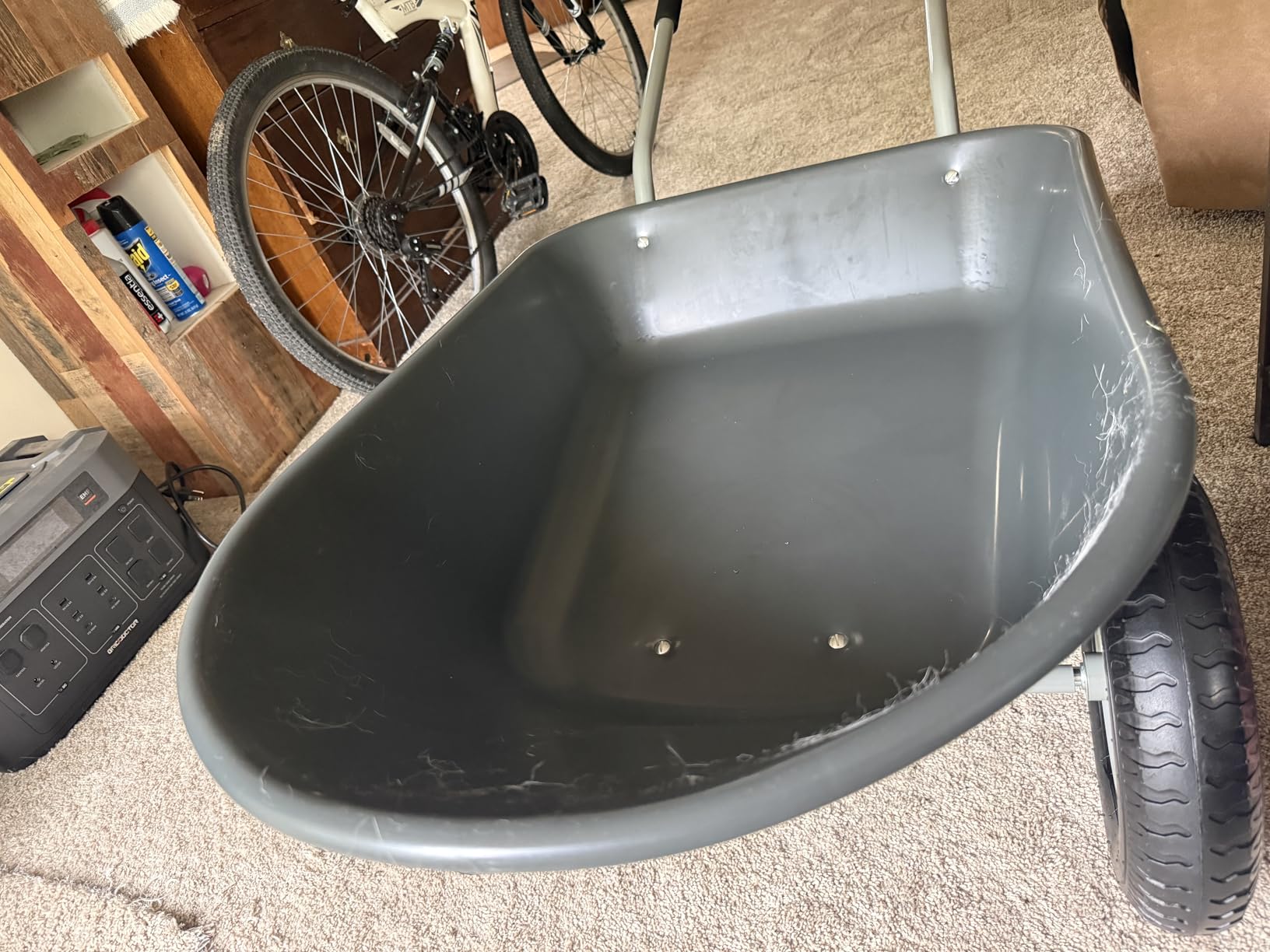
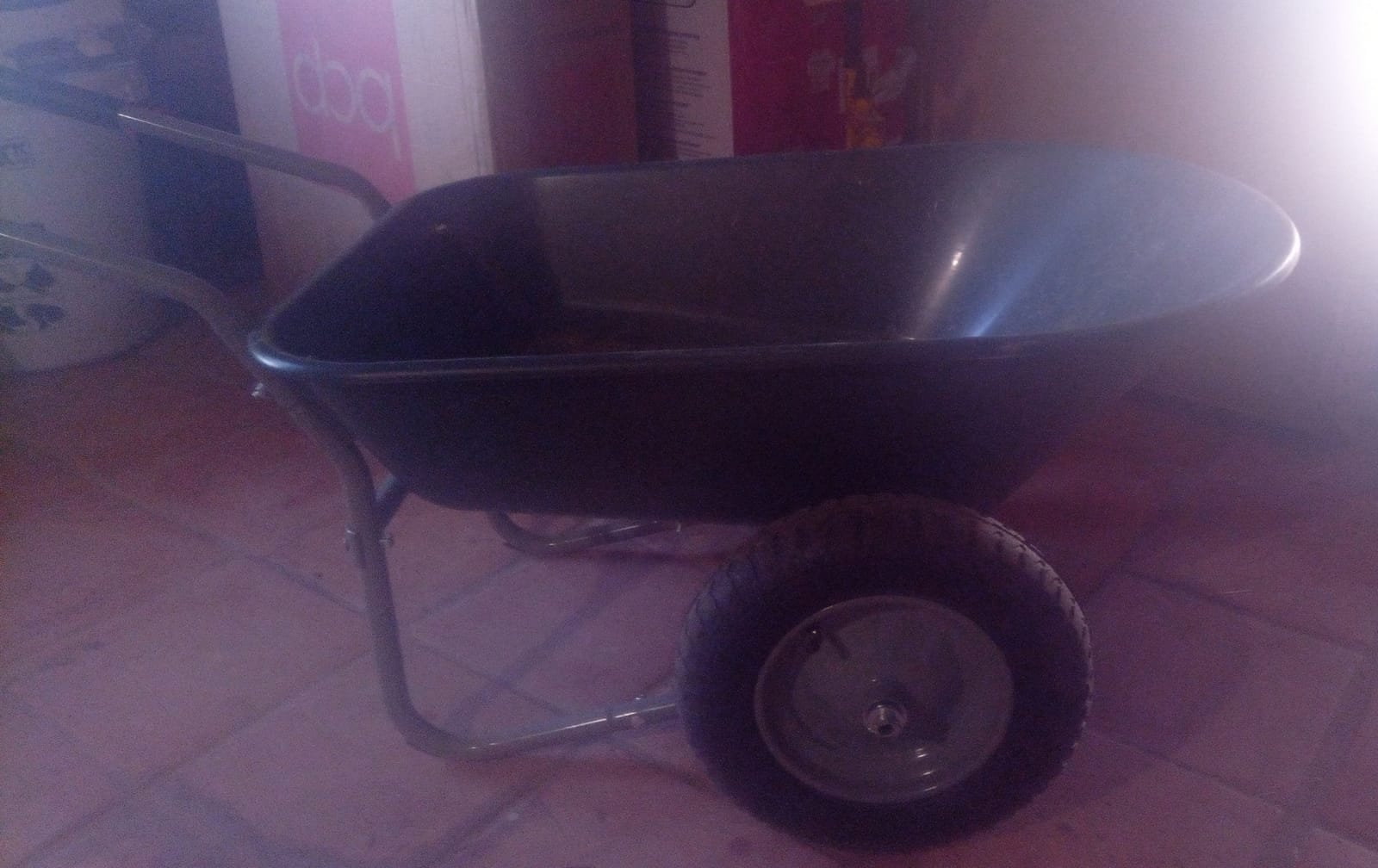
The dual-wheel layout is another genuine advantage. A single-wheel barrow tips if you hit a rut at the wrong angle, and the 5,341 reviews at 4.3 average keep mentioning that this one just keeps going upright.
Two small details earn their keep. The handlebar doubles as a stand, so it parks itself. And the whole cart tips onto its nose to store upright against a wall, which matters a lot in a two-car garage.
Who should buy the dual-wheel cart
Homeowners on uneven ground, gravel driveways or sloped lots. Anyone hauling bagged material, mulch, leaves or light yard debris where trips are measured in tens, not hundreds.
It is also the easiest model here to lift into a vehicle or carry down basement steps when empty, which makes it a good backup tool for small jobs.
Who should skip it
Skip it for gravel, river rock or concrete work. The 330-pound rating is below what a 5 cubic foot bin of wet concrete weighs, and reviewers report the plastic bin flexing under sharp point loads.
There is also a sourcing inconsistency worth flagging. Some listings describe the wheels as inflatable while the spec sheet says flat-free, so confirm which you are getting before you buy and plan for either maintenance or not.
4. BILT HARD GCB-1101: Best Heavy Duty Cart With No-Flat Tires
- No-flat tires roll over any terrain with no inflation
- 600 lb rating paired with a rust-proof poly bed
- 180 degree rotating handle tightens maneuvering
- Quick-release dump unloads by lifting the handle
- Heavy steel frame keeps movement stable
- Poly bed is less rigid than steel for sharp material
- Solid no-flat tires ride harder on rough ground
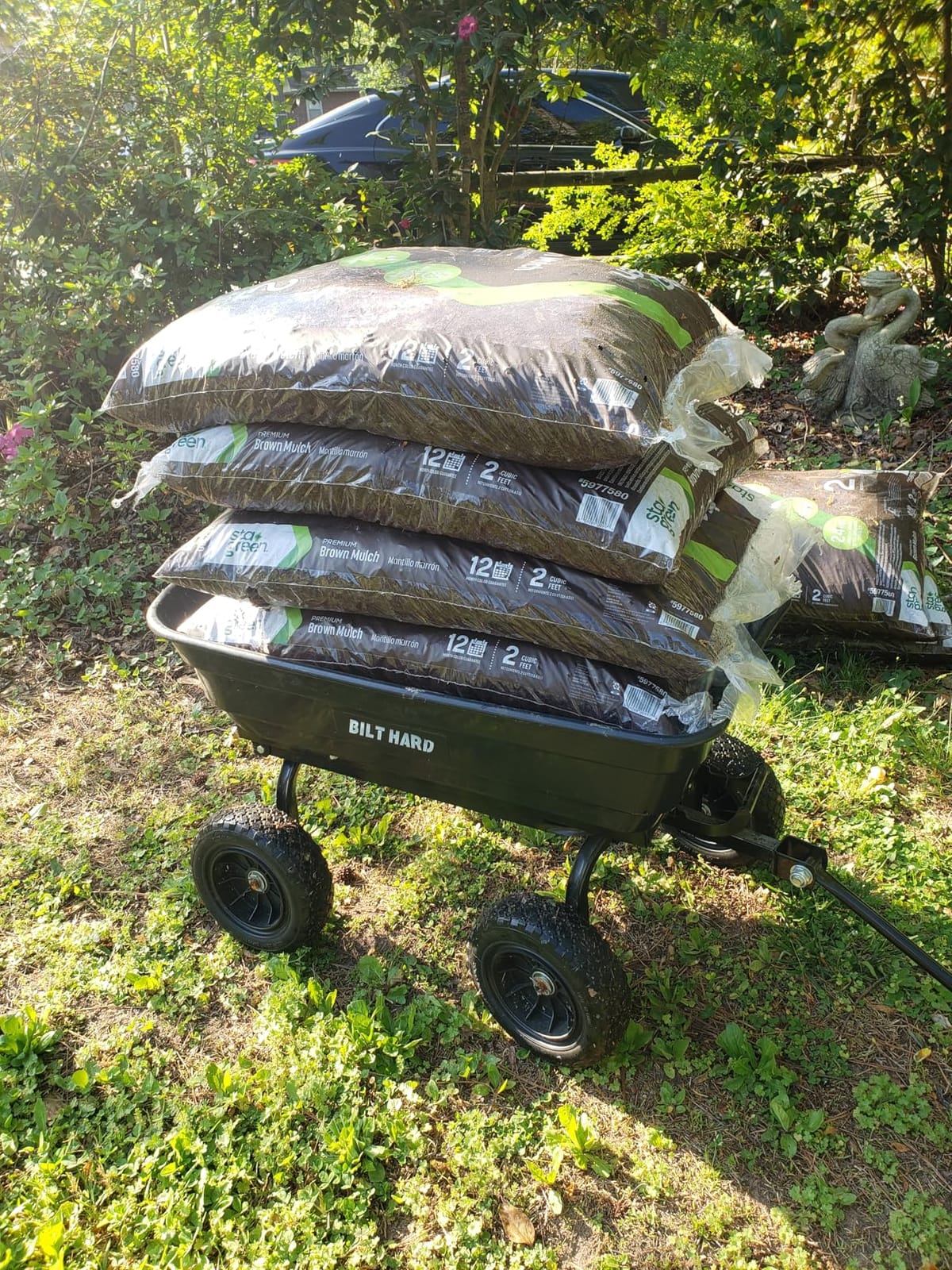
The BILT HARD is the answer to a common argument: flat-free tires are usually either narrow and twitchy or cheap and cracked. This one uses 10-inch no-flat tires with a 600-pound rating behind them, which is a rare combination.
With 2,126 reviews at a 4.5 average and 78 percent five-star, owners consistently name the same thing: capacity and zero maintenance. The tub unloads with a simple lift of the handle, so you are not dealing with a latch that jams in wet weather.
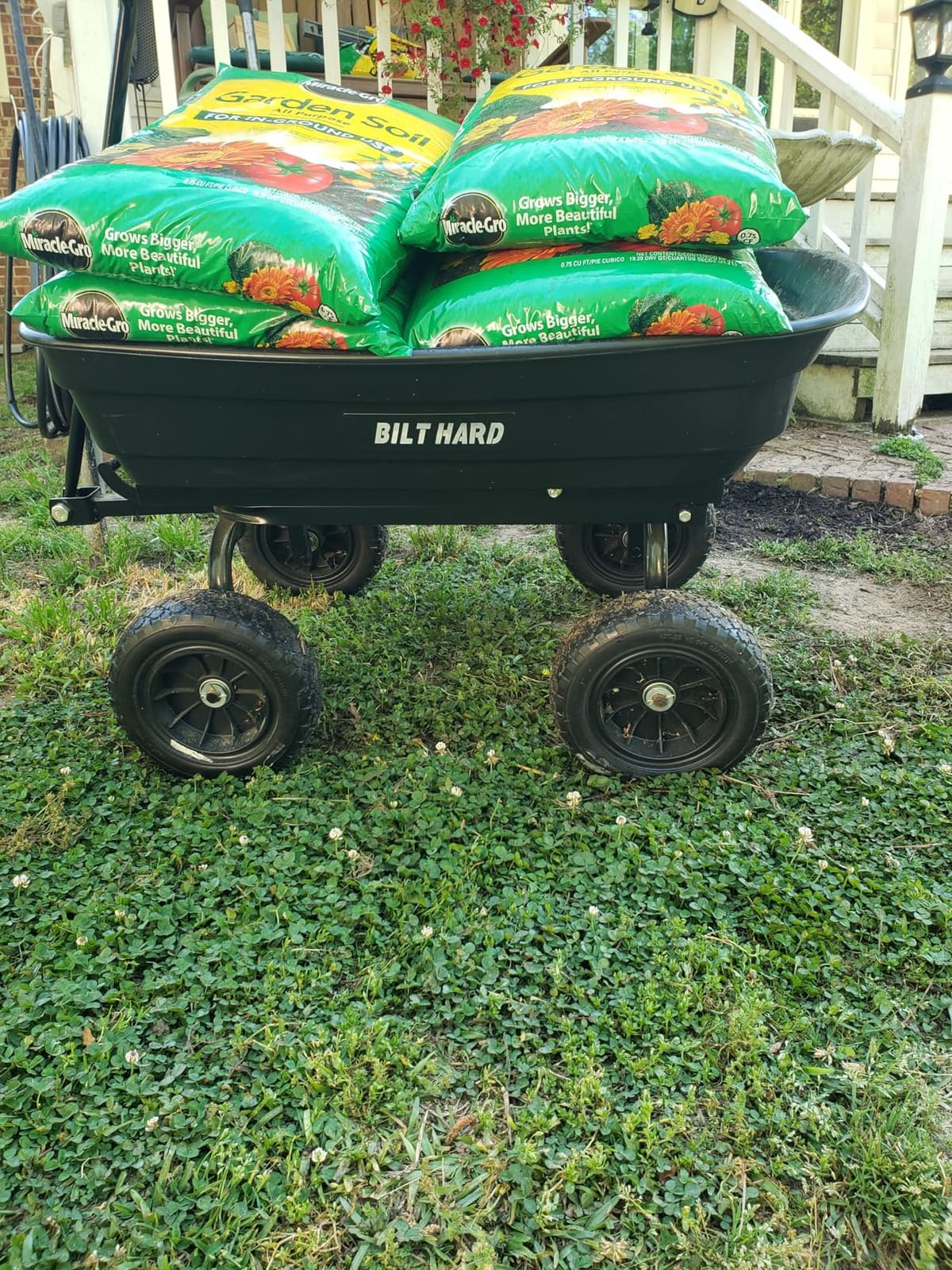
The 180-degree rotating handle is a small feature that makes a real difference in a tight yard. It lets you pivot the bed without pivoting the whole cart, which saves a lot of shuffling when you are working between a house wall and a fence.
The bed is 36.5 by 20 inches of rust-proof poly on a heavy steel frame, and the manufacturer backs it with a one-year warranty including free exchange for quality problems.
Who should buy the BILT HARD
Property maintenance crews, farm and small-landscape work, and anyone who hauls daily and refuses to own a pump. No-flat tires also handle mud, gravel and job-site debris without the punctures that end a pneumatic tire.
It is a strong pick for firewood, brush, leaves and gravel runs where the load is dense but not sharp.
Who should skip it
Skip it for sharp debris, broken concrete or brick, where reviewers note the poly bed has less rigidity than a steel tray and can crack at the front lip when tipped forward hard.
Expect a firmer ride too. Solid no-flat tires have no give, so on uneven ground you feel every rut through the handle, and the 4 cubic foot bed means more trips than the bigger carts require.
5. VEVOR 1200 lb 7 Cu Ft Dump Cart: Best Maximum Load Rating
VEVOR Heavy Duty 1200lbs 7 Cu.Ft Wheelbarrow Garden Dump Cart Wagon
- 1200 lb rating is the highest here
- Handle converts to a tow trailer for an ATV or tractor
- 13 inch all-terrain tires absorb bumps and slopes
- Quick-release dump frame and 180 degree handle
- Mesh cover and cushion keep loads secure
- 79.5 in length is bulky to store
- Wide 31.7 in stance limits tight turns
Nothing else in this guide is rated 1200 pounds. If your definition of heavy load is a full load of river rock or broken concrete, this is the only model here rated to survive the trip.
The 2-in-1 convertible handle is the feature nobody else on this list offers. Flip it and the cart becomes a trailer you connect to an ATV, UTV, tractor or mower, which is how most contractors move heavy material over distance once the pile gets far from the work area.
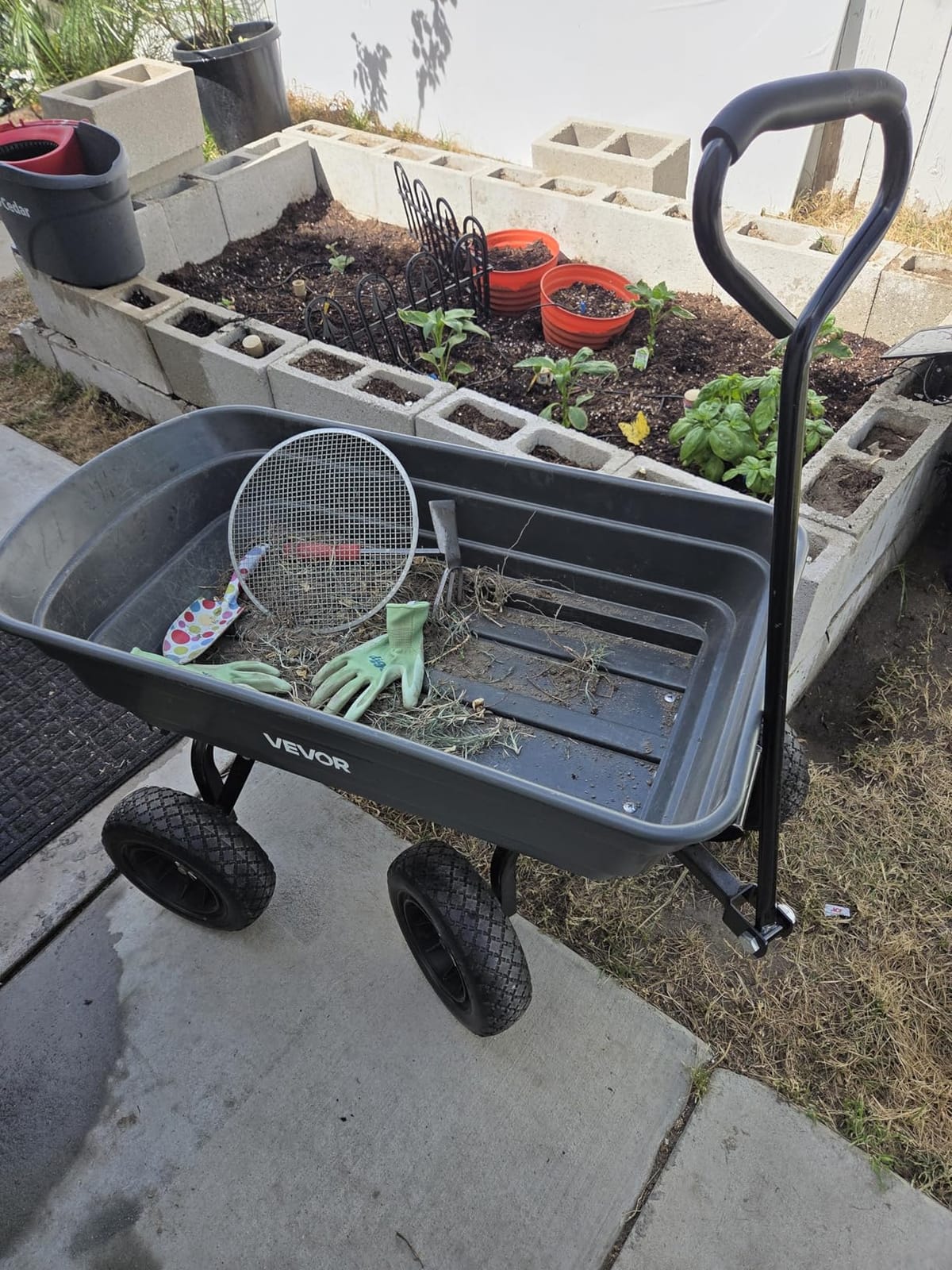
Thirteen-inch all-terrain rubber wheels are the biggest tires on any four-wheel model here, and reviewers point out how much better they absorb uneven ground and grassy slopes compared with the 10-inch wheels on most carts.
At 4.4 stars across 1,463 reviews, satisfaction is solid. The bed is 6.48 cubic feet, which cuts the number of trips noticeably, and the included mesh cover and cushion keep bagged material from sliding out on ruts.
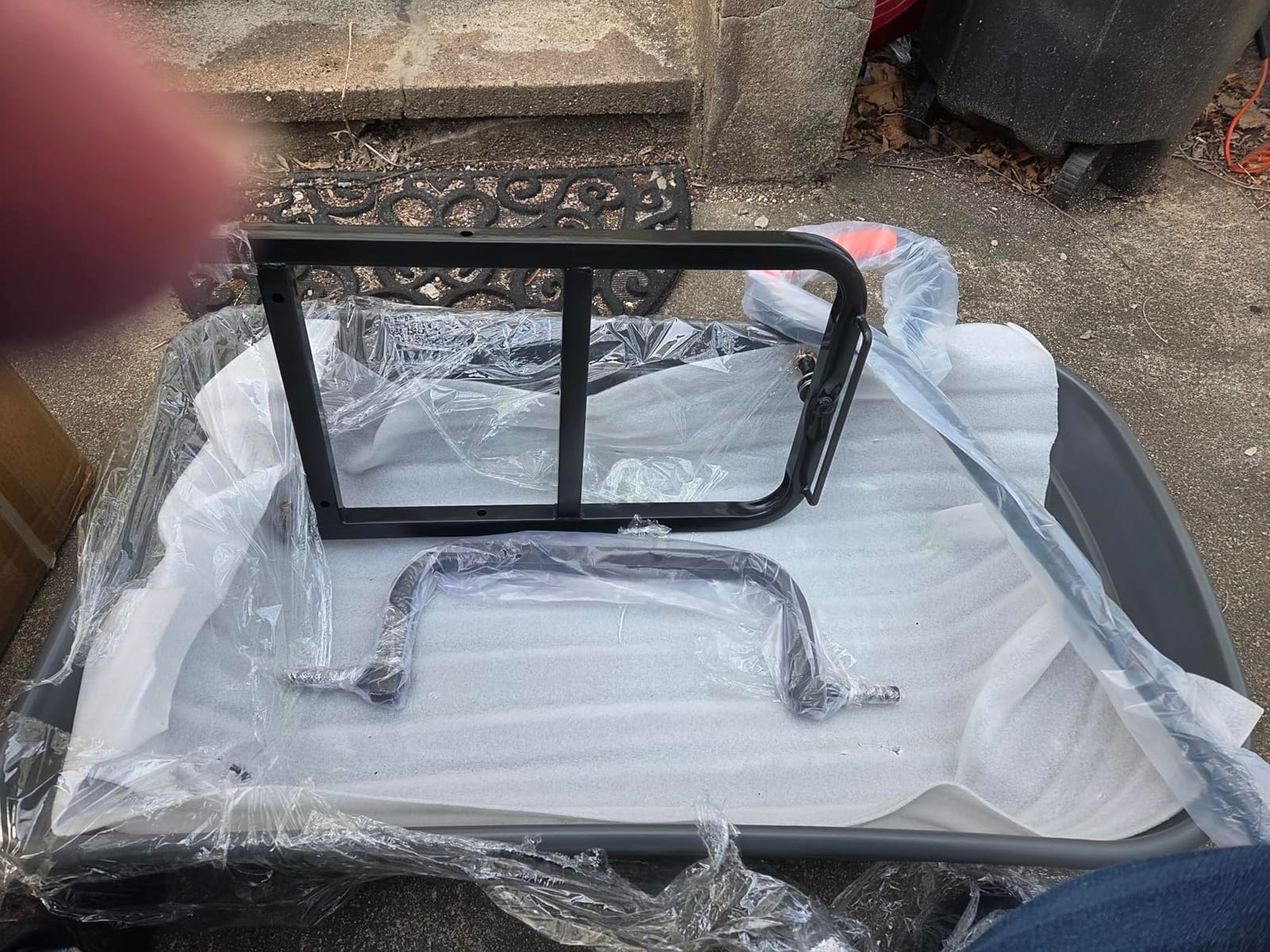
Who should buy the VEVOR 1200 lb cart
Contractors, landscapers, farmers and anyone moving genuinely heavy material in bulk. The towable handle makes it a strong fit on large properties where the work area is far from the pile.
It is the one to pick if you plan to move gravel, rock, sod pallets or demolition debris rather than mulch.
Who should skip it
Skip it if you have a small shed. At 79.5 inches long and 31.7 inches wide, this is the bulkiest cart in the roundup, and reviewers name storage as the most common complaint.
The wide stance also makes it awkward through gates and between tight obstacles, so it works best on open ground with a clear path to the dump.
6. VEVOR 600 lb Poly Dump Cart: Best for Bulk Hauling That Still Fits in a Shed
VEVOR Poly Garden Dump Cart 4 Cu.Ft. 600 lbs 4 Wheel Wheelbarrow Dump Wagon
- 600 lb rating at a lower entry point
- 3mm thick polypropylene bed with metal brackets
- 10 inch tires absorb bumps on uneven ground
- 180 degree handle and quick-release dump
- A scratch-resistant coated metal frame
- 74.8 in overall length is bulky to store
- PP tub is less durable than steel with sharp debris
- Four-wheel design widens the turning radius
This is the smaller sibling of the VEVOR 1200-pound cart, and it is a better fit for most people simply because it is narrower at 25 inches and takes up less room when parked.
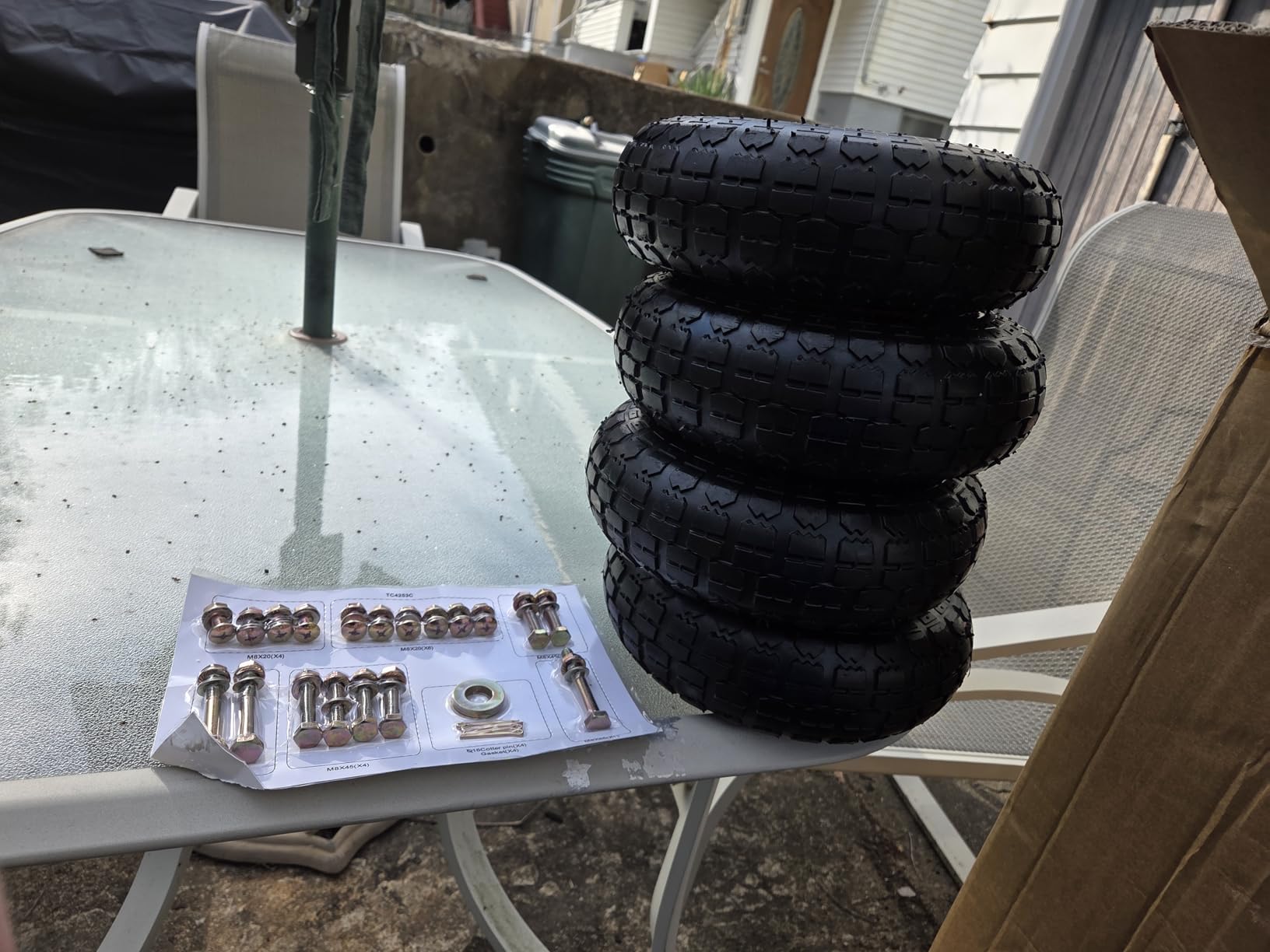
The bed is built from 3mm thick polypropylene reinforced with 25mm metal brackets at the stress points, which is the detail that keeps a poly tub from deforming under a heavy load. Reviewers confirm it holds its shape.
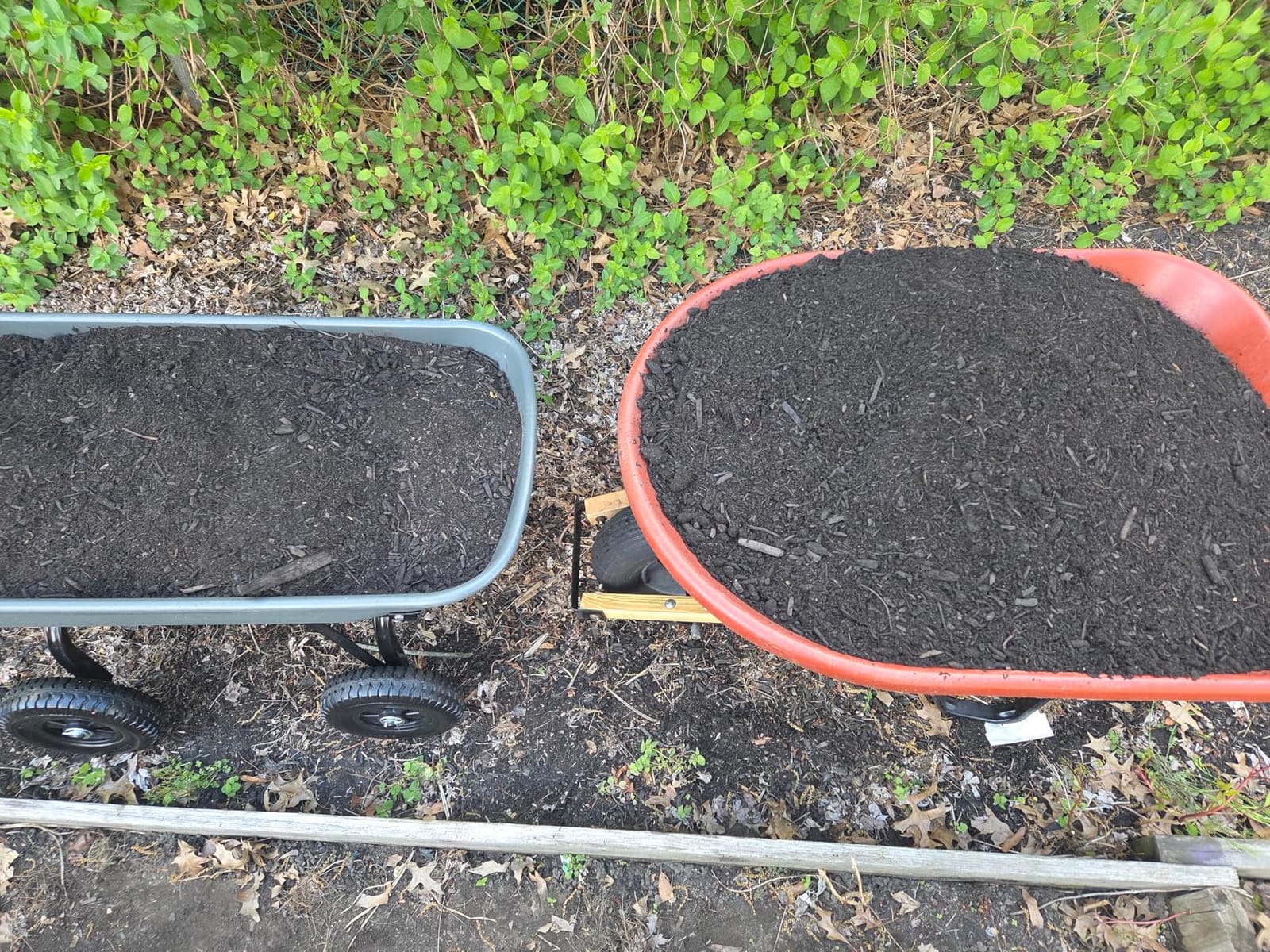
With 1,467 reviews at a 4.4 average and the same 73 percent five-star share as its bigger brother, buyers treat it as the sensible middle option. The 600-pound rating is a genuine contractor number, not a decorative one.
The 10-inch rubber tires give better shock absorption over uneven garden terrain and grassy slopes than a narrow solid wheel, and the quick-release front dumping frame makes unloading a one-handed motion.
Who should buy the 600 lb VEVOR cart
Anyone who wants a true 600-pound rating in a cart that is not enormous. It suits landscaping, hardscape prep and general yard work on properties with moderate storage space.
It is a good match if you want a four-wheel footprint for stability but do not need the towing capability or the 1200-pound ceiling of the larger model.
Who should skip it
Skip it for sharp or abrasive material, where the polypropylene tub is the weak point. It also still measures 74.8 inches end to end, so it is not the storage answer in a very small building.
Like the larger VEVOR, the four-wheel layout adds turning radius, so it is not the right tool for tight side yards and narrow gates.
7. Rubbermaid Commercial 8.75 Cu Ft Cart: Best for Bulk Volume
Rubbermaid Commercial Products Big-Wheel Yard Cart, 8.75 Cubic Feet, Black
- Largest tub volume of any model in this roundup
- 20 inch five-spoke wheels clear grass and gravel easily
- Seamless HDPE body is rust-proof and easy to hose off
- Flat-free pneumatic-style wheels need no inflation
- Ergonomic handles reduce lifting strain
- 300 lb rating is low for a tub this large
- Heaviest cart here at 49.5 lb empty
- Costs more than plastic four-wheel carts
This cart holds nearly three times the volume of a typical 3 cubic foot barrow tray, and for light material that is the whole point. Mulch, leaves, grass clippings and sod go in at a volume that would take many more trips in anything else on this list.
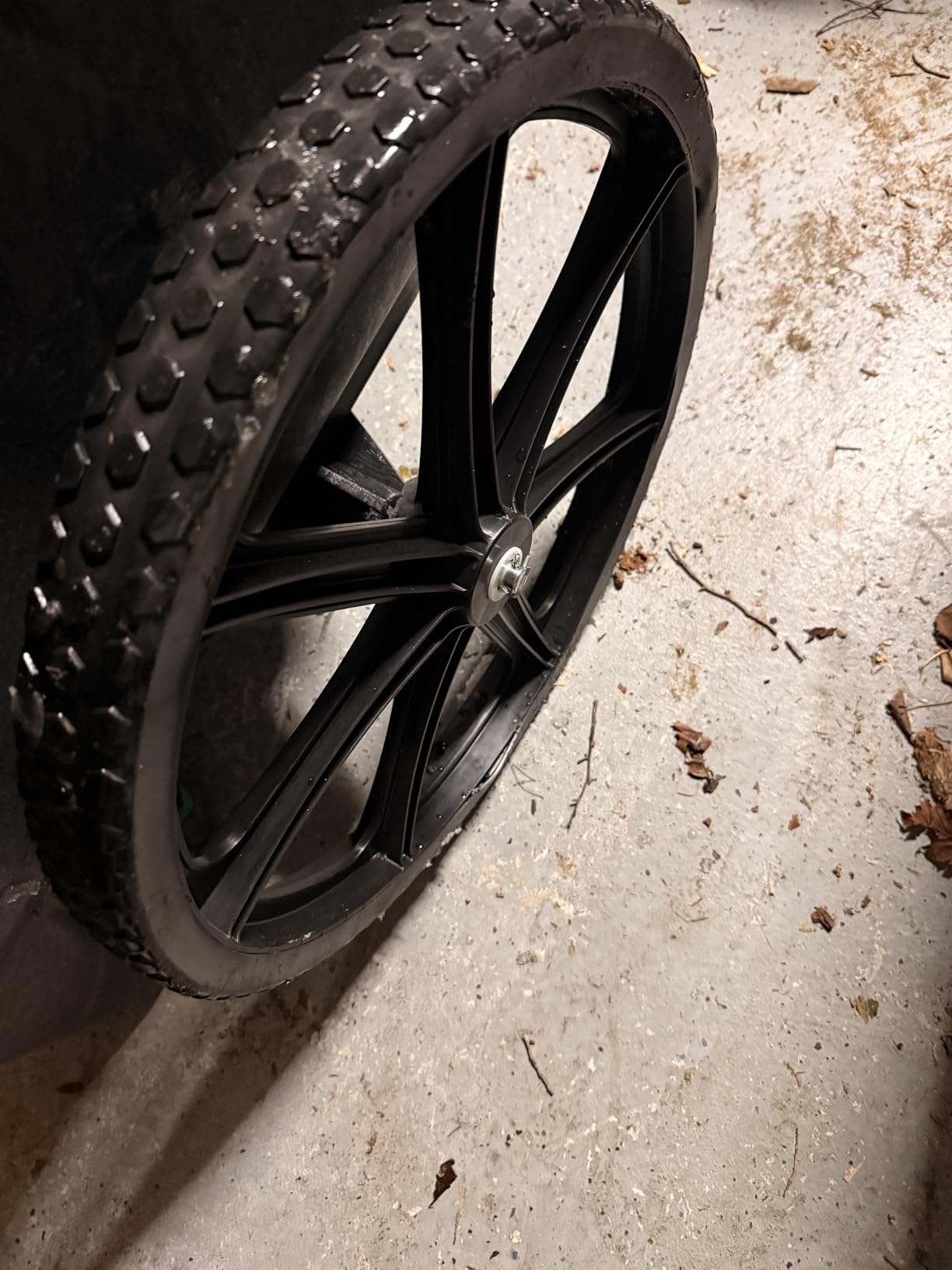
The 20-inch five-spoke flat-free wheels are the largest in the roundup and roll over grass, gravel and uneven ground without the drag of a narrow tire. At 4.6 stars from 419 reviews with 84 percent five-star, owners are consistently happy with how it moves.
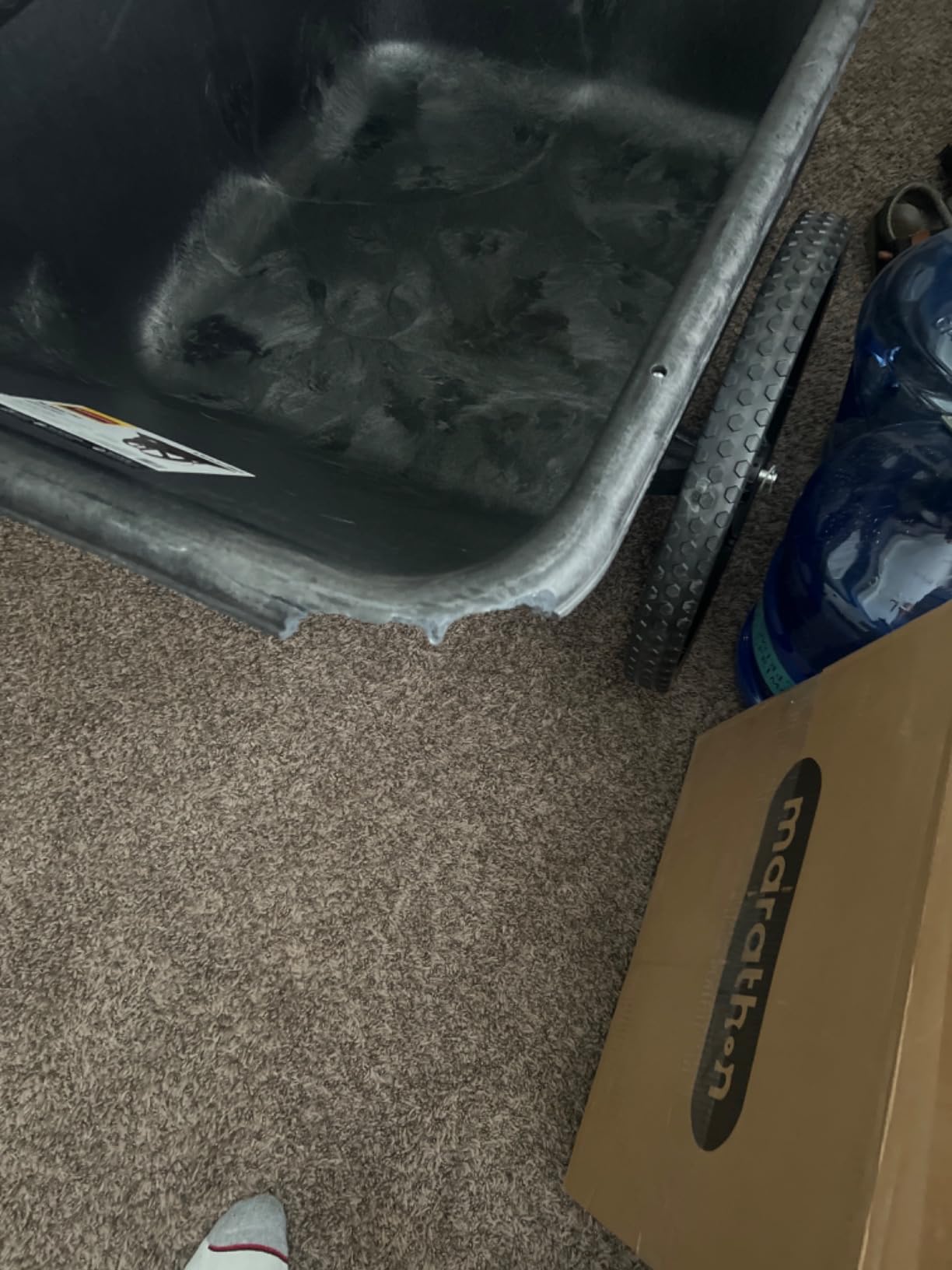
The seamless high-density polyethylene body has no seams for concrete slurry to settle into, and it is manufactured in Winchester, Virginia. Rubbermaid Commercial Products builds this as a commercial service cart, not a garden toy.
Ergonomic handles are shaped to reduce shoulder and back strain when you tip the tub, and the smooth body design means a hose is the entire cleaning routine.
Who should buy the Rubbermaid 8.75 cu ft cart
Anyone moving light but bulky material in volume: mulch, leaves, sod, grass clippings and yard waste. The wide tub means fewer trips, and the flat-free wheels mean fewer reasons to stop working.
It is a good fit for grounds maintenance and large-property work where trips across a lawn are the main cost.
Who should skip it
Skip it for dense material, and this is the important caveat. A 300-pound rating next to an 8.75 cubic foot tub is a mismatch. Owners fill it with gravel and find out quickly that the volume does not translate into poundage.
Also consider the 49.5-pound empty weight, the heaviest cart in this guide, which makes it awkward to reposition empty and tiring to lift over a curb.
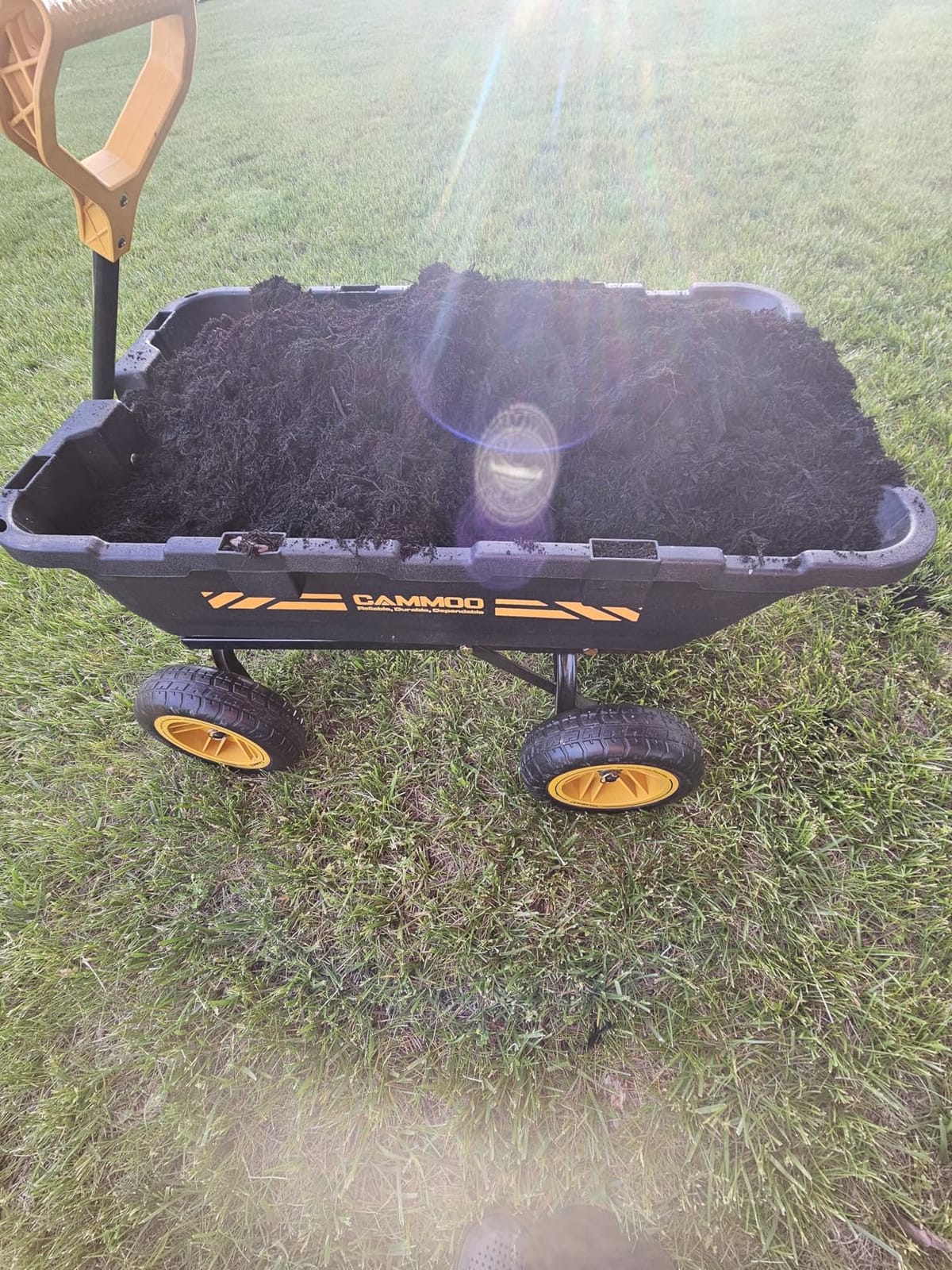
8. CAMMOO TF-S900: Best for Gravel, Rock and Rough Ground
CAMMOO 10-in NO-Flat Tires 900lb Garden Dump Cart Wheelbarrow Garden Wagon
- 900 lb rating in a compact 39.4 in frame
- Deep-tread no-flat tires grip mud gravel snow and turf
- Dual steel bearings smooth the roll
- Expandable side slots for bulky loads
- Triangulated rear supports and locknuts add rigidity
- Ridged bed floor means flat items sit unevenly
- Heavier than most four-wheel carts when empty
- Expansion boards are not included
This cart pairs the joint-highest rating in the roundup at 4.7 stars with the best structural story. Owners specifically mention the triangulated rear rods and the 100 percent locknuts, which are the parts that usually fail on cheaper carts after a season of heavy hauling.
The 900-pound rating in a 39.4 inch footprint is unusual. Most 900-pound carts are physically larger, which makes this one easier to maneuver between a gate and a gravel pile than its rating suggests.
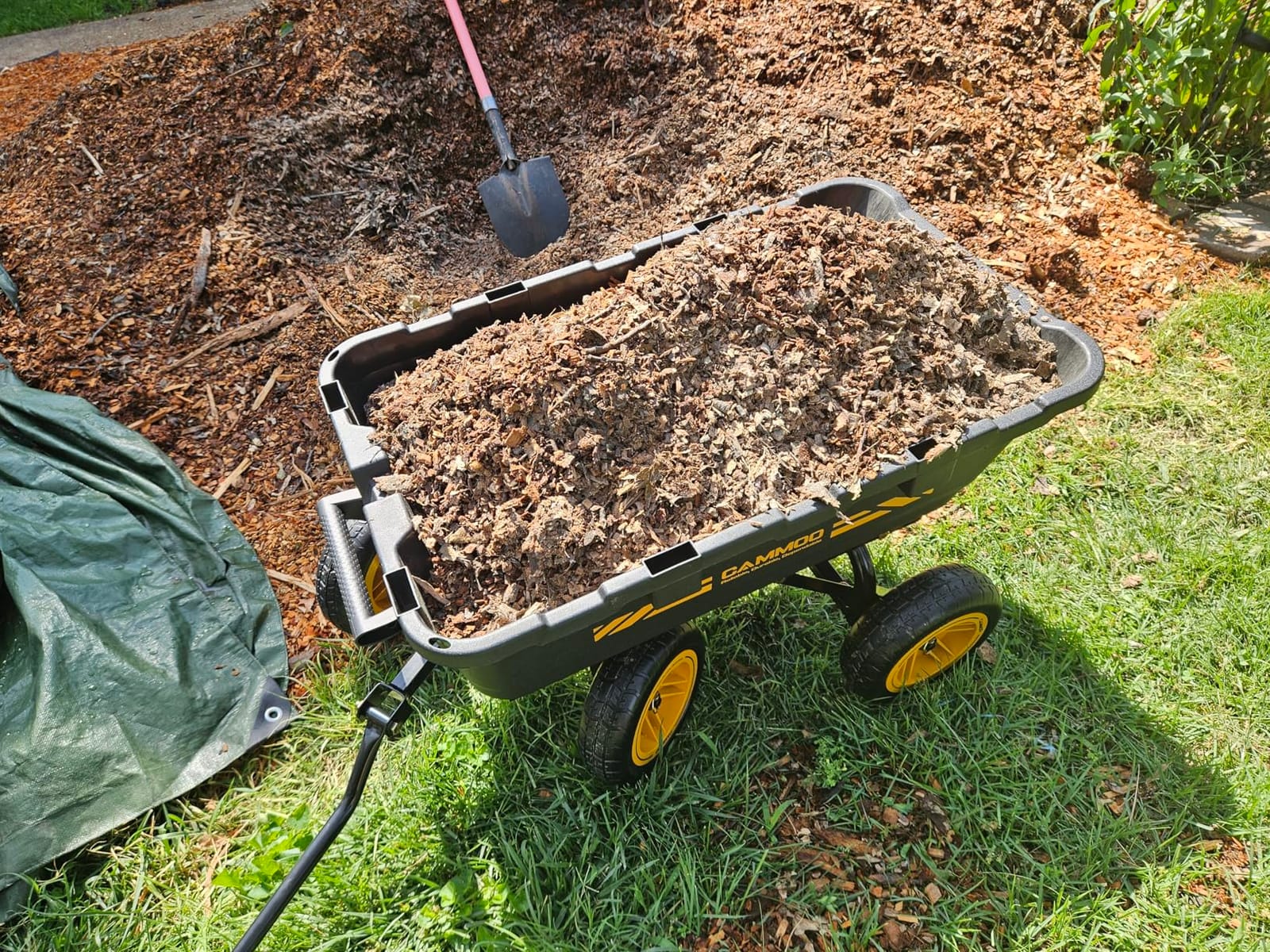
The 10-inch no-flat tires use deep tread and dual steel bearings, and owners note they hold up in mud, gravel, snow and turf without any air pressure to check. The 270-degree rotating handle gives you tight steering control in a confined yard.
Side expansion slots are a clever touch. You can add boards to raise the sides and haul leaves, branches or firewood in one trip, though boards are sold separately and not in the box.
Who should buy the CAMMOO TF-S900
Anyone moving rock, gravel, river stone or firewood over rough ground. The no-flat deep tread and 900-pound rating make it a genuine contractor cart rather than a garden one.
It is a good choice for farm and small-ranch work too, since owners mention the tires gripping everything from mud to snow.
Who should skip it
Skip it if you haul flat bagged material on the bed floor. The structural ridges that add strength also mean bags and panels sit unevenly, which is the most commonly reported drawback in reviews.
It is also the second-heaviest cart here at 43.2 pounds empty, so think twice before lifting it into a truck bed alone.
9. True Temper 6 Cu Ft Steel Wheelbarrow: Best Steel Tray for Mortar and Concrete
True Temper Steel Wheelbarrow with Never Flat Tire & Steel Handles, 6 Cu. Ft
- Seamless steel tray resists rust dents and abuse
- 6 cu ft is generous for a single-wheel barrow
- Sloped curved front makes dumping and spreading easy
- Never-flat tire needs no air
- All assembly hardware is included in the box
- Single-wheel design tips easily on uneven ground
- Heavier than a plastic barrow on long hauls
- No built-in stand so it must be propped
This is the only true single-wheel steel barrow in the roundup, and it is the right tool for mortar and concrete work. A seamless steel tray will not crack at the lip when you tip it forward, which is the single most common complaint about poly tubs on jobsites.
The sloped, curved front is an underrated design choice. It lets you dump a load precisely, then drag the front edge backward to spread and grade the material, which is exactly what you do with mortar and topsoil.
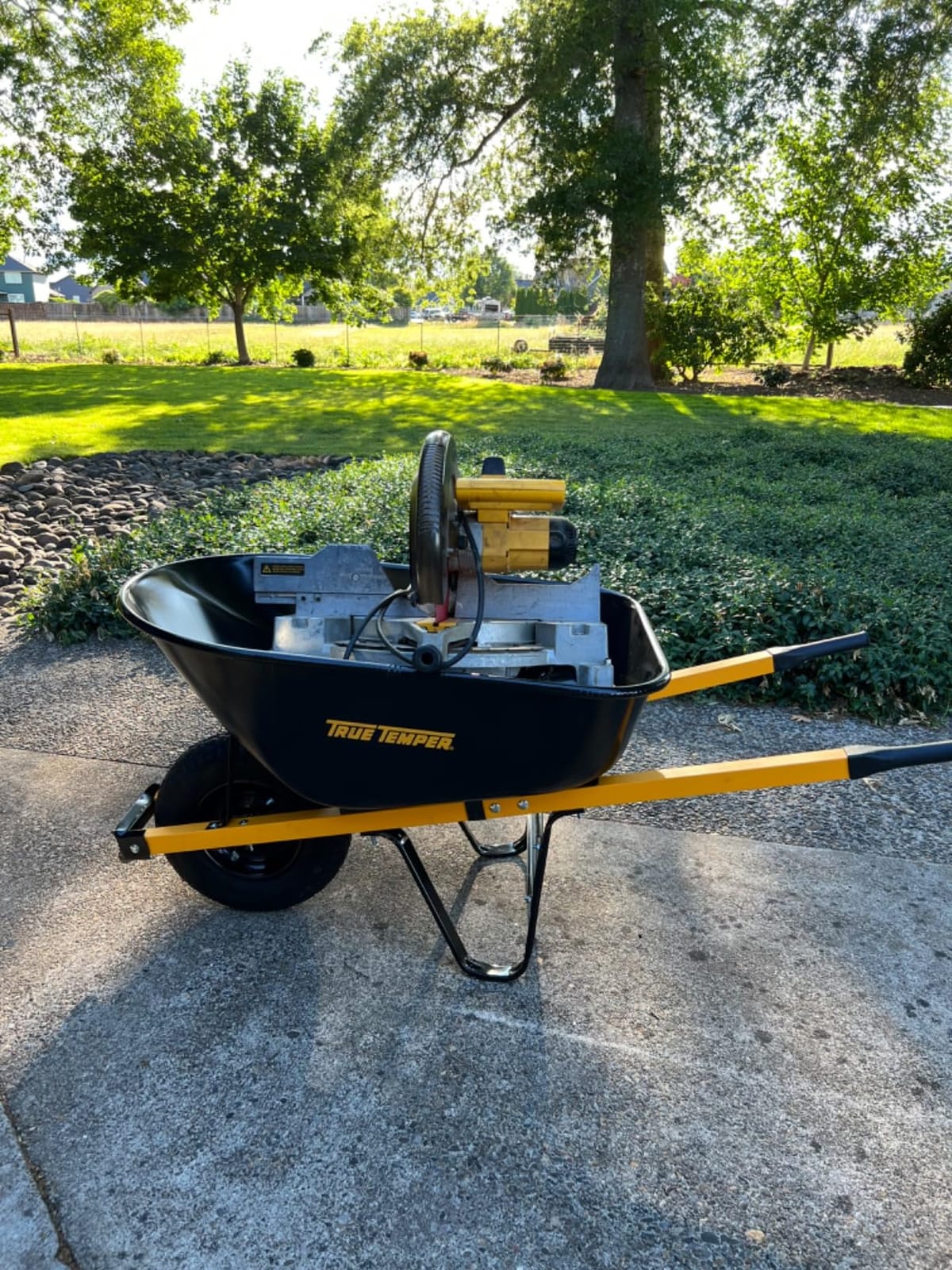
Contractors on masonry forums repeatedly name this brand as a daily-driver choice for concrete and mortar work, and the 4.6 rating from 163 reviews lines up with that reputation. The 6 cubic foot tray is generous for a barrow of this type.
The never-flat 4 by 8 inch tire is a solid rather than pneumatic design, so it never needs air while still keeping the single-wheel balance intact. All assembly hardware is included in the same box, which is more than many competitors manage.

Who should buy the True Temper steel barrow
Masons, bricklayers, concrete finishers and anyone hauling wet material daily. It is also the traditional choice when you want to spread material rather than just dump it.
Steel handles with comfort grips cut hand fatigue, and the heavy-duty undercarriage is built for the repeated loading cycles that crack cheaper frames.
Who should skip it
Skip it if your ground is soft, uneven or sloped. A single wheel puts the whole load on one contact patch, and review after review mentions the balance demands that come with it.
It is also the heaviest style to pull, and with no built-in stand you have to prop it somewhere every time you set it down, which is a real annoyance at the end of a long day.
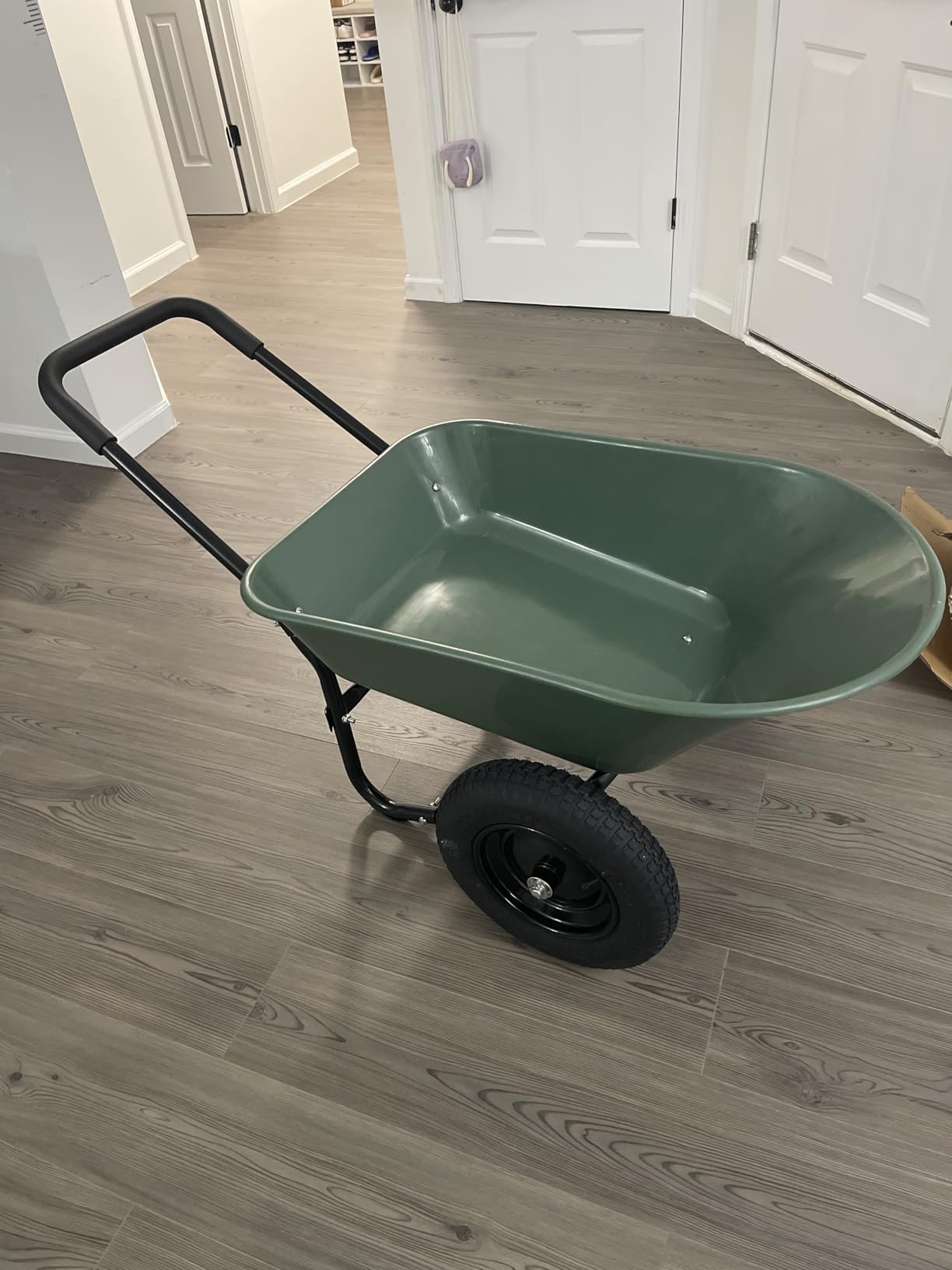
10. Amazon Basics 330 lb Garden Wheelbarrow: Most Versatile for Light Duty Hauling
Amazon Basics Garden Wheelbarrow, Heavy Duty, 330 Pounds Capacity, 3.7 Cubic Feet, 26.8W x 53.9D x 27.2H inches, Green, 1-Pack
- Lightweight frame is easy to lift and reposition when empty
- Inflatable rubber wheels roll over varied terrain
- Tips up for vertical storage in a shed
- 330 lb rating and 3.7 cu ft suit routine yard work
- Simple design that suits small DIY concrete mixing
- Plastic bucket is less durable than a steel tray
- 3.7 cu ft is the smallest tub here
- 330 lb rating is far below the 600 and 1200 lb carts
This is the one we include as a baseline, and it earns the slot for a specific reason: it is the only genuinely traditional wheelbarrow in the group that is also the easiest to handle empty at roughly 28 pounds.
If your work is bagged soil, leaves, light mulch and small DIY concrete mixing, the 330-pound rating and 3.7 cubic foot bucket are adequate. The inflatable rubber wheels roll well over varied terrain for a single-wheel design.
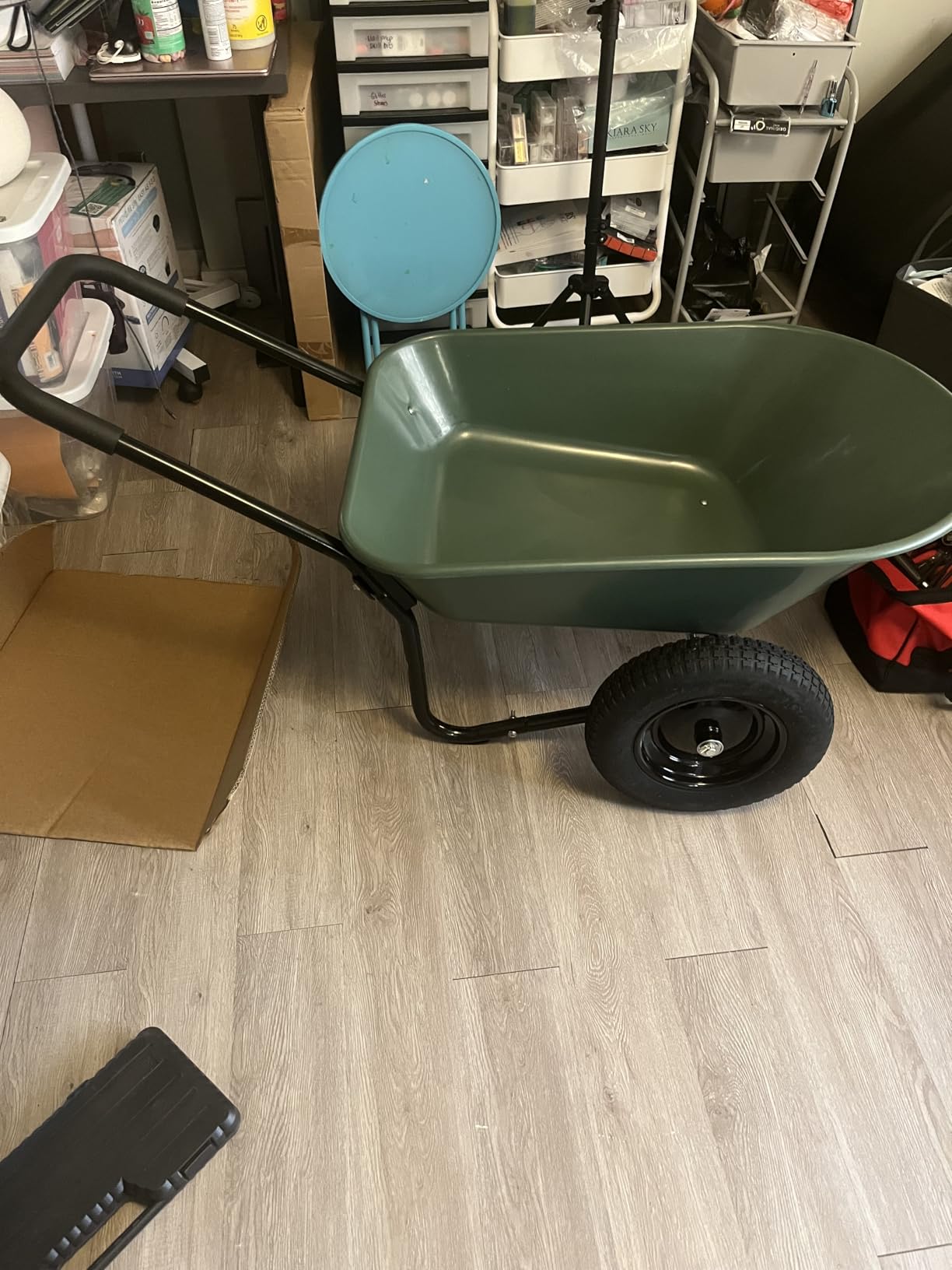
It tips up for vertical storage, which means it disappears against a garage wall. For renters or anyone in a two-car garage with no shed, that is a genuine advantage over anything in this list.
At 4.2 stars from 154 reviews, it has the lowest rating here and the highest one-star share at 11 percent. That number is worth taking seriously, and the complaints are consistent: the plastic bucket is the part that gives out.
Who should buy the Amazon Basics wheelbarrow
Homeowners with light, occasional work who want a cheap traditional barrow for leaves, bagged material and small garden projects. Also a good spare barrow for a property where the main tool stays out on site.
Anyone who struggles to lift a heavier cart will find this the least tiring model to pick up and move.
Who should skip it
Skip it for heavy loads, and the name of this guide is the reason. A 3.7 cubic foot bucket fills with gravel at about 370 lb, which is already past the 330-pound rating, and that is before you reach wet concrete.
Also avoid rocks and construction debris. A plastic bucket with an 11 percent one-star share does not have the durability margin for sharp material, and reviewers say so directly.
How to Choose a Wheelbarrow for Heavy Loads?
Start with the heaviest material you will move, not the average. Write down the weight per cubic foot and multiply it by the tray volume of anything you are considering. If the result is over 400 lb, you need a cart rated 600 lb or more, not a bigger barrow.
Next, pick the tray material. Steel trays are the right answer for concrete, mortar, brick and sharp debris, and they tolerate impact. Poly trays will not rust, hose clean in seconds and are lighter to move, but they can crack at the front lip when tipped forward hard. The weight-density problem above is usually solved by a poly cart, not a poly barrow.
Then choose tires. Pneumatic tires roll the smoothest over ruts and soft ground and are the standard on the highest-rated carts here, but they need periodic inflation and can go flat mid-job. Flat-free and no-flat tires remove that entirely at the cost of a firmer, noisier ride over broken ground. If you have ever had a tire give out on you while loading wet concrete, take the flat-free option.
Wheel count is the comfort and stability decision. Single-wheel barrows are maneuverable, light and traditional, and they put the full load on one contact patch, so they tip on uneven ground. Dual-wheel carts stay upright and feel far safer. Four-wheel carts trade some turning radius for the highest weight ratings and the ability to tow.
Check the handles and the frame next. Alloy steel handles beat hardwood for heavy loads, since wood splinters and rots and that failure is sudden. Confirm the frame is powder-coated or otherwise coated, and look for a model that includes its assembly hardware in one box, because missing hardware and confusing instructions are the most common assembly complaint in reviews.
Finally, plan your terrain. Stairs and steep slopes are where traditional wheelbarrows hurt people, and the safer answer is a four-wheel cart with a rotating handle, or simply more trips with a smaller load. If the route involves an incline, the heavy-load cart choices here are the safer option.
When a Wheelbarrow Is the Wrong Tool
If your loads are dense and repetitive, a four-wheel dump cart is usually the better purchase, and every cart rated 600 lb or more in this guide fits that description. A wheelbarrow earns its place on narrow paths, steps and short single-material runs, not on bulk gravel moves.
For genuinely heavy work over distance, powered options exist. We covered those separately in our guide to the best electric wheelbarrows for yard work, which is worth reading if you are moving several hundred pounds per load across a large property and want the load on wheels rather than on your back.
And if you are regularly moving heavy material in your own vehicle rather than towing a trailer, our picks for the best e-bikes for heavy riders cover a related problem, hauling serious weight over distance without straining a tractor or truck.
If the trailer or tow path is the harder problem, our testing of heavy-duty kickstands for heavy bikes covers the same load-versus-support question from a different angle. Similarly, our mobility scooters for heavy riders roundup looks at weight ratings and stability on uneven ground, which is a surprisingly close parallel to picking a wheelbarrow that will not tip under you.
Frequently Asked Questions
What is the best wheelbarrow for heavy loads?
For most people hauling gravel, mulch, firewood or yard debris, the best wheelbarrow for heavy loads is a four-wheel poly dump cart rated 600 lb or more. The Gorilla Carts GOR4G-COM is our top pick: a 600-pound rating, a 36 by 20 inch poly bed, 10-inch pneumatic tires and a quick-release dump mechanism, backed by more than 30,000 customer reviews.
What is the weight limit for a wheelbarrow?
It depends on the rating printed on the model, and most big-box wheelbarrows stop at 300 to 330 lb. Volume does not tell you the limit: a 6 cubic foot tray holds about 90 lb of dry mulch, about 600 lb of gravel and roughly 720 lb of wet concrete. Multiply material weight per cubic foot by tray volume, then stay at or under the published pound rating.
Is it better to get a steel or poly wheelbarrow?
Steel is better for concrete, mortar, brick and sharp debris, because it resists impact and will not crack at the front lip when tipped. Poly is better for mulch, leaves, soil and yard waste because it will not rust, weighs less and can be hosed off in seconds. Most heavy-load buyers end up with a poly four-wheel cart rather than a poly barrow.
Are flat-free or never-flat tires actually any good?
Yes, if you would rather not maintain tires. Flat-free and no-flat tires remove inflation and puncture worries entirely, which matters if you haul daily in mud, gravel or job-site debris. The trade-off is a firmer, noisier ride, because solid tires have no give over ruts. Pneumatic tires roll smoother and are the better choice on mostly even ground.
What is the best wheelbarrow for builders and bricklayers?
Builders and bricklayers should look for a seamless steel tray, alloy steel handles and a single wheel. The True Temper 6 cubic foot steel wheelbarrow fits that brief, with a sloped curved front that makes dumping and spreading mortar easy and a never-flat tire that never needs air. For pavers and block over distance, a 600 lb cart rated above removes the balance problem.
How many wheelbarrows equal 1 yard of mulch?
One yard of mulch is 27 cubic feet. A 3.7 cubic foot bucket needs about 8 loads, a 4 to 5 cubic foot cart needs 6 loads, and an 8.75 cubic foot cart needs about 4. Dry mulch weighs roughly 15 lb per cubic foot, so a full yard is roughly 400 lb spread across those trips.
Conclusion
The best wheelbarrows for heavy loads are not the ones with the biggest tubs. They are the ones whose published pound rating exceeds what your material weighs per cubic foot, multiplied by that tub, with margin to spare.
For most buyers that means the Gorilla Carts GOR4G-COM, which pairs a 600-pound rating with the deepest review history in the category. The BILT HARD is the pick if you want the same rating with no-flat tires, and the VEVOR 1200-pound cart is the only one here rated for a full load of rock or concrete.
Check the rating before you check the color, and you will not be disappointed with any of these in 2026.