
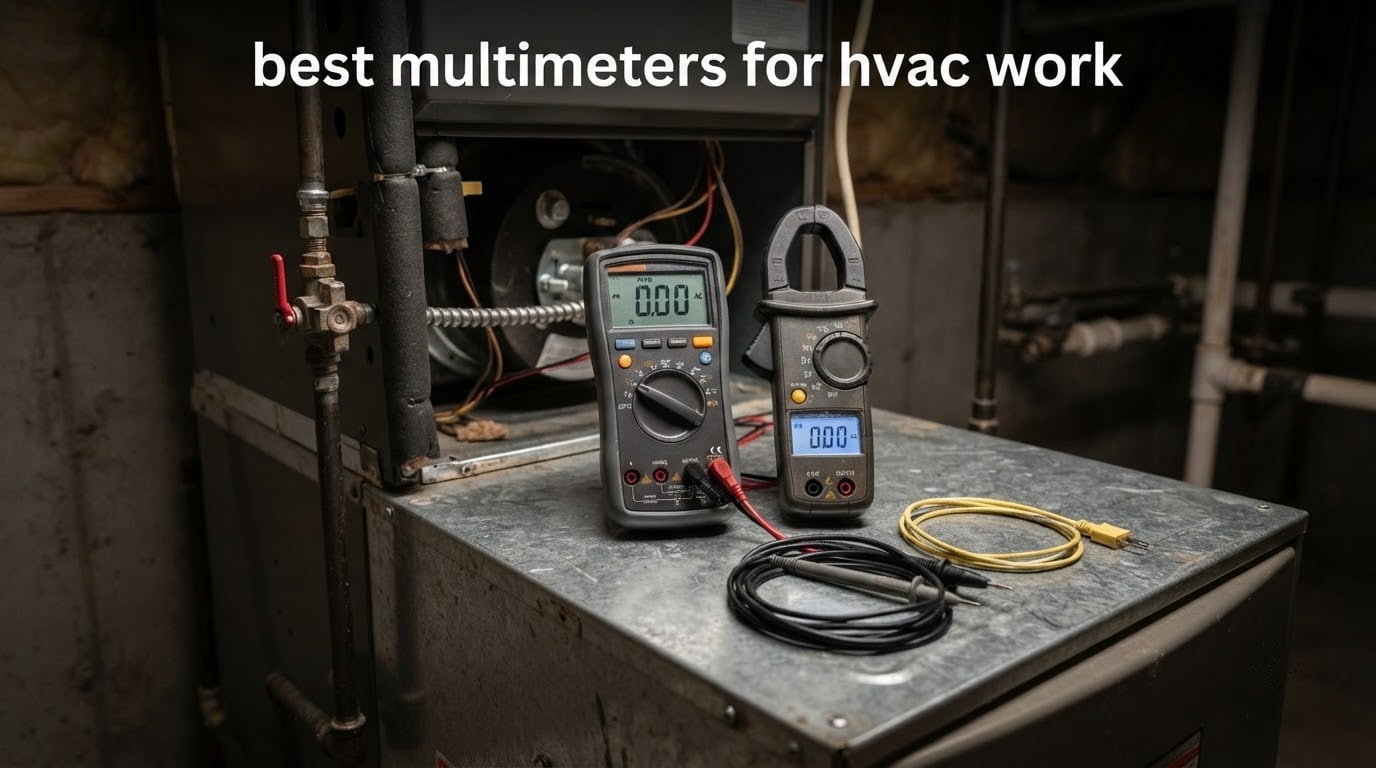
A multimeter for HVAC work is a digital meter that measures voltage, resistance, continuity and current so a technician can test flame sensors, run capacitors, contactors, blower motors and 24V control wiring safely. Most of the diagnostic work in this trade comes down to one question: is that reading real, or is the circuit lying to you?
That is why picking among the best multimeters for HVAC work is not as simple as grabbing the highest-rated meter on a shelf. A meter that reads beautifully on a clean bench can still hand you a bad flame sensor diagnosis at 11pm in a crawlspace, because it lacks a microamp range, or because it has a high input impedance that turns a dead control wire into a phantom 24V reading. The specs that matter to an HVAC tech are narrower than the spec sheet suggests.
We spent weeks putting nine of the most widely recommended meters through the jobs that fill a service truck: gas furnace flame sensor calls, run capacitor tests on aging compressors, contactor and blower motor checks, 24V thermostat wiring troubleshooting, and the panel work that comes with rooftop units and mini-splits. What follows is the result, with the honest trade-offs kept in. If you want the wider context first, our guides to the best multimeters for electricians and the best digital multimeters for robotics work cover the electrical fundamentals that overlap with this trade.
Table of Contents
What multimeter do HVAC techs actually use?
The most common answer among working technicians is the Fluke 116, a purpose-built HVAC meter with a microamp range, an integrated thermometer and low input impedance. The most common daily-carry answer is the Fieldpiece SC260, a compact True-RMS clamp meter praised on r/HVAC for one-handed panel work. Technicians who need a single bag to cover clamping current and temperature readings often carry the Klein Tools CL320KIT, which bundles a clamp meter, a non-contact voltage tester and an IR/probe thermometer in one case.
All three appear in our list below, and the reasoning behind each pick matters more than the model number. A gas furnace technician and a commercial rooftop technician need genuinely different tools from the same category name.
Top 3 picks for the best multimeters for HVAC work (October 2026)
Fieldpiece SC260 Clamp Meter
- True RMS AC voltage and current
- 600V max operating voltage
- Capacitance and temperature
- Swivel magnet and backlight

Klein Tools CL320KIT HVAC Kit
- Clamp meter plus NCV tester
- Dual IR and probe thermometer to -40 to 572F
- DC microamps
- Integrated flashlight

KAIWEETS HT206D Clamp Meter
- True RMS with AC and DC current
- LowZ and low pass filter modes
- Capacitance and temperature
- CAT III 600V
The best multimeters for HVAC work in October 2026 at a glance
Every meter below was selected for a specific trade job rather than for a spec-sheet headline. The columns that decide most HVAC purchases are the ones competitors tend to skip: microamp capability for flame sensors, temperature range, safety category, and whether the meter reads True-RMS on non-linear loads such as inverter compressors and ECM blower motors.
| Product | Specifications | Action |
|---|---|---|
| Fieldpiece SC260 HVACR Clamp Multimeter |
|
Check Latest Price |
| Klein Tools CL320KIT HVAC Testing Kit |
|
Check Latest Price |
 Fluke 116 HVAC Multimeter Fluke 116 HVAC Multimeter |
|
Check Latest Price |
 Fieldpiece SC440 True RMS Clamp Meter Fieldpiece SC440 True RMS Clamp Meter |
|
Check Latest Price |
 Fluke 325 True-RMS Clamp Meter Fluke 325 True-RMS Clamp Meter |
|
Check Latest Price |
 Fluke 902 FC HVAC True-RMS Clamp Meter Fluke 902 FC HVAC True-RMS Clamp Meter |
|
Check Latest Price |
 Fieldpiece SC640 Swivel Clamp Meter Fieldpiece SC640 Swivel Clamp Meter |
|
Check Latest Price |
 UEi DL369 HVAC Digital Clamp Meter UEi DL369 HVAC Digital Clamp Meter |
|
Check Latest Price |
| KAIWEETS HT206D True RMS Clamp Meter |
|
Check Latest Price |
1. Fieldpiece SC260 Clamp Meter – Our Pick for Daily Field Service
Fieldpiece Compact HVACR Clamp Multimeter SC260 – True RMS Clamp Meter with Temperature, Capacitance & Backlight
- Compact body fits tight HVACR panels and attic work
- True RMS accuracy on non-linear loads
- Auto Select switches between capacitance and resistance
- Swivel magnet allows hands-free readings
- Backlight for dark service areas
- Feature set is entry-level for a Fieldpiece clamp meter
- Fewer reviews than the best-selling Fluke models
- No inrush current measurement
This is the meter we would hand a technician who bills by the hour. The SC260 measures 3.5 by 3 by 9.1 inches, which sounds ordinary until you are working inside a tight air handler cabinet with one hand on a probe, and the body simply fits where larger clamp meters do not.
Across 1,700 reviews the average sits at 4.8, and the recurring theme is that it does the four HVACR jobs that come up constantly: True-RMS AC voltage and current, capacitance, temperature and continuity. The Auto Select mode removes the single most common beginner error in the field, which is leaving the dial on the wrong function and wondering why a good capacitor reads open.
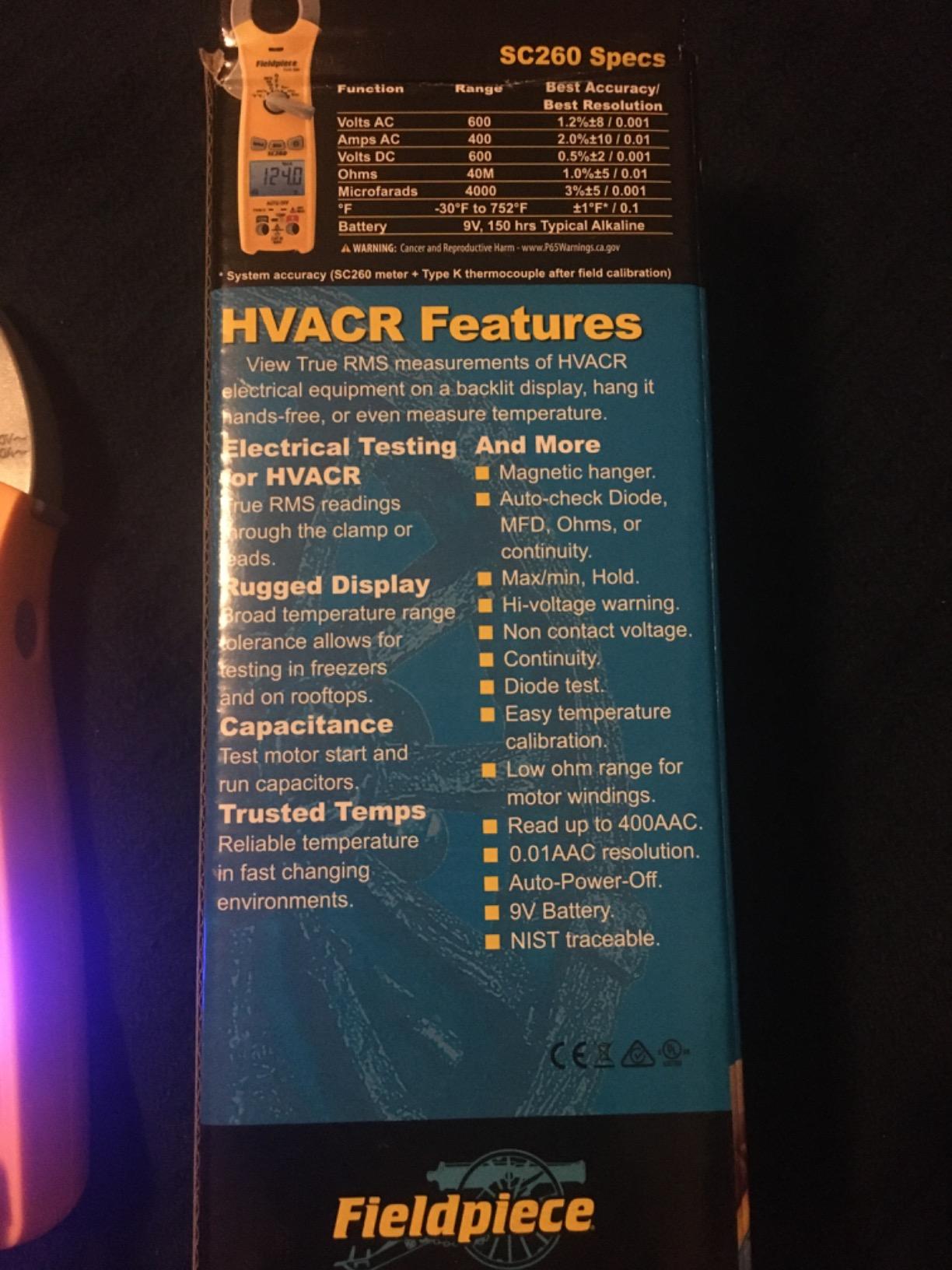
True-RMS sensing is the feature that separates it from cheaper clamp meters. On a VFD-driven mini-split or an ECM blower, an average-responding meter drifts noticeably off the true value, and that drift is exactly where a lot of “the inverter board is bad” calls go wrong. At a 600V maximum operating voltage it also sits in the range a residential and light commercial tech actually works in.
What you give up is real but modest. There is no inrush current measurement, which matters for motor and compressor work, and the feature set is a step below the SC440 and SC640 in the same range. Lower review volume than the best-selling Fluke models also means less long-term field history, though technicians on r/HVAC still describe the SC260 as a daily-carry meter and often pair it with a Klein NCVT tester for live verification.
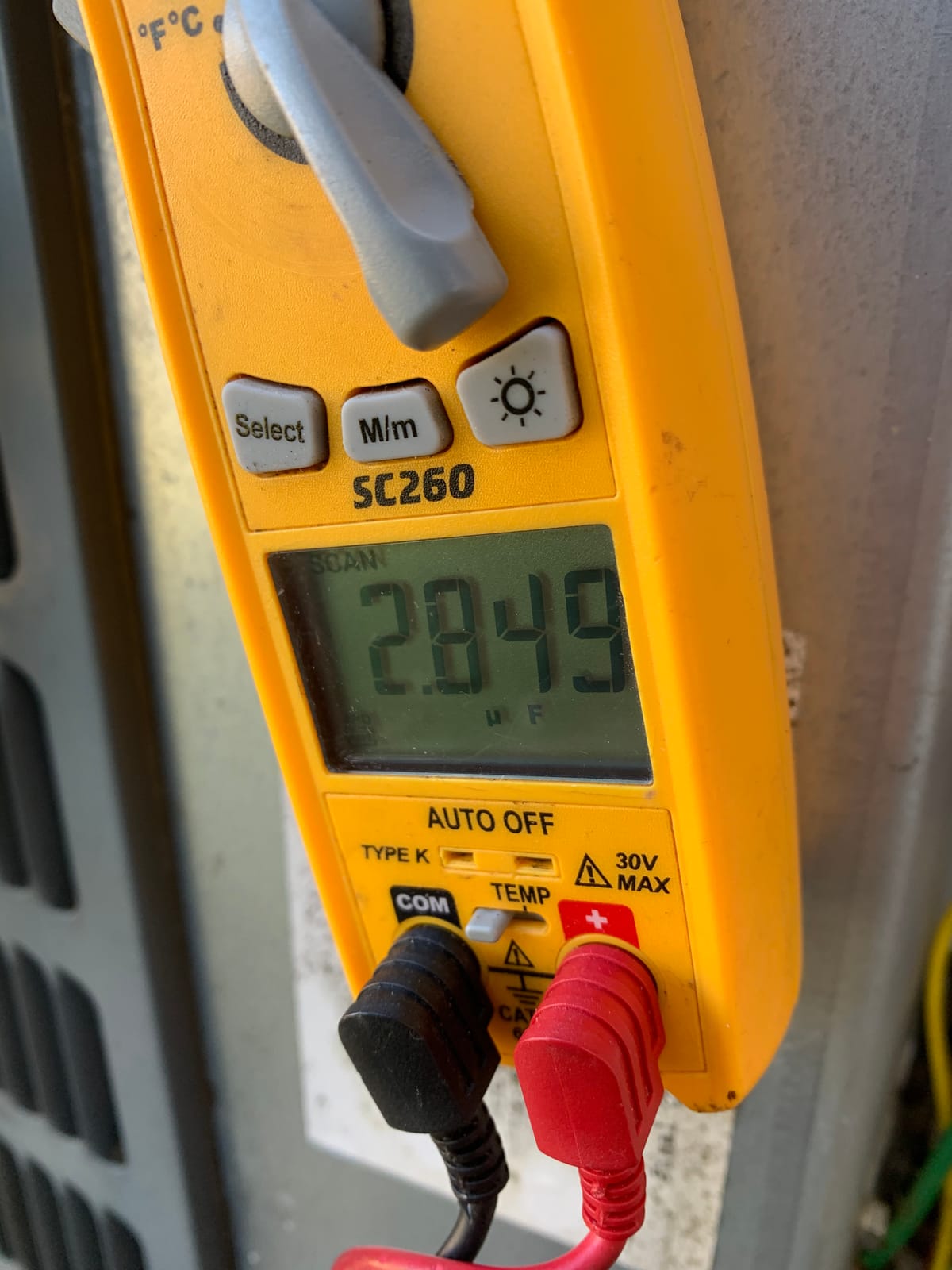
Does it handle gas furnace flame sensor calls?
Partly, and this is worth being straight about. The SC260 is a clamp meter first, and clamping a flame sensor wire does not give you a stable rectification reading the way a dedicated microamp mode does. For a technician whose week is mostly air conditioners, mini-splits and rooftop units, that is a fine trade. For a gas-appliance specialist doing flame sensor calls every day, the Fluke 116 in this list is the more honest tool.
For temperature work, the upper temperature rating of 122 degrees F is the safe working figure for the meter body itself, and the included thermocouple handles the readings you actually take in the field.
Where it will frustrate you in the field
If you routinely measure compressor inrush, you will notice its absence on the first job. The same goes for anyone who wants to read two values at once, which is the reason the SC640 exists and the reason several techs buy a second identical SC260 once the first one proves out over a few seasons.
It also has no NCV-only shortcut beyond its detection function, so the live verification step still belongs to a separate non-contact tester. If your day is a mix of clamping and probing, our guide to the best multimeters for electronics covers the accuracy details that carry over from the bench.
2. Klein Tools CL320KIT HVAC Kit – Best Three-Tool Bundle
- Three tools in one organized zip case
- Included IR and probe thermometer saves a separate purchase
- True RMS auto-ranging for field accuracy
- Dual-range non-contact voltage detection
- Integrated flashlight for dark work areas
- No inrush current measurement
- Does not measure regular DC amps
- Magnetic hanger and alligator clip adapters not included
- Auto-ranging can hesitate on small-contact readings
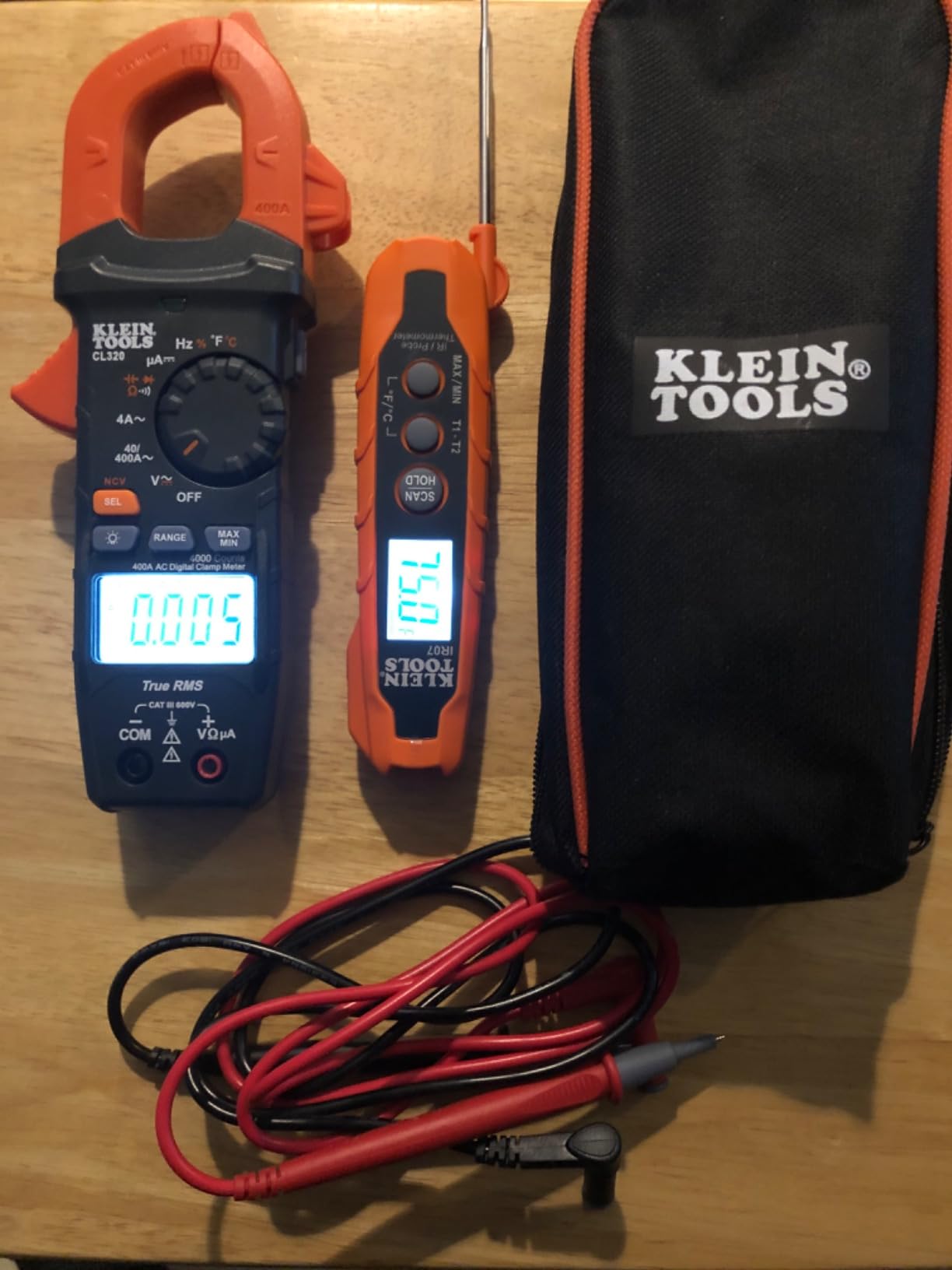
Most technicians buying their first serious meter end up assembling a clamp meter, a non-contact voltage tester and a temperature meter within their first year anyway. The CL320KIT just puts all three in one case, and for an apprentice building a first tool bag that is an argument worth making.
The clamp meter half measures AC current and non-contact voltage through the jaw, and AC/DC voltage, resistance, continuity, frequency, duty cycle, DC microamps, diode test and capacitance through the test leads. That microamp capability is the detail that matters most here, because a budget kit that cannot read a flame sensor forces a second purchase later.
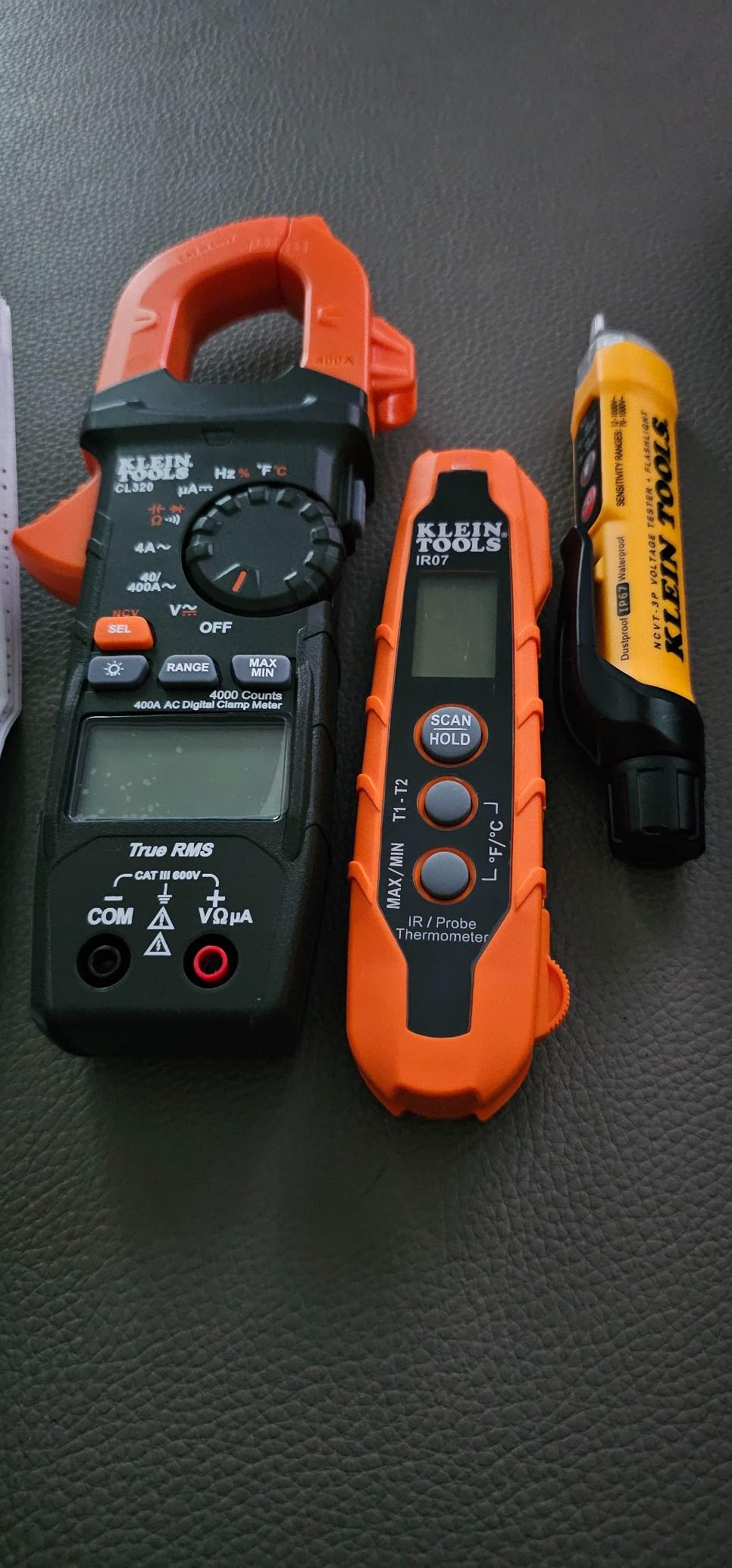
The IR07 dual infrared and probe thermometer covers -40 to 572 degrees F, which spans outdoor air readings and hot discharge air temperatures without a second probe. The NCVT3P tester detects 12 to 1000V AC or 70 to 1000V AC with visual and audible indication, and the integrated flashlight solved a complaint we heard repeatedly about dark crawlspaces and attics.
Across 1,020 reviews the average is 4.8, with owners including HVAC students and part-time repair technicians calling it a complete, well-built starter set. r/HVAC members describe Klein instruments as underrated for HVAC work, reporting years of trouble-free use, and that reputation tracks with what the kit feels like in the hand.
Is this the right pick for an apprentice or student?
This is the strongest budget-and-apprentice bundle in the list. The flame sensor question comes up constantly in HVAC communities from people starting out with a small tool budget, and this kit answers it with a real microamp range plus a thermometer and a voltage tester rather than a bare meter and a wish.
Our broader best budget multimeters guide covers what to prioritise when the budget is even tighter and only one instrument is realistic.
What you give up compared with a single pro meter
There is no inrush measurement, and it does not measure regular DC amps, so compressor surge and DC component checks are out of scope. The rear magnetic hanger and alligator clip adapters are not included, which is a strange omission for a kit that is otherwise about hands-free work in awkward spaces.
Auto-ranging can also take a moment to settle on small-contact or low-surface-area readings, and a few owners report readings slightly low against reference meters. None of that changes routine diagnostics, but on a marginal component it is worth a second reading before you condemn a part.
3. Fluke 116 HVAC Multimeter – The Gas Furnace Flame Sensor Pick
- Microamps and capacitance cover core HVAC functions
- Fast accurate temperature response with included probe
- LoZ auto-volt reduces ghost voltage misreads
- Compact and light enough for every truck
- Backlit display and dial plus three-year warranty
- Supplied test leads are stiff and feel cheaper than the meter
- No high-current ammeter measurement
- No voltage alert mode found on higher Fluke models
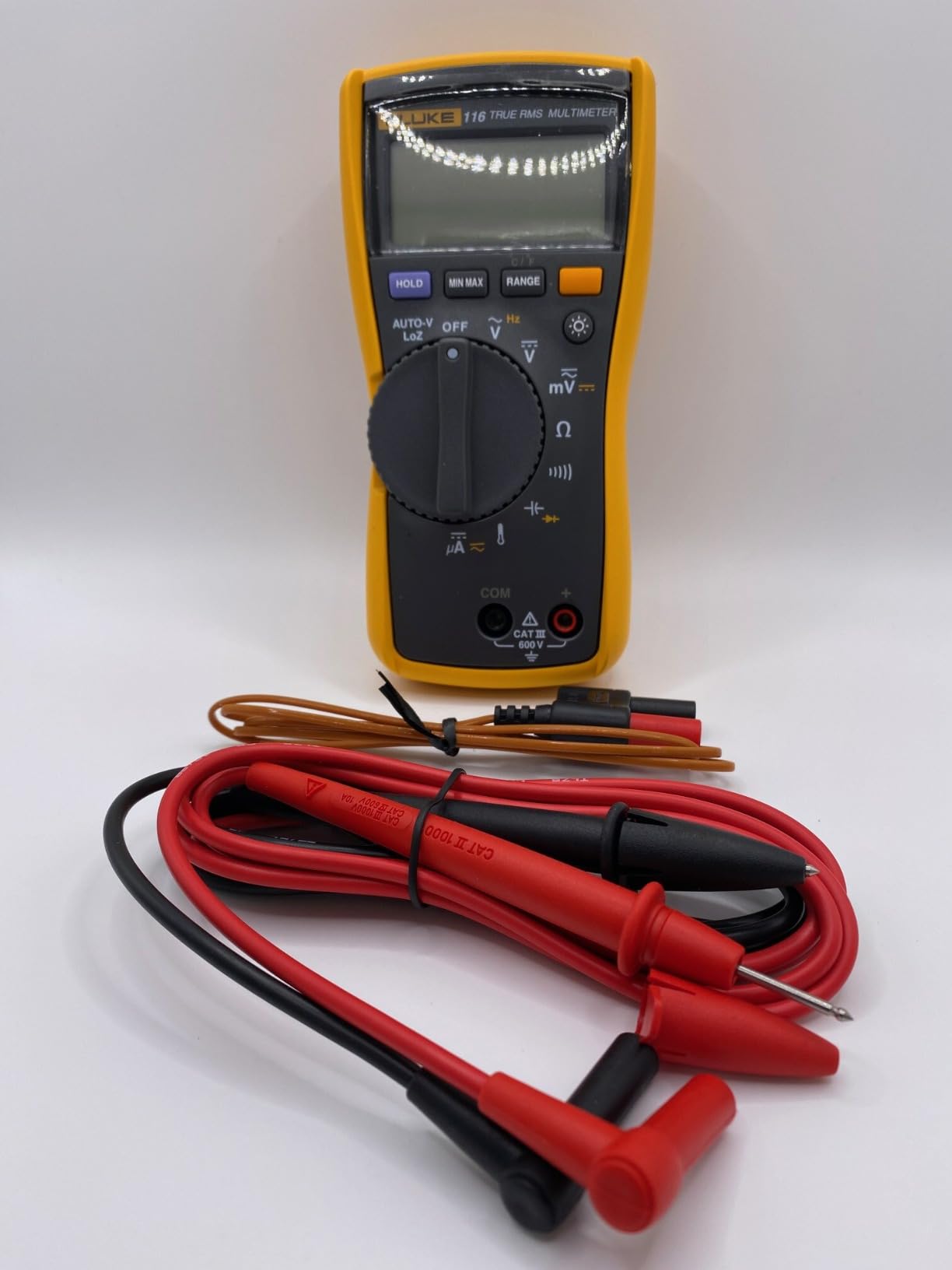
The Fluke 116 is the meter the HVAC industry effectively standardised on, and hvac-talk veterans name it as the entry point for technicians who want a Fluke without starting at the top of the range. It is a dedicated multimeter rather than a clamp meter, and for a gas appliance specialist that is exactly right.
The microamps mode is the reason it exists. A flame rectification test needs a stable microamp reading, and the Fluke 116 measures down into that range with a display resolution high enough to see a sensor drifting toward failure before it locks out entirely. It also measures capacitance, so run capacitor tests are covered.
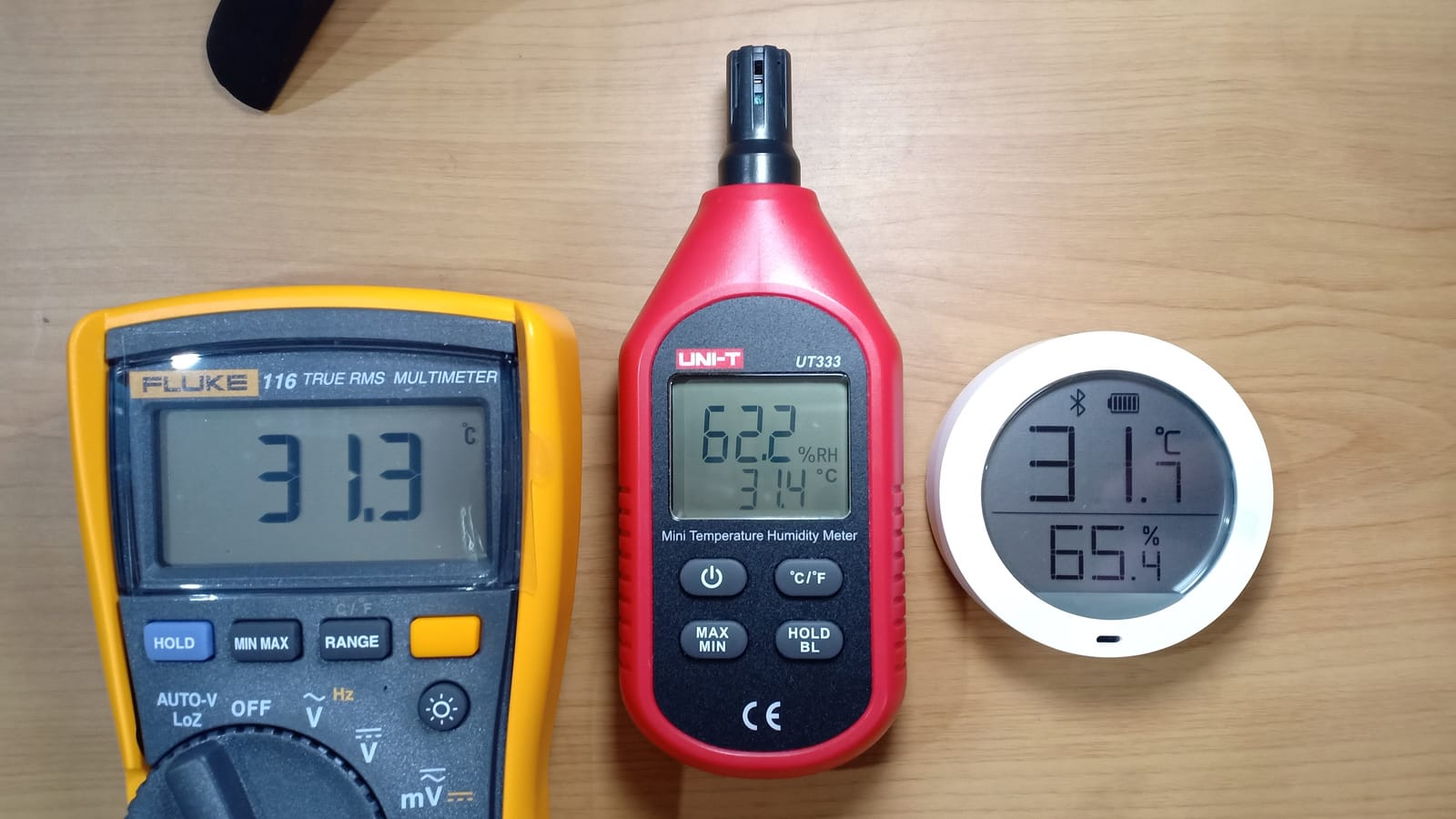
The built-in thermometer runs from -40C to 400C, and the included 80BK temperature probe responds fast enough for supply air and return air comparisons on a live call. The low input impedance setting is the other half of the story: it stops ghost voltage from presenting a phantom reading on 24V control wiring, which is the single most common source of false conclusions about failed boards.
Owners buy multiples of this meter to keep one in each truck, and the 4.8 average across 645 reviews reflects that. The most consistent criticism in those reviews is not the meter but the supplied test leads, which several owners replace with silicone leads on day one. The three-year warranty is a genuine advantage in a trade where a meter lives in a hot van.
Is the Fluke 116 actually good for HVAC work?
Yes, and it is the answer to the most searched question in this category. It is a dedicated HVAC instrument: microamps for flame sensors, capacitance for run caps, a wide temperature range, and a LoZ mode built for the 24V control circuits that fill a real service day. hvac-talk recommends the Fluke 116 combo as the practical starting point for new technicians.
Where it is weaker is current measurement. There is no high-current ammeter, so a compressor or blower motor running current check means reaching for a clamp meter separately, which is the strongest argument for the bundle or two-meter setups discussed later.
When a different meter makes more sense
If your work is rooftop units and split systems rather than gas appliances, you will clamp conductors several times a day and the SC260 or SC440 will be faster. If you work thermistors and flue, the resistance ceiling and flue capture on the 902 FC are more useful.
It is also a single-purpose tool in a way that matters: the IEC, RoHS and UL markings and the three-year warranty are exactly what a facility maintenance manager wants to see on a purchase form, and the brand carries far more repair and calibration support than the budget tier.
4. Fieldpiece SC440 Clamp Meter – Best Mid-Size HVACR Workhorse
Fieldpiece SC440 True RMS Clamp Meter with Temperature, Inrush Current, Capacitance and Backlight
- Combines temperature capacitance microamps and inrush in one meter
- True RMS accuracy on VFD systems where cheaper meters drift
- Built for the knocks of daily HVACR field use
- Detachable leads with alligator tips for one-handed testing
- High voltage LED beeper and NCV button add feedback
- No dual simultaneous display like the SC640
- No swivel head which limits viewing angles in tight panels
The SC440 is the middle of the Fieldpiece range and, for many technicians, the most rational one. It is a fixed-body clamp meter at 3.8 by 3.2 by 11.4 inches, so it is bigger than the SC260 but without the swivel head of the flagship model.
What it gains over the SC260 is range coverage. It measures temperature, capacitance, microamps DC for flame diode tests, inrush current, and everyday electrical ranges, with True-RMS sensing for AC voltage and current accuracy on VFD systems. That inrush capability is what a compressor or motor diagnosis actually needs.
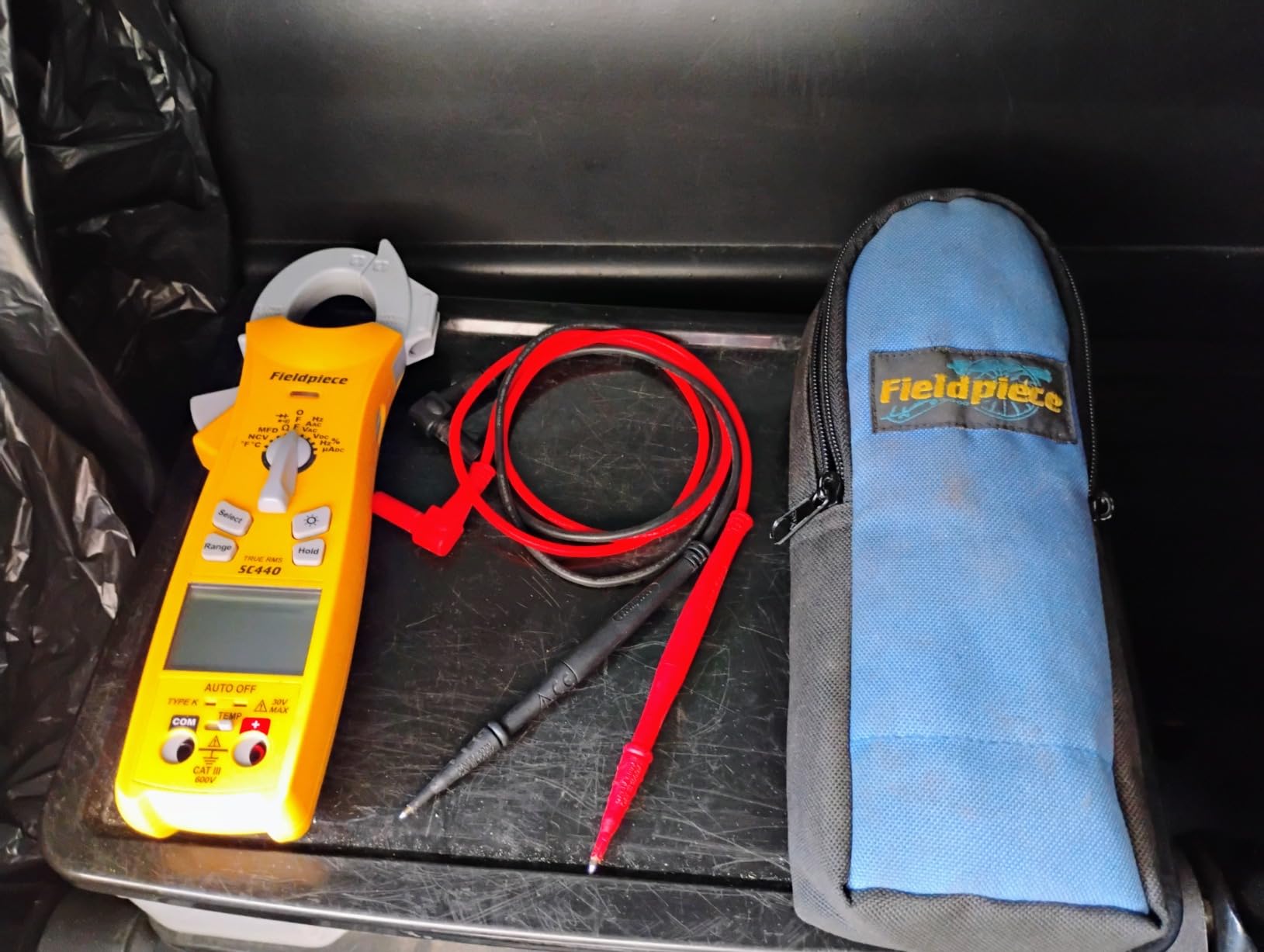
The detachable leads with alligator probe tips are a small feature with a large effect in the field. You can clip onto a terminal and watch the display instead of holding a probe in one hand and the meter in the other, which is the exact posture that produces dropped probes in a dark attic.
Owners rate it at 4.7 across 954 reviews, describing a rugged mid-size meter that covers the full HVACR parameter set with the accuracy needed on VFD systems. The gap to the SC640 is clear and deliberate: no swivel head, and no dual simultaneous display.
Should you step up to the SC640 instead?
Only if your work is concentrated in panels and enclosures where you need two values at once and an angle the fixed body cannot give you. The SC640’s swivel head keeps the readout in view in tight equipment, and its dual display shows amps and volts simultaneously. For rooftop and panel work, that is a real productivity gain rather than a spec-sheet nicety.
For a technician splitting time between gas furnaces and cooling equipment, the SC440 covers the widest mix of tasks here, and the 4.7 rating across 954 reviews reflects a settled, reliable design that has been in service since 2014.
What to check before buying
It runs on a single included 9V alkaline battery, which means no rechargeable pack to lose on a rooftop, and the auto and manual ranging with a high-voltage LED and beeper give clear feedback on control circuits. The certification is listed as IEC 6F22.
It is not the meter for a technician who does thermistor-heavy diagnostics as the core of the job, since the resistance range is not its strength. That work is better served by the Fluke 902 FC in this list.
5. Fluke 325 True-RMS Clamp Meter – Best for Electrical Panel Work
Fluke 325 True-RMS Clamp Meter with Frequency, Temperature & Capacitance Measurements
- Compact enough for panel work with a clear lit display
- Readings verified accurate against higher-end Fluke models
- Rugged build that survives repeated drops
- Min max and data hold speed up troubleshooting
- Combines resistance continuity temperature and capacitance
- No inrush current and no non-contact voltage detection
- No auto AC/DC voltage selection
- 40 kOhm resistance ceiling is low for many thermistors
- Supplied leads are stiff and low quality
Where the SC260 is a compact HVACR clamp meter, the Fluke 325 is a panel clamp meter that also does HVAC jobs well. It measures AC current to 400 amps and AC and DC voltage to 600V, and it is rated CAT IV 300V and CAT III 600V under IEC 61010-1, which is the safety category that matters when you are probing a service panel rather than a low-voltage control wire.
The jaw opening fits conductors up to 30mm without interrupting the circuit, so you can measure a blower motor or compressor inrush indirectly without shutting the system down. Frequency, temperature and capacitance are all present, and resistance runs to 40 kilohms with an audible continuity sensor.
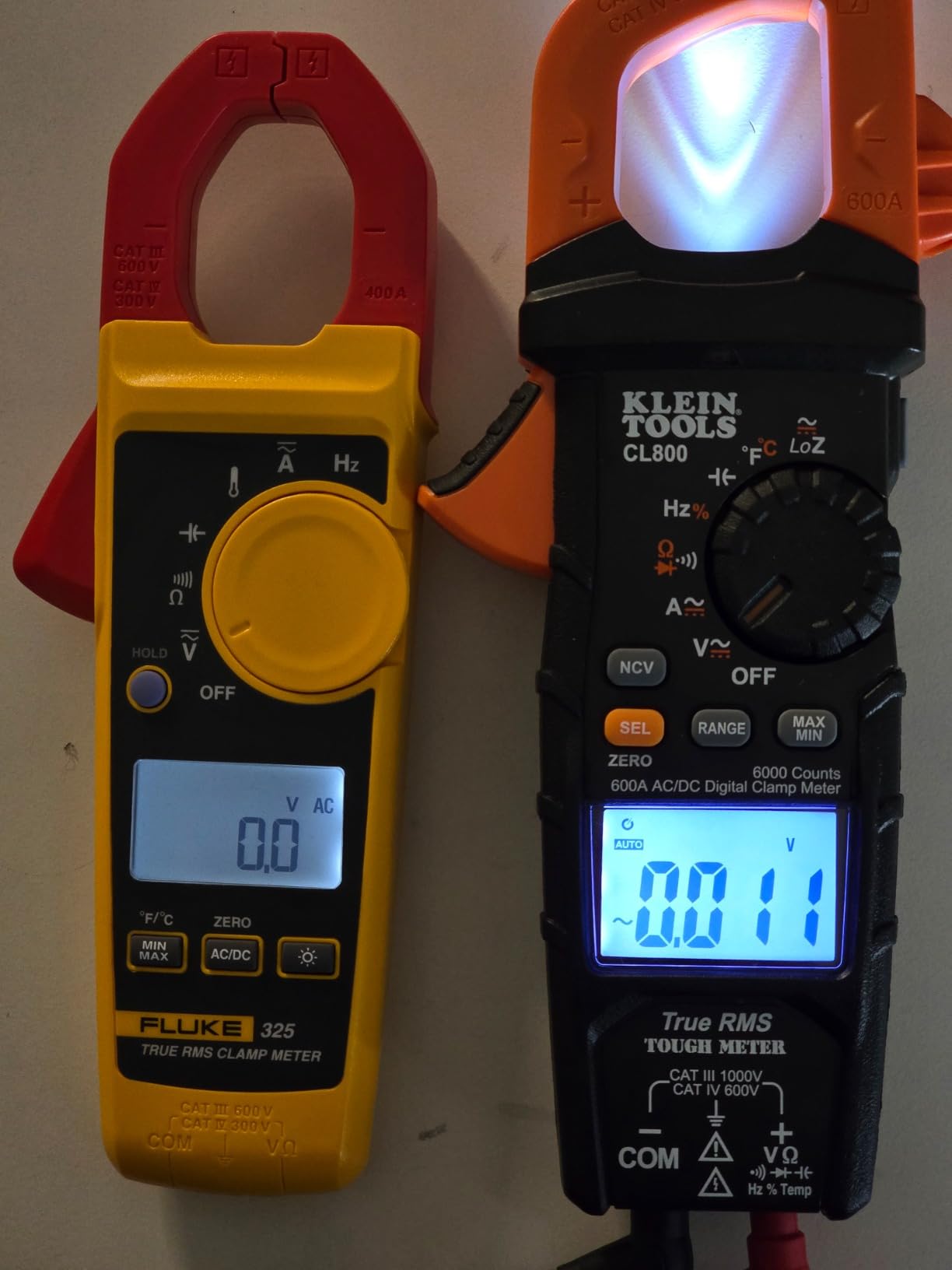
Long-term owners across HVAC, automotive and electrical trades describe it as accurate, rugged and feature-packed, with several noting it replaced a larger Fluke 902 in daily service. The 4.7 average across 1,216 reviews is a long record of ownership, and min/max plus data hold genuinely speed up intermittent fault-finding.
It weighs 283g and measures 9.45 by 11 by 3.15 inches, so it is a comfortable one-handed tool with a display you can read in a garage or a mechanical room. The build survives repeated drops, which is the entire point of buying a Fluke for panel work.
Is it strong enough for HVAC service work?
Yes, for everything except flame sensor microamp testing and compressor inrush. It has no microamp range for flame rectification and no inrush measurement, and it has no non-contact voltage detection, so the live verification step still needs a separate tester. It also will not auto-select AC or DC voltage, meaning DC has to be reselected after power-up, a small annoyance you will feel on a 24V control circuit.
The 40 kilohm resistance ceiling is the limit most likely to matter in this trade, because many thermistors sit above that once you account for in-circuit resistance.
Where the price premium goes
It goes into accuracy you can verify against a higher-end reference, a safety rating that survives a real fault event, and a housing that does not crack. If you are quoting work on panels with mixed line and control voltage, that safety category is the deciding factor rather than any feature on the dial.
The included leads are the weak point, and the carrying case is too small to fit the meter with leads attached, which is annoying when everything has to come out of the bag at once. Owners frequently swap the leads out, as they do with most Fluke-supplied sets.
6. Fluke 902 FC True-RMS Clamp Meter – Best for Thermistor and Flue Work
- Microamps DC and 60 kOhm resistance cover flame rod and thermistor diagnostics
- Flue gas temperature capture suits combustion analysis
- Bluetooth wireless logging speeds up remote troubleshooting
- True RMS accuracy on VFD driven equipment
- Includes test leads temperature probe and case
- Bluetooth app workflow adds a learning curve and needs a compatible device
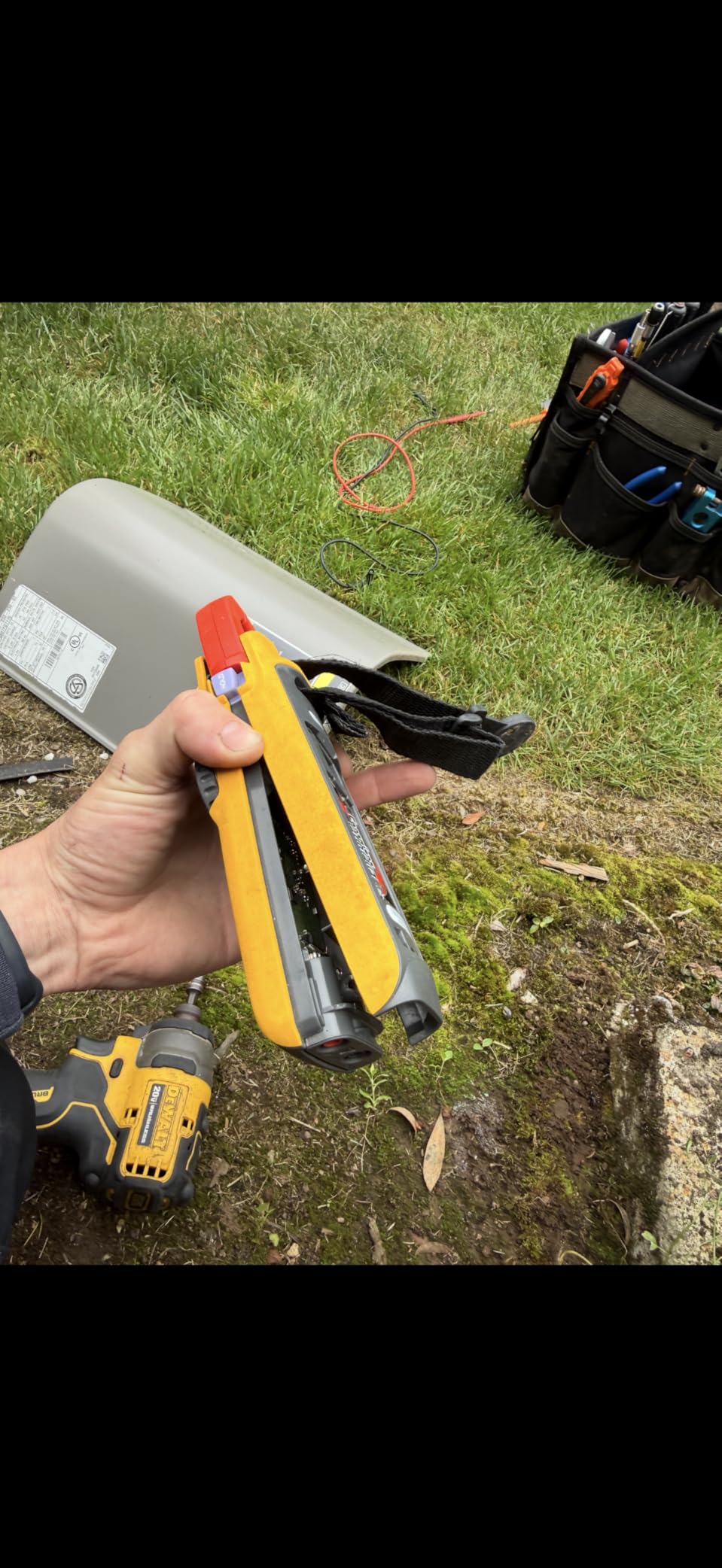
- Heavier and bulkier than smaller Fluke meters
The 902 FC is the one to buy if thermistors, flame rods and combustion analysis are a regular part of your week. It measures 200 microamps DC for flame rod testing, extends resistance to 60 kilohms specifically for thermistor work, and captures flue gas temperature.
That 60 kilohm figure is the detail that separates it from the Fluke 325. Most room thermistors and outdoor temperature sensors read above 40 kilohms at room temperature, so a meter that stops at 40 kilohms cannot give you a meaningful reading on a healthy sensor, let alone a failed one.
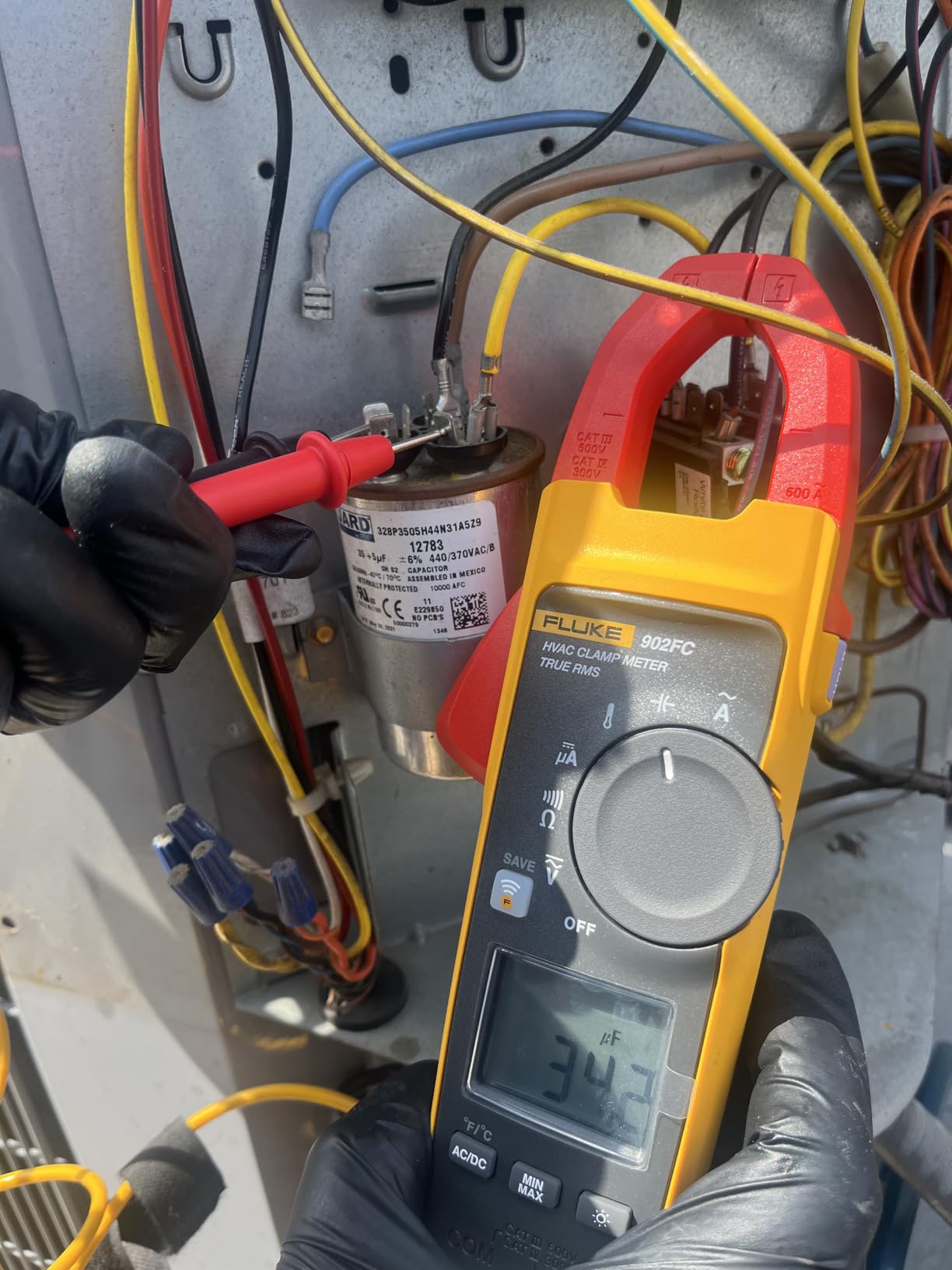
True-RMS voltage and current measurement keeps it accurate on non-linear signals, and the Fluke Connect Bluetooth link sends readings to a phone for remote logging, which is genuinely useful when the data you need is inside a unit you cannot reach while also holding a meter. hvac-talk veterans specifically recommend the Fluke 902 as the true-RMS option worth stepping up to.
Owners rate it 4.7 across 650 reviews, and the reasons service technicians cite are almost always the same three: microamp flame-rod testing, the extended thermistor range, and flue gas capture. The kit includes TL75 test leads, an 80BK temperature probe rated to 400C, and a carrying case.
Do you need the app at all?
No, and that is the main reason people hesitate. Every measurement works standalone on the meter. The Bluetooth workflow only matters if you are logging readings across a fault, and it requires a compatible phone or tablet, which adds a setup step that a lot of technicians simply never use again.
At 419g and 11.02 by 11 by 2.36 inches it is the heaviest meter in this list. In a bag with a full set of leads, that is a real consideration for a technician climbing ladders all day.
How it compares to the Fieldpiece option
Against the SC440 you are choosing resistance and flue measurement depth over inrush and ergonomics. If your diagnostics are split roughly evenly between gas appliances and cooling, the Fieldpiece is the lighter, more flexible tool. If gas work is the majority, the 60 kilohm thermistor range makes this the better instrument.
Whichever way you go, an important limit applies: no multimeter diagnoses an ECM blower motor board or an inverter control board on its own. You can verify the 24V feed, the thermostat call, the pressure switch and the motor windings, but once the board itself is the suspect, the meter has done its job.
7. Fieldpiece SC640 Swivel Clamp Meter – Best for Tight Panels and Dual Displays
Fieldpiece – SC640 Swivel Clamp Meter with Dual Display, Inrush Current, LED Jaw Flashlight and Backlit Display – HVAC Tools
- Dual display and backlit selector dial make panel work easier
- Swivel head keeps the readout in view in tight enclosures
- Inrush microamps duty cycle and temperature cover full HVACR range
- Strong rear magnet holds the meter hands free
- Reported accurate rugged and comfortable over years of daily service
- Does not read DC amps only microamps DC
- Costs more than mid-range Fieldpiece models
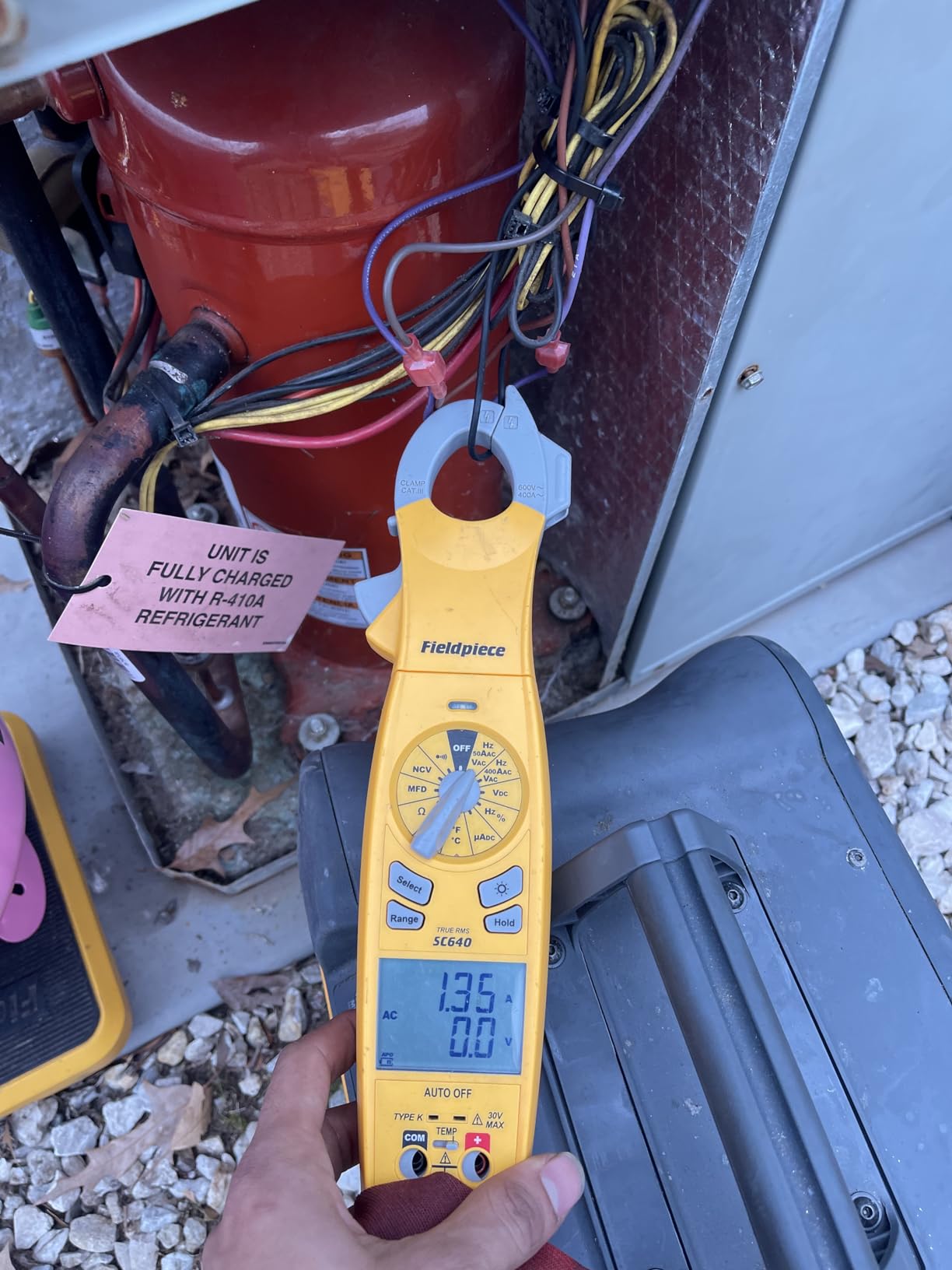
The SC640 is the flagship, and the swivel head is the reason. At 3.8 by 3.2 by 14.6 inches it is the longest meter here, but the rotating head means you can set the display angle to whatever the enclosure allows, which in a packed air handler or an electrical room is the difference between reading a value and guessing at one.
The dual display shows two measurements at the same time, so you can watch amps and volts on a single screen during a motor start rather than switching back and forth and losing the transient. Combine that with inrush current, microamps DC, capacitance, temperature and duty cycle, and it covers the full HVACR parameter set in one instrument.
Visibility is handled thoroughly: an LED jaw flashlight, a backlit selector dial, a large backlit display, a magnetic strap and onboard lead storage. In a dark attic or under a raised unit, those details are not luxury features.
It holds a 4.8 average across 324 reviews, and several technicians report buying a second identical unit after years of service. The box includes a deluxe silicone lead set, a wrap-tab type K thermocouple, short alligator lead extensions, a velcro strap, a 9V battery and a padded case, which is the most complete kit in the list.
Is the microamp range enough for flame sensor work?
Yes for flame rectification testing, which is listed among its settings. The clarification that comes up most often in reviews is that its DC amperage range is microamps only, not full DC amps, and that surprises some buyers who assumed a clamp meter reads DC current. The operating range is also listed as 32 to 122 degrees F.
That said, a clamp-based microamp reading is a different technique from a dedicated multimeter microamp mode, and for repeated gas furnace diagnostics the Fluke 116 remains the cleaner instrument.
Where the extra spend is justified
Justified when you are in panels and enclosures all day and the swivel head plus dual display remove real friction from the work. The one-handed ergonomics are praised repeatedly on r/HVAC, and the strong rear magnet genuinely lets you clip into a live test and look at your notes.
It is not justified if you need a full DC amp reading, or if you are buying your first meter and the mid-range SC440 would cover your actual mix of calls. Several owners in the reviews treat the SC440-to-SC640 upgrade as a second purchase after the first meter proved its worth.
8. UEi DL369 Digital Clamp Meter – Best Dual Display Value Pick
- Dual display showing amps and volts at once speeds up troubleshooting
- Covers volts amps microamps ohms and capacitance in one meter
- Lead holder NCV and screw-on alligator clips add safety
- Capacitance range plus mini Farad mode for charging
- Includes a carrying case and 3-year limited warranty
- No built-in temperature measurement
- No magnet on the back
- Readings can take several seconds to settle
- Supplied leads lack tip covers and fit the holders poorly
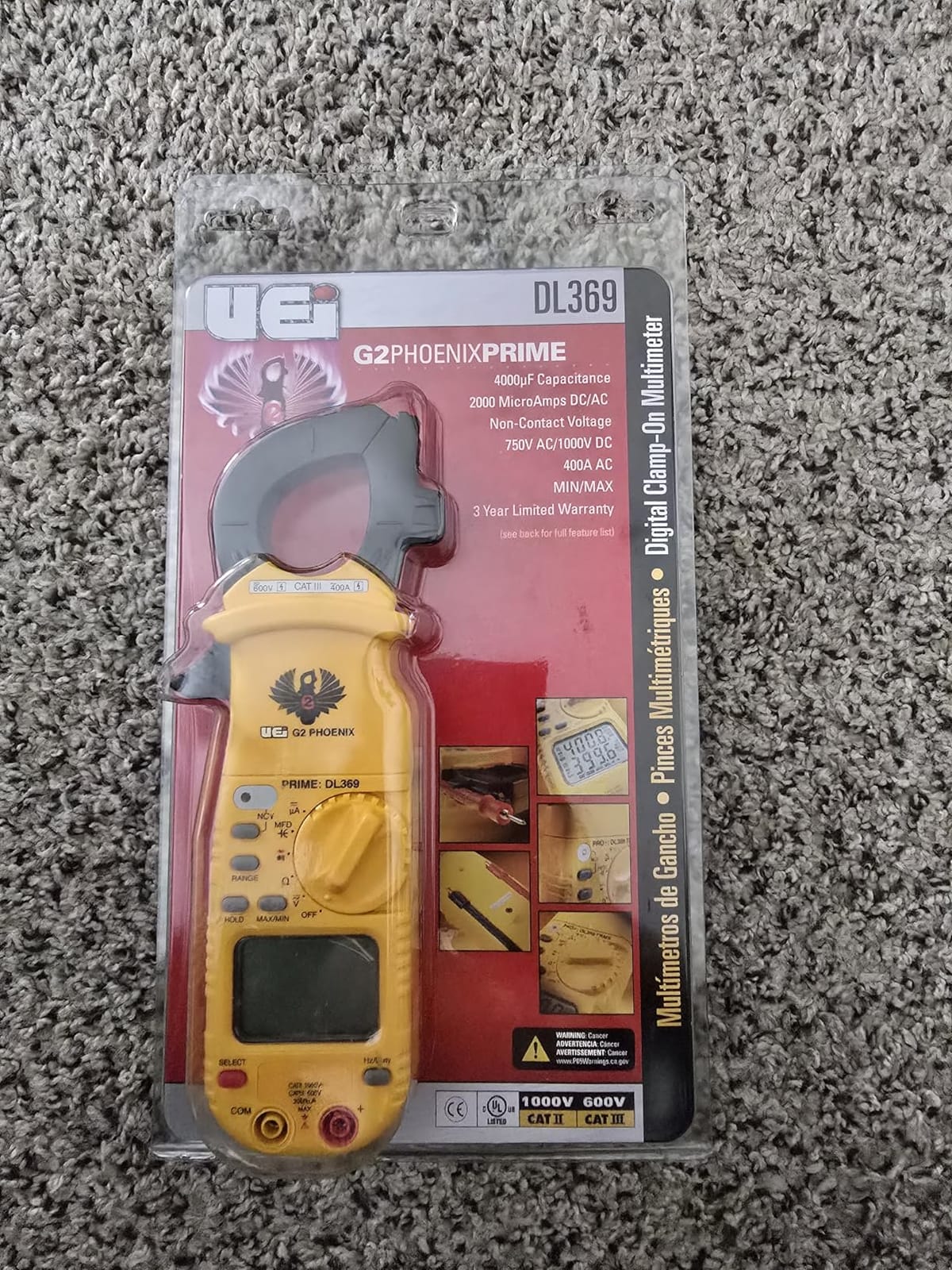
The DL369 is the value pick for anyone who wants a dual display and a microamp range without reaching for a Fluke. It measures AC current up to 400 amps and AC/DC current to 2000 microamps, which covers flame sensor testing, alongside capacitance to 4000 microF plus frequency and duty cycle.
Those two details together are rare at this end of the market. Many budget meters cannot read microamps at all, which forces a separate purchase the moment gas furnace work lands on the schedule, and several of them have no capacitance range either.
The dual 4000-count display shows two readings simultaneously, which makes it a genuinely useful companion to the Fluke 116 approach of measuring resistance and temperature. The mini Farad mode for watching a run capacitor charge is a practical detail that shows the meter was designed with HVAC work in mind rather than adapted to it.
Safety touches are good for the tier: audible non-contact voltage detection, 600V CAT III and 1000V CAT II ratings, test lead holders on the clamp, included screw-on alligator clips, a carrying case and a 3-year limited warranty. UEi is UL listed.
Across 1,569 reviews the average is 4.5, and technicians with 10 to 20 years of field experience rate it as the meter they keep buying replacements for, citing value against a Fluke 323.
Can a technician actually work a whole call with it?
For electrical and control diagnostics, yes. For anything involving temperature, no, and that is the real limitation. There is no built-in temperature measurement at all, so supply air, return air and refrigerant line readings need a separate thermometer, and on duct or coil diagnostics that is a meaningful gap rather than a checkbox.
Readings can also take several seconds to settle, which is mildly annoying when you are checking a control circuit and slightly more annoying on a marginal capacitor, where consistency is what you are trying to establish.
What to watch out for in the field
There is no magnet on the back, so nothing hands-free when you are clipping leads into a live circuit. The supplied leads lack tip covers and barely fit the rear lead holders, and the build quality falls short of UEi’s more expensive models, which is visible in how the case and hinges feel.
If temperature matters at all to your work, add the IR and probe thermometer from the Klein bundle in this list rather than buying two separate tools from scratch.
9. KAIWEETS HT206D Clamp Meter – Best Budget Clamp Meter
- True RMS AC and DC current capacitance duty cycle and temperature in a low cost body
- LowZ and low pass filter modes work on VFD driven motors
- Two color backlit display turns red above 80V or 3A
- LED flashlight and K-type thermocouple included
- Small and comfortable to read from overhead
- Supplied test leads have poor conductivity and jumping resistance
- Low DC current readings can be inconsistent
- No way to measure small mA currents with the probes
- Thin plastic build is not rugged enough for heavy trade use
The HT206D is the reason the budget tier in this list changed in 2026. With more than 12,000 reviews averaging 4.5, it is the most widely proven meter here by volume, and owners widely treat it as the best value clamp meter available, performing most jobs that would otherwise demand a far more expensive Fluke.
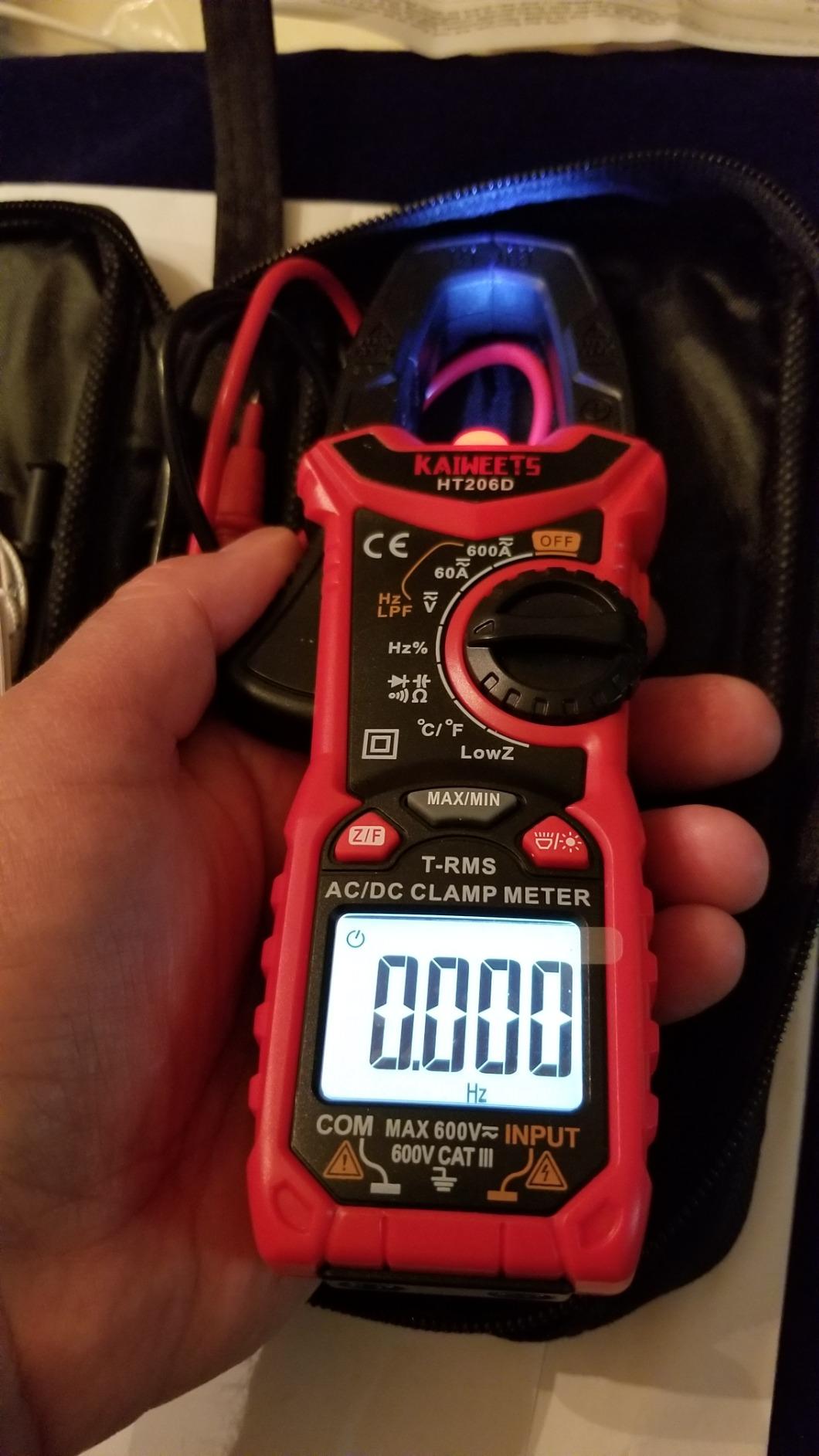
On paper it is hard to argue with: True-RMS AC and DC current, AC/DC voltage, frequency, duty cycle, resistance, capacitance, diode, continuity and temperature. The LowZ mode and low-pass filter are specified for VFD-driven motor and transformer signals, which is a real HVAC and refrigeration concern, not a generic electrical feature.
The two-colour backlit LCD turns red above 80V or 3A, which gives you a visual warning without reading the number, and the included K-type thermocouple covers liquid and air-conditioning port temperatures. It is rated to 600 volts under IEC 61010-1 CAT III 600V double insulation with 36-month service, which is the honest safety category for this tier.
At 7.5 by 2.8 by 1.3 inches and 7.68 ounces it is the smallest meter in the list, easy to hold overhead in a ceiling space and easy to read from an awkward angle.
What are you trading away at this price?
The test leads are the weak point and the most consistent complaint. Several owners replaced them with third-party kits after finding poor conductivity and resistance readings that jumped around. Budget for a replacement lead set before you judge the meter’s accuracy.
Low DC current readings can be inconsistent even after zeroing, and there is no way to measure small milliamp currents with the probes, which matters if you do gas appliance diagnostics. The thin plastic housing is not built for heavy trade use, and the only way to wake the meter after the 15-minute auto power-off is to cycle the function dial.
Who should buy this instead of spending more?
Buy this one if you are a student, an apprentice on a tight tool budget, or a technician in a building where the meter will live in a desk drawer rather than a service truck. It covers the majority of residential diagnostics accurately and it is backed by the largest review base of any meter here, which matters when you are buying a tool sight-unseen.
Spend up if you are doing daily gas work, need flame sensor microamps, or expect the meter to survive being dropped off a ladder. For bench and electronics work in between, our bench multimeter guide covers the accuracy side.
How to test a flame sensor with your multimeter?
This is the diagnostic that makes an HVAC-specific meter worth buying, and it is the one most general roundups never explain. A healthy flame rectification test reads between 0.5 and 5 microamps. Above that range the sensor is usually clean but the ground path is poor, and below it the sensor is dirty, cracked, mispositioned or disconnected.
Start with the system off at the thermostat. Open the burner compartment, locate the flame sensor, and set your meter to DC microamps. Connect the red lead to the sensor terminal and the black lead to the burner ground or the control module ground, not to a random wire in the cabinet.
Now start the burner and hold the meter steady. A healthy reading should hold steady between 0.5 and 5 microamps for the duration of the call. If the reading wanders up and down, the sensor is contaminated or the ground is poor. If it sits near zero, clean the sensor rod with fine abrasive, keep the flame in the right place, and retest before replacing anything.
The technique matters as much as the range. The number is small enough that hand movement changes it, so rest an elbow on the cabinet and keep your breathing still for the few seconds you need. This is exactly the complaint technicians raise about budget meters: several report units that read 0 or 1 microamp on a healthy flame and cannot repeat the reading, which reads as a failed sensor when the flame is fine.
Six of the nine meters in this list have a dedicated microamp range you can rely on for this test. Before you buy, check the manual for a DC microamp figure, because a meter without one will send you chasing a component that is working correctly.
Multimeter or clamp meter: which one does your service truck need?
A multimeter uses probes and needs a second hand. A clamp meter wraps around a conductor and reads current without breaking the circuit. For a technician doing furnace and air conditioner calls, you generally want both, and the question is whether you carry two tools or one bundle.
If your days are gas furnace flame sensor calls, thermostat wiring, and control circuit diagnosis, a dedicated multimeter such as the Fluke 116 is the priority, because the microamp mode and low input impedance do the work. Add a clamp meter for motor current checks, and the pairing covers nearly every residential call.
If your days are split systems, rooftop units and mini-splits, lead with a clamp meter. The SC260, SC440 or SC640 will give you non-intrusive current readings on live circuits that a probe meter cannot reach without shutting the system down, which on a cooling season afternoon is a real productivity difference.
A bundle like the Klein CL320KIT makes sense when you are building a first bag or working alone without a mentor to borrow from, because it delivers a clamp meter, a non-contact voltage tester and a thermometer in a single case. A two-meter setup is better value once you know which gaps remain. Buying guides for the electrician side of the trade go deeper on the panel-safety differences between the two formats.
How to choose a multimeter for HVAC work?
Safety category first. A CAT III 600V rating covers the fixed installation work in most residential and light commercial systems, while CAT IV 300V or CAT IV 600V covers the service entrance side where transients are larger. An under-rated meter can fail violently on a fault event, so this is not a place to compromise to hit a target number.
Microamp range, if you do gas work. There is no substitute. A meter without a DC microamp range cannot diagnose a flame sensor, and that is the most common reason technicians buy a second meter later. A 200 microamp or 2000 microamp ceiling both work; the lower resolution range gives you the stable reading you need.
True-RMS versus average-responding. True-RMS means the meter measures the true effective value of an AC signal rather than estimating it from a waveform assumption. On a clean sine wave the two agree. On the chopped, non-linear output of an inverter mini-split, an ECM blower, or an LED ballast, the average-responding reading can be off enough to send you replacing a board that is working.
Temperature probe range. For most service work, -40 to 400 degrees F covers supply air, return air, and refrigerant line readings comfortably. If you do combustion analysis or measure discharge temperatures on a heat pump, you want the range to reach 572 degrees F and beyond, which is why the Klein kit’s IR07 thermometer spans -40 to 572F.
Low input impedance and ghost voltage. A high-impedance voltmeter applies so little load that it can read 24V on a wire that is effectively open, because a tiny amount of charge sits on the line. Low input impedance, sometimes called LoZ or Load mode, collapses that phantom voltage. This is one of the most common false conclusions HVAC techs draw about control boards, and the meters that fight it are worth the money on their own.
Display resolution and count. A 6000-count display resolves the difference between a good capacitor and a marginal one far better than a 2000-count one, and the higher counts matter most on the microamp and millivolt ranges where the reading is small. A dual display, as on the SC640 and DL369, lets you watch two values during a motor start.
Build, backlight and calibration. Readability in a dark attic is a safety issue, not a comfort one, so a backlit display and dial should be near the top of your list. On calibration, expect accuracy to drift with heat and humidity over a year of van service, and look for a brand with a local calibration service and NIST-traceable certificates. Fluke and Klein both have that service network, which is the practical argument for buying one meter for a decade instead of replacing budget units every few years.
Our complete digital multimeter comparison goes deeper on the accuracy and display-count side for readers who want the full spec picture.
Frequently Asked Questions
What multimeter do HVAC techs use?
Most HVAC technicians use a purpose-built HVAC meter with a microamp range, an integrated thermometer and low input impedance for 24V control wiring. The Fluke 116 is the industry standard for gas furnace flame sensor work, while the Fieldpiece SC260 is widely carried as a compact True-RMS clamp meter for panel and attic service. Technicians who want one case to cover clamping, voltage detection and temperature often carry the Klein Tools CL320KIT.
What meter is better, Fluke or Fieldpiece?
Fluke meters carry a stronger brand reputation for calibration accuracy, repair support and three-year warranties, and the Fluke 116 and 902 FC cover flame sensor and thermistor work in depth. Fieldpiece meters lead on ergonomics, swivel-head and dual-display design, and inrush measurement, and r/HVAC technicians describe the SC260 and SC640 as daily-carry tools. For gas appliance diagnostics pick Fluke, for panel and motor work pick Fieldpiece.
Which Fluke multimeter is best for HVAC?
The Fluke 116 is the best all-round HVAC choice, with a microamp range for flame sensors, a built-in thermometer to 400C, low input impedance against ghost voltage and a three-year warranty. The Fluke 902 FC is the better pick for thermistor and flue work, extending resistance to 60 kiloohms and adding flue gas capture. The Fluke 325 is a clamp meter for panel and current work, with no microamp range.
Is Fluke 323 good for HVAC work?
The Fluke 323 is a solid general clamp meter for HVAC current measurement, with True-RMS sensing to 400 amps, AC and DC voltage to 600V, and a CAT IV 300V and CAT III 600V safety rating. It has no microamp range for flame sensor testing, no inrush measurement, and resistance stops at 40 kilohms, which is low for many thermistors. It suits technicians focused on air conditioning and electrical panels rather than gas appliances.
Is the Fluke 116 good for HVAC work?
The Fluke 116 is the most widely recommended HVAC meter in the trade. It measures microamps for flame sensor testing, includes a temperature probe covering -40C to 400C, and its low input impedance mode prevents false readings from ghost voltage on 24V control wiring. It holds a 4.8 average across 645 reviews. Its weaknesses are the stiff supplied test leads and the lack of any high-current ammeter measurement.
Is Fieldpiece SC260 good for HVAC?
Yes. The SC260 is a compact True-RMS clamp meter built for electrical and thermal HVACR service, with a 600V maximum operating voltage, capacitance, temperature, non-contact voltage detection and a swivel magnet for hands-free use. It holds a 4.8 average across 1,700 reviews, and r/HVAC technicians describe it as a daily-carry meter. It has no inrush measurement and no dedicated flame sensor microamp mode.
What is the best multimeter for a beginner HVAC technician?
For a beginner the Klein Tools CL320KIT is the strongest single purchase, because it bundles a True-RMS clamp meter with a microamp range, a non-contact voltage tester and an IR and probe thermometer covering -40 to 572F in one case. The KAIWEETS HT206D is the lower-cost option if only one meter is realistic, though it has no microamp range and the supplied leads are worth replacing. Replace leads first on any budget meter.
Do I need a True-RMS multimeter for HVAC?
Yes, if you service inverter mini-splits, ECM blower motors or LED ballasts, because those loads are non-linear and an average-responding meter can read low enough to send you replacing a healthy board. On older split-phase and conventional PSC motor systems an average-responding meter is adequate. Every meter in this roundup is True-RMS except where noted, so the cost of getting it right is mostly about which model you choose.
Which multimeter should you buy?
After working through nine of the most recommended meters in the trade, the Fieldpiece SC260 is our pick for the best multimeters for HVAC work in 2026. It is the meter we would put in a truck first: compact enough for tight panels, True-RMS accurate on the inverter-driven equipment filling modern systems, and carrying the capacitance and temperature functions that a full HVACR day requires.
Add two specialists from this list. Gas appliance technicians should pair it with the Fluke 116 for the microamp flame sensor test and the low input impedance that keeps 24V control wiring honest. Technicians who live in rooftop units and mini-split cabinets should consider the SC640 when the swivel head and dual display start earning their keep, and thermistor-heavy gas work is better served by the Fluke 902 FC.
On a tight tool budget, the Klein Tools CL320KIT covers more ground in one case than any single meter here, and the KAIWEETS HT206D is the value pick with the largest proven review base of the lot. Replace its test leads first. Whichever you choose, confirm it has a DC microamp range if gas work is coming, a CAT III 600V or better safety rating, and low input impedance. Our broader multimeter comparisons for electricians and budget picks are worth reading if you are still narrowing the field.