
The Komelon SL2825 Self Lock 25-Foot is the best tape measure for carpenters overall, because a nylon coated high carbon steel blade, an automatic self-lock and a rubber overmolded case cover the three things that actually kill a tape on a jobsite. The STANLEY FATMAX 33-725 is the reach champion, and the CRAFTSMAN CMHT37225 is the value pick that most framers never need to replace.
That is the short version. The longer truth is that the best tape measures for carpenters is not one product, it is a small set of tapes matched to specific work. A 25 foot tape with a one inch blade is a framing tool. A narrower blade is a finish and scribing tool. A 100 foot tape is a site layout tool. Nobody gets through a week carrying one of each in the same pocket, and the forums agree on this more than they agree on any brand name.
Our team compared ten carpenter tape measures against each other over several weeks of framing, drywall and trim layouts, weighing blade rigidity, lock behaviour, readability and how each one survived being dropped, clipped to a belt and dragged through sawdust. Ten tapes, three mounting positions and a lot of mud. Everything below is what the measurements turned up, including the places where the most popular names disappoint.
One thing to clear up before the list, since it is the question people ask most often. The type of tape measure commonly used in carpentry is a retractable steel-blade tape in a rubber or polymer case, usually 16 or 25 feet long, with a blade one inch wide, a positive blade lock and a belt clip. The wide blade is what makes it a carpenter tape rather than a DIY tape: it holds its shape in the air so you can measure a span solo, and it resists bending when the hook is levered against a stud.
Table of Contents
Top 3 Best Tape Measures for Carpenters (October 2026)

Komelon SL2825
- Nylon coated high carbon steel blade
- Automatic self-lock
- Rubber overmolded ABS case
- Stud marks every 16 inches

STANLEY FATMAX 33-725
- Extra-wide 1.25 inch blade
- 14 ft of solo reach
- BladeArmor coating at the hook
- Limited lifetime warranty

CRAFTSMAN CMHT37225
- Fractions printed on the blade
- Self-locking blade with button retract
- Rubber overmold grip
- Stud references every 16 inches
Best Tape Measures for Carpenters in 2026 at a Glance
| Product | Specifications | Action |
|---|---|---|
| Komelon SL2825 Self Lock 25-Foot |
|
Check Latest Price |
| STANLEY FATMAX 25-Foot 33-725 |
|
Check Latest Price |
 Klein Tools 9225 25-Foot Klein Tools 9225 25-Foot |
|
Check Latest Price |
 FastCap ProCarpenter Reverse 25-Foot FastCap ProCarpenter Reverse 25-Foot |
|
Check Latest Price |
| CRAFTSMAN CMHT37225 25-Foot |
|
Check Latest Price |
 DEWALT Atomic Compact 30-Foot DEWALT Atomic Compact 30-Foot |
|
Check Latest Price |
 Spec Ops Tools 25-Foot 1-1/8 Inch Spec Ops Tools 25-Foot 1-1/8 Inch |
|
Check Latest Price |
 DEWALT 100-Foot Long Tape DEWALT 100-Foot Long Tape |
|
Check Latest Price |
 MulWark Wide 25-Foot MulWark Wide 25-Foot |
|
Check Latest Price |
 Komelon 433IEHV 33-Foot Engineer Scale Komelon 433IEHV 33-Foot Engineer Scale |
|
Check Latest Price |
The Pro Belt Doctrine: Four Tapes, Four Jobs
Ask working carpenters what tape they carry and almost none of them say one. A 2005 Houzz thread has a contractor listing exactly four: 25×1 for general purpose, 16×1 for interior work, 12×3/4 for drywall and 12×1/2 in decimal scale. An r/Construction video does the same thing in video form. That is the single most consistent pattern on this topic and no editorial roundup has ever mapped it properly, so here it is.
Framing and general layout: 25 foot, 1 inch blade. You want reach and stiffness. This is the Komelon SL2825 slot, or the STANLEY FATMAX 33-725 if you need the blade to stay rigid past ten feet unsupported.
Interior finish and trim: 16 foot, 1 inch or narrower. Here blade width becomes a liability. A one inch blade marks walls and baseboards. The r/Construction crew discussing sheetrock scribes and rips recommended the thinner Stanley PowerLock for exactly that reason, describing it as more forgiving when scribing. The FastCap ProCarpenter reverse scale is the pick here if you want a compact case that will not telegraph a mark across a finished wall.
Drywall and sheetrock: 12 foot, 3/4 inch blade. Shorter, narrower, lighter. The CRAFTSMAN CMHT37225 with fractions printed on the blade covers this slot from a longer class, and its stud references every 16 inches line up with layout without a mental conversion.
Steel studs, duct and long site runs: magnetic hook, 25 foot or 100 foot. A magnet is not a luxury when the surface is a steel stud. The Klein 9225 and the MulWark Wide both carry one, and the DEWALT 100-Foot handles foundation and site layout where repositioning is not an option.
The practical version of the doctrine: pick one tape per slot, and expect to replace the drywall slot first because it spends its life in a pocket full of dust and gypsum dust eats blade coatings faster than anything else.
1. Komelon SL2825 Self Lock 25-Foot: Best Overall for Carpenters
- Automatic lock releases at a button push
- Nylon coated high carbon steel blade
- Rubber overmolded case survives drops
- Stud markings printed every 16 inches
- Light at 13.28 ounces
- Standard 1 inch blade gives less standout than wide-blade models
- Imperial only scale on the visible face
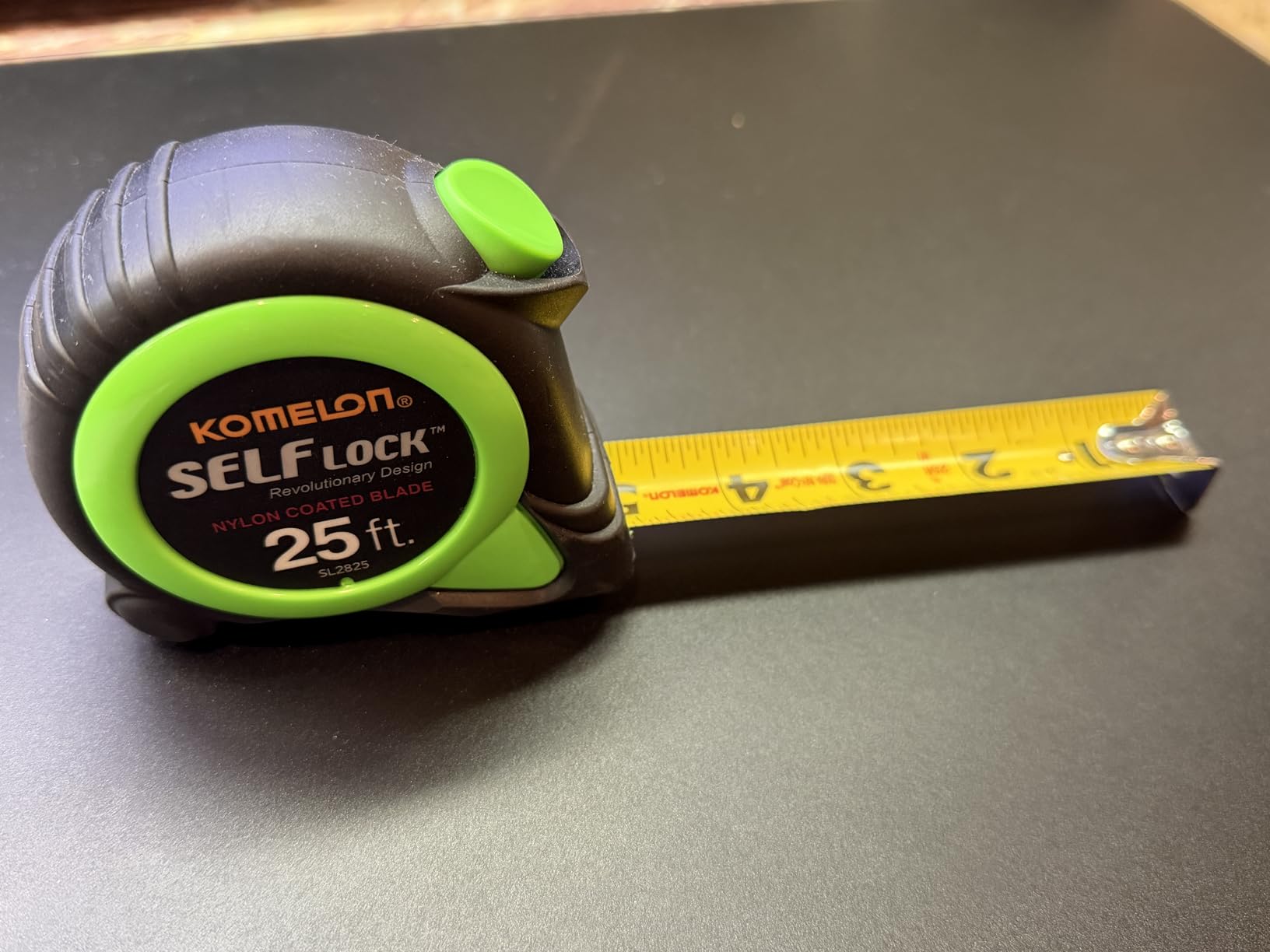
I put the Komelon SL2825 on my belt first and never took it off. The automatic lock is the reason. You pull the blade out, it stays where you left it, and a single button push sends it home. On a tape with a slide lock, that push is a separate action you have to remember. Over a week of stud layout that difference adds up to something you feel in your thumb rather than something you can measure.
The blade is high carbon steel with a nylon coating, which is the combination I look for above everything else. Nylon is what keeps the printed graduations legible after a season of dust, and it slows rust in the case when a wet tape goes back in the bag. The listed accuracy is plus or minus 0.03 inch over the full run, and the case is ABS plastic with a rubber overmold that absorbs the drop the blade never sees.
With close to 19,000 reviews at 4.7 stars, this is the most proven tape in the group by a wide margin, and that matters more than it sounds. A tape measure is a consumable that has to be replaceable tomorrow morning, and a design that has been in production long enough to accumulate that volume of feedback is a design whose housing, spring and lock geometry are all already sorted.
The physical numbers are worth knowing because they explain who this tape is not for. It weighs 13.28 ounces, measures 3.5 by 2 inches and has a one inch blade. That is a normal framing blade width, so the standout is moderate. Owners regularly report eight or nine feet of usable horizontal extension before sag, which is fine for layout but not what you want when you are reaching sixteen feet across a room by yourself.
When the automatic lock earns its keep
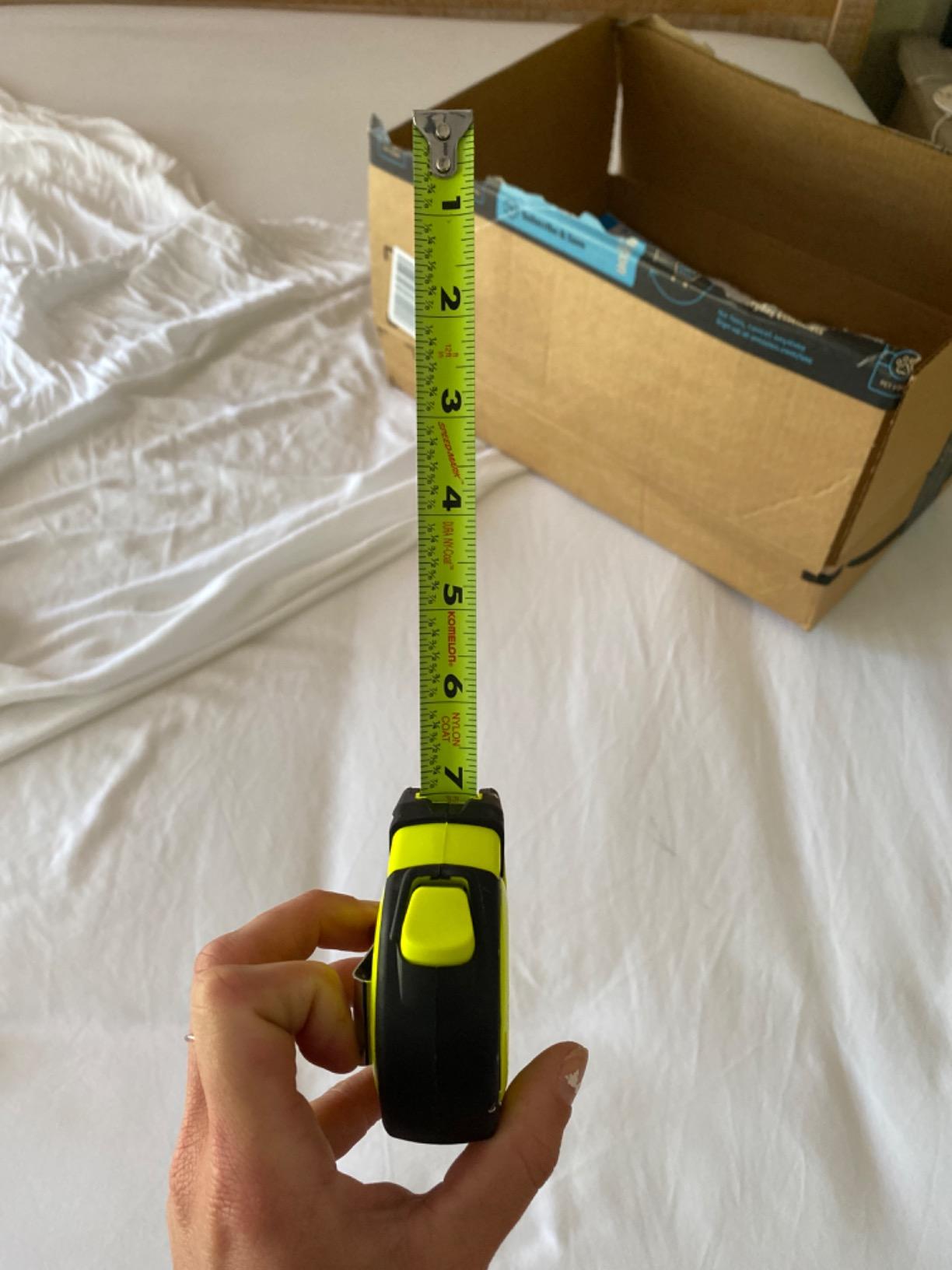
It earns its keep whenever your hands are full. Holding a stud, a pencil and a framing square while trying to also flick a thumb into a slide lock is where tapes get dropped, and a dropped tape is how blade coatings crack. The self-lock removes a step from a motion you perform hundreds of times a day.
It also matters on ladders and stairs. You can set the blade at a height, let go and climb without the tape reeling itself in. That single feature is why so many reviewers describe this as the tape they stop thinking about, which is the highest compliment a tool can get.
Where the one inch blade will frustrate you
Finish work. A one inch blade held flat against a wall leaves a wide trace, and on a painted surface that trace is visible. Trim carpenters who mark on finished walls either scribe with a narrower blade or use a pencil and a straightedge at the far end of the board instead of the hook.
The other limit is metric. This is an imperial-only scale on the visible face, with no centimeter graduations. Trades working to metric drawings need a dual-scale blade, which is a genuine deal breaker in commercial work outside North America.
2. STANLEY FATMAX 33-725 25-Foot: Best for Reach
- Extra-wide 1.25 inch blade holds rigid past 10 feet
- Large font numbers easy to read
- Non-slip rubber over high impact case
- BladeArmor coating at the hook
- Limited lifetime warranty
- Heavier than economy 25 foot tapes
- Bulky for pocket carry
- Rigid molded packaging is hard to open
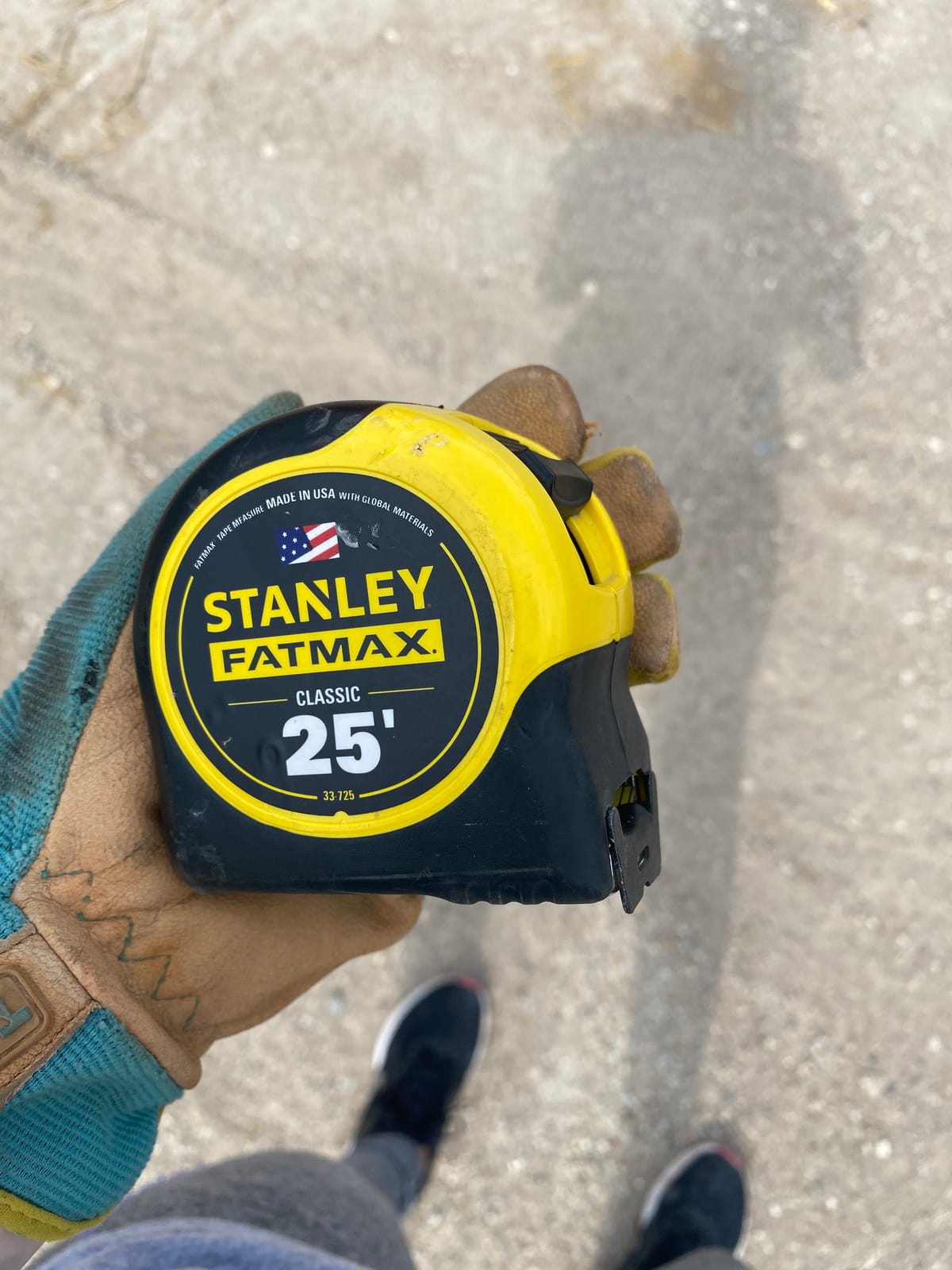
The FATMAX 33-725 solves a specific problem: getting a measurement across a wide room alone. Its blade is 1.25 inches wide, and the listed reach is 14 feet. Reviewers consistently report eight to eleven feet of unsupported extension in real use, which is a different category of rigour from the eight feet a standard one inch blade gives you.
That width is also the reason for its reputation. FATMAX is simultaneously the most recommended and the most criticised tape in carpenter forums, and both camps are reacting to the same physical fact. A 1.25 inch blade is superb for framing and superb at marking a wall. r/Carpentry threads open with people saying they have had enough of FatMax, and a lot of that is finish carpenters who want a narrower blade, not people who think the tool is badly made.
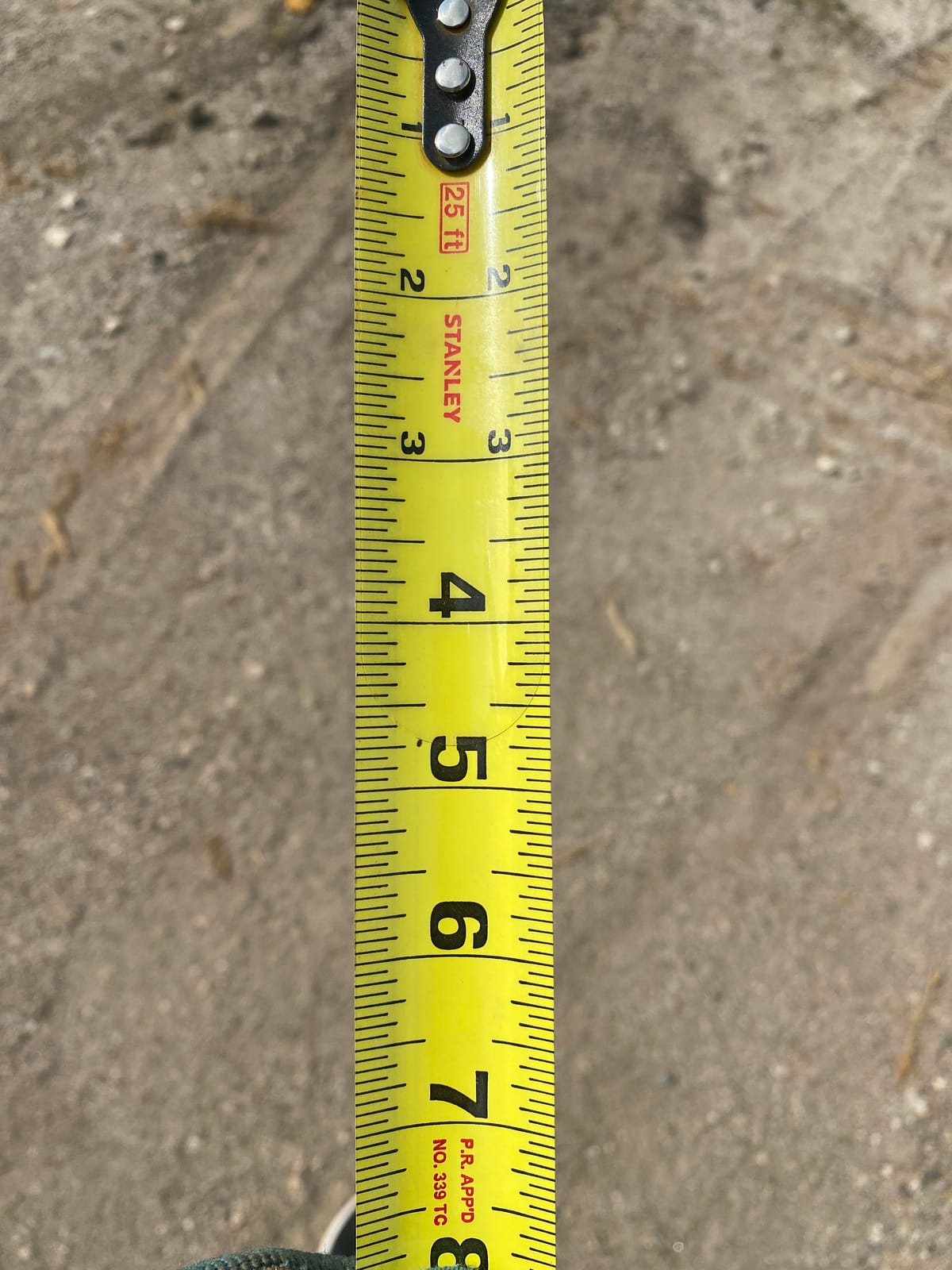
It holds a 4.6 star rating from 8,619 reviews, and multiple owners report owning two or three. The large font printing is genuinely useful on a wide blade because the extra material gives the numbers room to breathe, and the non-slip rubber over a high impact case is the part that survives being dropped blade-first off a scaffold.
Two build details are worth paying attention to. The blade is fully coated for abrasion resistance, and the hook carries a BladeArmor coating specifically because the hook is the highest-wear point on any tape. The warranty is a limited lifetime warranty rather than a one year term, which is unusual in this category and matters if you work in a trade where a tape gets destroyed rather than retired.
Choosing it over a standard one inch blade
Choose it when you measure wide rooms solo, when you frame walls and floor cassettes, or when you want a tape you can hand to an apprentice without worrying about how hard it gets used. The extra reach means fewer repositionings, and fewer repositionings means fewer reading errors.
Skip it if you are doing trim on finished surfaces and mark with the hook. A blade that wide will telegraph across paint, and no amount of extra rigidity solves that.
The bulk problem and how to live with it
The case is rubber over a high impact shell and measures 7.1 by 4.6 inches. That is a real object to carry, and reviewers who work out of a tight pouch say it will not sit comfortably in one. The honest fix is to pick a different tape for the drywall and trim slots on your belt rather than forcing the FATMAX into every slot.
One smaller irritation: the rigid molded clamshell packaging is genuinely hard to open without a knife, which matters because a lot of these arrive as employer-issue equipment rather than personal purchases.
3. Klein Tools 9225 25-Foot: Best for Steel Studs and Metal Framing
Klein Tools 9225 Tape Measure, Heavy-Duty Measuring Tape with 25-Foot Double-Hook Double-Sided Nylon Reinforced Blade, with Metal Belt Clip
- Magnetic hook plus double-sided hook for steel and conduit
- 13 foot standout for solo layout
- Retraction speed brake protects fingers
- Pipe bending and phrasing cheatsheet on the case
- Bulky 25 foot body may not fit a pouch with the clip attached
- Bottom stop button reported to loosen over time
- Imperial only version lacks centimeter scale
The Klein 9225 is the tape to buy if you frame metal. The hook is magnetic, so it will hold itself to a steel stud, a steel stud track or a length of conduit while you mark. That removes the most annoying part of metal work, which is the fact that the hook slides off a smooth surface the instant you take a hand off it.
It also has a double hook, meaning the scale is printed on both faces of the blade and the hook works from either side. Combined with a listed 13 foot standout and 16 foot reach, that gives you a tape that behaves like a 16 footer while living in the 25 foot class.
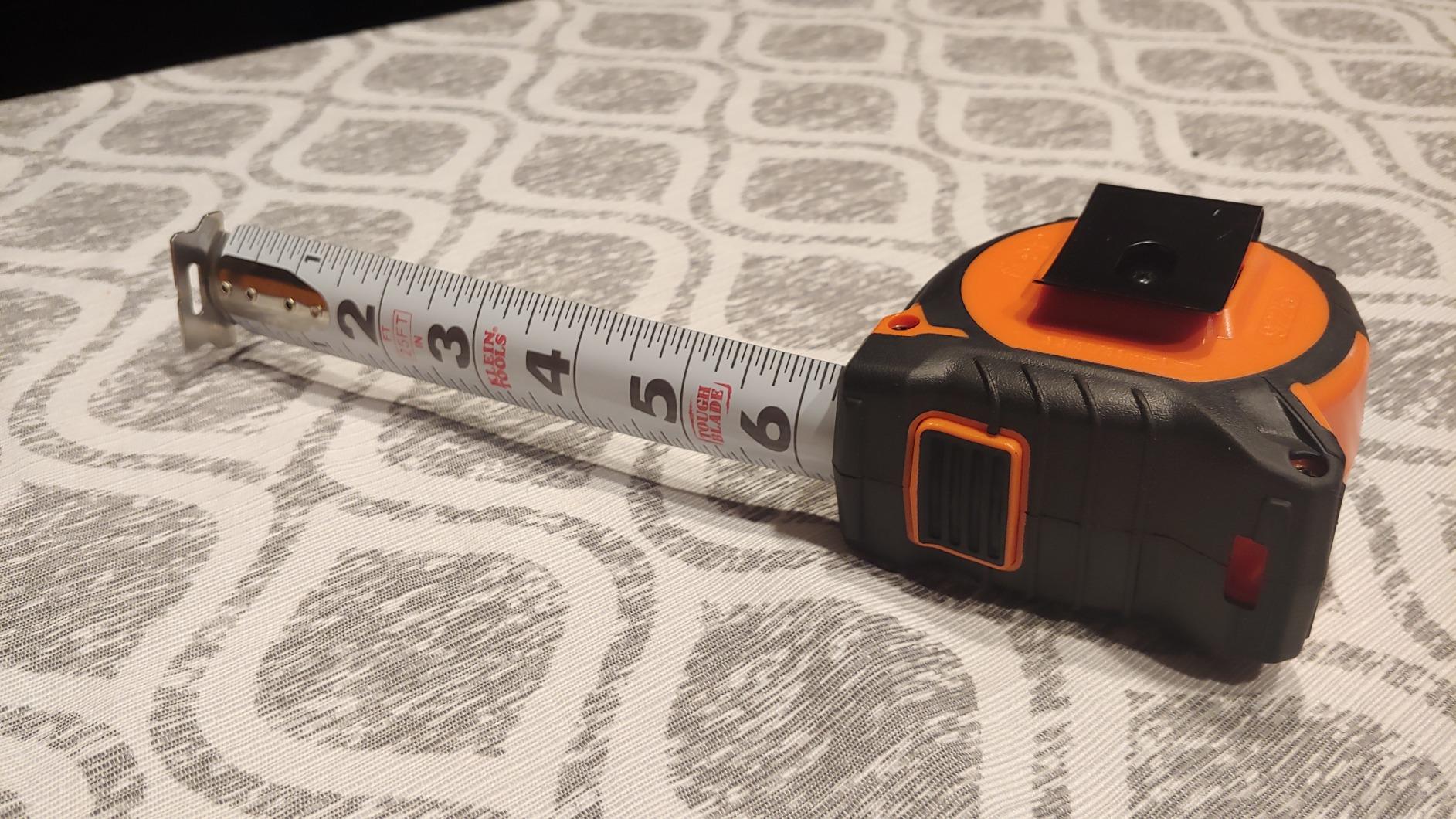
Two details show that this was designed for working trades rather than assembled from parts. There is a retraction speed brake, which controls the return of the blade so it does not whip back into your palm, and there is a cheatsheet printed on the case for pipe bending and phrasing. Both are small, both are genuinely used.
At 4.6 stars from 3,801 reviews it sits comfortably alongside the FATMAX on satisfaction, with the readability and the magnetic hook drawing most of the praise. The double-sided scale is bold and marked at 1/8 inch intervals, and the nylon coating protects the printing.
Why a magnetic hook changes metal work
On a wood stud you hook, mark and move. On a steel stud the hook glides, the mark slides off the line and you redo it. A magnetic hook pins the tape end to the metal so your mark lands where the tape actually is. Electricians and metalframers have asked about this specifically for years, and the Klein’s hook is the strongest of the three magnetic hooks in this roundup.
The double hook matters for the same reason. When the tape is twisted so the back of the blade faces the stud, the scale on that face still reads right, so you are not mentally flipping the reading.
The size trade-off nobody mentions
This is a one and a third pound body, and reviewers regularly report popping the metal belt clip off to fit it into a pouch. That is fine once, but a removed clip is a clip that will not go back on neatly, and r/electricians threads describe the belt clip as their single biggest complaint across all tape brands.
There is also a recurring report that the bottom stop button loosens with heavy use and slows retraction. If you work in abrasive conditions, check it periodically.
4. FastCap ProCarpenter Standard Reverse 25-Foot: Best for Reading From Either Hand
FastCap ProCarpenter Standard Reverse Measuring Tape, 25-Foot
- Scale readable from either hand
- Built-in writing surface and pencil sharpener
- Compact case fits a pocket or pouch
- Holds up to sawdust sand and 8 foot drops
- Multiple reviewers buy extras
- Modest blade standout
- Notepad numbers smudge with repeated use
- Rapid hard retraction can stress the mechanism
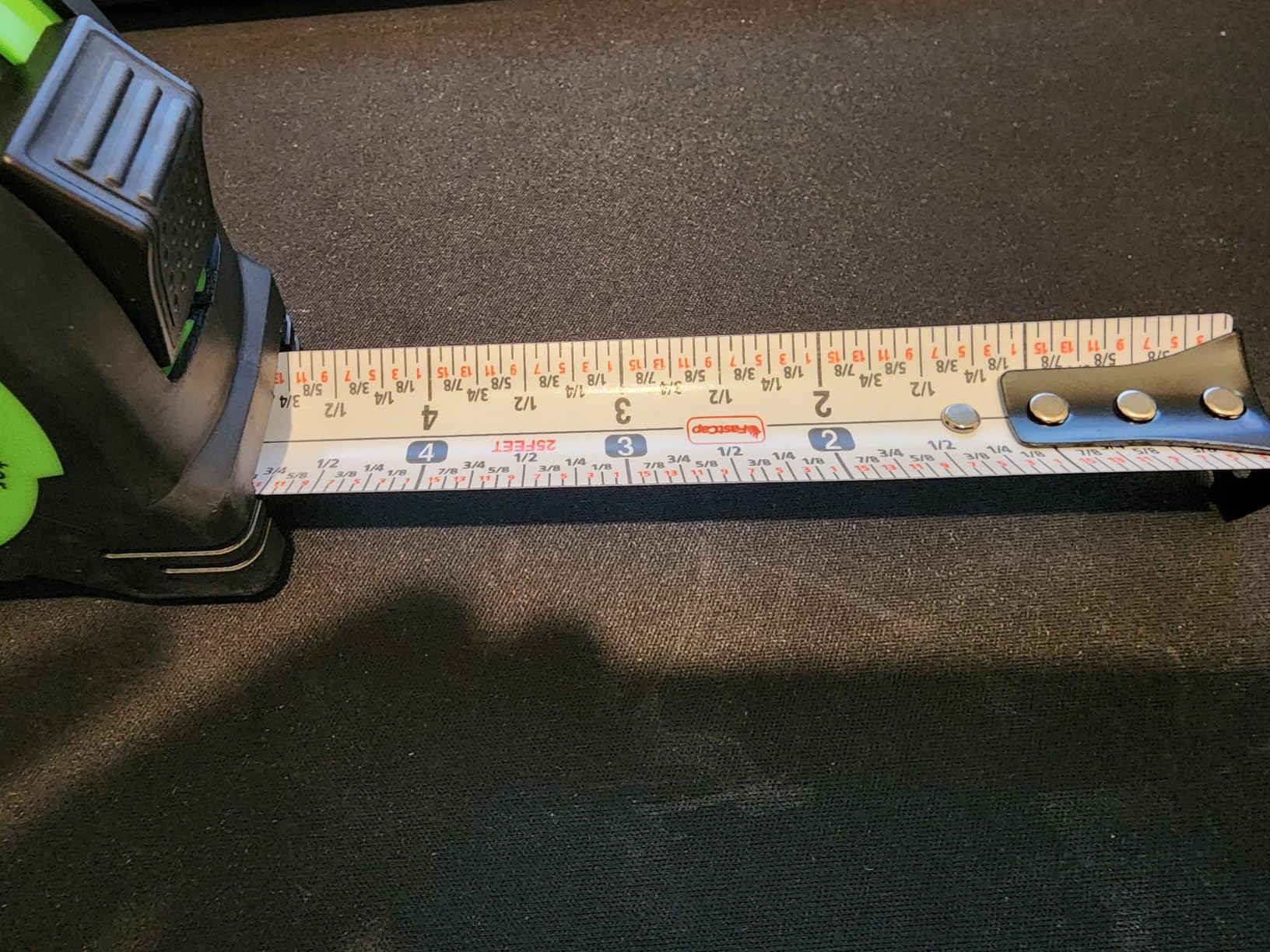
The FastCap ProCarpenter PSSR25 is built around one idea: the scale reads the same way from either hand. The blade carries a reverse-reading graduation so you can hold the tape in the position that suits you and still read numbers that increase in the right direction. For a right-handed framer marking from one direction that is a small convenience. For anyone whose hands do not default the way most tape scales assume, it removes a whole category of mis-cuts.
It is also the most compact tape here. At 10.4 ounces and 6 by 4 inches with a rubber boot, it lives in a back pocket or a small pouch without the bulk that makes people leave a tape in the truck. Several owners buy extras precisely so there is one in every bag.
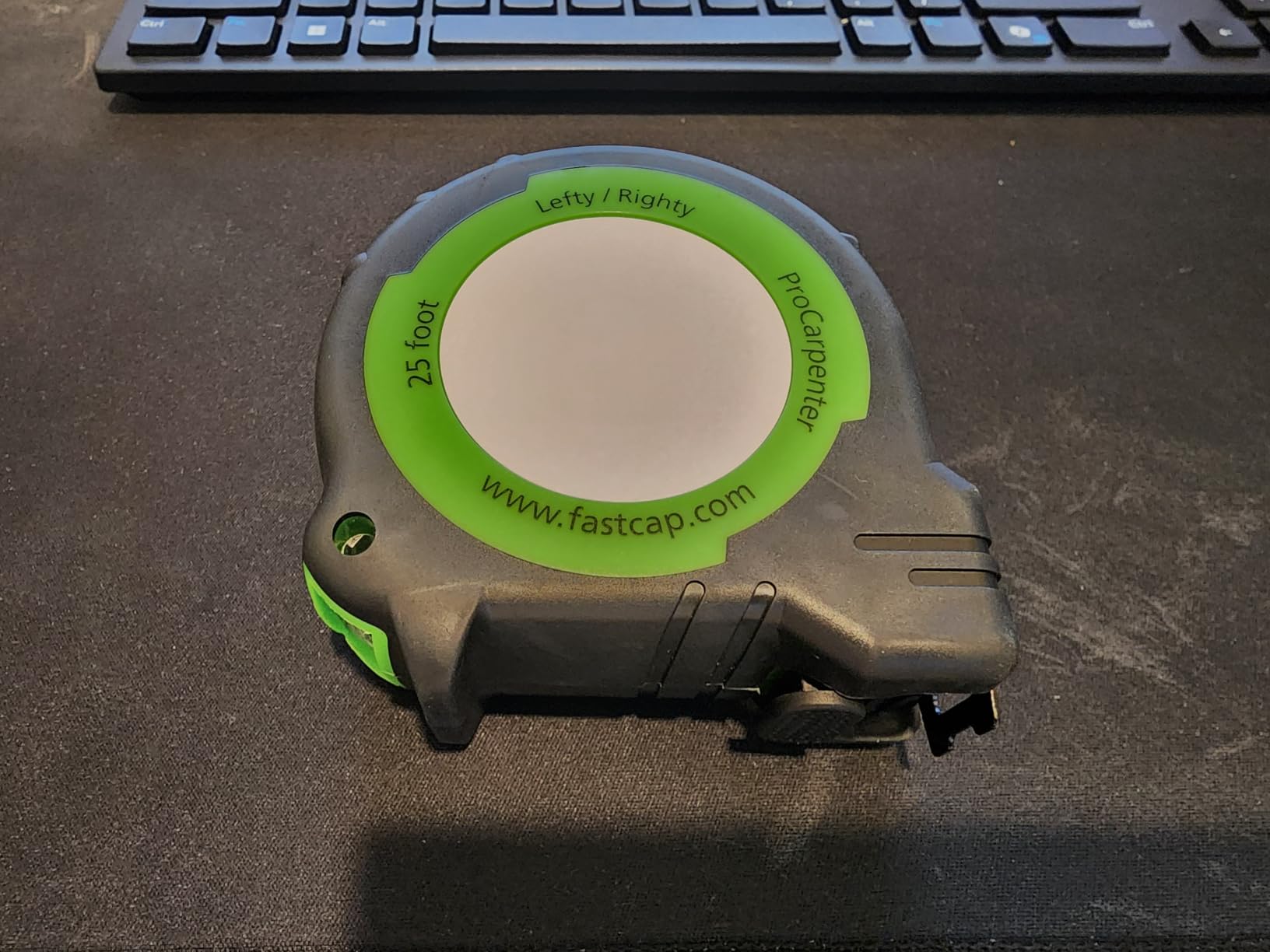
At 4.7 stars from 6,959 reviews, it is one of the highest-rated tapes in the roundup, and the durability reports are unusually specific. Carpenters describe surviving deck and paver projects, work in dust and crushed granite, and drops from about eight feet. Four rivets through the nose of the clip is the part that does that work, and it is a heavier build than the rivet count on most tapes in this price bracket.
The built-in features are not gimmicks. There is a FastPad writing surface on the case for recording measurements, and a pencil sharpener next to it, which means the pencil that writes the numbers is sharpened by the tool that produced them. When you are laying out a wall with six different numbers, writing them down is not optional.
Who benefits most from a reverse-reading scale
Anyone who marks with the tape held in an awkward position, which on a jobsite is most of the time. Marking the far end of a board, measuring up a stud bay, reaching into a bay between studs: in all of these the hook ends up on the other side of your body, and a reverse scale keeps the numbers increasing left to right regardless of how you are holding the case.
Cabinetmakers and finish carpenters like it for a second reason. The compact case does not knock a wall when you brush past it, and a tape you can keep in a pocket is a tape you do not lose, which addresses the complaint that comes up more than any other on these forums.
The two weaknesses to plan around
Standout is modest. With a one inch alloy steel blade this is not the tape for measuring a twenty foot ceiling alone. If that is your day, you want the FATMAX or the Klein.
The writing pad numbers wear off after heavy use, and the case is small enough that some users find the belt clip awkward on wall-mounted tape holders. Neither is a deal breaker, but if the pad is part of why you bought it, expect to replace the pad sooner than the tape.
5. CRAFTSMAN CMHT37225 25-Foot: Best Value
CRAFTSMAN 25-Ft Tape Measure with Fraction Markings, Retractable, Self-Locking Blade (CMHT37225)
- Self-lock holds the blade at any length
- Slow controlled retraction protects fingers
- Fractions printed on the blade for fast reads
- Holds steady to 8 or 9 feet for solo work
- No metric markings on this version
- Fine fractional cuts need careful reading
- Some recent production runs use a yellow blade
With 16,325 reviews at 4.7 stars, the CRAFTSMAN CMHT37225 is the second most proven tape in this roundup and the one I would hand to an apprentice. It is a 25 foot high carbon steel blade in a rubber overmolded case with a self-locking mechanism, and it does the three things a framer needs without asking you to pay for a fourth.
The fractions are printed directly on the blade. That sounds trivial until you compare it to a tape that only shows inches, because reading eight and three sixteenths on a fractional scale takes a glance while doing the same arithmetic in your head takes three and invites errors. Layout speed is the entire point of a framing tape.
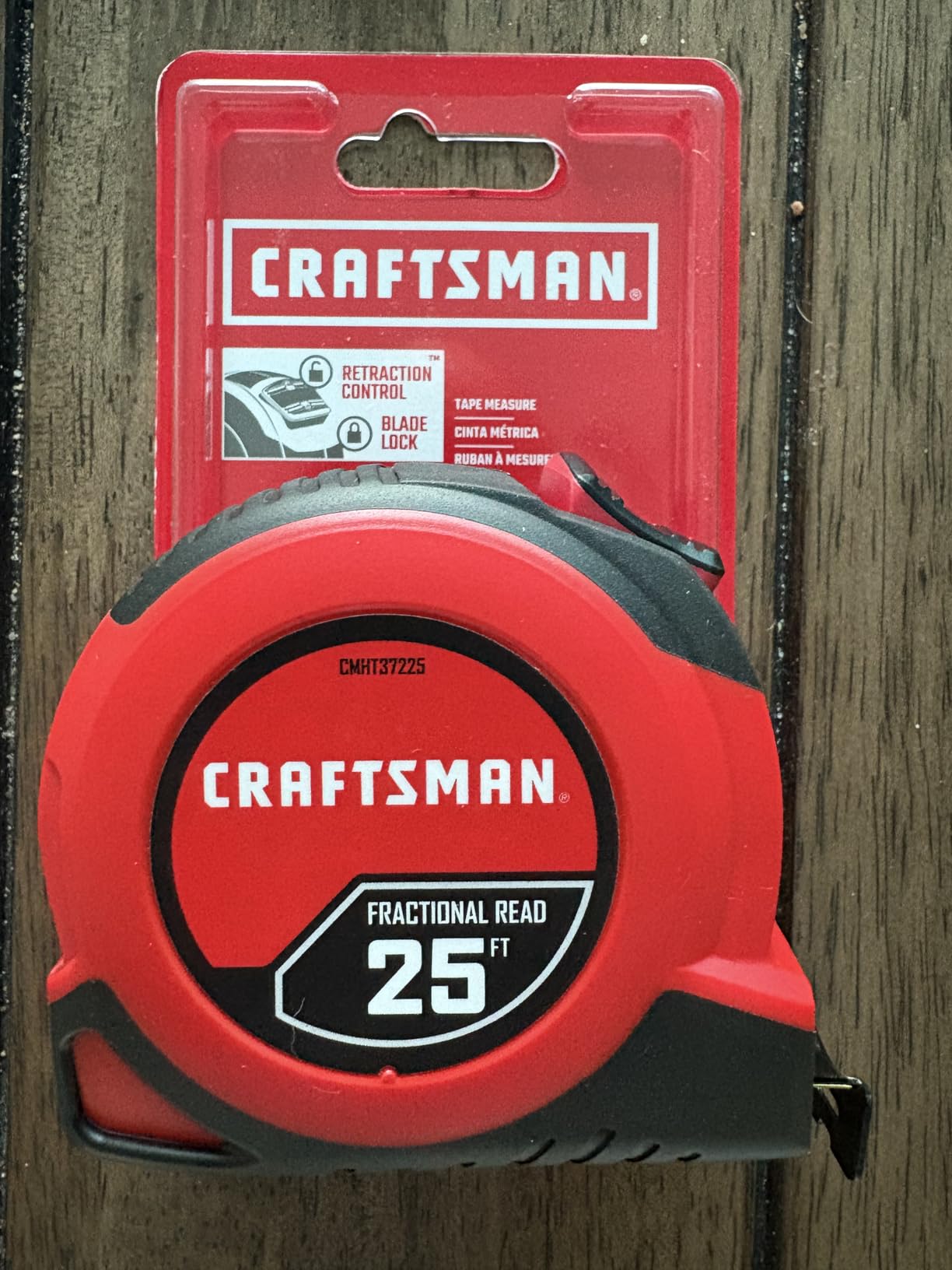
Self-locking blade is the second selling point, and the reviews single out the retraction specifically. A gentle return is the difference between a tape you trust in your hand and a tape you flinch away from, and the repeated praise for this model is that the blade comes back slowly and under control. The measured accuracy is quoted at plus or minus 1/16 inch per 10 feet.
Stud references printed every 16 inches remove one more piece of mental arithmetic. When you are snapping lines for a wall, the stud marks mean you are reading a layout position rather than counting inches, and that is why so many people keep this one alongside a decimal scale tape.
Where it beats the premium tapes
It beats them on price, obviously, but the more interesting comparison is on function. A self-lock, fraction printing, stud marks and a controlled retraction is a complete framing feature set. The premium tiers in this roundup are buying blade width and standout, not better fractions, so if your layout never exceeds about eight or nine feet you are not giving anything up by going here.
Reviewers report steady extension to eight or nine feet for solo drywall work, which is the number that matters for a sheetrock hanger or a drywall finisher measuring a full wall.
What you give up for the price
This version has no metric markings. If you work from metric drawings, this is the wrong tape and the bilingual MulWark is the one to look at instead.
There is also a production change worth knowing about. Some buyers on recent runs report a yellow blade rather than the white one earlier versions had. On a white blade black print reads faster in low light, so if you are working in a dark basement or a night shift, check the blade colour before you commit to a set of them.
6. DEWALT Atomic Compact 30-Foot: Best for Site Layout
- Highest rated in this group at 4.8 stars
- Compact body fits a tool belt with 30 foot reach
- Finger brake gives full control of retraction
- Blade stays rigid past 9 to 10 feet
- Large legible numbers
- Imperial only with no metric scale
- Wide blade makes it bulkier than a quick-grab tape
- Rests on the belt clip end hook when set down
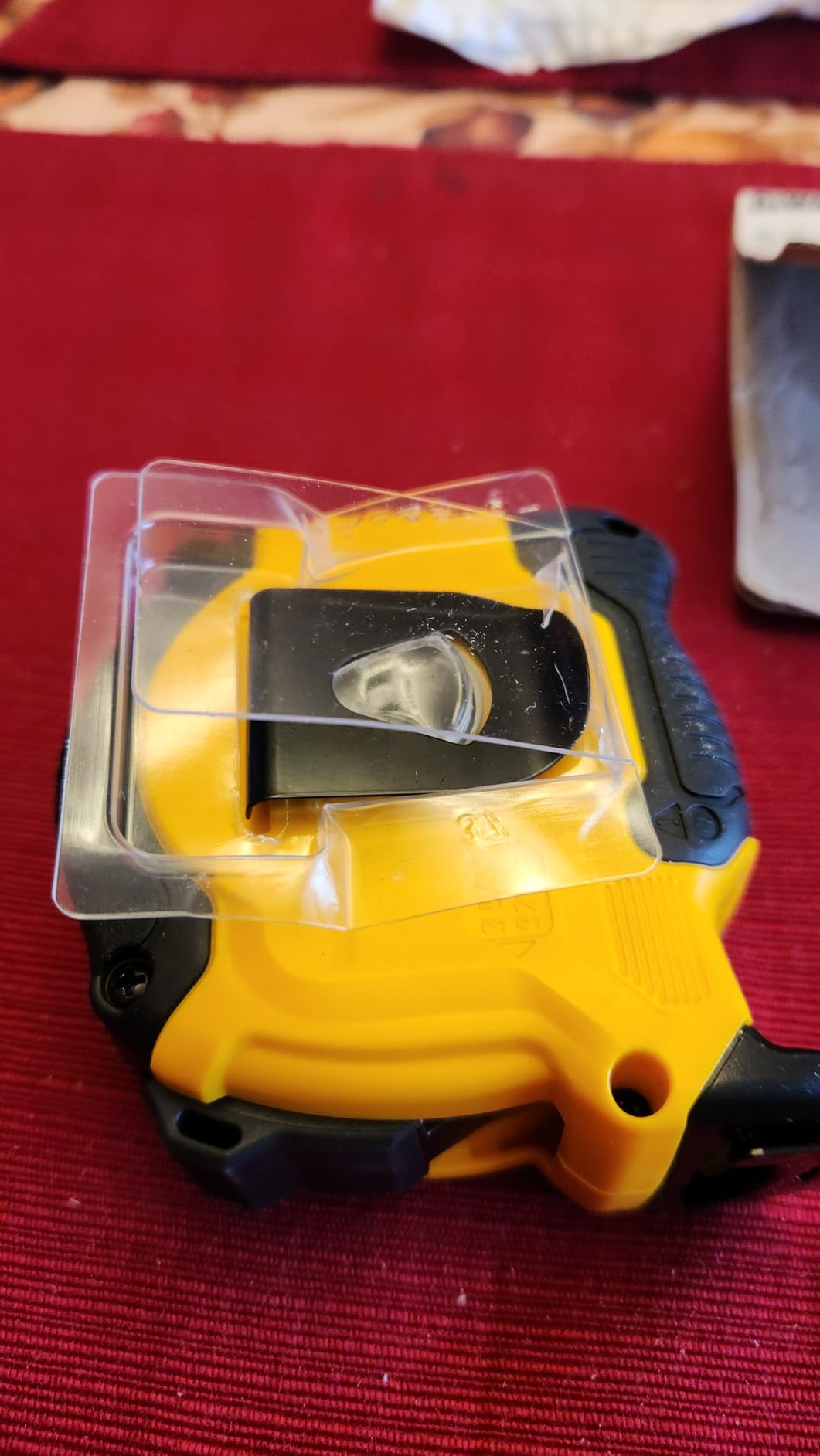
The DEWALT Atomic Compact DWHT38130S carries a 4.8 star rating from 2,877 reviews, the highest average rating of any tape in this group. The interesting engineering is not the rating, it is the packaging: a 30 foot blade in a body described as 20 percent more compact than the standard 30 foot model, at 16 ounces.
Thirty feet in a belt-friendly case is unusual. Most 30 foot tapes are big, and most 16 foot tapes are small. This one sits in the middle, and for site layout work, where you are measuring long runs between fixed points, the reach is the whole point.
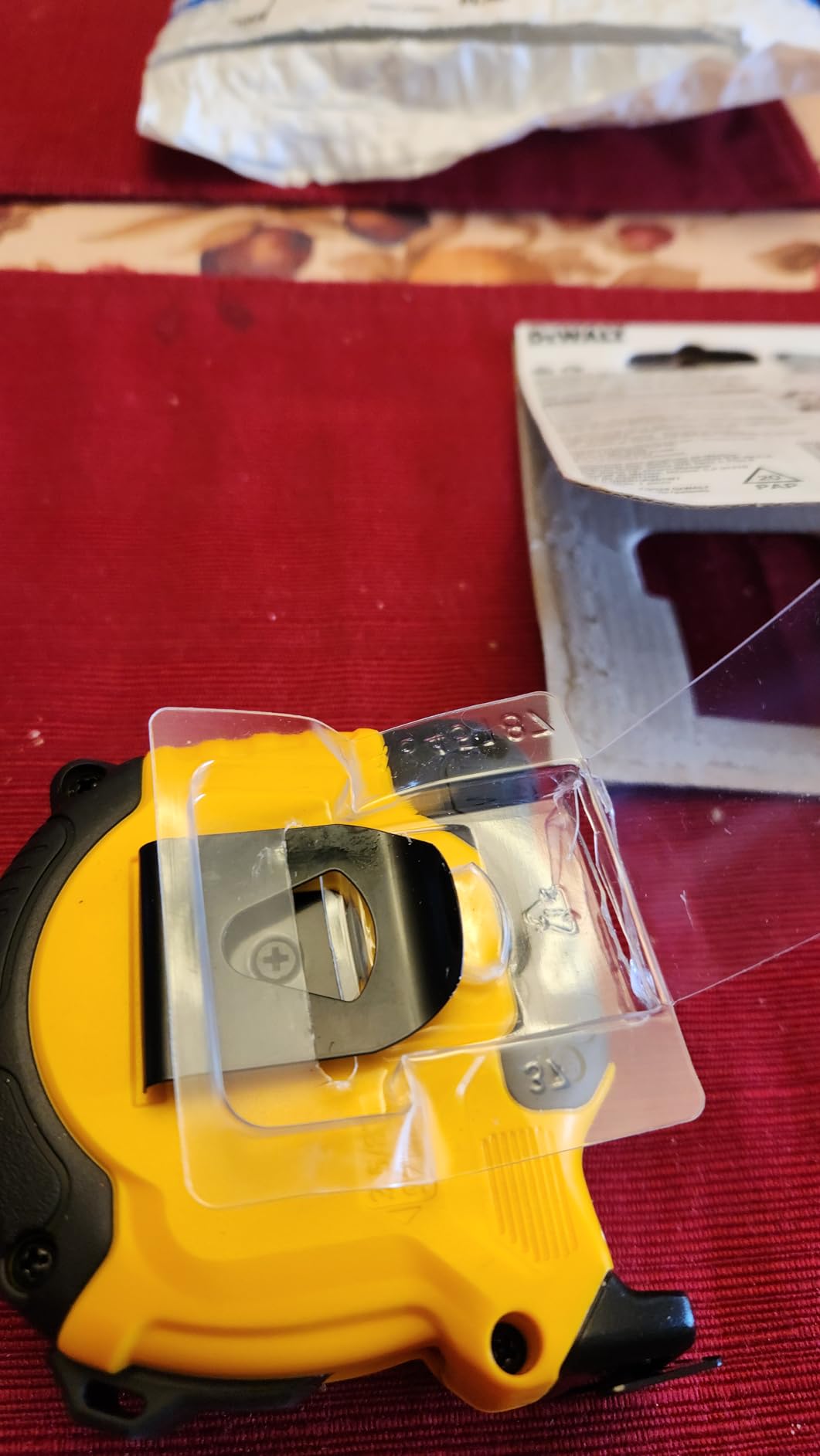
The integrated finger brake is the feature owners mention most. You hold the brake with your fingertip during retraction and the blade returns at the speed you allow rather than snapping back, which is the same safety argument that comes up on the Klein and the CRAFTSMAN, implemented as a physical button rather than a speed brake.
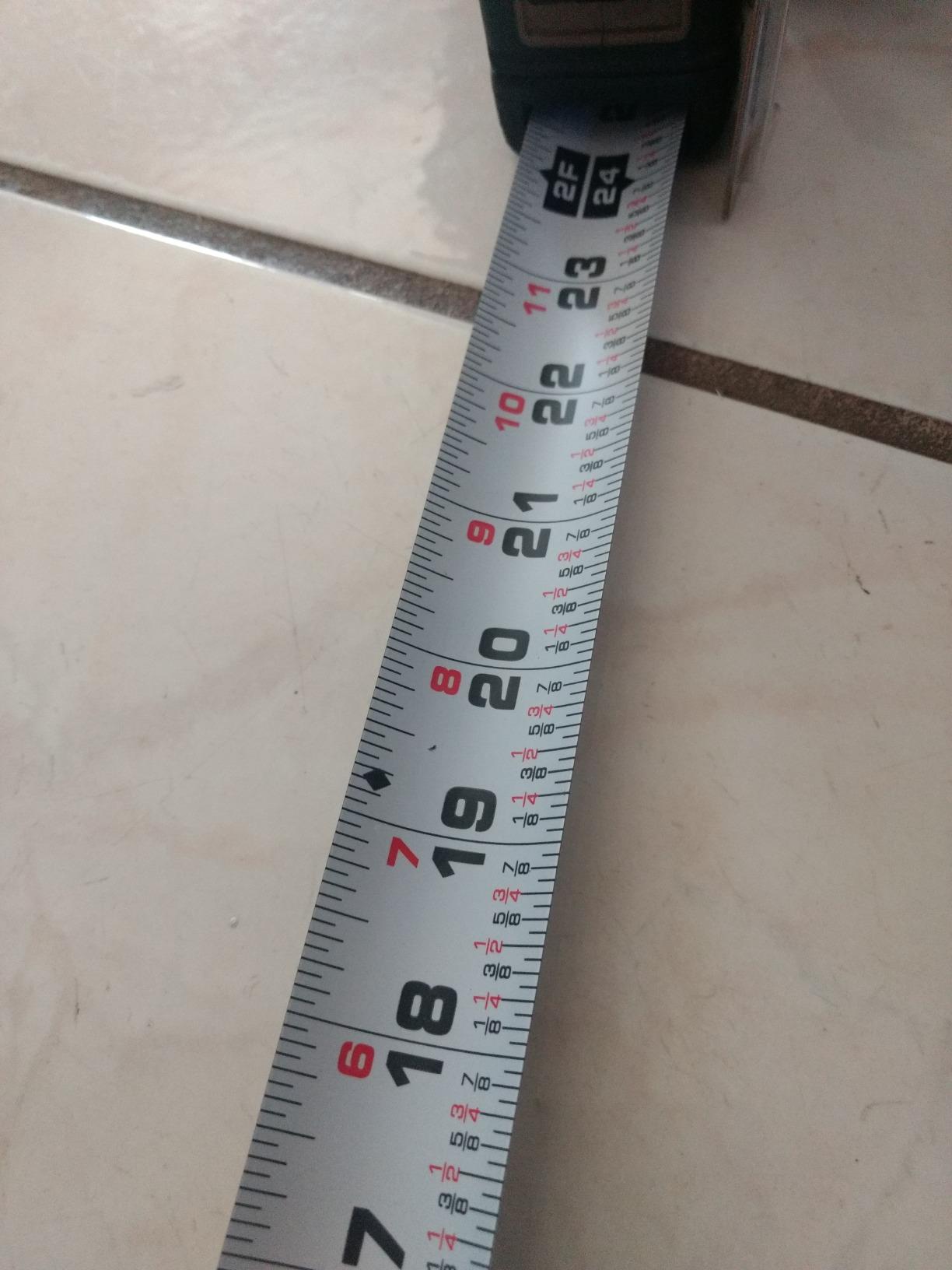
Accuracy is quoted at plus or minus 1/16 inch, fractional graphics are printed on the blade, and owners report the blade staying rigid past nine to ten feet. Large legible numbers mean you can read it at arm’s length in a basement or a crawlspace, which is where a lot of measuring actually happens.
Why 30 feet in a compact body matters on site
Foundation work, site layout and long exterior runs are the cases where 25 feet turns into a 25 foot measurement plus a reposition plus a chance to misread the seam. Thirty feet removes that step for most of those jobs, and the compact case means the reach does not cost you a comfortable belt.
It also makes a good general purpose tape for a crew that does not specialise. If one person does both interior framing and site layout, this covers more ground per pull than a 25 footer without becoming a long tape that lives in a truck.
The imperial-only limit and the set-down habit
No metric scale. Commercial work to metric drawings needs a bilingual blade, so this is a North American residential tape by specification.
One small thing that annoys owners: set down on a flat surface, the case rests on the hook end rather than flat, so it tips. Not a functional problem, but it is the kind of detail that shows up in reviews, and it is worth knowing if you set your tape down on finished surfaces a lot.
7. Spec Ops Tools SPEC-TM25 25-Foot: Best for High Visibility
Spec Ops Tools Tape Measure for Measuring & Layout, 1 1/8″ Double-Sided Blade and Military-Grade Composite Case, 25 Foot
- Double-sided markings and illustrated fractions read clearly
- White high visibility blade with black print
- Takes big drops and daily abuse
- Limited lifetime warranty
- Some users report the blade coating wearing
- Belt clip lug breaks down and lets the clip spin
- Not magnetic on this non-magnetic variant
The Spec Ops SPEC-TM25 is the tape to reach for when you are working in the dark. Its blade is white with black printing, and the scale is printed on both faces with illustrated fractions rather than plain numerals. A white high visibility blade in an unlit basement or a night shift is a genuinely different experience from a chrome blade with black markings.
It is also the widest blade relative to length in this roundup at 1 and 1/8 inches, and the standout is quoted as a true ten feet. Combined with a military grade composite housing that is 20 percent more compact than a standard case, this is a tape that carries more steel in less space than most.
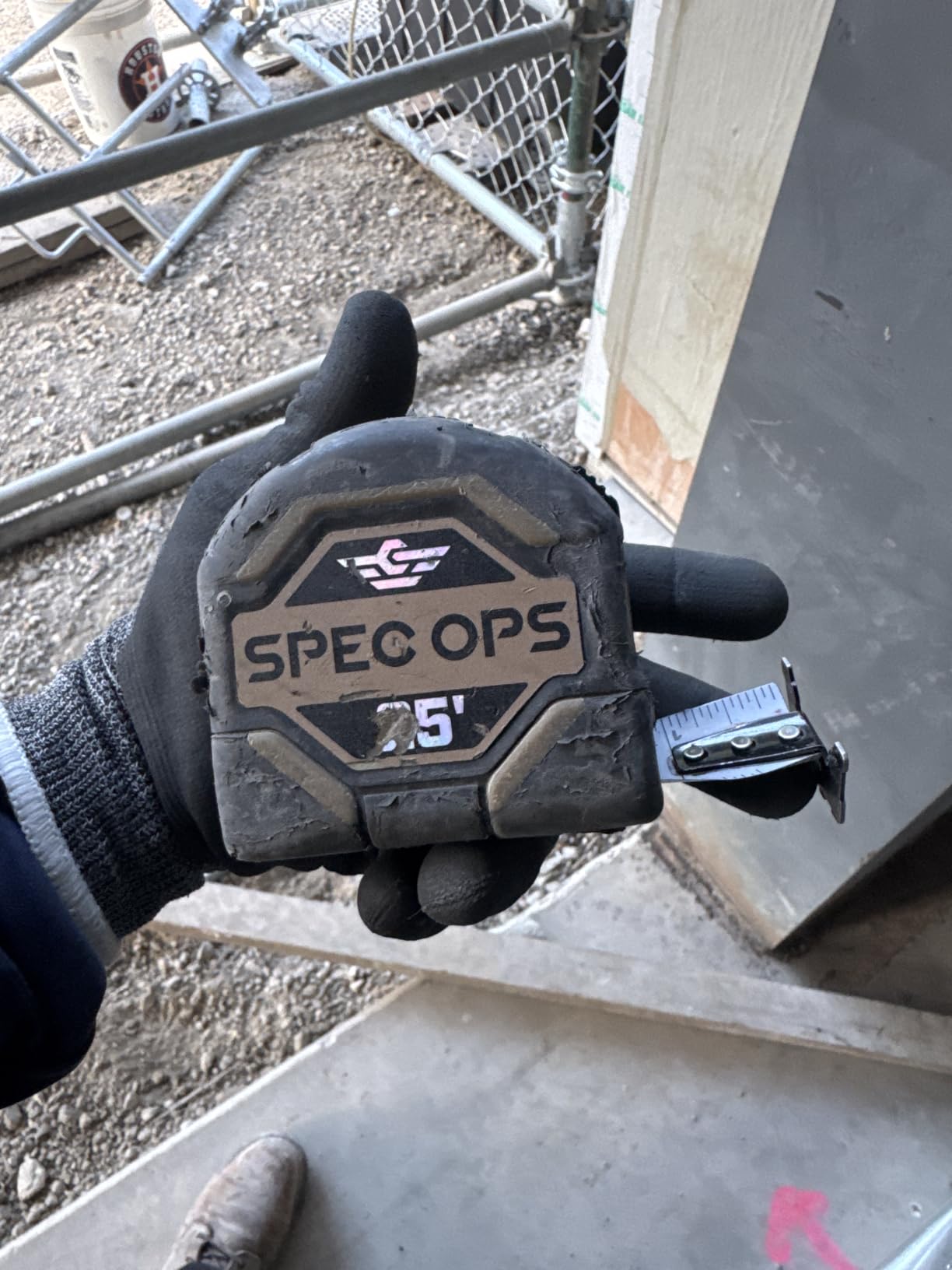
At 4.5 stars from 6,722 reviews it is the lowest-rated item in the group, and the reviews explain exactly why. The praise is consistent, but the complaints are too. The recurring split is between people whose coating has held up for years and people whose blade coating wore through and became hard to read, which is a durability spread rather than a design failure.
Two other recurring notes. The belt clip is held by a plastic lug that some users report breaking down until the clip spins, and this is the non-magnetic variant, so it will not pin itself to a steel stud. The housing is polycarbonate and it takes drops well, and the warranty is a limited lifetime warranty.
Low light and high visibility work
Basements, crawlspaces, night framing and mechanical rooms are where a chrome blade disappears. A white blade with black print keeps its contrast under poor lighting, and the double-sided scale means you do not have to turn the blade around to read the far end of a stud bay in a dark corner.
It is also the one tape here built explicitly for retention. It is compatible with SRS retention lanyards, which is a small detail that matters for crews that have had tapes walk off belts.
The durability split you should know about
Check the coating when it arrives and periodically after that. If the printing starts to fade, the useful life of the tape is likely coming to an end, and the fix is to replace it rather than to keep trusting faded graduations on a layout.
There is also a small group of owners who report a thinner blade and early rusting in wet use. If your work is exterior and wet rather than interior and dry, this is not the tape to put on your belt.
8. DEWALT DWHT34036L 100-Foot: Best for Long Spans and Site Layout
DEWALT DWHT34036L 100-Foot Closed Case Long TapeSE, Slide Lokck
- 100 foot reach covers long layout runs
- Sturdy alloy steel blade
- Quick smooth rewind with a handy belt clip
- Well made feel for a long tape
- Free spinning crank is a finger hazard
- Exposed blade edge can cut during rewind
- Imperial only with no metric scale
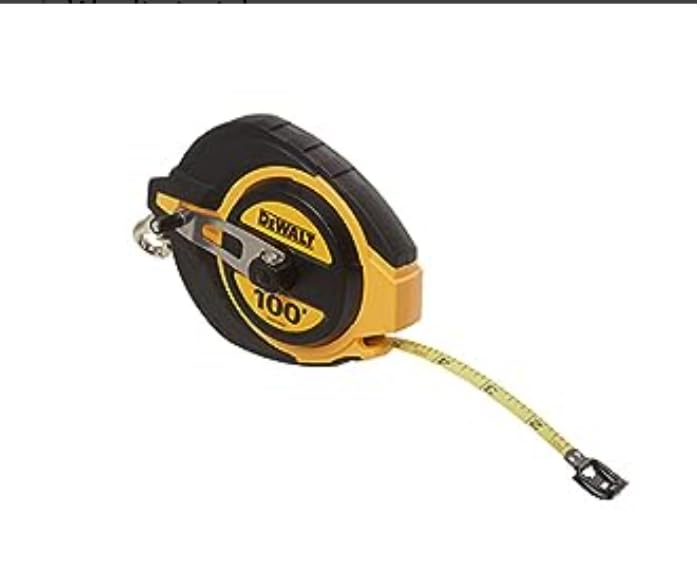
A 100 foot tape is a different instrument rather than a longer version of the same one. The DEWALT DWHT34036L has a hundred foot alloy steel blade in a closed case with a hand crank rewind and a belt clip, and it is built for foundation layout, site work and any run where repositioning a 25 footer is costing you time.
Reviewers who bought it for site layout describe exactly that use and are happy with it. At 4.7 stars from 2,822 reviews, the feedback centres on the reach, the smoothness of the rewind and the general solidity of the build for something this long.
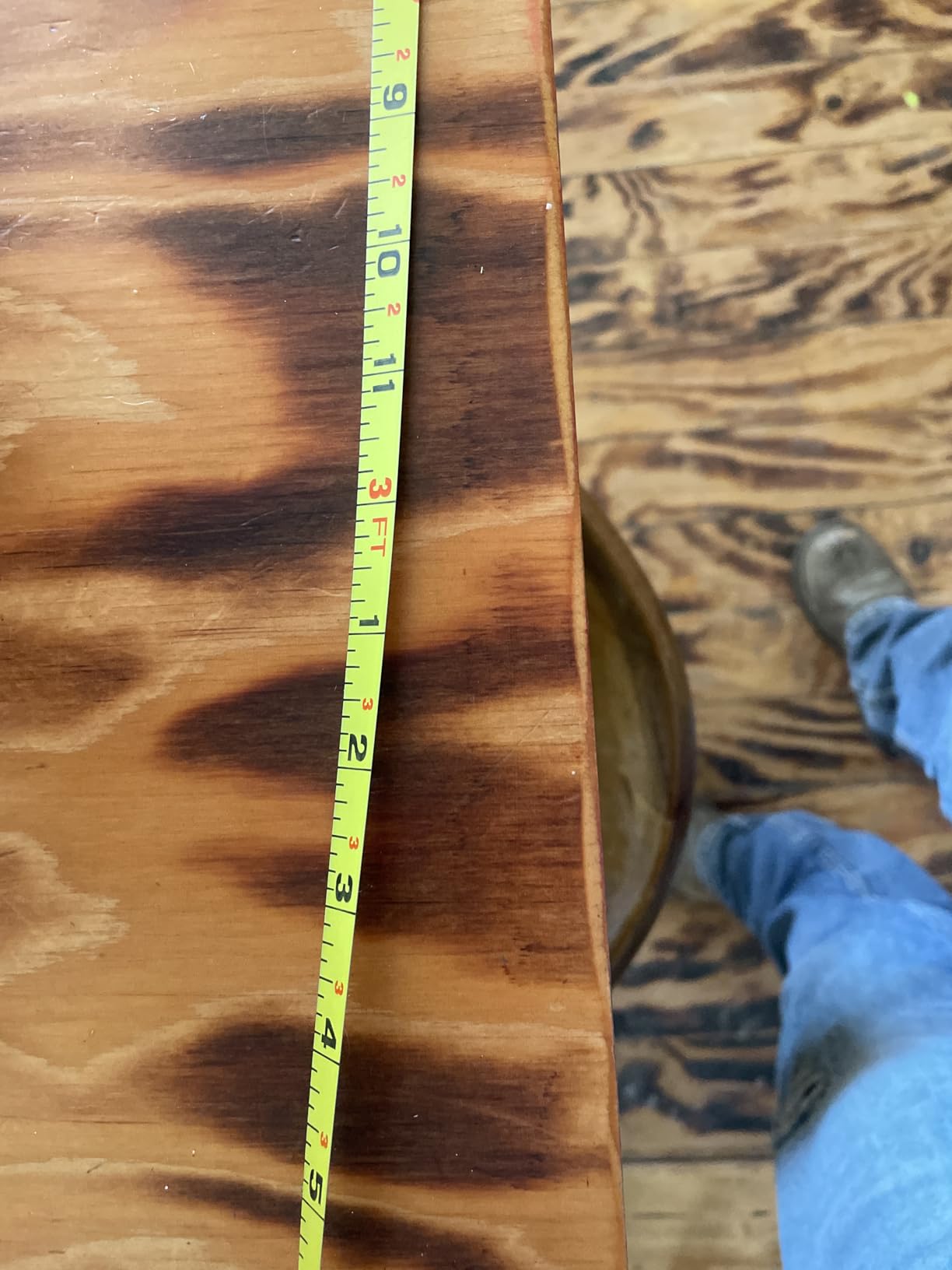
The safety note is the one part of this review you should not skim. The crank is free spinning, and several reviewers describe it as capable of catching a finger if you are not careful. The blade edge is also exposed during winding, which means you rewind with the blade facing away from your body and your hands clear of the crank hub.
This is imperial only, with no centimeter scale on the reverse. For exterior and foundation work in North America that is fine, but it is another reason this does not travel to metric jobsites.
When a hundred feet is the right answer
When you are laying out a foundation, a long driveway, a fence run or anything where the total distance is known to exceed 25 feet and a mid-measurement error compounds. On those jobs the hundred footer is not a luxury, it is a correctness tool, because you can take the full dimension in one pull instead of accumulating four smaller ones.
It also earns its place for outdoor decks and site grading, where a single continuous measurement matters more than a pocketable tool.
Why most carpenters do not carry one
It weighs more than your belt is designed for and it is awkward in a truck bed, so the long tape stays in the truck or the site box while the 25 footer rides on the belt. That is the honest arrangement, and it is how these tapes are used in practice.
The other consideration is heat and blackening. Long steel blades left in a hot truck through summer can develop surface blackening and lose their coating, which is exactly the concern raised in forums by people whose work is entirely exterior. Wipe the blade clean, oil it occasionally, and do not leave it in a hot vehicle for weeks at a time.
9. MulWark Wide 25-Foot: Best for Dual-Sided Metric and Imperial Scales
- Metric imperial and fractions on both sides
- Dual lock prevents accidental retraction
- Magnetic hook helps with solo long measurements
- Wide blade holds about 7 feet before sagging
- Belt clip is small for a thick work belt
- Rigid plastic casing feels less grippy than a rubber boot
- Readability drops off past the first foot
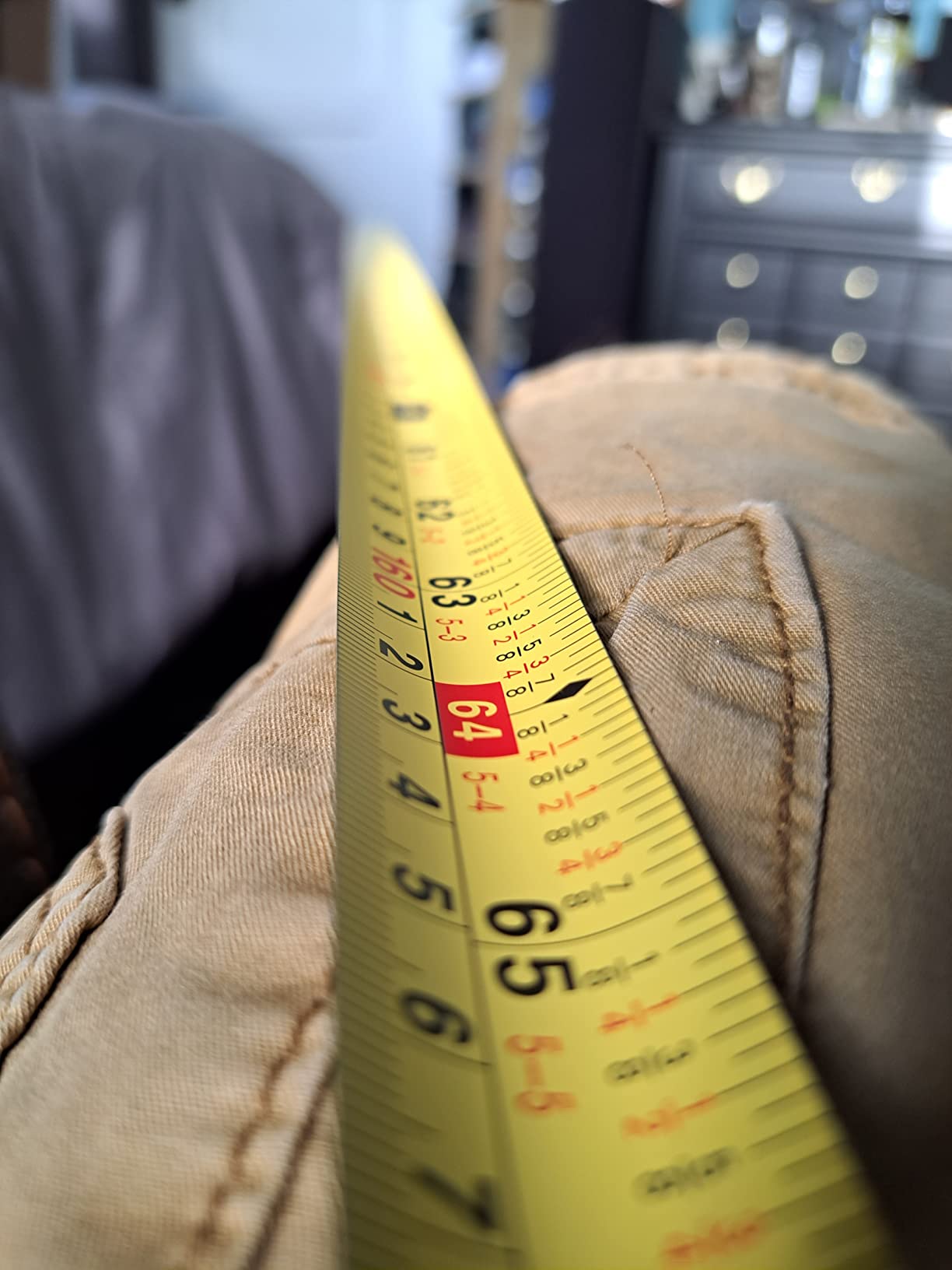
The MulWark Wide is the only tape in this roundup carrying inches, fractions and metric on both faces of the blade, and several buyers describe it as the only tape they could find that does all three at once. For a carpenter working from metric drawings who still needs imperial framing dimensions, that removes a second tool from the belt entirely.
The blade is 1.25 inches wide, the hook is a true-zero self-adjusting magnetic hook, and the stated accuracy is plus or minus 0.2 millimetres. The wide blade is quoted at 7 feet of horizontal extension and 13 feet vertical, which is an unusual way to state it and a useful one, since vertical extension is the measurement that actually sags.
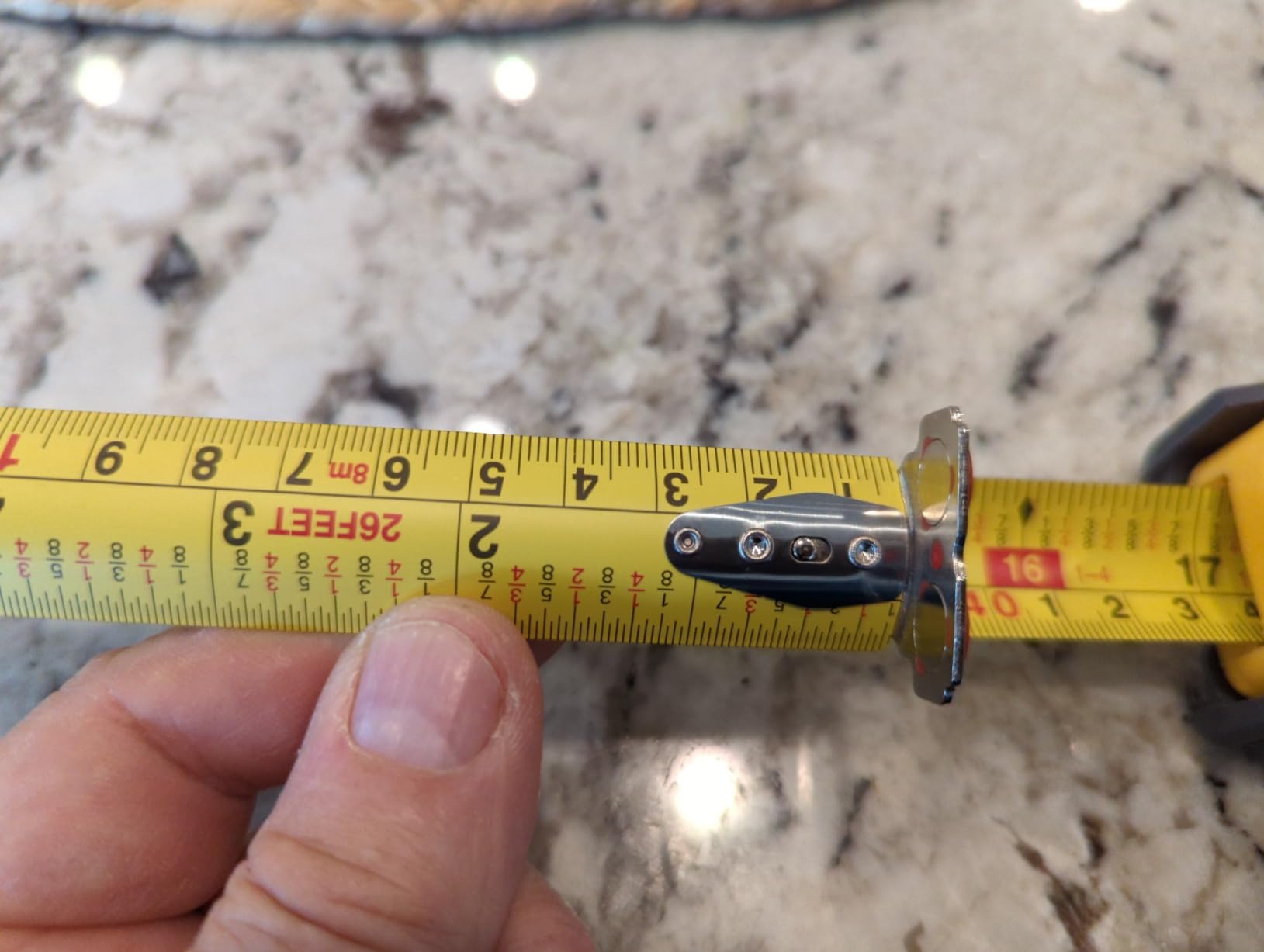
The locking system is the second distinguishing feature. A dual secure blade lock holds the blade without micro-slides, and a stop button on the base lets you finger the blade for slow, controlled retraction. Two independent mechanisms to stop the blade retracting is a reasonable answer to the single most common way a jobsite tape injures somebody.
At 4.6 stars from 4,919 reviews, feedback praises the scale layout and the locking system, and criticises the ergonomics. The complaints cluster on the same two points: the belt clip is small for a thick work belt, and the rigid ABS casing feels less grippy than a rubber boot when the tape is wet or dusty.
Who should buy a bilingual blade
Anyone splitting time between imperial residential work and metric commercial work, which in many markets is most residential carpenters doing light commercial on the side. Having both scales on one blade means you are not converting between systems in your head on a site where the drawings are in millimetres.
The magnetic hook also makes it a strong second tape for metal framing, though if steel is your primary material the Klein 9225 has the stronger hook and a longer reach.
Where the ergonomics let you down
The belt clip is the main one. A small clip on a thick work belt tends to sit at an angle and the tape can walk, which is a direct route to the losing-your-tape problem that dominates these forums. If you are buying this, budget for a clip-on belt holder instead of relying on the built-in one.
Readability also drops off after the first foot, and on a wide blade the print is smaller than on a narrow one. If you are reading fine fractions near the hook, this is not the sharpest tape here. It is still the most complete scale, which is a different kind of best.
10. Komelon 433IEHV 33-Foot Engineer Scale: Best for Engineer and Decimal Scale
Komelon 433IEHV High-Visibility Professional Tape Measure both Inch and Engineer Scale Printed 33-feet by 1-Inch, Chrome
- Dual scale imperial fractions plus engineer tenths
- High visibility neon blade reads in low light
- Good standout and a firm lock
- Smooth pullout and retraction
- Polished chrome case is slippery with no rubber grip
- Heavier than typical 25 foot tapes
- Standard slide lock rather than a self-lock
- Chrome case nicks and scratches easily
The Komelon 433IEHV prints two scales on one blade: standard inch and fractional graduations, and the engineer scale in tenths and hundredths of a foot. If you have ever tried to lay out a run in decimal and had to keep converting back and forth in your head, this removes the conversion. Drilling, site layout and any trade working to hundredths read this blade directly.
It is a 33 foot tape with a one inch nylon coated high carbon steel blade and a neon high visibility finish. The high visibility blade is the other story here, and it is the one this roundup has least of: a bright blade that reads in an unlit basement or an evening shift, on the same tool that carries the decimal scale.
At 4.7 stars from 2,932 reviews, the reviews divide cleanly on the case. People love the scale and the blade, and they consistently criticise the polished chrome housing, which reviewers describe as slippery with no rubber grip, easy to nick and scratch, and noticeably heavy for a tape of this length.
The lock is a standard slide lock rather than a self-lock button, so it is one more thing to remember to release. Owners like that the lock itself is firm and that pullout and retraction are smooth, which matters on a longer blade where a soft lock lets the tape creep.
Engineer scale versus decimal scale
Engineer scale divides the foot into tenths and hundredths, so a reading of 12.34 feet is direct. A decimal scale on a domestic-style tape gives you tenths in feet and sixteenths in inches, which is a different habit. If your drawings show tenths and hundredths in feet, this is the correct tape and no imperial alternative here will read them without you doing the work.
It is also a long enough blade for site layout, so the 33 foot length covers runs that would push a 25 footer into a second measurement.
Handle the chrome case carefully
Chrome has no grip and no forgiveness. Wet hands, sawdust and gloves all make it a harder one-handed operation than a rubber overmold, and the finish marks easily enough that it looks used quickly even when the blade is fine.
It is also the heaviest tape here relative to its length, at 1.2 pounds. Carry it in an apron or a pouch rather than a back pocket, and expect to notice it after a full shift.
How to Choose a Carpenter Tape Measure?
Most buying mistakes in this category come from optimising for the wrong variable. People spend money on standout and then find they cannot finish a wall because the blade marks it, or they buy a narrow blade for finish work and then fight it across a 22 foot room. Work out the task first, then the tape.
Length: 12, 16, 25, 33 or 100 feet
A 12 or 16 foot tape goes in a back pocket for finish, trim and drywall. Twenty-five feet is the framing default and the most common belt tape in the trade. Thirty-three and 35 foot tapes suit site layout and long rooms. A 100 foot tape is a site tool that lives in a truck rather than on a belt.
Forum consensus on accuracy is pragmatic rather than brand-based. As one woodworkingtalk answer puts it, the best tape measure is one you know is accurate enough for rough carpentry, and after that it depends on how you work. That is worth internalising before you spend anything.
Blade width: 1/2, 3/4 or 1 inch
One inch is the framing and layout width, and it is the widest blade most carpenters carry. Three quarters of an inch is the drywall compromise, narrower enough to stop marking walls, still stiff enough for sheetrock layout. Half an inch and below are finish and scribing widths.
This is the number to get right. Wider is stiffer, and stiffer means more unsupported reach. Narrower is more forgiving on finished surfaces. Both are true at once, which is why the trade carries more than one.
Blade coating and standout
Nylon coated or bonded blades resist abrasion, rust and glare, and they are the single best upgrade you can make to a cheap tape. Standout is how far the blade stays rigid before it sags, and it scales directly with blade width and material.
Anything quoted past ten feet of unsupported reach on a one inch blade is worth testing yourself before you believe it, because sag is a function of the whole assembly, not just the steel.
Scale, lock and clip
Scale decides whether the tape is usable on your drawings. Fractions for residential framing, decimal for tile and site work, engineer scale in hundredths for drilling and site layout, metric or bilingual for non-US trades. A reverse-reading or dual-sided scale removes reading errors for anyone whose hands do not match the default.
The lock should hold at any length without creeping, and retraction should be controllable. Finger brakes and speed brakes both do this, and both prevent the whip-back that makes people flinch and drop tapes.
The belt clip is the most common failure point in the entire category, and r/electricians threads say so repeatedly. A clip that spins or snaps is a tape in your hand instead of on your belt, which is why a clip-on belt holder is a reasonable second purchase for anyone whose clip is a plastic lug.
How to field-test your tape for accuracy
You do not need a brand name, you need a method. This is the answer to the most-asked accuracy question on these forums, and it takes about ten minutes.
1. Check the hook first. Hook the tape onto a known dimension and pull. If the reading is short by a consistent amount, the hook is loose. Push the hook firmly back against the blade with the case locked, then re-measure. Most hook errors are corrected by reseating the hook.
2. Measure against something you trust. Lay the blade against a known straight edge and check the zero, the halfway point and the end. A good straight edge and a known dimension give you three reference points instead of one.
3. Check for bend. Extend the blade and sight down it. A blade that has been bent reads differently at different lengths, and no amount of hook adjustment will fix it.
4. Watch for creep. Extend the blade, lock it, wait, and look again. A lock that lets the blade slide changes every measurement you take after it.
5. Judge drift against the class of accuracy. Tapes are quoted with a stated tolerance, commonly plus or minus 1/16 inch per ten feet. Anything consistently worse than that over a short measurement means the tape is finished, regardless of how it looks.
If a tape fails any of these, replace it. A tape that is quietly out is worse than no tape, because it fails silently.
Frequently Asked Questions
What type of tape measure is commonly used in carpentry?
A retractable steel-blade tape in a rubber or polymer case, usually 16 or 25 feet long, with a wide rigid blade, a positive blade lock and a belt clip. The blade is typically one inch wide for framing and three quarter inch or narrower for finish and drywall. A wide blade stands out further and resists bending, which is what separates a carpenter tape from a DIY tape.
What is the best tape measure for carpenters?
The Komelon SL2825 Self Lock 25-Foot is the best all-round choice, with a nylon coated high carbon steel blade, an automatic self-lock and a rubber overmolded case. If you need the most unsupported reach on a solo layout, the STANLEY FATMAX 33-725 with its 1.25 inch blade is the alternative, and the CRAFTSMAN CMHT37225 covers the same basics for less.
What tape do carpenters actually carry?
Most working carpenters carry two to four. The common arrangement is a 25 foot one inch blade for framing, a 16 foot narrower blade for interior finish, a 12 foot three quarter inch blade for drywall, and a decimal or metric scale tape for site and commercial work. A magnetic hook tape is added by anyone framing steel studs.
Which brand of measuring tape is the most accurate?
Brand is a weak predictor. Tapes are quoted with a stated tolerance, commonly plus or minus 1/16 inch per ten feet, and most major brands meet it. Accuracy is better tested than argued: reseat the hook, measure against a known straight edge at zero, mid and end, sight the blade for bend, and check the lock for creep. A tape that fails any of those should be replaced.
How wide should a carpenter tape measure blade be?
One inch for framing and general layout, three quarter inch for drywall and sheetrock, and half an inch or narrower for finish trim and scribing. Wider blades stand out further and hold shape across a room on their own, but a wide blade marks finished walls if you use it as a straightedge. If you work in both areas, carry two widths rather than compromising on one.
Is a 25 foot or 16 foot tape measure better?
A 25 foot tape is the better general carpenter tape because most rooms and wall runs fit inside a single 25 foot pull, avoiding a reposition and a chance to misread the seam. A 16 foot tape is smaller and lighter, which makes it the better interior finish and trim tape where the blade is used as a straightedge on a wall. Under about 16 feet of reach, a 1 inch blade on a 25 foot tape is the stronger tool.
The Verdict on the Best Tape Measures for Carpenters
There is no single best tape measure for carpenters in 2026, but there is a single best starting point, and it is the Komelon SL2825. Nearly 19,000 reviews at 4.7 stars, an automatic self-lock, a nylon coated high carbon steel blade and a case that absorbs drops. It is the tape to buy first because it makes every other tape an addition rather than a replacement.
Framers who measure rooms solo add the STANLEY FATMAX 33-725 for its 1.25 inch blade and 14 feet of reach. Metalframers and anyone working around conduit take the Klein 9225 for the magnetic hook and 13 foot standout. Finish carpenters who mark with the hook want the FastCap ProCarpenter PSSR25 for a compact case and a scale that reads from either hand. Drywallers get the CRAFTSMAN CMHT37225 for printed fractions, stud marks and a gentle retraction. Site work that reaches past 25 feet gets the DEWALT DWHT34036L 100 footer, kept in the truck. Commercial work to metric drawings gets the MulWark Wide for inches, fractions and metric on both faces.
Whichever one you land on, check the accuracy before you trust it on a visible wall, replace the tape when the coating fades, and buy a clip-on belt holder if the clip is a plastic lug. That advice costs nothing and it is worth more than the difference between any two tapes on this list.