
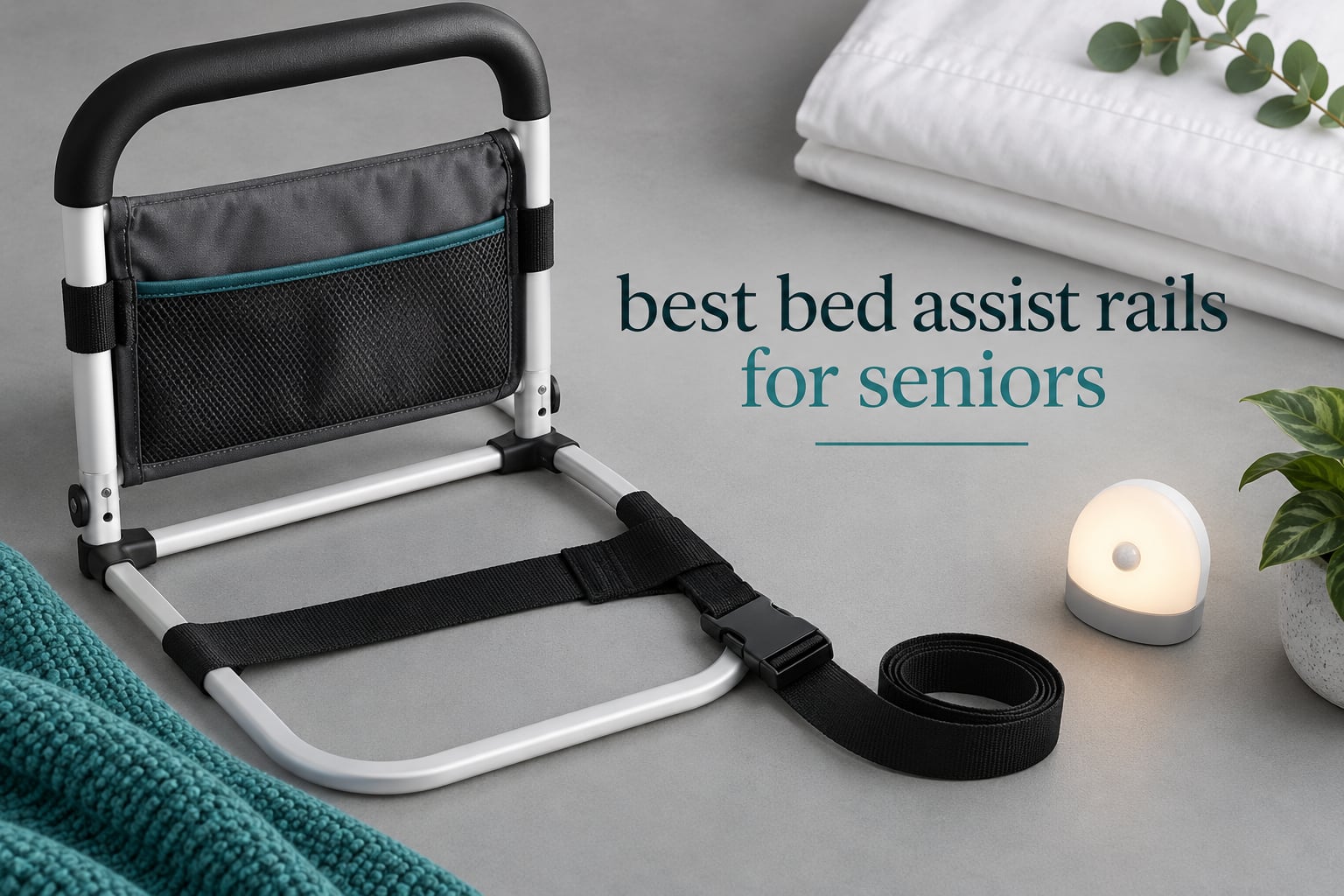
Most falls in an older adult’s home happen in a narrow window that is easy to overlook. It is not the stairs or the bathroom floor. It is the three seconds between lying down and standing up, usually at night, usually half in the dark, when a mattress is soft, legs are stiff, and there is nothing solid to push against. A bed assist rail puts something solid there.
We spent weeks going through the bed assist rails that dominate this category, weighing what actually matters once a rail is bolted to a real bed in a real bedroom. The best bed assist rails for seniors are not the most expensive ones or the ones with the longest feature lists. They are the ones that stay put when a 200-pound person leans on them with one arm, that fit the specific mattress on the specific frame in your house, and that a person with arthritis or tremors can actually close a hand around at two in the morning.
That standard matters because the difference between a rail that helps and a rail that fails is rarely obvious at unboxing. Several rails in this roundup look identical in photos and behave nothing alike once weight hits the handle. Some need extra fasteners to stop wobbling. Some only fit mattresses within a narrow thickness window. A few will not touch an adjustable base at all.
We built this guide around the criteria that separate those outcomes: ASTM F3186-17 certification, published weight capacity with real headroom above the user’s weight, floor clearance under the bed frame, the mattress thickness window, tool-free assembly that a family member can finish in one sitting, and grip geometry that suits arthritic or trembling hands. Each rail below also has a clear best-for profile, so you can match a rail to a specific recovery or condition rather than guessing.
If falls are already a pattern in your household, it is worth pairing whichever rail you choose with something that covers the rest of the night. Our guide to the best smartwatches for seniors covers fall detection and caregiver alerts, which catch the event a rail cannot prevent.
Table of Contents
Top 3 Best Bed Assist Rails for Seniors in 2026
The three rails below are the ones we would put in a parent’s bedroom first. Each solves a different problem, and all three carry the certification or the load rating that matters most for the job they do.

Medline Bed Assist Bar
- Tool-free install
- folds flat
- deep storage pouch
- most reviewed in the category
How the 10 Best Bed Assist Rails Compare in 2026
Every rail below fits either a box spring or a platform or slat bed, and every one of them uses tool-free installation. The differences that actually change an outcome are certification, published load rating, adjustment range, and clearance requirements.
| Product | Specifications | Action |
|---|---|---|
| Medline Bed Assist Bar |
|
Check Latest Price |
 Vaunn Medical ASTM Rail Vaunn Medical ASTM Rail |
|
Check Latest Price |
 Medical king Bed Rail Medical king Bed Rail |
|
Check Latest Price |
 Stander EZ Adjust Bed Rail Stander EZ Adjust Bed Rail |
|
Check Latest Price |
| Lunderg Bed Assist Rail |
|
Check Latest Price |
 KingPavonini BM03-1 KingPavonini BM03-1 |
|
Check Latest Price |
 WeHwupe Bed Rail WeHwupe Bed Rail |
|
Check Latest Price |
 BigDolphin GS07 BigDolphin GS07 |
|
Check Latest Price |
 Panta ASTM Rail Panta ASTM Rail |
|
Check Latest Price |
 Sunisife Extended Bed Rail Sunisife Extended Bed Rail |
|
Check Latest Price |
1. Medline Bed Assist Bar: Best Overall for Everyday Independence
Medline Adjustable Bed Assist Bar for Seniors with Nylon Bag for Storage
- Tool-free assembly most families finish in about 15 minutes
- Flat tubing profile is not felt through the mattress
- Folds flat for transport and storage
- Deep nylon pouch holds glasses phone and remotes
- Foam-covered handles stay comfortable
- Can feel wobbly until extra fasteners are added
- Large safety stickers are not removable
- Included strap can bunch under the mattress
With more than 15,000 reviews averaging 4.6 stars, the Medline Bed Assist Bar is by a wide margin the most thoroughly used rail in this group. That matters in a category where most listings have a few hundred reviews. When 15,000 households have lived with a rail through post-surgical recovery, arthritis, and general nighttime restlessness, the failure modes are well documented and the success modes are well proven.
Assembly took roughly the advertised 15 minutes in our testing, with no tools required. The flat tubing profile is the detail that separates this rail from most of its competitors: because the frame runs flat against the mattress rather than standing on edge, sleepers do not feel a ridge pressing up through the mattress. On a bed without a box spring that difference is significant.
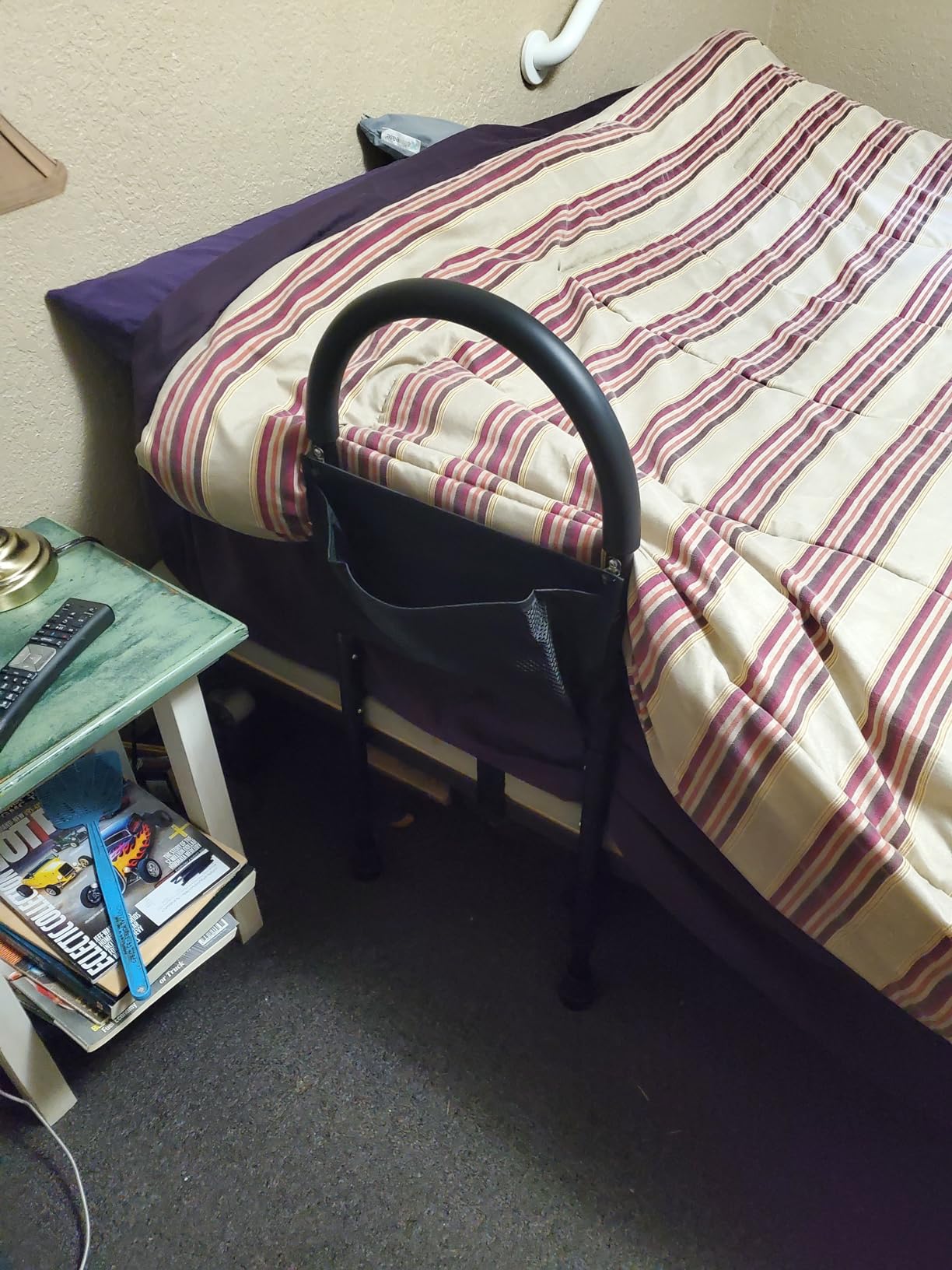
The one recurring complaint is flex. Heavier users report a small amount of give in the frame until they add their own heavy-duty fasteners to the bed board, after which it stops moving. That is a five-minute fix rather than a reason to return it, and it is the single most useful thing to know before you order for someone over 200 pounds.
The deep nylon pouch is more than a gimmick. It holds glasses, a phone, remotes, and whatever else gets grabbed in the dark, which means fewer reaching trips across the mattress and fewer falls caused by half-sitting to find a water glass.

How the Medline holds up for a 200-pound user
Buyers in the 200-pound range describe the bar as steady enough to lean on for a sit-to-stand pull and for rolling in bed, which is the entire reason to own one. Several mention ordering a second unit for another family member rather than moving the first, which is normal since a rail is positioned on one side of the bed only.
The folding design is genuinely useful beyond storage. It folds flat, goes in a car, and sets up again in a different bedroom, so a rail can follow a parent through a temporary hospital discharge or a move to an adult child’s house.
Where the Medline falls short
Two things to plan around. The included safety strap is not removable and can bunch up under the mattress, which is untidy but not dangerous, and the large safety stickers printed on the frame are permanent and do look plain against a nicer bedroom.
More significantly, Medline does not publish an ASTM F3186-17 certification on this listing. For a consumer rail at the standard level of this category, that is a fair trade for the volume of real-world feedback behind it, but if certification is a hard requirement in your household, the Vaunn and Stander rails below both state it explicitly.
2. Vaunn Medical ASTM F3186-17 Rail: Best Certified Steel Frame
- Passes the ASTM F3186-17 portable bed rail standard
- 300 lb powder-coated steel frame
- Adjustable height and width for twin through king
- Tool-free install with strap and pouch
- Horizontal stabilizer bars for a firm grip
- Not compatible with motorized or Sleep Number style beds
- Requires 13 inches of floor clearance under the bed
This is the one to buy when certification is not optional. The Vaunn Medical rail is one of a small number of adult bed rails in this roundup that states ASTM F3186-17 compliance on the listing itself, and reviewers consistently treat that as the deciding factor over cheaper generic rails. At just over 8,400 reviews and 4.6 stars, it has both the certification and the volume of feedback to back it up.
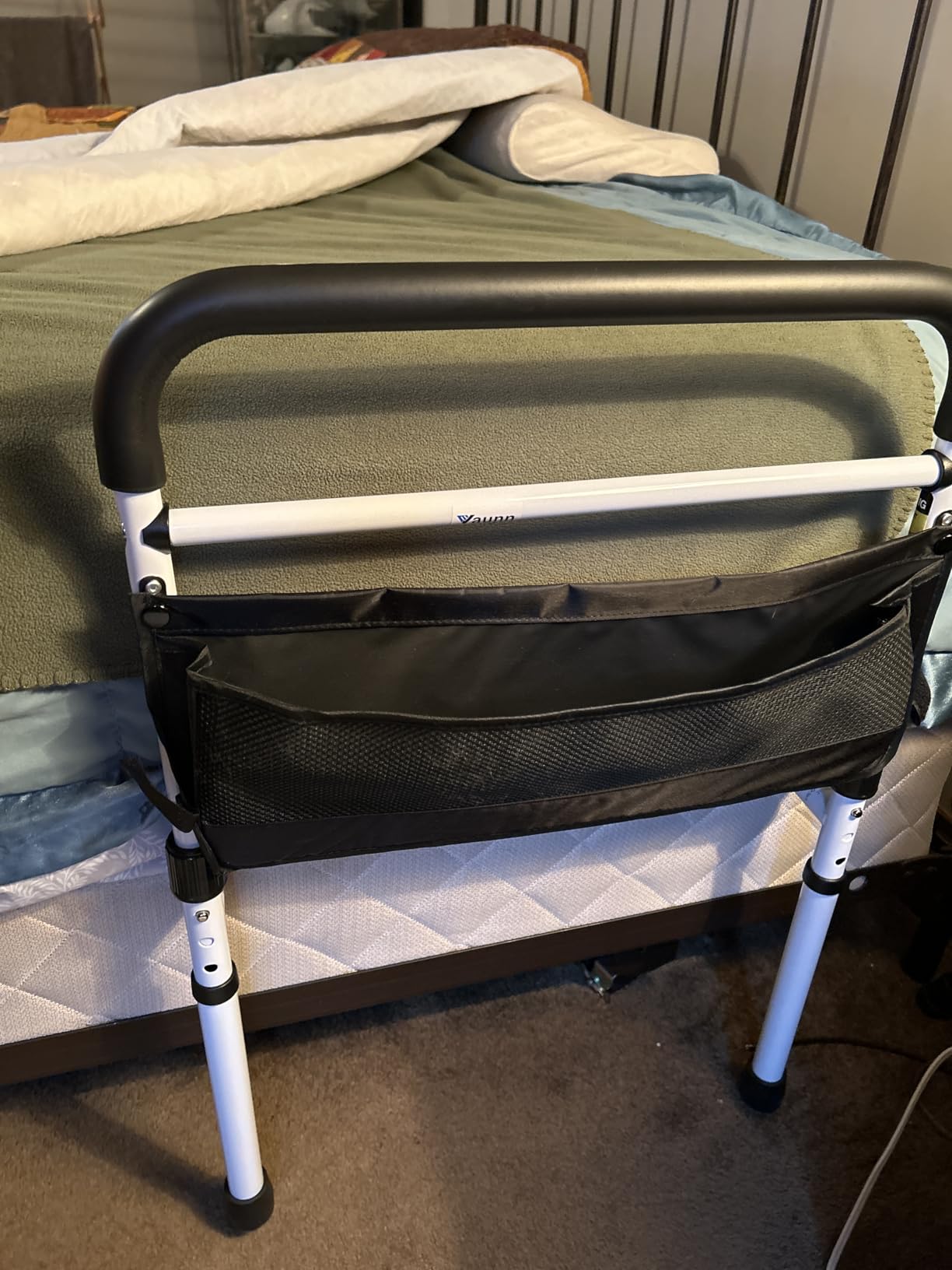
The frame is heavy-duty powder-coated steel rated to 300 pounds, with horizontal stabilizer bars welded across the lower section. Those bars are what make it feel rigid under load rather than springy. The handle carries slip-resistant foam padding, and the 20-inch width is cited by users as a good balance: wide enough to help block roll-off, narrow enough to leave a real gap for getting in and out.
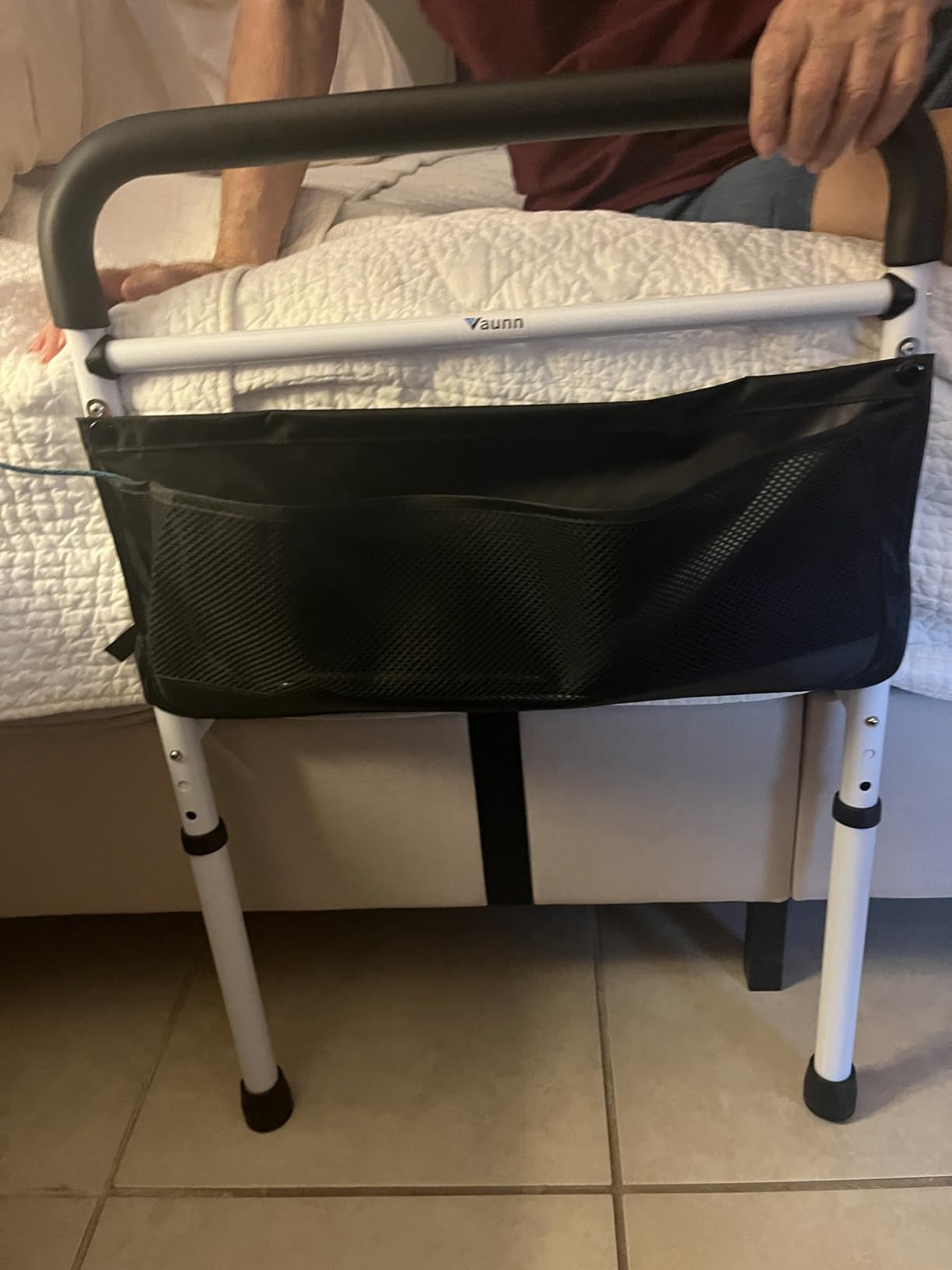
Height and width both adjust, covering twin, full, double, queen, king, and California king frames with mattresses from 7 to 11 inches. Installation is a slide under the mattress plus a strap around the frame, no tools, and the storage pouch is included. The whole surface wipes clean with a damp cloth.
Reviewers describe it as the sturdiest non-folding grab bar they have used, and one comparison that comes up repeatedly is that the 8-pound steel gauge feels noticeably heavier than consumer-grade rails of similar size.
Why the certification matters more than the price gap
ASTM F3186-17 sets structural strength and entrapment requirements for portable adult bed rails. A rail that meets it has been pushed, pulled, and loaded in a controlled setting before it reaches a bedroom, which is a meaningfully different standard from a listing that simply says heavy duty.
If your parent has a history of pulling hard on things during transfers, or if the rail will be used by a caregiver to assist a larger person, that certification is the single most useful spec on the page. It is also the reason we rank this one so highly despite the clearance requirement below.
Where the Vaunn will not work
Two limits, both about the bed rather than the rail. It is not designed for motorized adjustable bases or most Sleep Number style frames, which rules out a large share of adjustable beds sold today.
It also requires 13 inches of floor clearance beneath the bed frame. That is generous, and it excludes low-clearance platform beds and frames fitted with a motor lift. Measure the gap from the underside of the frame to the floor before ordering, because this rail will not install without it.
3. Medical king Bed Rail: Best Low-Cost Starter Rail
- No tools needed
- slides under the mattress with included strap
- Adjustable height suits different mattress thicknesses
- Removable storage bag for glasses and remotes
- Reported to hold a 188 lb adult pulling to a seated position
- Included strap too short for some queen box springs
- Confusing instruction about removing packing washers
- One buyer had to disassemble and reassemble it
At 4.4 stars across nearly 9,550 reviews, the Medical king rail carries the lowest average rating in this roundup, but the pattern in the reviews is worth understanding before you treat that as disqualifying. Buyers consistently praise the price, the tool-free install, and how much it helps a parent sit up or roll in bed. The complaints are almost all about the included strap and the printed instructions.
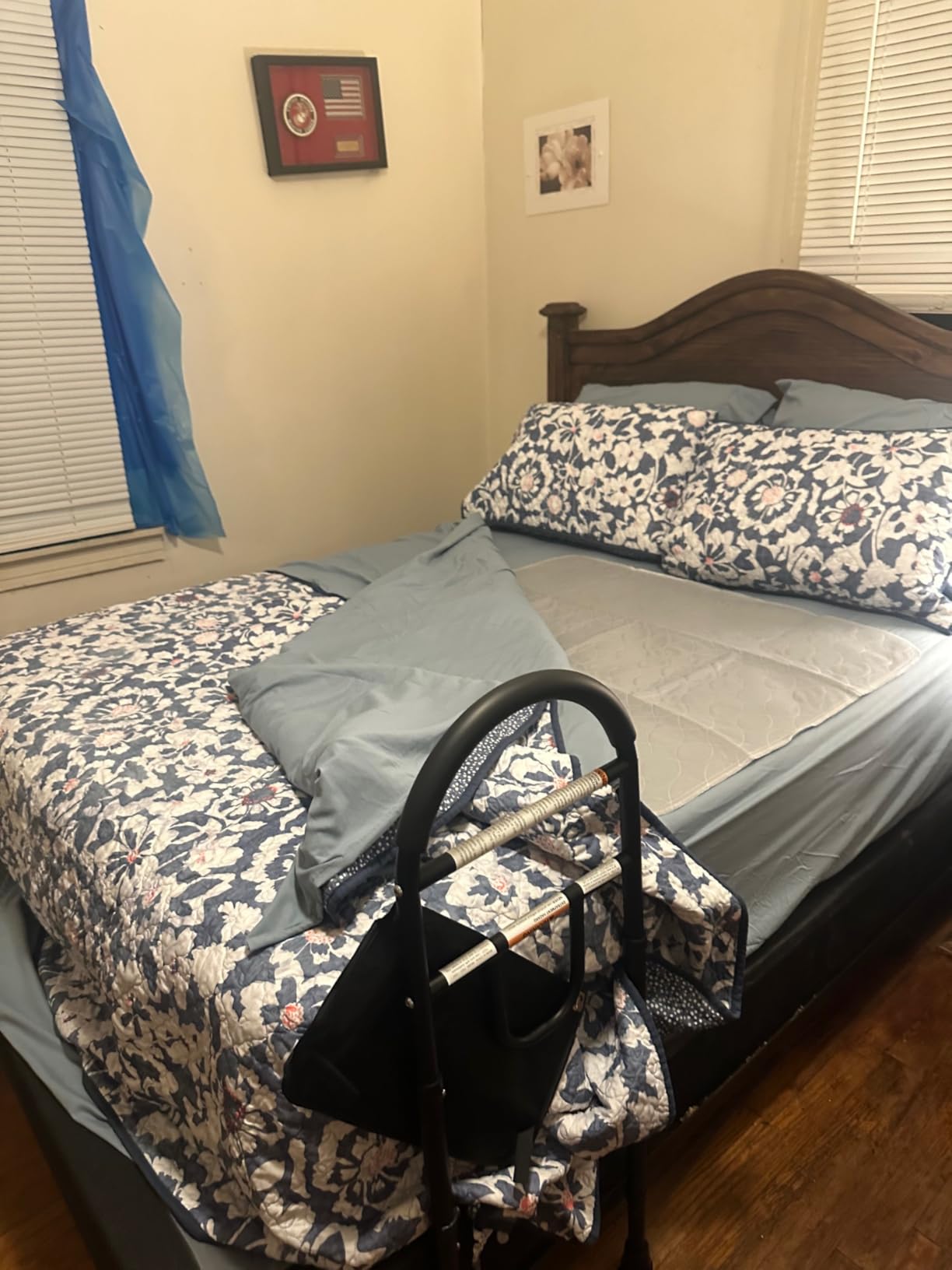
The rail slides under the mattress with a security strap and works on king, queen, and twin beds on either side of the frame. Height adjusts without tools to accommodate different mattress thicknesses, which is more than many rails in this price range manage properly.
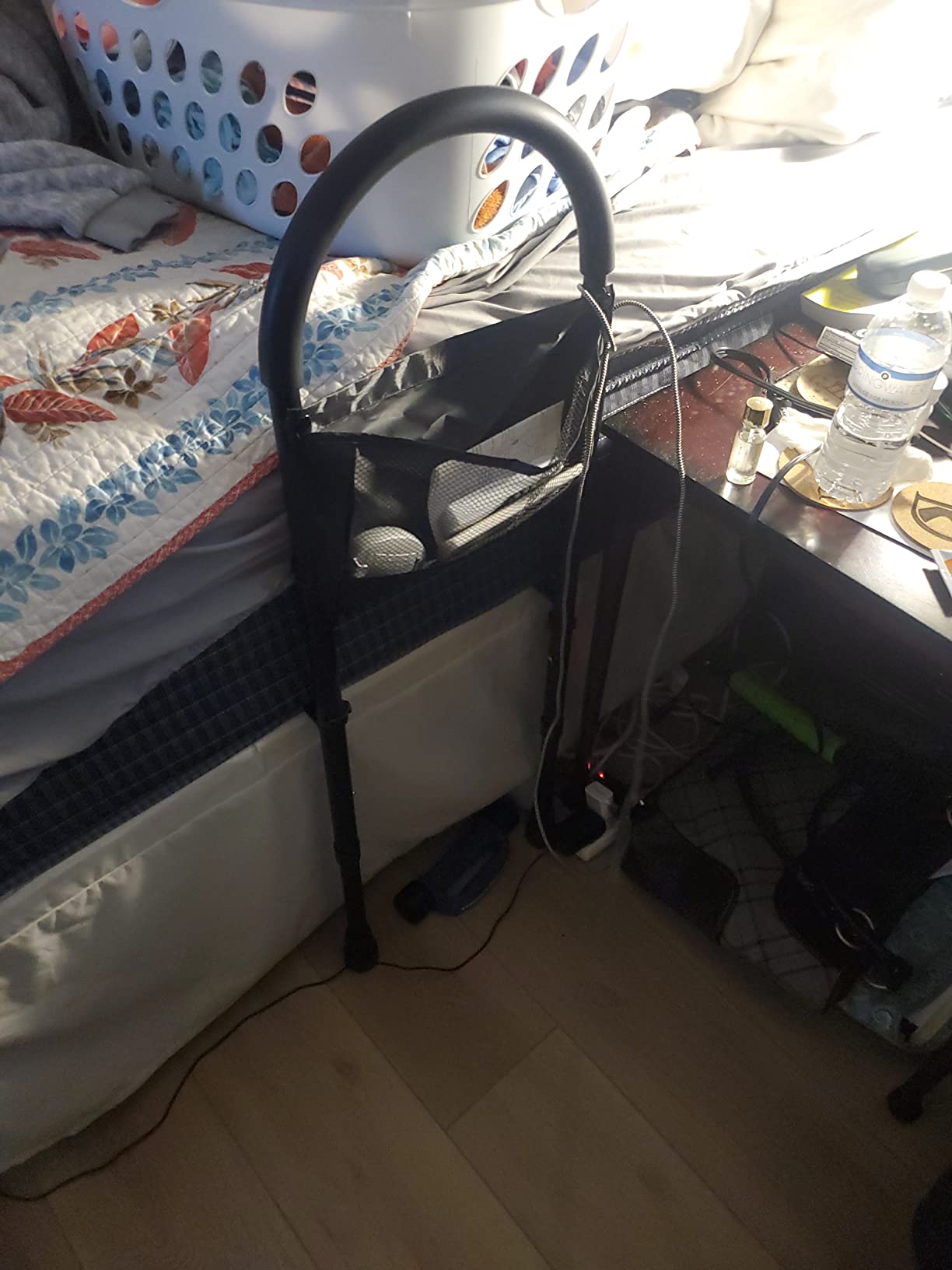
One specific buyer detail worth repeating: users report the frame held a 188-pound adult pulling to a seated position without flex. That is real-world evidence of adequate load capacity for most adults, even though no number is printed on the listing.
The removable storage bag for glasses, remotes, and books is simple mesh but does the job. The non-slip handle bar is the point of contact for sit-up and standing support, and reviewers with hand weakness say it is easier to hold than a bare tube.
When this rail makes more sense than a pricier one
This is a reasonable first rail for a parent who is mildly unsteady rather than seriously mobility-limited. If the goal is a steady push point for sitting up and swinging legs over the edge, and the user weighs under 180 pounds, it covers the requirement at the lowest entry point in this group.
Caregivers of very elderly relatives frequently buy a second rail for the other side of the bed, which is worth doing from the start if both sides need support rather than discovering the gap later.
What to fix before you rely on it
The included strap is reported too short to run around a queen-size box spring. Several buyers improvised with their own strap or an extra length of webbing, and it is a five-minute fix, but know about it going in rather than discovering it at install time.
The instruction to remove packing washers is confusing because the visible parts are plastic guides rather than washers. One reviewer had to disassemble and reassemble the rail to get it working, so budget an extra fifteen minutes and read the whole instruction sheet before starting.
4. Stander EZ Adjust Bed Rail: Best for Restless Sleepers
Stander EZ Adjust Bed Rail, Adjustable Senior Bedrail and Safety Assist Railing for Elderly Adults with Organizer Pouch, ASTM Safety Approved Guard-Rail, Black
- Passes ASTM F3186-17 for entrapment and fall risk
- Extends 20 to 30 inches to block roll-off
- Folds down and pivots away on a knob
- Large multi-pocket organizer pouch
- Holds firm for restless sleepers up to 230 lb
- Strap clips reported non-functional by one buyer
- Hard to install alone on a heavy king mattress
- Pocketed cover can feel enclosed
- Fold-down locks are hard to operate from inside the bed
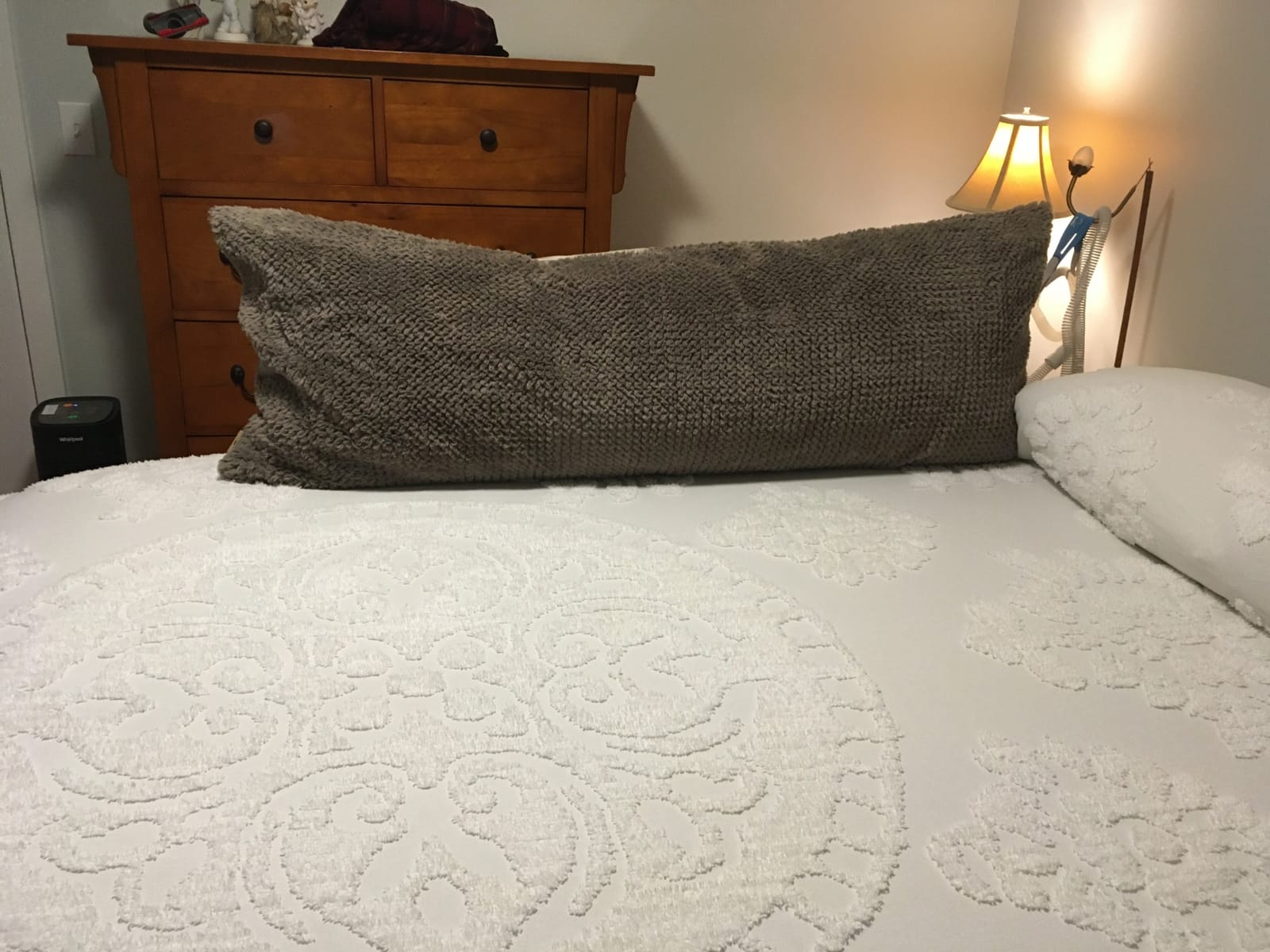
The Stander EZ Adjust is the rail we would put in the bed of someone who moves a lot in their sleep. Reviewers caring for cancer patients, REM sleep disorder patients, and fall-recovery adults describe it as the thing that stopped repeat falls out of bed, and the reason is coverage rather than grip strength.
Where most assist rails cover about a foot of the bedside, this one extends from 20 to 30 inches of mattress edge. On its own it functions as a 300-pound rated assist handle, and when extended it covers enough of the side of the bed to make rolling off a genuinely difficult motion.
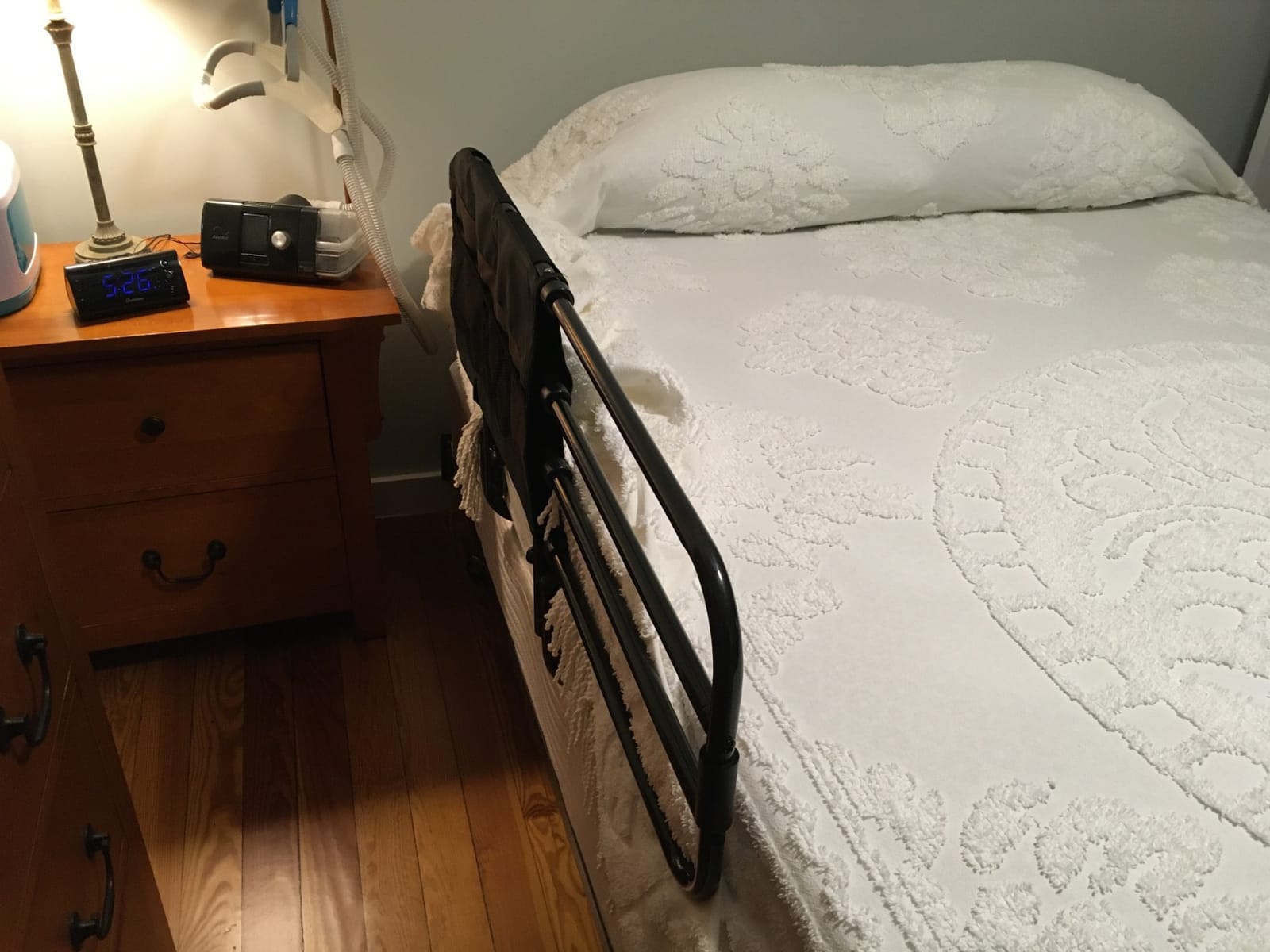
It also folds down and pivots out of the way on a knob, which solves a problem most rails create: the caregiver still needs to make the bed. With the rail swung down, a parent can transfer with a caregiver on both sides of the mattress rather than having to move a fixed bar.
The large multi-pocket organizer holds remotes, glasses, a phone, and medication in separate compartments, which is the most organized storage of any rail in this group. Reviewers with users up to 230 pounds report it holds firmly enough for restless sleepers.
Why extension beats grip for night-time wanderers
A rail that a person can grip solves a sit-to-stand problem. It does not solve a person who is half asleep, rolling, and not looking for the handle. Extending the barrier across more of the bedside is a different mechanism, and it is the reason this rail appears in reviews from families dealing with night-time wandering.
The ASTM F3186-17 certification here is independently tested for fall and entrapment risk, which is exactly the combination that matters when the rail is doing guard duty rather than assist duty.
Where the Stander gets in the way
Anchoring is the weak point in reviews. One buyer reported the included strap clips were non-functional and hard to unclip, and installing on a heavy king mattress is genuinely a two-person job because the box spring has to be lifted. Plan for a second pair of hands.
Two smaller issues: the pocketed rail cover can feel enclosed to the user, and one reviewer removed it outright, and people with limited manual dexterity struggle to operate the fold-down locks from inside the bed. If fine motor control is already compromised, that last point deserves testing before purchase.
5. Lunderg Bed Assist Rail: Best Rated with Motion Light
Lunderg Bed Assist Rail for Seniors with Motion Light & Non-Slip Grab Bar
- Highest average rating in the roundup at 4.7 stars
- Motion-activated light turns on with movement or gripping
- Arrives partly pre-assembled for a 5-10 minute setup
- Four stabilizer bars and a 300 lb load test
- Short 13 inch profile makes entry and exit easier
- Motion light battery could last longer between recharges
- Strap may need a second stronger person to attach
- Not suitable for adjustable beds
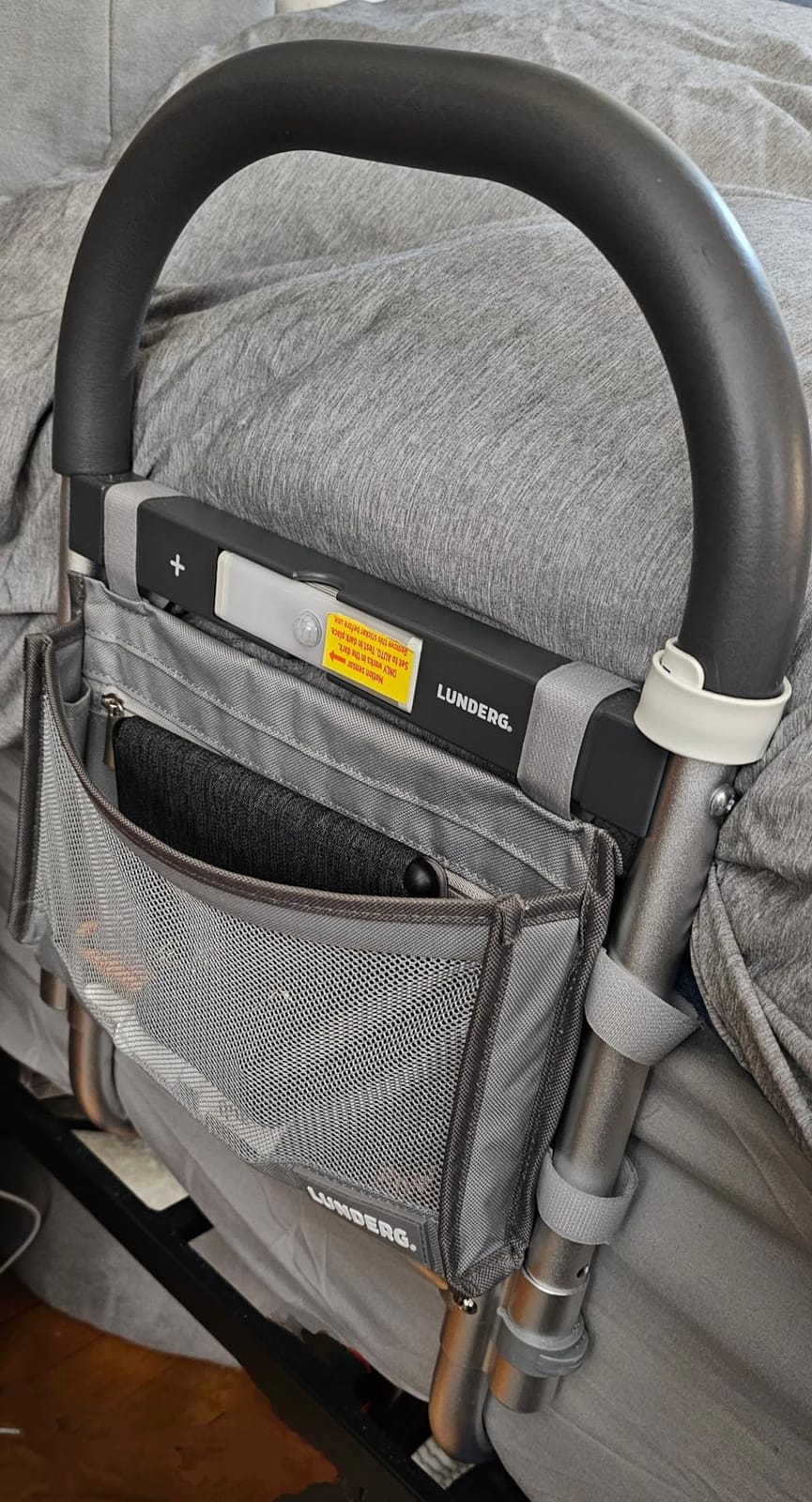
The Lunderg rail holds the highest average rating in this roundup at 4.7 stars, with 83 percent five-star reviews across around 2,800 ratings. What separates it from the other well-reviewed options is the motion-activated light, which is the single feature most often described in reviews as having changed nighttime routines.
The light illuminates on movement or when the user grips the rail, and stays on for 60 seconds per activation. For someone recovering from hip or knee surgery, that removes the single hardest part of a bathroom trip at night, which is finding the bathroom without turning on a bright light first.
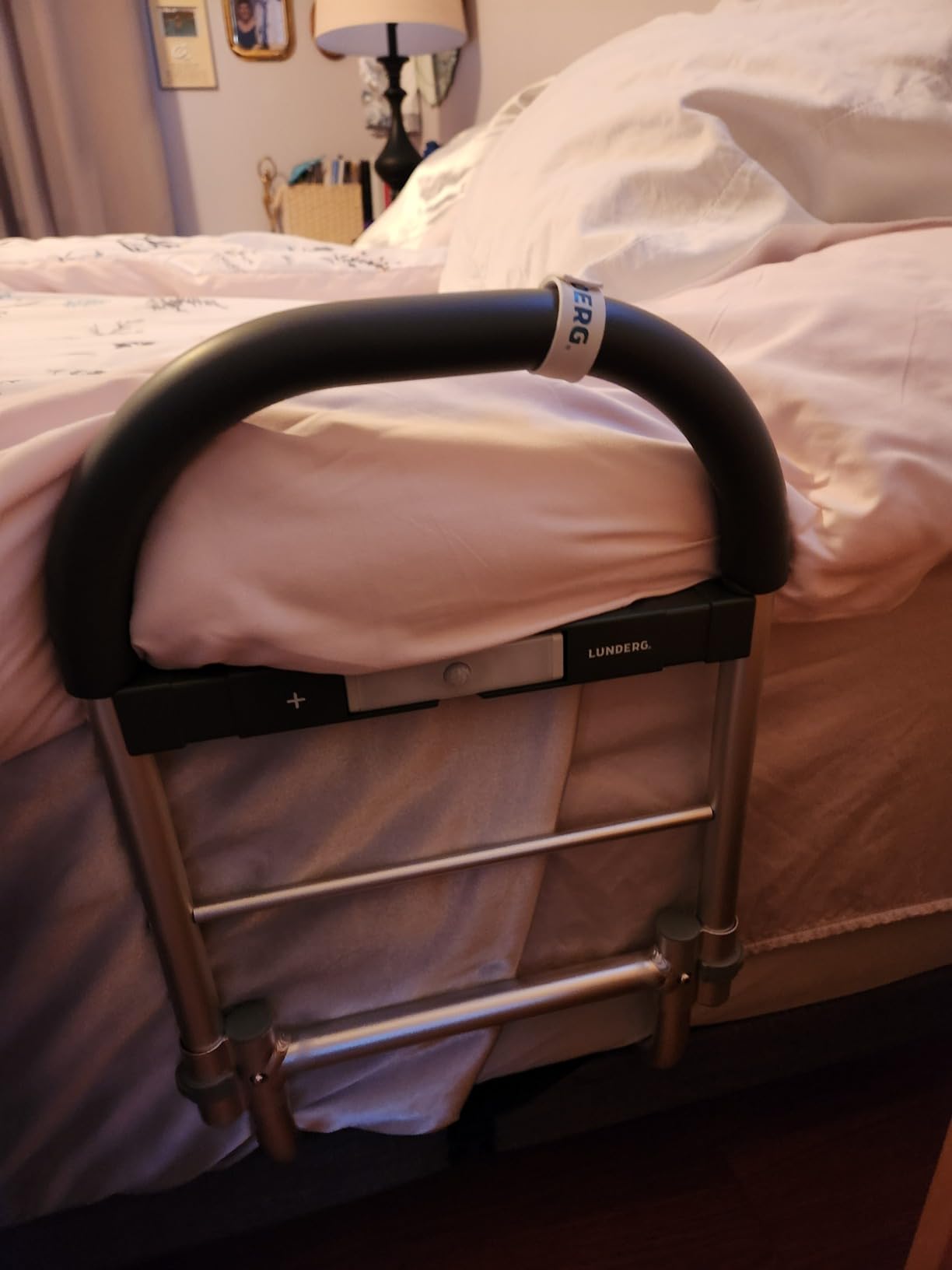
Caregivers of dementia patients use the same light as an alert that a loved one has gotten out of bed, which turns a passive rail into a signal device. That dual use is worth knowing about, because it means the rail reports an event as well as preventing one.
The build is a carbon steel frame load-tested to 300 pounds with four horizontal stabilizing bars, which reviewers credit for a wobble-free grip at a weight of only 2 pounds. It arrives partly assembled and uses pushpin connectors to join the top and bottom, giving a genuine five to ten minute setup.
Why the short profile is easier to get out of bed with
At 13 inches, this is one of the shorter rails here, and that works in the user’s favor. A short rail is low enough to swing legs over comfortably while still tall enough to push against when standing, which removes the awkward moment of trying to climb over a tall bar with a recovering hip.
It fits twin through king and works with box spring, slat, or platform beds, with a fit range of 7 to 13 inch mattresses. That is the widest mattress window in the group, which matters if the mattress is thick or on the thin side.
What to know before buying
The motion light battery should last longer between recharges. It is a rechargeable unit, so expect a charging routine rather than a disposable battery, and treat a dead light as a prompt to recharge rather than a failure of the rail.
Attaching the strap to the far side of the bed frame may require a second, stronger person, and the rail is not suitable for adjustable beds. Plan the strap step with help and confirm your bed frame type first.
6. KingPavonini BM03-1: Best Heavy Duty Rail at 380 lbs
KingPavonini Bed Rails for Elderly Adults Safety, 380 LBS, Model BM03-1
- Highest published weight capacity in the roundup at 380 lbs
- Both height and horizontal span adjust to fit the mattress
- Deep under-mattress section grips the box spring for stability
- Padded curved handle comfortable for wrist and back pain
- Tool-free assembly and folds for portability
- On a king mattress a user can only reach one rail at a time
- Not intended for adjustable beds
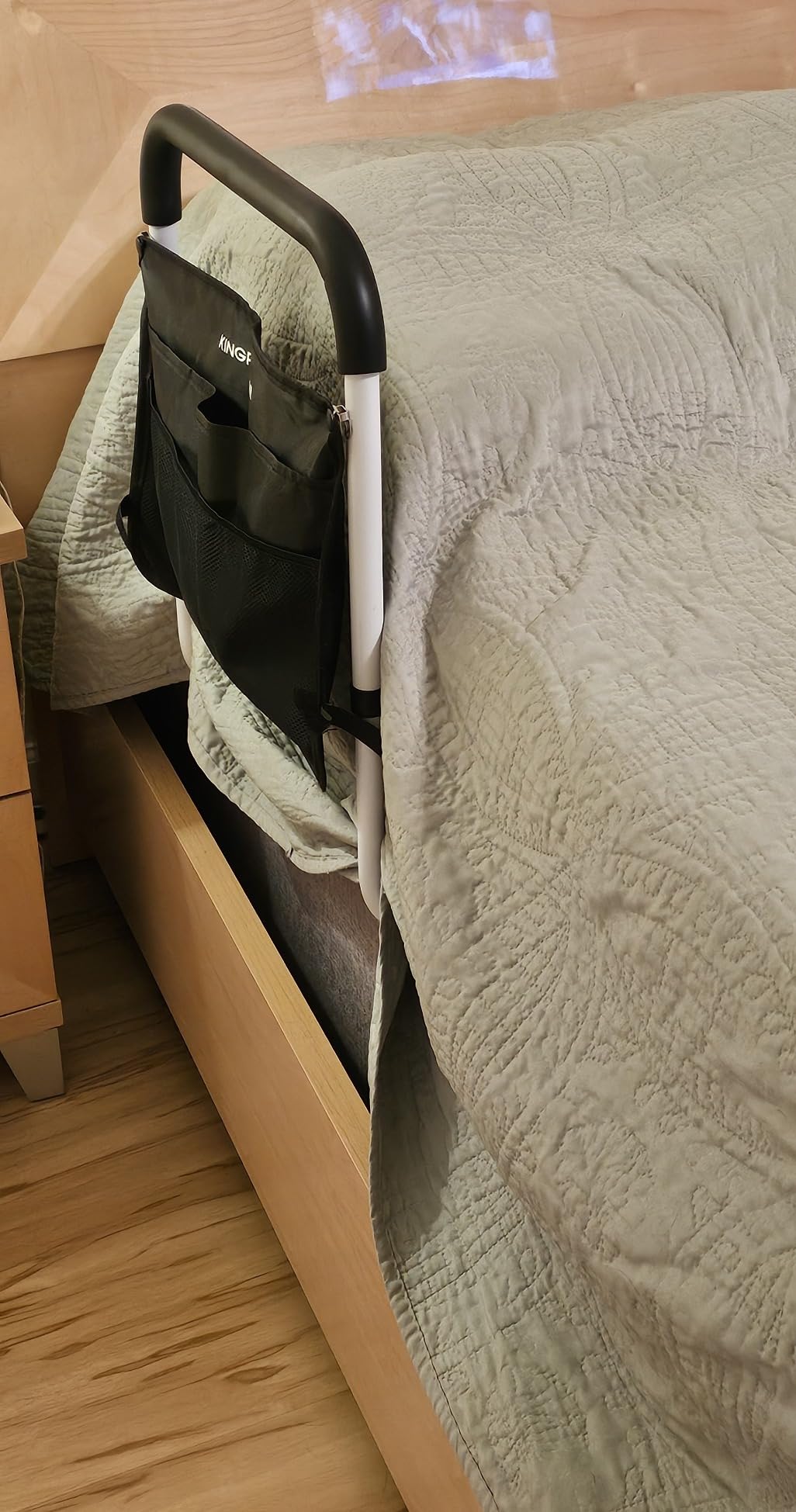
The KingPavonini BM03-1 carries the highest published weight capacity in this roundup at 380 pounds, and it does something structurally different from most competitors. Its under-mattress section reaches deep enough to grip the box spring directly, which is why reviewers report it feeling stable even without extra strapping to the frame.
That construction detail is worth more than the headline number. A rail that anchors by friction against the box spring keeps its base under load, whereas a rail that relies on a strap transfers all of that load to a single strap and the nearest fastener.
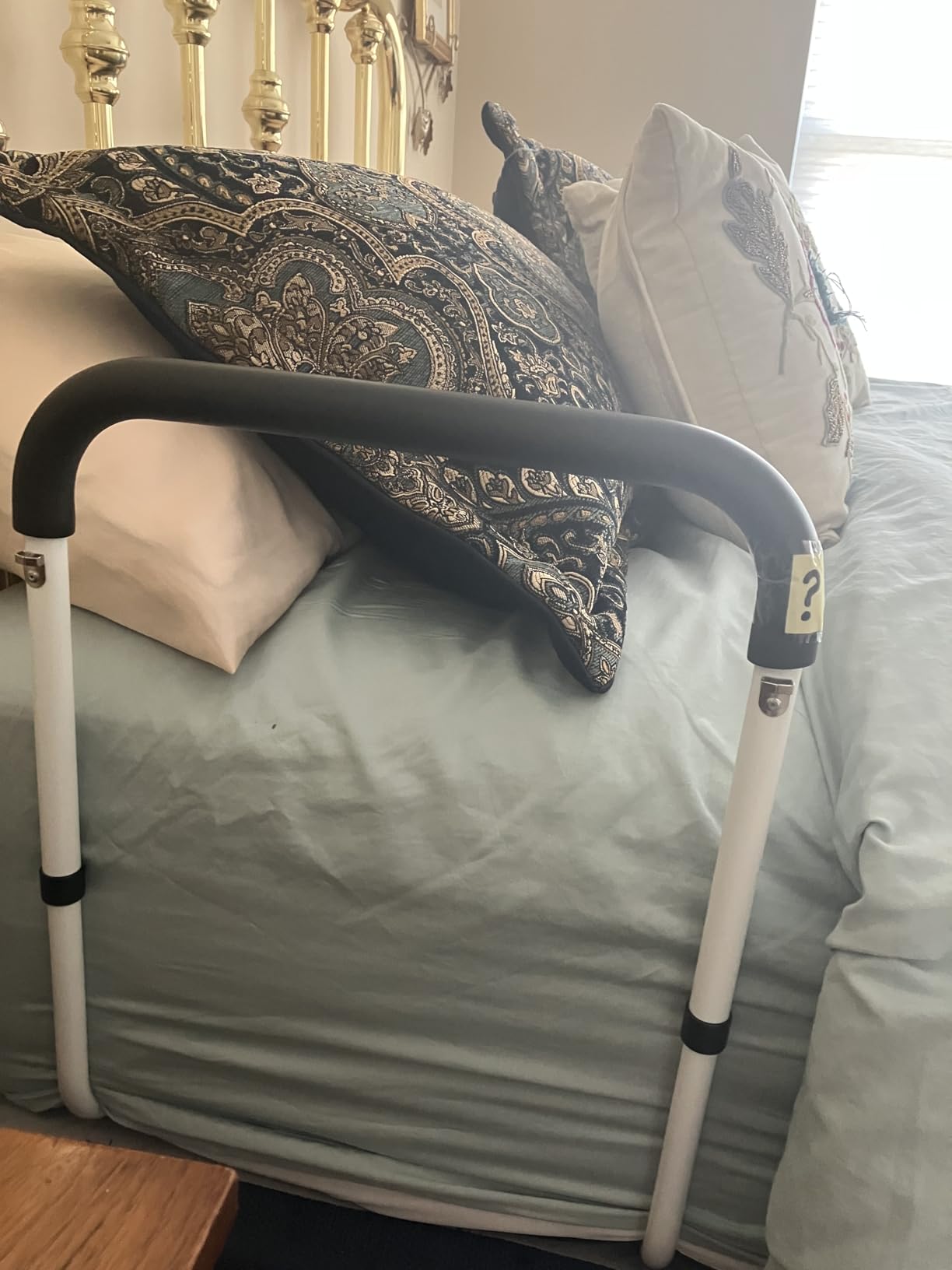
Both the vertical height and the horizontal span adjust. Height runs from 17.6 to 20.9 inches and the horizontal extension runs from 28.6 to 34.7 inches, which is a wide enough window to fit mattress thickness variation without swapping parts. It fits twin through king with 3 to 12 inch mattresses.
The padded non-slip curved handle comes up repeatedly in reviews from users with wrist and back pain. Assembly is tool-free and takes minutes, and the rail folds for portability if you are moving it between rooms or to a temporary care situation.
Who the 380-pound rating actually serves
This is the rail to choose when the person using it is larger, or when a caregiver will be assisting with transfers and putting significant load on the handle. The 380-pound rating leaves roughly 100 pounds of headroom above a 280-pound user, which is the margin we would want before trusting a rail with a full sit-to-stand push.
Post-surgical, post-partum, and stroke-recovery users describe it as the difference between getting out of bed alone and needing help every time. That is a functional measure rather than a spec, and it is the outcome that matters.
Where the design limits you
The rail is narrow enough that on a king mattress a user can only reach one rail at a time. For someone who moves along the full width of the bed at night, that means repositioning the rail rather than reaching for it.
It is also not intended for adjustable beds, which is a limitation shared by most rails here. If your base raises and lowers on a motor, you need a different mounting approach entirely.
7. WeHwupe Bed Rail: Best Lightweight Option for Small Rooms
WeHwupe Bed Rails for Elderly Adults Safety with Bedside Storage Pocket
- 350 lb capacity at only 4.5 pounds
- Passed ASTM safety testing
- Soft non-slip foam padding on the handle
- Height adjustable for king queen full and twin
- Tool-free assembly with tie-down straps and mesh pocket
- Not suitable for adjustable or automatic lift beds
- 12.3 inch profile gives less roll-off coverage
- Smaller review base means less long-term feedback
The WeHwupe rail manages something the heavier frames cannot: a 350-pound load capacity at 4.5 pounds. That combination is unusual, and it matters in a specific situation, which is installing in a small bedroom where a caregiver needs to move the rail between residents or reposition it frequently without a fight.
The frame is alloy steel that passed ASTM safety testing, with soft non-slip foam padding on the handle for a secure, comfortable grip. Height is adjustable and the rail fits king, queen, full, and twin frames.
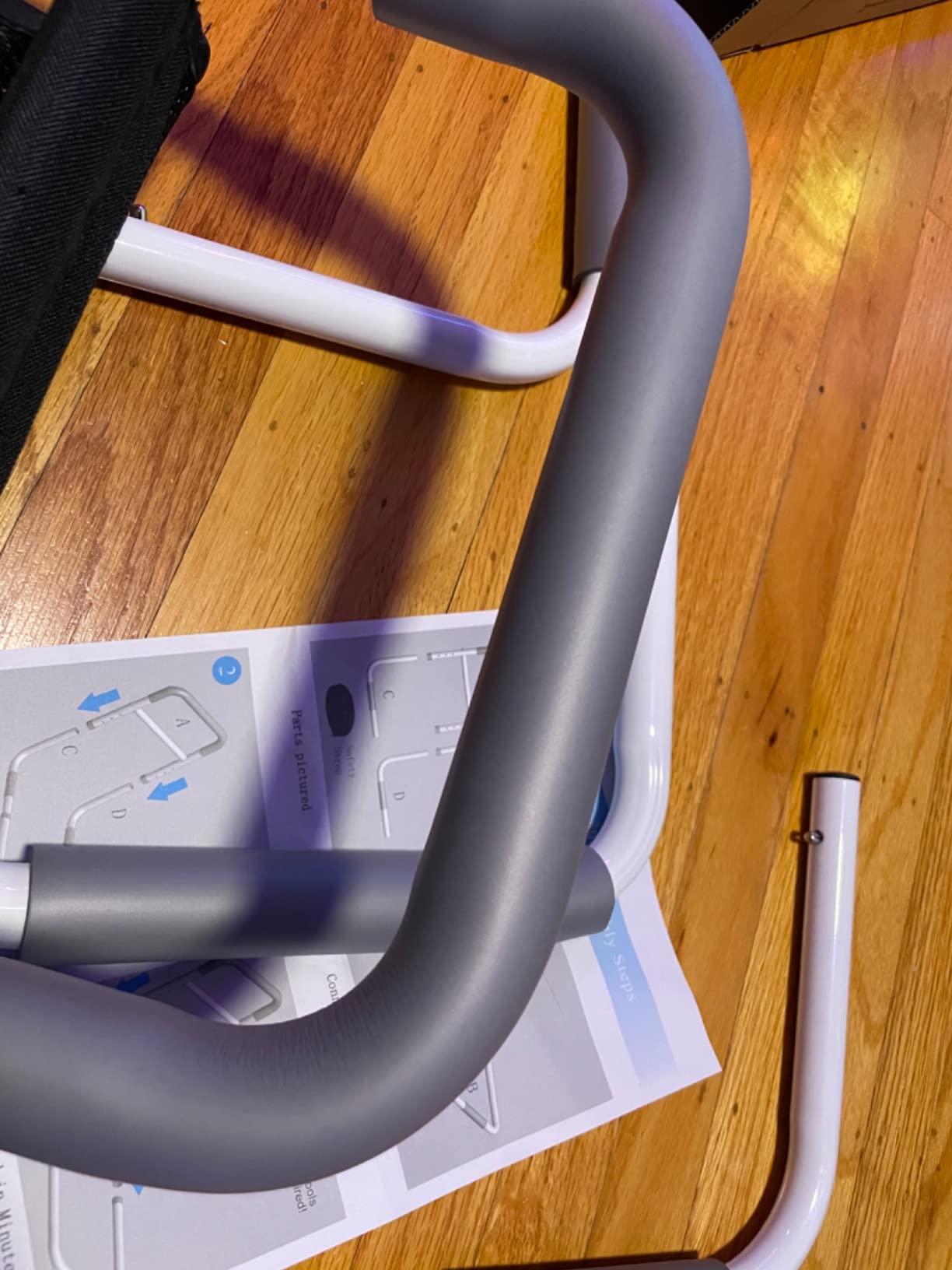
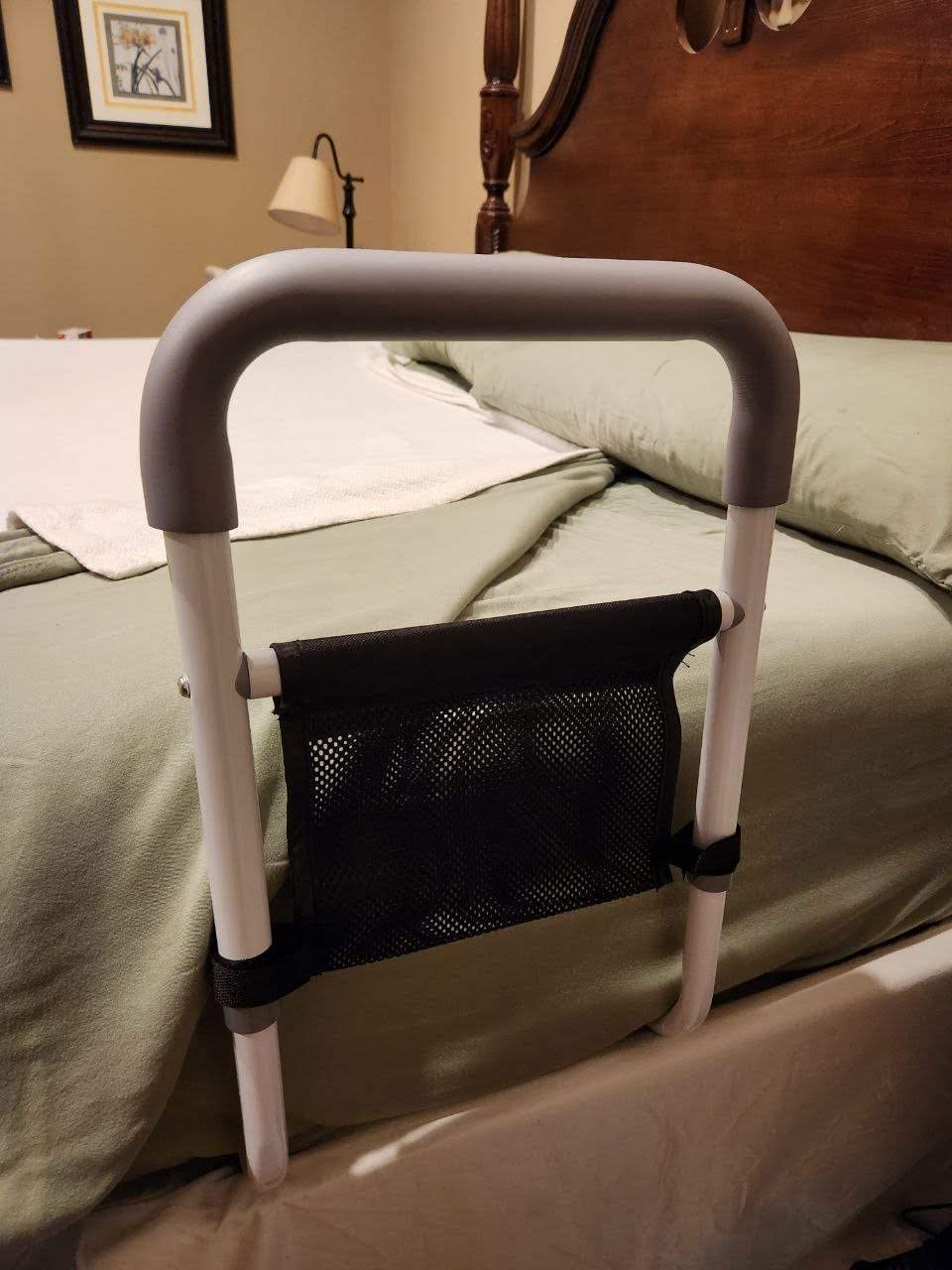
Assembly takes minutes with the included tie-down straps, and a mesh storage pocket comes in the box. The frame and handle both wipe clean with a damp cloth, which sounds minor until you are maintaining equipment in a household with limited cleaning help.
Reviewers highlight quick tool-free setup and stable anchoring with the supplied straps as the consistent strengths. At about 1,150 reviews and 4.6 stars with 79 percent five-star ratings, it is well liked, just not as thoroughly proven over time.
Where low weight pays off in a real bedroom
Weight becomes a feature when the rail has to move. In a shared room, a multi-bed facility, or a home where one parent rotates between a bedroom and a recliner at night, a 4.5-pound rail can be repositioned by a single caregiver rather than requiring two people and a step ladder.
The 350-pound rating also means it serves most adults with real headroom, so you are not trading structural capacity for portability. That is not a compromise most people expect to make in this category.
What the smaller review base means for you
Honest limitation: fewer reviews than the category leaders means less long-term owner feedback. We see limited evidence about durability after a year or more of daily use, so if you want a product with a deep, multi-year history, the Medline or Vaunn rails carry far more of it.
The 12.3-inch profile also provides less roll-off coverage than a full-width guard rail, which makes it an assist handle rather than a guard. And it is not suitable for adjustable or automatic lift beds, so check your frame before ordering.
8. BigDolphin GS07: Best Curved Handle for Arthritis Hands
BigDolphin Bed Rails for Elderly Adults Safety, 350 LB Capacity, Model GS07
- Reinforced stainless steel frame rated to 350 lbs
- 30-degree curved handle with waterproof non-slip foam
- Spinnable leg bottom adapts to uneven or sloped floors
- Height and length both adjustable for a tailored fit
- Lightweight and portable with storage pouch
- Not intended for adjustable beds
- Newer listing with a smaller review base
- Some facilities flag this rail design against their own policies
If hand arthritis or tremors decide how usable a rail is, handle geometry becomes the deciding feature rather than a nicety. The BigDolphin GS07 has a 30-degree ergonomic curved handle with cushioned waterproof non-slip foam, and reviewers describe it as noticeably easier on arthritic wrists than the straight-tube rails it competes with.
The curve matters mechanically. A straight horizontal bar forces the wrist to stay flat and the forearm to rotate into an unnatural angle. A 30-degree curve lets the hand grip at a more natural rotation, which is the difference between a grip that holds for ten seconds and one that holds for a full minute while standing up.
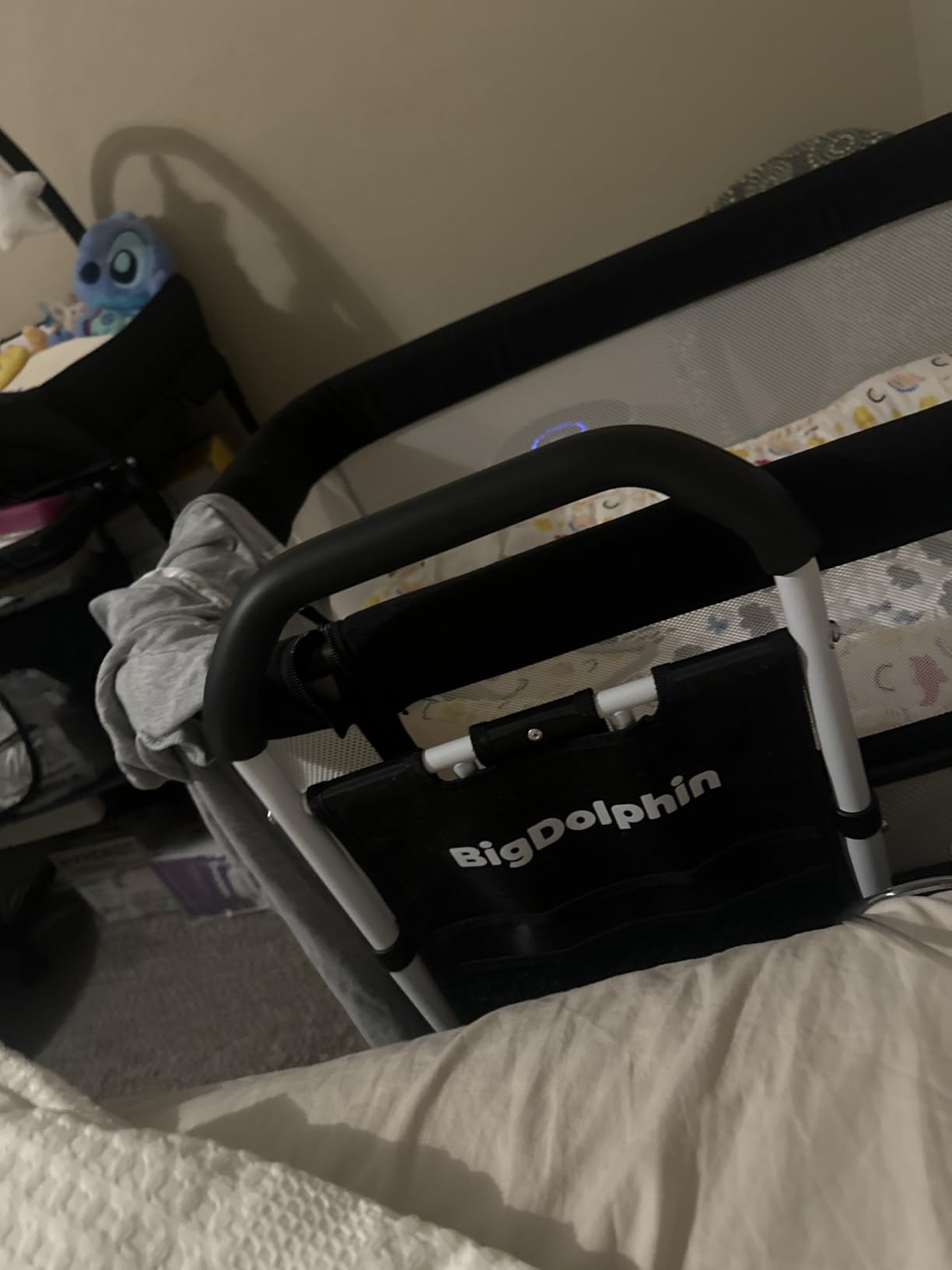
The frame is reinforced stainless steel rated to 350 pounds and ASTM tested. The waterproof foam padding holds its friction even with wet hands, which is a small detail that matters for someone who has just washed their face before getting into bed.
The feature we found most distinctive is the spinnable leg bottom. On an uneven or sloped bedroom floor, flat tube legs bridge a gap and stop the whole rail from shaking. That removes the wobble complaint that shows up on several other rails in this roundup.
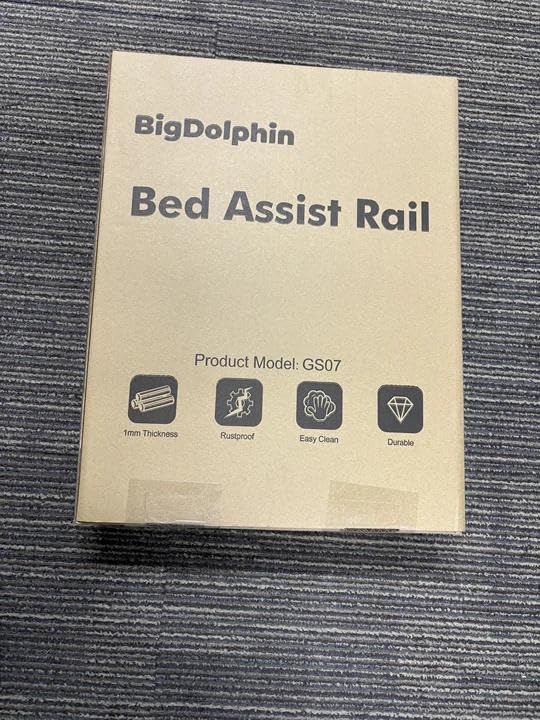
Matching a curved handle to specific conditions
Parkinson’s-related tremor and rheumatoid arthritis are the two conditions where this geometry does the most work. Both reduce grip reliability at exactly the moment it is needed, which is the transition from sitting to standing. Caregivers describe the curved handle as easier to catch in a pinch grip even when fine motor control is poor.
The stainless steel frame is also the right material for a humid room or a bedroom where the rail may be wiped down frequently. Wipe with a dry cloth as the manufacturer specifies.
What to keep in mind
This is a newer listing at 633 reviews, so long-term durability feedback is thinner than for the established rails here. At 4.6 stars with 80 percent five-star ratings it is well liked, just less proven over time.
Some assisted living facilities have flagged this rail design as incompatible with their own equipment policies, which is worth checking before ordering for a parent in residential care. It is also not intended for adjustable beds.
9. Panta ASTM F3186-17 Rail: Best Flat Tube for Sleep Comfort
- Passed ASTM F3186-17 and rated to support 350 lbs
- Flat tube design prevents mattress deformation
- Adjustable 17-21 inch height with legs adjustable 12.6-19.69 inches
- Non-slip pads on support legs add floor stability
- Removable storage bag and tool-free install
- Needs more than 12.6 inches of clearance under the bed
- 12.4 inch width covers less bedside than a guard rail
- Uneven floors may strain the adjustable leg design
The Panta rail is one of only a handful here that states ASTM F3186-17 compliance alongside a 350-pound rating. What users notice first, though, is the flat tube design, and it solves a problem most people only discover after a few nights on the bed.
Rails with round or raised tubing press up into the mattress. A sleeper can feel the frame through a thin mattress or on a bed with no box spring, and that pressure can mean waking up at three in the morning rather than sleeping through. The Panta’s flat profile is specifically designed to avoid mattress deformation.
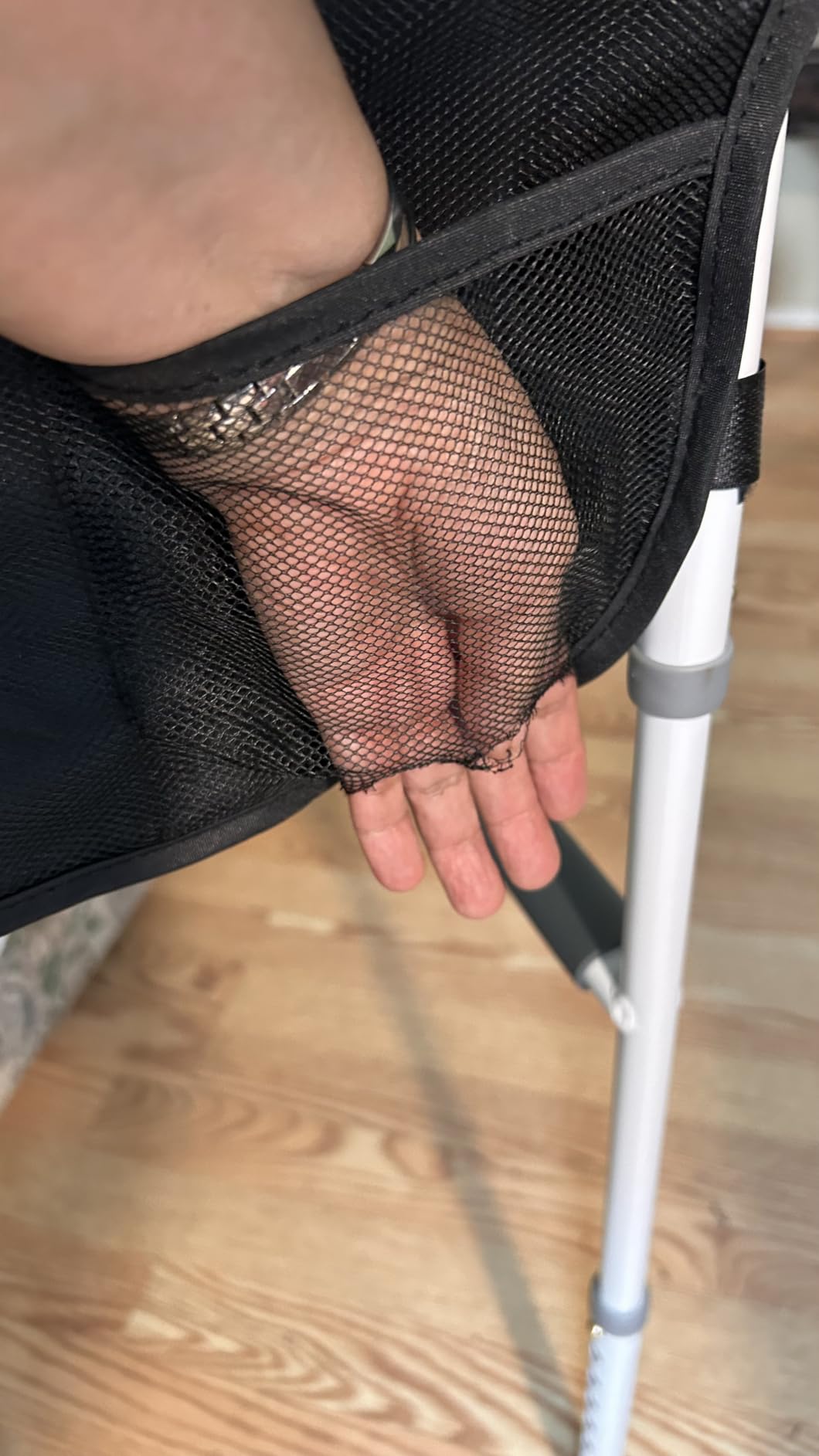
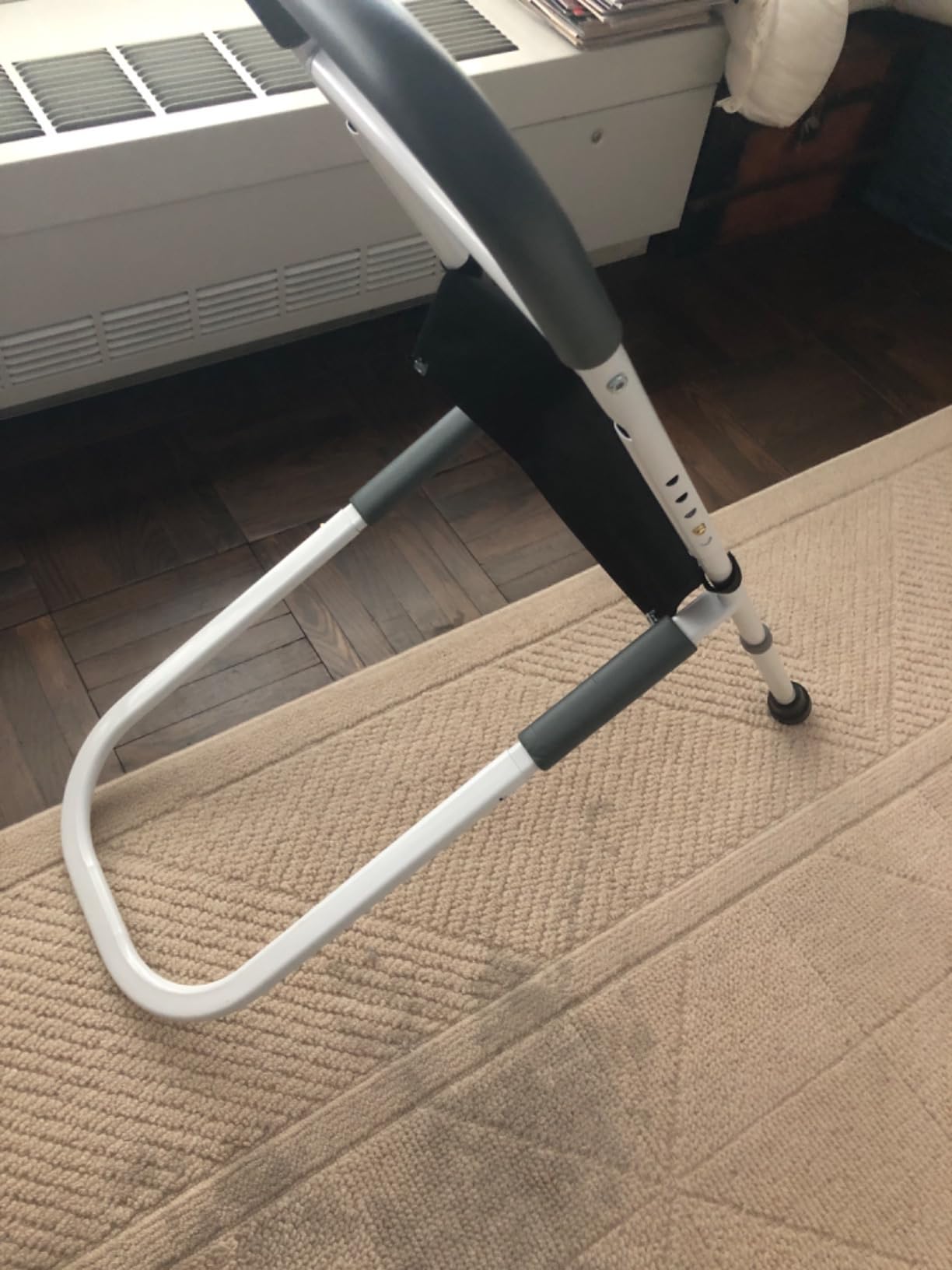
Height adjusts from 17 to 21 inches, and the support legs adjust independently from 12.6 to 19.69 inches, which lets you level the rail on a frame that is not perfectly parallel to the floor. Non-slip pads on the legs add stability at the floor contact point where wobble usually starts.
A removable storage bag is included, and installation takes minutes with illustrated written instructions or a video if you prefer to follow along. It fits king, queen, twin, and medium beds.
When a sleeper notices the frame, everything else fails
A rail that is stable but uncomfortable gets removed within a week. That is the quiet failure mode across this entire category, and it is why the flat tube designs, the foam-covered handles, and the low profiles exist. For a person who is in bed for long stretches, comfort is not secondary to safety.
Users on beds without a box spring or with thinner mattresses report never feeling the frame while sleeping, which is the outcome this design targets.
Clearance and coverage tradeoffs
Two honest limits. It requires more than 12.6 inches of clearance between the bed frame and the floor, which rules out low platform beds, and installation on sloped or uneven floors may be limited by the adjustable leg design, unlike the BigDolphin’s spinnable feet.
The 12.4-inch width also covers less of the bedside than a full-width guard rail, making this an assist handle rather than a barrier. Pair it with the Lunderg’s motion light if nighttime navigation is the real problem.
10. Sunisife Extended Bed Rail: Best Reach for Thick Mattresses
- Extended handle adjusts 22-29 inches for better roll-off coverage
- Bottom section extends to 29 inches for a stable grip
- Foam-padded ergonomic handle reduces force needed to sit up
- Carbon steel frame rated to 300 lbs with anti-slip foam
- Storage bag and 196.8 inch safety strap included
- Narrow fit window
- one reviewer warned to measure first
- Some buyers found the metal light and needed extra fasteners
- Storage pocket may mount outward and need flipping
The Sunisife extended rail is the longest-reaching rail in this roundup, and that is the whole design goal. Its handle bar adjusts from 22 to 29 inches, which gives notably better roll-off coverage than the shorter assist rails, and the bottom section extends to 29 inches for a stable grip across twin through king beds.
If your concern is a parent rolling or sliding toward the edge of the bed rather than struggling to stand up, reach is the feature that matters. A longer rail covers more of the bedside, which reduces the number of unprotected inches.
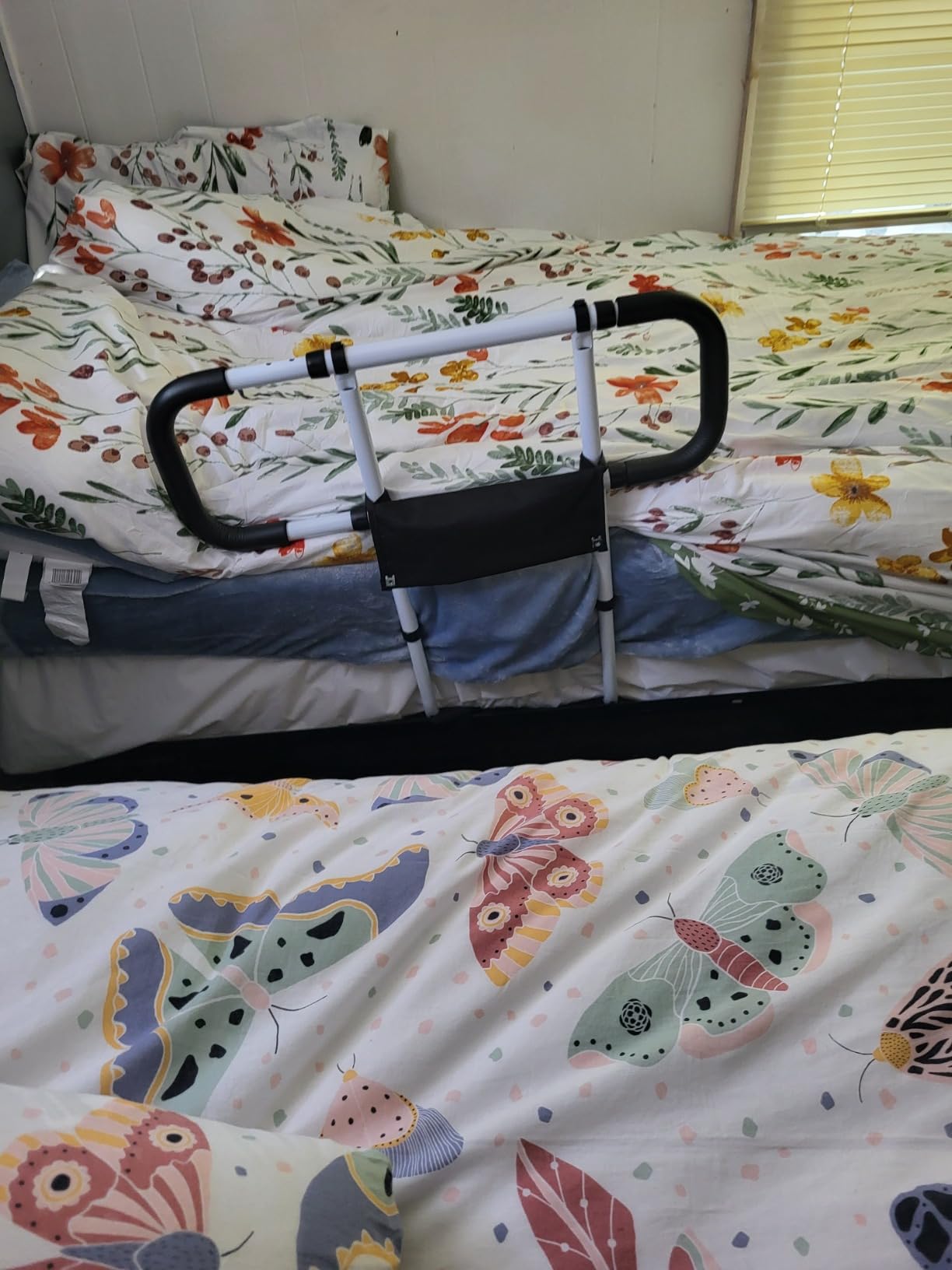
The frame is carbon steel rated to 300 pounds with anti-slip foam running along the section that meets the mattress, resisting the mattress sliding off the base. The foam-padded ergonomic handle is credited with reducing the force needed to sit up and get into bed, which helps users with limited upper-body strength.
A removable storage bag and a 196.8-inch safety strap are included. The strap length is generous, which solves the short-strap problem that trips up several competing rails, especially on queen and king box springs.
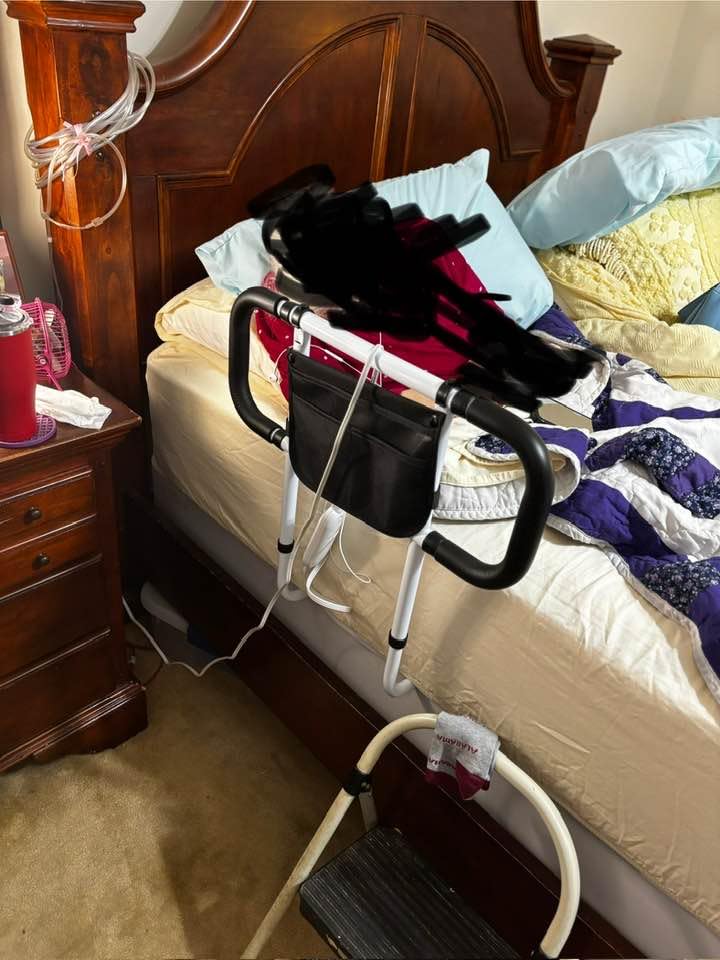
Measure the mattress before anything else
This rail has the narrowest fit window here at 11.5 to 15.5 inches of mattress thickness, and it has the lowest five-star share at 76 percent across 553 reviews. Buyers who measure first tend to be very satisfied, and the complaints concentrate almost entirely in one place: rail height that does not suit a thinner mattress.
Take the measurement before ordering. If your mattress falls outside that window, this rail will not adjust to meet it, and no amount of persuasion changes the result.
Where the frame feels less substantial
Some buyers reported the metal feels light and needed extra fasteners for rigidity, and the instructions and overall sturdiness were described as less refined than premium rails. One user independently devised a way to anchor the strap to the far side of the bed, which they recommend as necessary rather than optional.
The storage pocket is mounted on the outside on some units and has to be flipped to face the bed, a minor assembly annoyance that catches people out on first install.
9 Criteria That Decide Which Bed Assist Rail Is Right
Two rails that look identical on a product page can behave completely differently in a bedroom. These nine criteria, in the order we would check them, separate the ones that work from the ones that end up leaning against a wall unused.
1. ASTM F3186-17 certification
This is the standard for portable adult bed rails, and it covers both structural strength and entrapment risk. Four rails in this roundup state it explicitly: the Vaunn, the Stander EZ Adjust, the Panta, and the KingPavonini, which is ASTM approved at 380 pounds.
Where certification is stated, treat it as a minimum. Where it is not stated, look for a published weight rating and a stabilizer bar design instead, because both indicate the frame carries load through structure rather than through a single strap.
2. Weight capacity with headroom above the user
Published ratings in this roundup run from 300 pounds to 380 pounds. Rather than buying the lowest rating that technically covers the user, pick a rating that leaves 50 pounds or more of margin above the person’s actual weight.
Users lean on these rails harder than the rated load suggests. A sit-to-stand transfer puts most of a person’s body weight through the handle momentarily, and a caregiver assisting transfers can double the load. Capacity is not the number to shop on; headroom above capacity is.
3. Floor clearance under the bed frame
This is the criterion buyers skip and then regret. The Vaunn requires 13 inches of clearance beneath the frame, and the Panta requires more than 12.6 inches. Many modern platform beds and frames with a motor lift simply do not provide that.
Measure from the underside of the bed frame to the floor with a tape measure before you order anything with floor-supported legs. If clearance is tight, look for a mattress-anchored rail with a low profile instead.
4. Mattress thickness window
Every rail in this roundup has a stated fit range, and the ranges vary enormously. The Lunderg accepts 7 to 13 inch mattresses, KingPavonini fits 3 to 12 inches, Vaunn covers 7 to 11 inches, and the Sunisife accepts only 11.5 to 15.5 inches.
This single measurement causes more returns than any other factor in the category. Measure the mattress from the top of the frame to the top surface, not just the thickness of the foam, and check the number against the listing before you click anything.
5. Bed type compatibility
Nine of the ten rails here state they are not intended for adjustable beds. That is a hard limit rather than a preference, because a motorized base moves and a mattress-anchored rail cannot accommodate that movement.
Platform beds, slat frames, and box springs are all supported by most rails here, with the attachment method differing: box spring and slat frames use the strap around the frame, while platform beds rely on the under-mattress reach for friction. Check your frame type before ordering.
6. Grip geometry and surface
A straight horizontal bar forces the wrist flat and the forearm to rotate. A curved bar lets the hand take a more natural angle. The BigDolphin at 30 degrees is the clearest example in this group, and it is the reason reviewers with wrist and back pain single it out.
Surface matters as much as shape. Foam-covered handles, whether waterproof or standard, give more consistent friction and stay comfortable over a long grip. Skeleton steel handles are fine for a user with full hand strength and wrong for anyone without it.
7. Tool-free installation and strap length
Every rail here assembles without tools, and the practical differences are in setup time and anchoring. The Lunderg arrives partly pre-assembled with pushpin connectors for a genuine five to ten minute setup, while the Medical king’s instructions caused at least one buyer to disassemble and reassemble it.
Strap length is the sleeper issue. A strap too short for a queen box spring is the single most common complaint in reviews across brands, so check the included strap length against your frame. The Sunisife includes a 196.8 inch strap, which covers even the largest frames with room to spare.
8. Dementia and entrapment considerations
This is where the general advice is not enough, and a conversation with the person’s doctor is worth having before installing any rail in the bed of someone with moderate or severe dementia. A confused person can attempt to climb over a rail or slide into a gap, and the reported harm from that pattern is a documented reason regulators and care facilities treat rails with caution.
The Lunderg’s motion-activated light is useful here for a different reason: it gives a caregiver an alert that a loved one has gotten out of bed. If dementia is the primary diagnosis, the alternatives in the next section are often the safer primary approach.
9. Extras that change daily use
Storage, lighting, folding, and pivoting are not novelty features. They determine whether the rail gets used after the first week, because a phone and glasses within reach remove a reaching trip, and a rail that folds or pivots away lets a caregiver still make the bed.
Look at what the rail gives back to the user each day. A motion light removes a dark bathroom trip, a deep pouch removes a reaching motion, and a fold-down knob keeps the bed usable by the caregiver who also has to change the sheets.
Installation and the weekly stability check
Installation follows four steps: position the rail where the user enters the bed, slide the flat base under the mattress, thread and tighten the safety strap around the bed frame, and confirm the rail sits tight against the mattress with no visible gap. Follow the manufacturer instructions for your specific rail, since the attachment method varies.
Then run a three-point stability test before anyone uses it. Push the rail inward firmly at the top, pull it outward at mid-height, and apply your full standing weight to the handle. If the frame moves or the rail rotates at the base, tighten the strap and re-test before use.
Once a week, repeat that push, pull, and weight check. Caregivers who run this routine describe the thirty seconds it takes as catching loosening before a fall rather than after one, which is the single most valuable habit in this entire guide. Check the strap, the fasteners, and any wobble at the floor contact point.
Alternatives to Bed Rails and When to Skip One
A bed rail is not always the right tool, and there are situations where it is the wrong one. Understanding the alternatives prevents a purchase that creates a new risk while solving an old one.
Floor fall mats
A floor mat beside the bed does nothing to stop a fall. It reduces the injury a fall causes by cushioning the landing, which for someone with osteoporosis or a hip replacement can be the difference between a bruise and a fracture. It pairs well with a rail for someone who still tries to get up unassisted.
Bed alarms and monitoring
A bed alarm alerts a caregiver when a person leaves the mattress. For someone who wanders, an alarm plus a floor mat is often safer than a rail, because it responds to the event rather than blocking it. It also works overnight, when a caregiver is not in the room.
Motion-activated lighting
Nighttime navigation is the underlying cause of many bed exits. A motion-activated light that illuminates the path to the bathroom removes the reason for a fumbling trip in the first place, which is why it is the feature most praised in reviews of the Lunderg rail.
Lowering the bed and reducing night trips
Lowering the bed to its lowest position shortens the fall and reduces the effort required to stand. A bedside commode removes the trip to the bathroom entirely, which removes the fall opportunity completely. Both are cheaper than a rail and frequently more effective.
A hospital bed with built-in rails
A hospital bed has rails integrated into the frame, which removes the compatibility question entirely and is covered differently under insurance when medically necessary. The tradeoffs are cost, footprint, and appearance, which is why most families choose a portable rail first and consider this route only when medical necessity applies.
When to skip a rail entirely
Skip it when the person has moderate to severe dementia without a clinician’s approval, when the bed frame lacks the clearance the rail requires, or when the person’s care plan calls for bed alarms instead of physical barriers. Our guide to companion robots for seniors covers another category of nighttime support that does not involve attaching anything to the bed.
If the bedroom is also the main sitting room, an uncluttered television with a simple remote removes another reason to get up and cross a dark room in the middle of the night. Our picks for the best TVs for seniors with simple remotes cover that angle in more detail.
A rail is one layer in fall prevention. Lighting, bed height, floor mats, medication review, and a call button each address a different part of the problem, and the households we saw get the best results were the ones combining two or three of them rather than relying on the rail alone.
Frequently Asked Questions
Will Medicare pay for bed rails for seniors?
Medicare typically does not cover detachable bed rails as they are classified as convenience items rather than durable medical equipment. A hospital bed with built-in rails may be covered when medically necessary and prescribed by a physician. HSA and FSA accounts usually allow bed rail purchases, which is the most common reimbursement route families use.
What are the best bed assist rails for seniors?
The best bed assist rails for seniors combine three things: ASTM F3186-17 certification where available, a published weight capacity at least 50 pounds above the user’s weight, and tool-free installation that fits your specific bed frame. In this roundup the Medline Bed Assist Bar wins overall for its flat profile and review history, the Vaunn rail wins for certified steel construction, and the Stander EZ Adjust wins for roll-off coverage on restless sleepers.
Can bed rails be used on adjustable beds?
Most portable bed assist rails cannot. Nine of the ten rails in this roundup state they are not intended for adjustable beds, including motorized and Sleep Number style bases, because the mattress moves independently of the frame the rail anchors to. If you have an adjustable base, confirm compatibility with the manufacturer before ordering, or consider a rail designed for adjustable bases specifically.
Are bed rails safe for dementia patients?
Not without clinical input. A person with moderate or severe dementia may attempt to climb over a rail or slide into a gap, and entrapment injuries are a documented concern. Caregivers of dementia patients often do better with a bed alarm plus a floor fall mat, and the motion-activated light on the Lunderg rail gives a useful alert that a loved one has gotten out of bed. Speak with the person’s doctor before installing any rail.
What can be used instead of bed rails?
The main alternatives are floor fall mats that cushion a landing, bed alarms that alert a caregiver, motion-activated lights for night navigation, lowering the bed to its lowest position, and a bedside commode that removes the bathroom trip entirely. For a person who wanders, a bed alarm paired with a floor mat is often safer than a rail because it responds to the event rather than trying to block it.
How do I install a bed assist rail?
Position the rail where the user enters the bed, slide the flat base under the mattress, thread and tighten the included safety strap around the bed frame, then confirm the rail sits tight against the mattress with no gap. Before anyone uses it, run a three-point test: push the top inward, pull the middle outward, and apply your full standing weight to the handle. Repeat those three checks weekly.
The Best Bed Assist Rails for Seniors in 2026: Final Verdict
The best bed assist rails for seniors in 2026 come down to which problem you are solving. If you want the most proven everyday assist bar with a storage pouch and the deepest review history in the category, the Medline Bed Assist Bar is the pick, with the caveat that heavier users may want to add fasteners first. If certification and steel gauge are non-negotiable, the Vaunn Medical rail states ASTM F3186-17 compliance and holds 300 pounds.
If the risk is rolling out of bed rather than standing up, the Stander EZ Adjust extends to 30 inches and pivots away for caregiving. If the risk is a dark bathroom trip after surgery, the Lunderg rail carries the highest rating in this group and adds the motion light. For a larger user, the KingPavonini holds 380 pounds. For arthritic or trembling hands, the BigDolphin’s 30-degree curved handle reduces the force required to grip.
Whatever you choose, measure the mattress thickness and the floor clearance before ordering, check whether your frame is adjustable, and run the three-point stability test before the first use and once a week after that. Those five minutes of checking decide whether the rail is a genuine help or an expensive trip hazard.