
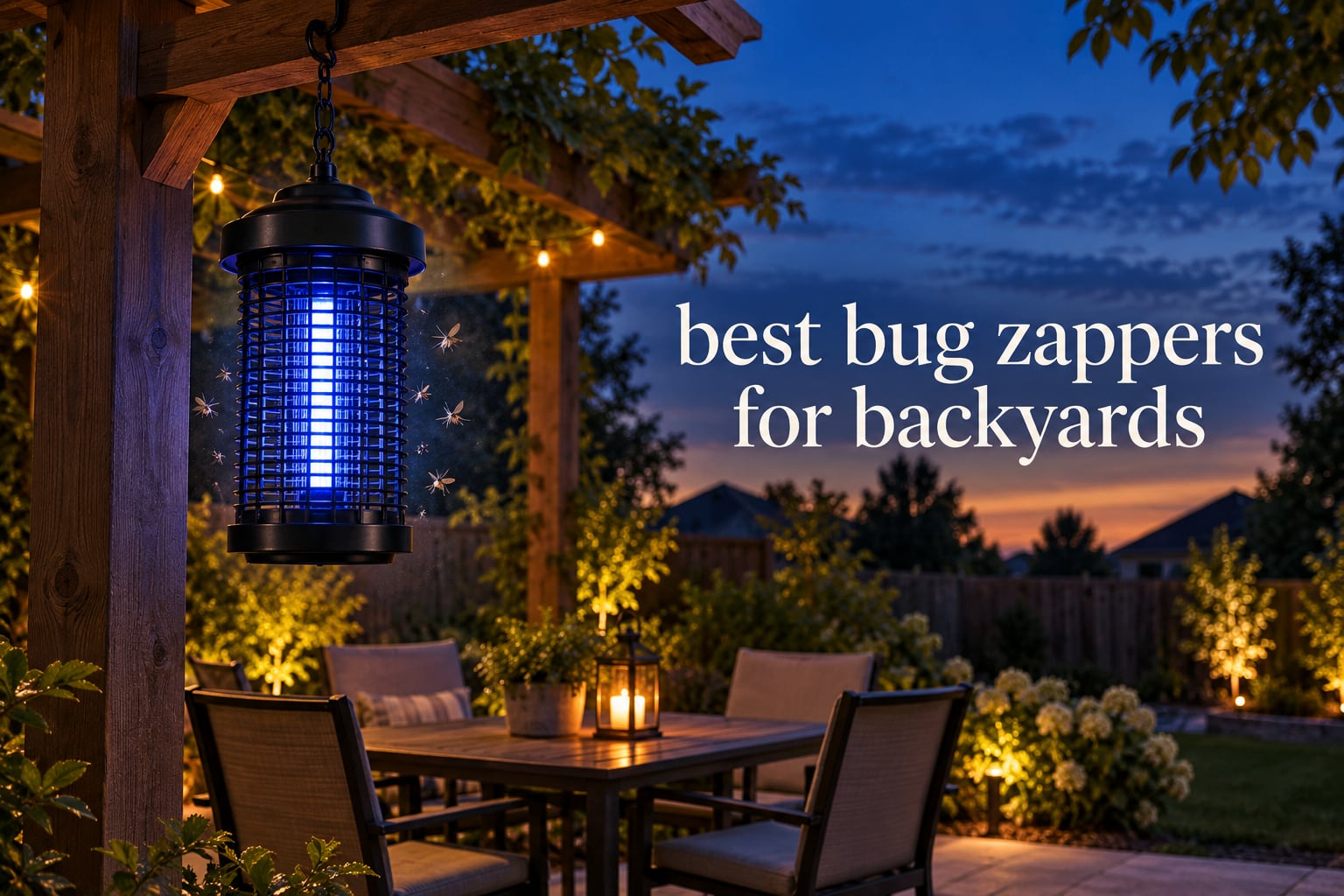
The best bug zappers for backyards do one job well: they knock down flying insects around a seating area after dark. They do not clear a yard of mosquitoes, and any page that promises otherwise is selling you something. We compared ten outdoor-rated zappers and traps on the variables that actually separate them, including grid voltage, UV wavelength, weather sealing and how far each one claims to reach.
Here is the honest mechanic. A UV-A tube lures flying insects toward an energized metal grid that kills them on contact, and a removable tray catches the bodies. Mosquitoes navigate almost entirely by carbon dioxide, body heat and skin odor rather than light, so a UV-only unit kills a great many mosquitoes along with everything else that flies past, yet the bites you feel on your arm keep coming. That is the honest core of the debate on forums like r/MosquitoHating and r/ottawa, where the sharpest summary is that these devices kill the insects that eat mosquitoes. Read on for the honest verdict, the top picks, and the full comparison table below.
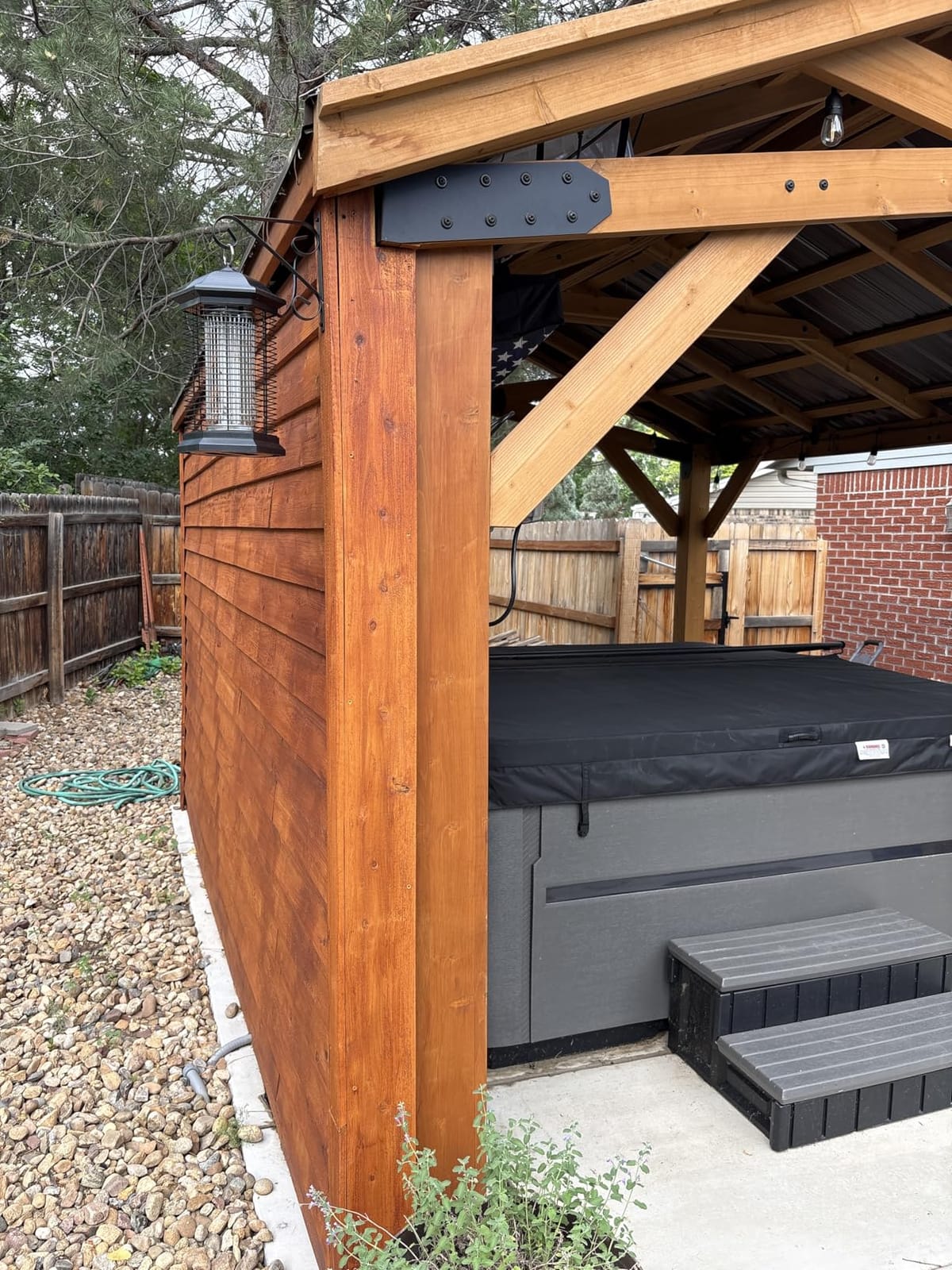
What changed is placement. A unit set down beside the table competes with the people eating at that table for the same warm, CO2-rich air, and some buyers report being bitten within minutes of installation. Set the same device 20 to 40 feet away and slightly downwind, and it becomes a background nuisance reducer instead of a mosquito delivery system. Everything we recommend below assumes you will do that.
If you are also upgrading the yard itself this year, our [12 Best Cold Plunge Tubs for Backyards](https://www.smashingrobotics.com/best-cold-plunge-tubs-for-backyards/) guide covers the other end of the outdoor-living checklist.
Table of Contents
Do Bug Zappers Actually Work in a Backyard?
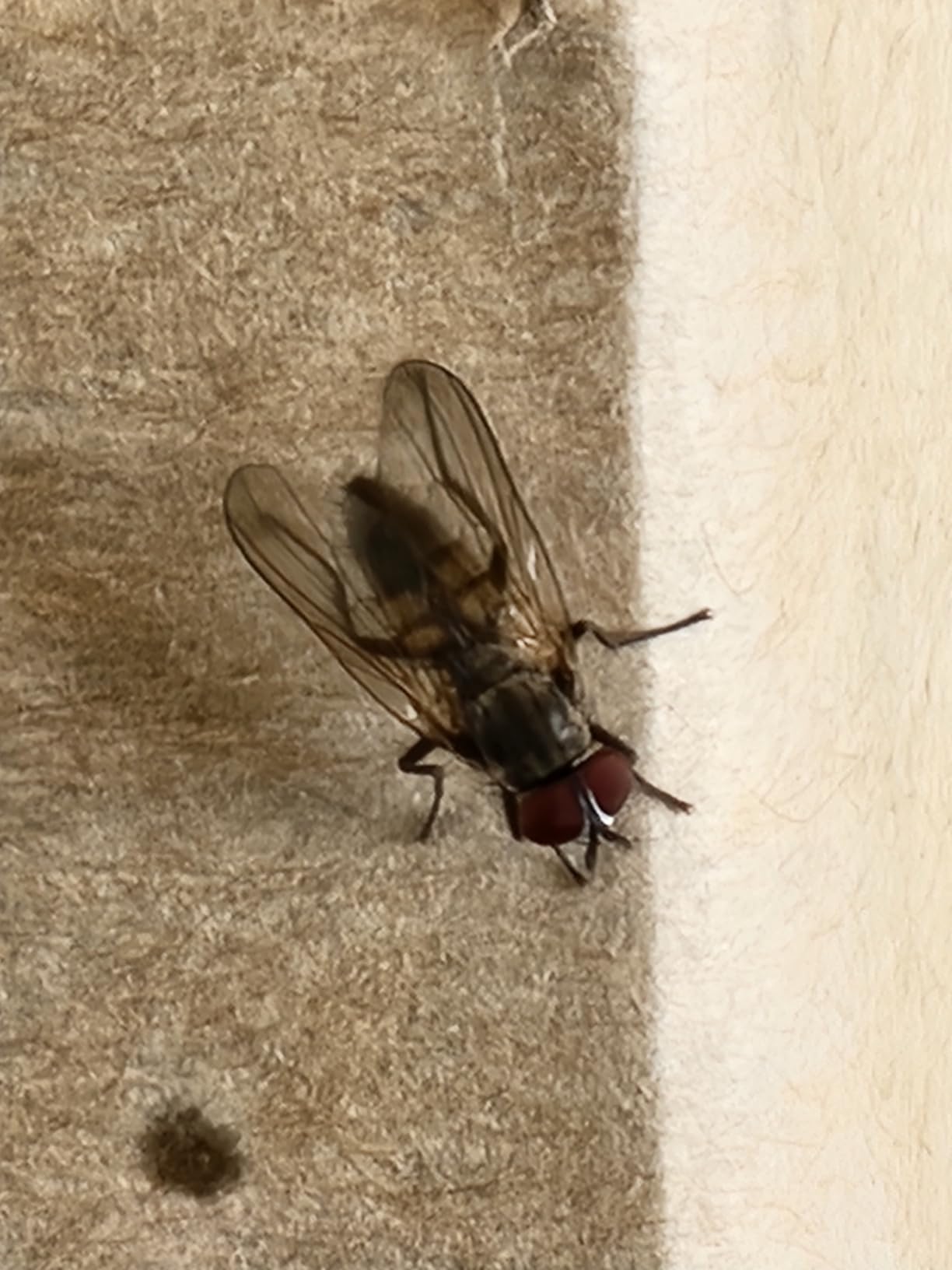
Partially, and the mechanism matters more than the brand. A bug zapper attracts flying insects with UV-A light, then kills anything that touches the high-voltage grid on contact. That is genuinely effective against mosquitoes, gnats, midges, flies, moths and wasps that are already airborne and close to the unit.
What it does not do is reduce mosquito bites on people sitting nearby, because mosquitoes are not strongly drawn to light. Three things set a good outdoor unit apart: grid voltage (2800V to 5600V across this group), weather sealing (IP44, IPX4 or IPX6), and stated coverage. Reviews also show that a filled grid and a dusty tray reduce kill rates noticeably, so maintenance is part of the performance.
People stopped leaning on them for two reasons: the units were often placed too close to seating, and the disappointing bite reduction was blamed on the device rather than the placement. Forum complaints about pollinator kill-off, noise, and solar units that underperform in partial shade still show up regularly, and we weigh each of those against the specs below.
Top 3 Bug Zapper Picks for Backyards (October 2026)


Our overall pick is the ASPECTEK because it has the highest average rating in the group at 4.5 stars alongside a deep review base, and because two UV bulbs plus two spare bulbs in the box is the best maintenance story here. If you have a full acre and an outdoor outlet, the Flowtron BK-40D is the stronger machine on paper with 5600V and a 100-hour octenol cartridge. For most half-acre patios, the GOOTOP is the value pick and carries the largest review base in the group at over 30k ratings.
Quick Spec Comparison of All 10 Picks in 2026
Every claim in this table comes from the manufacturer listing data, so you can compare the engineering directly instead of taking our word for it.
| Product | Specifications | Action |
|---|---|---|
| ASPECTEK 20W Bug Zapper |
|
Check Latest Price |
| Flowtron BK-40D 40W UV 5600V |
|
Check Latest Price |
 GOOTOP 4200V Plug-In Zapper GOOTOP 4200V Plug-In Zapper |
|
Check Latest Price |
 Endbug IPX6 Two-in-One Zapper Endbug IPX6 Two-in-One Zapper |
|
Check Latest Price |
 LUOJIBIE 4200V Waterproof Zapper LUOJIBIE 4200V Waterproof Zapper |
|
Check Latest Price |
 Jawlark 4200V Budget Zapper Jawlark 4200V Budget Zapper |
|
Check Latest Price |
 AMUFER 18W 4400V Zapper AMUFER 18W 4400V Zapper |
|
Check Latest Price |
 DynaTrap DT2030SR Suction Trap DynaTrap DT2030SR Suction Trap |
|
Check Latest Price |
 PIC Solar Killer Torch PIC Solar Killer Torch |
|
Check Latest Price |
 Dickinda 4200V Compact Zapper Dickinda 4200V Compact Zapper |
|
Check Latest Price |
1. ASPECTEK Electric Bug Zapper – Best for Covered Patios and Garages
- Highest average rating in the group at 4.5 stars across nearly 14400 ratings
- Two UV bulbs deliver stronger attraction than single-bulb models
- Protective mesh screen adds a layer around the grid
- Two spare replacement bulbs ship in the box
- Washable tray and self-cleaning grid
- Built for covered outdoor areas rather than fully exposed yard positions
- Loose bulb connections can shift in transit and need tightening
This is the unit we keep recommending first because the review data backs it up rather than the marketing copy. It carries a 4.5 average across nearly 14,400 ratings, the strongest rating in this group, with 76% of buyers giving five stars. The build is aluminum rather than plastic, which matters if you are hanging it under a covered patio through a full season.
The engineering choice that separates it is two UV bulbs at 20W total rather than one. Reviewers consistently single out brightness as the reason for strong catch rates, and the 2800V grid is on the lower end of this roundup, so the attraction side is doing more of the work here. That combination works well where the unit hangs close to a seating zone but under cover, where ambient light is the limiting factor.
Two spare replacement bulbs in the box extend service life substantially, which matters when you compare it to models where the bulb is a separate consumable. The self-cleaning grid and washable removable tray are genuinely the low-friction maintenance option in this list. A recurring tip in the reviews is to tighten the bulb connections if a unit arrives not lighting after shipping.
Its limits are honest ones. The manufacturer positions it for indoor and covered outdoor use, so a fully exposed position in driving rain is outside what this housing is designed for. The 2800V grid also means a slightly less decisive kill than the 4400V to 5600V models, which matters only if you are counting individual mosquitoes rather than reducing the general insect cloud.
Why the two-bulb design earns its place
Attraction is the limiting variable in a zapper, not voltage. Doubling the UV source raises the photon output the unit presents to a night-flying insect, and reviewers report a visible difference against single-bulb budget models in the same yard. Combined with included spares, it means you are not ordering a replacement bulb at the end of the first summer.
Where it falls short
Do not hang this one on an exposed pole in open yard. It is a covered-area device, and the grid voltage is the lowest among the plug-in models here. For an open lawn, a weatherproofed unit with a higher grid is the better mechanical match.
2. Flowtron BK-40D 40W UV 5600V Zapper – Best for Large Yards
Flowtron Electric Bug Zapper, 1 Acre Outdoor, 40W UV, 5600V Zap, Black
- Highest grid voltage in the group at 5600V with a non-clogging design
- Dual attraction from UV black light plus octenol cartridge
- 100-hour octenol cartridge included
- Largest stated coverage at 1 full acre
- UL listed weatherproof polycarbonate housing with a 2 year warranty
- Octenol cartridge is a recurring consumable you must replace
- Heavier and bulkier than the compact zappers at 2.2 kg
This is the most mechanically serious machine in the roundup, and the only one that attacks the attraction problem directly. Instead of UV alone, it pairs a 40W black light with an octenol attractant cartridge that the UV warmth vaporizes, mimicking the breath scent that mosquitoes actually hunt. That is the closest any plug-in zapper here gets to CO2 mimicry without a fan trap.
The electrical side matches. A 5600V instant-kill non-clogging grid is the highest voltage in the group, and the listed 1 acre coverage is the largest outdoor claim among the plug-in models. The housing is UL listed, weatherproof polycarbonate, and it carries a 2 year manufacturer warranty, which is the longest stated warranty in this set.
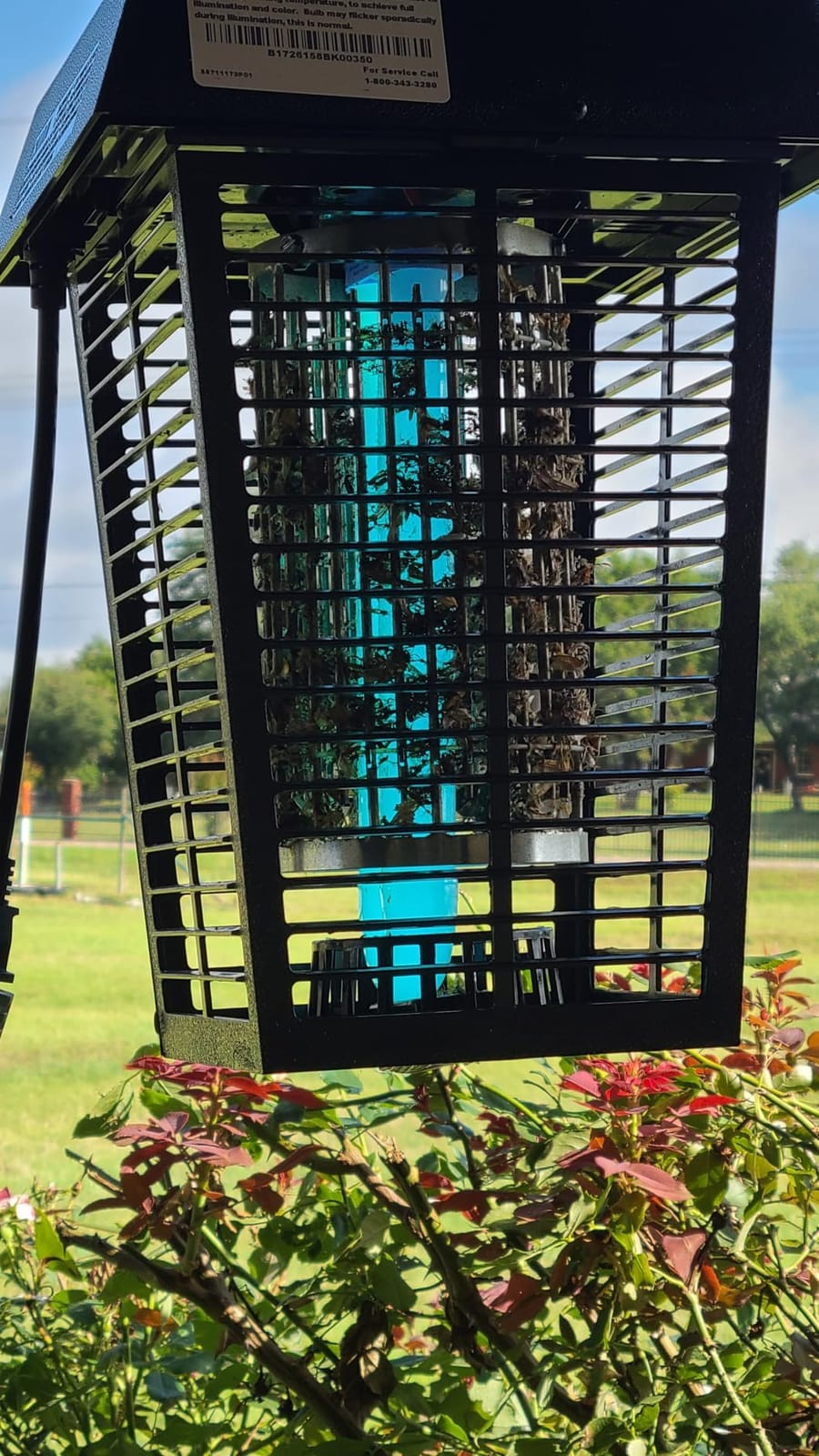
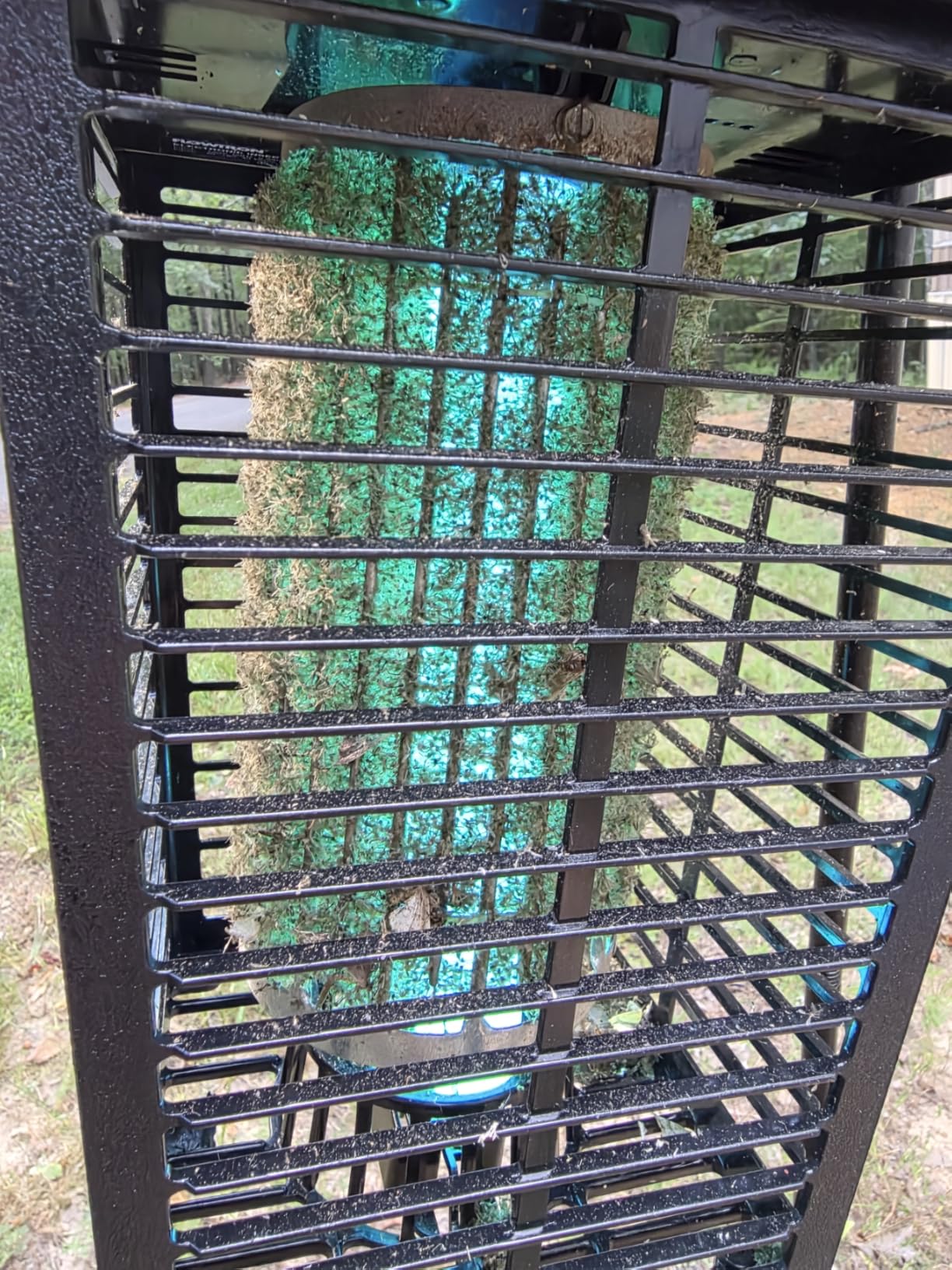
Reviewers like the coverage, the build, and the audible snap of the kill, with 74% five-star and 13% four-star across 27k+ ratings. The 2.2 kg weight is real and noticeable, so plan a solid hanging point rather than a light branch. If the crackle bothers a neighbor at night, this is the loudest category of device we tested and the suction trap further down the list exists for exactly that reason.
The octenol cartridge is the ongoing cost and the ongoing chore. The included cartridge is rated at 100 hours, and when it runs out the dual-attraction advantage disappears. Treat the refill as part of the seasonal maintenance budget rather than a surprise.
Why dual attraction changes the mosquito math
Light alone is a weak mosquito lure, which is why pure UV zappers disappoint. Adding a warm-vaporized attractant gives the unit a second, closer-to-reality signal, so it pulls from a wider radius than the coverage numbers suggest. That is why this model is the pick for a full acre rather than for a small patio where a compact unit would do the same job.
What you give up for it
Weight, bulk, recurring cartridge cost, and noise. It also needs a permanent outdoor outlet within cord reach, so placement is fixed by your wiring rather than by where the insects are. If you have close neighbors or a garden nearby, the noise and pollinator exposure deserve a closer look before you commit.
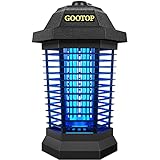
3. GOOTOP 4200V Plug-In Zapper – Best Value for Half an Acre
- Largest review base in the group with 4.4 stars across over 30k ratings
- 4200V grid with a replaceable 15W bulb
- Brush-clean collection tray and hanging design
- Light at 980 g so it mounts almost anywhere
- Half-acre coverage for patios and porches
- Mains corded so it needs a nearby outdoor outlet
- Works best at night when insects are active and lights are off
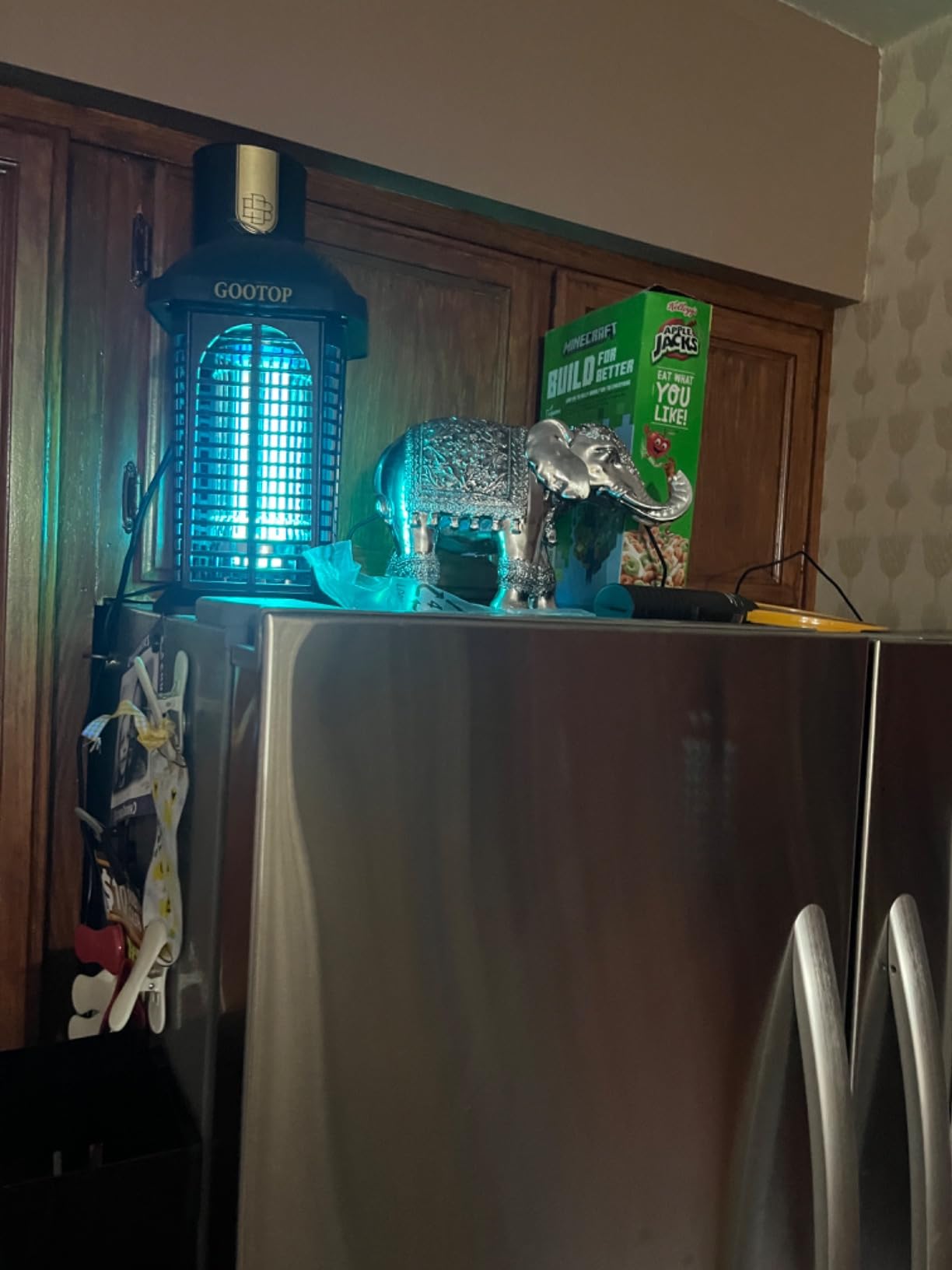
The GOOTOP earns its slot on evidence, not novelty. It ranks number one in the Bug Zappers category and carries more than 30k ratings at a 4.4 average, the deepest review base of anything in this roundup. When a unit has that much history, the failure modes are well documented rather than theoretical.
Mechanically it is a clean 4200V grid with a replaceable 15W UV bulb, rated for coverage up to half an acre. At 980 g and 12 inches tall it is one of the lighter options, which matters when you are hanging it from a pergola beam or a low branch rather than a purpose-built post. The ABS outer housing keeps fingers and curious pets away from the live grid.
The tray takes a cleaning brush rather than a water rinse, and reviewers rate that as simple rather than premium. The EPA registration means the kill is physical, with no spray, insecticide or attractant cartridge to replenish. The listing notes a 1 year manufacturer warranty.
Two constraints are worth planning around. The mains cord fixes your placement to within a few feet of an outlet, and reviewers note the unit is most effective in darkness, so a bright patio light across the yard will blunt it. This is a value pick for a defined zone, not a whole-property solution.
What the review volume tells you
With 30k+ ratings and a distribution of 75% five-star, this is a low-risk buy. The recurring praise is for build quality, the 4200V grid, the light weight, and how easily the tray cleans. The recurring limitation is the same one the specs predict: it wants darkness and a nearby outlet.
When to pick something else
Skip it if you have no outdoor outlet, or if your yard is a full acre rather than half. In both cases you are paying for less than the device can do. The Flowtron above covers the large-yard case properly, and a solar unit covers the off-grid case.
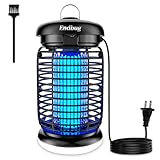
4. Endbug IPX6 Two-in-One Zapper – Best for Harsh Weather Exposure
- IPX6 is the strongest weather sealing in this roundup
- Integrated white LED doubles as a light for dinners and grilling
- Fireproof ABS with 0.27 inch spacing between grid bars
- Covers over 1500 sq ft with a replaceable 15W 365nm bulb
- Only 5 percent one-star ratings among the plug-in models
- Costs more than similar 4200V designs that share the same grid
- The 15W bulb is a consumable you have to source separately
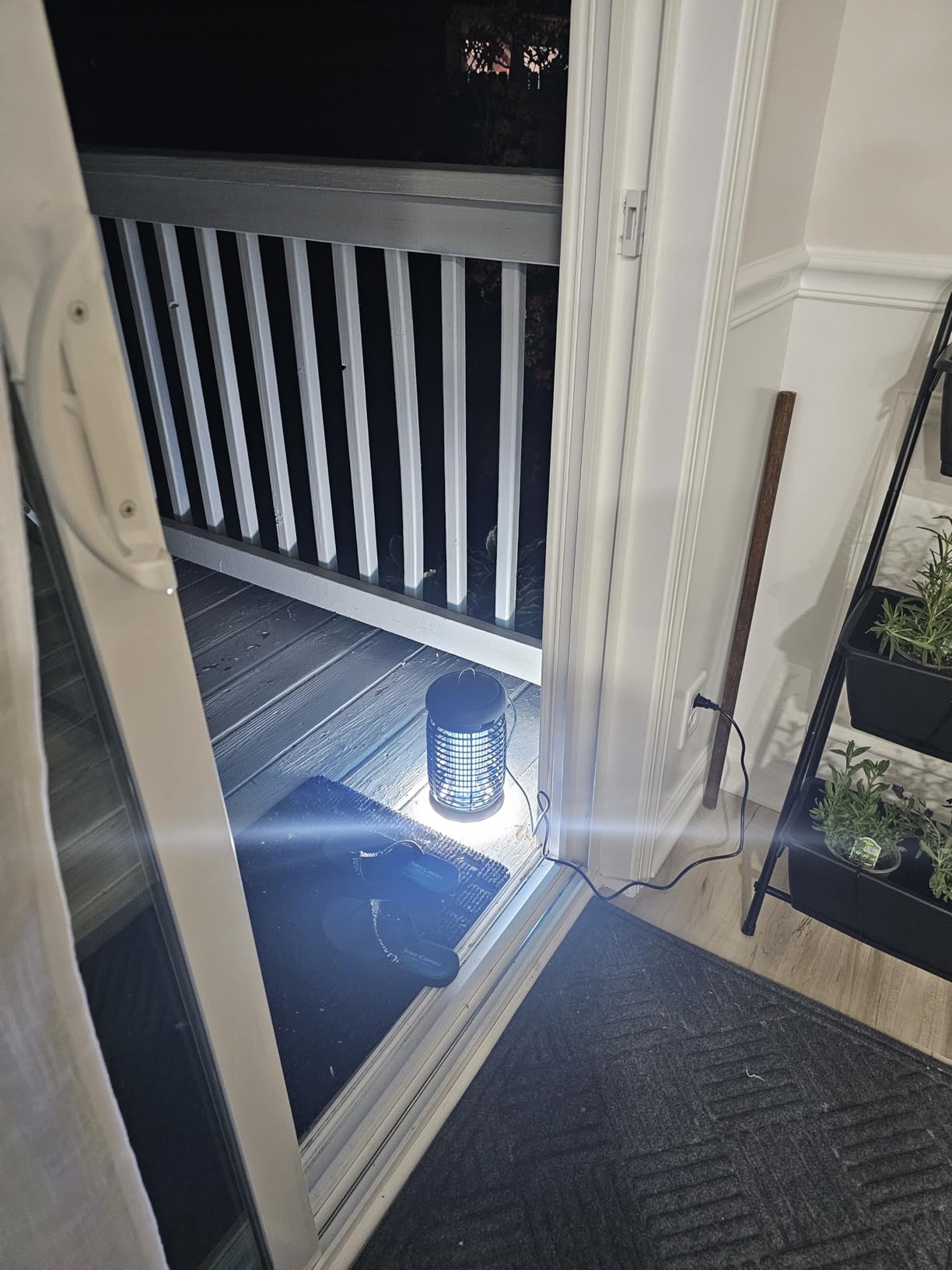
Weather sealing is the whole argument for this one. IPX6 means protection against powerful water jets, which makes it the unit we would actually leave on an uncovered patio through a full season of rain and morning dew. Most competing shells in this group are rated IPX4, which handles splashing and rain but is a lower bar.
The rest of the spec sheet is competitive rather than exceptional: a 4200V grid, a replaceable 15W bulb at 365nm, and coverage over 1500 sq ft. The genuine differentiator is the white LED integrated into the base. It works as a table light for evening meals and it adds a second light source to the trap, and reviewers mention the two-in-one function more than anything else.
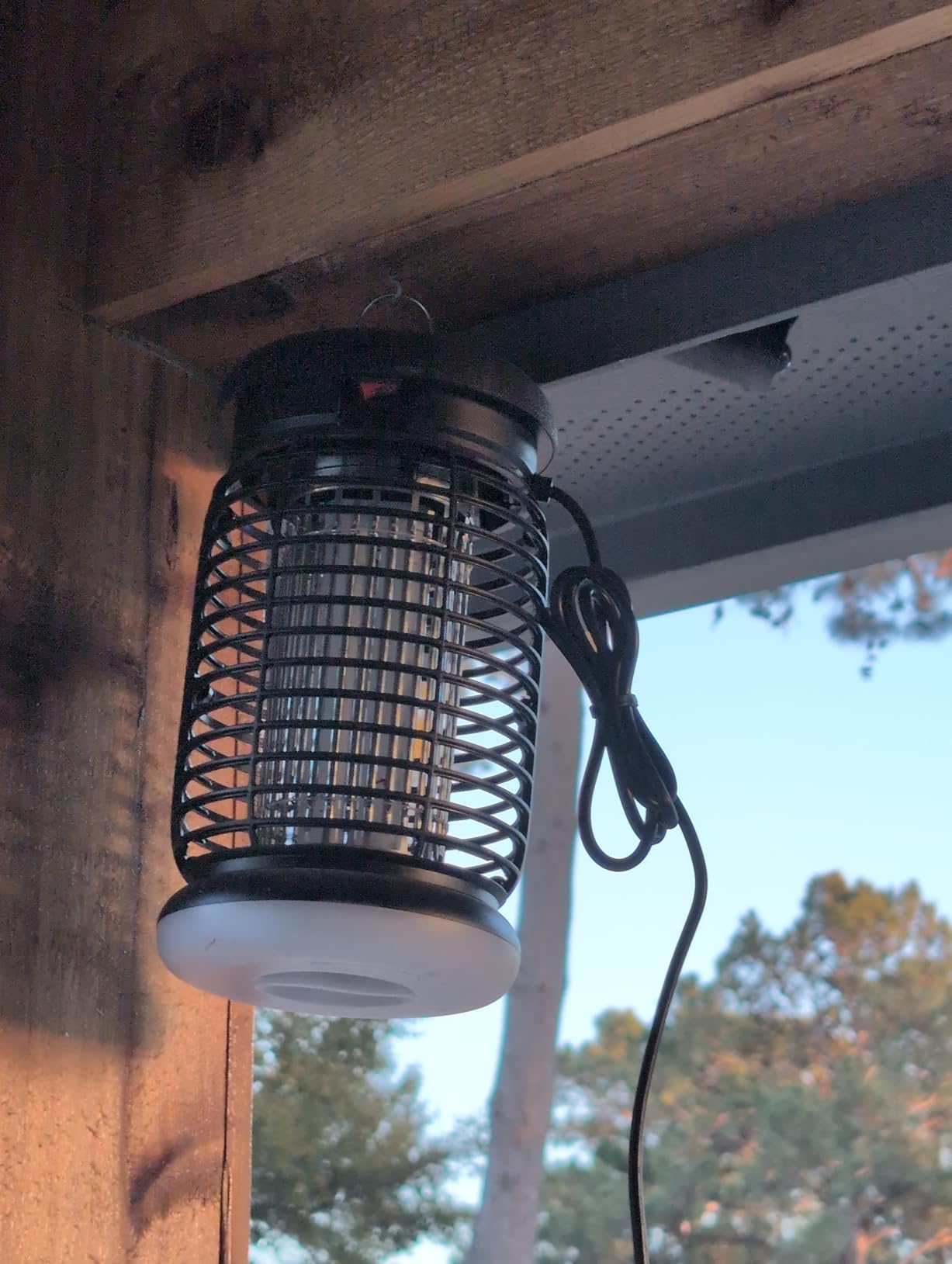
Safety specifics are unusually well specified. The housing is fireproof ABS with grid bars spaced 0.27 inch apart, and the unit is EPA registered, which addresses the family-and-pets concern directly rather than by implication. The 5ft cord and hanging hook give decent placement reach, and the weight is 0.9 kg.
The honest complaint in the reviews is price per unit of capability. Mechanically it sits close to other 4200V models, so you are paying more for the IPX6 sealing and the LED than for a faster grid. And the bulb is a separate purchase when it eventually fails, which is why the ASPECTEK with included spares is a better long-term value story.
Why IPX6 matters in a real yard
Bug zappers live outdoors in conditions that are wetter than most product ratings assume. IPX4 tolerates rain and dew, IPX6 tolerates the hose-accident and storm-driven spray case as well. If your unit hangs exposed with no roof over it, that difference decides whether you are still using it in month three.
Where the money goes
The premium buys sealing and the LED, not voltage. If your patio is covered, the ASPECTEK or GOOTOP give you more catch per dollar. If it is not covered, the sealing becomes the feature that protects everything else, and this is the model we would pick.
5. LUOJIBIE 4200V Waterproof Zapper – Best for Small Patios and Balconies
- IPX4 waterproof housing rated for genuine outdoor exposure
- Detachable bottom tray rinses clean with no tools
- Protective outer grate keeps kids and pets off the live grid
- Compact 5 inch by 12 inch body suits a patio table
- Bottom LED works as a night light and adds attraction
- 4.4 average with 8 percent one-star ratings means results vary in heavy mosquito conditions
- UV only with no octenol or chemical attractant to widen the pull
This is the compact courtyard model. At 5 inches square by 12 inches tall it disappears into a patio corner or hangs from a branch without needing a post, and the IPX4 housing makes that placement honest rather than aspirational. The listed manufacturer is the same Shenzhen facility behind several units in this category, which is worth knowing when you compare support options.
The tray is the standout feature. It detaches from the bottom and rinses clean with water, so there is no brush, no scraping and no dry-out step after a wet evening. For a unit you are expected to clean weekly, that saves real friction over a season.
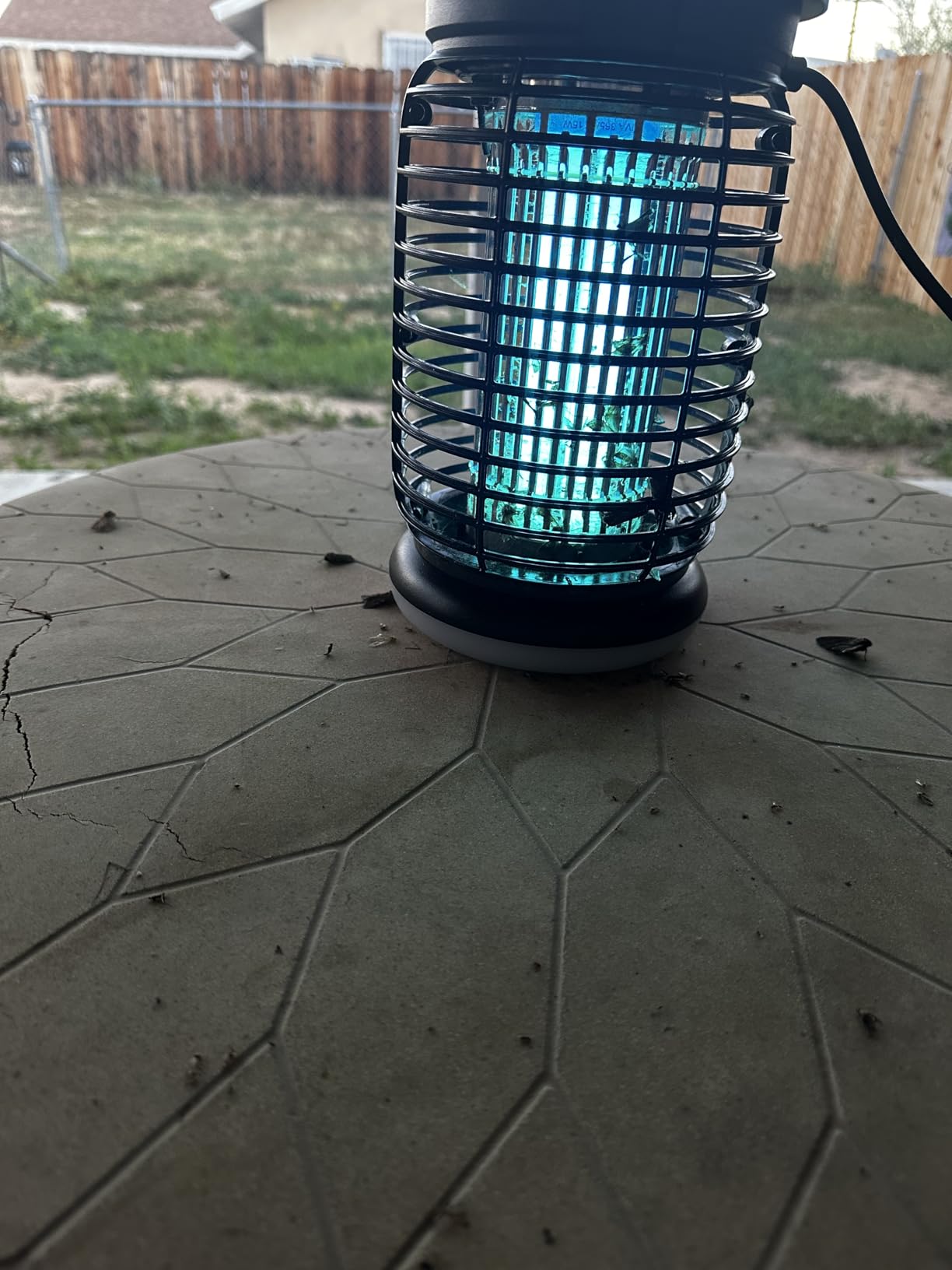
The bottom LED does double duty as a night light and as a second attraction source, which is a genuine improvement over single-source designs. The protective outer grate gives you a physical barrier between the grid and anything that reaches for it, and 73% of reviewers give five stars.
The 8% one-star share is the thing to note here. Those reviews concentrate on variable kill rates in heavy mosquito conditions, which is the predictable weak point of any UV-only device. There is no attractant cartridge to widen the radius, so in a high-pressure yard this will feel less impressive than the coverage numbers imply.
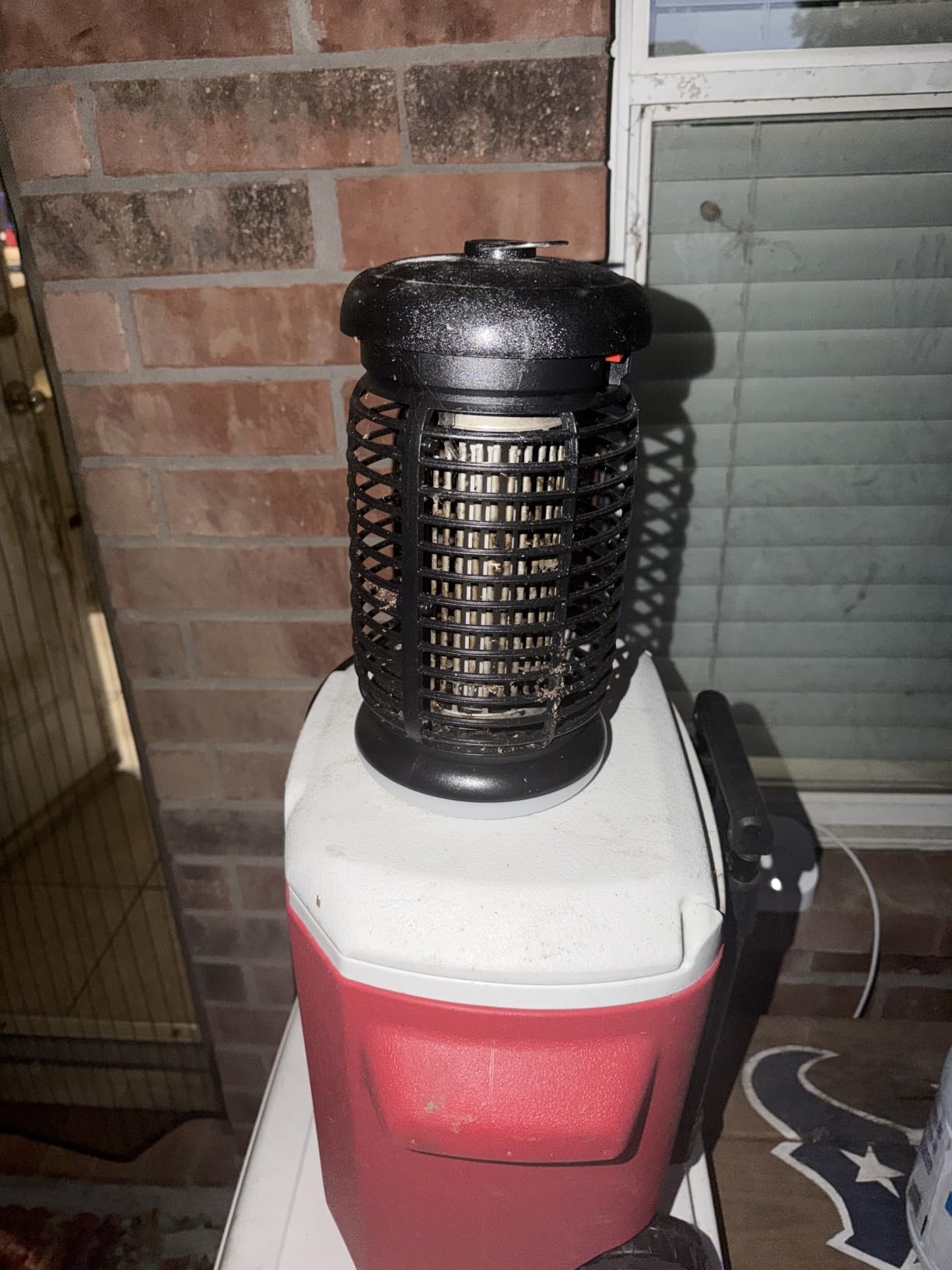
Best fit: a small defined space
This is a table-and-chair zone, a balcony, or a covered courtyard where you want the mosquitoes and gnats thinned during a two-hour dinner. The rinseable tray means you will actually do the maintenance, which is the difference between a zapper that keeps working and one that quietly stops.
Its structural limit
No attractant, no CO2 mimicry, and a 5-inch footprint that does not project far. In a yard with sustained mosquito pressure, you will need more than one device or a different archetype entirely. For sustained pressure, look at the DynaTrap or the Thermacell-style personal repeller approach rather than stacking compact UV units.
6. Jawlark 4200V Budget Zapper – Best Budget Pick for a Single Zone
- Lowest cost in the group while still running a 4200V grid
- IP44 waterproof shell rated for balconies and courtyards
- 18W 365nm UV light covers a wide range of flying insects
- Top hanging loop and included cleaning brush
- Protective housing surrounds the internal grid
- Small 5.9 inch cube footprint suits spot treatment rather than whole-yard coverage
- Manufacturer advises unplugging and regular tray cleaning to stay effective
The Jawlark is the entry point that still gets the fundamentals right. A 4200V internal grid and an 18W UV tube at 365nm are real specifications, not filler, and the IP44 shell means it survives being left on a balcony through rain. At 5.9 inches square it is the smallest unit in the group.
It is built for a specific job: treating one zone. The cube shape, the 5ft cord and the top hanging loop make it easy to move between the patio, a camping site or a garden corner as the season moves. EPA registration and the protective housing address the pet-and-kid question as well as anything else here.
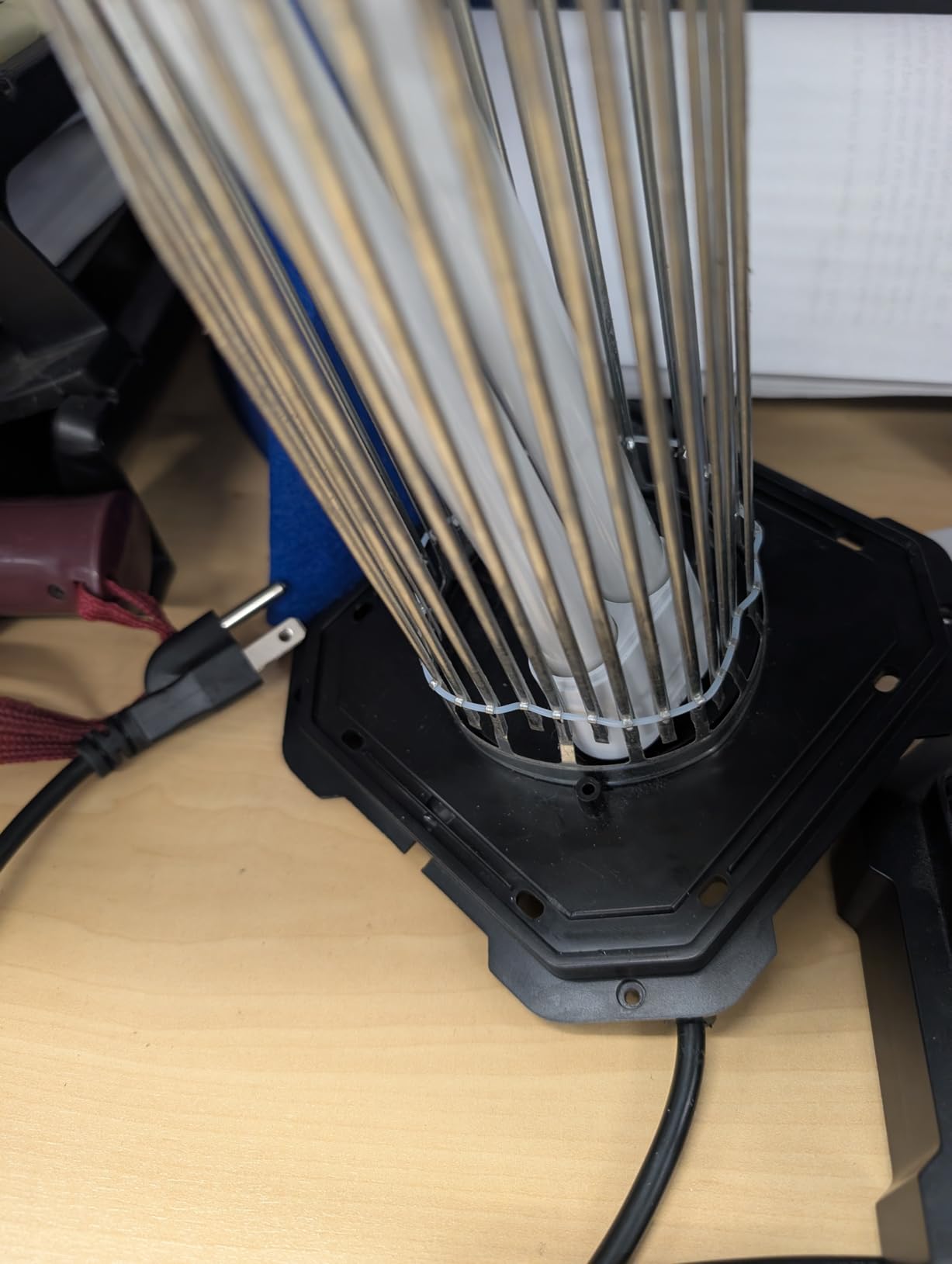
Owners treat it as a budget device and rate it accordingly, with 72% five-star and 14% four-star. The feedback is consistent: it works well for patios, balconies and camping, and it does not reach far. Expect that, and the price stops feeling like a compromise.
Two practical notes. The footprint is small enough that coverage claims should be read as a spot radius, not a yard area. And the manual advises unplugging and cleaning the tray regularly, so budget a few minutes a week rather than assuming it runs itself for months.
Why the 365nm figure matters
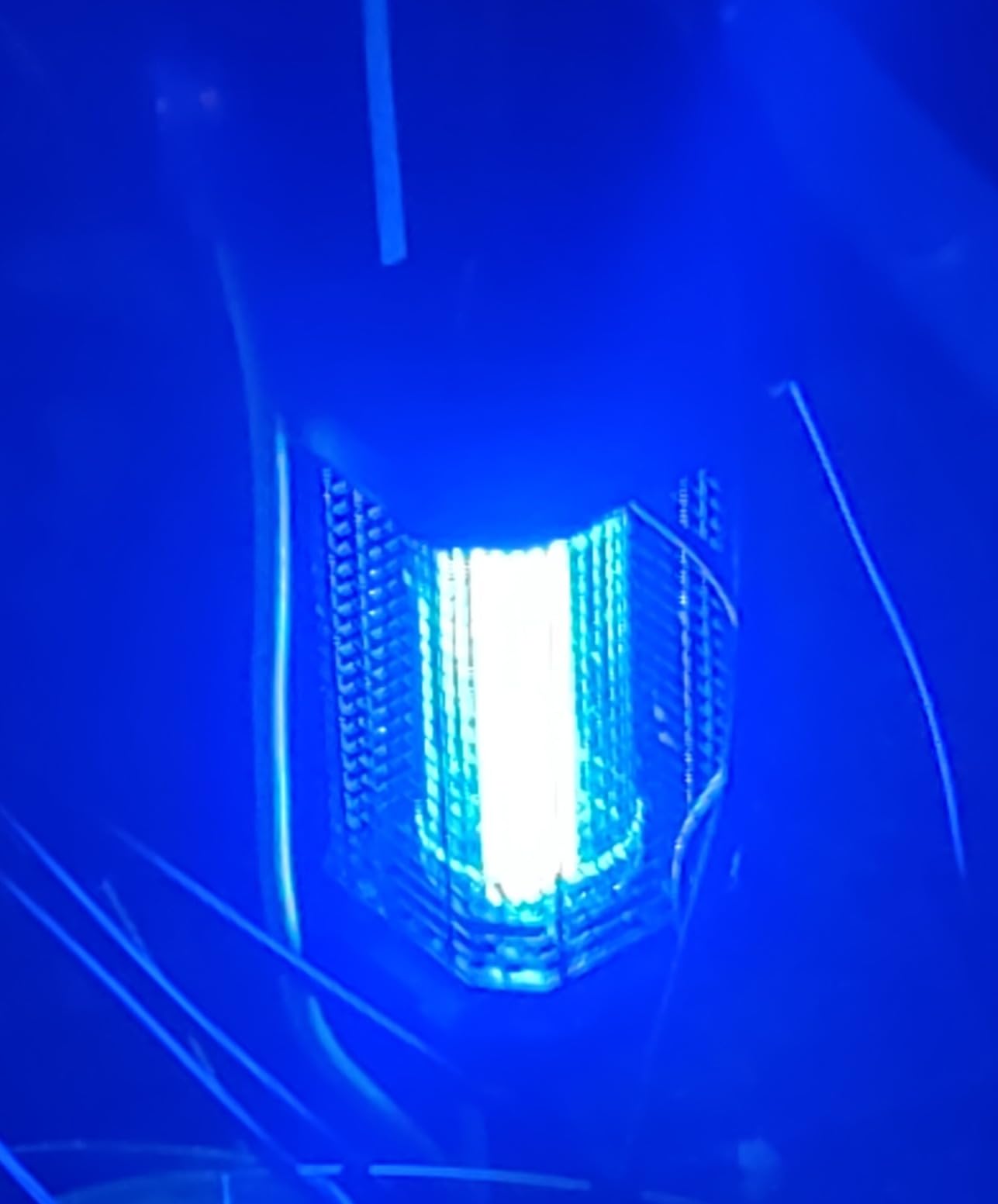
365nm sits squarely in the UV-A band that draws night-flying insects, and an 18W tube is a reasonable amount of output for a device this size. The pairing of that tube with a 4200V grid gives you a genuine kill margin at a price that leaves room for a second device if you want wider coverage.
Where it will disappoint you
Trying to cover an open lawn with it. A spot-treatment device in a large yard is a device that looks busy from the patio and does nothing at the perimeter. If your problem is bites across a whole property, the Flowtron or a suction trap covers more ground with less guesswork.
7. AMUFER 18W 4400V Zapper – Best for Multi-Season Owners
AMUFER Bug Zapper Outdoor & Indoor, 18W & 4400V, 1/2 Acre, 5.5-Ft Cord
- 4.5 star average with 79 percent five-star ratings
- 4400V grid with 30 percent more grid area than standard designs
- Bulb rated for 13000+ hours of continuous use
- UL 1599 tested and US EPA certified
- V0 fireproof shell with galvanized steel grid and double-insulated cord
- Half-acre coverage falls short of the 1 acre units
- Manufacturer advises brushing the grid weekly and checking socket voltage compatibility
This is the one to buy if you want a device that stays in service across several seasons rather than one that looks impressive for a month. The bulb is rated at 13,000+ hours of continuous use, and a 2 year manufacturer warranty backs it up. That is the longest-run ownership story in the group.
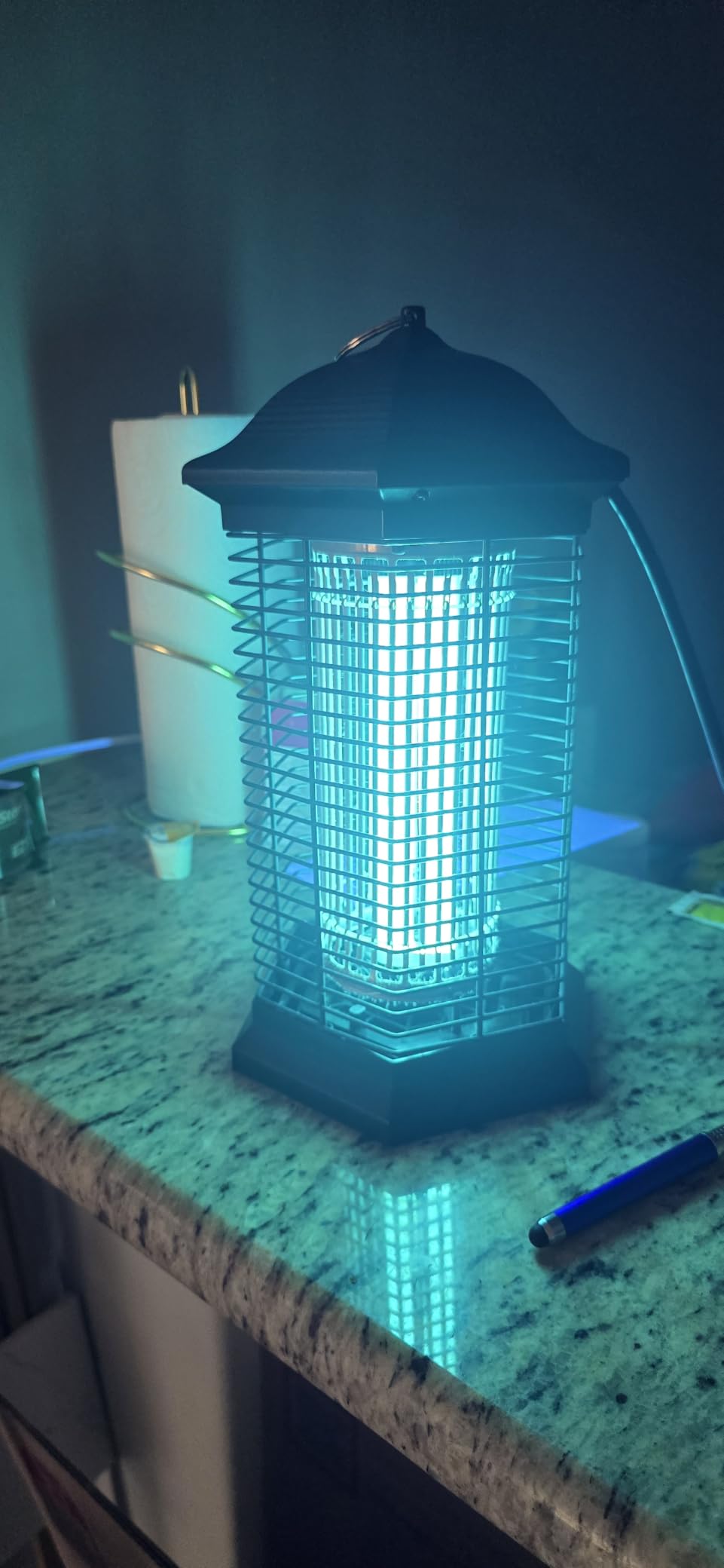
The electrical design is the most thorough on the checklist. A 4400V grid paired with a 30 percent larger grid area than standard designs means more contact surface per pass, and the 18W blue-violet bulb covers 330nm to 420nm of UVA, a wider band than most competing bulbs. Coverage is rated up to half an acre.
Certifications are unusually specific for this category: UL 1599 tested, US EPA certified, a V0 fireproof shell, a galvanized steel grid, and a triple-core double-insulated cord with a 5.5ft length that works on 90-130V. If you have small children, those are the specs you actually want to be able to read.
The 4.5 average with 79% five-star and only 6% one-star is the best consistency in the roundup. The limit is coverage: half an acre does not stretch to a large property, and the manufacturer asks owners to brush the grid weekly and confirm socket voltage before use.
Why a bigger grid area changes kill rates
Grid area is the variable most listings hide. A larger energized surface means an insect passing through the kill zone has more chances to bridge a gap, which shows up as fewer insects surviving contact and fewer partial hits fouling the grid. Combined with 4400V, that is why this unit performs closer to the premium Flowtron despite costing far less.
The tradeoff you accept
Half-acre coverage, a weekly brush, and a mains cord that fixes the location. If your yard is bigger than that, buy the Flowtron for the reach. If you want a device that stays reliable for years in one well-chosen spot, this is the stronger buy.
8. DynaTrap DT2030SR Suction Trap – Best for Quiet Yards
- Suction trapping means no zapping noise at all
- Whisper-quiet fan suits patios where buzzing would be intrusive
- Contained basket leaves no loose insect remains to sweep up
- One acre of stated outdoor coverage
- Touch-button basket emptying and a long-lasting LED bulb
- Most expensive unit in the roundup by a wide margin
- Basket still needs periodic emptying as part of routine upkeep
- 4.0 star average includes a 13 percent one-star share
This is not a zapper, and that is the entire point. A UV-LED attraction light sits above a quiet suction fan that pulls insects into a contained basket instead of an exposed high-voltage grid. There is no crackle, no exposed grid, and no loose insect debris on your patio in the morning. For close neighbors or a garden-heavy yard, that difference is decisive.
Coverage is listed at up to 1 acre, matching the Flowtron as the joint-largest claim in this group. The unit stands 14.5 inches tall in a black finish that blends into outdoor decor, the construction is weather-resistant for season-long use, and the LED bulb is rated as long-lasting rather than a seasonal consumable.
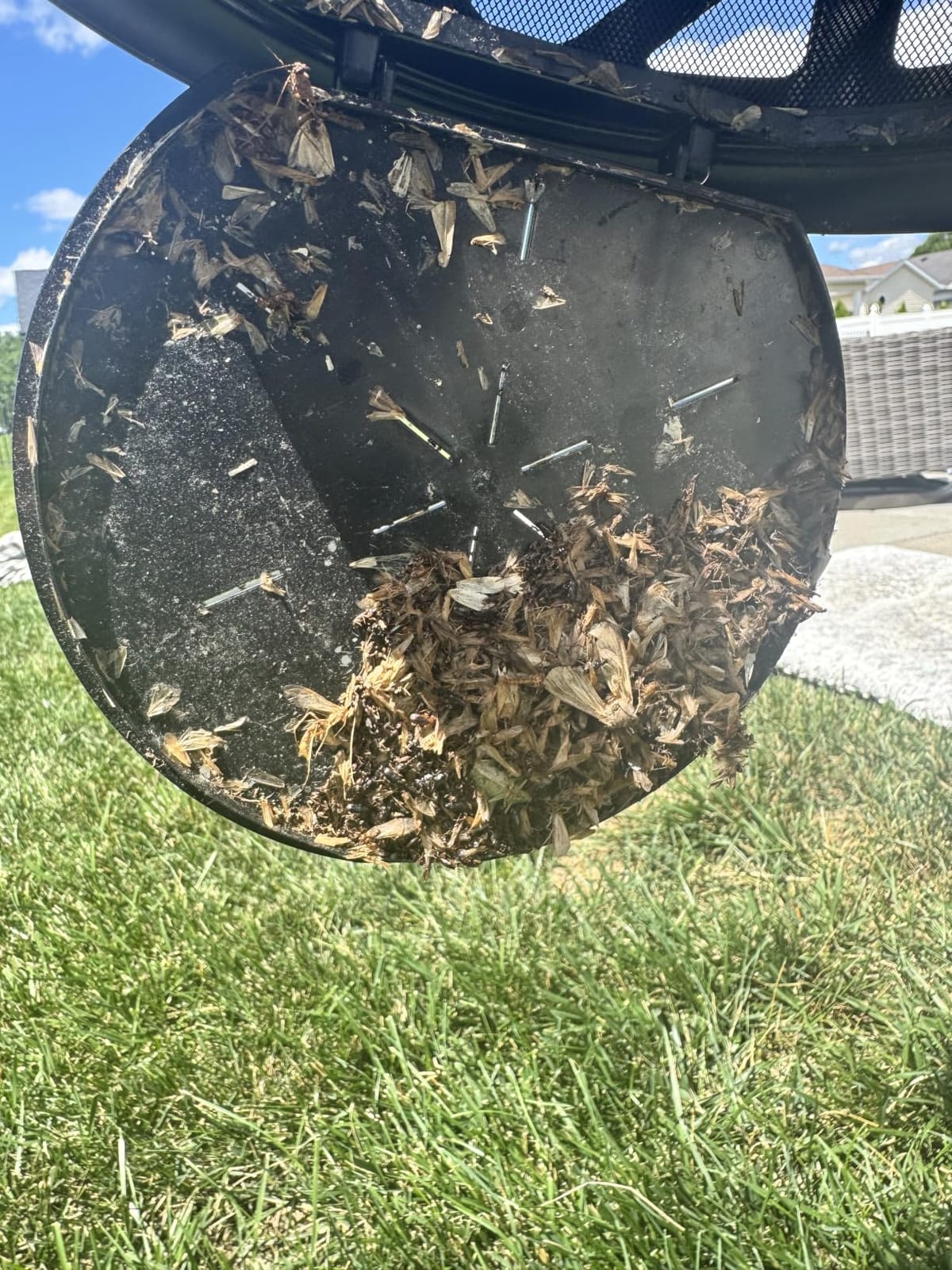
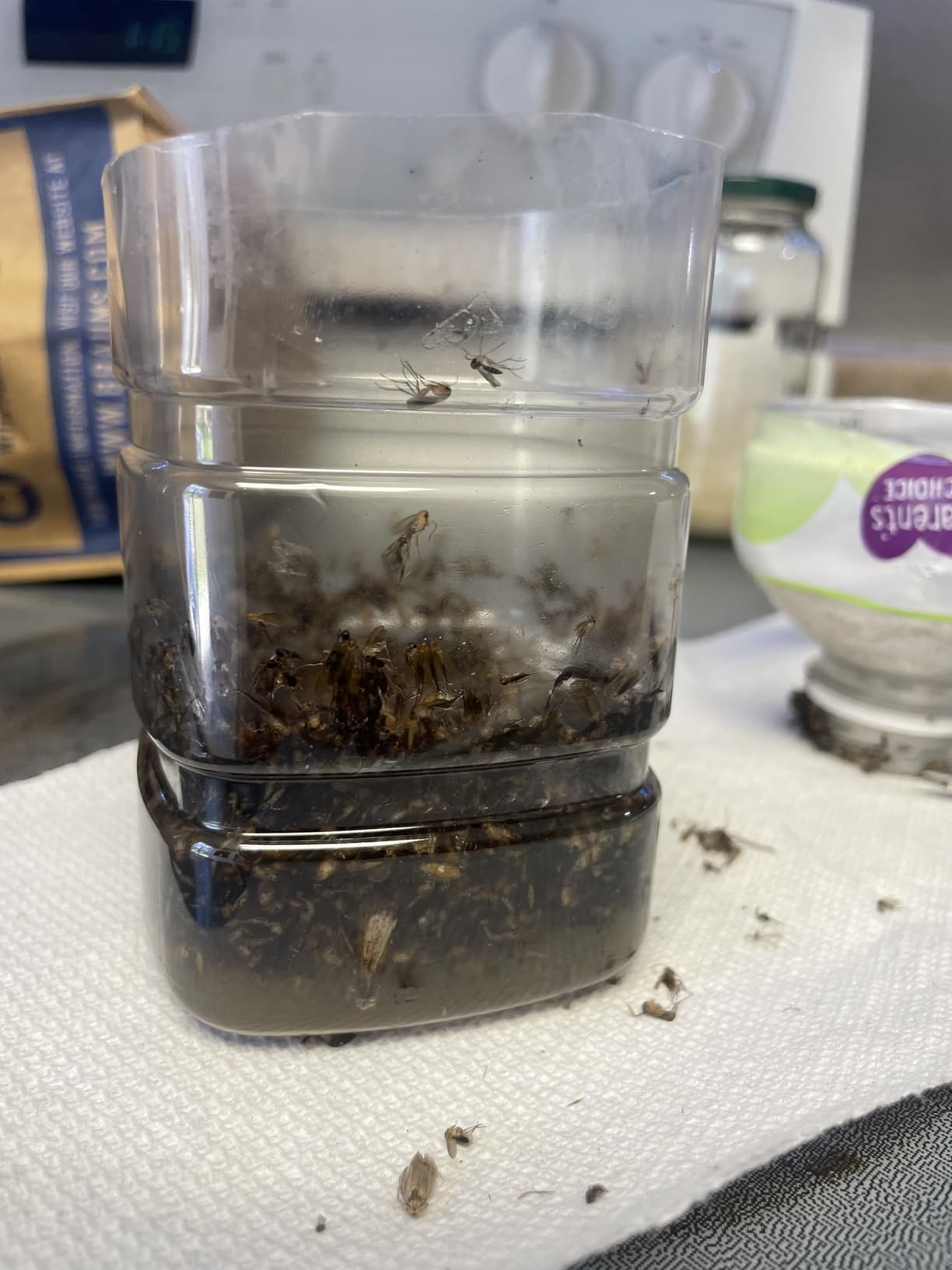
The maintenance trade is baskets for zaps. Emptying the basket is a touch-button operation with no brushing of a fouled grid and no risk of touching a live surface, which is why this suits households with small children or curious pets. As a suction device, it also has the lowest non-target impact profile of the mechanical options here.
It is the most expensive unit in the group by a wide margin, and the 4.0 average with a 13% one-star share reflects that price sensitivity plus slower catch rates than zapping models. Detractors report fewer insects captured per hour, which is the honest mechanical cost of fan suction versus a direct grid kill.
When silence and containment beat raw kill rate
There are yards where noise and dead insects on the deck at dawn are deal breakers. A family with a toddler, a house with a neighbor ten feet away, or a property with an active bee colony nearby all fall into that group. In those cases a contained basket capture is worth paying for, and the touch-button emptying means a ten-second task rather than a scrub with a brush.
When to pick a zapper instead
If your priority is the highest visible drop count and you are unbothered by noise, the 4400V and 5600V grid models kill faster. The fan has to physically move air to capture, and that adds cost and sound. This is a comfort and safety decision more than a performance one.
9. PIC Solar Killer Torch – Best Cord-Free Pick
PIC Solar Insect Killer Torch (DFST), Bug Zapper and Accent Light, Solar Bug Zapper – Kills Bugs on Contact
- Only cord-free option here so no outlet or extension cord is needed
- Works as a decorative flickering flame accent light for paths and tables
- Weatherproof and solar charged for full sun exposure
- Contact kill with no attractant consumable or live grid
- Stake heights of 48 plus 36 plus 24 inch with a tabletop base
- Lowest average rating in the group at 4.0 with 12 percent one-star
- Contact-kill only so it supplements rather than replaces a high-voltage zapper
- Solar charging reduces performance in shaded or overcast conditions
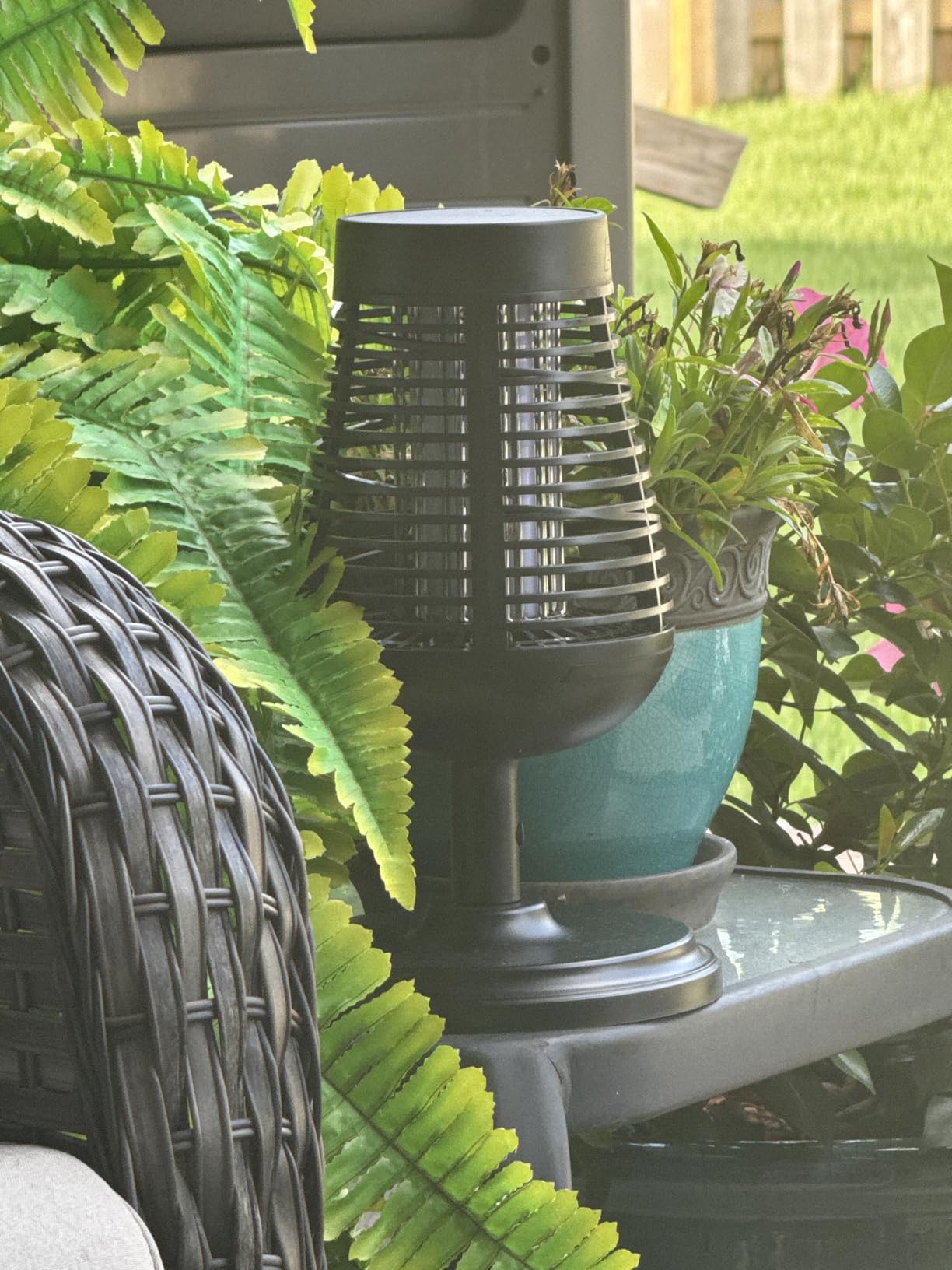
This solves the problem no other unit here can: a yard corner with no power. A solar panel charges a torch that combines a flickering flame LED, a blue UV LED that attracts flying insects, and contact kill with no grid and no consumable attractant. You stake it in a bed, along a path, or set it on a table and it works all evening.
The build flexibility is genuinely good. Included poles and connectors give stake heights of 48, 36 and 24 inches, plus a tabletop base, and the package includes the torch, three poles, two connectors, a ground stake and the base. Owners note it replaces the refills of an oil torch, which is a real saving over a season of path lighting.
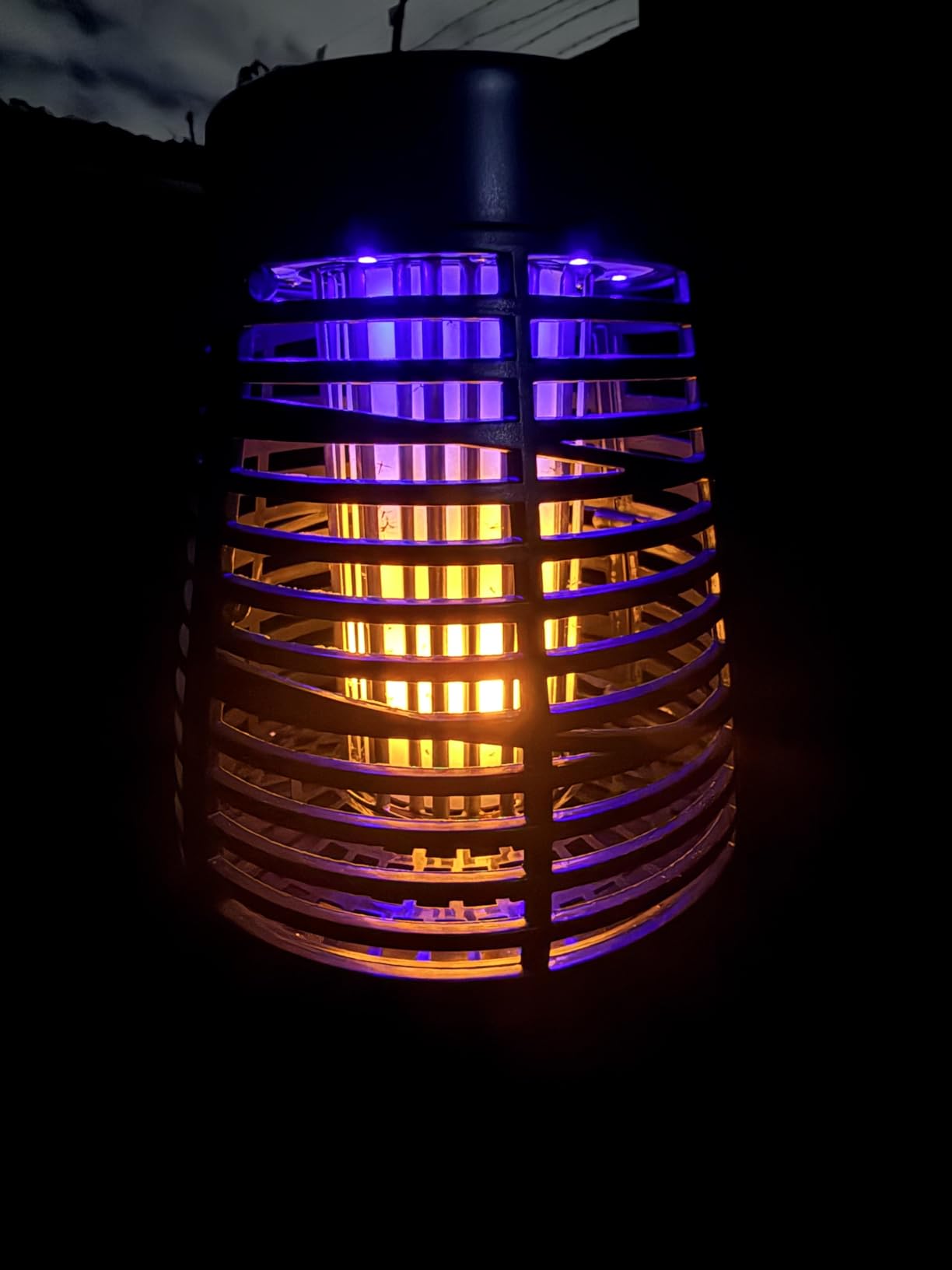
It is also the most polarised product we looked at, with 58% five-star against 12% one-star and 11% three-star. That split is explained by the mechanism. Contact kill requires an insect to fly directly into the torch head, so it is effective against curious moth-like traffic at close range and weak against fast mosquitoes at distance.
The go or no-go rule is sunlight. Solar charging means meaningful performance only where the panel gets direct sun, and reviewers report weak kill rates and slow charging in shaded or partly shaded yards. The flickering flame is a light source, not a heat-and-CO2 lure, so it will not change the mosquito equation.
Best used as a supplement, not a replacement
Think of it as ambience with a bug-control side effect along a path, a garden bed, or a campsite. Those are places where a cord cannot reach and where low-level moth and gnat traffic is the actual complaint. A pair of torches flanking a walkway is a realistic use, and the flame effect is the reason owners keep them lit.
When it is the wrong tool
Do not use it as your primary mosquito answer, and do not stake it in shade. If your problem is bites at a table, you want an attractant-based device, not a decorative light. If you have no outlet, the honest options are this for low-traffic areas or a personal repeller for the table itself.
10. Dickinda 4200V Compact Zapper – Best for Tight Spot Treatment
- Rainproof housing with a safety guard around the lamp
- Coverage stated at up to 1000 sq ft for patios and gardens
- Removable tray and included brush make cleaning quick
- Raiseable hanging ring for trees and porch overhangs
- Compact 6.1 inch by 11 inch body at 807 g
- 1000 sq ft of coverage is well below the half-acre and one-acre models
- 10 percent one-star share means performance varies in heavy mosquito conditions
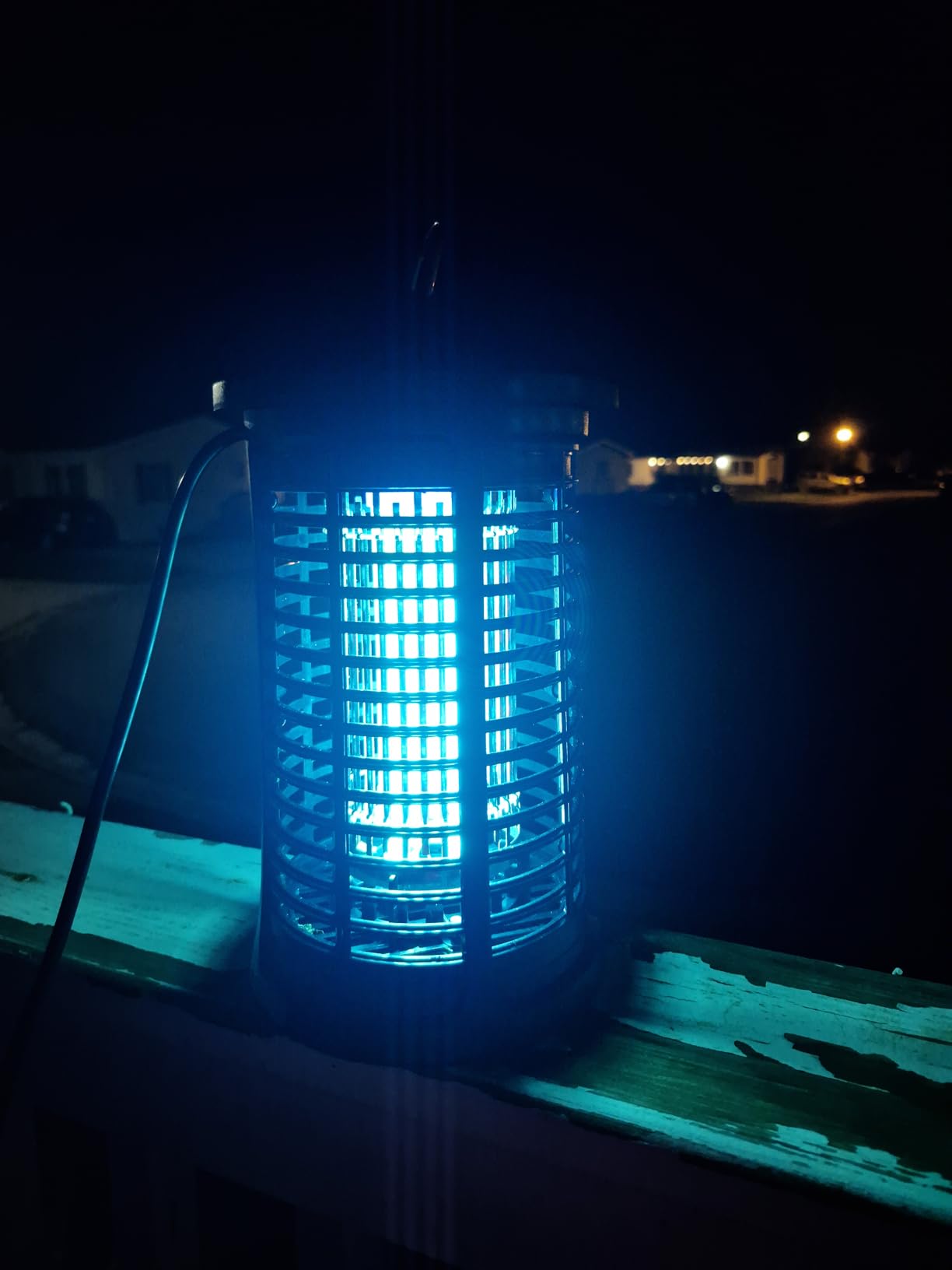
The Dickinda is a small, well-built unit for the smallest useful job. A 4200V grid, a 15W UV bulb at 365nm running at 60Hz, and a rainproof housing with a safety guard around the lamp. At 807 g and 11 inches tall it is easy to reposition between a garage, a deck and a porch overhang as the season moves.
Maintenance is the strong suit. The tray removes for cleaning and a brush is included, and the UV light is replaceable, so the consumable parts are conventional and widely available. The hanging ring makes it the easiest unit here to suspend from a tree or a beam without hardware.
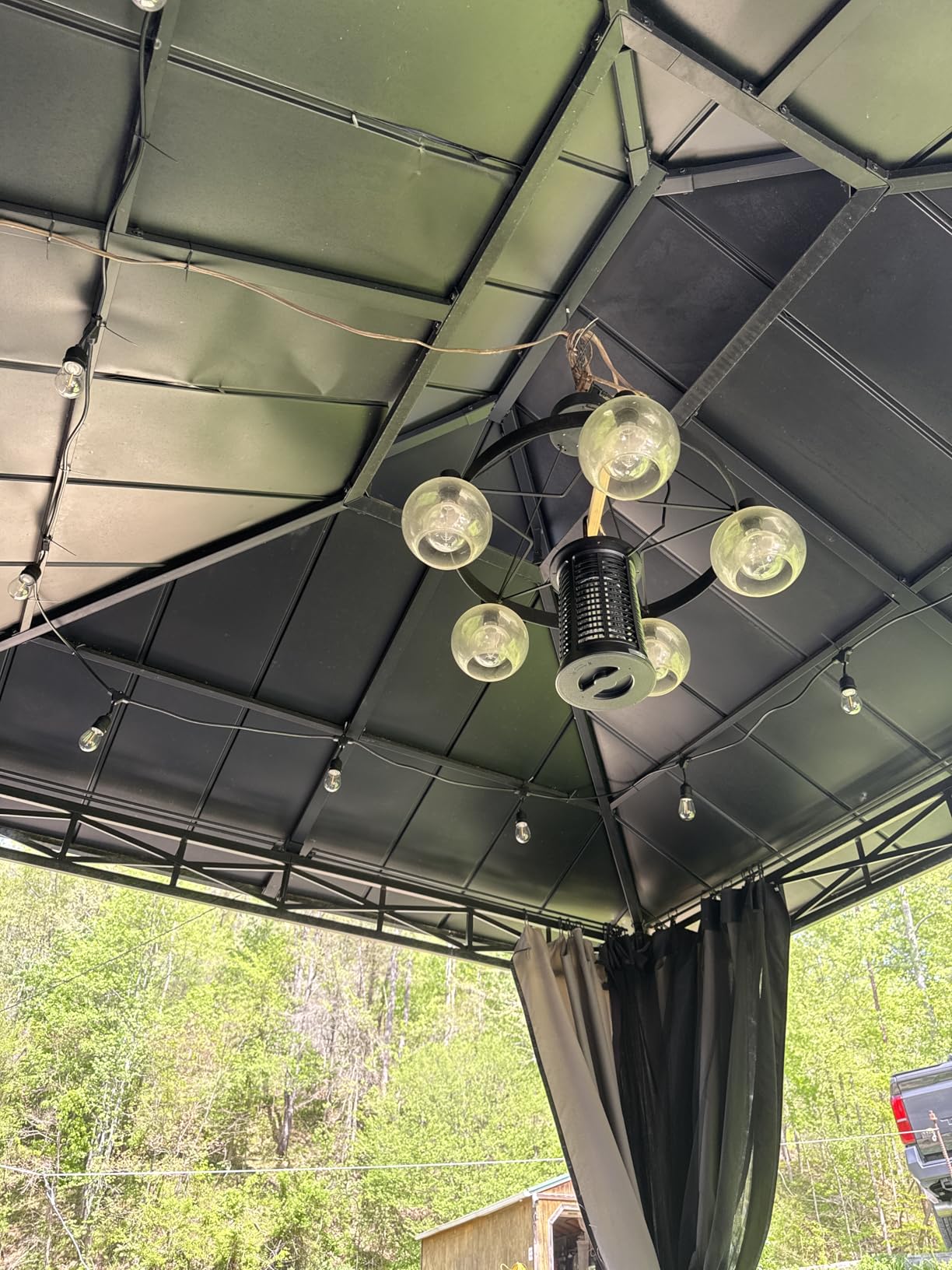
Reviews split at 72% five-star, 9% four-star and 10% one-star, which is the widest critical share among the plug-in models here. The recurring complaint is reach: owners consistently note that the unit covers a smaller zone than the higher-wattage and higher-voltage models, and 1000 sq ft is a fraction of the half-acre and one-acre claims in this roundup.
That said, 1000 sq ft is still a meaningful dining area. If your whole problem is a patio table and two chairs, this covers the job and nothing more is needed. The honest limitation is that it is not a solution for an open lawn.
When 1000 square feet is genuinely enough
Coverage claims are always optimistic, but the gap between a 1000 sq ft unit and a half-acre unit is large enough that the difference is real rather than marketing. Use this one to cover a single defined seating area, a garage, or a covered porch section. It is also the easiest to move when you want the patio in the morning and the deck at night.
What to upgrade to instead
If mosquitoes are biting you across the yard rather than at one table, move up in voltage and coverage. The AMUFER doubles the grid area at 4400V and rates half an acre, and the Flowtron adds octenol attraction on top of that. Pay for reach only when you actually need it.
How to Choose a Bug Zapper for Your Backyard in 2026?
Start with the archetype, not the brand. All ten units here are UV-light devices, but they divide into three mechanical approaches. Plug-in grid zappers kill on contact and are the fastest and loudest. Suction traps such as the DynaTrap fan insects into a basket for quiet, contained capture. Contact-kill torches such as the PIC trade coverage for zero wiring. A personal repeller is a fourth category that protects a person rather than clearing a space, and it sits outside this roundup.
Second, match coverage to the zone. The range here runs from 1000 sq ft to a full acre, and the difference is roughly ten times the area. If your problem is one table, any of the compact units work. If it is an open yard, only the half-acre and one-acre claims are relevant, and those need a nearby outlet or a solar design.
Third, settle the power question honestly. Plug-in units never stop working because the grid has no battery to degrade, but they fix your location within cord reach. Rechargeable and cordless units give placement freedom at the cost of runtime and battery life over seasons. Solar units need a direct-sun position, and partial shade is the most common reason solar zappers disappoint.
Fourth, plan placement before you buy. The consensus answer across every source we checked is 20 to 40 feet from where people sit, ideally between the seating and the mosquito source and slightly downwind. Under a covered patio, a hanging point 4 to 6 feet above head height works. Never place a zapper on the table, and never place one where a bright exterior light competes with the UV tube.
Fifth, budget for maintenance. A self-cleaning grid and a washable tray take a minute a week. An octenol cartridge needs replacing when it runs out. Bulbs are consumables, and the difference between a unit rated at 13,000+ hours and one with no stated figure is a few seasons of ownership. A grid that is never brushed stops performing, and a full tray is the most common reason a zapper seems to have quit.
Finally, think about what the device kills. UV light does not discriminate between mosquitoes, moths and pollinators, and that is the most common objection raised in homeowner discussions. If you keep bees, run a vegetable garden, or have a pollinator-heavy property, choose a contained suction trap, place the unit away from flowering plants, and run it after dusk rather than all day.
What actually works alongside a zapper matters as much as the zapper. Drain standing water from containers, gutters and kiddie pools weekly, because that is where the population comes from. Keep screens closed at dusk, and use an EPA-registered repellent on your skin for the minutes before the unit has any effect. A zapper is the second layer of control, not the first.
Frequently Asked Questions
Do yard bug zappers really work?
Partially. A bug zapper kills mosquitoes, gnats, flies, moths and wasps that come within a few feet of the unit, and it reliably thins the general insect cloud around a patio after dark. It does not stop the bites on people sitting nearby, because mosquitoes locate hosts by carbon dioxide, body heat and skin odor rather than by light. Place the unit 20 to 40 feet from your seating area and it works as a nuisance reducer. Do not place it on or beside the table.
Do mosquitoes get drawn to bug zappers?
Only weakly. Mosquitoes are drawn primarily to carbon dioxide, body heat and skin odors, so a UV light is a weak lure for the species you most want to catch. That is why units with an added attractant perform better: the Flowtron vaporizes an octenol cartridge with UV warmth to mimic animal breath, and fan-suction traps pull with airflow. A UV-only zapper still kills large numbers of mosquitoes, but along with every other insect that passes.
Why did people stop using bug zappers?
Three reasons. First, early units were placed next to where people sat, so they competed with the humans for mosquitoes and drew more of them into the seating area. Second, the disappointing reduction in bites got blamed on the device rather than the placement. Third, owners noticed the non-target kill-off, including bees and butterflies, and the noise. None of these are hardware failures, which is why placement, attractants and containment matter more than price.
Are bug zappers safe for kids and pets?
They can be, with the right hardware. Look for a protective outer grate or mesh screen so nothing can touch the live grid, and a fireproof housing. The ASPECTEK has a mesh screen, the Endbug has a 0.27 inch grid bar spacing with a fireproof ABS shell, and the AMUFER is UL 1599 tested with a V0 fireproof shell and a double-insulated cord. A contained suction trap removes the exposed grid entirely, which is the safest option for a household with small children.
How far away should a bug zapper be placed?
Between 20 and 40 feet from where people sit. That distance lets the unit intercept insects before they reach the table rather than competing with you for the same warm, carbon-dioxide-rich air. Hang it 4 to 6 feet above head height, ideally between the seating and the mosquito source and slightly downwind. Never put it on the table itself. If you are within about 10 feet of a neighboring property, check that you will not hear the grid snap at night.
Are you supposed to leave a bug zapper on all night?
Leaving it on overnight is normal and the grid is designed for continuous duty, with bulbs rated for thousands of hours. What you should not do is run it through the brightest part of the day, because UV attraction is weakest against strong ambient light and the unit will simply be on. Dusk-to-dawn behavior is the sensible target. Just unplug before cleaning the grid, and check the socket voltage matches the unit’s rating on first use.
Final Verdict: Which Bug Zapper Should You Buy in 2026?
The ASPECTEK Electric Bug Zapper is our pick of the best bug zappers for backyards, because a 4.5 rating across nearly 14,400 reviews, two UV bulbs, a protective mesh screen and two spare bulbs in the box make it the most complete package we could find. Set it under a covered patio, 20 to 40 feet from your table.
Go bigger with the Flowtron BK-40D if you have a full acre and an outlet. Go quieter and safer with the DynaTrap if noise or pollinators are your concern, and go cord-free with the PIC torch only if the position gets real sun. Whatever you choose, place it well, clean the tray weekly, and drain standing water first. That last step is still the single most effective thing you can do for mosquitoes.