
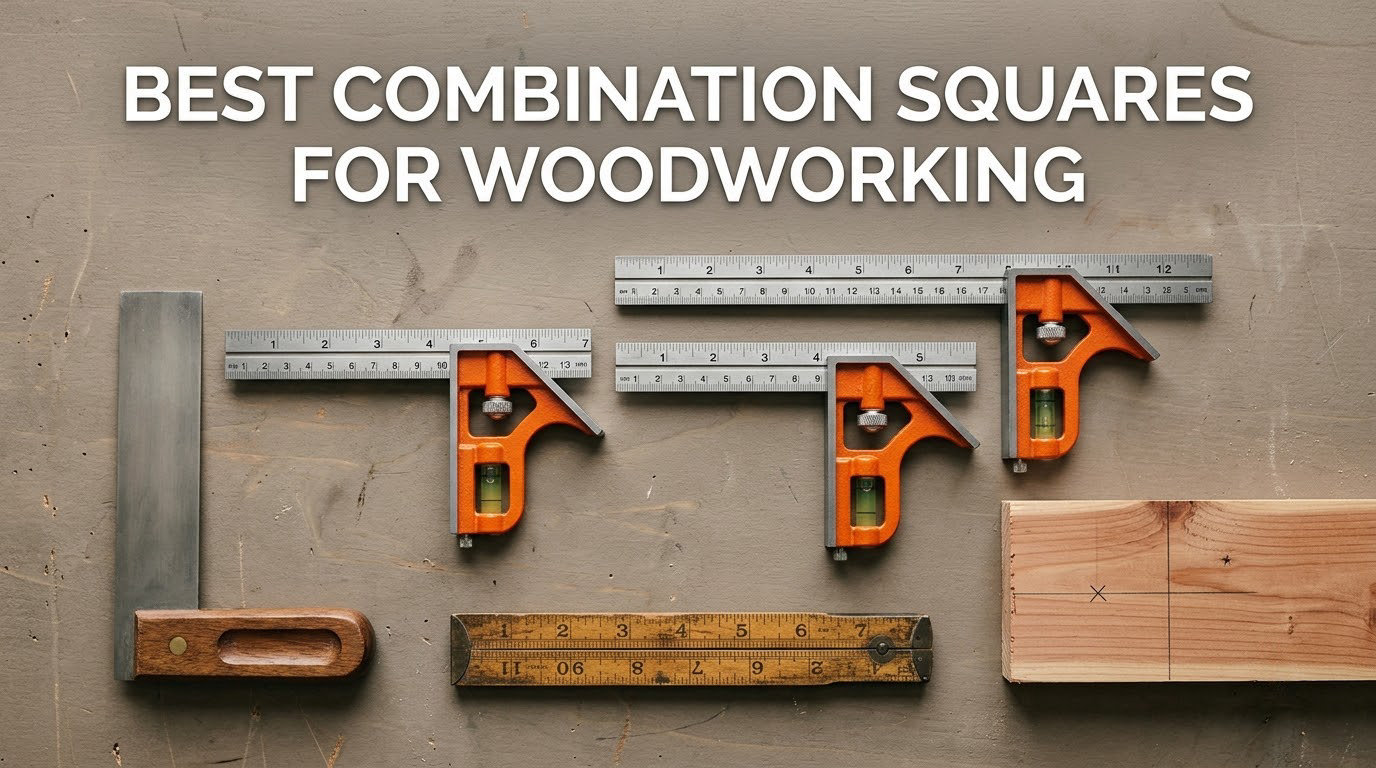
The best combination square for woodworking is the one that stays square after a season of knocks, holds a set depth without creeping, and gives you a clean line to cut on. Most disappointment in this category comes from buying on looks and skipping the five-minute accuracy check that forum users repeat more than anything else.
Our team put eight of the most-reviewed combination squares side by side, read the owner complaints that actually matter, and worked out which ones deserve a place in a small shop. Two of them are the same brand, one is aimed at electricians, and one is a compact metric-first tool built to teach apprentices. The rest are the everyday candidates most woodworkers argue about on woodworking forums.
What follows covers the four jobs a combination square does, a review of every pick, a flip test you can run on arrival, and a buying guide that explains when a premium tool is worth it and when a simple machined square does everything you need. If you are still setting up a bench, our table saw guide is the other piece of layout equipment worth getting right early.
Table of Contents
Top 3 Combination Square Picks for Woodworking (October 2026)

IRWIN 6 Inch Combo Square
- Cast zinc body
- Stainless blade
- Etched 90 and 45 degree scales
- Limited lifetime warranty

Starrett 12 Inch Steel Combo Square
- Cast iron head
- Hardened steel blade
- 4R graduations
- Reversible lock bolt
iGaging 6 and 12 Inch Square Set
- Two 4R blades
- Laser etched graduations
- Foam insert case
- Checks against machinist squares
Our editor’s choice, the IRWIN 6-inch, is the square most woodworkers should buy first: a heavy cast zinc body, a thick stainless blade with black etched scales, brass hardware, and the largest owner base of anything in this group at more than 13k reviews. The Starrett 12-inch carries the highest rating here and is the pick for anyone marking furniture shoulders and joinery lines where the knife line has to be right the first time. The iGaging set suits people who want a short blade in the head and a long one in the drawer without buying two tools.
All 8 Combination Squares Compared in 2026
| Product | Specifications | Action |
|---|---|---|
| IRWIN Tools Combination Square, Metal-Body, 6-Inch (1794468) |
|
Check Latest Price |
| Starrett Steel Combination Square with Square Head, 12 Inch Blade |
|
Check Latest Price |
| iGaging Combination Square Set 6 and 12 Inch 4R Steel Blade |
|
Check Latest Price |
 Klein Tools 935CSEL Combination Square, 12 Inch, Magnetic Klein Tools 935CSEL Combination Square, 12 Inch, Magnetic |
|
Check Latest Price |
 Swanson 12-Inch Combo Square with Stainless Steel Rule, Zinc Body, TC132 Swanson 12-Inch Combo Square with Stainless Steel Rule, Zinc Body, TC132 |
|
Check Latest Price |
 Johnson Level and Tool 400EM-S Heavy Duty 12 Inch Combination Square Johnson Level and Tool 400EM-S Heavy Duty 12 Inch Combination Square |
|
Check Latest Price |
 Mr. Pen Combination Square, 12 Inch Combo Square Mr. Pen Combination Square, 12 Inch Combo Square |
|
Check Latest Price |
 Starrett Student Combination Square, 150mm Blade, Cast Iron Head, 10MH-150 Starrett Student Combination Square, 150mm Blade, Cast Iron Head, 10MH-150 |
|
Check Latest Price |
A few things stand out before we get into the individual reviews. Only two of these eight have a cast iron head, which is the material most experienced woodworkers trust for a fixed reference surface. Four use cast zinc, which is heavier and more stable than the plastic and thin aluminium bodies that dominate cheap tool sets. Only the Starrett 12-inch and the iGaging set graduate down to 1/64 inch with 4R notation, so if you mark fine joinery lines those are the two to weigh first.
What a Combination Square Actually Does
The four jobs every combination square handles
A combination square is a measuring and marking tool with a sliding rule-style blade locked into a head that has 90-degree and 45-degree faces. The blade slides through the head and locks at a set depth, so the same head can gauge a repeated depth, stand upright in a corner to check squareness, or run along an edge with a pencil at the blade tip to mark a parallel line. It also scribes mitre angles for your saw and a 45-degree face for transferring an angle to a timber.
Those functions map onto four jobs: depth gauging, parallel marking, inside-corner checking, and angle scribing. The depth gauge is the reason a combination square beats a machinist square for hand-tool layout, because the head carries a fixed offset from the blade edge that a machinist square simply does not have. The cost of that convenience is a moving part, and a moving part is where accuracy problems start.
Combination square vs speed square: when you actually need each
If your work is saw guiding, rafter angles, and framing, you want a speed square. A speed square has a fixed triangular body, a wide fence on one edge, a common nail hole, and a thick bevelled edge that rides the top of a saw blade. Nothing slides, nothing locks, nothing goes out of adjustment.
A combination square wins when the work is layout rather than guiding. Marking parallel lines, gauging tenon depth, checking that a box or panel is square, and scribing a mitre are all jobs a speed square cannot do well. Furniture makers, cabinet builders, and hand-tool joiners are the people who feel the difference daily; framers and circular-saw users are better served by a fixed speed square and a machinist square for checking.
What 4R graduations actually mean
Graduation notation tells you how finely a blade can be read. The Starrett 12-inch and the iGaging set are 4R types, graduated in eighths, sixteenths, thirty-seconds, and sixty-fourths of an inch. The IRWIN 6-inch, the Johnson 12-inch, the Mr. Pen 12-inch, and the Swanson 12-inch run to thirty-seconds, which is enough for most furniture layout. The Klein reads in eighths and sixteenths because one of its faces is given over to conduit layout marks.
Etched or laser-marked graduations outlast printed ones, because a printed scale rubs off with use and leaves you guessing. Both the IRWIN and the iGaging blades are marked rather than printed, and the Klein’s stainless markings are deeply etched. If you can rub the scale with a thumbnail and nothing comes away, the blade was made to last.
Cast iron, cast zinc, alloy, and aluminium heads compared
Head material decides how a square behaves after a year of bench work. Cast iron is heavy, hard, and dimensionally stable, and it takes a file without complaint when a head goes out of square. Both Starretts in this list use cast iron heads, and that is the reason experienced joiners keep coming back to them.
Cast zinc is the sensible middle ground. The IRWIN 6-inch, the Swanson 12-inch, and the Johnson 12-inch all use zinc, and they feel heavier and more machined than thin stamped bodies. Alloy steel and hardened steel sit at the top for accuracy but will spot rust in a humid shop if you leave them unprotected. Aluminium is the softest option here, and the Klein 935CSEL trades rigidity for magnetic convenience and a lighter tool.
1. IRWIN 6-Inch Metal Combination Square – Best Overall
- Heavy cast zinc body that feels machined rather than stamped
- Thick stainless blade with black etched scales that stay readable
- Brass lock nut plus knurled brass scribe and brass level plug
- Limited lifetime warranty
- Checks 45 and 90 degrees accurately out of the box on most examples
- Some examples arrive slightly out of square and need checking
- Soft casting corners can be knocked out of square by hard knocks
- Scribe pin is thin and easy to lose
This is the square we hand to anyone who asks which one to buy. At more than 13k owner reviews and a 4.7 rating, it has the largest installed base of anything on this list, and the pattern in those reviews is remarkably consistent: it feels heavy, it reads cleanly, and it holds a set depth. For general layout, cabinetry, and framing work this is the whole answer.
The construction is the reason. A cast zinc body, a thick stainless steel rule, black precision-etched scales on the blade, and brass hardware at the lock, the scribe, and the level plug. That is a better parts list than most squares twice its size, and it is why owners who upgrade from thin plastic squares describe it as a step change rather than a marginal gain.

The one caveat that comes up repeatedly is arrival condition. A minority of examples arrive slightly out of square, and soft casting corners can be knocked out of square if the tool lands badly in a toolbox. Both are reasons to run the flip test the moment the box opens rather than trusting the badge on the back.
One more practical note: the blade carries both inch and metric scales, so one face is less useful if you work purely in imperial. That is a fair trade for the etched black graduations, which stay readable long after printed scales have rubbed off.

Where this square earns its place on the bench
It covers the four core jobs without a second tool: depth gauging, parallel marking, inside corners, and mitre scribing. The 6-inch blade is short enough to stay in a tool roll and long enough for most furniture parts, and the 1794468 model is also made in 12-inch and 16-inch sizes if your work is larger panels.
Who should look past it
If you mark fine joinery lines that need sixty-fourth graduations, the Starrett or the iGaging set reads more precisely. If you drop tools, work in a humid shop, or need a 12-inch blade to reach across a full sheet of plywood, this is not the one, and no budget square is.
2. Starrett Steel Combination Square, 12 Inch – Best for Precision Work
- No play at the head and blade joint with very fine adjustment for layout marks
- Satin finish makes graduations easy to read
- Hardened cast iron head and hardened steel blade
- Locking screw tightens and loosens smoothly with a positive grip
- Only 4R square in a 12 inch frame from a major US maker
- Not supplied with a storage case
- Some examples arrived with residue or out of square
- 4R graduations take practice to read quickly
The Starrett C11H-12-4R is the highest-rated square in this group at 4.8 from 579 reviews, and owners describe it as the accuracy benchmark. Reviewers switching up from budget and mid-tier squares talk about the same two things: no play at the head-to-blade joint, and graduations they can actually read in poor light.
Build is a hardened cast iron head, a hardened steel blade, a reversible lock bolt, and an integral scriber, with 4R graduations covering eighths, sixteenths, thirty-seconds, and sixty-fourths. At 1.2 pounds it has the weight you want pressing a layout line into a board rather than skating across it.

Forum experience on this brand is genuinely mixed, and you should know it before you buy. In a Sawmill Creek thread on combination square options, owners report their 12-inch and 24-inch Starretts as excellent, while another owner found an 8-inch Starrett measuring 1/16 inch out over 8 inches and described it as amazingly bad. The reputation is earned over decades, but the quality control on individual pieces varies.
That variance is the practical reason to flip-test any Starrett on arrival. The head is cast iron, so a piece that arrives out of square can be filed back rather than discarded, which puts it in a different category from a plastic-head square that is finished when it ships.

When the extra precision actually pays off
It pays off on hand-cut joinery. Mortise shoulder lines, tenon baselines, and the second face of a cabinet carcass all depend on a line that does not wander, and a cast iron head with sixty-fourth graduations is the version of this tool that keeps its reference as the bench gets dusty and the seasons turn.
What you give up for it
The graduations are dense, and 4R markings take practice before you read them at speed. There is no storage case in the box, so a bench hook or a drawer slot matters more here than with the cheaper picks. And if your work is cabinetry and site carpentry rather than furniture, most of that accuracy goes unused.
3. iGaging 6-Inch and 12-Inch Combination Square Set – Best for Set Buyers
- Checks square against machinist squares with no measurable error for most buyers
- Hardened precision-ground satin chrome blades with fine 1/64 graduations
- Heavier than expected for its size so the head stays put
- Foam lined storage case included
- Locking screw bore is sloppy and can bind during adjustment
- Blade is fiddly to reinstall in the head after removal
- Alloy steel head will rust if left unprotected in a humid shop
The set gives you two tools from one purchase: a 6-inch and a 12-inch 4R combination square, both with laser-etched graduations and hardened precision-ground satin chrome blades, in a foam-insert case. That pairing covers small layout in one hand and full-panel reach in the other, and the short blade is the one that stays in the head most of the time.
What reviewers like most is the accuracy-to-cost relationship. Owners repeatedly compare the set against machinist squares costing several times more and find comparable results, which is a strong claim for a tool that most people would not recognise on a shop wall.

The recurring complaint is the lock, not the accuracy. The locking screw bore is described as sloppy, causing a bind while you adjust the blade, and the blade can be fiddly to reinstall after removal. On Sawmill Creek and other woodworking forums, the iGaging screw is the one people single out as poorly designed.
Two smaller notes: the alloy steel head will spot rust in a humid shop unless you wipe it and add a drop of oil, which is a common recommendation in the reviews. A few owners also report a cracked case or a bent square on arrival, so run the flip test before the case goes back in the drawer.

Why the two-blade set is genuinely useful
A 6-inch blade and a 12-inch blade solve different problems. The short one fits inside a small cabinet or a drawer’s side and marks depths without fouling the bench. The long one reaches across sheet goods and lets you check a full panel diagonal without picking up a second tool.
Where the money is better spent elsewhere
If you are choosing one tool rather than two, the IRWIN 6-inch has a far larger owner base and brass hardware instead of a troublesome screw. This set is the better answer when you specifically want 1/64 inch graduations at both sizes and somewhere to keep them.
4. Klein Tools 935CSEL 12-Inch Combination Square – Best for Electricians
Klein Tools 935CSEL Combination Square Ruler for Electricians and Carpenters, Stainless Steel Double Sided Ruler, Bubble Level, Magnetic
- Rare-earth magnets hold the rule firmly to the head and speed up adjustment
- Precision machined 45 and 90 degree edges for saw and mitre setup
- Deeply etched stainless markings resist rubbing off
- Large high-visibility bubble vial and stored stainless scriber
- Aluminium body is lighter and less rigid than cast iron or zinc heads
- One ruler face carries conduit layout marks instead of a second measurement scale
- Primarily aimed at electricians so machinist style graduations are limited
This is the odd one out in the lineup, and that is the point. The Klein 935CSEL uses rare-earth magnets to hold the rule to the head instead of a screw, so you snap the blade to a depth in a second and it stays there while you mark. For anyone measuring repeatedly to the same depth, that is faster than any thumb screw in this list.
It also carries a built-in EMT conduit centre-knockout layout template and a large bubble vial, which is why it shows up on both a carpenter’s belt and an apprentice electrician’s. The 45 and 90 degree edges are precision machined for saw and mitre setup, and the stainless markings are deeply etched rather than printed.
Woodworkers will not use the conduit template at all, and one of the two rule faces is given over to those layout marks, so you are effectively carrying a single scale. The graduation range is 1/16 inch, the finest of the eight, and the aluminium body is lighter and less rigid than a cast zinc or cast iron head.
Where the magnet genuinely helps
Repetitive gauging. Drilling depth, shelf heights, stud layout, and conduit runs all mean setting the same measurement over and over, and a magnetic joint means you set it once and snap it back into place. It also stops the blade shifting when you are marking with a heavy pencil or a scribe.
Why a woodworker might pass
Light in the hand, a second face lost to electrical marks, and graduations that stop at sixteenths. If your work is mortise and tenon layout, the cast iron and zinc options give you a stiffer head and a finer scale, and you will never touch that template.
5. Swanson TC132 12-Inch Combo Square – Top Rated
- Cast zinc head feels like a serious tool rather than a thin casting
- Accurate to known reference squares with some owners reporting no adjustment needed
- Brass bolt and nut give smooth slide action and a secure lock
- Built-in acrylic level vial plus a stored hardened steel scriber
- Edges arrive rough and can be knocked out of square on impacts
- Blade finish described as rough by some owners
- A few reports of incomplete contents or a missing scriber
The Swanson TC132 answers the question forum users ask most often, which is what to buy when you want a real tool without a premium price. It is a 12-inch combo square with a cast zinc head, a stainless blade graduated in eighths, sixteenths, and thirty-seconds plus millimetres, and a brass bolt-and-nut lock that reviewers single out for smooth action.
Accuracy reports are good. Owners compare it favourably with Johnson and Irwin units they previously owned, and several report checking out against a Starrett with no adjustment needed. At 12.8 ounces it has the weight to stay put on a board while you draw a line across it.

The criticisms are about finish quality rather than function. Edges can arrive rough and sharp enough to notice, and can be knocked out of square by hard knocks. One reviewer reported the blade being high-carbon steel rather than the advertised stainless, so keep it out of a wet shop. A few people also received incomplete contents with the scriber missing.
This is the square to buy if you want a 12-inch blade and the option to levelling checks on the same tool. It is not the one to buy if you need sixty-fourth graduations for fine joinery lines.

Where the brass hardware earns its keep
Brass bolt and nut hardware resists corrosion and, more importantly, runs smoothly for years without developing the grab you get with cheap plated steel. On a tool you slide in and out dozens of times a day, that difference shows up in how willingly you reach for the tool at all.
What you trade for the low price
You give up the fine graduations of a 4R blade, the cast iron reference surface of a Starrett, and the reassuring heft of a machined head. You also accept a finish that some owners describe as rough, which matters less to accuracy than to how much you enjoy looking at it.
6. Johnson Level and Tool 400EM-S 12-Inch Combination Square – Most Versatile
Johnson Level & Tool 400EM-S Heavy Duty Professional Inch/Metric Metal Combination Square, 12″, Silver, 1 Square
- CNC machined head for dependable 45 and 90 degree accuracy
- Auto-Lock blade assembly keeps alignment steady during use
- Inch and permanently imprinted metric graduations on a stainless blade
- Usable as a machinist square
- try square
- mitre square
- depth gauge and rule
- Lightweight for its 12 inch size compared with zinc or cast iron alternatives
- Blade fit in the head is reported as sloppy by some owners
- Lock knob can stick and be hard to loosen after tightening
The Johnson 400EM-S is the general-purpose square that does the most jobs per purchase. One owner review lists it as a machinist square, straight edge, try square, mitre square, marking gauge, and depth gauge, and that is not exaggeration. The CNC machined head gives dependable 45 and 90 degree accuracy, and the blade carries inch and permanently imprinted metric graduations.
The Auto-Lock blade assembly is meant to keep alignment steady during use, and a built-in level vial covers the plumb and level checks. It is a sensible first square for a shop that does framing, sheathing, and general carpentry rather than furniture.

The main weakness is weight. At 4.8 ounces for a 12-inch tool, it is noticeably lighter than the zinc or cast iron alternatives, and buyers comparing it directly note that. Some owners also report the blade fit in the head as sloppy, and a lock knob that sticks after being tightened hard.
None of that ruins the tool for carpentry. It does mean you hold it rather than lean on it when you want a deep knife line, and it means you check it sooner rather than later.

Where the multi-function head pays off
On site and in rough work, the head functions stack up fast: mitre work for roof and trim, depth gauging for joist layout, a level vial for setting a stud wall plumb, and a marking gauge face for repeated line work. Very few tools cover that many jobs before you buy a second square.
Where a machinist square would serve you better
Fine layout. If your work is hand-tool joinery where a shoulder line has to be right the first time, a light head with a sloppy blade fit is the wrong trade, and the extra reference accuracy of a machinist square is worth more than the level vial.
7. Mr. Pen 12-Inch Combination Square – Best for First-Time Buyers
Mr. Pen- Combination Square, 12″ Combo Square, Carpentry Tools
- Accurate 90 and 45 degree angles verified against other quality squares
- One rule face in inches only and the other with inch and cm scales
- Spring-loaded brass bolt and knurled brass scriber
- Light and easy to adjust with a useful built-in level
- Lightweight construction that will not take heavy knocks
- Blade edges can be rough or burred straight from the factory
- Occasional reports of a missing spring or an incomplete set
If you need a square this week and you do not yet know what you are looking at, this is the least complicated place to start. At more than 2k reviews and a 4.6 rating, owners confirm that the 90 and 45 degree angles check out against other quality squares, and the dual-scale blade reads clearly at 1/16, 1/8, and 1/32 inch.
Owners use it as a try square, mitre square, and straight edge for cabinetry and framing, which covers the majority of what a first square is asked to do. The spring-loaded brass bolt holds a set depth without a separate nut to lose, and the brass scriber is knurled for grip.
The honest limitation is that it is built light. That is a virtue if you carry one square, and a problem if your shop has a habit of dropping tools. A few owners also report factory burrs on the blade edges or a missing spring, which the seller replaced without fuss.
Why it suits a first shop
Nothing about it needs explaining and nothing about it is fragile in careful hands. It does the four core jobs, it has a level, it has a scribe, and it is light enough to stay in a tool roll you actually carry. That combination is hard to beat as a first square.
When to replace it
The moment you start cutting joinery by hand and want sixty-fourth graduations, or as soon as a dropped tool knocks the head out of shape. Cheap generic heads are often not repairable, so buy this one to learn with, not to keep for twenty years.
8. Starrett 10MH-150 150mm Student Combination Square – Best for Apprentices
- Cast iron head resists abrasion and indentation and outlasts die-cast copies
- Hardened and tempered blade with combined inch and millimetre graduations
- Compact 150mm blade suits apprentices and smaller layout work
- Doubles as try square
- 45 degree mitre square
- depth and height gauge
- Metric-forward 35 graduation scale so imperial-only users get less from it
- Short 150mm blade limits reach on large panels and framing
This is the teaching version of the classic Starrett combination square, and the same head material as the expensive 12-inch model. A cast iron head, a hardened and tempered blade, combined inch and millimetre graduations, and a 150mm blade that is deliberately compact for small layout work and for showing an apprentice how a square should sit on a board.
Buyers value durability and the ease of teaching layout technique with it. It works as a try square, a 45 degree mitre square, a depth gauge, a height gauge, a layout tool, or a plain rule, and the abrasion and indentation resistant cast iron head is the part that will still be true in a decade.
The compromise is scale and reach. The 35 graduation metric scale is metric-forward, so imperial-only users get less from the markings, and a 150mm blade will not reach across a sheet of plywood or a framing member. It is a bench tool, not a site tool.
Why it works as an apprentice square
It teaches the same habit the 12-inch model does, on a scale a young hand can control. The blade is short enough to read the graduations accurately, and the cast iron head takes abuse that would crack a zinc or plastic head, which matters in a school shop.
Why most woodworkers will want the 12-inch instead
Reach, mostly. Once you are marking full-width joints, the 150mm blade forces you to step the square along the board and re-align, which is where marking errors creep in. If your workshop is metric, this is a superb little tool. If it is imperial, the graduations fight you.
Combination Square Buying Guide
Check the flip test before you trust any square
Out-of-square arrival is the most reported problem with this category, and the flip test is the fix every experienced woodworker reaches for. It takes five minutes and it needs nothing but a flat surface and a straight edge you already trust.
Set the head on a flat surface with the blade running out along the surface, and mark or scribe the blade position on the surface.
Rotate the head 180 degrees on the same spot, keeping the reference edge on the same line.
Check whether the blade’s graduations or edge now line up with the mark or scratch you made in step one.
Repeat on a second surface and at a second blade setting. A square that is true on one board can still be false on another.
Check the inside corners too: stand the head into a corner you are confident is square and see whether the blade sits flush with the second wall.
Readings that fail by less than a thin knife line are usually a tolerance question, not a defect. Anything obviously visible means you should return the tool, or file the head, before you mark a single shoulder with it.
How to true an out-of-square head with a file
Three steps, and only worth doing on a cast iron or hardened head. First, mark the high spot with a fine file or a marking knife so you know where to take metal. Second, take light passes with a warding file across the offending face only, checking with the flip test after every two or three strokes. Third, deburr the edge lightly and re-check the graduations so the blade is still readable.
Never file a plastic or cast zinc head to correct squareness. Those castings are not thick enough to clean up, and a repaired cast iron head is a better tool than a filed zinc one.
6 inch or 12 inch: which blade length do you need
Choose 6 inches for furniture, cabinetry, boxes, and hand-tool layout. It fits inside most assemblies, which is exactly what you need when checking a drawer or a carcass, and it stays sharp in your hand. Choose 12 inches for sheet goods, plywood, framing, and any layout where you need the blade to reach across a full panel.
If you can only own one, the 12-inch covers more work and the 6-inch jobs are only slightly less convenient. If you work on small furniture exclusively, the 6-inch is genuinely the better tool, which is why our editor’s choice is the shorter one.
Is a premium combination square worth it for woodworking?
Sometimes, and the honest answer is more often no than buyers expect. Wood moves seasonally by far more than the accuracy a machinist-grade square adds, so for framing, decking, and general carpentry a machined zinc head is enough. Long-term owners on woodworking forums report eight to twelve years of daily use from mid-tier squares without a single complaint, which is a long time to be wrong about a purchase.
Premium tiers earn their place in hand-tool joinery, where a knife line on a shoulder is your only guide and the wood is expensive enough that a scrapped joint hurts. That is the situation the Starrett 12-inch and the iGaging 4R set are built for. Buy your marking knife first if you have neither, then upgrade the square when the knife line starts to matter more than the pencil line.
Brand head-to-head verdicts
Starrett versus the field is really a conversation about head material. Starrett uses cast iron and has for decades, which is the reputation people mean when they call it the benchmark, and Sawmill Creek owners rate their 12-inch and 24-inch models highly. The counterpoint in the same forums is that quality control slips on some pieces, so the flip test is not optional.
Empire and Johnson are the names that come up when people ask for a dependable site square, and owners on Garage Journal and elsewhere describe them as accurate and made in the USA. IRWIN is the pragmatic middle, with the largest owner base of anything here. The Japanese and Taiwanese specialty makers come up in WoodCentral threads as the enthusiast choice for machinist work, and it is worth knowing that Mitutoyo combination and double squares are discontinued, with PEC the most commonly cited modern substitute.
Woodpeckers and JessEm are the comparison that shows up most in search data, and the practical answer is that neither of them makes a combination square in the sense used here. Their woodworking layout reputation rests on marking gauges, chisels, and shooting boards, so if your question is which of those brands to buy for layout, the honest response is to start with a marking knife and a marking gauge rather than a combo square.
Used and vintage squares are a real option
Brown and Sharpe, Pratt and Whitney, PEC, and Bridge City all turn up in the used market, along with older Starrett cast-iron models and a good deal of Millers Falls. A vintage cast iron head can be filed and re-lacquered, so a used tool that fails the flip test is a project rather than a write-off. Buy knowing how to check it, and treat the savings as a side benefit rather than the plan.
What to buy first, and when to move up
Buy a marking knife, then a combination square with a cast or machined head and a fine enough scale for your work. Add a machinist square when you start checking machine setup, and only then consider the top tier. Most shops never need more than two squares, and the second one should be the one that tells you whether your layout is right rather than the one that makes it faster. If you are still buying the machines that the layout is meant to serve, our best table saw picks are the logical next step.
Frequently Asked Questions
What is the best quality combination square?
The best quality combination square for general woodworking is the IRWIN 6-inch metal-body square, which pairs a heavy cast zinc head with a thick stainless steel blade, black etched 90 and 45 degree scales, and brass lock and scriber hardware. If your work is fine hand-tool joinery and you mark shoulders and tenons, the Starrett 12-inch cast iron model is the higher quality choice, and it carries the highest owner rating in our group.
Is a Starrett combination square worth it?
Yes, if you cut joinery by hand and mark lines with a knife, because the cast iron head and hardened steel blade hold a reference far better than cast zinc. For framing, cabinetry, and general carpentry, a machined zinc head gives you everything you need for far less, and long-term owners on woodworking forums report a decade of daily use from mid-tier squares without complaint.
What is the most accurate woodworking square?
For absolute accuracy, machinist squares and double squares set the standard rather than any combination square, because they have no moving joint to shift. Among combination squares, cast iron heads with 4R graduations to 1/64 inch, such as the Starrett 12-inch and the iGaging 6 and 12 inch set, hold the reference best. Verify any square with the flip test before trusting it.
Which square is better, JessEm or Woodpeckers?
That question comes up often in search data, but neither JessEm nor Woodpeckers makes a combination square. Their layout reputations rest on marking gauges, chisels, and shooting boards. For a combination square specifically, look at cast iron or machined zinc heads such as the Starrett, IRWIN, or Empire, and pair whichever you choose with a marking knife.
How do I check if a combination square is accurate?
Run the flip test. Set the head on a flat surface with the blade extended and mark its position, rotate the head 180 degrees on the same spot, then check whether the blade lines up with your mark. Repeat on a second surface and at a second blade setting, and stand the head into a corner you trust to check the inside faces.
Which Combination Square Should You Buy in 2026?
Buy the IRWIN 6-inch combination square if you want one tool that covers depth gauging, parallel marking, inside corners, and mitre scribing for a small shop, because its cast zinc body and etched stainless blade are the most proven combination on this list. Buy the Starrett 12-inch instead if you cut joinery by hand and need a cast iron reference with sixty-fourth graduations, and buy the iGaging set if you want 4R graduations at both 6 inches and 12 inches with a case to keep them in.
Whichever you pick, run the flip test the day it arrives, and mark your layout with a knife rather than a pencil. That habit, more than the model on your bench, is what keeps your joinery true. If you are still building out a bench, start with the rest of our 2026 shop setup guides before you upgrade anything else.