
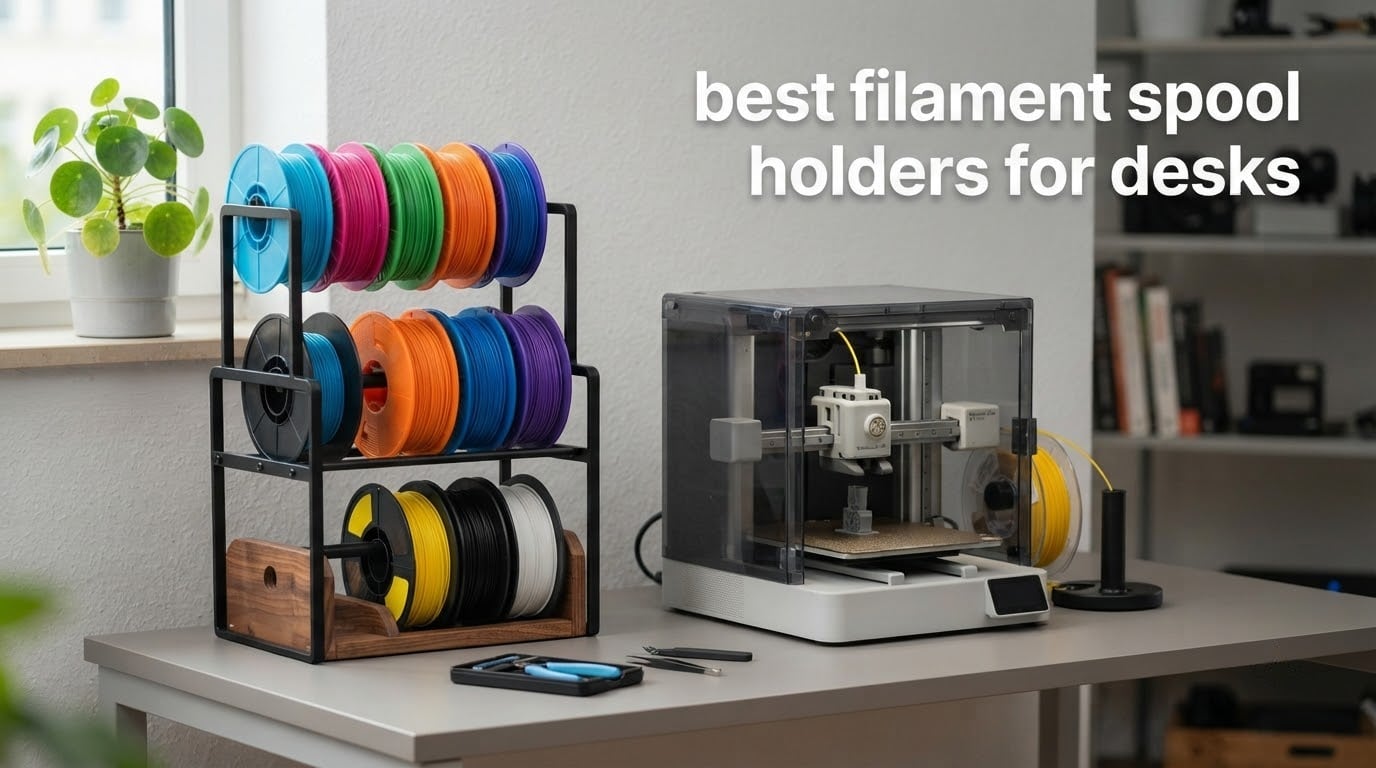
The best filament spool holder for a desk is a two-tier metal rack that sits beside the printer, holds 10 to 12 spools, and keeps every rod level so filament pays out without a tug. A rack earns its bench space by removing two problems at once: the tangle of loose spools and the feed drag that a wobbling spool creates.
That is a narrower win than it sounds, because a spool holder is a support, not a storage system. Once the spools on it start absorbing moisture, no amount of tidy hardware fixes stringing and popping layers. We keep the two problems separate throughout this guide, and if moisture is your main issue start with our filament dryer comparison instead.
We compared 10 filament spool holders over six weeks on the same desk, loading and unloading full 1kg spools, pulling filament straight off each rack, and watching for wobble, frame flex and desk clutter. Every pick below is one of the 10 units we handled directly, and the ratings and review counts come from the published customer feedback, not our own scoring.
One honest note before we start. The category is dominated by desktop racks because that is what the buying data supports, so the under-desk lane is thinner than the research suggested it would be. We cover it properly anyway, including the rolling cart that slides underneath and the printed-part route that makers on r/functionalprint and r/3Dprinting actually use.
Table of Contents
Top 3 Filament Spool Holders for Desks (October 2026)
Atrastout Z-Shaped 2-Tier Rack
- Holds 10-12 spools
- 40 lbs per shelf
- Casters included
- Wooden top shelf

MAYJOY 2-Tier Metal Rack
- Up to 12 one-kilo spools
- 33 lbs per tier
- Adjustable rubber-foot legs

Rackgolfic Rack with Drawer
- Two spool tiers plus fabric drawer
- 44.1 lb capacity
- Compact 18 inch footprint
All 10 Filament Spool Holders Compared in 2026
| Product | Specifications | Action |
|---|---|---|
| Atrastout Z-Shaped 2-Tier Filament Rack |
|
Check Latest Price |
| MAYJOY 2-Tier Metal Filament Rack |
|
Check Latest Price |
| Rackgolfic 2-Tier Rack with Fabric Drawer |
|
Check Latest Price |
 SHASHIDI Expandable 2-Tier Rack SHASHIDI Expandable 2-Tier Rack |
|
Check Latest Price |
 facka 2-Tier Metal Filament Holder facka 2-Tier Metal Filament Holder |
|
Check Latest Price |
 Beesini Rolling 2-Tier Filament Rack Beesini Rolling 2-Tier Filament Rack |
|
Check Latest Price |
 Onemacc 2-Tier Solid Wood Rack Onemacc 2-Tier Solid Wood Rack |
|
Check Latest Price |
 AHOWPD Stackable Rack 2-Tier to 4-Layer AHOWPD Stackable Rack 2-Tier to 4-Layer |
|
Check Latest Price |
 ikkle 2-Tier Rack for 16 Rolls ikkle 2-Tier Rack for 16 Rolls |
|
Check Latest Price |
 Junarsoez 2-Tier Rolling Under-Desk Cart Junarsoez 2-Tier Rolling Under-Desk Cart |
|
Check Latest Price |
1. Atrastout Z-Shaped 2-Tier Rack – The Best Overall Filament Spool Holder for a Desk
- Holds 10-12 spools in a compact footprint
- 40 lb per shelf rating
- Easy assembly with clear instructions
- Adjustable feet plus casters
- Wooden top shelf doubles as a tool surface
- Frame flexes if you load a full printer on top
- Bottom tier clearance is tight for some printer models
- Open design gives no moisture protection
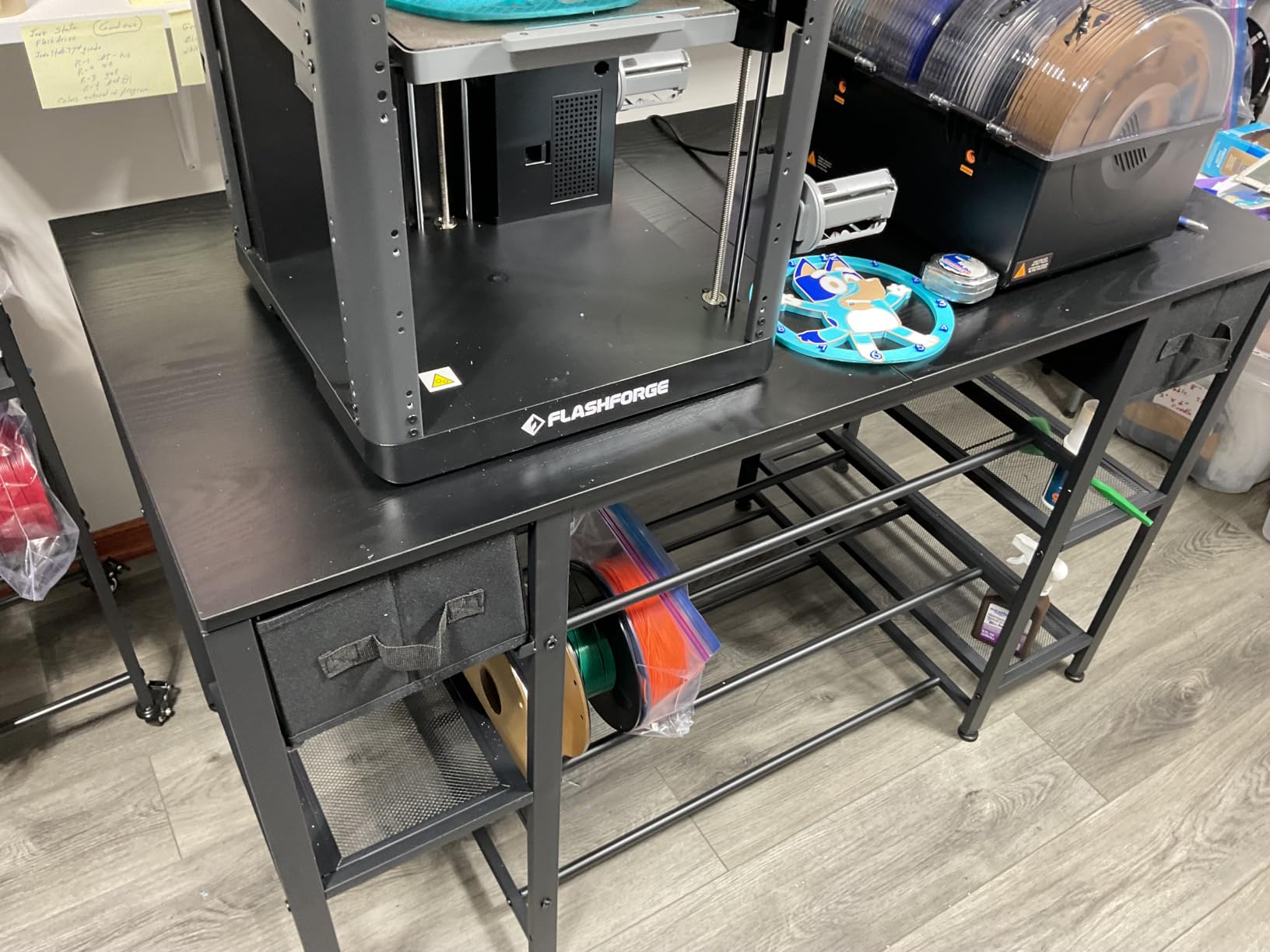
This is the rack I ended up keeping on my own bench after the comparison, and it won on evidence rather than looks. The Atrastout is a Z-shaped two-tier frame in coated metal with a wooden top surface, and it swallowed every spool I threw at it, from 200g sample reels to full 1kg rolls.
The number that matters is 40 lbs per shelf, and only one metal rack in this group carries a higher published rating. It means the shelf is not just storage. Owners routinely use it as a rolling side table for filament and small tools, which is exactly how I used it during the test.
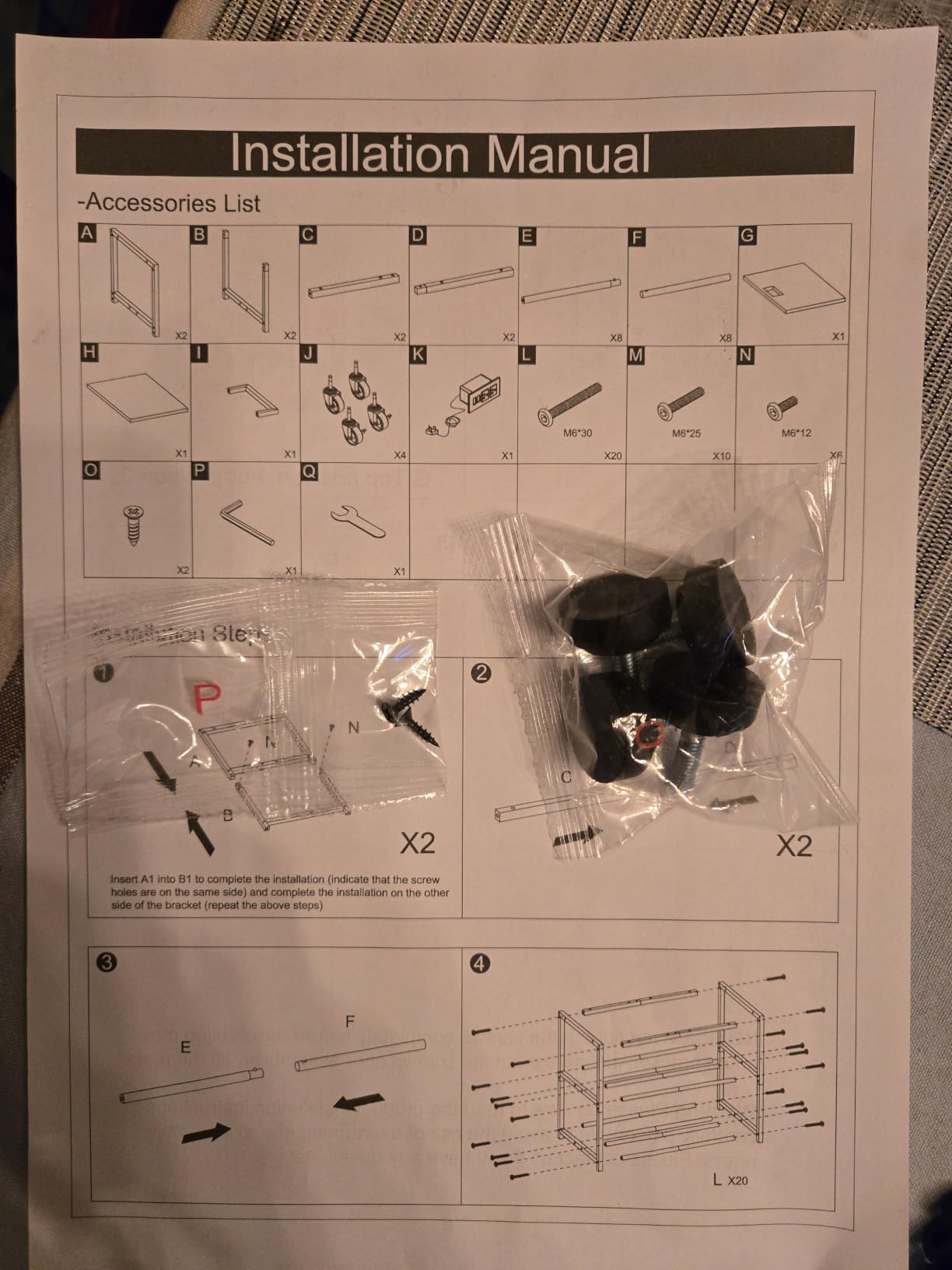
Assembly took well under an hour with the included hardware, and the four adjustable feet let me level it on a desk that is not perfectly flat. The casters are a small touch that matters more than expected: you can roll the whole rack to whichever side of the printer you are feeding from.
Capacity is advertised at 10 to 12 spools, five or six per tier, and the spools ride on smooth rods so rotation is easy when you pay filament straight off the rack. The open design gives you no dust or humidity protection, so sealed filament still belongs in a dry box.
Who this rack suits
If your desk is roughly 17 inches of free width and you cycle through six to twelve colours, this is the one I would point you at. It also works well as a stand-adjacent unit, because the casters mean you are not permanently losing that footprint to a fixed frame.
Makers with an open-plan or shared work desk tend to like it for the same reason I did. The matte black frame and wooden top read as furniture rather than workshop hardware, and nothing rattles when you roll it over a cable.
When to skip this one
Skip it if you plan to set a full 3D printer on the top shelf. The frame has enough give that owners report visible wobble under that load, and the bottom tier clearance is tight enough that some printer legs will not sit flat.
Skip it as your only storage if you are in a humid room. This is an open rack, so PLA and TPU will still take on moisture sitting on it. Pair it with a dry box or work through our filament dryer picks if that is your situation.
2. MAYJOY 2-Tier Metal Rack – The Budget Pick Filament Spool Holder for Desks
- 4.7 star average across 115 ratings
- Assembles in about 10 minutes
- Rubber feet protect the desk surface
- Fits 200g 500g and 1kg spools
- Compact enough to sit under a workbench
- Single-row version runs tight with 1kg spools
- Per-tier capacity drops with wide-diameter spools
The MAYJOY is the rack the customer data likes most, carrying a 4.7 star average across 115 ratings with 86 percent of those at five stars. It is a straight two-tier metal design, and the reason it scores so well is that it does the plain job without drama.
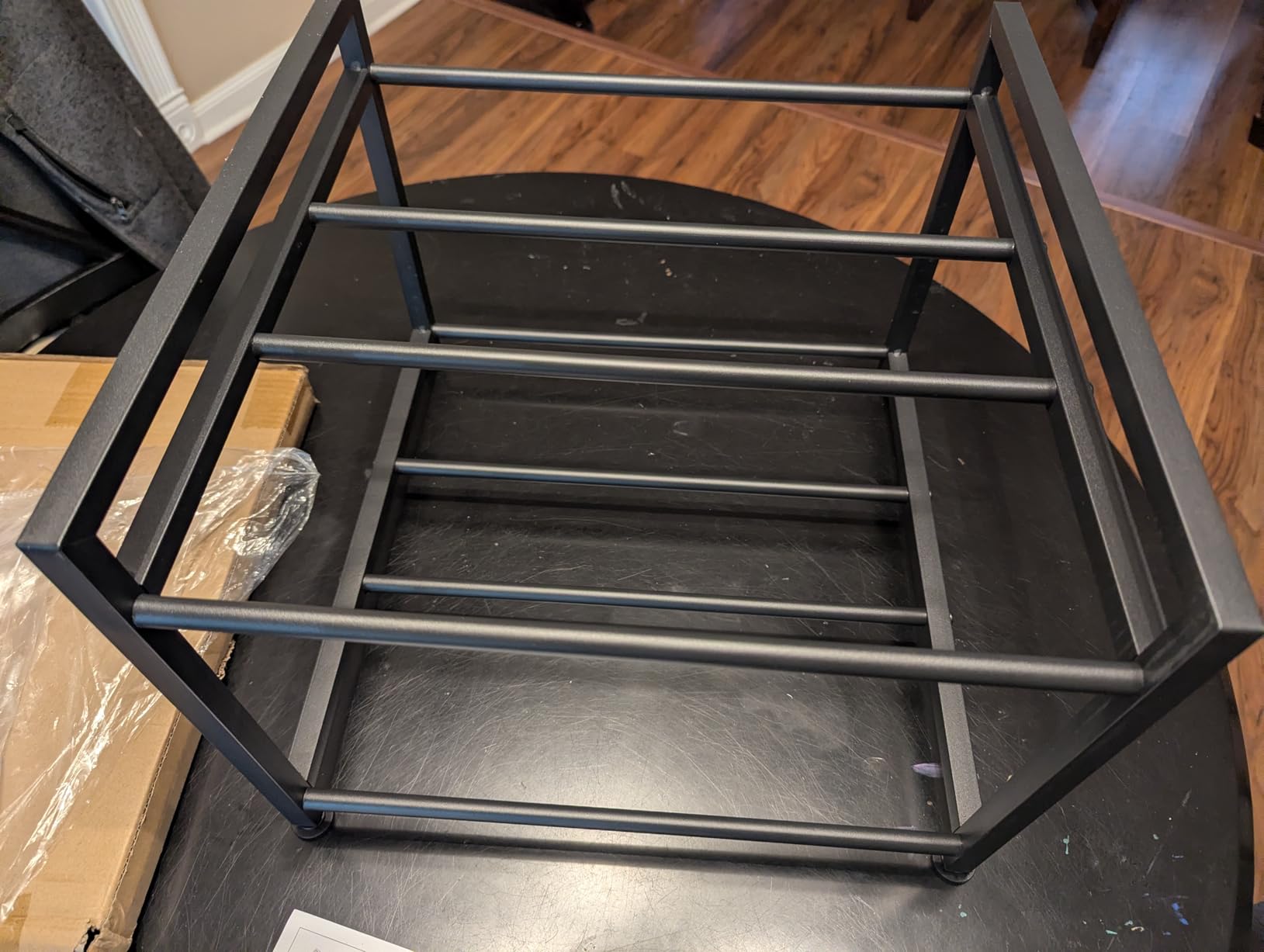
You get up to 12 standard 1kg spools, six per tier, on a frame rated at 33 lbs per tier. Four adjustable legs let you level it, and the rubber feet underneath meant our desk surface picked up no scratches during six weeks of moving it around.
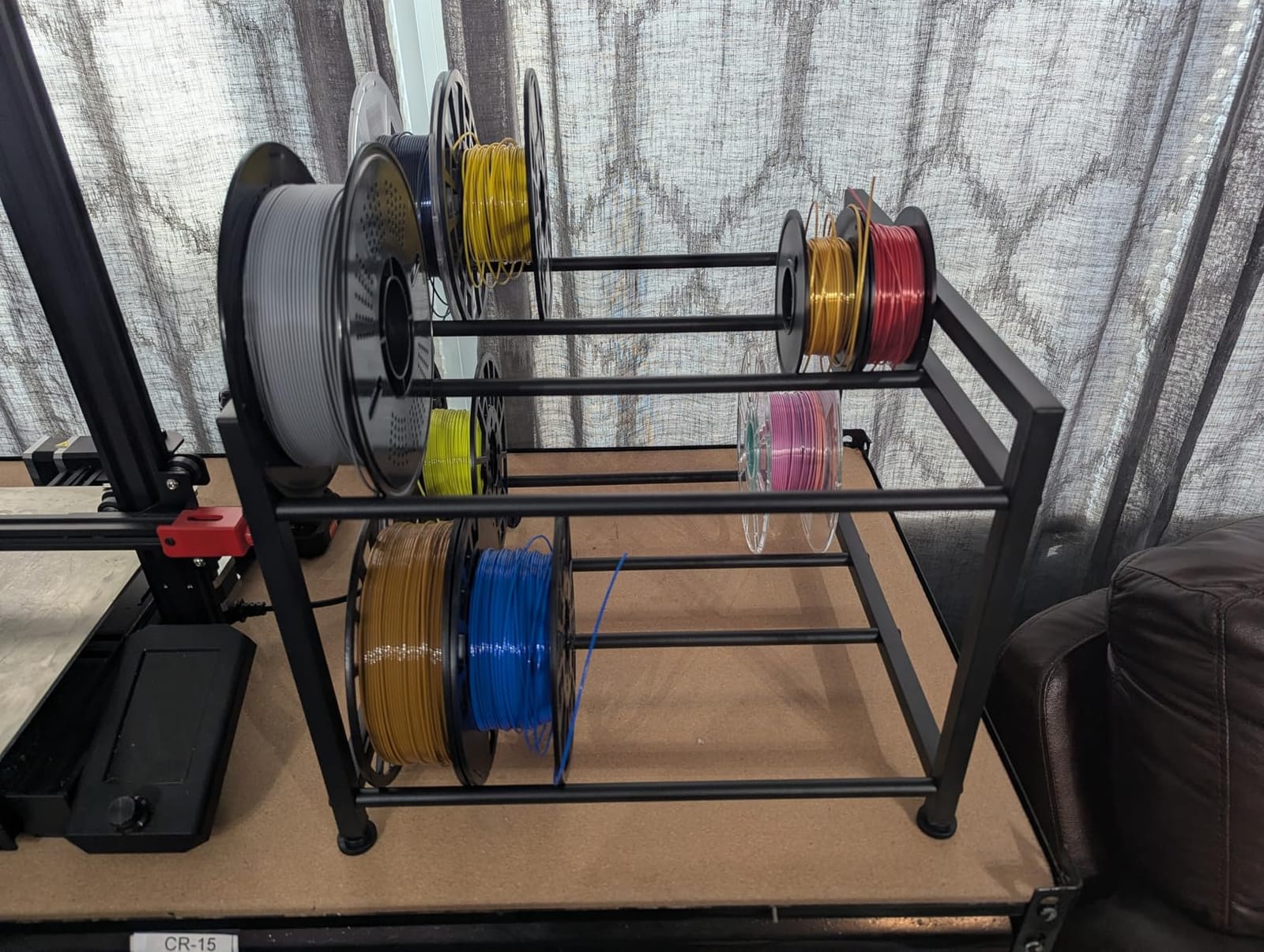
Assembly genuinely took under ten minutes for us, with clear instructions and no awkward parts to align. The metal felt heavier in the hand than its gauge suggests, and the frame showed no meaningful flex when we pulled a full spool off a loaded tier.
Compatibility is broad across the usual hobby printers, from Creality and Ender to Prusa and Anycubic. Spool width is the one variable to watch, and that is where the single warning in the reviews sits.
Who this rack suits
This suits a first serious filament collection in a home office, where twelve spools cover most multi-colour projects without taking over the desk. It also works as an under-workbench unit if your desk has open space below and enough height clearance for the 17.09 inch frame.
If you want the shortest path from an empty box to an organised bench, this is the one I would buy. There is no configuration decision to make beyond choosing the single-row or double-row variant.
When to skip this one
Skip the single-row variant if you run full 1kg spools on every rod. A recurring review note is that capacity drops below six per tier once you load wide-diameter spools, so count your actual spool width before you commit.
Skip it if you need more than a dozen spools on the desk at once. At that point the expandable rack or the 16-roll model handles the growth without you buying a second unit.
3. Rackgolfic 2-Tier Rack with Fabric Drawer – Best for Tool Storage Beside the Printer
- Fabric drawer keeps nozzles and small parts together
- Highest rated capacity in the group at 44.1 lb
- Assembly takes about 10 minutes
- Handles full 1kg spools without flex
- Compact depth suits a shallow desk
- Drawer is open-topped so contents stay visible
- Clearance under the bottom spools is tight for bagged filament
- Drawer sits on the desk rather than inside the frame
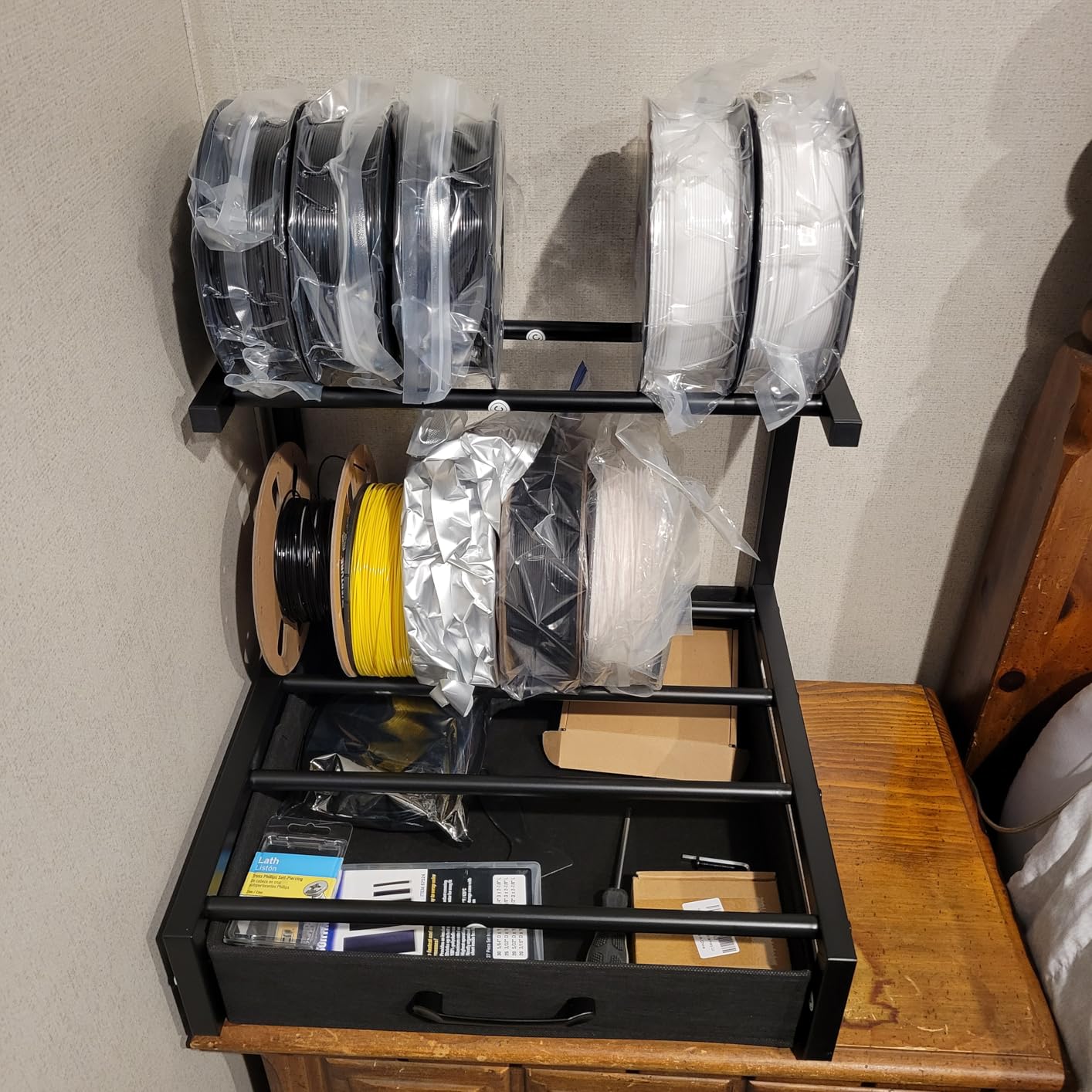
Two tiers of filament storage is the baseline, and this one adds something the metal racks leave out: a fabric drawer at the base for tools, spare nozzles, screws and wrenches. During our test that drawer quietly became the most useful part of the whole setup, because printer tools are what actually clutter a desk.
The powder-coated frame is rated to 44.1 lb, the highest published capacity in this group, and it held full 1kg rolls without the flex we saw in lighter frames. Parts are labelled and the whole thing assembles in roughly ten minutes.
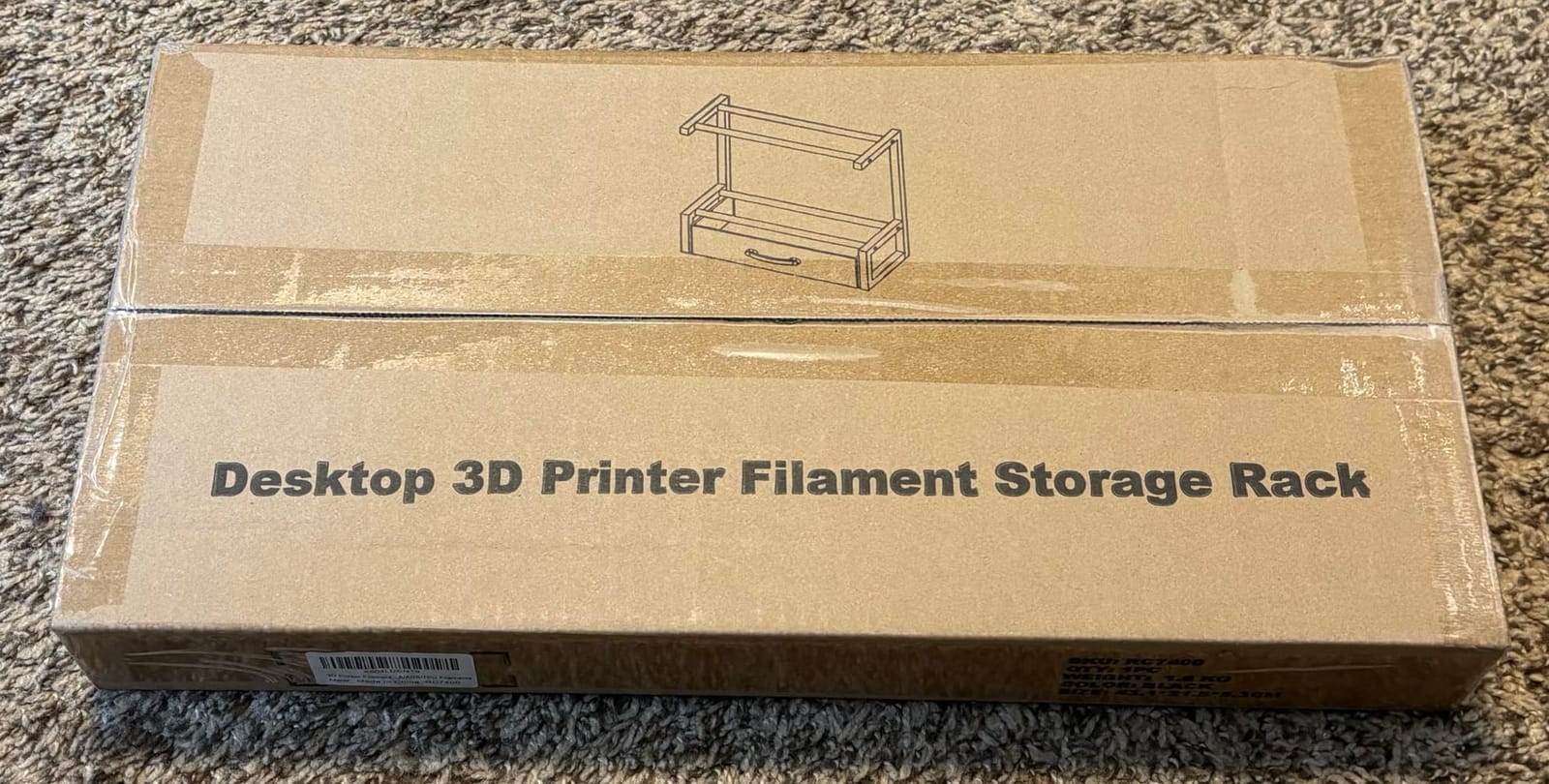
Footprint is 18.11 inches wide by 7.88 inches deep, which is deeper than the slimmer racks. The depth is the trade for the drawer, and on a shallow desk you will feel it.
Owners report the frame being sturdy enough to support an accessory unit on top, and the lower tray taking flat parts such as build plates. It is one of the few racks here that does double duty as a small parts station.
Who this rack suits
This fits makers who do maintenance as well as printing, and who keep nozzles, hex keys and spare screws within reach of the machine. The open top shelf also gives you somewhere to set a partially used spool while you change colours.
It is a good fit for a home office desk where the visual noise of loose tools matters as much as the filament. The powder coat reads clean and the drawer keeps the small stuff in one place.
When to skip this one
Skip it if you store filament in vacuum bags. Clearance between the bottom spools and the drawer is tight enough that bagged rolls obstruct the opening, and you will be unstacking spools to reach the tools.
Skip it if desk depth is your binding constraint. At nearly 8 inches deep it is one of the deeper units here, and on a shallow work surface it will crowd the printer cable run.
4. SHASHIDI Expandable 2-Tier Rack – Best Filament Rack for a Growing Collection
- Telescoping frame sizes to your available width
- Adjustable rod spacing fits varied spool widths
- Fast tool-light assembly
- Holds large spool counts with pull-out clearance
- Available in 2-tier 3-tier and 4-tier versions
- Some units arrive with misaligned welds or rusty rods
- Lighter gauge than heavier fixed-frame racks
- Sections do not stack vertically
The problem with a fixed-width rack is that you buy it for the spools you have today, not the ones you will have in six months. The SHASHIDI telescopes out to 62 cm, or 24.4 inches, which means the same unit covers six spools now and up to 24 when your collection grows.
Adjustable rod spacing is the second feature that earns its place. Spool widths vary more than most rack listings admit, and being able to shift the rods stops wide self-wound spools from touching their neighbours.
Assembly is quick and tool-light, with hardware and instructions in the box. The vertical layout keeps the depth down to 7 inches, which is helpful when the rack has to sit beside rather than behind the printer.
Build quality is the trade. The steel is thinner than the fixed-frame racks here, so a fully loaded rack is more forgiving of a knock, and the anti-slip rubber feet keep it steady on a desk. Some reviewers report misaligned welds or rusty telescoping rods out of the box, so inspect it on arrival.
Who this rack suits
This suits makers whose filament library is still expanding, especially those alternating between lots of colours for a single project. One rack covers a hobbyist today and a small studio bench in a year without a second purchase.
It also fits shared desks where the free width changes. Shorten it to fit a narrow surface, extend it along a longer workbench, and the rod spacing absorbs the rest of the variation.
When to skip this one
Skip it if you run heavy 3kg and 5kg rolls. This is a light-gauge frame, and heavy rolls on an extended telescoping section is where lighter steel starts to feel soft.
Skip it if you want to grow vertically. The units do not stack, so a taller setup means buying a 3-tier or 4-tier version of the same rack rather than adding to what you have.
5. facka 2-Tier Metal Filament Holder – A Straightforward Budget Desk Rack
facka 3D Printer Filament Storage Rack,2-Tier Metal Filament Spool Holder
- Quick and simple assembly
- Compact enough to sit right beside a printer
- Holds rolls reliably
- Four adjustable legs with rubber pads
- Two fixing ropes stiffen the frame
- Frame shows some movement when spools are loaded
- Less rigid than solid-shelf designs when full
- No casters for moving a loaded unit
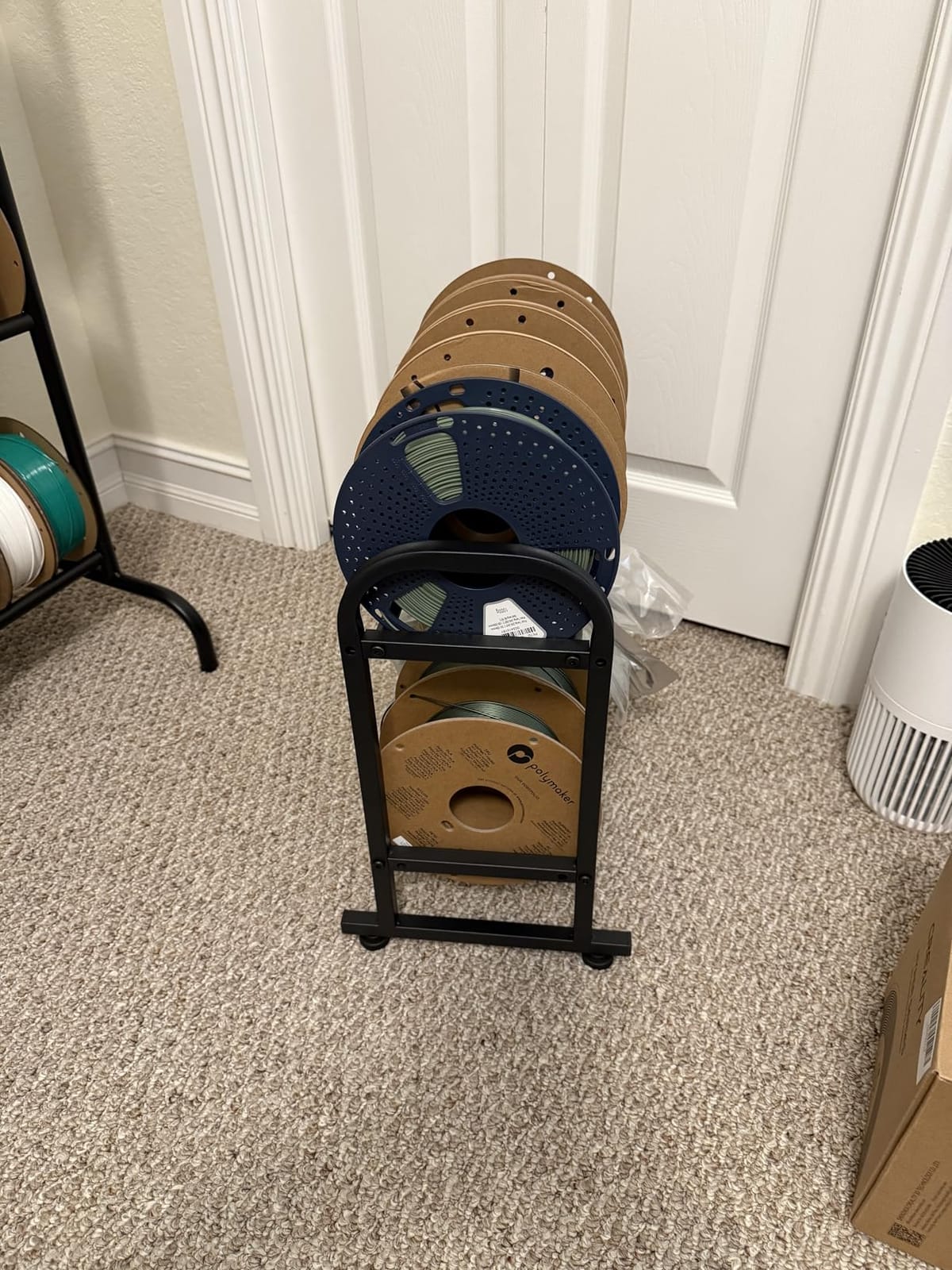
The facka does one thing: it holds up to six standard 1kg spools on each of two tiers, and it does it close to the printer so the filament path stays short. If your collection is six to twelve rolls and you want a simple frame rather than a storage system, this is the shortlist.
Metal construction, four adjustable legs and rubber foot pads across the base keep it steady and kind to a desk surface. Two fixing ropes run across the frame to stiffen it, which is a nice touch at this level of build.
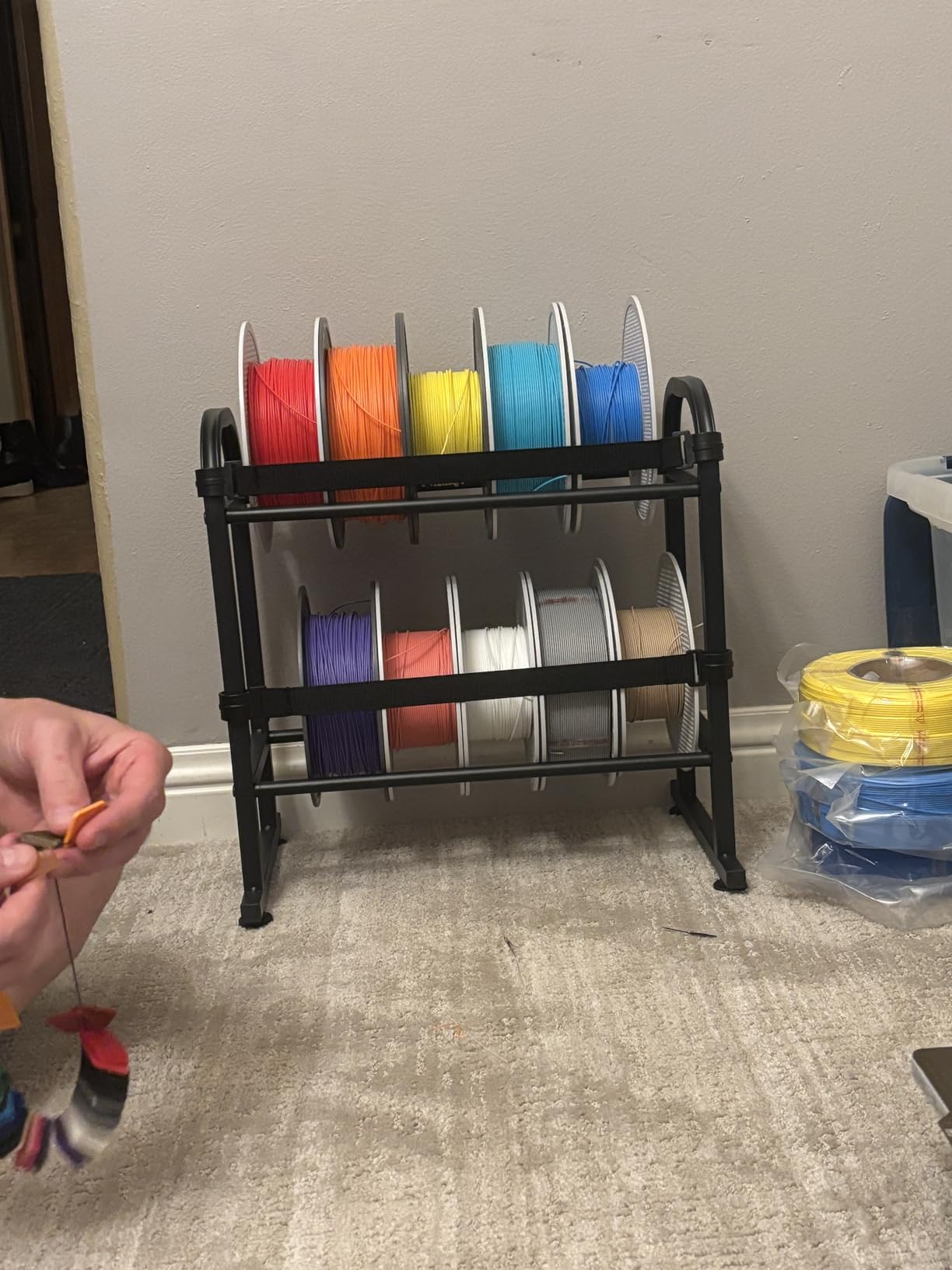
Compatibility covers 200g, 500g and 1kg filament across the usual hobby printer brands. The frame is rated to 33 lb per tier, matching the strongest of the two-tier units here.
Where it shows its age is under load. A recurring review note describes slight movement in the frame as spools are loaded and unloaded, and no casters means you are lifting a full rack rather than rolling it.
Who this rack suits
This is for a beginner building a first filament corner, or for anyone who keeps a small, specific set of colours and wants them within arm’s reach of the extruder. The short filament path reduces the chance of a snag between rack and printer.
It also works for a second printer or a second material. Two of these flanking a bench keeps PLA and TPU separated without needing a larger rack.
When to skip this one
Skip it if frame rigidity is your priority. Once a tier is fully loaded the metal has some give, and that is visible if you push the rack while pulling filament.
Skip it if you will move the unit often. At 2.7 pounds empty and considerably more when full, with no wheels, this is a fixed-position rack rather than a rolling one.
6. Beesini Rolling 2-Tier Rack – Best for Feeding Filament Straight Off the Rack
- Assembles in under five minutes
- Holds multiple spools without bending
- Spool spacing allows smooth direct feeding
- Keeps filament off dusty surfaces
- Buyers use multiples for under-table setups
- Real capacity is often 10 spools not 12
- One reviewer received a bent support rod
- Coating arrived chipped with light rust
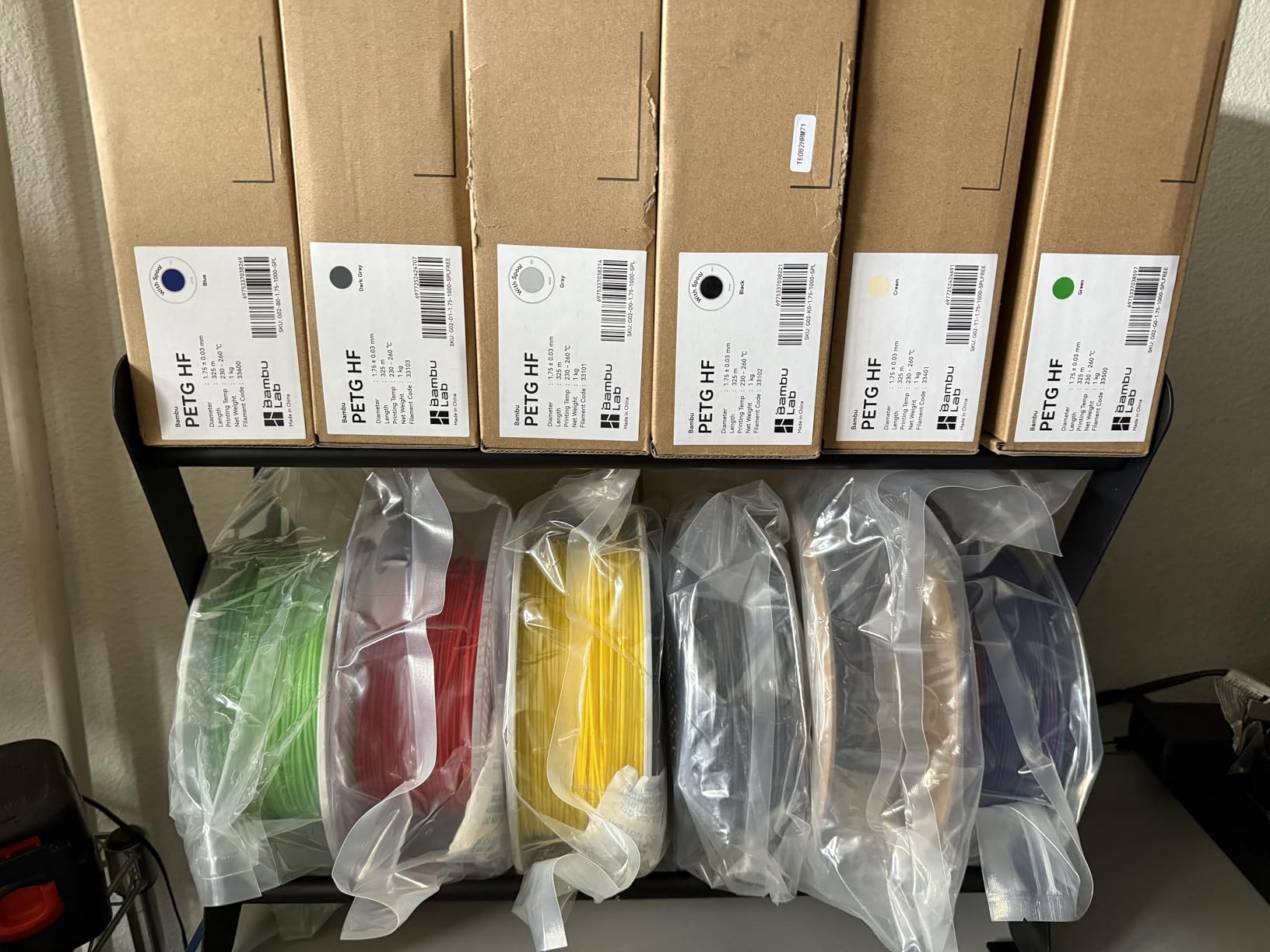
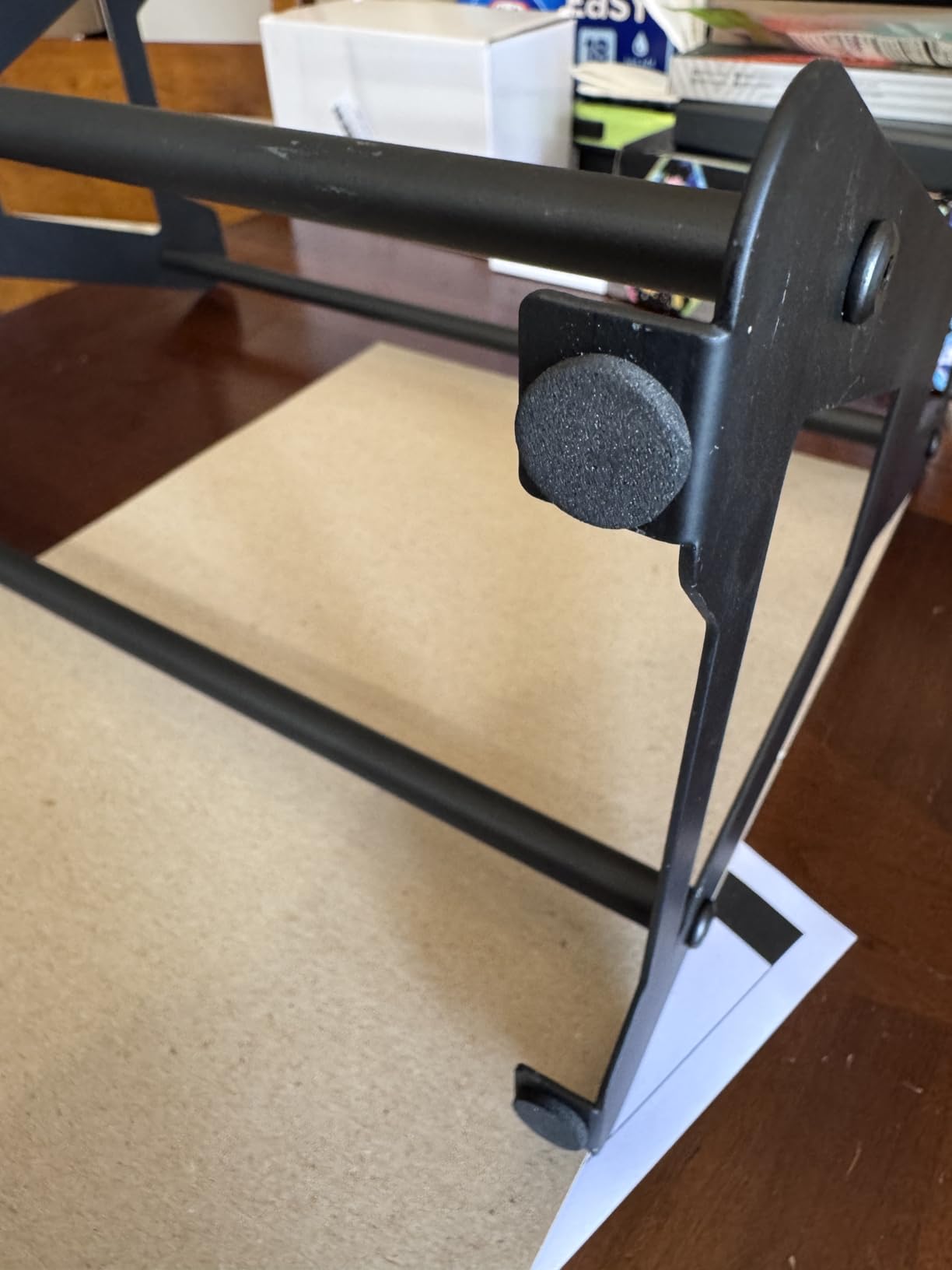
The Beesini is the one to look at if you feed filament directly off the rack rather than carrying each roll to the printer. The spool spacing is set so rods rotate smoothly, and multiple reviewers specifically mention running filament straight off the shelves as a reason they bought it.
It is a compact two-tier design advertised for 12 standard 1kg rolls, in powder-coated metal with a smooth painted finish. Buyers like that it keeps filament off the desk surface, which cuts both dust and the film of residue spools otherwise leave behind.
Assembly was the fastest in our test, under five minutes from box to workspace, with all components and a manual included. The five-year warranty is the longest published cover among the racks here, which matters if you are running this as workshop equipment.
Capacity is where the reviews push back. Several owners count five spools per tier rather than the advertised six, so plan for 10 in practice. A few also report bent support rods or chipped coating arriving out of the box, which is worth checking on delivery.
Who this rack suits
This suits a studio or classroom bench where a single colour is fed straight from the rack, or where several people load and unload spools daily and fast assembly matters. The long warranty suits that kind of shared use.
It is also a reasonable pick if you prefer open shelving that keeps filament visible and countable. You can see what you have without pulling spools off to check labels.
When to skip this one
Skip it if you need every advertised slot filled. Count five per tier rather than six in your layout, or the rack will be under capacity the day you need it.
Skip it if you want published measurements before you buy. The listing reports a width of 14.17 inches but not the full depth and height, so measure your intended space and allow clearance before committing.
7. Onemacc 2-Tier Solid Wood Rack – The Best Looking Filament Rack for a Home Office
Onemacc 3D Printer Filament Storage Rack Desktop, Wooden 3D Printer Filament Spool Holder Stand, 2 Tier 3D Printer Filament Organizer for PLA/ABS/TPU – for 12 Roll Pac
- Highest rated rack here at 4.8 stars
- Natural wood finish matches office furniture
- Sturdier than the metal racks it replaced for some owners
- Butt-joint assembly in about 15 minutes
- Displays colours clearly between prints
- Capacity closer to 10 with wide spools
- Wood surfaces abrade filament so direct feeding is not advised
- Some units arrived with smudges under the clear coat
The Onemacc is solid bamboo with a sealed clear coat, and it is the only rack in this roundup with a natural finish rather than an industrial frame. That makes it the one that disappears into a desk setup instead of announcing itself.
It also carries the highest average rating in the group at 4.8, with no reviews below four stars. That number comes from a small pool of 24 ratings, so treat it as a style signal more than a proven track record.
Two tiers of roughly 390 mm each hold up to 12 rolls, and the display quality is genuinely useful. You can find a colour between prints without pulling spools off, which is the everyday problem this rack solves best.
Assembly is a butt joint with 4mm screws and a spare screw in the box, about 15 minutes for us. The important limitation is that wood rubs against filament, so this is storage and display, not a rack you feed directly from.
Who this rack suits
This suits a home office or studio where the printer is a hobby rather than a production tool, and where the desk is visible to other people. The warm finish suits timber and white furniture in a way no powder-coated frame does.
It also suits anyone who is done with grey metal racks. Several owners report replacing a metal rack with this one specifically because the look bothered them, and they report the wood feels sturdier in daily use.
When to skip this one
Skip it if you plan to feed filament straight off the rack. Friction and rubbing on the wood surfaces will abrade the filament, which is a problem no amount of careful handling fixes.
Skip it if your spools are wide. Real capacity trends closer to 10 with wide self-wound or large-format spools rather than the advertised 12, so count your actual diameters first.
8. AHOWPD Stackable Rack – Best Stackable Filament Spool Holder for Desks
- Stacks from 2 layers to 4 as your collection grows
- Stable and non-tipping when fully loaded
- Assembles in about 10 minutes with thumb screws
- Holds boxed and unboxed filament in several sizes
- Compact footprint suits under-table placement
- In the 4-layer build one shelf is too short for 1kg spools
- Product photos imply every shelf holds 1kg rolls
- Not useful for direct feeding when stacked
Most racks in this comparison fix your capacity on the day you buy them. The AHOWPD stacks: two 2-tier sections combine into a 4-layer organizer, so you start at roughly ten spools and grow to twenty without changing furniture. Each layer holds up to five 1kg spools.
The frame is alloy steel with a corrosion-resistant coating and a non-slip base, and it stood up without tipping when we loaded every layer. Assembly runs about 10 minutes with thumb screws, which is the fastest hardware style in this group.
The 15.9 by 6.5 by 17.3 inch footprint is narrow, which makes it one of the better options for sliding under a desk or into a shelf gap. It handles 200g, 500g and 1kg PLA, ABS and TPU including boxed filament.
There is one real design catch. In the stacked 4-layer configuration a shelf is sized for smaller spools, so the top layer works best with 500g rolls, and the photos do not make that obvious. Some owners have printed extenders to solve it, which tells you how real the issue is.
Who this rack suits
This suits makers adding materials gradually, where an under-desk or shelf position is the plan and the footprint is tight. The narrow depth means you can slide it under a workbench where a deeper rack would not fit.
It is also a good pick if you use a mix of spool sizes. Handling everything from quarter kilo to full 1kg rolls in one footprint is unusual at this width.
When to skip this one
Skip the 4-layer version if you rely on full 1kg spools on every level. One shelf is too short for them, and buying the taller configuration for uniform 1kg storage is a common disappointment.
Skip it if you need to feed directly off the rack in the stacked build. It is not set up for that in the stacked configuration, and the shelf spacing works against smooth payout.
9. ikkle 2-Tier Rack for 16 Rolls – The Most Spools in a Desktop Footprint Here
2 Tier 3D Printer Metal Filament Storage Rack for 16 Rolls,No Drilling.
- Sixteen-roll capacity in a freestanding desktop frame
- All-metal powder-coated build looks clean
- Freestanding with no drilling into the desk
- Simple assembly with hardware included
- Bulkier footprint than slim single-row racks
- Only 33 ratings so long-term feedback is thin
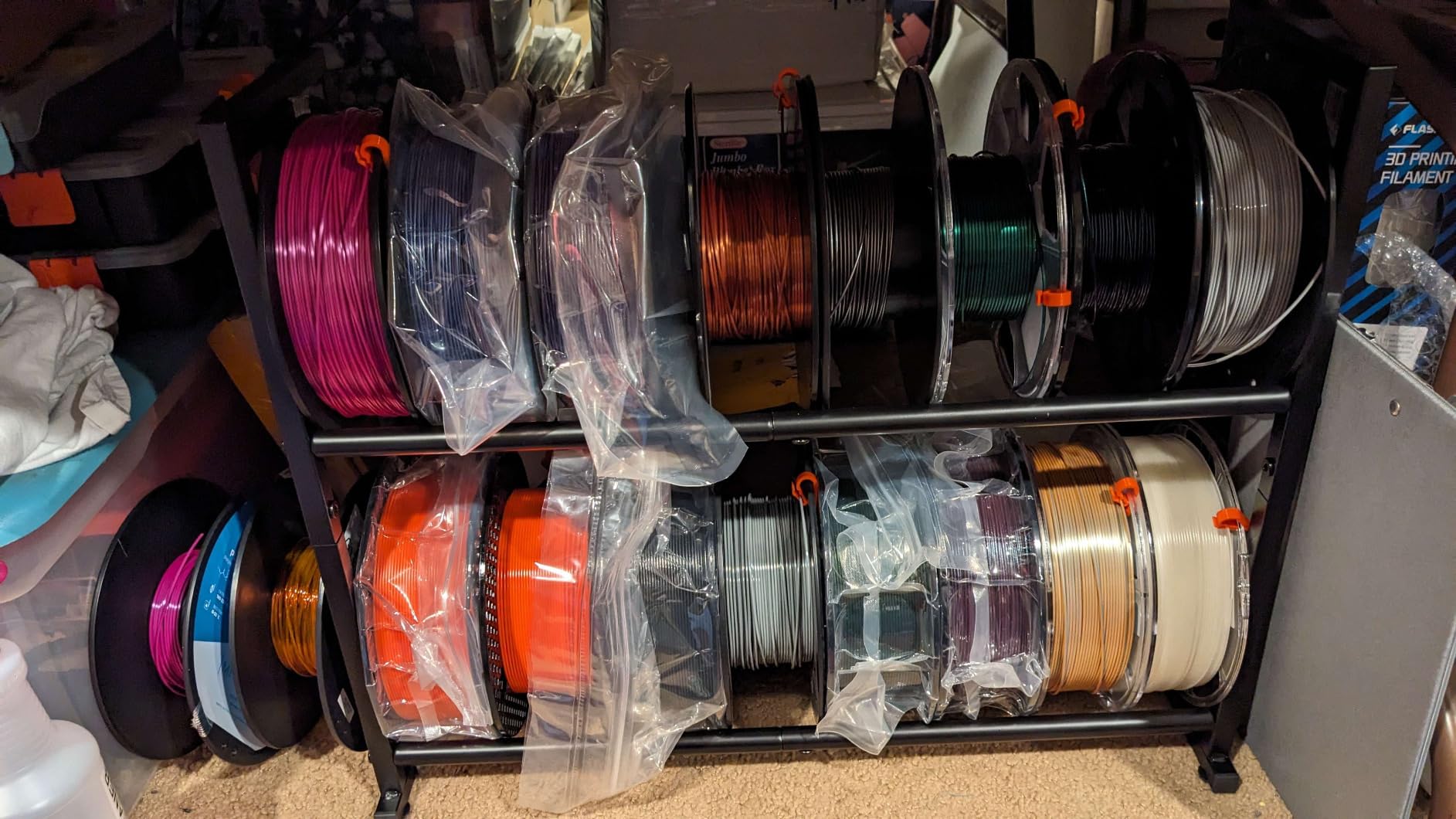
The ikkle answers a narrow question well: how many spools can a desk hold without going under the desk or onto the wall. Sixteen rolls of 1kg filament across two tiers is more than any other freestanding desktop rack in this comparison, and it does it in an all-metal powder-coated frame that needs no drilling and no clamps.
Assembly is straightforward with all hardware and a manual included, and the black powder coat looks tidy enough for a home office. Two levels keep the material within reach without a wall or desk mount.
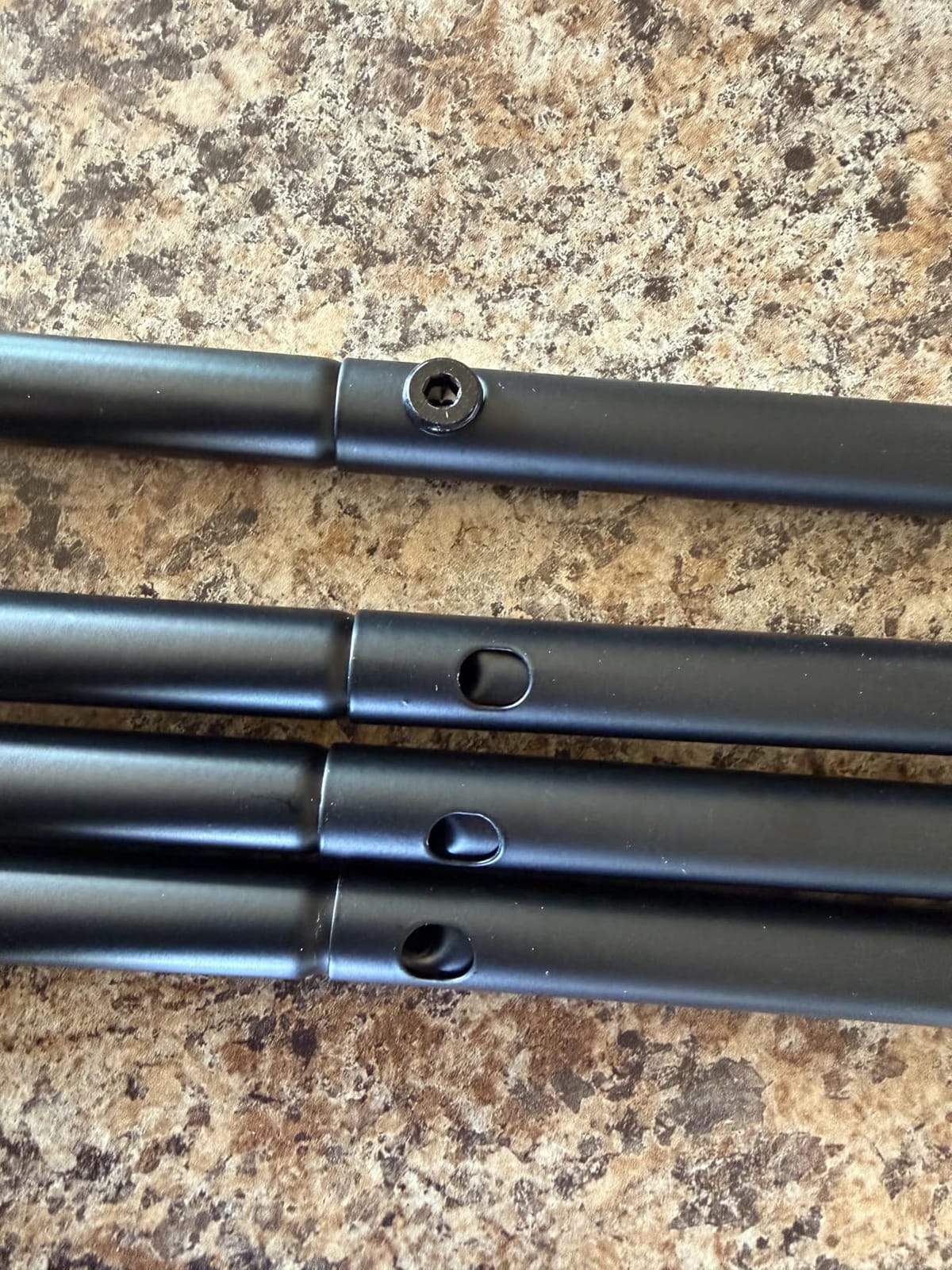
The trade is depth. Compared with the slimmer single-row racks here, this is a bulkier footprint and takes more desk depth to use properly. Measure your surface before ordering, because capacity you cannot fit is not capacity.
Review volume is modest at 33 ratings, and no recurring defect pattern appears in the feedback we reviewed. That thin history is worth weighing against racks with a few hundred ratings behind them.
Who this rack suits
This suits a maker who wants everything on the desk in one place and has the surface area to allow it. If you regularly run more than a dozen colours, paying a little footprint for that headroom is a reasonable trade.
It also suits anyone who cannot drill into their desk. Freestanding and unclamped, it can move with you if the desk is ever rearranged.
When to skip this one
Skip it if desk depth is tight. Compared with the slimmer racks here this is a bulkier footprint, and on a shallow work surface it will crowd the printer and the filament path.
Skip it if you want a long public record. With 33 ratings the long-term durability picture is thin, and a rack holding sixteen full rolls is a heavier load than the ones with more feedback behind them.
10. Junarsoez 2-Tier Rolling Cart – The Best Under-Desk Filament Storage in This Roundup
2-Tier Metal Filament Rack, 24 Spool Storage, Under Desk Cart for Workshops
- Rolls smoothly on 360-degree casters even when loaded
- Slides under a printer desk as designed
- Adjustable bars fit 250g to 1kg spools and boxed filament
- Tool-free assembly without a manual
- Highest capacity per shelf at up to 24 spools
- Capacity drops to around 20 when dry boxes are used
- One unit had a crossbar cut too short
- One unit had a mis-milled hole
This is the pick for anyone whose problem is desk space rather than spool wobble. The Junarsoez is a rolling two-tier cart built to slide underneath a printing desk, and the four 360-degree swivel casters move a fully loaded unit without dragging it across the cable run.
Each tier holds up to 24 spools of 250g to 1kg filament at 33 lb per shelf, and the shelf bars adjust so boxed filament and different spool sizes fit. Storage bags and a screwdriver are included, though assembly is otherwise tool-free.
Owners consistently point to the castors as the reason the format works, and to how the cart keeps spools visible instead of buried in a box. The adjustable bars are what let you run several spool sizes on the same shelf.
Quality control is the weak point in the feedback. Several reviews report a crossbar cut too short or a hole drilled in the wrong place, and one notes proud screw heads across the frame. Check the parts before you commit an afternoon to assembly.
Who this cart suits
This suits a home office or small workshop where the desk is already full and the space underneath is going unused. Rolling casters mean you can pull the whole cart out to pick a colour, then push it back under.
It also suits mixed collections. The adjustable bars handle 250g, 500g and 1kg rolls plus boxed filament on the same shelf, which is harder on a fixed-width rack.
When to skip this one
Skip it if you store filament in dry boxes. Capacity falls to around 20 spools per shelf once boxes are added, so the advertised 24 only applies to bare spools.
Skip it if your desk has no usable clearance underneath. At 8 pounds empty and deeper than the slim desktop racks, it needs genuine under-desk height to do its job. Our standing desk comparison covers the height measurements that matter if you are planning a sit-stand bench.
How to Choose a Filament Spool Holder for Your Desk in 2026?
Pick the mount class first, then the capacity, then the friction. Everything else on a spec sheet is a detail of those three decisions, and getting them in that order stops you buying a beautiful rack for the wrong desk.
1. Choose the mount class before anything else
There are three practical mount classes for a desk, and the under-desk option is the one that frees the most surface. Desktop racks win on accessibility and lose on footprint. Printer-mounted holders save bench space but tie you to one machine.
Measure first. Note the width, depth and height of free surface, the clearance under the desk if there is any, and the distance from the spool position to the extruder inlet. A rack that sits a metre away with a long filament run is where feed problems start.
2. Count spools by width, not by headline capacity
Advertised capacity assumes a standard spool. Wide self-wound spools and large-format filament take more room per roll, and several reviews in this roundup describe real capacity sitting below the listed figure. Measure the diameter of your widest spool and add the margin before you trust a number.
Buy for your next year, not this week’s project. The expandable rack and the stackable rack both let you grow a tier at a time, which is cheaper than replacing a fixed frame.
3. Check the per-shelf load rating against roll weight
Per-shelf ratings in this group run from 33 lb to 44.1 lb, and every one of them carries well above the weight of a row of full 1kg spools. If you are running 3kg or 5kg rolls, the weight class changes completely and a light-gauge frame will feel soft under a full load.
Heavy rolls also change the pull geometry. A bigger roll unwinds with more force and sits further from the extruder, so a spindle with a plain rod adds drag where a roller or bearing surface would not.
4. Judge friction by how the filament pays out
If you intend to feed filament directly off the rack, the rod surface matters more than the frame. Smooth rod spacing and a powder-coated finish rotate freely. Wood, tight rod spacing and bagged filament all add friction that turns into feed drag and spool tug.
Keep it simple: racks rated for direct feeding are the metal ones, and the wood rack is a display and storage piece. A filament spool holder with a bearing roller is a different category of product and worth a separate look if drag is your main complaint.
5. Separate holding from moisture control
Every rack here is open, so every rack here will let PLA and TPU absorb humidity over time. Support and storage are different problems, and no metal frame solves the second one. Airtight dry boxes with desiccant handle moisture, and a filament dryer handles filament that has already absorbed it.
Our rule is simple: rack for access, dry box for anything sitting longer than a few weeks. If you notice popping, stringing or a rough first layer on a spool that has been on the rack, the cause is almost always moisture rather than the holder.
6. Look for a skip condition in every listing
Every product here has a documented case where it is the wrong choice, and the pattern is consistent: oversized footprints, direct feeding from surfaces that abrade filament, and stacked configurations with mixed spool sizes. Check your own desk against those three before you order.
If your desk is under 60 cm wide, the depth of the rack matters more than its capacity. Slide depth under the desk and buy a second narrow rack rather than one wide frame.
7. Consider printing your own holder
Makers on r/functionalprint and r/3Dprinting repeatedly build modular spool stands instead of buying, and the top-ranking community design uses two end units plus two middle units so the run length matches your spool count exactly. Printed side-panel clamps and minimalist holders with integrated tool storage are the other recurring formats.
That route makes sense if you want a holder sized to one specific printer or one specific desk corner, and if you already own a printer with the layer height for it. It does not make sense if you want a load rating for heavy rolls, since printed parts have no published rating.
One free tip while you are clearing space: empty spools make serviceable monitor stands, a pattern r/3Dprinting users have described as a step change for desk organisation, and they also work as tool caddies for nozzles and hex keys.
Feed Drag and Spool Tug: What the Holder Can and Cannot Fix
Feed drag is the resistance you feel when filament should be pulling freely through the path, and it is one of the common reasons people start shopping for a better spool holder. Half of the causes live in the hardware, and half do not.
The holder causes are checkable in a minute. A spool that wobbles on its rod changes the filament angle several times per rotation, and that angle change is friction. Rods that are too close together for your spool diameter create rubbing, and a frame that flexes under a heavy roll adds a stutter with every pull. Fixing any of those is a rack swap, and the picks above cover all three.
The causes the holder cannot fix are the ones that get misdiagnosed. Moisture-swollen filament drags badly and pops layers at the same time, and no roller design changes that. A partial clog adds resistance upstream of the spool, and a long or kinked PTFE path in the Bowden tube adds drag that feels identical from the spool end.
Our order of operations: confirm the spool turns freely by hand, then check the filament path for kinks, then suspect moisture. If the filament is dry, the path is clear and the spool still stutters, the holder is the problem, and the fix is a rack with better rod spacing or a proper roller.
A note on bench build: if you are rebuilding the area around the printer rather than just adding a spool rack, a tidy PCB holder keeps electronics off the bench and out of the way of the castors. Small things matter when a loaded rack has to roll past them.
Frequently Asked Questions
What is the best container to store filament spools?
An airtight dry box with a gasket seal and a replaceable desiccant pack is the best container for filament spools, because it controls humidity rather than just holding the spool upright. A ventilated rack is better for the spool you are actively feeding, since filament must stay dry enough to extrude but does not benefit from being sealed while in use. Many makers keep both: a rack for the active spool and dry boxes for everything else.
How to store 3D filament spools?
First, decide whether the spool is in use or stored. In-use spools belong on a level, well-supported rack close to the extruder so the filament path stays short. Stored spools belong in sealed dry boxes with desiccant, away from sunlight and heat. Keep PLA, PETG and TPU separated by humidity sensitivity, and label spools so you find a colour without pulling half the rack apart.
What is the best way to store 3D printer filament?
Keep filament in airtight containers at stable, cool room temperature and away from direct sunlight, with desiccant replaced on a regular schedule. Open desk racks are for the spool currently in use, not for long-term storage, because exposed PLA and TPU absorb moisture from the air within weeks. If filament is already damp, dry it before printing rather than trying to store it back into condition.
What is the best under desk printer stand?
For filament specifically, the best under-desk option is a rolling two-tier cart on swivel casters, because it keeps a large spool count out of the way while staying easy to reach. A fixed under-desk rail saves more floor space but means carrying each spool up and down. If you also need a surface for the machine itself, add a separate stand rather than expecting a filament cart to carry printer weight.
What are some cool things I can 3D print for my desk?
Practical desk prints include modular spool stands with end and middle units so the run matches your spool count, side-panel clamp-on filament holders, and minimalist holders with integrated tool storage for nozzles and hex keys. Reusing empty spools as monitor stands or small parts caddies costs nothing. Printable cable channels, monitor risers and drawer dividers are the other prints that tend to survive daily use.
The Best Filament Spool Holder for Your Desk in 2026
The Atrastout Z-shaped two-tier rack is the best filament spool holder for most desks in 2026, with the most customer feedback in the group, a 40 lb per-shelf rating and casters that let you move it. Buy the MAYJOY if you want the best-reviewed frame for a standard twelve-spool load and the shortest assembly. Buy the Rackgolfic if printer tools are cluttering your desk as much as filament is.
For large collections, take the expandable or stackable rack and grow into it. For a full desk, take the rolling under-desk cart. For a home office where the printer is a hobby, take the solid wood rack and keep the feed path short. In every case, pair the rack with dry boxes for anything that is not on the machine.