
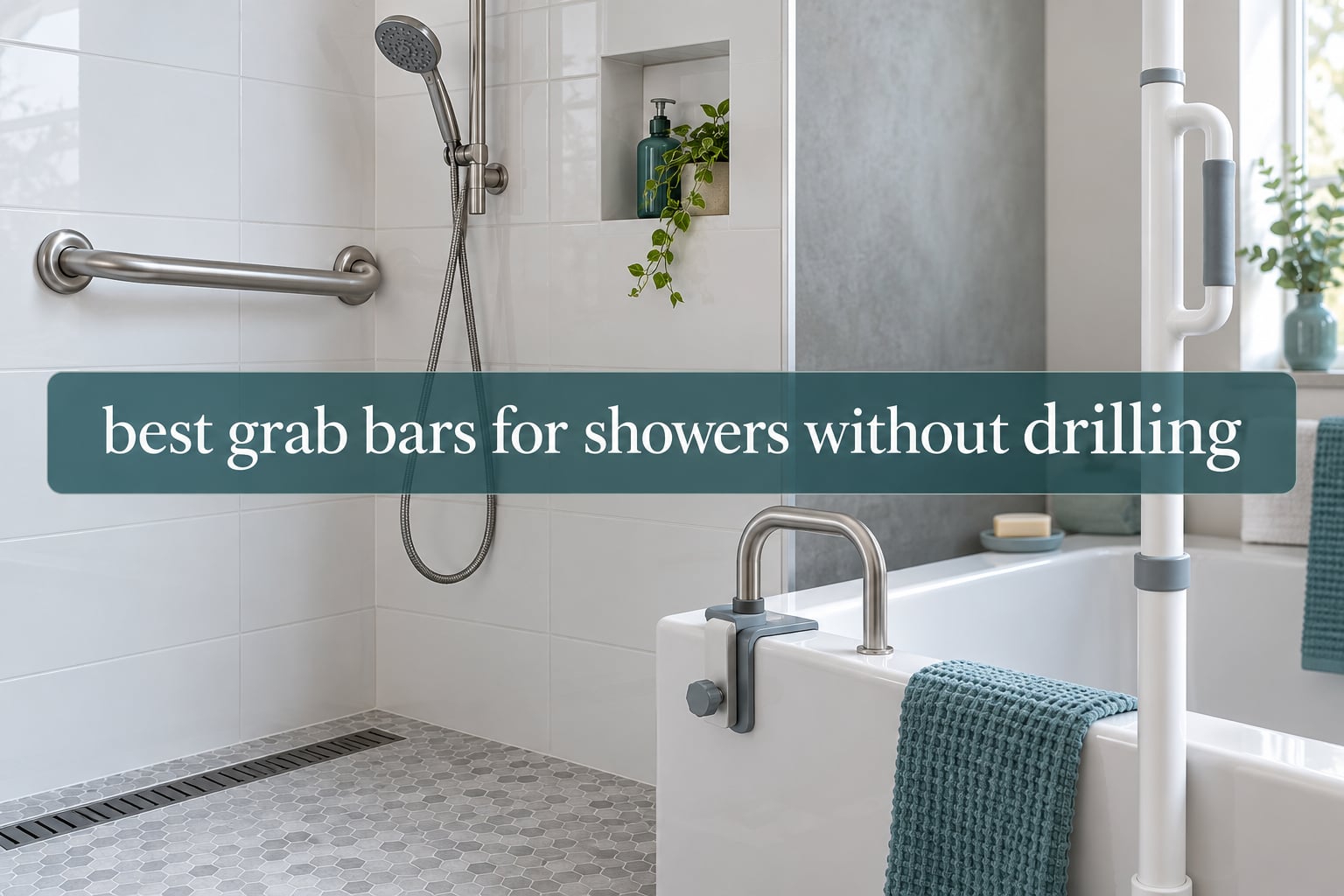
Most people searching for the best grab bars for showers without drilling are not shopping for a product. They are trying to solve a housing problem in a bathroom they do not own, or a temporary problem that will be over in six weeks.
That framing matters, because the no-drill category is dominated by suction bars with capacity claims of 240, 250 and even 385 pounds printed right on the listing, and almost none of those numbers describe what happens when a 200 pound person grabs the bar during a slip. Published lab testing of suction bars has produced failures at 70 pounds and at 92 pounds. We are going to spend the next few thousand words telling you which no-drill bars hold up, which ones are for decoration, and where a drilled bar is simply the better decision.
We assembled ten products covering every mounting family that avoids screws: tub clamp rails, a floor-to-ceiling tension pole, and six suction bars, plus one drilled stainless bar as the honest comparison point. Along the way we cover the surface rules that decide whether anything sticks at all, what weight capacity numbers actually mean, and how to pull-test a bar before you step in. If your bathroom is the subject of another accessory search, our guide to waterproof speakers for showers covers the same wet-environment questions.
Table of Contents
Do No Drilling Grab Bars Actually Work? The Direct Answer
Yes, but with limits you should know before buying. No-drill grab bars come in three mounting families: suction cups, adhesive backing, and a tension pole wedged floor to ceiling. They are balance aids for steady standing and slow transfers, never fall-arrest devices, and they only work on the surfaces they were designed for.
Of those three, only two families hold useful weight in real use. Tub clamp rails grip the rim of the tub with mechanical force and support several hundred pounds, because nothing depends on a seal. Tension poles press between a flat floor and a flat ceiling and never touch the wall at all. Suction bars depend on an airtight seal over a flat, non-porous patch of surface, and that single dependency is where nearly every complaint comes from.
Adhesive bars sit between the two. They bond chemically to smooth tile or glass, they can hold steady load, and they are the hardest to remove cleanly. None of the picks in our roundup use adhesive mounting, and we explain further down why we left that family out even though it is heavily advertised.
Top 3 Picks for Grab Bars for Showers Without Drilling (October 2026)
Our three strongest no-drill options cover three completely different situations. The Vaunn is the one we would put in our own shower, the TAILI is the best general suction bar for normal smooth tile, and the Stander pole is the only option that never touches a wall at all.

Vaunn Medical Secure Tub Rail
- Mechanical tub clamp
- no seal needed
- 300 lbs
- steel frame
- tool-free

TAILI 16.8 Inch Two-Pack Suction Bar
- Two suction cups per bar
- anti-slip top strip
- 240 lbs claimed
- 2-pack

Stander Double Handle Tension Pole
- Floor to ceiling pole
- 300 lbs
- two adjustable handles
- no wall contact
All 10 Bars Compared Side by Side (October 2026)
This table lists all ten products in the order we recommend them, with the mounting mechanism named first. Every weight figure below is the manufacturer’s stated rating, not a tested result.
| Product | Specifications | Action |
|---|---|---|
| Vaunn Medical Secure Bathtub Safety Rail |
|
Check Latest Price |
| TAILI 16.8 Inch Suction Bar Two-Pack |
|
Check Latest Price |
| Stander Double Handle Floor to Ceiling Pole |
|
Check Latest Price |
 LEVERLOC 12 Inch Suction Two-Pack LEVERLOC 12 Inch Suction Two-Pack |
|
Check Latest Price |
 songsoso Adjustable Bathtub Safety Rail songsoso Adjustable Bathtub Safety Rail |
|
Check Latest Price |
 HJSDYLIN Three-Cup Grab Bar Two-Pack HJSDYLIN Three-Cup Grab Bar Two-Pack |
|
Check Latest Price |
 Kekoy 17.5 Inch Grab Bar With Indicator Kekoy 17.5 Inch Grab Bar With Indicator |
|
Check Latest Price |
 Gotega 16 Inch Stainless Steel Two-Pack Gotega 16 Inch Stainless Steel Two-Pack |
|
Check Latest Price |
 Reyiu 16.8 Inch Shower Handle Two-Pack Reyiu 16.8 Inch Shower Handle Two-Pack |
|
Check Latest Price |
 quiheat Two-Pack Suction Grab Bar quiheat Two-Pack Suction Grab Bar |
|
Check Latest Price |
1. Vaunn Medical Secure Bathtub Safety Rail – Tub Clamp on Steel
Vaunn Medical Secure Bathtub Safety Rail, Shower Grab Bar Handle for Elderly and Disabled, Secure Locking Tub Clamp, 300 lbs
- Mechanical clamp
- no seal to fail
- 300 lbs stated capacity
- installs in under two minutes with no tools
- rubber pads protect the tub from marks
- portable at under 6 lbs
- Only fits flat-walled tubs
- not curved or textured models
- some users report slight horizontal play along the tub wall axis
- clamp hardware inside the tub can feel sharp to small children
This is the bar we would put in our own bathroom, and the reason has almost nothing to do with marketing. It clamps onto the rim of the tub with a mechanical locking screw, so there is no suction seal to degrade, no adhesive to fail, and no surface finish to worry about. The frame is a one-piece powder-coated steel tube rated by the manufacturer at 300 pounds, and at just under 6 pounds it is still light enough to carry between the tub and the toilet.
The installation is genuinely under two minutes with no tools, and the soft rubber pads sit between the clamp and the tub wall so the finish does not get marked. Across more than 12,700 ratings it holds a 4.6, and the pattern in the feedback is consistent: owners describe something much heavier and more rigid than they expected for a rail that never touches a screw.
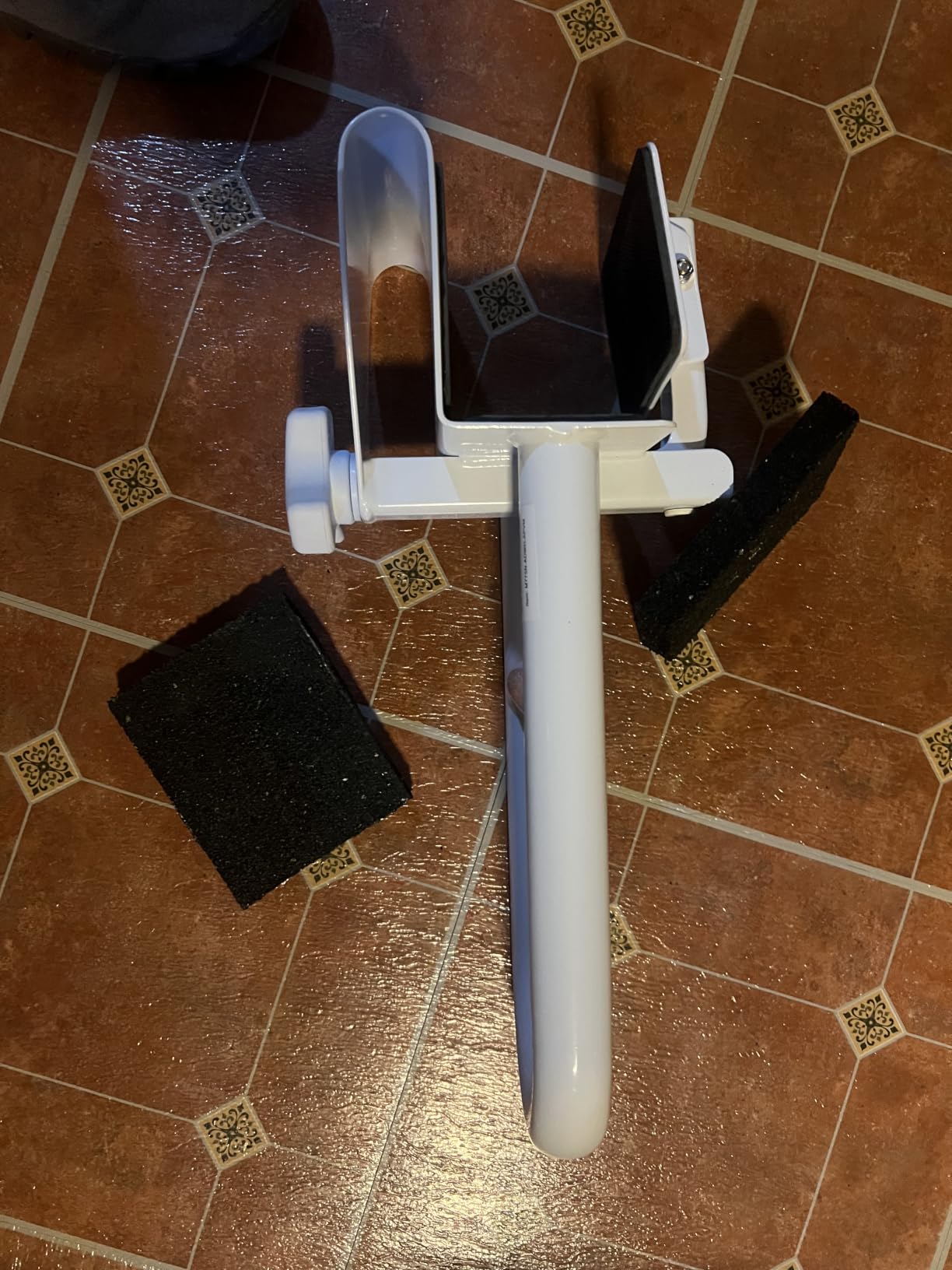
The most common complaint is a small amount of lateral play along the tub wall axis, noticed mostly by older users pushing up from a seated position. It is a minor movement at the clamp, not a bending of the rail, and it does not change the capacity. The second recurring note is that the hardware inside the tub can feel sharp to small children, which is worth considering if a toddler shares the bath.
One more constraint matters for shower stalls specifically. This rail clamps to a tub rim, so it does not work inside a walk-in shower where there is no tub lip to grip. If your bathroom is a tiled stall, skip to the tension pole or a suction bar.
Who this rail suits best
This is the pick for anyone stepping into or out of a standard flat-walled tub, especially older adults and people recovering from hip or knee surgery who need a fixed point of contact at the moment of transfer. It is also the safest no-drill choice we found for a person of higher body weight, because mechanical clamping does not degrade the way a suction seal does.
It works in a rental for the same reason it works anywhere else: nothing is drilled, and removal takes under a minute with no residue. Several buyers use it as a toilet-transfer aid as well as a tub rail, which adds value well beyond the bathroom.
Where it falls short
It will not fit curved, angled or textured tub exteriors, which covers a meaningful share of freestanding and older jetted tubs. If your tub wall is not flat from rim to waterline, the clamp simply cannot get a full bite and you should look at a suction or tension option instead.
Tightening the locking clamp takes real hand strength, which is a genuine problem for exactly the user who most needs the rail. If your grip strength is already limited, ask someone to set the tension before you rely on it, then check it before each entry.
2. TAILI 16.8 Inch Two-Pack – Best Suction Bar for Normal Tile
TAILI Grab Bars for Shower,Suction Shower Handles Rails,2 Pack,16.8″,Grey
- Largest review base in this group at more than 15700 ratings
- anti-slip top strip with contoured underside
- two-pack lets you place bars at two points
- moves between tub
- shower
- toilet and kitchen with no wall damage
- Requires tile of 4x4 inches or larger and fails on painted
- drywall or textured surfaces
- manufacturer rates it for balance assistance only
- 13 percent of reviews are 1-star with suction failure the usual cause
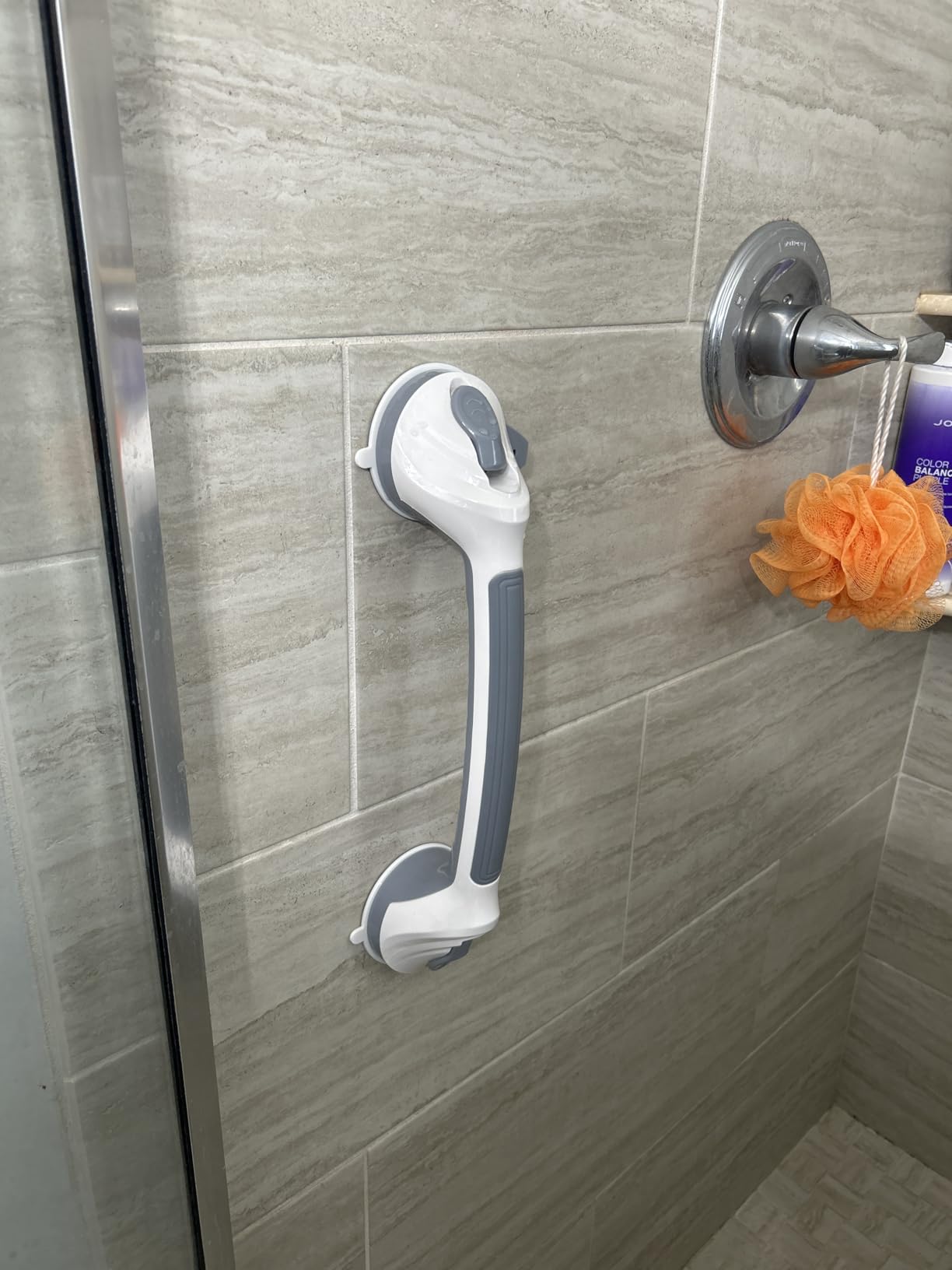
The TAILI is the most reviewed product in this roundup, sitting at the top of the Bath and Shower Grab Bars category, and that volume cuts both ways. Buyers like the tool-free install, the ability to move the bars around the house, and the grip pattern. They also complain about suction releasing, and every complaint we found traces back to the wall surface rather than the bar itself.
Each bar carries two suction cups with locking latches, is 16.8 inches long, and is rated by the manufacturer at 240 pounds per bar. The top of the handle has an anti-slip strip and the underside is curved into a wave shape, which is a genuine help with soapy hands. The listing explicitly limits use to balance assistance rather than full body weight.
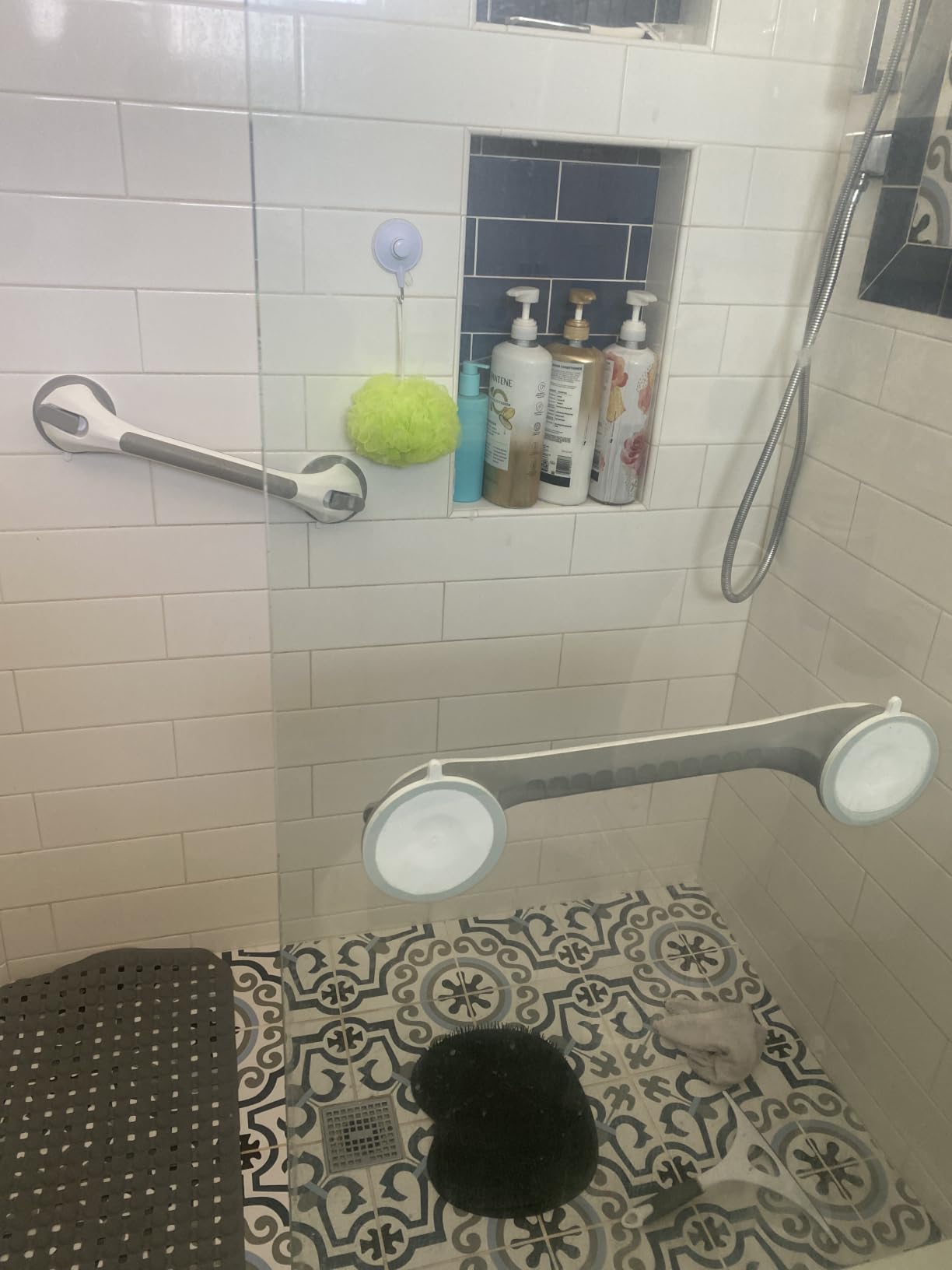
A r/SeniorConsumer reviewer who fitted two of these bars in about five seconds each valued being able to reposition them with no wall damage, and praised the textured top and wave underside for wet grip. That same reviewer reported instant total failure when the same bar was tried on slightly textured tile, which is the single most useful warning in this whole roundup.
They also observed that suction strength diminishes after several remove-and-reinstall cycles, describing it as not unsafe but something you notice, and they adopted a one-second pull test before every shower as a non-negotiable habit. That habit is worth copying regardless of which suction bar you buy.
Who this bar suits best
This suits a smooth, large-format tiled shower where you want two mounting points for the step-over and the exit, and where you want the option to take the bars into a rental or a hotel bathroom when you travel. The two-pack format means you can put one inside the shower and one on the wall beside the tub without buying separately.
It also suits a household where support is needed occasionally rather than daily, such as a visiting relative or a short rehabilitation period, since the bars store flat and leave nothing behind.
Where it falls short
Its 4.1 rating with a 13 percent one-star share reflects real failures, and the 240 pound figure is a static laboratory-style rating rather than a promise about a moving adult. Occupational therapists quoted by Wirecutter are blunt about this category, advising clients to take suction handles out of the bathroom entirely, with one stating she would not put one in her own home.
Do not buy this for textured tile, painted drywall, grout-line-crossing installs, or a shower with a curtain liner pressed against the wall. Any of those and you will be disappointed within a week.
3. Stander Double Handle Pole – Tension Mounted, No Wall Contact
- No wall mounting or drilling at all
- two non-rotating handles adjustable to any height or angle
- 300 lb stated capacity on a steel frame
- works for tub transfer
- toilet
- bedside and wheelchair support
- Cannot be placed inside a bathtub or shower enclosure
- will not work on vaulted ceilings
- 20 lb weight makes it a poor choice for travel or rental moves
This is the most structurally honest no-drill product in the roundup. A spring-loaded pole spans from floor to ceiling and presses between the two, so there is no wall attachment, no adhesive, and no seal. It works on a smooth tile shower wall, a textured wall, or no wall at all, which makes it the correct answer when the wall is not cooperating.
It carries a 4.6 rating across more than 1,400 reviews, and the two non-rotating handles adjust to any height or angle, which is what makes it useful for a transfer rather than just a static handhold. The steel frame is rated at 300 pounds, and ceiling heights from 7 feet to 9 feet 6 inches are accommodated.
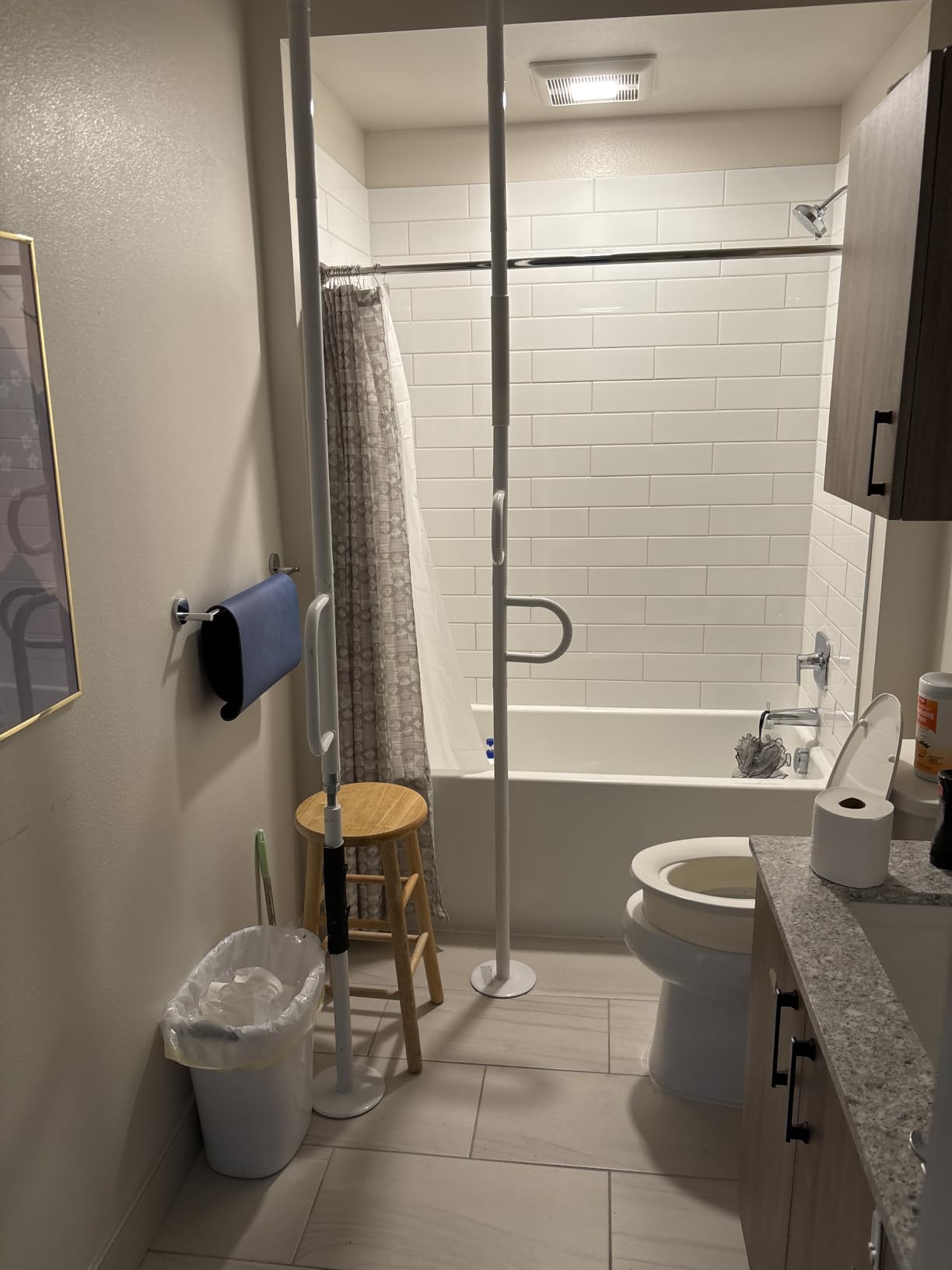
The placement caveat is the thing to understand before you buy. The pole stands beside the tub or shower, not inside the enclosure, so it supports the moment of stepping over the lip rather than giving you a handle while you are standing under the water. For a transfer pole that is exactly the right position, but it is not a substitute for an in-shower bar.
The 20 pound weight is real and worth planning for. This is a fixture for one bathroom in one home, not something you pack for a hotel trip or carry between rental moves.
Who this pole suits best
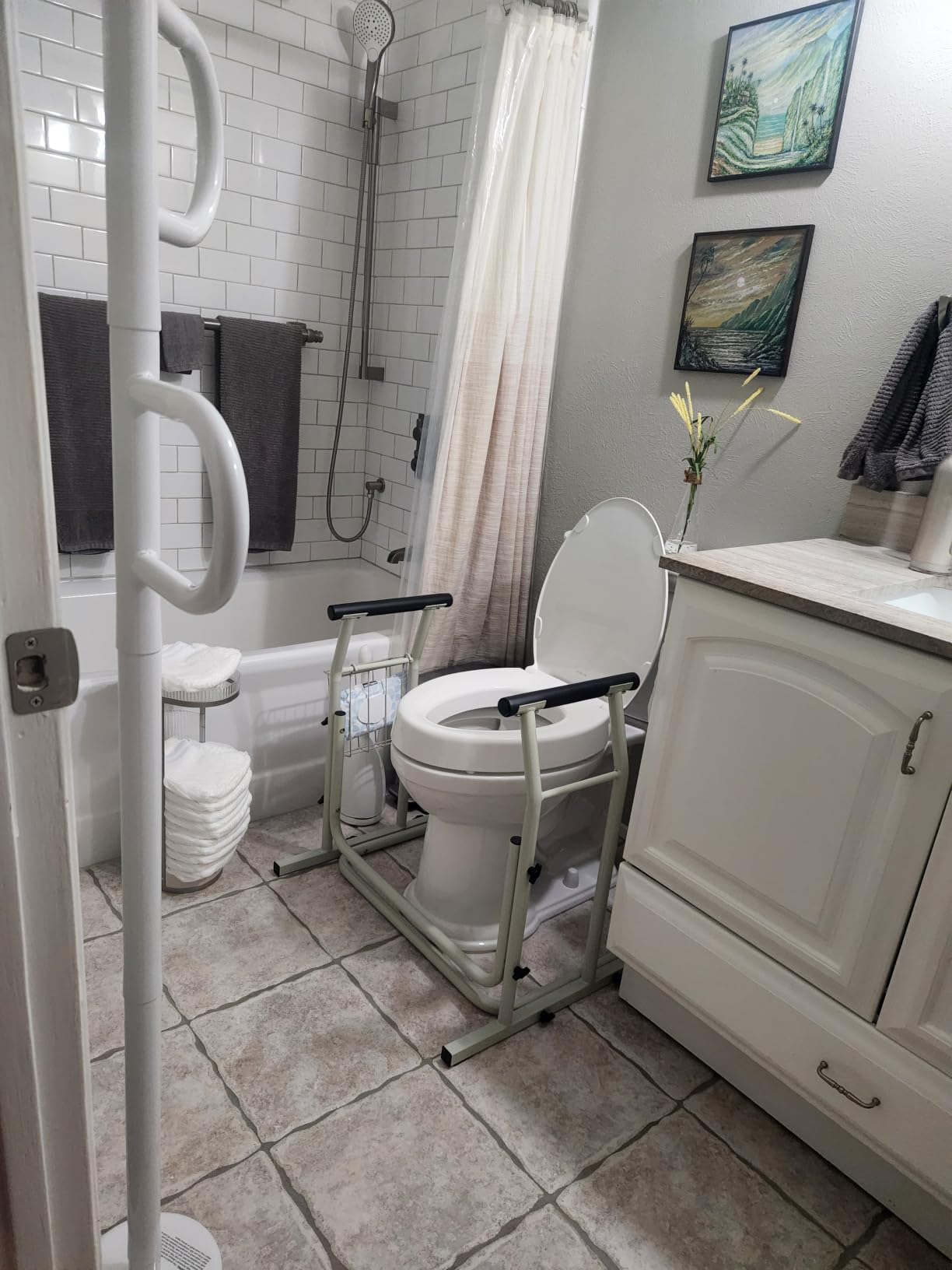
This is the strongest choice for a renter, a finished bathroom that cannot be altered, or anyone whose wall surface makes suction and adhesive mounting impossible. It is also a multi-purpose support: the same pole gets used at the toilet, beside a bed, and for wheelchair transfers, which stretches the value well past the shower.
Two handles at adjustable heights make it particularly good for a household with two different users of different heights, or for a caregiver who needs a low grip while assisting someone else.
Where it falls short
It cannot go inside a bathtub or shower stall, and it will not work with a vaulted ceiling because the pole needs two parallel surfaces. Those two exclusions rule it out for a large share of bathrooms, so check your ceiling first.
It also gives you nothing to hold while washing. If your concern is balance while standing under running water, you need a bar mounted at chest height inside the enclosure, and this is not that product.
4. LEVERLOC 12 Inch Two-Pack – Short Suction Bar for Tight Showers
- Locking latches hold firmly once snapped down
- five-second press-and-lock install with no tools
- two-pack suits opposite shower side walls
- anti-slip handle grip works well with wet hands
- Only adheres to smooth non-porous tile larger than 4x4 inches
- locking latches need real hand force to snap down
- manufacturer states it must not support full body weight
- 12 percent of reviews are 1-star
- mostly suction letting go
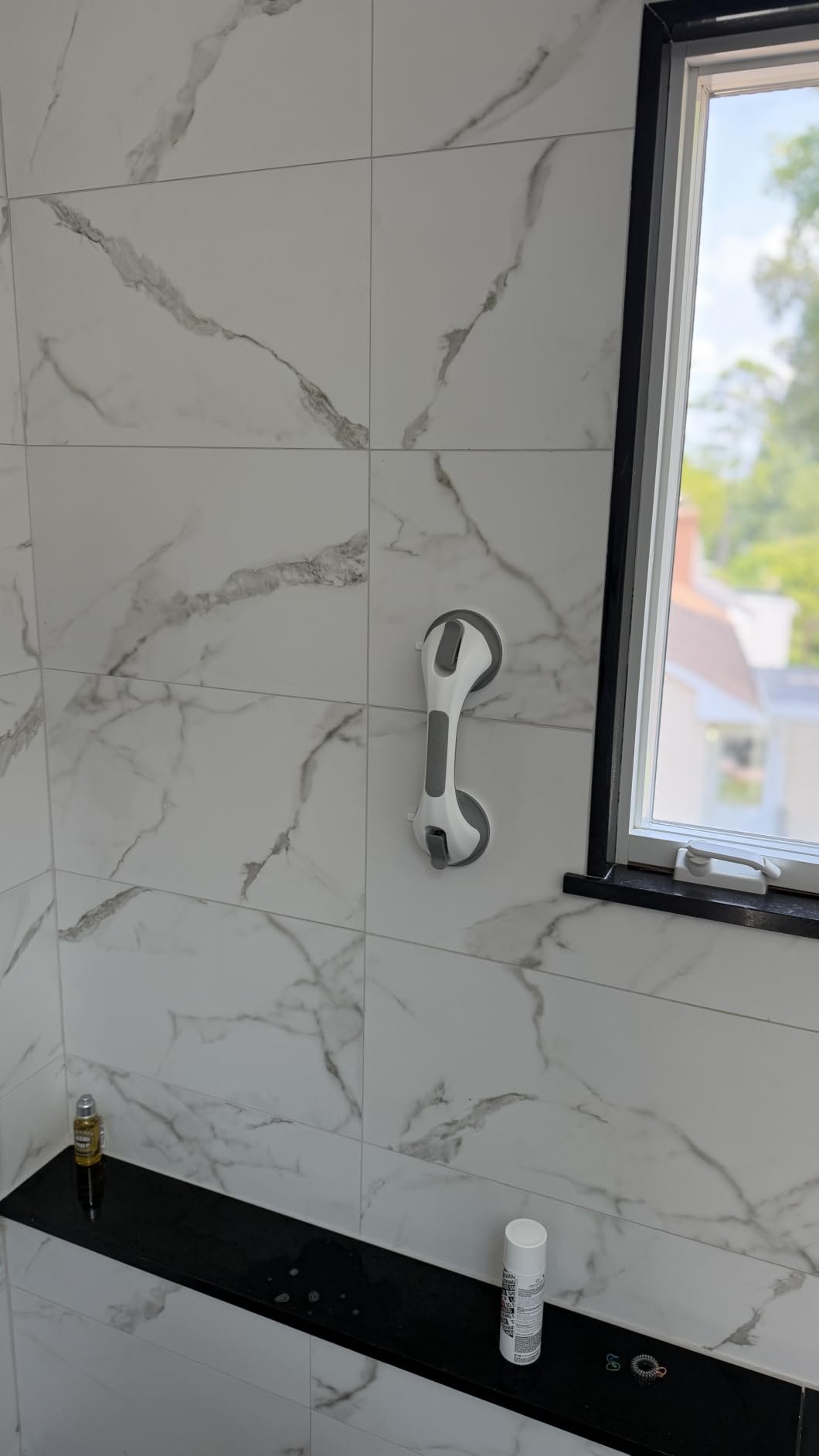
The LEVERLOC is the compact option. At 12 inches it fits a narrow shower wall where a 16 or 17 inch bar would overlap a grout line or run out of flat surface, and the two-pack lets you mount one on each side wall for a matched setup.
Each bar has two suction cups with locking latches, installs by pressing for about five seconds and snapping the latches down, and is rated at 240 pounds by the manufacturer. Buyers who owned cheaper suction bars frequently single this one out as the one that stays put, and the anti-slip top grip is praised by people using it with wet hands.
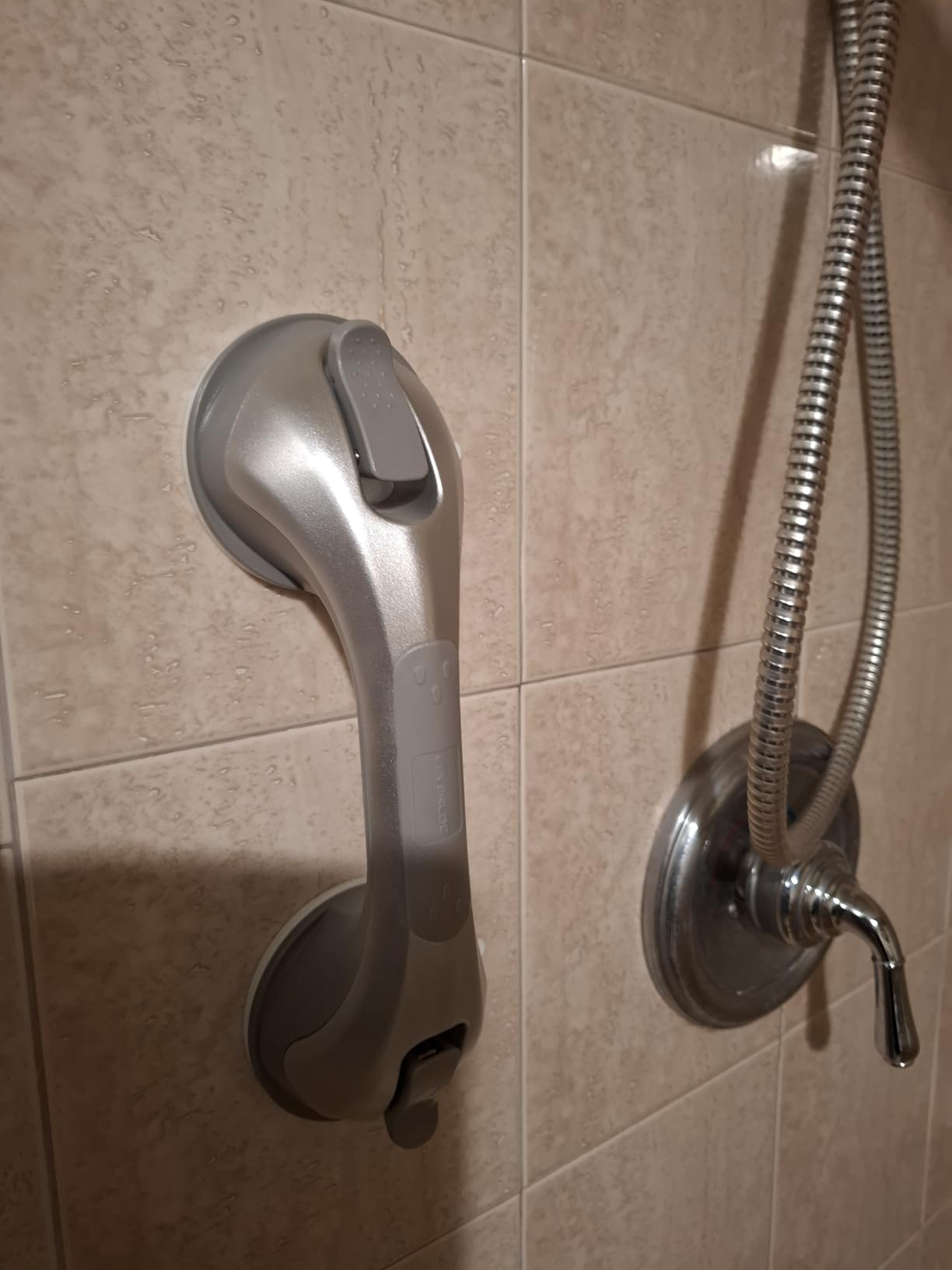
Two practical details stand out. First, the latches require genuine hand force to snap down, and at least one reviewer wears gloves for that step. If your grip strength is limited, plan to have someone set the bar and verify the seal before you rely on it.
Second, the brand itself limits the product to balance assistance rather than full body weight. That is the honest position for a suction bar, and it matches what the manufacturer says about every other product in this suction group.
Who this bar suits best
This is the pick for a small shower where wall space is the binding constraint, and for anyone who wants bars on both side walls for symmetry and reach. Users also comment that it looks less clinical than a clamp rail, which matters if the bar stays up permanently rather than being carried in a bag.
It wipes clean with water and comes out of the wall in seconds, so it works as a semi-permanent install in a bathroom you are not allowed to modify.
Where it falls short
Twelve inches is a short reach. If the wall is wide enough, a longer bar gives you a grip further from the wall, which is easier to grab with a weak hand or when seated. Choose length only when the wall forces you to.
All of the suction limitations apply in full: no painted walls, no drywall, no textured tile, nothing smaller than 4 by 4 inches, and no spanning a grout line. With 12 percent one-star feedback, check the seal every single time.
5. songsoso Adjustable Tub Rail – Height Matching Clamp Bar
Adjustable Bathtub Safety Rail, Bathtub Handle Grab Bar with Non-Slip Grip for Seniors, Elderly, Fits 3.1 to 6.7 Inch Tub Walls, Supports 300 lbs
- Height adjusts from 15 to 18 inches to match different users and tub depths
- stainless steel resists rust on older fiberglass tubs
- triple rubber pads grip firmly without scratching
- tool-free clamping install
- One reviewer reports the clamp loosens over time and needs re-tightening
- requires a smooth flat tub wall
- tub wall width must fall between 3.1 and 6.7 inches
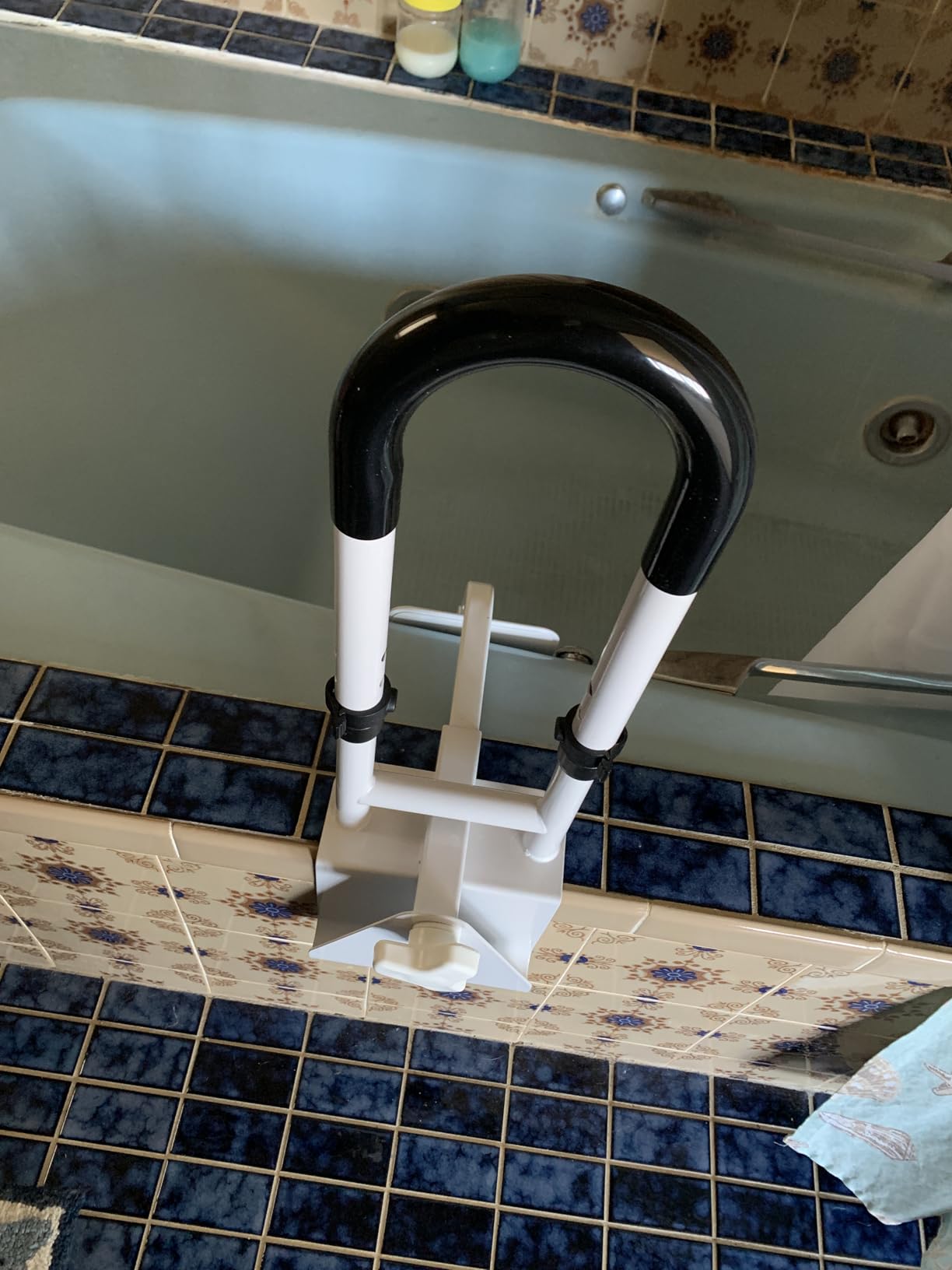
Where the Vaunn is a fixed rail, this one adjusts from 15 to 18 inches, which is the feature that matters if two people of different heights use the same bathroom or if you want the grip matched to a seated position rather than a standing one. The 1.5 inch H-shaped steel tubing is rated at 300 pounds.
The clamp fits tub walls between roughly 3 and 7 inches thick, with a stated fit range of 3.1 to 6.7 inches, and installs with no tools. The tubing is coated stainless steel, and at least one buyer fitted it to a fifty-year-old fiberglass tub that was not perfectly flat, which is encouraging given the amount of fuss most rails make about older tubs.
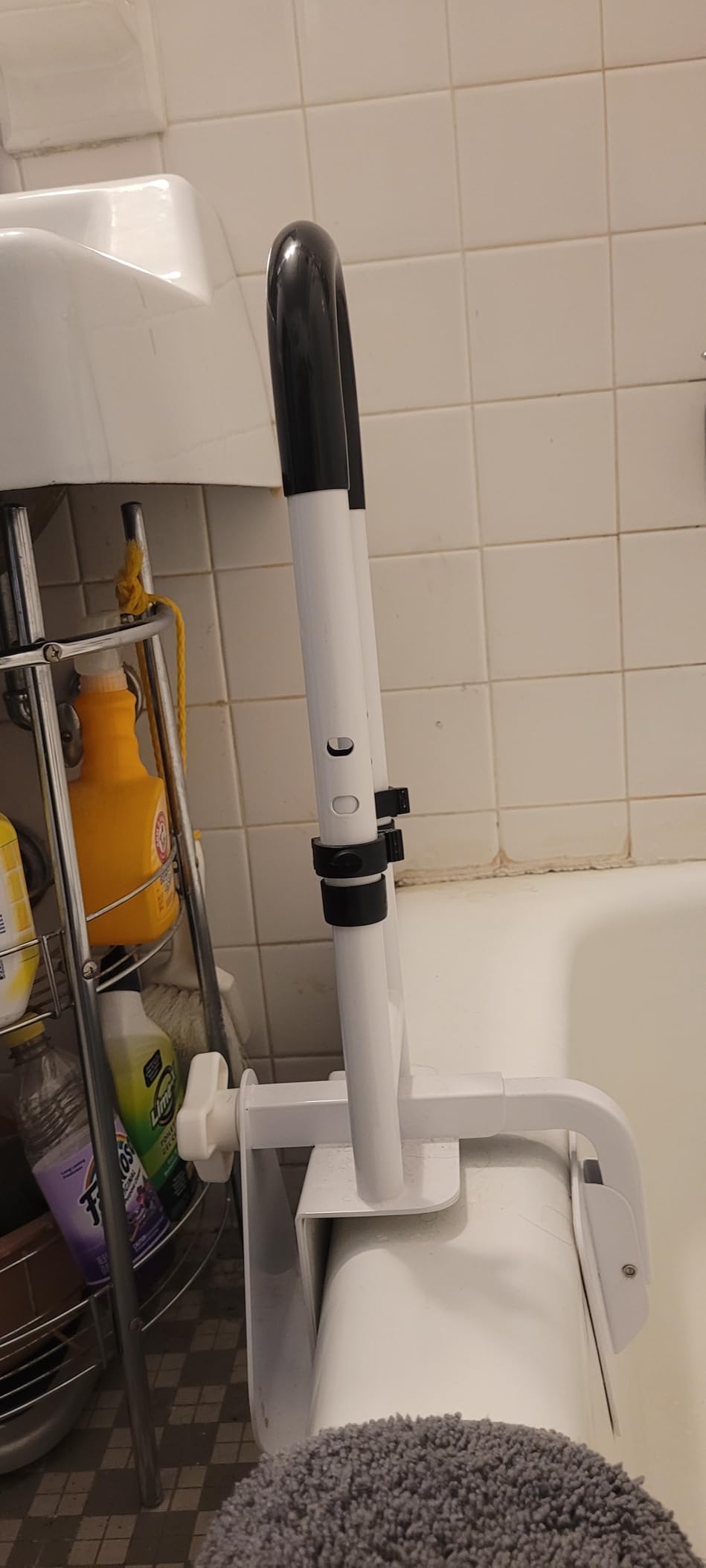
Triple non-slip rubber pads sit between the clamp and the tub so the grip is firm without scratching the surface. That combination of stainless steel and rubber pads is why this rail holds up on older fiberglass where bare steel would pit the gel coat.
The one recurring caution, coming from a detailed four-star review, is that the clamp can loosen with use and needs checking before each entry. That is exactly why it sits at 4.5 rather than higher, and it is a cheap habit to build.
Who this rail suits best
This suits a shared bathroom where the primary user is shorter than average, or a household where someone needs to push up from a low seated position rather than pull up from standing. The height range is modest, but within that range it puts the hand where the hand needs to be.
It is a strong choice for anyone who wants the Vaunn approach with more flexibility and who does not mind a slightly smaller review base.
Where it falls short
The loosening clamp is the honest drawback. A rail that has lost tension is a rail that will move under load, so treat a quick finger-check of the clamp before entry as part of using it, not as an optional extra.
It carries the same surface restrictions as other clamp rails: flat, smooth tub walls only, and a tub wall thickness inside the stated range. Measure before you order, because a tub outside those numbers is a return.
6. HJSDYLIN Three-Cup Grab Bar – Widest Suction Footprint
Grab Bars for Shower Seniors Elderly Heavy Duty Safety Grip No Drill(Gray)
- Three suction cups per bar give a wider and more stable mounting footprint than two-cup designs
- highest rated in this group at 4.6
- no drilling glue or nails needed
- lightweight at 16 ounces so it doubles as a travel aid
- Suction design only works on smooth non-porous surfaces
- listed dimensions of 1 by 1 inch appear inconsistent with a full-length grab bar
- this listing variant has no suction indicator window
Most suction bars in this roundup use two cups per bar. This one uses three, and that extra contact patch is the entire argument for it. A wider footprint spreads load across more of the surface and reduces the rocking you get when the bar is loaded off-centre.
Each bar carries dual locking latches on industrial-strength suction technology, is rated at 250 pounds, and is built from waterproof ABS with a textured anti-slip surface. At 16 ounces per bar it is light enough to live in a travel bag, which makes it the practical pick for a stay in an unfamiliar bathroom.
Two things to know before ordering. The listed dimensions of 1 by 1 inch do not obviously match a full-length grab bar, so if precise sizing matters, confirm it in the listing. And this particular variant does not include the red and green seal indicator offered on some competing models, so you lose the visual check before use.
Who this bar suits best
This suits someone who needs a lightweight, packable bar for travel, a hospital stay, or a short rehabilitation period away from home. The three-cup footprint also makes it the suction bar to consider if your wall is smooth but the flat patch is not enormous.
Its 4.6 rating with only 4 percent one-star feedback reflects a build quality that reviewers consistently notice, and it is the least expensive route into a real three-cup design.
Where it falls short
Without an indicator window you have no visual confirmation of a seal, so the pull test before every shower is not optional here. That is a meaningful disadvantage for anyone with limited vision, and it is the main reason we rated it below the indicator-equipped bars.
Everything else that applies to suction applies here: smooth non-porous surfaces only, nothing smaller than 4 by 4 inches, no grout lines, no painted walls. Published testing has shown suction bars failing well below their stated ratings, so treat 250 pounds as a lab figure, not a working one.
7. Kekoy 17.5 Inch Grab Bar – The Only Bar With a Magnified Seal Window
KEKOY Shower Grab Bars, 17.5in Safety Indicators 1 Pack, Stronger Suction
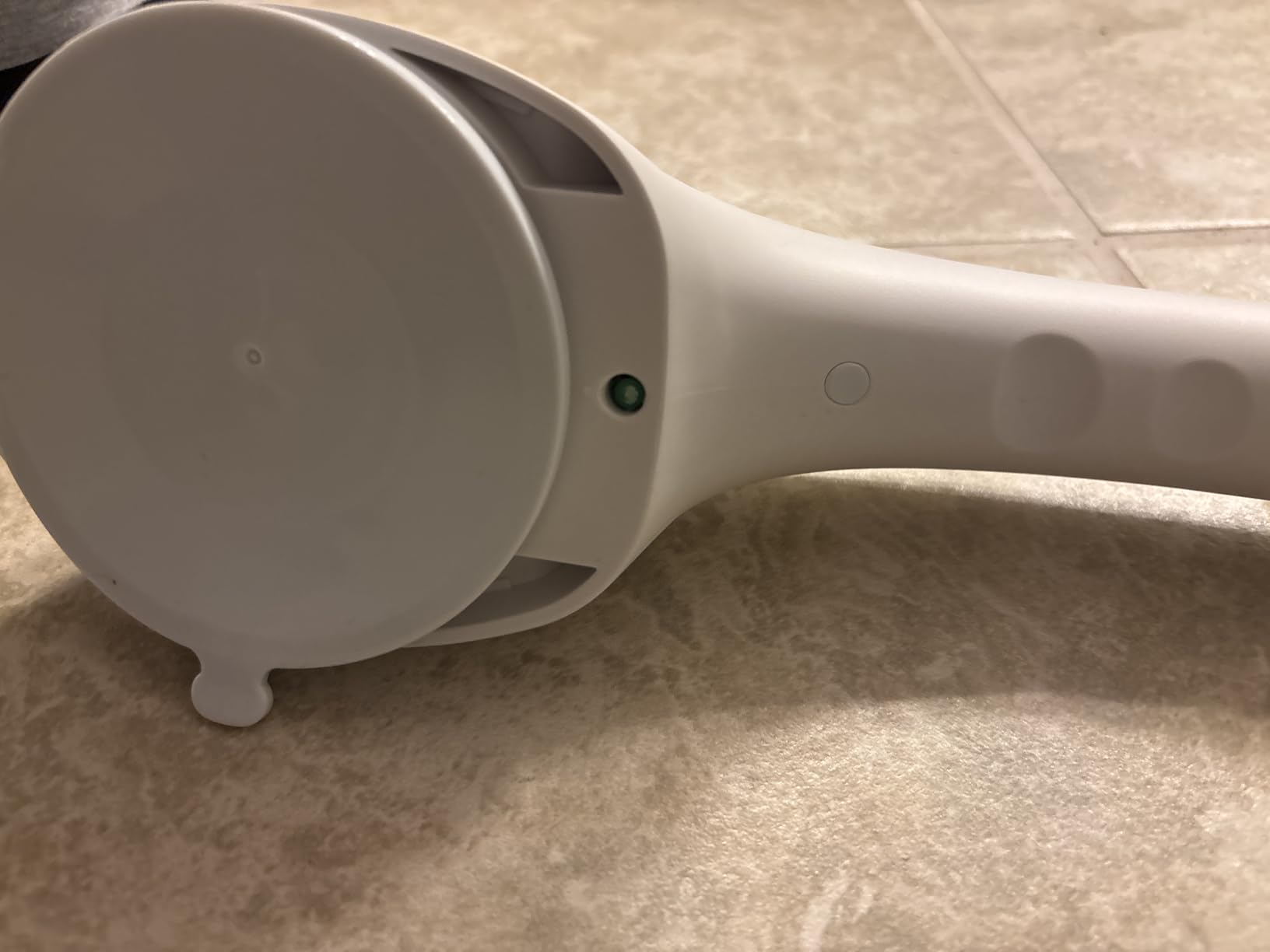
- Magnified two-colour indicator window shows green sealed or red loose at a glance
- 6 mm dual-layer cups with widened sealing rings give a long hold on smooth tile
- supports vertical horizontal and 15 to 75 degree mounting
- 3D diamond texture with an 8 degree finger groove reduces hand fatigue
- Suction strength degrades noticeably on porous surfaces
- one reviewer reports suction loosening repeatedly
- bulky appearance that some find unattractive in a finished bathroom
- sold as a single bar so a second mounting point needs another unit
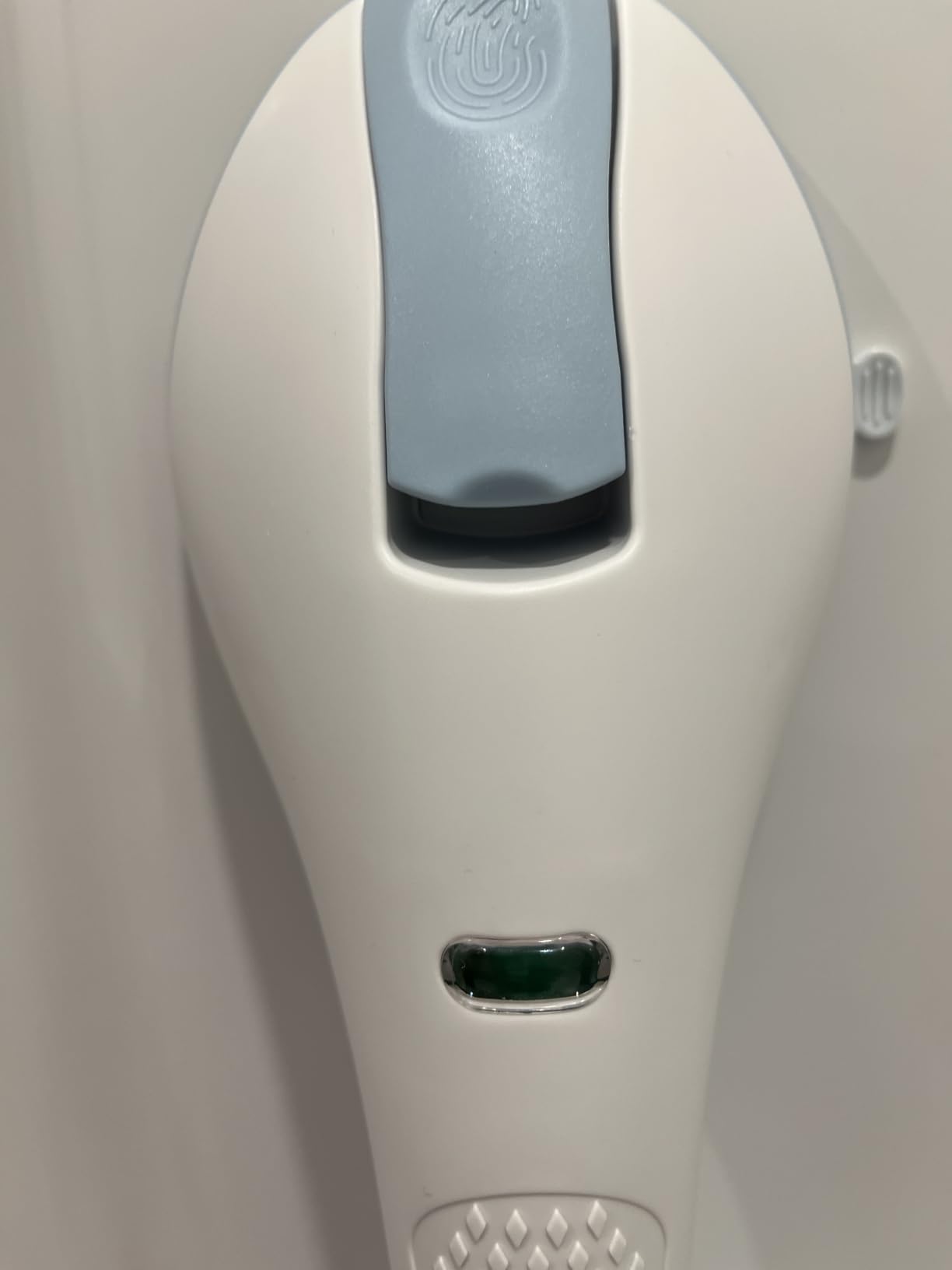
The reason to choose this bar over any other suction option is the indicator window. A magnified two-colour gauge reads green when the seal is set and red when it is loose, which means you can confirm the bar before you step in rather than after. Multiple reviewers describe that indicator as the reason they can use the bar without a helper standing nearby.
The suction hardware is substantial: 6 mm thickened dual-layer cups with widened sealing rings, a stated 12 percent improvement over standard cups, and a peak pull load of 231 pounds. It mounts vertically, horizontally, or at a tilt anywhere from 15 to 75 degrees, and the 3D diamond texture with an 8 degree finger guide groove and a 32 to 35 mm grip diameter is genuinely comfortable over a long shower.
One detailed reviewer benchmarked hold times by surface, reporting no suction loss on high-gloss tile and glass, more than 12 hours on matte counters, and rapid decay on unsealed natural wood. That is exactly the behaviour you should expect from a vacuum seal, and it is useful to have it spelled out.
The negatives are consistent and modest: suction weakening on porous surfaces, occasional reports of repeated loosening, and a handle some people find visually bulky. It is sold as a single bar, so a second mounting point means another unit.
Who this bar suits best
This suits anyone using a suction bar alone, without a caregiver present, because the seal check happens visually rather than by pulling on the handle. It is also a good fit for a glass shower door or a high-gloss tile wall, which is where the hold times hold up best.
The adjustable mounting angle makes it useful at a step-over point where a horizontal handle would sit awkwardly against a sloped wall.
Where it falls short
The 4.3 rating with a handful of loosening reports means it is not flawless, and the indicator only tells you about the seal, not about whether the surface underneath was ever suitable. A green light on textured tile is still a bad outcome.
Aesthetics are a legitimate consideration here. This is a visibly chunky bar, and if you are keeping it up permanently in a finished bathroom, a slimmer profile may suit the room better.
8. Gotega 16 Inch Stainless – The Drilled Alternative for Comparison
Grab Bars for Shower, 2 Pack 16 in Anti Slip Safety Bath Handle for Senior
- Solid stainless steel rated to 500 lbs
- knurled surface gives a reliable grip when wet
- concealed screw cover plates leave a clean look
- mounts at any angle and works in stairways and kitchens too
- Requires drilling and screw fasteners so it is not a no-drill option
- the decorative cover over the fastener does not stay snapped in place
- one reviewer considers the steel thin for the load
- not appropriate for drywall or unanchored surfaces
We are including one product that violates the premise of this article, and we want to be explicit about why. If you own your bathroom and intend to stay, this is what a grab bar actually looks like: two-pack solid stainless bars rated at 500 pounds, mounted into studs with screws, with concealed cover plates hiding the fasteners afterwards.
It holds a 4.4 across more than 3,500 ratings. Owners praise the knurled grip when hands are wet, the ability to mount at any angle, and the fact that many of them buy multiple pairs for stairways and kitchens as well as bathrooms. Repeat purchase is a good sign for a mounting system.
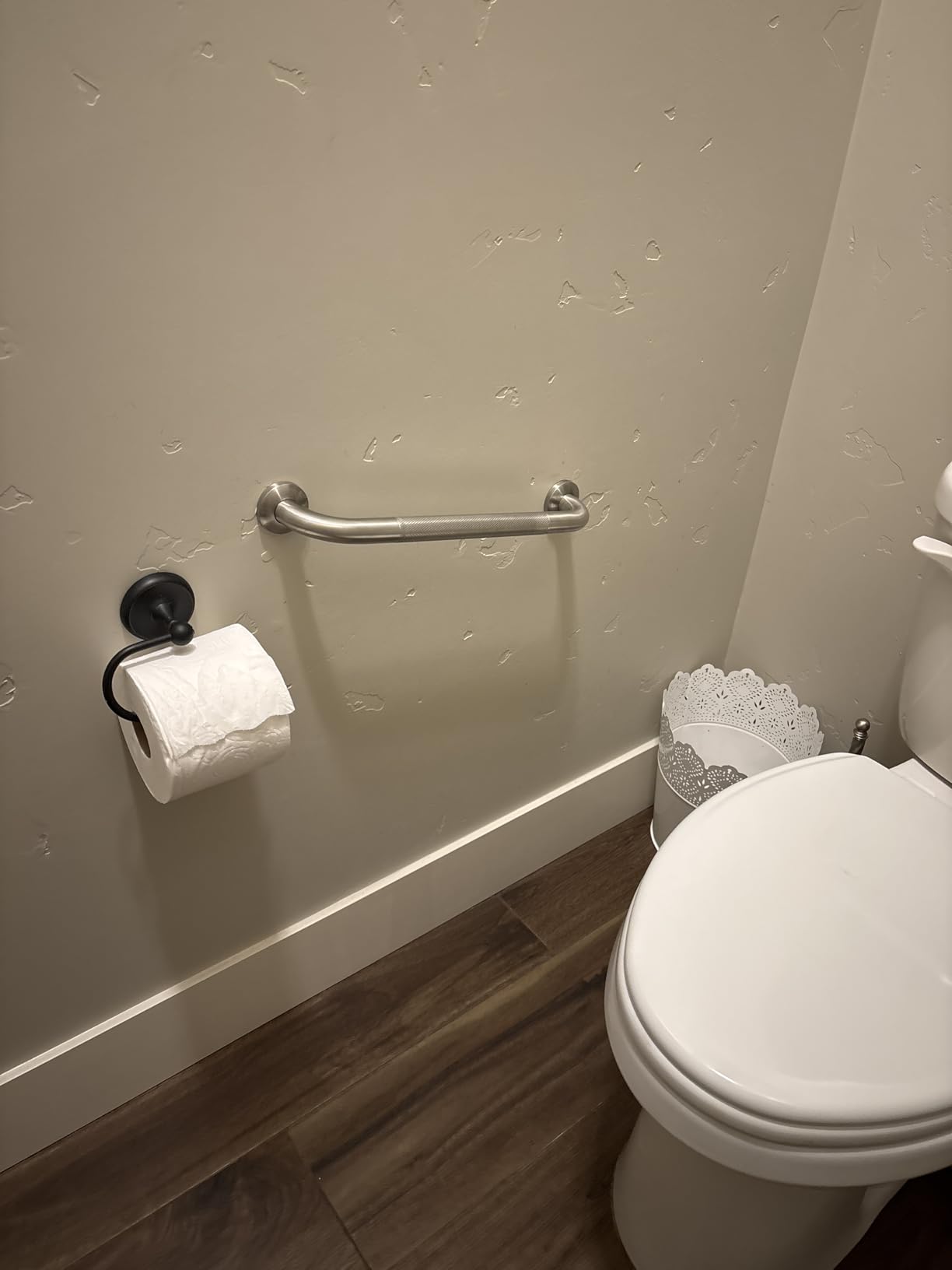
The criticisms are mostly cosmetic. The plastic cover that conceals the fastener pops loose and has to be tapped back into place, and one reviewer considered the steel thinner than the load rating implies.
Installation is the whole trade-off. These are 16 inch bars intended to be fixed into studs, so the drilling that disqualifies them from a no-drill list is also the only reason the 500 pound figure means anything at all. Buy them for a house you own and plan to stay in, and treat the drilling as a feature rather than a flaw.
Who this bar suits best
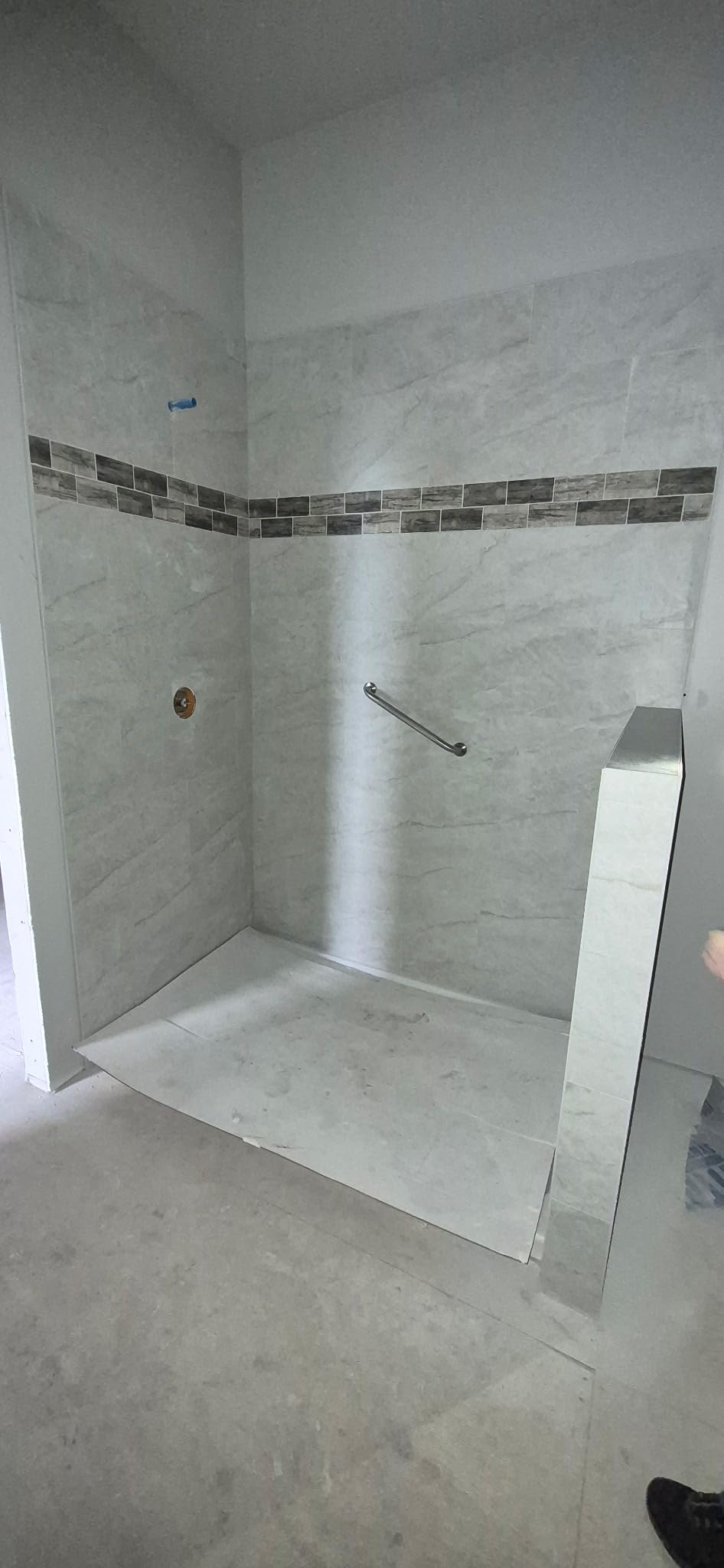
This suits a homeowner who wants a permanent, high-capacity bar and is willing to open a stud wall and anchor it properly. If your household includes someone at a high risk of a serious fall, this is the answer that does not depend on a seal.
It is also the right call when the wall is anything other than smooth tile or glass, because screws into studs do not care what the tile looks like.
Where it falls short
It is not a no-drill product and it should not be presented as one. If you rent, this is off the table without your landlord’s written approval, and it is the wrong product for a bathroom you may leave in a year.
It also needs something solid behind it. On drywall with hollow anchors, a bar that looks fixed is worse than no bar at all, because it gives false confidence. If you cannot reach a stud, this product is not the answer.
9. Reyiu 16.8 Inch Two-Pack – Indicator Bar With Longer Reach
Reyiu Grab Bars for Shower, Updated 16.8″ Shower Handle for Seniors, 2 Pack
- Built-in red and green indicator confirms the seal before use
- 16.8 inch handle is longer than most bars in this group
- two-pack allows two separate mounting points
- 4 mm thickened suction bases with reinforced steel connectors
- Lowest rated in this group at 4.1 with 13 percent one-star feedback
- requires tile of 4x4 inches or larger and fails on painted drywall or uneven surfaces
- manufacturer limits it to support and balance rather than full body weight
- indicator is hard to read with limited vision
This bar does two things well. The built-in red and green indicator lets you check the seal before stepping in, and the 16.8 inch handle is longer than the 12 inch options, which gives you a grip further from the wall and easier to reach with a weak hand.
The cup bases are thickened to 4 mm and the connecting parts are reinforced steel, with a stated rating of 250 pounds. Installation takes about five seconds with no tools and no wall damage, and the anti-slip top strip and wave finger relief underneath match what works well on the other bars in this group.
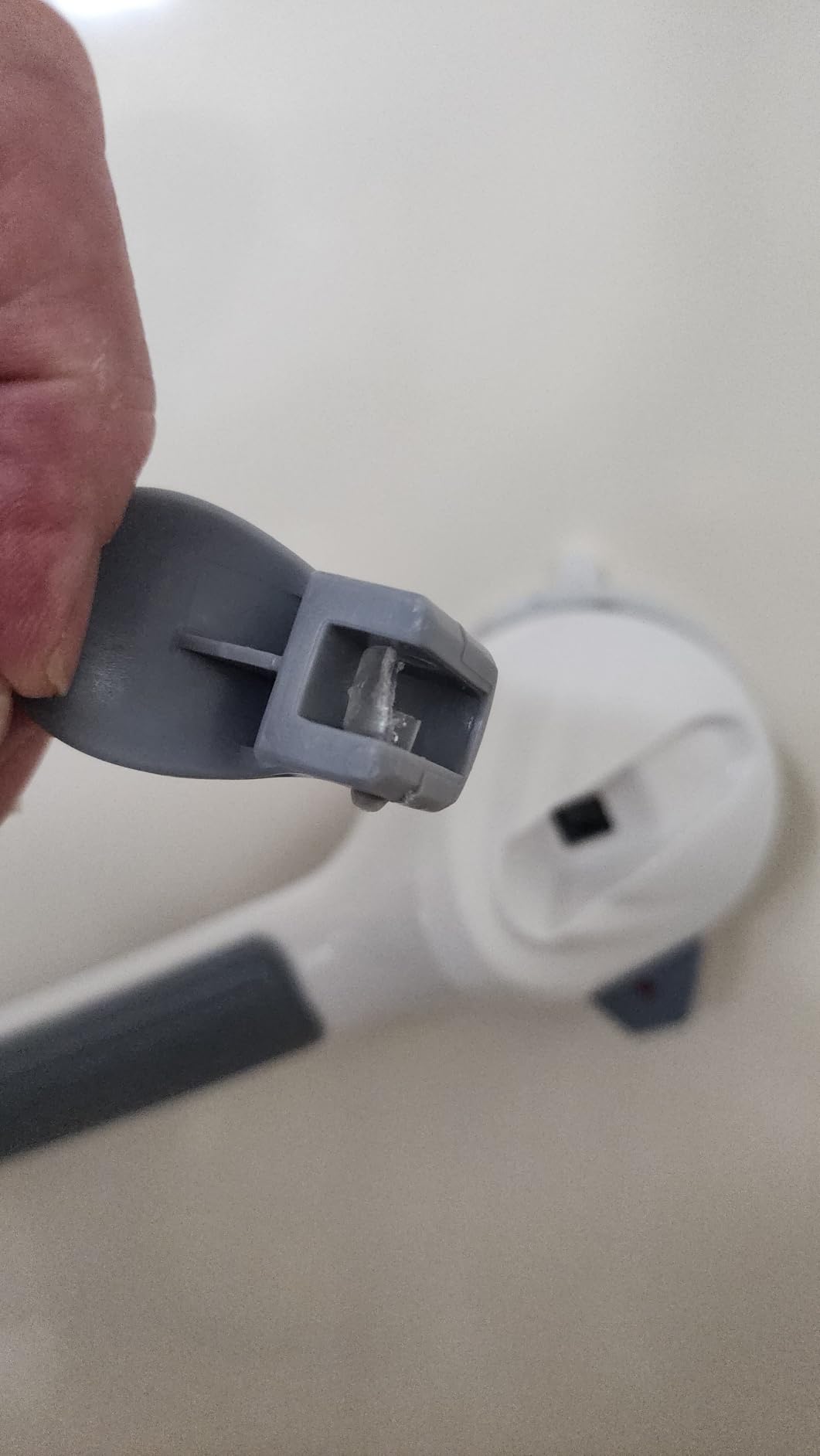
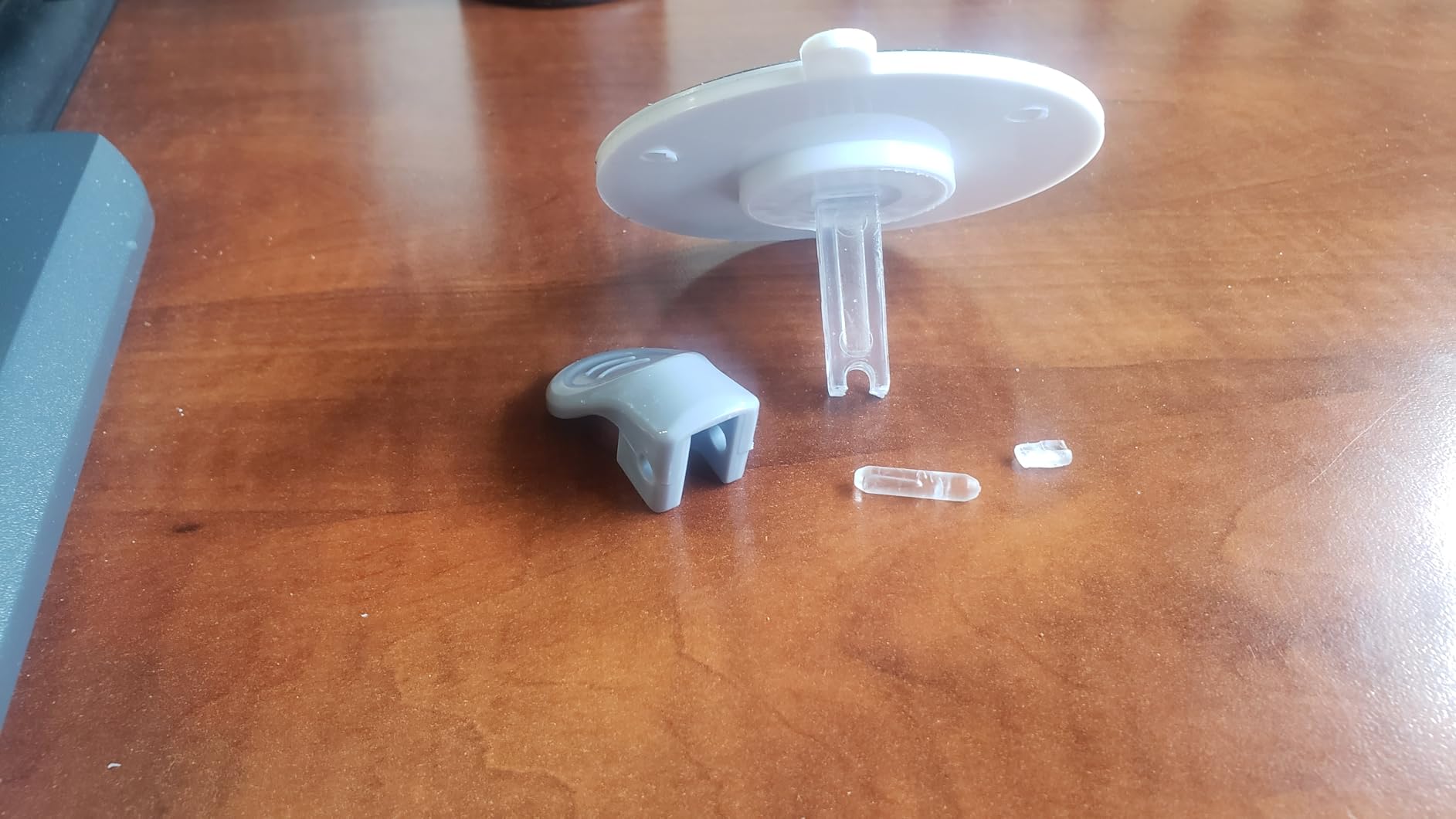
Be clear about the rating. At 4.1 with 13 percent one-star feedback, this is the lowest-rated product here, and the recurring complaint is suction releasing. As with every suction design, the complaints track wall surface type almost without exception.
A r/AgingParents user reported a suction bar working very well, with the practical caveat that they had to cut slits in the shower curtain liner so the bar could actually be reached while showering. That liner problem is common and worth solving before you install anything.
Who this bar suits best
This suits a wide tiled wall where a longer handle gives better reach than a 12 inch model, and a user who wants the indicator check without the bulk of the Kekoy frame. The two-pack covers both the entry point and the far wall of a shower.
It also suits a user who wants the reassurance of an indicator but has a tighter budget for a two-point setup.
Where it falls short
The one-star share is high enough that we would not recommend this as the only support in a bathroom used by someone at meaningful fall risk. If a bar is your primary support, choose the one with the better rating even if it costs a little more.
All suction restrictions apply, plus one specific to indicators: a red and green window is no help to someone with limited vision, who needs the pull test instead.
10. quiheat Two-Pack – Suction Bar That Grips Gel-Coat Fiberglass
Quiheat 2PK Grab Bars for Shower Handle, Elderly Assistance Products, Grey
- Reviewers report strong consistent holds on smooth tile and gel-coat fiberglass
- colour-coded indicators shift from red to green once a seal forms
- understated styling that suits a finished bathroom
- three-second press-and-lock install with no tools
- One of the two bars in a pack kept falling off while the other held
- plastic grip rather than rubber or silicone
- static weight claims are ambitious for a suction product
- must be installed over intact tile and never across grout lines
Reviewers who have owned weaker suction bars tend to rate this one well for simply staying put, particularly on gel-coat fiberglass and large ceramic tile. The adhesion base is 1 inch across with roughly three times the contact area of a standard cup, built around a high-vacuum chamber and a reinforced stabilising ring, and the spring core is 304 stainless steel inside a plastic shell.
The stated figures separate into two numbers: 280 pounds rated vertically and 240 pounds laterally, with the listing describing it as stabilising users up to 385 pounds. The indicators shift from red to green once a secure seal forms, and installation is a three-second press with an easy-pull removal tab.
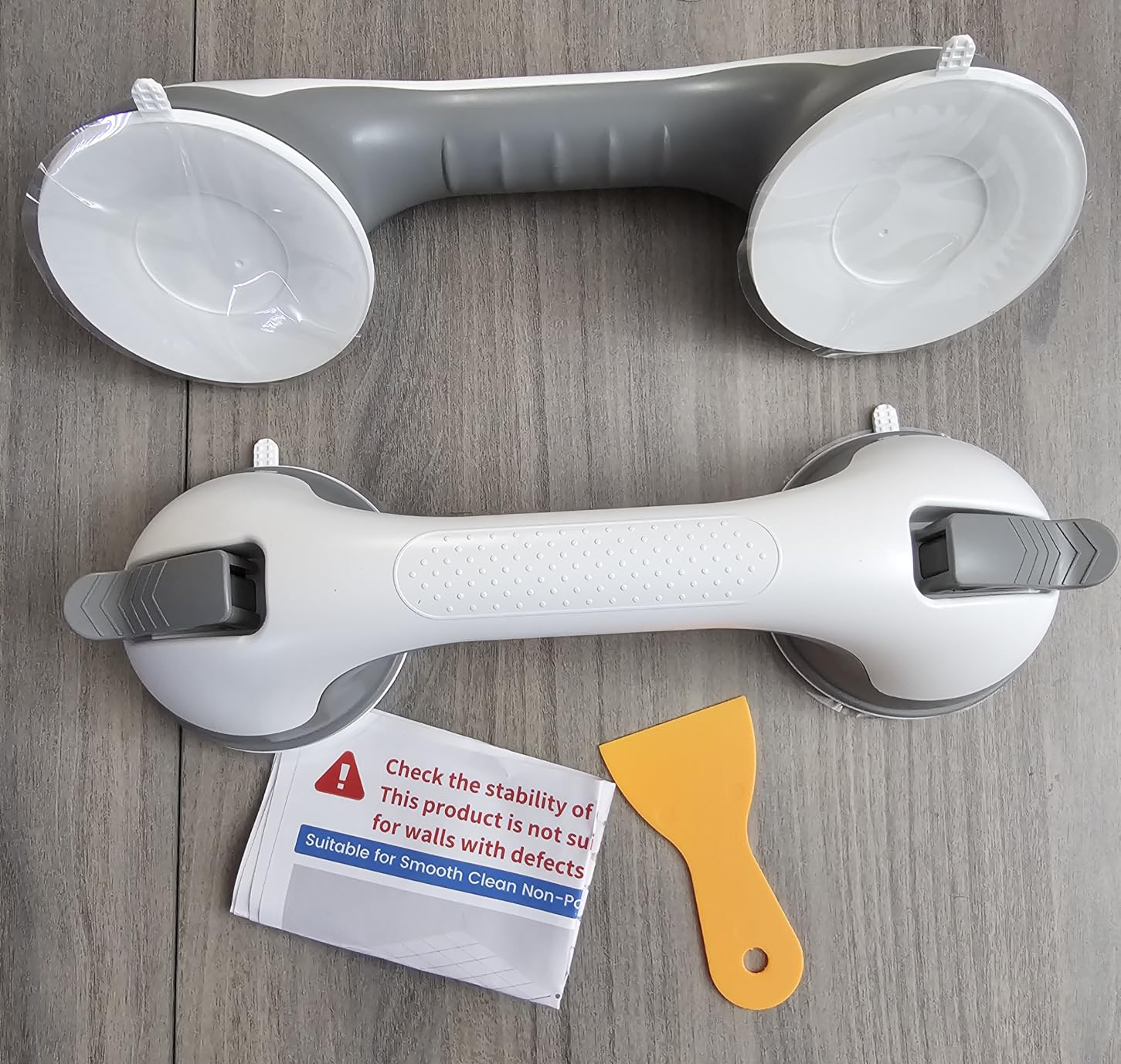
That rating spread is the thing to read carefully. A bar rated 385 pounds that also fails at 280 pounds vertically is telling you the same thing the rest of the category is telling you: the interesting number is the lateral one, which is what happens when your weight arrives off-centre during a slip.
One detailed reviewer notes that suction can settle with bathroom temperature changes, which is a good reason to check the indicator every time rather than assuming a seal from last week is still good. A single one-star report describes a handle that repeatedly released.
Who this bar suits best
This suits a fiberglass tub or a smooth acrylic surround where a conventional tub clamp rail cannot get a flat bite. It is also the one suction bar here that reviewers consistently describe as looking understated enough to leave up permanently in a finished bathroom.
If you want colour-coded confirmation without the weight of a larger frame, the indicators here do the job.
Where it falls short
The pack quality problem is worth flagging: one buyer reported that of the two bars in a pack, one held and the other repeatedly released even after repositioning. Test each bar separately on your own surface rather than assuming a good result transfers.
The grip is plastic rather than rubber or silicone, which at least one reviewer would have preferred for a wet hand, and those ambitious static weight figures should be read as lab numbers with no bearing on a dynamic slip.
Will a No-Drill Bar Stick to Your Shower Wall? Surface Rules
Surface compatibility decides success or failure more often than product quality does, and it is the check buyers most often skip. Before buying anything, identify exactly what your wall is.
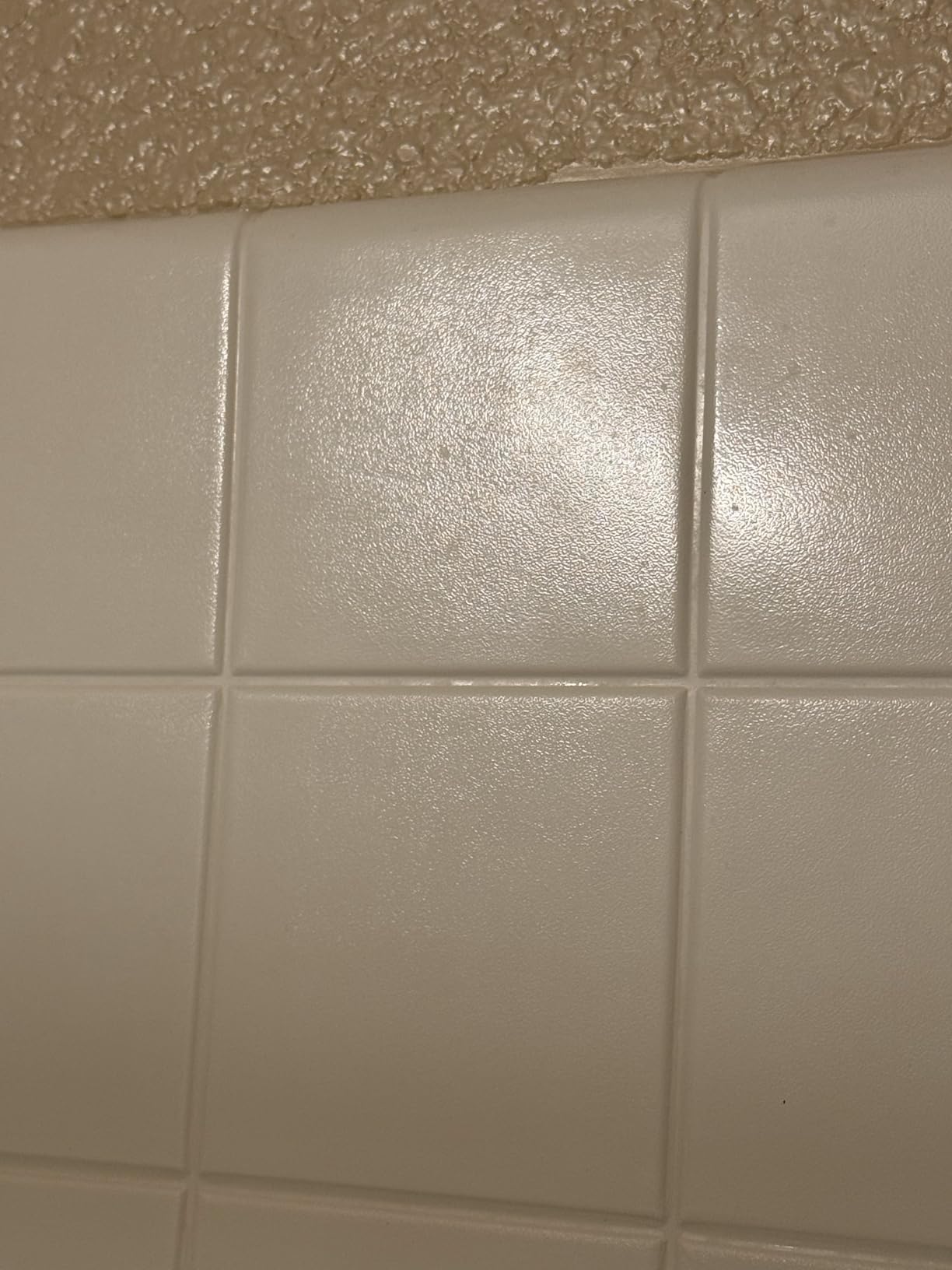
Smooth non-porous surfaces are what suction and adhesive systems need: glossy ceramic tile, glass, polished stone, glazed acrylic, and gel-coat fiberglass. Porous surfaces break the seal. Painted drywall, unpainted drywall, natural wood, unsealed grout, and textured or matte tile all cause either immediate failure or rapid decay.
Size matters as much as material. A suction cup needs roughly a 4 by 4 inch patch of flat uninterrupted surface, which means tiles must be at least that size and the cups must sit entirely on one tile. Anything smaller is a failure risk regardless of how good the product is. If your shower has many small tiles with wide grout lines, suction mounting is off the table and you should be looking at a clamp rail or a tension pole.
Grout lines are the other silent killer. A cup that bridges a grout line has no continuous airtight surface to hold against, and adhesive pads have the same problem in a different way. Two further practical notes: shower curtain liners pressed against the wall physically block a wall bar, and cutting slits in the liner is what one AgingParents forum user did to make a bar usable while showering.
If your wall fails any of these tests, stop shopping for a better suction bar. The problem is the wall, and the answer is a mount that does not depend on the wall at all. If you are not sure what is behind a wall or what a fair drilling job involves, it is worth checking whether the job is worth a handyman before committing to hardware, and our piece on learning a technical trade without a degree covers the same self-directed approach.
Stated Weight Capacity vs What Actually Happens
The capacity numbers in this category are close to meaningless as safety information, and understanding why is the most useful thing on this page. A figure like 240 or 385 pounds is typically a static laboratory pull measured on a smooth, flat, idealised surface with the load applied straight down and slowly. A fall is none of those things.
Independent testing has shown suction bars letting go at far lower weights. Wirecutter load tested suction bars with progressively heavier dumbbells and recorded the AmeriLuck 16.5 inch suction bar crashing to the floor at 92 pounds and the Safety and Beauty bar failing at 70 pounds. Both numbers are below the weight of most adults using the bar for assistance, which is why that publication declines to recommend any suction-style assist bar at all.
Occupational therapists quoted in that same testing were blunt. One said she would not recommend it to a client, to a family member, and would not put it in her own home. Another described suction handles as the first thing she tells clients to remove.
So how should you read a capacity figure? Treat it as an upper bound under perfect conditions, discount it heavily for any dynamic load, and apply a personal weight factor of about three before you rely on it for a person at real fall risk. For a household where the primary user weighs under about 100 pounds and needs a steady hand during a slow transfer, a good suction bar with an indicator and a pull-test habit is a reasonable tool. For a larger adult or someone who has already fallen, it is not, and the honest recommendation is a clamp rail, a tension pole, or a drilled bar.
Installing, Pull-Testing and Removing Each Mount Type
A bar you do not check is a bar you do not trust, and the check takes a second. This is the routine we recommend for every suction bar, and it costs nothing.
Clean the mounting patch with a non-abrasive cleaner and dry it completely. Water, soap film and body oil under a cup are the most common causes of a weak seal, and this step fixes most complaints before they happen.
Check your tile size and confirm both cups will sit fully on one tile with no grout line underneath. If they cannot, stop and choose a different mounting family rather than hoping.
Press each cup firmly for the stated time, five seconds on several of the products here, then snap the locking latches down and check that the indicator reads green if the bar has one.
Pull test before every use. Put one hand on the bar and pull outward and downward with firm but controlled pressure. It should not move at all. If it shifts, reseat it. If it shifts again, the surface is unsuitable and you should change products, not repeat the test.
For clamp rails, the equivalent check is different. Verify the locking clamp is still tight before each entry, particularly on the songsoso rail where loosening with use has been reported. For tension poles, check that both the floor pad and the ceiling pad are in full contact and that the pole has not been knocked out of plumb.
Removal is straightforward for suction and clamp mounts. Break the seal with the release tab or a fingernail and lift away, then wash the surface. Adhesive systems are the difficult case, which is part of why none appear in our picks: they need heat and a release agent, and a r/Tile user who recommended the leading adhesive brand flagged residue as a real consideration even while reporting that the bars worked perfectly.
Renting a Bathroom With a Grab Bar in It
Renting is the underlying motivation behind most no-drill searches, and it comes with more legal protection than most tenants realise. In the United States, the Fair Housing Act requires landlords to make reasonable modifications to existing housing at the tenant’s expense for a person with a disability, and a grab bar is one of the modifications most commonly approved. That applies whether you rent an apartment, a house, or a condominium.
A no-drill product sidesteps the question entirely, which is why the suction bars and clamp rails in this roundup exist. Nothing is drilled, nothing is filled, nothing has to be repaired at move-out, and the whole setup can be carried in a bag. If you are a renter who wants support without any conversation with a landlord, the tension pole or a suction two-pack is the right answer.
The practical advice is to document the wall condition with photographs before you install anything. That protects your deposit if an adhesive system ever does mark a surface, and it takes two minutes.
How to Choose the Right No-Drill Grab Bar
Start with the wall, not the product. Measure the tile, check the finish, and confirm there is no shower curtain liner blocking access. If the surface fails any of those checks, the choice has already been made for you and it is a clamp rail or a pole.
Next, decide whether the bar is for stepping over a tub lip or for standing under running water. Transfer support is best served by a clamp rail or a tension pole at the entry point. In-shower balance needs something mounted inside the enclosure, which narrows the field to suction bars on a suitable wall, or a drilled bar.
Then choose by user, not by rating. Weight, grip strength, vision and whether a caregiver is present all change which mechanism is appropriate. A user with limited vision should prioritise an indicator window. A user with limited hand strength should avoid locking latches that take force to snap down. A user who cannot pull on a bar to test it needs an indicator or a non-suction mount.
Finally, think about permanence. A temporary need, such as a visiting relative or a short rehabilitation period, is served well by a packable suction bar. A permanent need in a home you own is better served by a clamp rail that stays put, and a permanent need for someone at high fall risk is best served by a drilled bar into studs.
Whatever you choose, add a second support point. Nearly every serious fall in a shower happens during the step-over or the exit, and one bar at the wrong point helps less than two bars at the right ones.
When No-Drill Is the Wrong Choice
There are situations where spending money on a professional drilled install is money well spent, and we would rather say so than sell you another suction bar.
If the person using the bathroom has already fallen, or is at high risk of a serious fall, no-drill is the wrong category. A balance aid that can release is worse than no support, because it produces false confidence. Talk to an occupational therapist about a properly anchored bar installed into studs, and ask your landlord about the reasonable modification if you rent.
If your walls are textured, painted, or small-tile, no suction product will work and an adhesive system is a permanent alteration dressed up as a temporary one. Drill it properly instead, with the cover plates that hide the fasteners.
And if the shower is a walk-in stall with no tub lip, a clamp rail cannot reach it. Either use a tension pole beside the entry, or commit to drilling. There is no third option that we would trust.
Frequently Asked Questions
Are there any grab bars for showers that don’t require screws?
Yes. Three mounting families avoid screws entirely: suction cups that seal against a flat non-porous surface, adhesive pads that bond chemically to tile or glass, and a tension pole wedged between floor and ceiling. Tub rim clamps are a fourth option that grips the tub edge with mechanical force. All of them are balance aids, not fall-arrest devices.
Do no drilling grab bars work?
They work, with limits. Tub clamp rails and tension poles are mechanically secure and support several hundred pounds. Suction bars depend entirely on an airtight seal over a flat surface at least 4 by 4 inches, and independent testing has shown suction bars failing at 70 and 92 pounds. They are balance aids for steady standing, never devices for catching a fall.
What are the best adhesive grab bars for showers?
Adhesive grab bars are the one no-drill family we did not recommend. They hold steady load on smooth tile and glass, but they are the hardest mounting type to remove without residue or finish damage, which matters in a rental. For a permanent need in a home you own, a screw-mounted bar into studs is a better long-term answer than adhesive.
Do suction shower grab bars really work?
On the correct surface they work well for balance assistance, and on the wrong surface they fail without warning. They need smooth non-porous material such as glossy tile, glass, or gel-coat fiberglass, with a flat patch roughly 4 by 4 inches and no grout line underneath. They will not hold on textured tile, painted drywall, or unsealed natural wood.
How do you get suction cup grab bars to stick?
Clean and fully dry the mounting patch first, since water, soap film and body oil are the usual culprits. Confirm both cups sit on one tile with no grout line underneath. Press each cup firmly for the stated time, snap the locking latches down, and check that any indicator reads green. Then pull test the bar before every use.
How much weight can a no-drill grab bar hold?
It depends entirely on the mount. Clamp rails and tension poles are rated around 300 pounds and depend on mechanical force rather than a seal. Suction bars are advertised from 240 to 385 pounds, but those are static lab figures on ideal surfaces, and independent testing recorded failures at 70 and 92 pounds. Discount any suction figure heavily for a real slip.
Will a suction grab bar work on textured tile?
No. Textured, matte and small-format tile are the most common cause of suction complaints, and forum users report instant total failure when moving a bar that worked on smooth tile over to a textured wall. If your shower tile has texture, choose a tub clamp rail or a tension pole instead of any suction or adhesive product.
Which No-Drill Grab Bar Should You Buy
If we had to pick one bar from this list, it would be the Vaunn Medical Secure bathtub rail. A 4.6 rating across more than 12,700 reviews, a powder-coated steel frame rated at 300 pounds, and a mechanical clamp that does not depend on a seal make it the safest and most durable no-drill option for a standard flat-walled tub in 2026.
For a smooth tiled shower wall, the TAILI two-pack is the general-purpose pick, used with a pull test before every shower. For a rental, a textured wall or a walk-in stall, the Stander tension pole is the right answer because it never touches the wall. And if you own the home and the need is permanent, drill a bar into studs, because that is the only option here that will still be there in ten years.
Whatever you choose, install it this week rather than saving it for the fall. The whole point of a grab bar is the moment you need it, and that moment is never scheduled.