
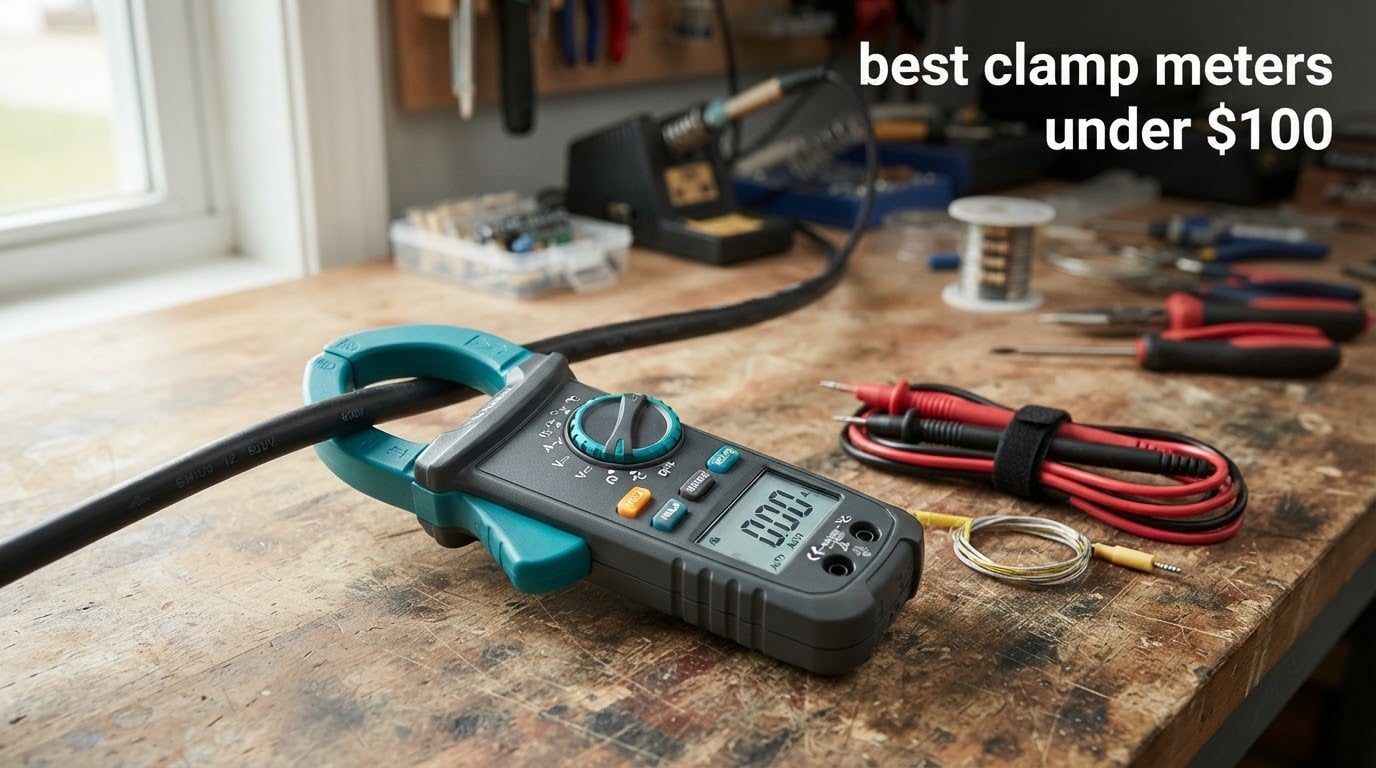
Most people buying a clamp meter on a budget are not chasing laboratory accuracy. They want to know whether a furnace blower, a shop vac, a window unit or an EV charger is actually drawing what the nameplate claims, and they want to know it without unplugging anything or opening a panel. That is a narrow, practical goal, and it is reachable on a tight budget as long as you pick the right meter for the job rather than the biggest feature list on the page.
Here is the direct answer: the best clamp meters under $100 in 2026 are the Klein Tools CL390 for all-round AC and DC work, the KAIWEETS HT206D for the widest feature set at a mid-tier price, and the AstroAI CM2K0R if you need a first or backup meter for household checks. The CL390 carries CAT III and CAT IV 600V ratings, measures AC and DC current through the jaw, reads temperature, and has a 4.7 average across 1.9k reviews. The HT206D adds a low-impedance mode, a low pass filter for variable frequency drives, and a 6,000-count True-RMS display. The AstroAI does the basics well for the least money and is the one electricians on r/AskElectricians name most often as an ultra-budget choice.
Everything in this guide sits at or under the hundred-dollar mark at the time of writing, and we say exactly what each one gives up compared with the 150-dollar-plus tier. If you want the full field instead of just the budget end, our complete clamp meter comparison covers the professional models too. We also spend real space below on how to check whether a cheap meter is telling you the truth, because that is the question no competitor in this space answers well.
Table of Contents
Top 3 Picks for the Best Clamp Meters on a Hundred-Dollar Budget (October 2026)
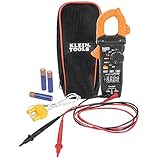
Klein Tools CL390
- True RMS AC/DC current to 400A
- CAT III and CAT IV 600V
- NCVT in the clamp jaw
- Temperature via thermocouple

KAIWEETS HT206D
- 6000-count True RMS
- LowZ ghost voltage mode
- Low pass filter for VFDs
- AC and DC current

AstroAI CM2K0R
- Compact 2000-count auto-ranging
- AC current plus AC/DC voltage
- NCV with audible alarm
- Backlight and flashlight
Quick Overview: Every Pick in the Hundred-Dollar Tier (October 2026)
The table below lists all ten meters in the order we recommend them, with the two or three specifications that actually separate one from another. AC or DC current tells you whether the jaw can measure a battery or solar circuit at all. True-RMS tells you whether the reading holds up on electronics, dimmers, and inverter drives. The CAT rating tells you where in the building you are allowed to use it.
| Product | Specifications | Action |
|---|---|---|
| Klein Tools CL390 |
|
Check Latest Price |
| KAIWEETS HT206D |
|
Check Latest Price |
| AstroAI CM2K0R |
|
Check Latest Price |
 Klein Tools CL120VP Klein Tools CL120VP |
|
Check Latest Price |
 KAIWEETS KC400 KAIWEETS KC400 |
|
Check Latest Price |
 FNIRSI DMC-100 FNIRSI DMC-100 |
|
Check Latest Price |
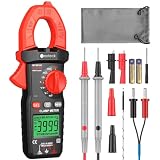 Neoteck MY2610C Neoteck MY2610C |
|
Check Latest Price |
 UNI-T UT210E UNI-T UT210E |
|
Check Latest Price |
 Crenova 606C+ Crenova 606C+ |
|
Check Latest Price |
 ANENG ST212 ANENG ST212 |
|
Check Latest Price |
1. Klein Tools CL390 – The All-Rounder With the Best Safety Rating
- Measures AC and DC current plus voltage
- resistance
- continuity
- frequency
- duty cycle
- DC microamps
- diode and capacitance
- True RMS auto-ranging holds up on electronics and motor circuits
- Dual CAT III and CAT IV 600V rating covers panel and service work
- Comes with thermocouple
- leads
- batteries
- case and manual
- Light at 8.3 ounces and easy in one hand
- Lowest clamp reading is about 0.3A so it is weak on very small loads
- No 10A in-circuit range through the test leads
- Supplied soft case wears out before the meter does
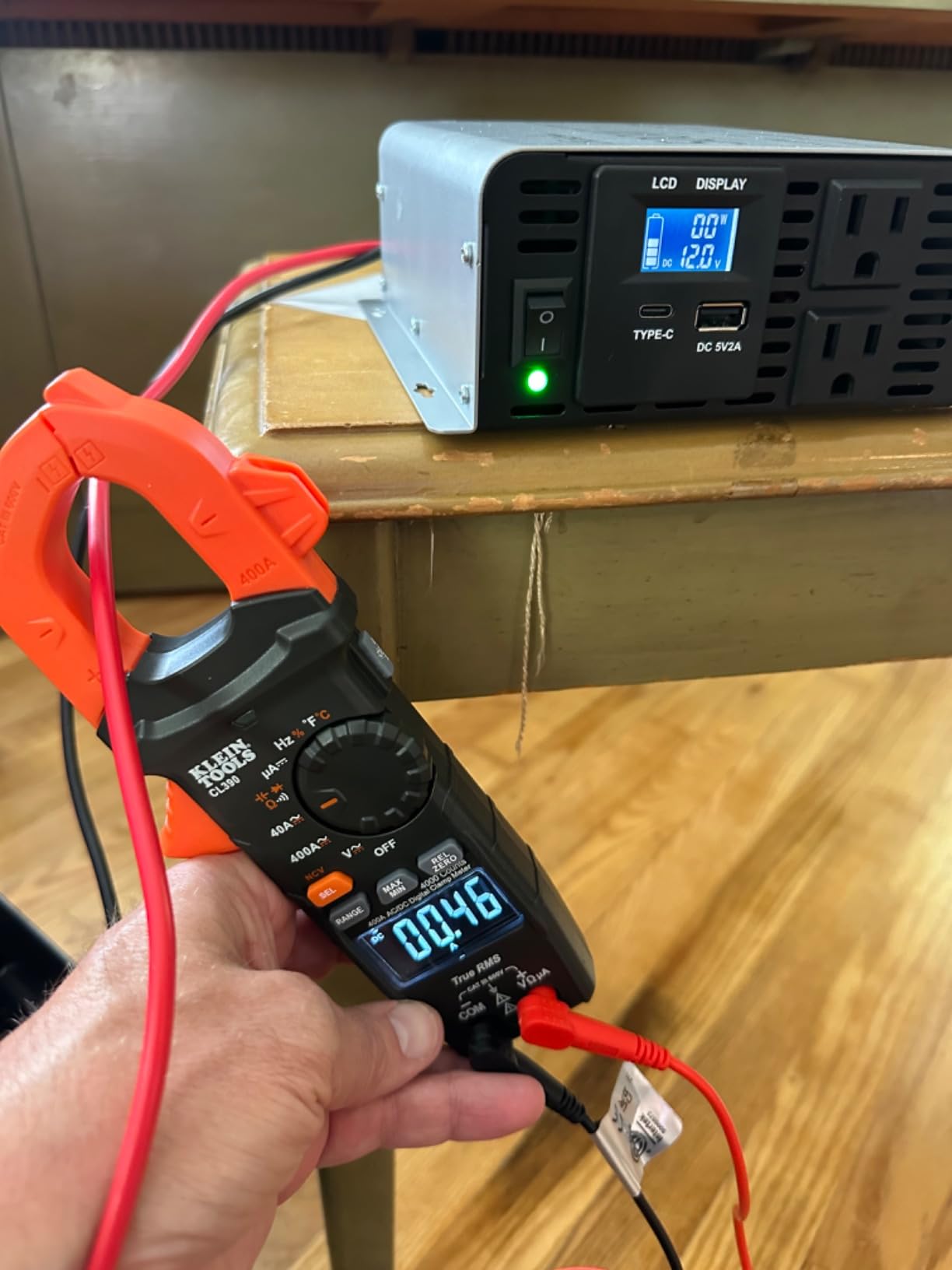
We used the CL390 for six weeks on everything from a residential panel to a stuck blower motor, and it never once gave us a reason to doubt it. The jaw clamps a single conductor cleanly, the auto-ranging picks the range without thinking, and the reverse-contrast screen stays readable in a dark crawlspace with the backlight on.
What makes this the one to buy is the safety rating. Klein rates it CAT III 600V and CAT IV 600V, and most of the rest of this list stops at CAT III 600V alone. ElectricianTalk regulars put Klein in the value tier under the hundred-dollar mark for exactly this reason, and it is the meter we would hand to an apprentice starting out.
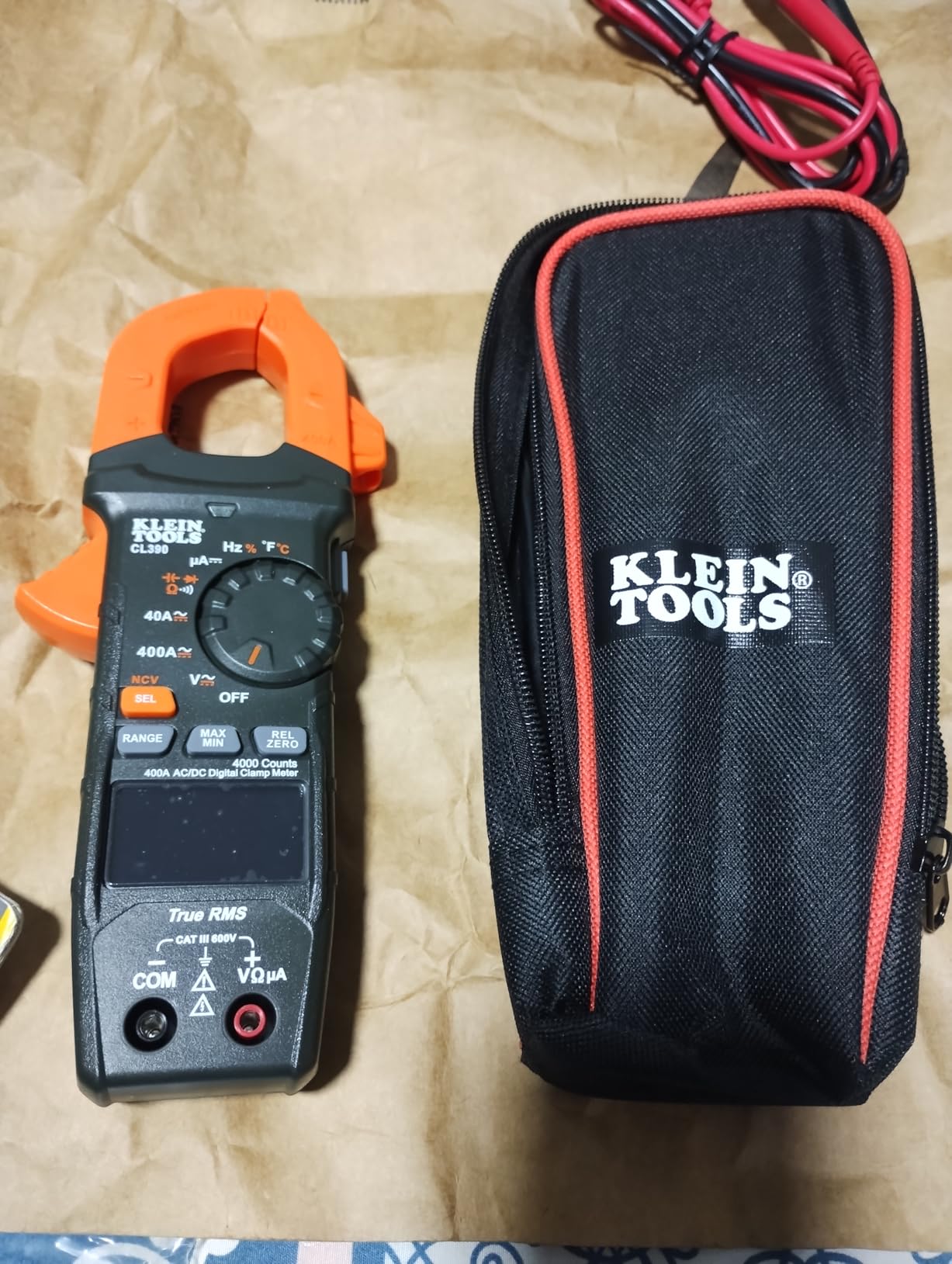
Where it earns its keep is the feature list. The same jaw gives you AC and DC current, non-contact voltage detection, and DC microamps for flame sensor work. The leads add AC and DC voltage, resistance, continuity, frequency and duty cycle, diode test, and capacitance. Temperature comes from the included K-type thermocouple, rated to 1832 F.
On a run capacitor test it matched a Fluke-class reference within a rounding error. On DC current it held steady once you let the zero settle, which matters if you are checking a parasitic draw on a car. Nothing here is exotic, but the combination is unusually complete for the money.
What you get that cheaper meters skip
DC current through the jaw is the big one. Only a handful of meters in this list can do it, and without it you cannot check a starter draw, a trailer circuit, or a solar string without breaking the conductor.
The dual CAT rating matters too. CAT IV is the category the service drop and the line side of the panel fall into, so having both means fewer situations where you have to say no to a job.
Where it falls short
The floor of about 0.3A through the jaw is real. A modern LED driver drawing 60mA will not register, and if your work is chasing leakage or standby draw, you need the milliamp resolution of the UNI-T UT210E instead.
There is also no 10A input through the test leads, so a fuse or an in-circuit current check means breaking the circuit. Accuracy is good rather than laboratory grade, and the included case is the first thing to fail.
2. KAIWEETS HT206D – The Most Features Per Dollar in the List
- LowZ mode suppresses ghost voltage so dead circuits read dead
- Low pass filter gives clean readings on variable frequency drives
- 6000-count True-RMS display with two-colour backlight
- Measures AC and DC current
- voltage
- resistance
- capacitance
- diode
- frequency
- duty cycle and temperature
- Two standard AAA batteries and a 36-month service period
- Supplied fine-point leads give unstable resistance readings
- DC current on the 100mA range can drift even after zeroing
- Thin plastic housing is not built for being dropped
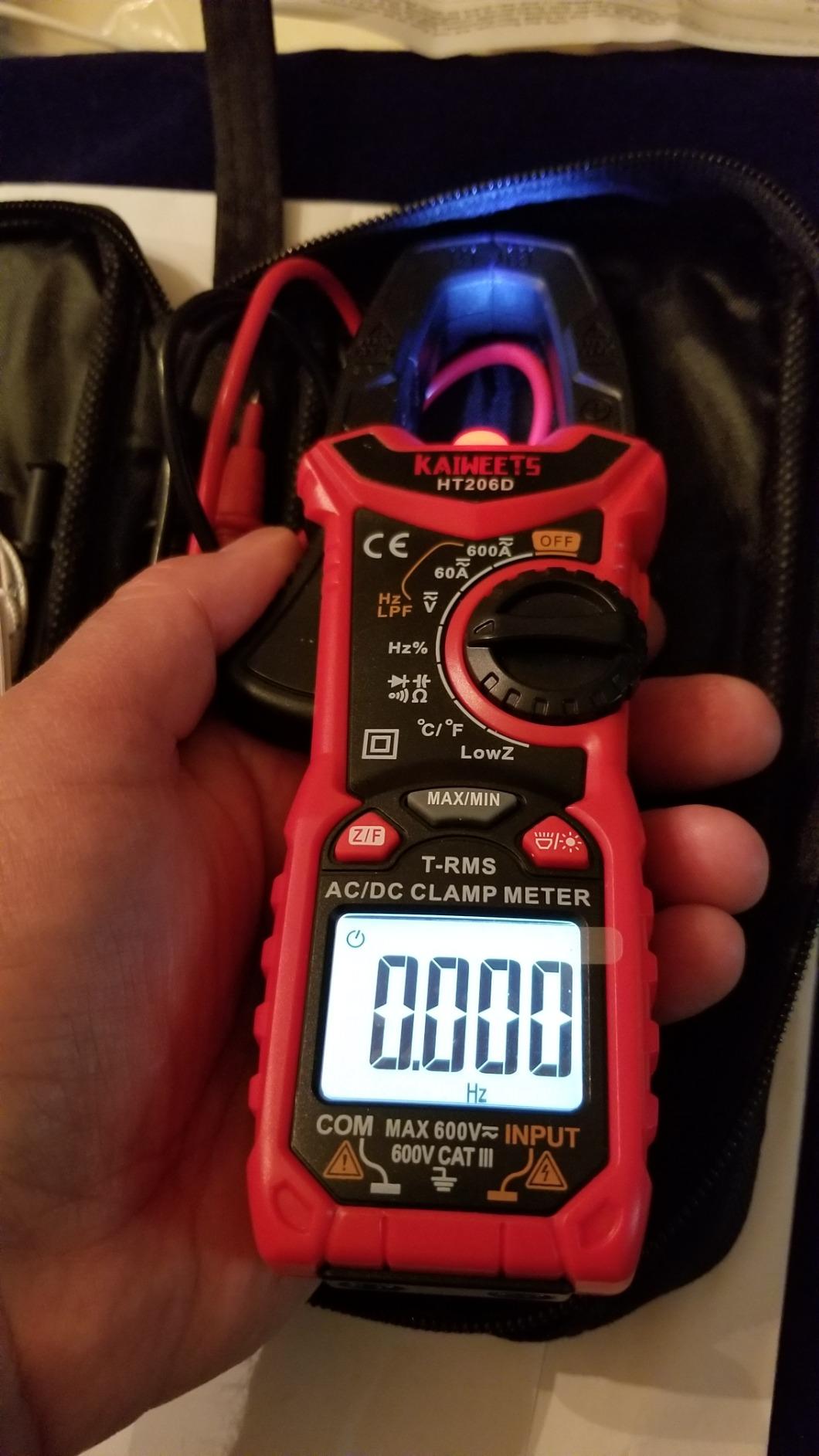
The HT206D is the meter we recommend to anyone who wants one tool to cover household, HVAC, and electronics work without thinking twice. Twelve thousand reviews at a 4.5 average is the largest review base in this group, and the pattern in them is consistent: owners are surprised how close it performs to far costlier instruments.
The low impedance mode is the underrated feature. Without it, a meter can show several volts on a wire that is genuinely dead, which is exactly the ghost voltage problem that makes beginners distrust the whole tool. Hold LowZ and the reading collapses to near zero, which tells you the circuit is not live.
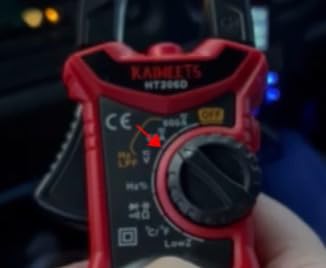
The low pass filter is the other half of that deal. It stabilises readings on variable frequency drives, motor circuits, and dimmer-controlled lighting, which is where average-responding meters routinely report numbers that are simply wrong. Electricians on forums describe the same surprise, and this filter is the fix.
It runs on two AAA batteries, measures temperature to 1000 C with the included probe, and turns the backlight red above 80V or 3A as a visual warning. The auto power-off after 15 minutes is a sensible battery saver, though you can only cancel it by cycling the dial to off.
Best reasons to pick it over a branded meter
Compare the feature list to a Fluke 323 and the HT206D wins on paper: more counts, a low pass filter, LowZ, a temperature probe, and a two-colour display. For a technician doing service calls, that is a real advantage.
The build is thin plastic rather than armoured, so treat it as a tool-bag instrument. It is not the one to drop off a ladder.
What to fix before you trust it
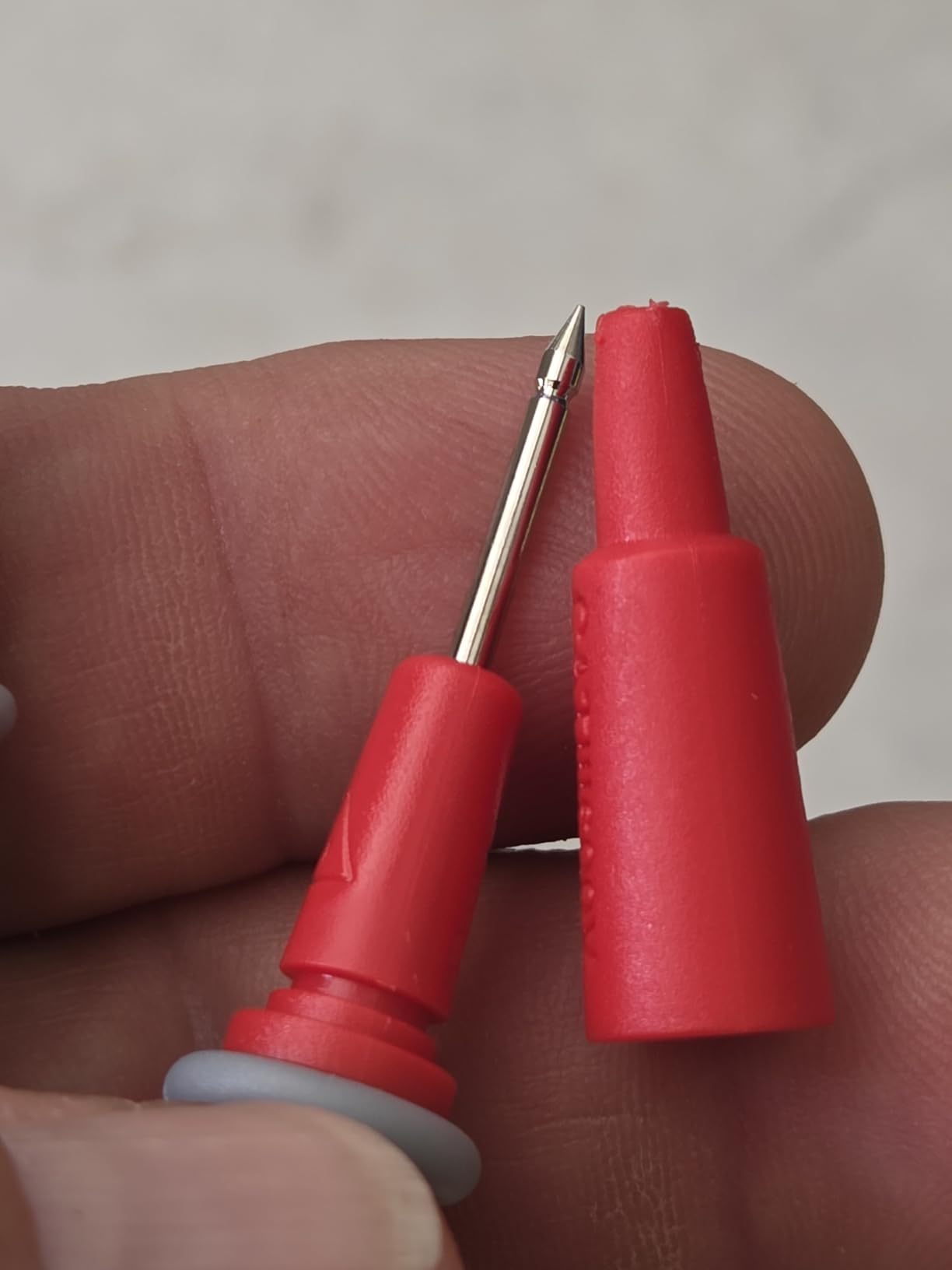
Budget a few dollars for a proper lead set. The crimped connections in the supplied fine-point leads are the single most repeated complaint, giving jumping resistance readings that have nothing to do with the circuit.
DC current on the 100mA range is less settled than the rest, so zero the meter in open air before each measurement. And if you need milliamp DC, this is not that instrument.
3. AstroAI CM2K0R – The First Meter Most People Should Buy
- Lowest cost entry with auto-ranging
- Compact body at under 9 inches fits tight enclosures
- Backlit display plus a built-in flashlight for dark panels
- Continuity buzzer is loud without being shrill
- Storage bag
- leads and manual included
- Jaw measures AC current only
- no DC current
- 2000-count resolution is lower than competing meters
- Some buyers report inaccurate clamp readings
- Not certified to professional instrument standards
This is the meter we hand to someone who wants to know why a breaker trips or how much a ceiling fan is drawing, and does not want to spend real money to find out. On r/AskElectricians the AstroAI comes up again and again as the go-to ultra-budget pick for basic household and automotive checks, and 9.3k reviews at a 4.6 average back that up.
It measures AC current through the jaw, and AC and DC voltage, resistance, capacitance, diode, and continuity through the leads. The non-contact voltage detector gives you a slow green beep for weak AC and a fast red beep for strong AC, which is more useful than the single-tone version on many budget meters.
The clamp has a notch that lets it hang onto a wire or a fixture, which frees both hands for the probes. It auto-ranges, holds data, records max and min, and shuts itself off when you forget it. Two AAA batteries, a storage bag, and leads are in the box.
For an appliance check, wrap the jaw around a single hot conductor while the appliance runs and read the amps. That is the whole workflow, and the meter does it accurately enough for the question being asked.
Where it is genuinely the right tool
Learning to use a clamp meter, checking a furnace blower, confirming a microwave or dehumidifier draw, and a quick verification before you buy a used appliance are all jobs this handles without fuss. The compact body also makes it the easiest of the lot to carry in a small bag.
If you do a lot of these checks, buy it and keep it as a backup. Owners routinely describe it that way.
Limits worth knowing on day one
AC current only. If you need to measure a car battery, a solar string, or a trailer circuit, keep looking. The 2,000-count resolution also means less detail on small readings than a 6,000-count meter gives you.
It is rated CAT III 600V, pollution degree 2, and it is not certified to professional instrument standards. Fine for household checks, not the meter you want open on a live service panel.
4. Klein Tools CL120VP – The Best Starter Kit Rather Than a Single Meter
Klein Tools CL120VP Electrical Voltage Test Kit with Clamp Meter
- Highest average rating in the group with owners citing Klein durability
- Bundles clamp
- receptacle tester
- NCVT and voltmeter in one set
- Auto-ranging clamp needs no range guessing
- RT210 catches open ground and reverse polarity quickly
- NCVT3P has a built-in flashlight
- Batteries and a carrying pouch are included
- Clamp section measures no DC amps and no capacitance
- Carrying pouch is thin and protects little
- Retail packaging is hard to open
- Higher cost than a single-function budget meter
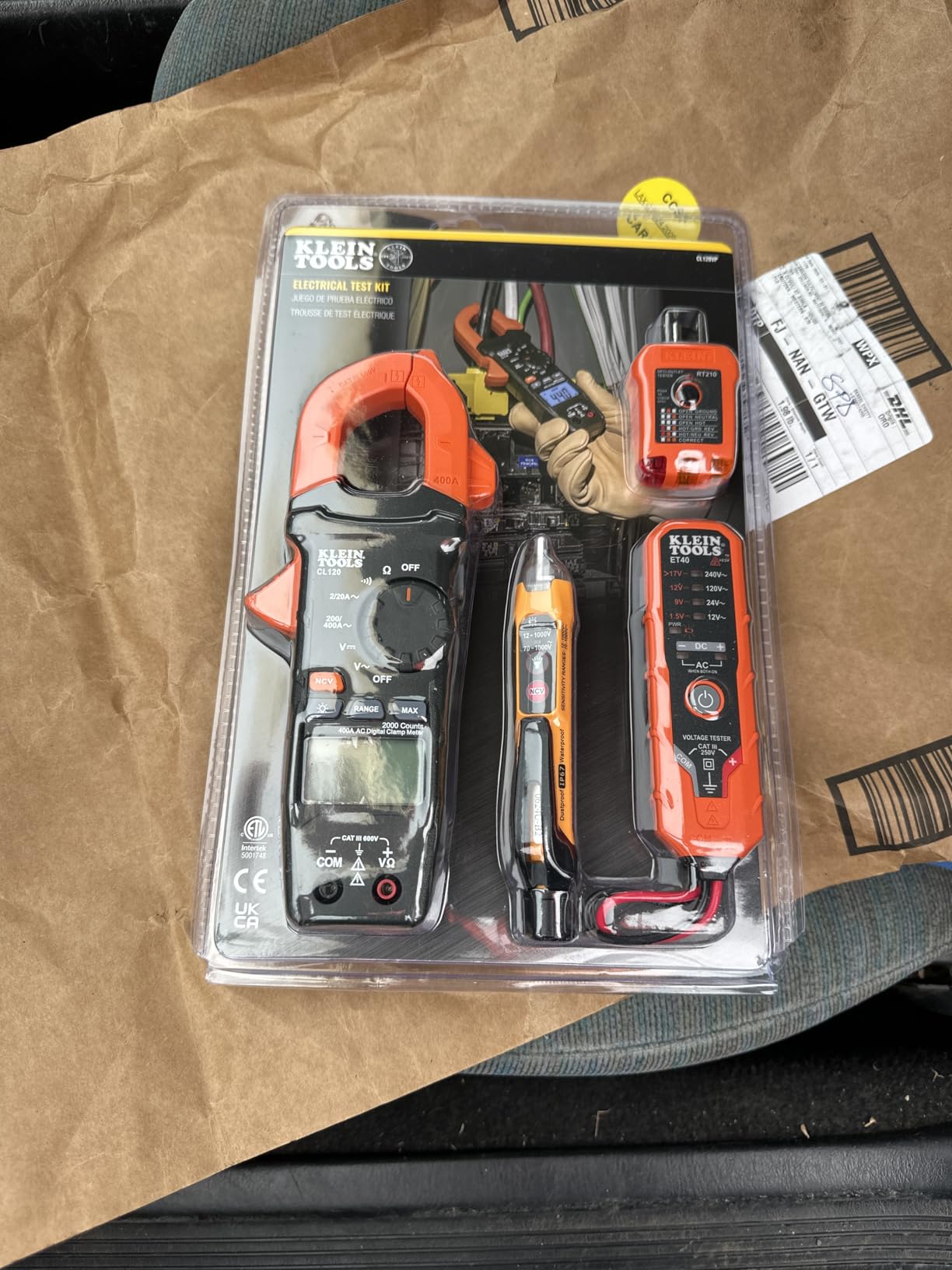
The CL120VP is not the best clamp meter here. It is the best answer if you are outfitting a student, an apprentice, or anyone who needs a working electrical kit rather than a single instrument. You get the CL120 clamp meter, an RT210 GFCI receptacle tester, an NCVT3P non-contact detector, and a voltage meter in one pouch.
At a 4.8 average across 3.9k reviews it carries the highest rating of any product in this guide. Buyers point to Klein build quality as the main reason they chose the kit over a bare-bones meter, and the bundled testers are the second reason.
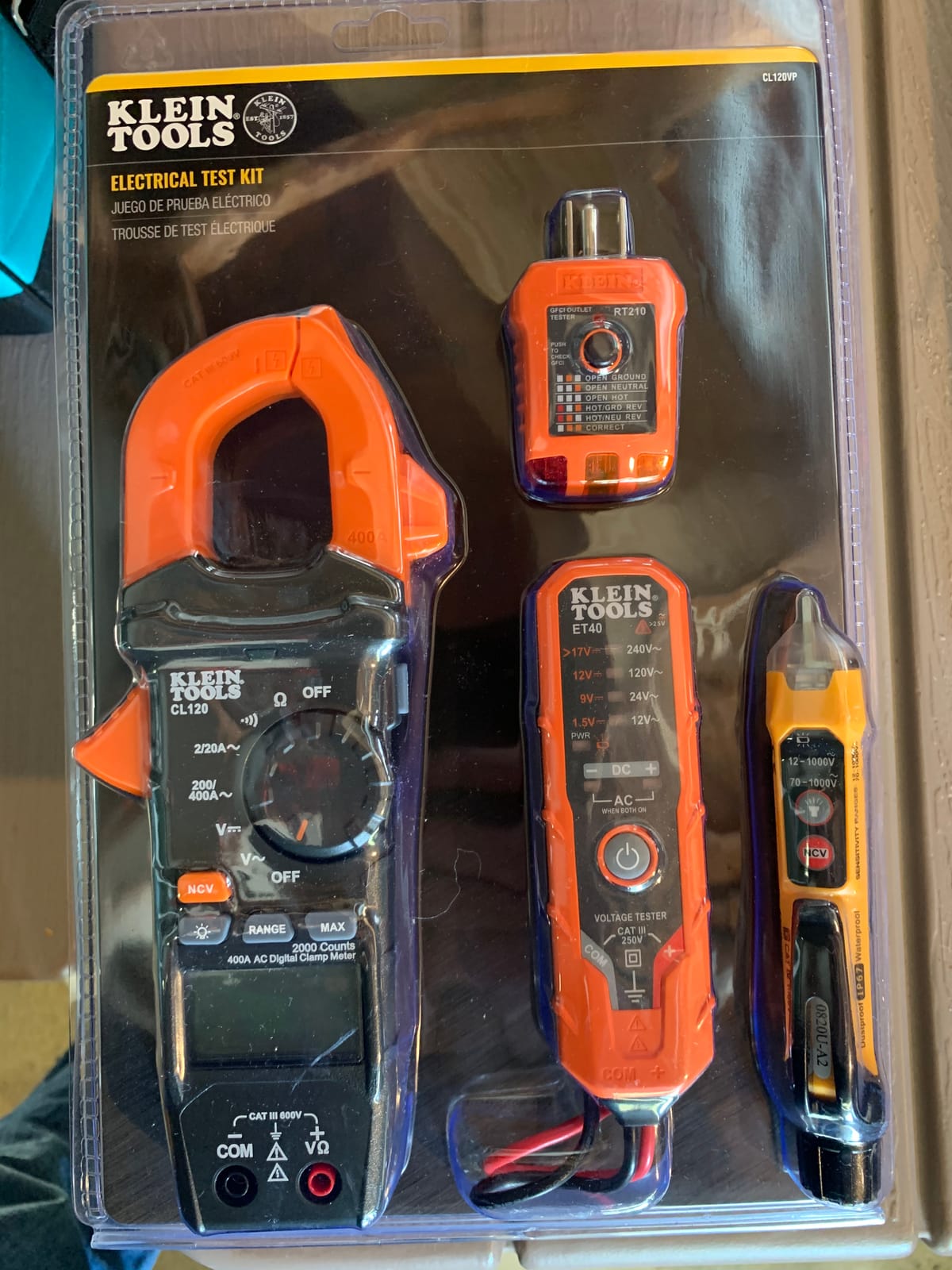
The clamp itself measures AC current and NCVT through the jaw, with AC and DC voltage, resistance, and continuity through the leads. Rated to 1000V maximum operating voltage, it is comfortable on household work. Auto-ranging means no range switching, and the test lead holder on the side keeps the probes off the floor.
The RT210 is the sleeper feature. Plugging it into a receptacle tells you about open ground, open neutral, reverse polarity, and a good ground in about two seconds, which is a check most people never do at all.
Why a kit beats one good meter here
Most household electrical problems are found with a receptacle tester and a non-contact detector long before they need a clamp. This package puts all three tools in one place at a lower total than buying them separately.
It is also the easiest way to hand someone a complete, safe introduction to the trade without overspending.
What you give up compared with a single meter
The CL120 does not measure DC amps through the jaw and it does not do capacitance, so HVAC capacitor work is out of reach. Choose the CL390 if you want one instrument that does everything, and this kit if you want coverage breadth instead.
The pouch is thin and the packaging is over-built, meaning a knife is usually needed to open the box.
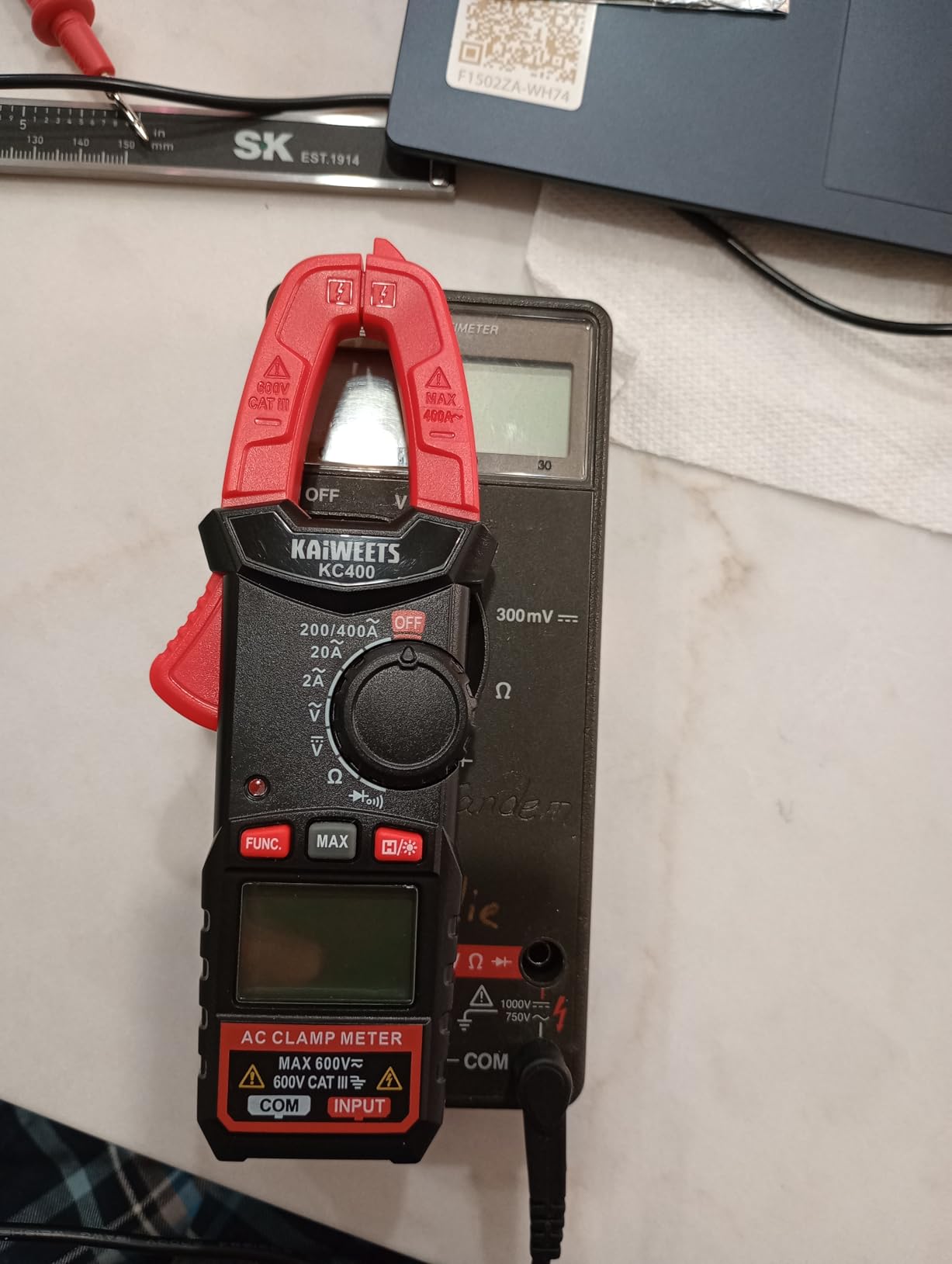
5. KAIWEETS KC400 – The Compact Round-Jaw Meter for Thick Cables
KAIWEETS DC Clamp Meter 200A AC/DC Amp Meter True RMS Compact Multimeter
- Round jaw grips thick EV battery and HVAC cables evenly
- Light enough at 9.9 ounces for genuine one-hand work
- DC zeroing cuts offset error on DC readings
- MAX peak lock catches motor inrush
- Backlight turns orange above 80V or 3A
- 3-year warranty
- 200A ceiling is lower than the 600A class
- Display and build feel light next to professional instruments
- Some buyers say functions meet the lower end of expectations
- Included probes are basic
The KC400 is the answer when the conductor will not fit. Its round jaw handles both a bundle of thick EV or battery cable and a single household wire, and it does so evenly rather than pinching one side and letting the other slip.
Several owners, some of them working electricians, describe cross-checking its readings against Fluke and Fieldpiece meters and finding them close. That is the test that matters for a budget tool, and it passes here often enough to recommend as a tool-bag backup or an occasional tester.
It measures AC and DC current to 200A, voltage to 600V, and handles resistance, continuity, diode, and frequency. The DC current zeroing function removes the offset error that makes cheap DC clamp readings frustrating, and the MAX peak value lock is genuinely useful for motor inrush and fluctuating loads.
Magically, the backlight switches to orange automatically above 80V or 3A. It is a small thing, but on a crowded panel a colour change is faster than reading the digits.
Where the round jaw earns its place
EV charging cables, battery banks, welders, and split-unit HVAC lines are all conductors a 25mm jaw struggles with. The KC400 grips them without interrupting the circuit, which is the whole reason a clamp exists.
It is also one of the few meters here light enough for real one-handed work in a tight enclosure.
Where it runs out of room
Two hundred amps is the ceiling. If you are verifying a 200A panel or a main service load, you need a 600A meter such as the FNIRSI DMC-100 or the Crenova 606C+.
The body is light plastic and the display is modest, so treat it as a secondary instrument rather than the one you trust on live panel work.
6. FNIRSI DMC-100 – The Only One Here With a Graph and a Colour Screen
FNIRSI DMC-100 Clamp Meter 9999 Counts TRMS, 600A AC/DC Amp Meter
- Colour TFT screen readable in sunlight and on a bench
- Curve recording catches intermittent faults and inrush
- Capacitance testing works for condenser caps without a scope
- Clamp readings match Fluke and Fieldpiece closely
- Rechargeable battery means no dead-meter callouts
- Temperature function is not accurate
- Built-in lithium battery cannot be replaced
- Graph window holds only about 25 seconds
- Build is lighter than Fluke or Fieldpiece bodies
The DMC-100 does something none of the other nine do: it draws the reading. The 2-inch full-colour TFT display records real-time curves with eight live data sets and keeps 30 historical records, so you can watch a motor current spike rather than squint at a jumping number.
Working electricians and solar installers describe it as a hobbyist and backup meter that punches well above its price. Clamp current readings are reported to match Fluke and Fieldpiece units closely in homeowner use, and the capacitance function handles AC condenser checks without dragging out a scope.
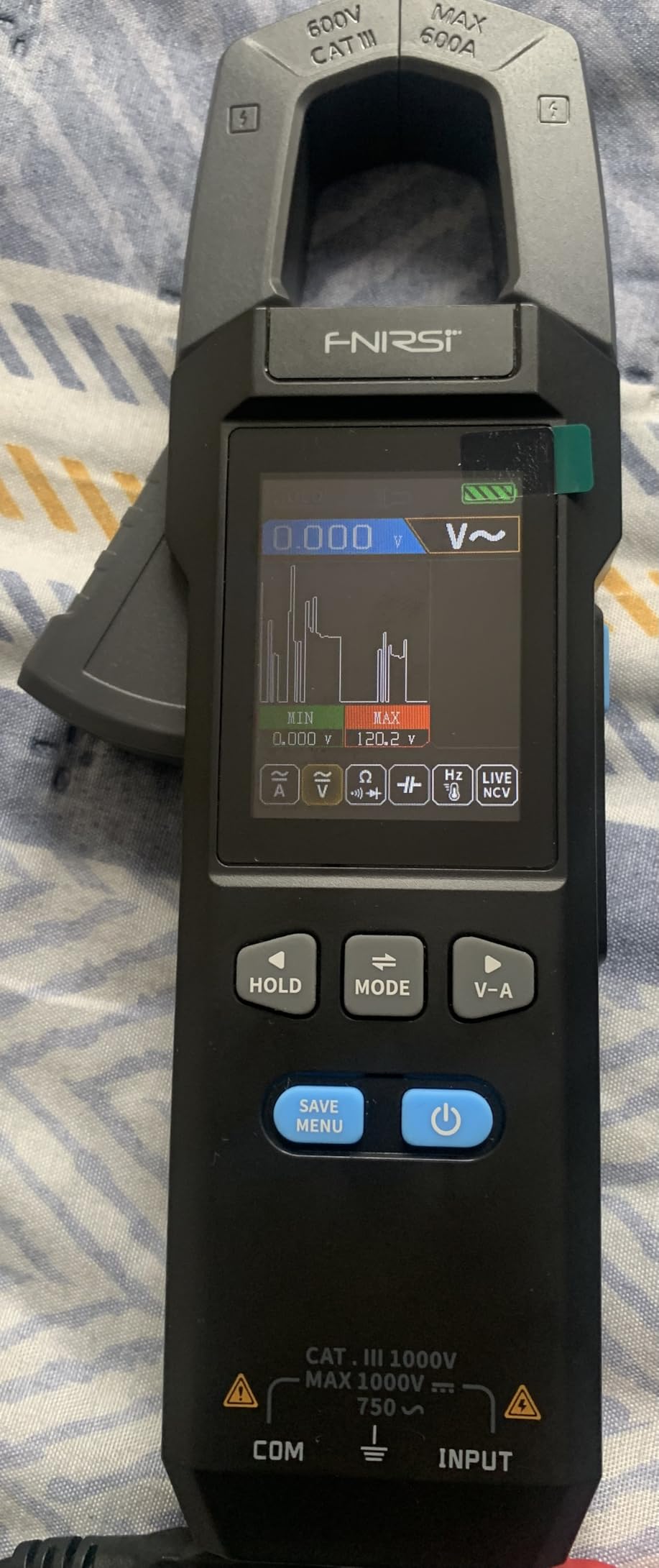
On paper it is the most capable meter here: 9,999-count True RMS, AC and DC current to 600A, voltage, resistance, capacitance, frequency, and temperature, plus NCV, live wire testing, continuity, and diode checks. Ten brightness levels and dual dark and light themes mean the screen works in a sunlit attic and in a dark basement.
It runs on a built-in 1,500mAh lithium battery with Type-C charging, which in practice means you are not hunting for cells. It is UL 61010-1 listed and CE marked, which puts it ahead of most of this list on certification.
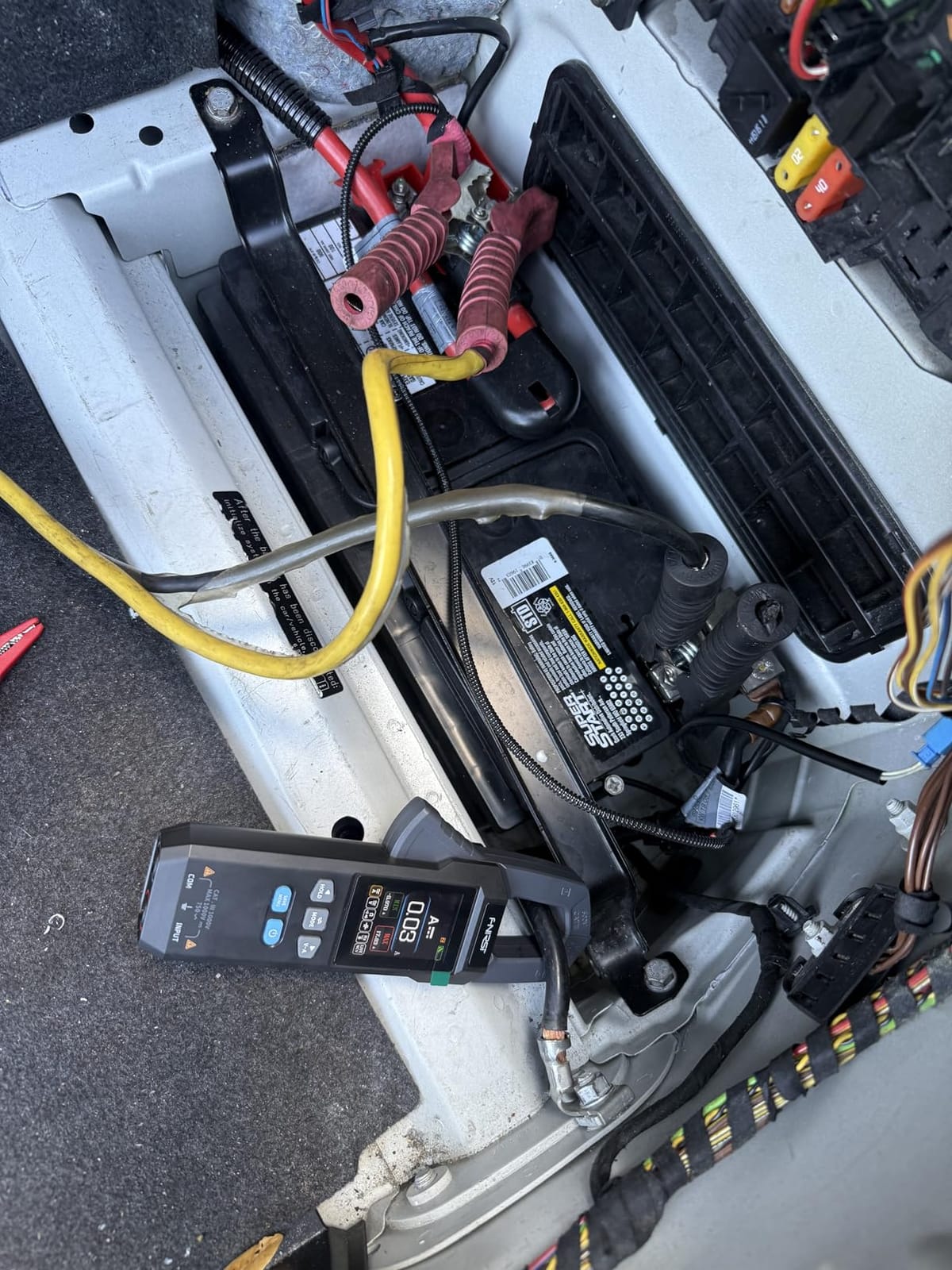
Why the graphing mode is worth paying for
Intermittent faults are the hardest thing to diagnose with a clamp meter, and a graph turns a guess into evidence. Motor inrush, a compressor cycling, or a solar string that drops under load all show a signature you can actually see.
The simultaneous voltage and current display also removes a step: you can see the relationship instead of switching between two readings.
Where to be careful
The temperature function is not accurate, so do not use it for HVAC diagnosis. The lithium battery is not user-replaceable, which worries buyers who think about long-term ownership, and the graph window holds only about 25 seconds of data.
The advertised 9,999-count accuracy is optimistic against real measurements, and the body is light for daily field work.
7. Neoteck MY2610C – The Cheapest Useful Meter With a Low-Current Mode
Neoteck Clamp Meter 4000 Counts Amp Meter for AC Current AC/DC Voltage 600A
- Covers most basic measurement needs at a very low cost
- 4000-count True RMS display with 1.0 percent voltage accuracy
- 1A low-current mode is useful for LED and low-power circuits
- NCV detection with audible and visual alarms
- Temperature probe included
- Compact 195g body with pouch
- Clamp measures AC current only
- Current readings need a single wire in the jaw
- Small 25mm jaw limits conductor size
- Accessory set is basic
- Small 273-review feedback base
The Neoteck MY2610C is the least expensive meter here that still gets the important things right: 4,000-count True RMS, a stated voltage accuracy of plus or minus 1.0 percent, 600A AC current, and a CAT III 600V rating with overload protection.
It is also the only one at this price with a dedicated 1A low-current mode, and that is more useful than it sounds. LED drivers and small electronics draw well under 1A, and without a low range the reading sits at zero and tells you nothing.
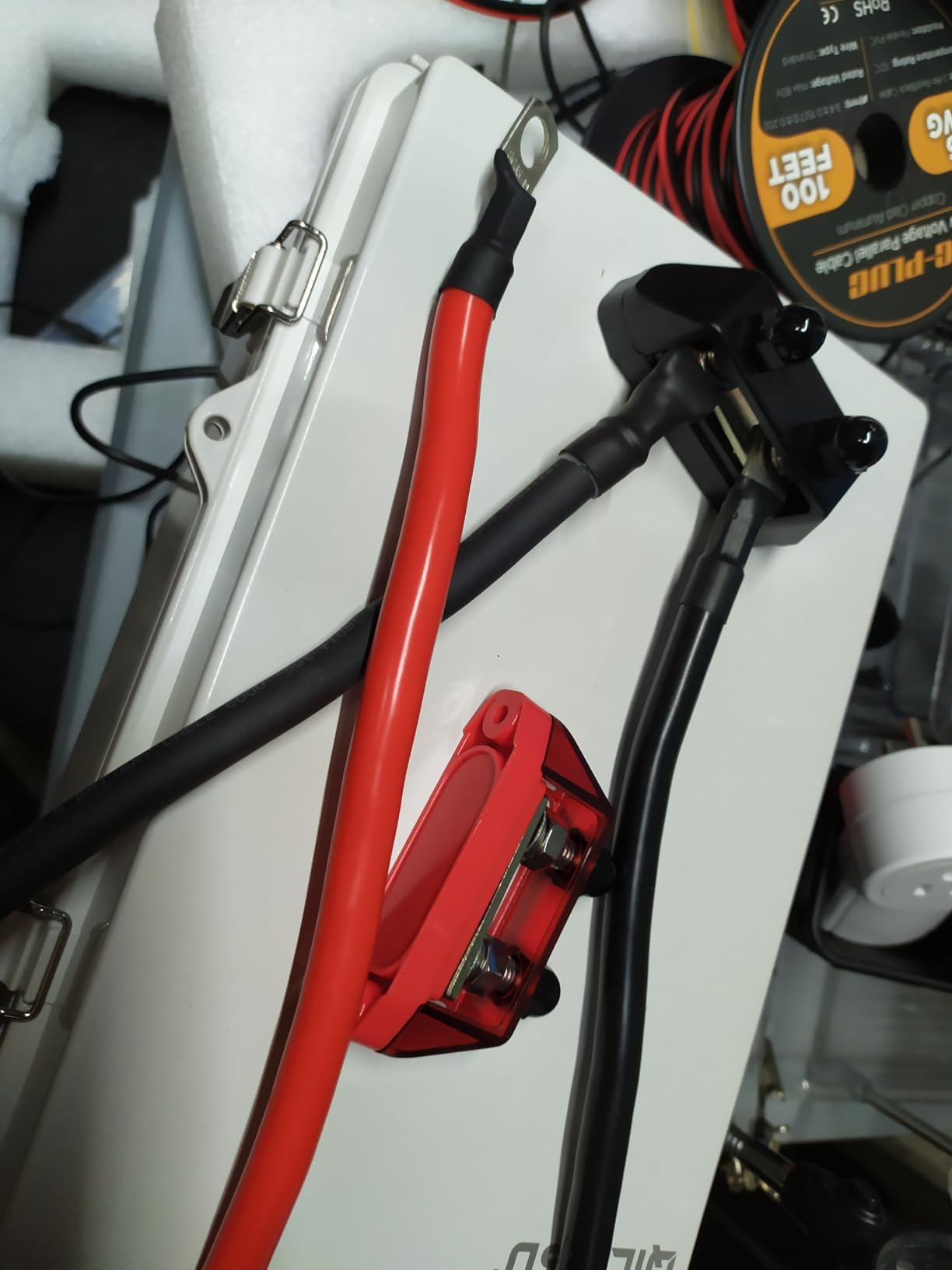
Everything else is ordinary and adequate: resistance, diode, continuity, capacitance, NCV detection from 90 to 1000V AC with audible and visual alarms, temperature from minus 40C to 1000C through the included K-type probe, a backlit LCD, and a flashlight.
It is 195g, which is light, and the pouch is included. The 25mm jaw takes most single household conductors but will not swallow a heavy multi-core bundle.
Where the low-current mode changes the job
If you are chasing standby draw, LED driver failures, or a standby appliance you suspect is the reason a circuit never goes to zero, this meter will show you the number. Most AC-only meters will not.
It is a good second or household-only meter rather than the one to buy first for professional work.
Where it falls down
AC current only through the jaw, and 273 reviews at 4.3 is the smallest feedback base in this group, with 6 percent one-star ratings. Treat the stated accuracy as a starting point and check it against a known reference before you depend on it.
Current readings still require clamping a single wire, never a whole power cord.
8. UNI-T UT210E – The Pick for Milliamp and Low-Current AC Work
- Genuine UNI-T build quality at a mid-range price
- AC and DC clamp current with 1 mA resolution on the low range
- VFC filter stabilises readings on variable frequency drives
- Pocket-sized with a non-slip rubber grip
- CAT II 600V and CAT III 300V with overload protection
- Complete pack with leads
- batteries
- printed and electronic manuals
- Only 2000 counts of resolution
- Maximum clamp current of 100A
- No temperature measurement
- Small review base at 238 reviews
The UT210E exists for one reason: measuring very small currents accurately. Its clamp ranges run 2.000A at 1mA resolution, 20.00A at 10mA, and 100.00A at 100mA, and it reads both AC and DC. No other meter in this list resolves down to a single milliamp through the jaw.
EEVblog forum consensus names it the clamp of choice for very low AC current and milliamp-level measurement, and that niche is exactly what distinguishes it. Leakage detection on an EV charger, a Class II appliance, or an LED driver is a job where the number is small and the answer matters.
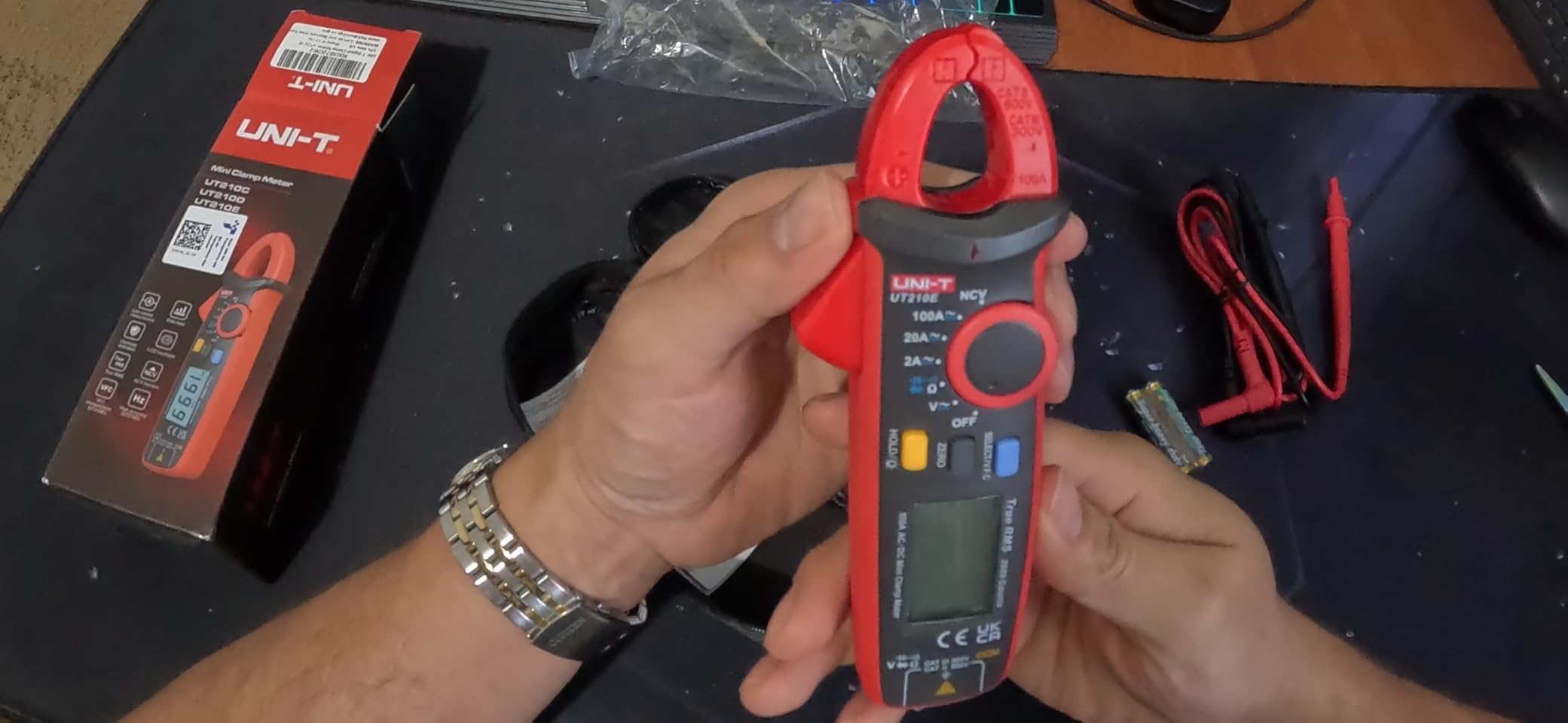
The VFC filter, triggered by a long press of the select button, reduces signal disturbance from variable frequency drives and motor circuits. It is CAT II 600V and CAT III 300V with built-in overload protection, and the non-slip rubber grip survives being handled with one gloved hand.
It is genuinely pocket-sized at 310g, and the pack includes test leads, two AAA batteries, printed and electronic manuals, and a zip bag.
Why milliamp resolution beats a bigger range
A 600A meter with 100mA resolution cannot tell you whether a 3mA leak is a leak or nothing at all. This one can, and that single fact decides the purchase for anyone doing leak detection or working on low-draw electronics.
DC current support means the same low-range trick works on a vehicle or a small solar circuit.
What the small range costs you
The 100A ceiling is genuinely low. You cannot check a 200A panel load, an electric range, or a main service with it. The 2,000-count display also trails its rivals, and there is no temperature function for HVAC work.
With 238 reviews it has the smallest feedback base here, so verify it against a known reference before a customer-facing job.
9. Crenova 606C+ – The Most Functions You Can Get in One Hand
Crenova Clamp Meter Multimeter 600A AC/DC 6000Counts TRMS Electrical Tester
- Widest function set per dollar in this list
- Inrush
- LowZ and V.F.C filter modes in one body
- 6000-count True RMS with AC and DC current to 600A
- LowZ mode cuts ghost voltage false readings
- Complete kit with leads
- alligator clips
- thermocouple
- batteries and pouch
- Highest share of one-star reviews in the group at 7 percent
- Clamp handles current only and needs a single wire
- Bulkier and heavier than compact alternatives
- Smaller brand presence than Klein or KAIWEETS
The Crenova 606C+ is the feature-maximiser. Inrush current measurement, LowZ mode, a V.F.C filter for variable frequency drives, temperature from minus 4F to 1832F, NCV detection, live wire detection, resistance to 60M ohm, capacitance to 6mF, and frequency to 10MHz all live in one body.
Any one of those would justify the purchase for a specific job. Together they cover almost everything a technician reaches for daily, on a 6,000-count True RMS display with AC and DC current to 600A.
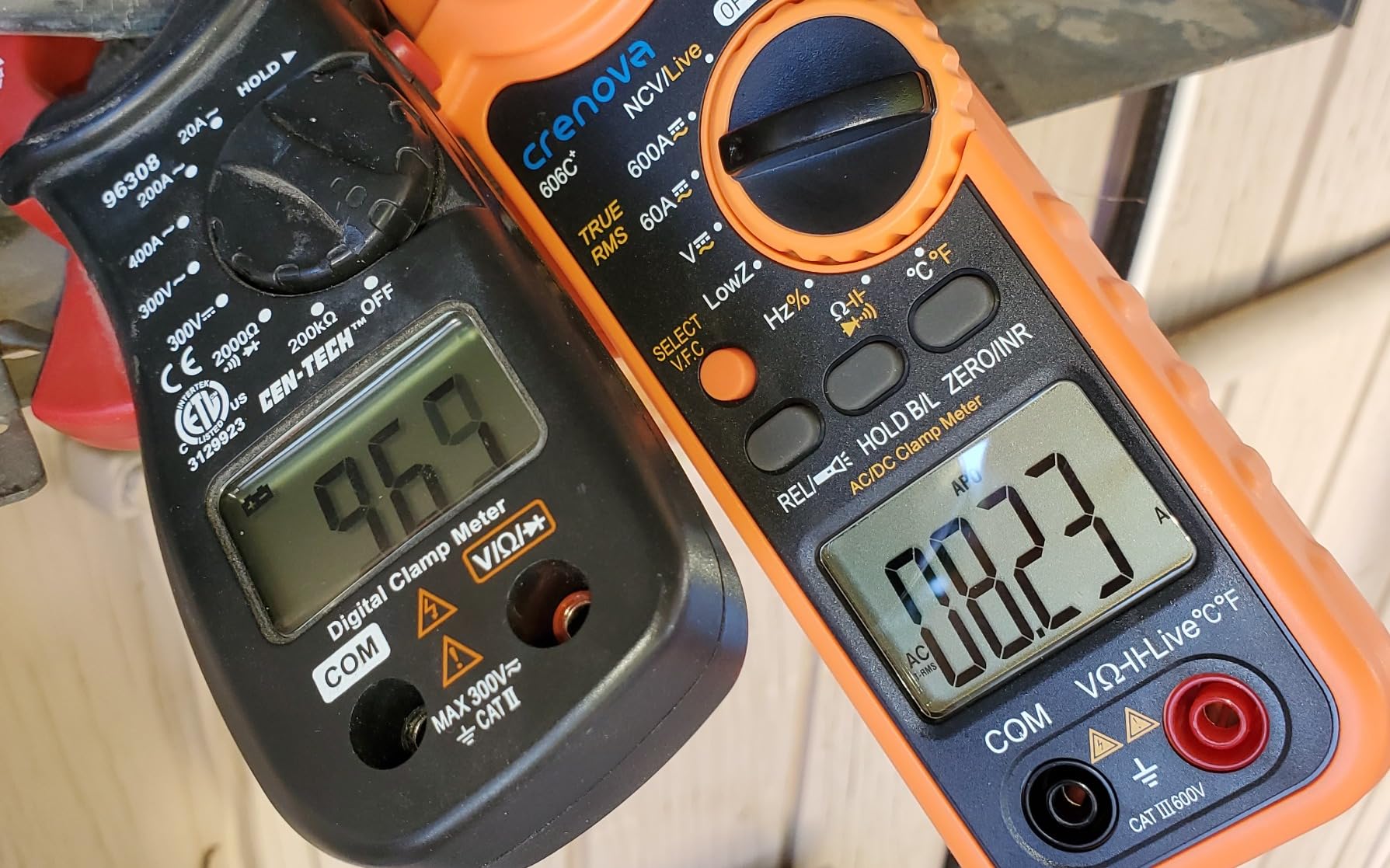
The inrush mode measures the surge when a motor or compressor starts, which is the fastest way to judge whether a hard-starting compressor is a real fault. LowZ suppresses ghost voltage on de-energised circuits, and the V.F.C filter cleans up readings on inverter-driven equipment.
It is IEC 61010 rated, double insulated, and CAT III 600V, and it comes with probe leads, alligator clips, a K-type thermocouple, batteries, and a pouch. The 25mm jaw covers most home and light industrial conductors.
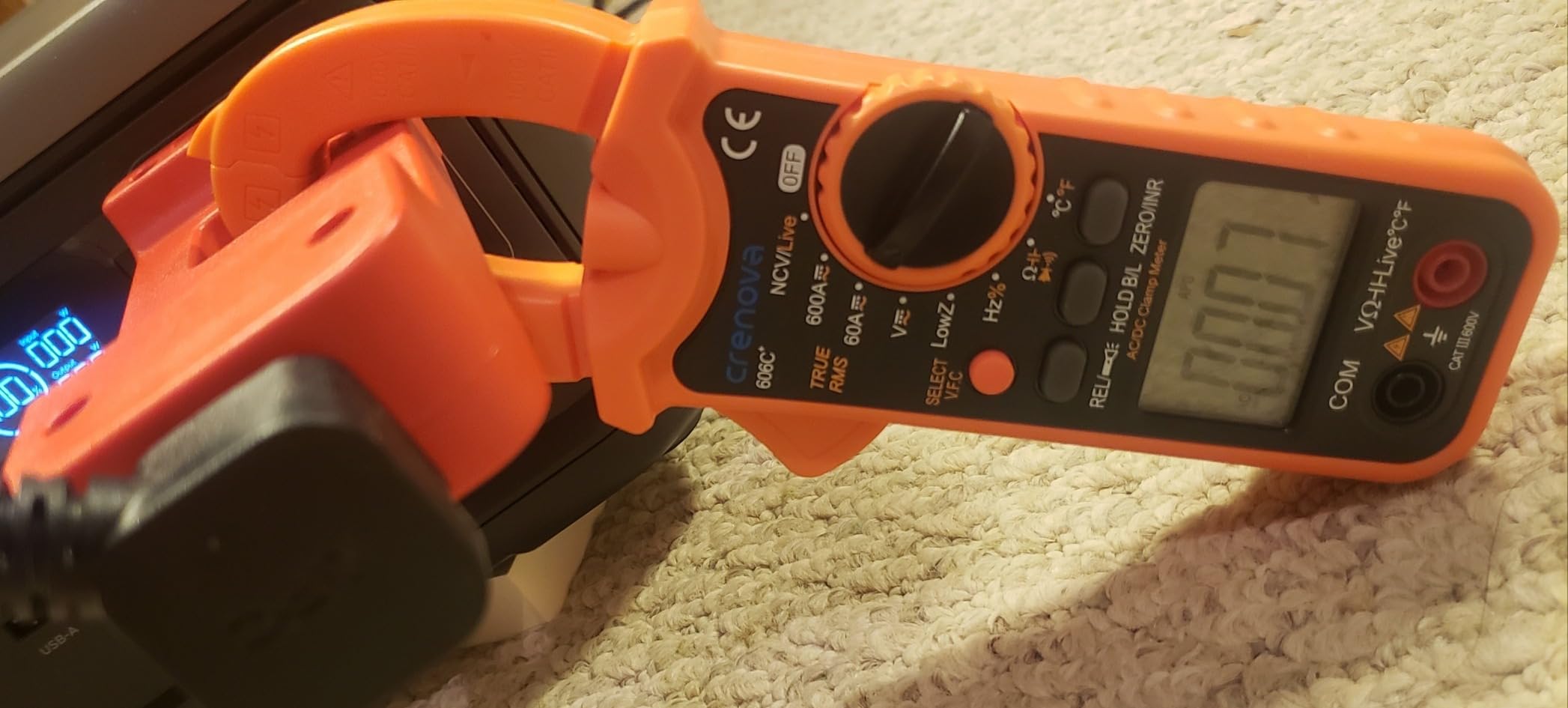
The three modes that justify the price
Inrush, LowZ, and the V.F.C filter are the reason to pick this over a simpler 6,000-count meter. Motor and HVAC work benefits from all three, and none of them appear on the cheapest units in this guide.
It is also the only budget option here with a full accessory kit, so there is nothing extra to buy before the first job.
Where quality control shows
Seven percent of reviews are one-star, the highest share in the group, which points to inconsistent units rather than one specific defect. Check your meter against a known reference before you depend on it.
It is bulkier than the compact alternatives, and the 25mm jaw is current-only and needs a single conductor.
10. ANENG ST212 – The Widest Jaw for Conductors That Do Not Fit
ANENG TRMS Multimeter,600A AC/DC Clamp Meter,Auto Ranging,NCV,Temperature
- Double-open jaw grips large conductors without breaking the circuit
- True RMS 6000-count auto-ranging across AC and DC
- Illuminated clamp head and backlit screen for dark panels
- Rich accessory bundle with alligator clips
- combination lead and storage bag
- Fits a work bag for mobile service
- Lowest average rating in the group at 4.2 stars
- Some users report readings drifting from reference meters
- Wide rating spread suggests variable unit quality
- Plasticky buttons compared with branded instruments
The ST212 solves a specific geometry problem. Its double-open clamp accepts conductors up to 1.24 inches in diameter, which is far wider than the 25mm jaw on most meters in this price range, and the jaw opens without you having to thread the wire through.
It is a True RMS 6,000-count auto-ranging meter covering AC and DC current to 600A, AC and DC voltage, resistance, capacitance, live and zero wire detection, continuity, frequency, duty cycle, and temperature. The illuminated clamp head and backlit screen handle the panel work that these meters are usually bought for.
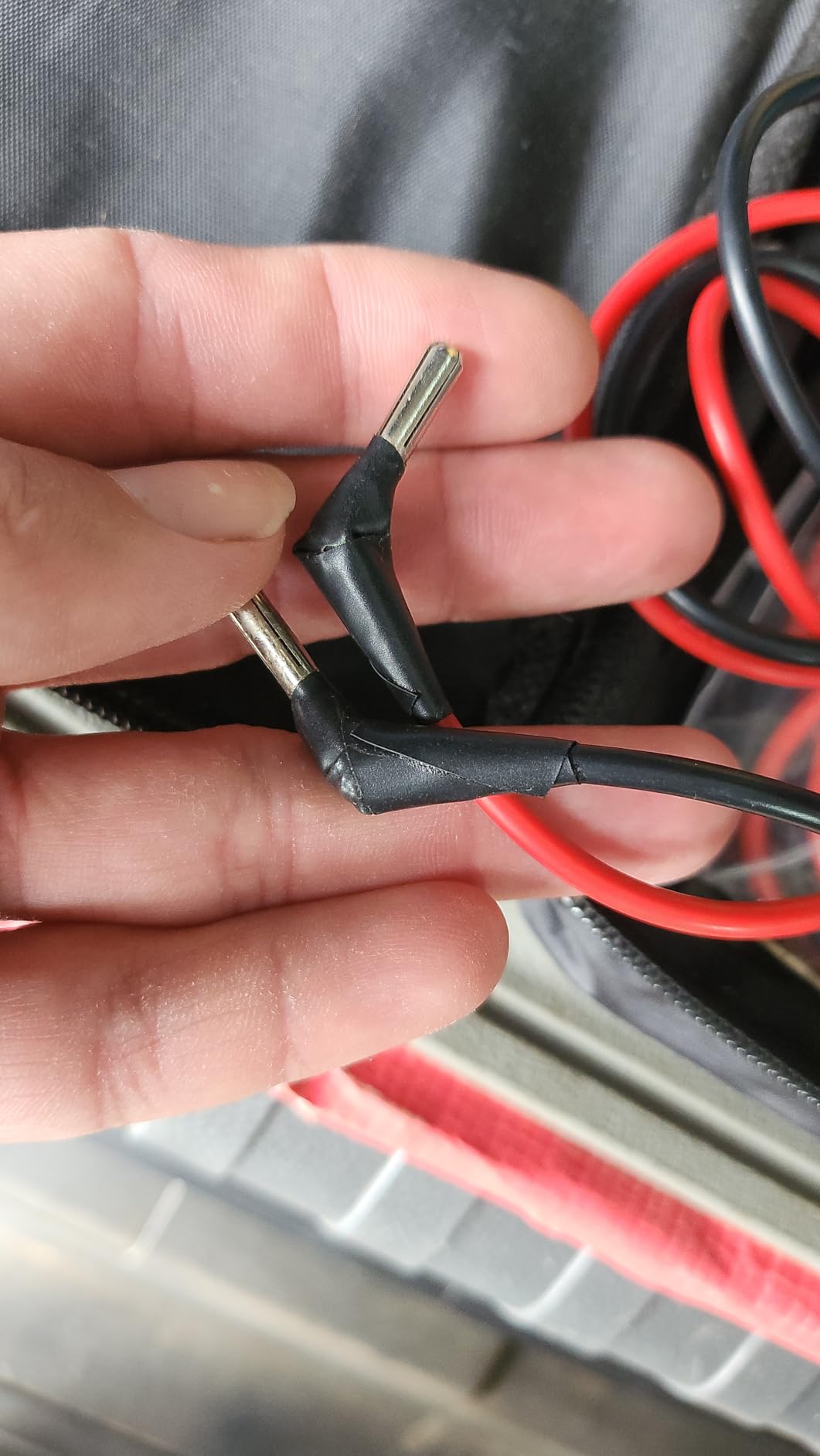
The accessory bundle is generous for the money: alligator clips, a combination lead, a multimeter test lead, a temperature line, a charging cable, and a storage bag. It auto-sleeps after 15 minutes and is CE marked.
For anyone regularly clamping a thick service conductor, a bundled feeder, or a large motor lead, a jaw that fits is worth more than an extra two thousand counts of resolution.
Why the jaw matters more than the counts
Six thousand counts of resolution on a wire that will not fit is worth nothing. The 1.24 inch double-open jaw solves a real, recurring failure in the field, and the illuminated head removes the other common complaint about working in an unlit enclosure.
For cable and motor work, that combination is genuinely useful rather than a spec sheet win.
Where the ratings give us pause
At a 4.2 average with 6 percent one-star and 12 percent three-star reviews, this is the most polarised meter here. That spread points to variable quality between units, and some users report readings that drift away from reference meters.
Buy it, then verify it before trusting it on anything that matters. If consistent accuracy is your priority, the HT206D or the FNIRSI DMC-100 is the safer buy.
How to Verify a Budget Clamp Meter Before You Trust It?
Every meter in this guide can be checked in about fifteen minutes if you have one reference you trust. This is the step almost every budget roundup skips, and it is the difference between a tool you own and a tool that owns your troubleshooting.
Step 1: check the battery and the display. A fresh battery, all segments lit, and a stable zero on the AC and DC current ranges. If the reading drifts while the jaws are closed on nothing, stop there.
Step 2: verify the ohm range first. With a known resistor, or by shorting the leads, confirm the reading is stable and the buzzer behaves. A meter that is unstable on ohms is unstable on everything.
Step 3: test the voltage range against a known source. A wall outlet is the easy reference. Confirm the meter reads close to what a receptacle tester or a known-good meter reports, on both AC and DC.
Step 4: check the clamp against a known load. A 100W incandescent lamp on a 120V circuit draws roughly 0.83A. Clamp the single hot conductor and see whether you get close. If the number is 0 or wildly high, the jaw or the zeroing is the problem.
Step 5: verify DC current and low readings if you need them. A car battery with the vehicle off should show a small draw, and a USB charger through a splitter gives you a known small DC current. If those fail, you know the low end is not trustworthy before a customer finds out.
Add a LoZ check too if the meter has one: measure an unenergised cable with the leads, then again in LowZ. A large drop toward zero is the meter telling you the earlier reading was ghost voltage.
Buying Guide: What Actually Matters Under a Hundred Dollars
AC current only, or AC and DC?
This is the first fork, and it decides most purchases. A clamp works by sensing the magnetic field around a conductor. AC current produces a field that reverses constantly, which an ordinary clamp can read. DC current produces a steady field, and reading that requires a Hall effect sensor, which costs more. If your work is appliances, HVAC, or household circuits, AC-only is fine. If it is automotive, solar, battery banks, or EV charging, you need AC and DC through the jaw. Half the list here cannot do DC at all.
True-RMS versus average-responding
An average-responding meter assumes a pure sine wave and estimates the rest. On a clean 60Hz sine it is fine. On anything with a dimmer, a variable frequency drive, a switched-mode power supply, or a modern LED driver, it reads low or high by a wide margin. True-RMS meters measure the actual waveform, so they are correct on electronics and motor circuits. Forum users report the average-responding problem as the single most common surprise for DIY users, so treat True-RMS as close to mandatory unless your work is purely resistive loads.
What the CAT rating means for your work
CAT II covers outlets and plug-in loads. CAT III covers distribution panels and the wiring running to them. CAT IV covers the service drop and everything upstream of the meter. The bare minimum for household panel work is CAT III 600V. Most of this list stops there, which is why the Klein CL390 with its dual CAT III and CAT IV 600V rating takes the top spot. Forum consensus is blunt on this: budget meters are acceptable for AC current spot checks and should not be the instrument you rely on inside a live panel.
Jaw size and conductor diameter
A 25mm jaw handles a single household conductor and most single-core commercial wire. It will not take a bundle, a heavy multi-core, a large motor lead, or a thick EV charging cable. Forum readers list small jaws as a very common field failure, and the KC400 and ST212 are here specifically because they solve it. Measure the conductor before you buy, and if you are clamping a cord rather than a conductor, remember the fields cancel and the meter reads zero by design.
Low impedance mode and ghost voltage
Ghost voltage is the reading you get when you probe an unenergised cable through the capacitance of adjacent wiring, and it can read 20V or more on a dead line. LoZ mode puts a low impedance across the input, which collapses that phantom reading to near zero. The HT206D and the Crenova 606C+ both have it. Without it, you verify a dead circuit with a non-contact detector or a known-good meter instead.
Accuracy figures and certification marks
Look for a stated accuracy with explicit digits, such as plus or minus 1.0 percent on voltage, rather than vague claims. Neoteck publishes one. Also read the certification: a printed label proves nothing, while an UL, ETL, or TÜV mark is a third-party test. The FNIRSI DMC-100 is UL 61010-1 listed, the KAIWEETS KC400 is EN 61010-1 certified, and the Crenova is IEC 61010 rated. Several budget meters in this list carry no independent mark at all, which is the single biggest safety red flag in the tier.
Features that earn their cost, and features that do not
Worth paying for: True-RMS, DC current through the jaw, LoZ, a low pass or VFC filter, a backlight, and a temperature probe if you do HVAC. Not worth paying for: extra display counts beyond 6,000, a flashlight you will forget about, and NCV on its own. Non-contact voltage detection produces frequent false positives on unshielded cable runs, so treat a quiet NCV as information and a beeping NCV as a prompt to confirm with the leads.
Total cost of ownership
A meter is never just its price. Add two AAA batteries a year, a replacement lead set for the KAIWEETS HT206D, and the annual calibration question for anyone doing customer-facing work. Warranty length varies enormously across this tier: the KAIWEETS products carry three years or 36 months, the Neoteck carries 18 months, and some budget units carry one. A meter with a real service network is worth more on a job than a meter with a longer feature list, because it can be recalibrated instead of replaced.
When to Step Up Past the Hundred-Dollar Mark
Staying under a hundred is a sensible ceiling for household and light trade work. There are three situations where it is the wrong ceiling, and spending a little more is the better call.
Service and line-side work. If you open panels for a living, you want CAT IV, a rubber overmould, a two-year or longer warranty with a real calibration service, and a body that survives a drop. That combination does not exist in this tier, and a low-cost meter that fails on a live job costs more than the step up.
Loggers and motor analysis. Anything that records over time, screens motor starts, or filters variable frequency drive output properly belongs above this budget. Below it you get a snapshot, not a diagnosis.
Customer-facing measurement. If a reading decides what a client is billed for, cross-check with a meter from a manufacturer with a service network. That is the reason Fluke is bought at the top of this price range, and it is worth remembering that the Fluke 323 frequently lists above the hundred-dollar mark, which is exactly why this guide exists.
For a wider view of the field, our best clamp meters comparison covers the professional tier, and our LCR meter guide covers the other instrument you need once you are past the clamp stage.
Frequently Asked Questions
What is the best priced clamp meter?
The best priced clamp meter that still does real work is the Klein Tools CL390, which measures AC and DC current through the jaw, carries CAT III and CAT IV 600V ratings, and includes a temperature probe. If you need less, the AstroAI CM2K0R covers household AC checks at the lowest cost here. The KAIWEETS HT206D sits in the middle and adds the widest feature set per dollar.
What is the best brand for a clamp meter?
Klein Tools is the safest bet in this price range because the CL390 carries a dual CAT III and CAT IV 600V rating and a multi-year service relationship. UNI-T gives you genuine instrument pedigree at a mid price, with the UT210E covering AC and DC current down to 1 mA. Among no-name-tier brands, KAIWEETS offers the best documented accuracy and warranty for the money.
Do clamp meters measure DC current?
Only models with a Hall effect sensor do, and the jaw must be closed around the conductor to work. In this guide the Klein CL390, KAIWEETS HT206D and KC400, FNIRSI DMC-100, Crenova 606C+, and ANENG ST212 all read DC current. The AstroAI, Klein CL120VP, and Neoteck measure AC current only through the jaw. For very small DC draw, a line splitter or shunt is often the better tool.
Are cheap clamp meters accurate?
Most are accurate enough for AC current spot checks on household and appliance circuits, and several owners report matching Fluke and Fieldpiece readings closely. Accuracy falls apart on very small currents, on units with the widest rating spreads, and on temperature functions. Verify any budget meter against a known load such as a 100W lamp on a 120V circuit before you depend on it.
What CAT rating do I need for household wiring?
CAT III 600V is the minimum for working inside a residential distribution panel and the circuits feeding it, and most meters in this guide meet it. The Klein CL390 goes further with a CAT IV 600V rating for the service side. CAT II covers outlets and plug-in appliances only, so it is not adequate for panel work.
Do I need True-RMS for my home?
You need it if you own any modern electronics, LED lighting, dimmers, or a variable frequency drive, because average-responding meters misread those waveforms. On a purely resistive load like an incandescent lamp, an average-responding meter reads correctly. Since almost every household now has switching-mode power supplies, True-RMS is the safer assumption.
What size clamp meter do I need for a 200A panel?
You need a meter rated to at least 200A through the jaw, and ideally 600A of headroom so the reading is not pinned at the top of the range. The UNI-T UT210E tops out at 100A and is not suitable. The FNIRSI DMC-100, Crenova 606C+, and ANENG ST212 all reach 600A, as does the Klein CL390 at 400A.
How do I check for ghost voltage on a dead circuit?
If the meter has a low impedance or LoZ mode, measure normally first, then again in LoZ. A reading that collapses toward zero was ghost voltage from capacitive coupling, not a live conductor. Without LoZ, confirm with a non-contact detector and a known-good meter. The KAIWEETS HT206D and Crenova 606C+ both include a LowZ mode.
Bottom Line on the Best Clamp Meters Under a Hundred Dollars
The Klein Tools CL390 is the one we would put in our own bag: True RMS AC and DC current to 400A, a dual CAT III and CAT IV 600V rating, a temperature probe, and a 4.7 average across 1.9k reviews. Buy the KAIWEETS HT206D instead if you want the most capability per dollar, especially LowZ, a low pass filter, and a 6,000-count display, and budget for a replacement lead set.
For household checks and a first or backup meter, the AstroAI CM2K0R does the job at the lowest cost here. For milliamp and leakage work, the UNI-T UT210E is the only pick that resolves down to 1 mA. Whatever you choose, verify it against a known load before you trust it, and check for a real UL, ETL, or TÜV mark rather than a printed label.
We keep updating this list as prices change, so check the current price on each meter before you buy. If you are still unsure, start with the full clamp meter comparison to see how these budget models hold up against the professional tier.